

Global V2H Home Energy System Products Market Size and Forecast – 2026 To 2033
The global V2H home energy system product market is estimated to be valued at USD 1.49 Bn in 2026 and is expected to reach USD 4.84 Bn by 2033, registering a CAGR of 18.3% during the forecast period 2026 to 2033. Market growth is driven by rising adoption of electric vehicle, rising demand for residential backup power, and rising interest in reducing household electricity cost by bidirectional charging.
The integration of electric vehicles with rooftop solar systems and energy storage at home is also creating opportunities for manufacturers of power conversion equipment and energy management systems. In June 2026, SolaX Power introduced its Binary Series V2H system at Intersolar Europe, designed to integrate compatible electric vehicles with residential solar generation, battery storage, and household electricity loads. This development highlights the expanding role of integrated bidirectional charging solutions in residential energy management.
Key Takeaways of the Global V2H Home Energy System Products Market
- Bidirectional EV Chargers and Power Conversion Units are expected to grow at a CAGR of 19.2% during 2026-2033 and account for 52.8% of the global V2H home energy system products market in 2026, owing to their electricity conversion, EV compatibility and backup-ready installation budgets. In March 2025, Wallbox announced the availability for preorder of its Quasar 2 charger and Power Recovery Unit for select Kia EV9 owners.
- DC-Based V2H Systems are forecast to expand at an estimated 20.1% CAGR through 2033 and command 68.5% of the global V2H home energy system products market in 2026, as external power conversion enables controlled household energy transfer without relying on an onboard bidirectional inverter. In September 2025, Enphase announced its DC-connected IQ Bidirectional EV Charger architecture for home backup and grid services.
- Above 5–10 kW systems estimated to record a CAGR of 17.6% till 2033 and contribute 45.6% of revenue in 2026, offering practical coverage of household circuits at a lower cost compared to oversized electrical infrastructure. Nichicon introduced its third generation Tribrid energy system with a V2H stand with 5.9 kW discharge power in February 2025.
- North America is predicted to experience a CAGR of 16.5% by 2033, and hold 38.4% of the global V2H home energy system products market revenue share in 2026, attributed to strong automaker-driven product bundling and homeowners’ interest in outage preparedness. General Motors said in February 2026 it sold more than 246,000 vehicles with V2H capability in 2025, expanding the pool of potential customers for compatible residential energy systems.
- Asia Pacific market is expected to expand at a CAGR of 21.0% through 2033 and account for 34.8% of the global V2H home energy system products market in 2026, driven by the growing need for bidirectional charging in households with renewable generation and variable electricity prices. Australia’s energy ministry said in May 2026 it will boost funding for ARENA’s Amber Electric residential pilot exploring homes powered by EVs and exporting electricity.
Segmental Insights
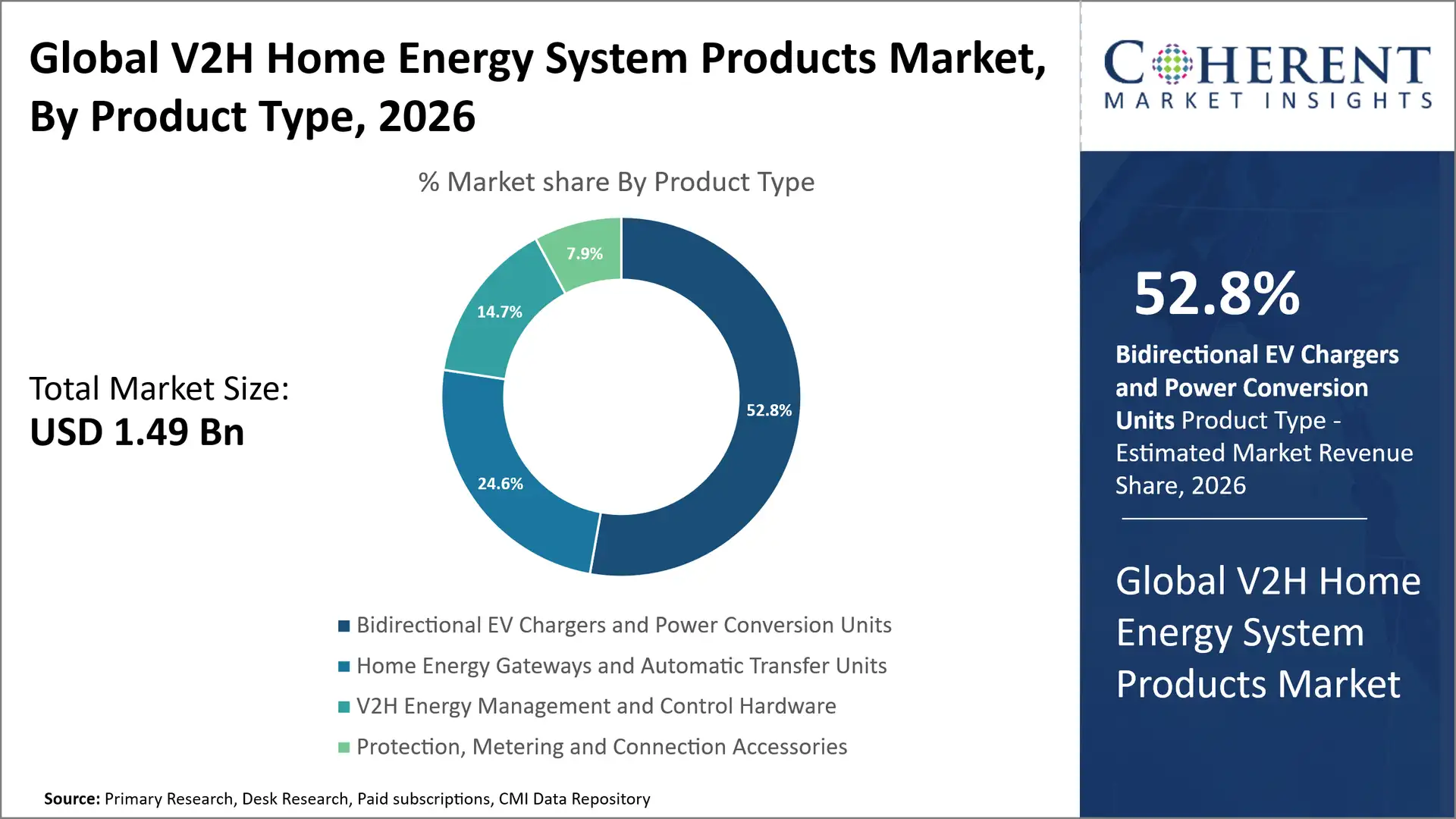
Why Do Bidirectional EV Chargers and Power Conversion Units Dominate the Global V2H Home Energy System Products Market?
Bidirectional EV Chargers and Power Conversion Units are expected to account for 52.8% of the global V2H home energy system products market in 2026, These components enable the transfer of electricity between electric vehicles and residential power systems in a controlled manner. They account for the bulk of revenues owing to their higher equipment value, specialized power electronics and their part in charging and discharging. Homeowners are putting more emphasis on equipment that can provide reliable backup power, and manufacturers are looking for ways to improve conversion efficiency, electrical safety and compatibility with different EV models. In April 2025, ChargePoint announced a next-generation AC charging architecture designed to support vehicle-to-home functionality, dynamic load balancing, and smart-home integration. This development highlights manufacturers' efforts to expand bidirectional charging capabilities and create additional revenue opportunities through advanced residential charging equipment.
- Current Industry Events of 2026
- Market Size Estimation
- Regional Breakdown
- Competitive Landscape
- Customer Intelligence
- Segmental Analysis
- Pricing Analysis
- Key Market Drivers, Challenges & Future Trends
- Customized Insights Section
Why Do DC-Based V2H Systems Dominate the Global V2H Home Energy System Products Market?
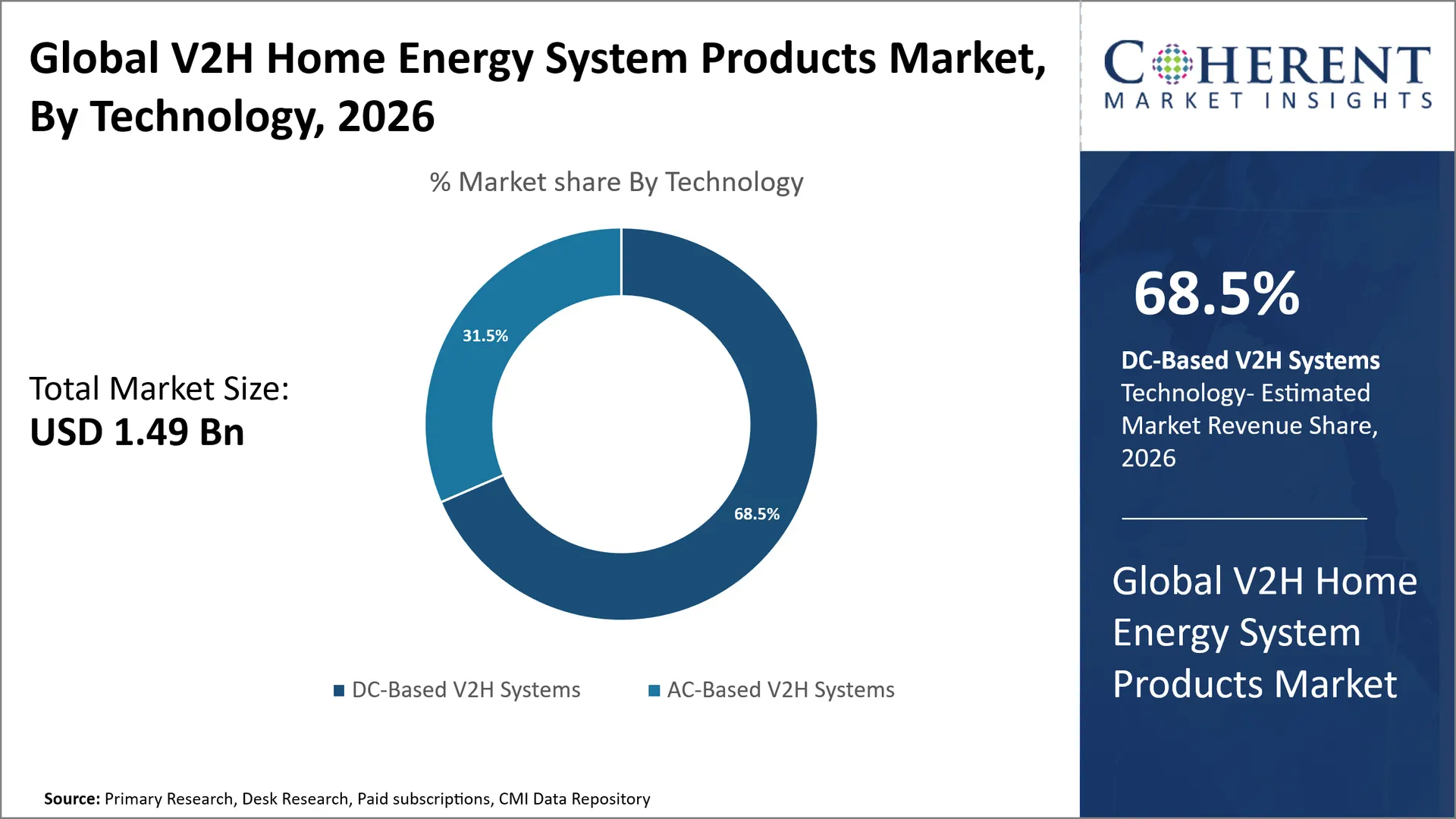
The DC-Based V2H Systems are expected to capture 68.5% of the technology segment in the global V2H home energy system products market, owing to the capability to verify charger performance with specific vehicle DC interfaces. automakers need to confirm bidirectional communications, battery-management compatibility and protective operation before suppliers are able to deliver repeatable residential installations. That gives tested vehicle-charger combinations commercial value: Installers have fewer unknown configurations, and power-electronics manufacturers can build approved product portfolios. In May 2025, MAXUS announced successful bidirectional DC charging tests involving AMBIBOX equipment and its eDELIVER 5, eDELIVER 7 AWD, and eTERRON 9 vehicles. The company identified household energy supply as a potential application while noting that customer availability was still being prepared. These tests illustrate how technical validation, rather than charging capability alone, can influence procurement and market access.
Why Do Above 5–10 kW Systems Represent the Largest Power Capacity Segment in the Global V2H Home Energy System Products Market?
Above 5–10 kW systems are expected to represent 45.6% of the power-capacity category in 2026, Manufacturers are expected to prefer a residential output band that can support useful household loads, but is still manageable through program charge control. Buyers need to consider contracted electrical capacity, priorities for back-up circuits and the cost of installation work required. By bundling correct-rated equipment with load-adjustment functionality, suppliers can help installers to explain these trade-offs and improve purchasing confidence. In May 2026, Honda Access announced its Honda V2H Stand, rated for charging and discharging at up to 5.9 kW, with planned sales through Honda Cars dealerships from late June. The company also highlighted automatic charging adjustment when household electrical limits apply. This illustrates the commercial importance of matching equipment capacity to residential electrical constraints and established vehicle-sales channels.
Current Events and their Impact
Current Event | Description and Its Impact |
California Energy Commission's Bidirectional Charging Roadmap – March 2026 |
|
Japan's V2H Equipment Subsidy Guidance – June 2026 |
|
United Kingdom's Clean Flexibility Roadmap – July 2025 |
|
Global V2H Home Energy System Products Market Dynamics
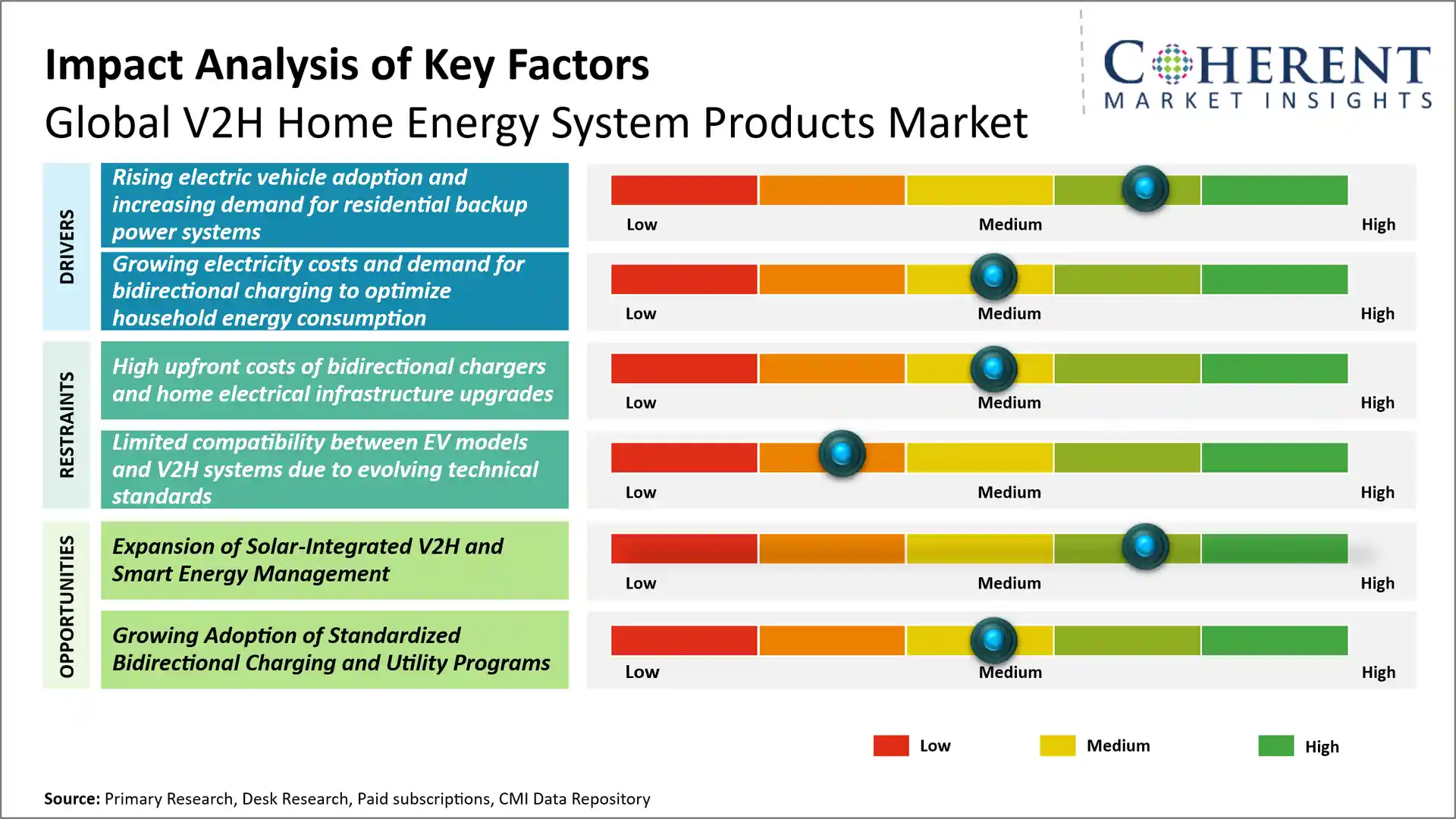
Key Market Drivers
- Rising electric vehicle adoption and increasing demand for residential backup power systems: Electric vehicles increasingly function as a household energy reserve, but unlocking that value requires a compatible bidirectional charger, transfer equipment, and professionally installed controls. This creates more hardware and service revenue beyond the vehicle sale, especially for homeowners who need a reliable response to outages. V2H is also good for electrical contractors, power-electronics manufacturers and auto makers when it’s presented as an option for home energy upgrades. In October 2025, Ford described a vehicle-to-home managed charging pilot with DTE Energy using F-150 Lightning trucks and Home Integration Systems, showing how installed EV capacity can support residential electricity needs.
- Growing electricity costs and demand for bidirectional charging to optimize household energy consumption: Households with variable tariffs can replace purchases with a compatible EV battery during costly electricity periods, but the actual savings depend on charging losses, driving schedules and rate structures. This moves the equipment evaluation to control software, metering accuracy and integration with solar or storage, which is good for smart power-conversion suppliers and installation partners.” In September 2026, dcbel announced the Texas launch of its Ara Core Home Energy Station, which is designed to synchronize bidirectional electric vehicles (EVs) with household energy assets and electricity flows. The product is an example of how adding bill-management functionality can improve the purchase case for V2H hardware.
Emerging Market Trends
- Transition Toward Vehicle-Agnostic V2H Systems and Interoperable Charging Infrastructure: Hardware vendors are adopting vehicle-agnostic interfaces that allow homeowners to switch EV brands without replacing their whole electrical system. The commercial challenge is not only the compatibility of connectors, but also the chargers, gateways and vehicle software must agree on the allowable discharge, fault responses and user controls. Organizations that provide upgradeable communications and clearly documented paths to integration can build trust with installers and distributors. Proprietary ecosystems may retain their original customers throughout the forecast period, but risk increased support costs and reduced access to households with mixed brand equipment.
- Increasing Emphasis on EV Battery Health Assurance and Discharge Management: As V2H transitions from occasional emergency-use to more-frequent use, battery-health assurance is becoming a consideration in the purchasing decision. More and more homeowners are asking for clarification on issues such as what happens if you sell or replace a car, what is the state of charge reserve, what is covered by the warranty, and how many discharge cycles are allowed. Vendors that can translate complex technical specifications into understandable operational guaranties can reduce the perceived risk of ownership. Without reliable vehicle status data, hardware vendors may experience long sales cycles and difficult service disputes, while car manufacturers and specialized software vendors may increase customer retention.
Regional Insights
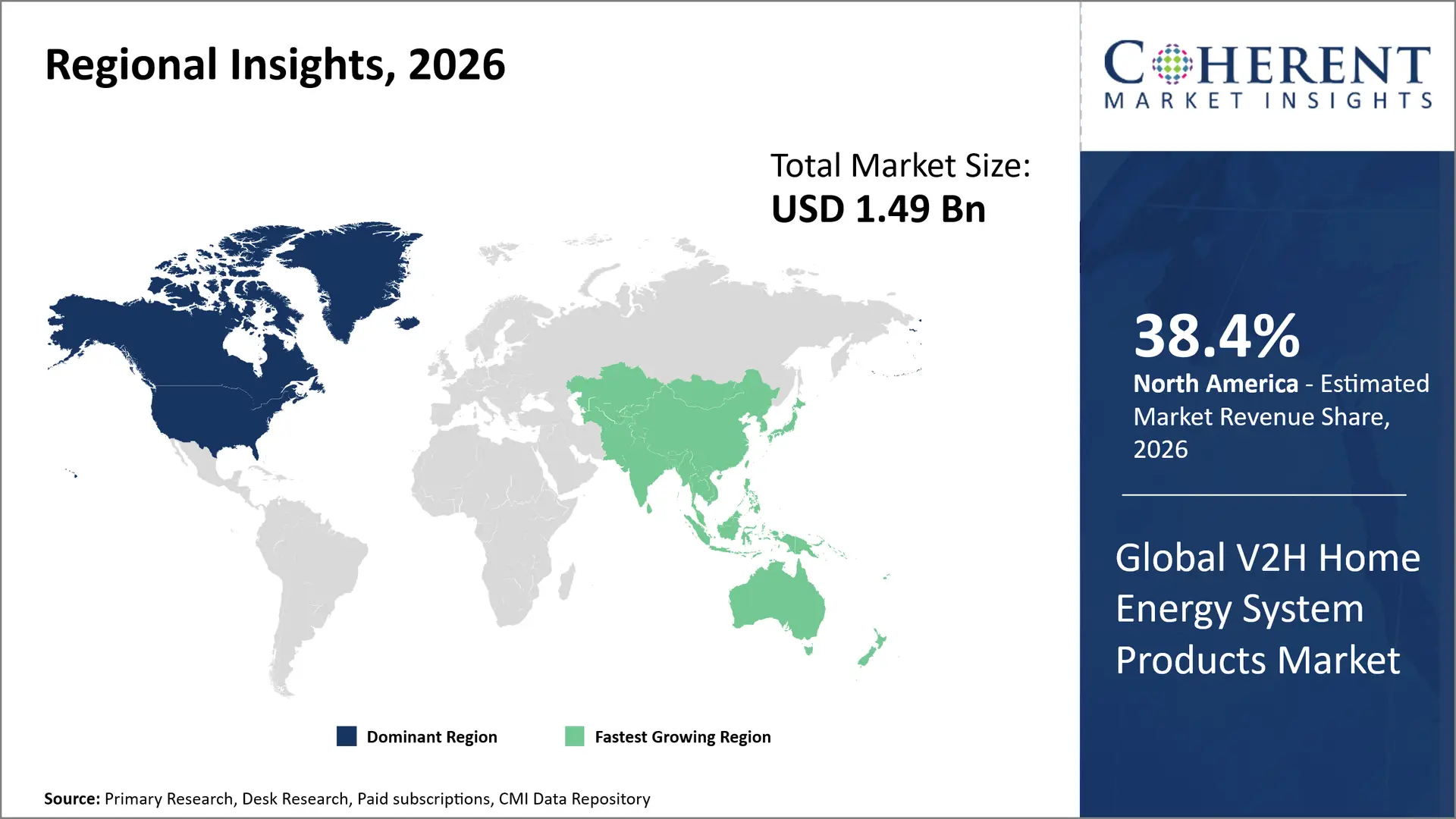
Why Does North America Dominate the Global V2H Home Energy System Products Market?
North America is expected to account for 38.4% of the global V2H home energy system products market in 2026, supported by residential energy resilience investments, advanced electrical infrastructure, and established EV charging installation networks. Homeowners are willing to invest in equipment that connects compatible electric cars to home electrical systems, benefiting the region. Also, North American suppliers might be able to use their present distribution channels for residential energy controls, protection devices and electrical panels. In July 2026, Environment and Climate Change Canada announced support for an Electric Mobility Canada initiative bringing utilities, automakers, regulators, and policymakers together to advance managed and bidirectional charging. The initiative, while focused on broader vehicle-grid integration, has the potential to improve technical coordination relevant to the commercialization of residential V2H, particularly in the areas of system interoperability and utility integration requirements.
Why Is Asia Pacific Emerging as the Fastest-Growing Region in the Global V2H Home Energy System Products Market?
Asia Pacific is projected to account for 34.8% of the global V2H home energy system products market in 2026 and is expected to grow at the fastest rate through 2033. Regional expansion is supported by the ability to manufacture for both directions of charging, the development of residential electricity markets and the opportunities to integrate electric vehicles with distributed energy resources. However, suppliers face additional market entry requirements as grid-connection procedures and equipment standards differ from country to country. In April 2026, the Australia's energy authorities published findings highlighting product availability, connection policies, building types and insurance as barriers to the uptake of V2H and V2G. The assessment paves the way for future regulatory improvements. Overcoming these barriers could reduce the costs of commercialization and enable equipment manufacturers to reach more households by standardizing product configurations and installation procedures.
Global V2H Home Energy System Products Market Outlook for Key Countries
Why Is the U.S. a Key Market for the Global V2H Home Energy System Products Market?
The United States is a major player in the global V2H home energy system products market, as automotive software, residential battery systems and certified electrical installation services are increasingly being made to work together. Buyers are now looking at whether their existing home-energy investments can handle compatible vehicles, making interoperability and retrofit economics top priorities in their purchase decisions. Installers have opportunities with system commissioning, protection upgrades and servicing, and integrated packages from suppliers can avoid coordination problems. Tesla confirmed in October 2026 that Model 3 and Model Y vehicles ordered in the U.S. and Puerto Rico after October 1 can use Powershare, assuming the home equipment is compatible. Tesla to recognize wall connectors that work with Powerwall-based residential backup setups. The expansion of eligible vehicle models may increase the demand for compatible installed hardware. But household readiness and the cost of additional equipment remain significant constraints to adoption.
Why Does China Support Growth in the Global V2H Home Energy System Products Market?
China’s position in the global V2H home energy system products market is based on its ability to combine residential inverter, storage and energy-control hardware with vehicle charging equipment and its power-electronics production base. Manufacturers can develop modular offerings for export-oriented solar installers and energy distributors through shared electronics expertise and component supply chains. The business opportunity is not only in domestic EV ownership, but also in the provision of systems that meet electrical certification and destination-market metering requirements. The company’s 22 kW V2X DC Charger, designed to work with the company’s HiOne home battery system, was launched in September 2026 by Hangzhou-based Hoymiles. Features such as vehicle-to-home backup and integrated energy management are expected to be included in the product announcement. These products are an example of how Chinese suppliers can compete on system-level functionality versus charger pricing alone, assuming vehicle compatibility and local approvals are obtained.
Why Is Japan Important in the Global V2H Home Energy System Products Market?
The technology also has a well-defined household preparedness function beyond everyday mobility, which is why Japan continues to be a strategically important market for V2H home energy system products. Specialized conversion equipment is used externally and separately in compatible plug-in hybrid and electric vehicles to supply residential electricity. This creates a separate aftermarket for chargers, wiring and installation services. Automaker sales networks can help demystify the safe operation of approved combinations and provide clear explanation to customers. Toyota will launch its plug-in hybrid Alphard and Vellfire models in Japan in December 2024, with sales expected to start in January 2025. The vehicles will be able to send power to a home, but will require a V2H device that is sold separately. The announcement highlights a significant aspect of Japanese demand: When consumers are assessing existing vehicle models, they may find V2H, which acts as a gateway for electrical equipment suppliers to reach household customers via automobile dealerships.
Why Is Germany a Strategic Country in the Global V2H Home Energy System Products Market?
Germany is a big player in the international market for V2H home energy system products as it enables homeowners to integrate electric vehicles with sophisticated home electricity-management equipment and existing rooftop solar installations. The supply-side challenge is to fit measurement-compliant bidirectional chargers, vehicle software and household controls into an installation that meets local electrical standards. This is good for technology providers with engineering know-how and existing relationships with automakers and energy service companies. Volkswagen Group said in September 2025 that its subsidiary Elli was recruiting German households for a bidirectional charging pilot, which will use a modular energy-management platform and an 11 kW charger. The charger was to be distributed to participants for a pilot project that was scheduled to start in December 2025. The project demonstrates a German model of commercialization built on proven multi-component packages, not on the sale of individual chargers.
Why Is South Korea an Important Growth Market for the Global V2H Home Energy System Products Market?
South Korea is a fast growing market for global V2H home energy system products, given its strong battery, semiconductor and auto electronics industries that can support locally engineered bidirectional power systems. But domestic demand depends on more than the technical ability to reverse the flow of electricity. Before it can be installed widely and be economically viable, approved household connections, vehicle warranty conditions and practical incentives need to be aligned. In January 2026, South Korea’s Ministry of Climate, Energy and Environment announced updated electric vehicle subsidy guidelines that will serve as a basis for supporting advanced charging functions such as vehicle-to-grid capability. No direct residential V2H rebate was announced in the related policy, but more V2G-related support was indicated to come from 2027. The policy direction could provide confidence for equipment suppliers, but translating auto expertise into V2H sales will require compatible residential products and clear eligibility rules.
V2H Technology Deployment and Infrastructure Landscape in the Global V2H Home Energy System Products Market
Technology | Adoption Landscape | Key Application | Commercial Impact |
DC Bidirectional Power Conversion Systems | Commercially deployed in selected compatible configurations | Converts electricity between EV batteries and residential AC networks through external power electronics | Creates opportunities for high-value chargers, power modules, and conversion-efficiency improvements |
AC Bidirectional Charging Technology | Emerging, with deployment dependent on vehicle and grid compatibility | Uses vehicle-integrated conversion capability to exchange electricity with residential electrical systems | Could reduce external hardware requirements and reshape charger manufacturing economics |
Automatic Transfer and Grid-Islanding Systems | Established electrical protection principles, with V2H-specific integration requirements | Isolates residential circuits during outages and manages safe transitions between grid and EV power | Supports demand for certified protection equipment, transfer controls, and installation expertise |
Intelligent Home Energy Management Systems (HEMS) | Increasing integration into compatible home-energy configurations | Coordinates EV charging, discharge limits, household consumption, and other distributed energy resources | Expands software integration, monitoring, and energy-management service opportunities |
ISO 15118-20-Based Bidirectional Communication | Evolving implementation across compatible vehicles and chargers | Supports communication required for bidirectional power-transfer functions and control | Improves interoperability potential while increasing the importance of software validation and vehicle compatibility testing |
Advanced Metering and Grid-Interconnection Controls | Adoption varies according to utility and jurisdictional requirements | Measures energy flows and supports compliant operation, including export where authorized | Creates opportunities for metering, control integration, compliance services, and utility-compatible products |
How Is V2H-Ready Housing Construction Creating New Growth Opportunities in the Global V2H Home Energy System Products Market?
An underdeveloped opportunity lies in making newly built and extensively renovated homes V2H-ready before their owners purchase a compatible electric vehicle. Homebuilders and electrical designers could specify reserved panel capacity, protected circuits, communications wiring, meter provisions, and space for future bidirectional power equipment during construction. This would separate relatively inexpensive preparation work from the later purchase of a complete system, reducing disruption and uncertainty when a homeowner decides to activate V2H.
Equipment manufacturers can capture this opportunity through standardized pre-installation kits, electrician training, and documentation that identifies compatible upgrades. The model also creates a channel through residential developers, architectural practices, and renovation contractors rather than relying exclusively on automotive dealerships.
Participation requires coordination with electrical-code authorities, installers, and vehicle manufacturers, plus careful treatment of evolving interconnection rules. Specialist suppliers may lead initial specification work, but vertically integrated manufacturers could scale adoption through repeat relationships with major housing developers over several years.
Market Players, Key Development, and Competitive Landscape
Key Developments
- In July 2026, Hyundai Motor Group introduced AllDayEnergy as a global identity covering smart charging, V2G, and V2H services. Its initial rollout was planned around smart charging through the Kia app, with additional functions following. This creates a potential route for scaling household energy services through existing automotive customer interfaces.
- In June 2026, BMW Group presented a joint V2H offering with SOLARWATT, combining Neue Klasse electric vehicles, the BMW Wallbox Professional, and residential energy-management software. Orders were announced for the trade-fair period, with deliveries scheduled later in 2026. This supports bundled procurement and retrofit opportunities for integrated home-energy equipment.
- In September 2025, Mercedes-Benz announced plans to introduce its MB.CHARGE Home bidirectional charging offering during 2026, beginning in selected European V2H home energy system products market. The proposed package connects compatible vehicles, wallboxes, electricity tariffs, and energy-market access. This development points toward subscription and service opportunities alongside hardware sales, subject to regional requirements.
Competitive Landscape
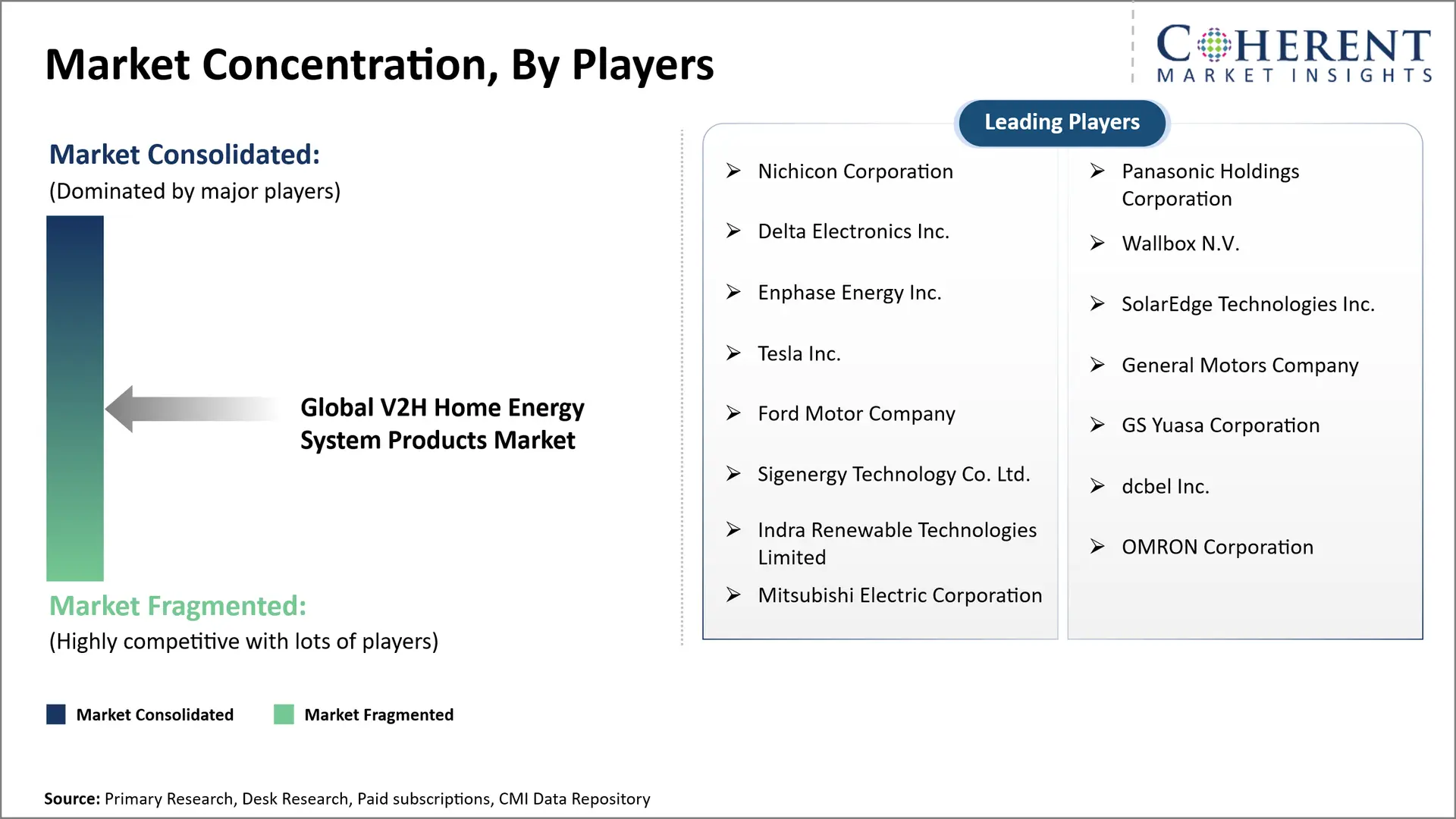
The V2H home energy system product market globally remains fragmented, with automotive manufacturers, power-electronics companies, energy-management specialists and electrical-equipment suppliers competing across interrelated product categories. Factors affecting purchase are vehicle compatibility, electrical safety, usable discharge performance, cost of installation and clarity of warranty. Regional specialists can differentiate themselves by using their local grid-code knowledge and installer networks, while larger suppliers can use their current customer support infrastructure and manufacturing scale.
Key Competitive Factors
- Vehicle Compatibility: Support for multiple approved EV models and bidirectional charging configurations.
- Power Conversion Performance: Improving thermal management, operation stability and conversion efficiency.
- Installation Economics: Reduced complexity of commissioning, electrical upgrades, and total cost of ownership.
- Certification and Compliance: Compliance with applicable cybersecurity, electrical safety and grid-interconnection requirements.
- Manufacturing and Component Reliability: Security of critical components, contactors, control electronics, and power semiconductors.
- Distribution and Installer Networks: Develop relationships with residential energy experts and certified electrical contractors.
- After-Sales Services: Technical support, software maintenance, diagnostics and reliable warranty coverage.
Market Report Scope
V2H Home Energy System Products Market Report Coverage | |||
Report Coverage | Details | ||
Base Year | 2025 | Market Size in 2026: | USD 1.49 Bn |
Historical Data For: | 2020 To 2024 | Forecast Period: | 2026 To 2033 |
Forecast Period 2026 To 2033 CAGR: | 18.3% | 2033 Value Projection: | USD 4.84 Bn |
Geographies covered: |
| ||
Segments covered: |
| ||
Companies covered: | Nichicon Corporation, Panasonic Holdings Corporation, Delta Electronics Inc., Wallbox N.V., Enphase Energy Inc., SolarEdge Technologies Inc., Tesla Inc., General Motors Company, Ford Motor Company, GS Yuasa Corporation, Sigenergy Technology Co. Ltd., dcbel Inc., Indra Renewable Technologies Limited, OMRON Corporation, Mitsubishi Electric Corporation | ||
Growth Drivers: |
| ||
Restraints & Challenges: |
| ||
Analyst Opinion (Expert Opinion)
- The Global V2H Home Energy System Products Market leadership may increasingly depend on which participant controls the homeowner's long-term service relationship rather than who supplies the charging equipment. Automotive manufacturers, residential energy providers, and specialist installers could compete to become the primary system operator. Companies that retain responsibility for performance and customer support may capture greater recurring value than suppliers relying on one-time equipment transactions.
- A potential structural disruption is the wider integration of bidirectional power conversion into vehicle and residential electrical architectures. If onboard conversion becomes economically attractive and broadly compatible, dedicated external charging hardware could face pricing pressure. This would shift competitive advantage toward control electronics, grid-interface technology, and software licensing, potentially challenging manufacturers whose revenues depend heavily on standalone power-conversion units.
- Manufacturers should prioritize independently validated safety performance, supply-chain diversification, and products that can accommodate changing vehicle specifications. Investments in power semiconductors, protective switching components, and installer training deserve attention, while aggressive inventory expansion ahead of confirmed vehicle compatibility should be avoided. Commercial teams should emphasize transparent installed pricing, dependable local servicing, and carefully selected distribution partnerships to protect margins and reduce adoption barriers.
Speak to the analyst
Want personalized insights?
Take the findings above to one of our principal consultants, or have the report rebuilt around the segments, geographies and competitors you actually track.
Market Segmentation
- Product Type Insights (Revenue, USD Bn, 2021 - 2033)
- Bidirectional EV Chargers and Power Conversion Units
- Home Energy Gateways and Automatic Transfer Units
- V2H Energy Management and Control Hardware
- Protection, Metering and Connection Accessories
- Technology Insights (Revenue, USD Bn, 2021 - 2033)
- DC Based V2H Systems
- AC Based V2H Systems
- Power Capacity Insights (Revenue, USD Bn, 2021 - 2033)
- Up to 5 kW
- Above 5 to 10 kW
- Above 10 to 20 kW
- Above 20 kW
- System Integration Insights (Revenue, USD Bn, 2021 - 2033)
- Standalone V2H Systems
- Solar Integrated V2H Systems
- Battery Integrated V2H Systems
- Application Insights (Revenue, USD Bn, 2021 - 2033)
- Residential Backup Power
- Household Energy Cost Optimization
- Solar Self Consumption and Energy Management
- Distribution Channel Insights (Revenue, USD Bn, 2021 - 2033)
- Direct Manufacturer and Automotive OEM Sales
- Certified Installers and Electrical Contractors
- Energy Equipment Distributors
- Regional Insights (Revenue, USD Bn, 2021 - 2033)
- North America
- U.S.
- Canada
- Latin America
- Brazil
- Argentina
- Mexico
- Rest of Latin America
- Europe
- Germany
- U.K.
- Spain
- France
- Italy
- Russia
- Rest of Europe
- Asia Pacific
- China
- India
- Japan
- Australia
- South Korea
- ASEAN
- Rest of Asia Pacific
- Middle East
- GCC Countries
- Israel
- Rest of Middle East
- Africa
- South Africa
- North Africa
- Central Africa
- North America
- Key Players Insights
- Nichicon Corporation
- Panasonic Holdings Corporation
- Delta Electronics Inc.
- Wallbox N.V.
- Enphase Energy Inc.
- SolarEdge Technologies Inc.
- Tesla Inc.
- General Motors Company
- Ford Motor Company
- GS Yuasa Corporation
- Sigenergy Technology Co. Ltd.
- dcbel Inc.
- Indra Renewable Technologies Limited
- OMRON Corporation
- Mitsubishi Electric Corporation
Sources
Primary Research Interviews
- Bidirectional EV charger manufacturers, power conversion equipment suppliers, and automotive OEMs
- V2H technology developers, home energy management solution providers, and utility companies
- Electrical contractors, certified installers, energy distributors, and industry experts
Stakeholders
- V2H equipment manufacturers and power electronics suppliers
- EV manufacturers, inverter producers, and energy storage technology providers
- Utilities, residential energy solution companies, installers, distributors, and homeowners
End-use Sectors
- Residential backup power and emergency electricity supply
- Household electricity cost optimization
- Solar-integrated residential energy management
- Smart homes and residential energy storage
Regulatory and Industry Bodies
- U.S. Department of Energy (DOE)
- California Energy Commission (CEC)
- International Electrotechnical Commission (IEC)
- International Organization for Standardization (ISO)
- Institute of Electrical and Electronics Engineers (IEEE)
- Society of Automotive Engineers (SAE International)
- Japan Ministry of Economy, Trade and Industry (METI)
Databases
- Company annual reports and investor presentations
- International Energy Agency (IEA) EV and energy databases
- U.S. Energy Information Administration (EIA)
- Eurostat and UN Comtrade databases
- EV charging infrastructure, equipment pricing, patent, and residential energy databases
Magazines and Journals
- Journal of Energy Storage
- Applied Energy
- IEEE Transactions on Transportation Electrification
- World Electric Vehicle Journal
- Renewable and Sustainable Energy Reviews
- IEEE Spectrum
Associations
- Charging Interface Initiative (CharIN)
- CHAdeMO Association
- Electric Drive Transportation Association (EDTA)
- Smart Electric Power Alliance (SEPA)
- Electric Power Research Institute (EPRI)
Public Domain Sources
- EV adoption, bidirectional charging, and residential electricity consumption statistics
- V2H equipment production, pricing, and power conversion technology developments
- Residential backup power, solar integration, and energy management data
- Government incentives, technical standards, product launches, and manufacturing investments
Key Standards and Regulations
- ISO 15118-20:2022 – Bidirectional EV charging communication
- IEC 61851-23:2023 – DC EV charging equipment requirements
- UL 9741 – Electric vehicle power export equipment
- IEEE 1547-2018 – Distributed energy resource grid interconnection
- SAE J3072 – Vehicle-integrated grid-support inverter interconnection
- NFPA 70, Article 625 – Electric vehicle power transfer installations
Proprietary Elements
- CMI Data Analytics Tool and proprietary CMI research repository, incorporating available intelligence on EV charging infrastructure, V2H technologies, equipment pricing, residential energy demand, power electronics, regulatory developments, and competitive landscapes.
Get access to 250+ pages report
Every segment, forecast, competitor profile and data table behind the analysis above — available for instant download.
- ESOMAR Member
- ISO 9001:2015 Certified
- D-U-N-S Registered
- GDPR & CCPA Compliant
Frequently Asked Questions
The CAGR of global V2H home energy system products market is projected to be 18.3% from 2026 to 2033.
The global V2H home energy system products market is estimated to be valued at USD 1.49 billion in 2026 and is expected to reach USD 4.84 billion by 2033.
Vehicle-to-home (V2H) technology enables compatible electric vehicles to supply stored battery electricity to residential electrical systems through bidirectional charging equipment.
A V2H system typically requires a compatible electric vehicle, bidirectional charger, power conversion equipment, energy management controls, and appropriate electrical safety devices.
V2H technology transfers electricity from an EV battery to a home, while vehicle-to-grid (V2G) technology allows stored energy to be supplied to the electricity grid.
Yes, compatible V2H systems can provide residential backup electricity during grid outages when equipped with appropriate isolation, transfer, and power management systems.
Rising electric vehicle adoption and growing demand for residential backup power systems are key factors driving the global V2H home energy system products market. Increasing electricity costs and the need for efficient household energy management through bidirectional charging further support market growth.