

Global Home Appliances Market Size and Forecast – 2026 To 2033
The global home appliances market is estimated to be valued at USD 568.34 Bn in 2026 and is expected to reach USD 826.75 Bn by 2033, exhibiting a compound annual growth rate (CAGR) of 5.5% from 2026 to 2033. Increasing disposable incomes and the desire for modern, comfortable living spaces are driving homeowners in the U.S. to invest more in home maintenance and improvement projects. For example, in Q1 2025, spending by homeowners on these projects rose 0.5% year-over-year to USD 513 billion, according to the Joint Center for Housing Studies (JCHS) of Harvard University’s Leading Indicator of Remodeling Activity (LIRA). This trend highlights growing consumer demand for home upgrades, including appliances, fixtures, and lifestyle-oriented improvements. (Source: AP)
Key Takeaways of the Global Home Appliances Market
- The major appliances segment is projected to hold 89.5 % of the global home appliances market share in 2026, making it the dominant product. High replacement cycles and growing consumer preference for durable, energy-efficient products are key factors driving this dominance. For example, frost-free refrigerators and washing machines offered by Haier.
- The supermarket and hypermarket segment is expected to hold 31.5 % share of the global home appliances market in 2026, driven by the one-stop shopping convenience offered by them. For example, Walmart U.S. comparable store sales increased by around 4.8% in fiscal 2025, mainly due to more customer visits and stronger sales of general merchandise. This growth was also supported by Walmart’s everyday low-price strategy, which helped attract value-conscious shoppers. Likewise, in India, Reliance Digital has increased the sales of appliances in large format stores, thus achieving better regional penetration.
- Asia Pacific is projected to hold the largest market share of 45.5 % in the market in 2026, which is attributed to robust manufacturing capabilities and the emerging middle-class demand in the region. China alone produces more than four in five (over 80%) of refrigerators and washing machines in the region, and Haier has established a local DTC e-commerce business on JD.com and Tmall, which aims to sell smart appliances to urban Chinese customers with installation services.
- The Middle East will be the fastest growing region holding an estimated 19.3 % share of the market in 2026 because of urbanization, increasing disposable income levels, and growing energy efficient appliance usage. In this regard, the U.A.E government’s Energy Efficiency Labeling Scheme drives the sales of energy efficient appliances such as Samsung Smart ACs and Bosch refrigerators. (Source: IEA)
- Technological Innovations & Sustainability: Smart and interconnected appliances are driving the market growth. In Japan, Panasonic’s IoT-based washing machines can be remotely controlled and monitored based on their energy consumption. On the other hand, LG’s ThinQ model has the ability to connect to the smart kitchen appliances and optimize energy saving.
- Market Expansion Catalysts: Global market expansion is fueled by innovations in IoT appliances, smart home technologies integration, and energy efficient appliances. To capitalize on the high growth markets, such as China and India, companies are using direct-to-consumer e-commerce platforms, design, and customization of products based on local requirements, and after-sales support networks.
Segmental Insights
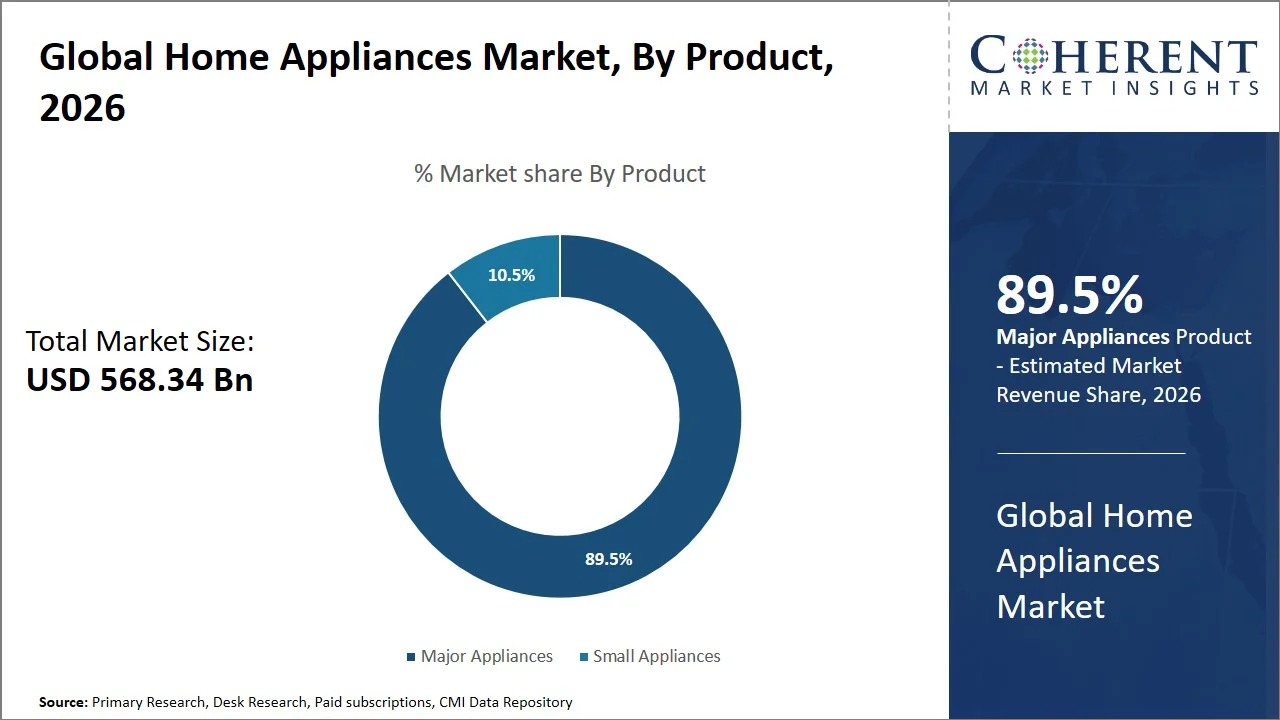
Why Do Major Appliances Dominate the Home Appliances Market?
The major Appliances segment is expected to hold 89.5% share of the global home appliances market in 2026, primarily due to several key factors that shape consumer behavior and market dynamics. The growing demand for basic household equipment like refrigerators, washing machines, cooking ranges, and ovens has been driven, foremost, by the rapid pace of urbanization and the rising standard of living in emerging markets. In modern homes, these products have become essential for everyday use and convenience, making them a vital part of lives.
For example, in India, LG Electronics India and Samsung India reveal that refrigerators and washing machines make up around 45-50% of their appliance revenue which makes the segment very significant.
- Current Industry Events of 2026
- Market Size Estimation
- Regional Breakdown
- Competitive Landscape
- Customer Intelligence
- Segmental Analysis
- Pricing Analysis
- Key Market Drivers, Challenges & Future Trends
- Customized Insights Section
Supermarket and Hypermarket Segment Dominates the Home Appliances Market
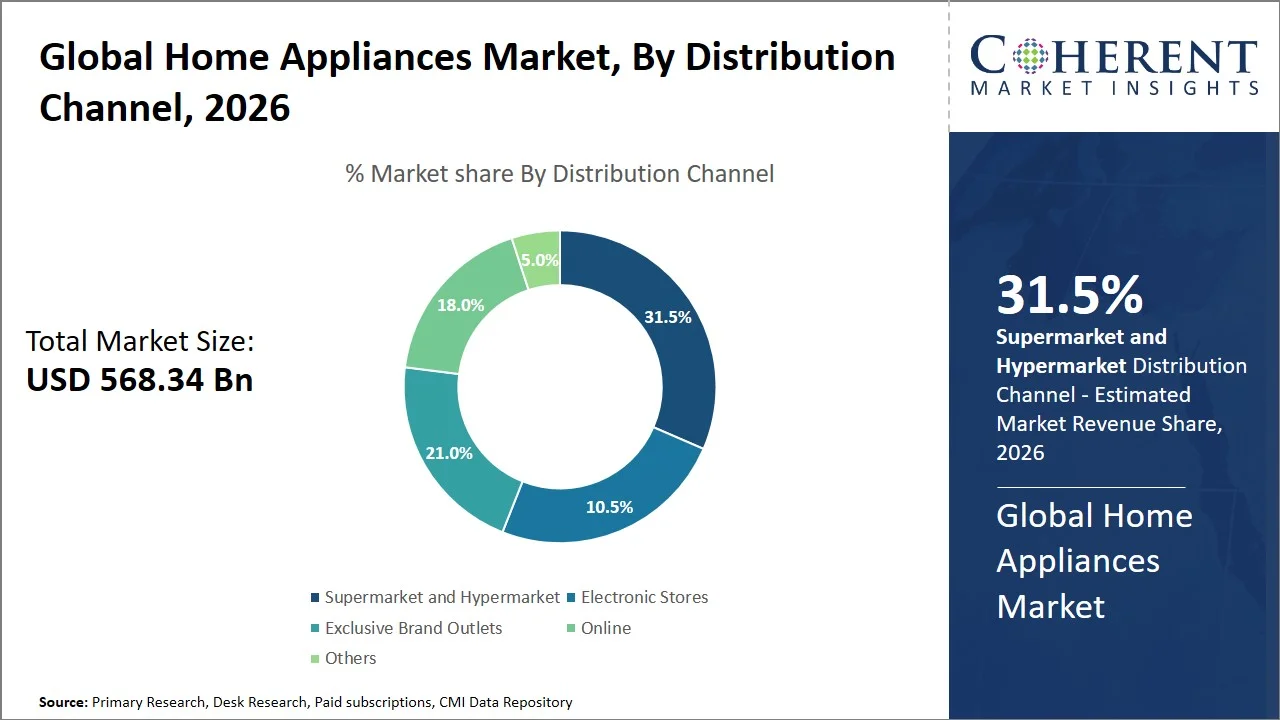
The supermarket and hypermarket segment is expected to hold 31.5% share of the global home appliances market in 2026, due to their ability to provide a one-stop shopping experience, which appeals significantly to busy consumers. These outlets are likely to have a huge selection of home appliance products at one store so that individuals can easily compare features, prices, and brands without needing to travel to different outlets. Supermarkets and hypermarkets are the most popular places to buy big and small household appliances, as their wide range of offers and products attract customers.
In India, electronics and appliance retailers such as Reliance Digital have historically driven strong festive‑season demand; during Diwali 2025, overall retail sales in India reached record levels of approximately USD 68.8 billion about (₹6.05 lakh crore), electronics and electricals at 8% reflecting sharply higher consumer spending compared with earlier in the year. (Source: India Brand Equity Foundation)
Currents Events and their Impact
Current Events | Description and its Impact |
Global Energy Efficiency Regulations |
|
Smart Home Adoption Trend |
|
(Source: SAMSUNG)
Home Appliances Market Dynamics
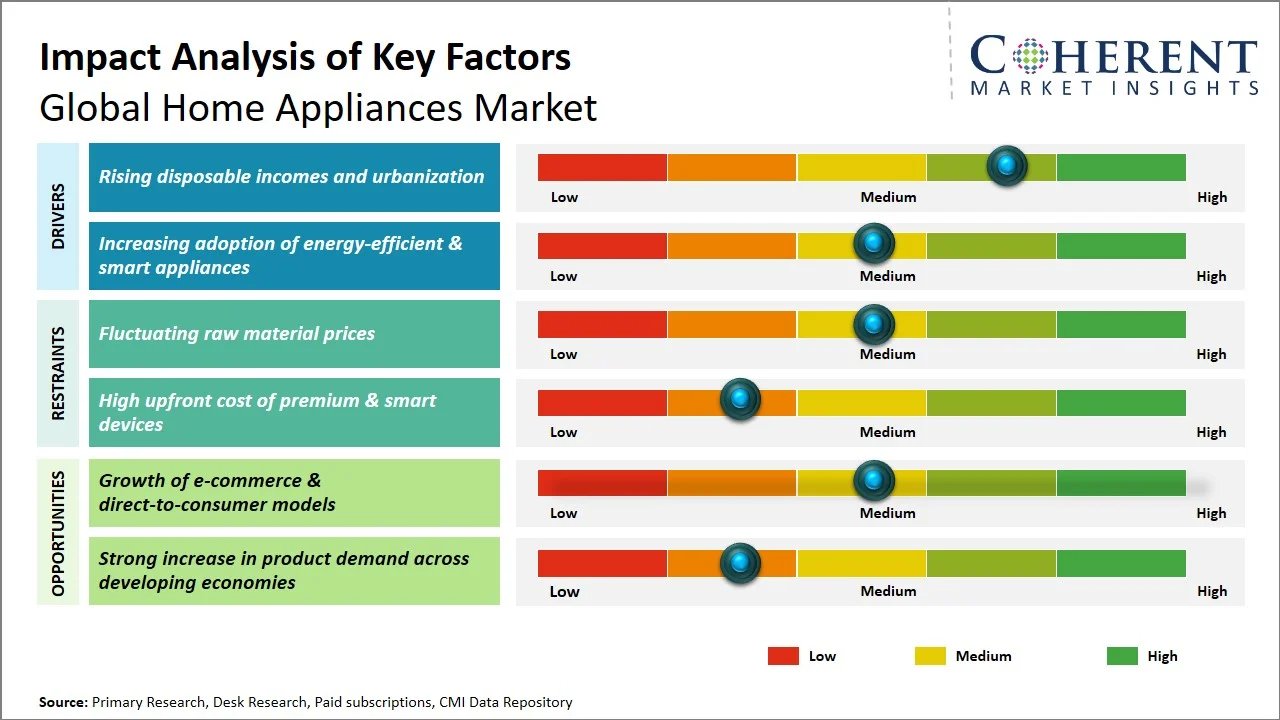
Market Drivers
Rising Disposable Incomes and Urbanization
There has been increasing demand for home appliance products driven by factors such as increased disposable incomes and urbanization that have resulted into increased disposable incomes for consumers hence increased purchasing power. The result is the desire to purchase modern home appliances that consume less energy yet technologically advanced to increase convenience in life. Also, urbanization has transformed the lifestyle of people such that the optimization of space and time becomes important in urban areas. The home appliances industry is also witnessing innovation and adoption among urban consumers due to demand for small sized, multifunctional appliances that are better fit in smaller homes and tight budgets.
In India, total disposable personal income reached approximately USD 3.57 trillion (₹296.38 lakh crore) in 2023, marking an increase from the prior year and supporting greater consumer spending capacity on durable goods like modern appliances. Urbanization in India has also been rising steadily; the urbanization rate reached about 66.2% of permanent residents in 2023, up from 65.2% in 2022, indicating that a growing share of the population lives in urban environments where appliances are essential to daily life and lifestyle optimization.
Increasing adoption of energy efficient & smart appliances
There have been increasing government policies, energy efficiency awareness, and urban lifestyles that have been responsible for the growing adoption of energy efficient and intelligent home appliances in the Asia Pacific region, specifically in China and India. With respect to this, the BEE Standards and Labelling programme will be continuing its contribution to consumer preference for energy efficient products through education about energy savings and benefits. For example, the Bureau of Energy Efficiency (BEE) reports that the Standards & Labelling programme has registered over 3,662 brands and helped generate savings equivalent to ~89.8 billion units of electricity under its appliance efficiency framework, indicating growing production and penetration of energy‑efficient labelled appliances in the market. This reflects increasing emphasis on efficient technologies as part of national energy policy and consumer adoption. (Source: Bureau of Energy Efficiency)
Emerging Trends
- Premiumization and Experiential Offerings: Home appliances are increasingly positioned as premium, smart, and design-focused products. The brands are producing gourmet-type appliances like Samsung Family Hub refrigerators with screen integration for recipes and entertainment purposes, and LG’s premium smart ovens with artificial intelligence in cooking functionalities to increase customer experience. Limited edition color range, customized finishes, and IoT functionalities give the brands the ability to price their products at a higher margin.
- Surge in Energy-Efficient and Health-Focused Appliances: Customers’ preference is shifting toward appliances that will enable them to save on energy usage, minimize their environmental footprint, and provide quality indoors. For example, BEE Star-rated washing machines and refrigerators in India assist the household in saving energy, whereas Panasonic and Philips' air purifiers and water purification systems cater to the consumers’ health needs.
Regional Insights
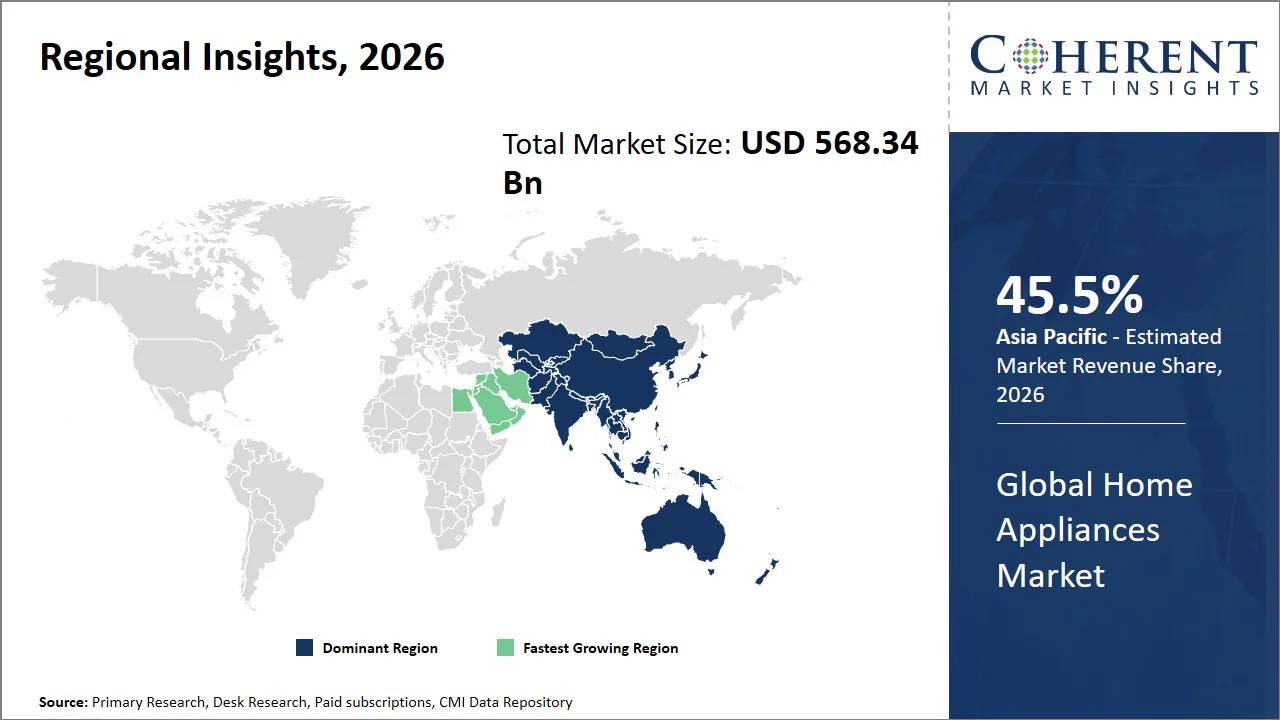
Why is Asia Pacific a Strong Market for Home Appliances?
Asia Pacific leads the global home appliances market, accounting for an estimated 45.5% share in 2026 driven by a robust manufacturing ecosystem, strong consumer demand, and favorable government initiatives promoting industrial growth and urbanization. Countries like China, Japan, and South Korea have well-developed industrial bases, supported by high levels of technology and trained workforce, which means their production capacities are high.
Firms such as Haier, LG Electronics, and Panasonic are aggressively marketing their products to Chinese customers by offering localized designs, energy-efficient appliances that match China's government incentives (e.g. China Energy Label program), and smart home systems that integrate with the Chinese IoT ecosystem. They are also setting up D2C sales channels via e-commerce platforms such as JD.com and Tmall and providing installation and after-sales services according to local needs.
Why Does the Middle East Home Appliances Market Exhibit the Fastest Growth?
The Middle East home appliances market is expected to exhibit the fastest growth with an estimated contribution of 19.3% share to the market in 2026, due to rising urbanization, increasing disposable income, and a growing young population embracing modern lifestyles. With the influx of expatriates and infrastructure development projects, the demand for basic and premium home appliances has been heightened. The manufacturing sector is still in the emerging phase in this region compared to other regions, but supportive policy efforts are being made by governments to encourage FDI and industrial growth.
Electrolux and Midea are examples of companies that are expanding their presence by creating regional partnerships and developing specific products that appeal to local customers' tastes.
Global Home Appliances Market Outlook for Key Countries
Why is China Leading Innovation and Adoption in the Home Appliances Market?
As the world's manufacturing hub, China remains strong in the home appliances industry. A vast supply chain system and a high number of domestic consumers in the country ensure continuous innovation and scale of operations. Chinese giants like Haier Group and Midea Group have been venturing abroad and developing smart appliance technology.
The government-backed consumer goods trade-in program is a big boost to China's home appliance demand. Retail sales of home appliances and audio and visual equipment under the scheme reached about USD 151.1 billion (1.03 trillion yuan) in 2024, according to data from the National Bureau of Statistics. This marks the first time the figure has surpassed the USD 146.8 billion threshold and represents a 12.3 percent year-on-year growth. (Source: State Council Information Office)
Is the U.S. a Favorable Market for Home Appliances?
The home appliances market in the U.S. is technologically advanced and offers a preference for high quality and energy efficient appliances. Demand for energy-efficient replacement is driving home appliances market, along with the presence of ENERGY STAR appliances. According to the EPA ENERGY STAR CY2023 shipment report released in November 2024, there were 9.148 million consumer refrigeration units shipped as ENERGY STAR models, representing 66% of the estimated market share for refrigerators. It also found that 59% of clothes washers used at home are ENERGY STAR certified with 6.475 million used. One of the more critical policy developments is the U.S. DOE's final efficiency regulations for residential clothes washers and dryers issued in February 2024, which are expected to cut down on the energy and water consumption of households. (Source: ENERGY STAR)
Is India Emerging as a Key Growth Hub for the Home Appliances Market?
India’s home appliances market growth is driven by increasing residential electricity consumption and penetration of star rated cooling and refrigeration products. BEE reported 500 TWh electricity consumption by buildings in FY 2023 – 24, where BEE's Standards & Labelling database has mapped 197.70 TWh at the appliance/end-use level. Washing machines used 1.72 TWh, room air conditioners were the largest appliance load at 104.34 TWh, and refrigerators used 27.38 TWh. BEE had 11.34 million direct-cool refrigerator sales and 9.29 million variable-speed room AC sales, validating good penetration of appliances in November 2024 in FY 2023-24. (Bureau of Energy Efficiency India)
Why Does Germany Top the Europe Home Appliances Market?
Germany is a mature replacement-driven home appliances market where high levels of appliance ownership, combined with the need for replacement and repair, and energy-efficient appliances will ensure the market for home appliances has ongoing demand. According to DESTATIS data from the Sample Survey of Income and Expenditure (EVS) published in December 2025, Germany had an estimated 40.84 million households in 2023. Nearly all of these households owned refrigerator/fridge‑freezers (99.9% penetration), while washing machines (97.4%) and dishwashers (78.0%) also showed high ownership rates, indicating widespread household equipment penetration across the country. In terms of volume stock, households held an estimated ~51.0 million refrigerator/fridge‑freezers, ~41.2 million washing machines, ~32.7 million dishwashers, and ~19.6 million dryers, reflecting a mature market with substantial replacement demand for major home appliances.
How is the rise of e-commerce and direct-to-consumer models creating new growth opportunities in the global home appliances market?
The global growth of e-commerce platforms and rise of direct-to-consumer (DTC) business models are offering a great opportunity in the home appliances market. Manufacturers and retailers are using digital technologies to allow them to tap into a wider and more varied customer base and minimize their reliance on physical stores. All these benefits of e-commerce work together to improve the customer buying journey, offering convenience, a larger selection of items, in-depth product facts, and competitive pricing.
Smart Appliance Penetration in the Global Home Appliances Market
Appliance Category | Popular Smart Features | Notable Brands / Products in India | Household Penetration / Usage Insights | Replacement / Upgrade Cycle |
Smart Refrigerators | App control, temperature monitoring, alerts | Samsung Bespoke, LG InstaView, LG ThinQ | Increasing adoption among urban households | 2–3 years |
Smart ACs | Wi-Fi control, energy optimization, voice control | Samsung WindFree AC, LG ThinQ AC | Moderate penetration in metro cities | 2–3 years |
Smart Washing Machines | Remote start, cycle optimization, notifications | IFB Home Appliances, LG ThinQ, Samsung Bespoke | Gradually rising in Tier-1 & Tier-2 cities | 3 years |
Market Players, Key Development, and Competitive Intelligence
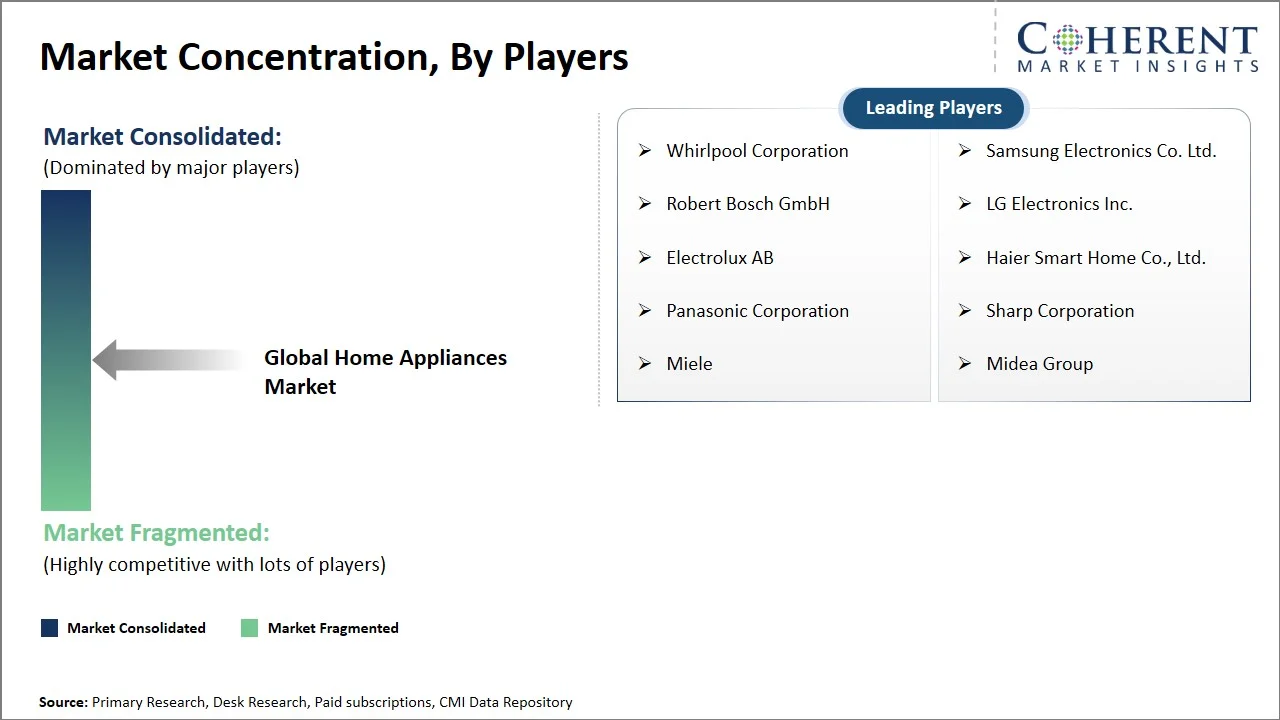
Key Developments
- In August 2024, Samsung Electronics Co. Ltd. introduced 10 large-capacity Bespoke AI washing machines for Indian consumers, reinforcing its commitment to smart, energy-efficient appliances. These new models feature AI-driven technologies like AI Wash, which enhances water and detergent usage based on load weight and fabric type, and AI EcoBubble for improved cleaning performance with energy savings. The machines are also equipped with Wi-Fi connectivity, enabling users to control and monitor wash cycles remotely through the SmartThings app. This launch is part of Samsung's strategy to enhance convenience, sustainability, and personalization in the home appliance sector in India.
- In January 2024, Bosch introduced innovations in its line of dishwashers in 2023 to enhance the user experience. These improvements include sleek touch controls, anti-fingerprint design, and advanced features like the PowerControl spray arm technology for better cleaning performance. The Home Connect app offers remote monitoring, customization options for different cycles, safety alerts, and other convenient features for a seamless dishwashing experience. Bosch aims to provide users with a range of dishwasher models across different series to meet various needs and budgets.
Competitive Landscape
The home appliances market is characterized as highly competitive and dynamic as the brands possess strong brand portfolios, products are constantly innovating, and there is a growing preference for smart and energy-efficient home appliances. It's a competition between global giants who have decades of manufacturing and distribution scale, regional specialists who have limited product offerings, and digitally native brands making direct-to-consumer plays. Key focus areas include:
- Smart, connected, and energy-efficient products
- Product diversification and ecosystem expansion
- Strategic partnerships and omnichannel expansion
Market Report Scope
Home Appliances Market Report Coverage
| Report Coverage | Details | ||
|---|---|---|---|
| Base Year: | 2025 | Market Size in 2026: | USD 568.34 Bn |
| Historical Data for: | 2020 To 2024 | Forecast Period: | 2026 To 2033 |
| Forecast Period 2026 to 2033 CAGR: | 5.5% | 2033 Value Projection: | USD 826.75 Bn |
| Geographies covered: |
| ||
| Segments covered: |
| ||
| Companies covered: | Whirlpool Corporation, Samsung Electronics Co. Ltd., Robert Bosch GmbH, LG Electronics Inc., Electrolux AB, Haier Smart Home Co., Ltd., Panasonic Corporation, Sharp Corporation, Miele, and Midea Group | ||
| Growth Drivers: |
| ||
| Restraints & Challenges: |
| ||
Analyst Opinion (Expert Opinion)
- The global home appliances market is not only expanding in size but also transforming structurally as smart, connected, and software‑enabled products increasingly define competitive differentiation and value capture. While traditional drivers such as rising disposable incomes and urbanization continue to bolster base demand — particularly in under‑penetrated Asia Pacific markets like India, Vietnam and Indonesia — the premiumization of appliance portfolios is accelerating growth in both emerging and developed regions.
- Smart, AI‑integrated appliances (e.g., connected refrigerators, predictive‑maintenance washers, and IoT‑synchronized HVAC systems) are commanding higher ASPs and driving segment penetration, with IoT‑enabled product adoption growing rapidly in Asia Pacific and North America. OEMs are reconfiguring product strategies toward ecosystem‑led offerings that bundle hardware with software services (energy management, voice/assistant integration, over‑the‑air updates, subscription features) to increase consumer stickiness and lifetime value.
- There is a high potential for smart and energy efficient appliances for new construction in the residential sector in India and Southeast Asia. Tier-1 urban centers such as Mumbai, Jakarta, and Ho Chi Minh City are witnessing the rapid rise of apartment constructions, where developers and property managers are looking for appliances that provide energy-efficient, long-lasting and reliable functionality in premium apartments and multi-family housing. Likewise, with the increasing purchasing power and penetration of the online retail channel, mid-sized cities are embracing brand and durable goods. Furthermore, small hotels, serviced apartments, and co-living are all new-to-market commercial applications that are also gaining traction in their adoption of high-quality, integrated appliances.
Speak to the analyst
Want personalized insights?
Take the findings above to one of our principal consultants, or have the report rebuilt around the segments, geographies and competitors you actually track.
Market Segmentation
- Product Insights (Revenue, USD Bn, 2021 - 2033)
- Major Appliances
- Water Heater
- Dishwasher
- Refrigerator
- Cooktop, Cooking Range, Microwave, and Oven
- Vacuum Cleaner
- Others (Washing Machine and Dryers, etc.)
- Small Appliances
- Coffee Makers
- Toasters
- Juicers, Blenders and Food Processors
- Hair Dryers
- Irons
- Deep Fryers
- Others (Electric Trimmers and Shavers, etc.)
- Major Appliances
- Distribution Channel Insights (Revenue, USD Bn, 2021 - 2033)
- Supermarket and Hypermarket
- Electronic Stores
- Exclusive Brand Outlets
- Online
- Others
- Regional Insights (Revenue, USD Bn, 2021 - 2033)
- North America
- U.S.
- Canada
- Latin America
- Brazil
- Argentina
- Mexico
- Rest of Latin America
- Europe
- Germany
- U.K.
- Spain
- France
- Italy
- Russia
- Rest of Europe
- Asia Pacific
- China
- India
- Japan
- Australia
- South Korea
- ASEAN
- Rest of Asia Pacific
- Middle East
- GCC Countries
- Israel
- Rest of Middle East
- Africa
- South Africa
- North Africa
- Central Africa
- North America
- Key Players Insights
- Whirlpool Corporation
- Samsung Electronics Co. Ltd.
- Robert Bosch GmbH
- LG Electronics Inc.
- Electrolux AB
- Haier Smart Home Co., Ltd.
- Panasonic Corporation
- Sharp Corporation
- Miele
- Midea Group
Sources
Primary Research Interviews
- Senior Executives of major appliance manufacturers (e.g., Whirlpool, LG Electronics, Samsung, Haier)
- Supply Chain and Procurement Directors of appliance producers
- Innovation & R&D Heads of smart appliance divisions
- Sustainability Officers of energy-efficient appliance certification authorities
Stakeholders
- Manufacturers of home appliances (e.g., DuPont, CertainTeed, Benjamin Manufacturers: Whirlpool Corporation, LG Electronics, Samsung Electronics, Haier Appliances, Bosch, Panasonic
- End-use Sectors: Residential households, Commercial facilities (hotels, hospitals), Real estate developers
- Retailers & E-commerce Platforms: Home Depot, Lowe’s, Best Buy, Amazon, Flipkart, Alibaba
- Regulatory & Certification Bodies: ENERGY STAR, Bureau of Energy Efficiency (India), IEC, ISO
- Technology Integration Players: Smart home solution providers, IoT-enabled appliance innovators
Databases
- UN Comtrade Database (HS codes 8418–8438 relevant to appliances)
- India EXIM Database (imports/exports of electrical appliances)
- USITC DataWeb (construction and consumer electronics imports)
- USGS & National Energy Reports (material usage and energy efficiency adoption)
Magazines
- Appliance Retailer Magazine – Trends in smart appliances
- Consumer Electronics Daily – Product launches and innovations
- Professional Builder – Residential appliance integration
- Energy Efficiency News – Appliance efficiency ratings and adoption
Journals
- Journal of Building Engineering – Appliance integration in buildings
- Energy and Buildings – Energy efficiency and smart appliances
- Journal of Cleaner Production – Sustainable appliance technologies
- International Journal of Consumer Studies – Consumer adoption trends
Newspapers
- The Wall Street Journal – Global appliance market demand
- Business Standard – India’s appliance imports and domestic production
- Financial Times – Investment and merger trends in appliance industry
Associations
- Association of Home Appliance Manufacturers (AHAM)
- Consumer Electronics Association (CEA)
- Indian Electrical & Electronics Manufacturers’ Association (IEEMA)
- European Committee of Domestic Equipment Manufacturers (CECED)
- ENERGY STAR Program – Appliance efficiency standards
Public Domain Sources
- U.S. Department of Energy – Appliance efficiency guidelines
- International Code Council (ICC) – Standards for electrical appliances
- Bureau of Energy Efficiency (India) – Appliance energy labeling
- OECD – Trade and sustainability reports on consumer electronics
Proprietary Elements
- CMI Data Analytics Tool, Proprietary CMI Existing Repository of information for last 10 years.
Get access to 250+ pages report
Every segment, forecast, competitor profile and data table behind the analysis above — available for instant download.
- ESOMAR Member
- ISO 9001:2015 Certified
- D-U-N-S Registered
- GDPR & CCPA Compliant
Missing comfort of reading report in your local language? Find your preferred language:
Transform your Strategy with Exclusive Trending Reports
Frequently Asked Questions
The global home appliances market is estimated to be valued at USD 568.34 Bn in 2026 and is expected to reach USD 826.75 Bn by 2033.
The global home appliances market refers to the worldwide industry involved in the manufacturing, distribution, and sale of household electrical appliances used for cooking, cleaning, food preservation, and comfort. It includes major categories such as refrigerators, washing machines, air conditioners, dishwashers, ovens, microwaves, vacuum cleaners, and other small household devices.
The CAGR of the global home appliances market is projected to be 5.5% from 2026 to 2033.
Rising disposable incomes and urbanization and increasing adoption of energy‑efficient & smart appliances are the major factors driving the growth of the global home appliances market.
Technology drives IoT-enabled, AI-powered, app-controlled, and voice-integrated appliances with predictive maintenance.
Fluctuating raw material prices and high upfront cost of premium & smart devices are the major factors hampering the growth of the global home appliances market.
In terms of product, major appliances are estimated to dominate the market revenue share in 2026.