

Global Video Doorbell Market Size and Forecast – 2026 To 2033
The Global Video Doorbell Market is estimated to be valued at USD 2.84 Bn in 2026 and is expected to reach USD 5.79 Bn by 2033, growing at a compound annual growth rate (CAGR) of 10.7% from 2026 to 2033. Market expansion is supported by households moving beyond basic doorstep viewing toward AI-enabled visitor identification, package monitoring, intelligent event detection, and integrated home-security management. Wider availability of connected security platforms is also creating opportunities for recurring video services and premium device upgrades.
In March 2026, Alarm.com introduced the ADC-VDB775 Video Doorbell, incorporating high-resolution video, Familiar Face recognition, detection of people, packages, vehicles and animals, and onboard microSD recording. The development demonstrates how suppliers are adding contextual intelligence and local recording capabilities to strengthen the commercial value of video doorbells within connected residential security ecosystems.
Key Takeaways of the Global Video Doorbell Market
- Wireless Video Doorbells are estimated to expand at an 11.1% CAGR during 2026–2033 and are expected to hold 71.8% of the global video doorbell market in 2026, reflecting installation flexibility, rechargeable designs, and suitability for homes without accessible doorbell wiring. In March 2026, Ring introduced its Battery Doorbell Pro with 4K video, reinforcing premium feature migration into wire-free form factors
- Advanced Models are estimated to grow at a 12.2% CAGR during 2026–2033 and are expected to capture 58.6% of the global video doorbell market in 2026, as buyers increasingly prioritize intelligent alerts, richer video interpretation, package awareness, and deeper smart-home integration over basic viewing functions. In October 2025, Google launched a new Gemini-powered Nest Doorbell with 2K HDR video and AI-assisted event understanding.
- Self Owned installations are estimated to advance at a 10.5% CAGR during 2026–2033 and are expected to account for 77.4% of the global video doorbell market in 2026, because owner-occupiers can more readily approve permanent wiring, ecosystem integration, and long-duration security subscriptions. In September 2026, SimpliSafe launched Video Doorbell Series 2, a wired 2K model designed around integrated residential security and monitoring.
- North America is estimated to grow at a 9.5% CAGR during 2026–2033 and is expected to represent 44.6% of the global video doorbell market in 2026, supported by mature smart-home ecosystems, broad retail availability, professional monitoring networks, and high consumer familiarity with connected entry security. In October 2025, ADT began offering five refreshed Google Nest camera models, including updated doorbell hardware, across its U.S. security portfolio.
- Europe is estimated to record a 12.4% CAGR during 2026–2033 and is expected to hold 24.2% of the global video doorbell market in 2026, making it the fastest-growing region as interoperable home-security ecosystems gain traction across major European markets. In January 2024, Yale made its next-generation Smart Video Doorbell available in Germany, linking it with smart locks, alarms, cameras, and app-based access control.
Segmental Insights
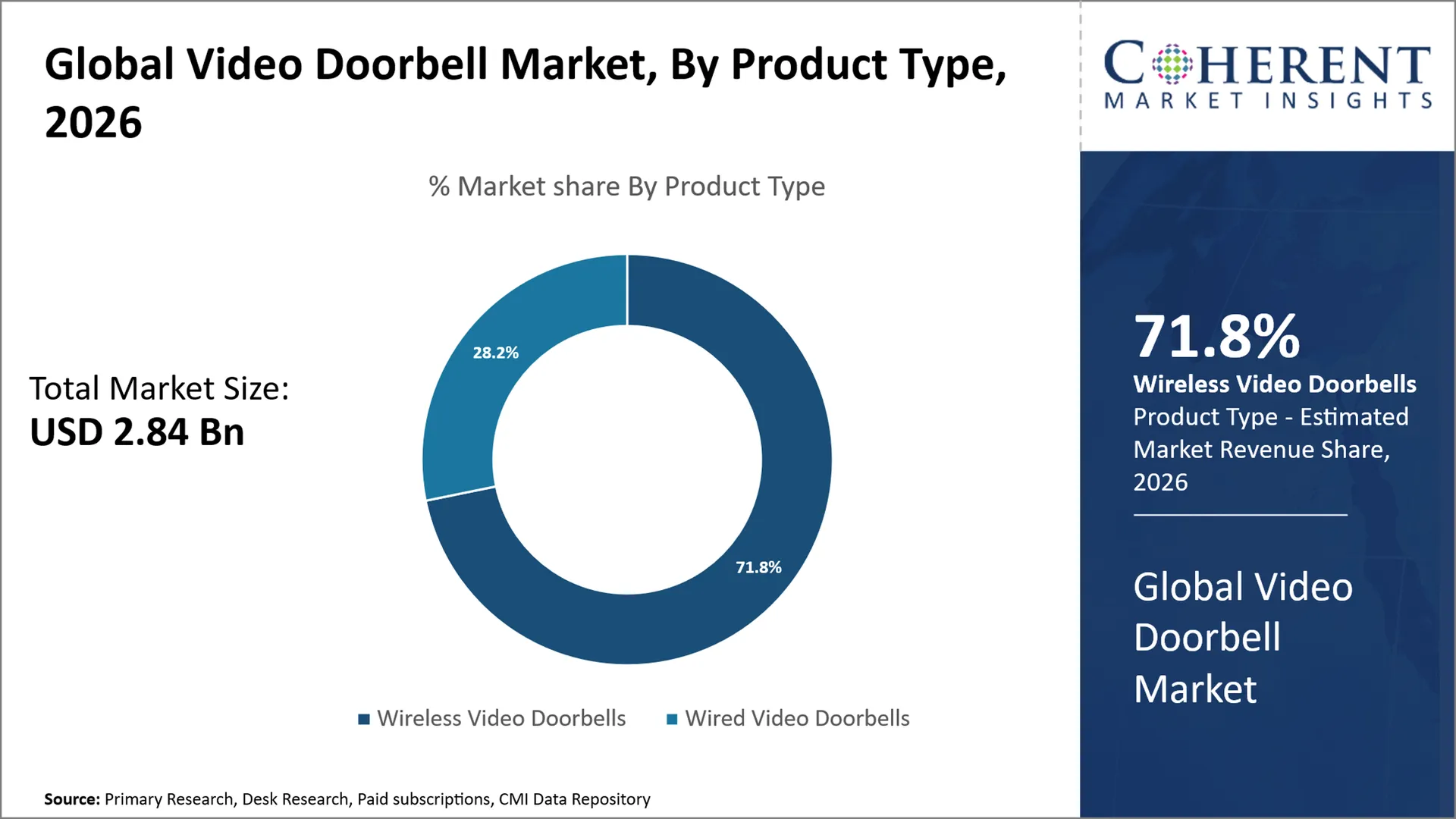
Why Do Wireless Video Doorbells Dominate the Global Video Doorbell Market?
Wireless Video Doorbells are expected to account for 71.8% of the global video doorbell market in 2026 because the format removes dependence on existing low-voltage doorbell wiring and reduces installation friction across retrofits, apartments, and older homes. Battery-powered designs shorten the path from purchase to operation, while Wi-Fi connectivity, mobile setup, bundled chimes, and long battery life make the category easier for mass retailers and direct-to-consumer brands to scale. Residential buyers also value the ability to relocate the device during renovation or tenancy changes. For manufacturers, wireless platforms widen the addressable housing stock and support accessory sales around chimes, mounts, batteries, and hubs. In May 2026, Blink announced its Battery Doorbell 2K+, adding 2K video, head-to-toe viewing, long battery life, and quick installation to its battery-powered front-door security lineup.
- Current Industry Events of 2026
- Market Size Estimation
- Regional Breakdown
- Competitive Landscape
- Customer Intelligence
- Segmental Analysis
- Pricing Analysis
- Key Market Drivers, Challenges & Future Trends
- Customized Insights Section
Why Do Advanced Models Represent the Largest Feature Segment in the Global Video Doorbell Market?
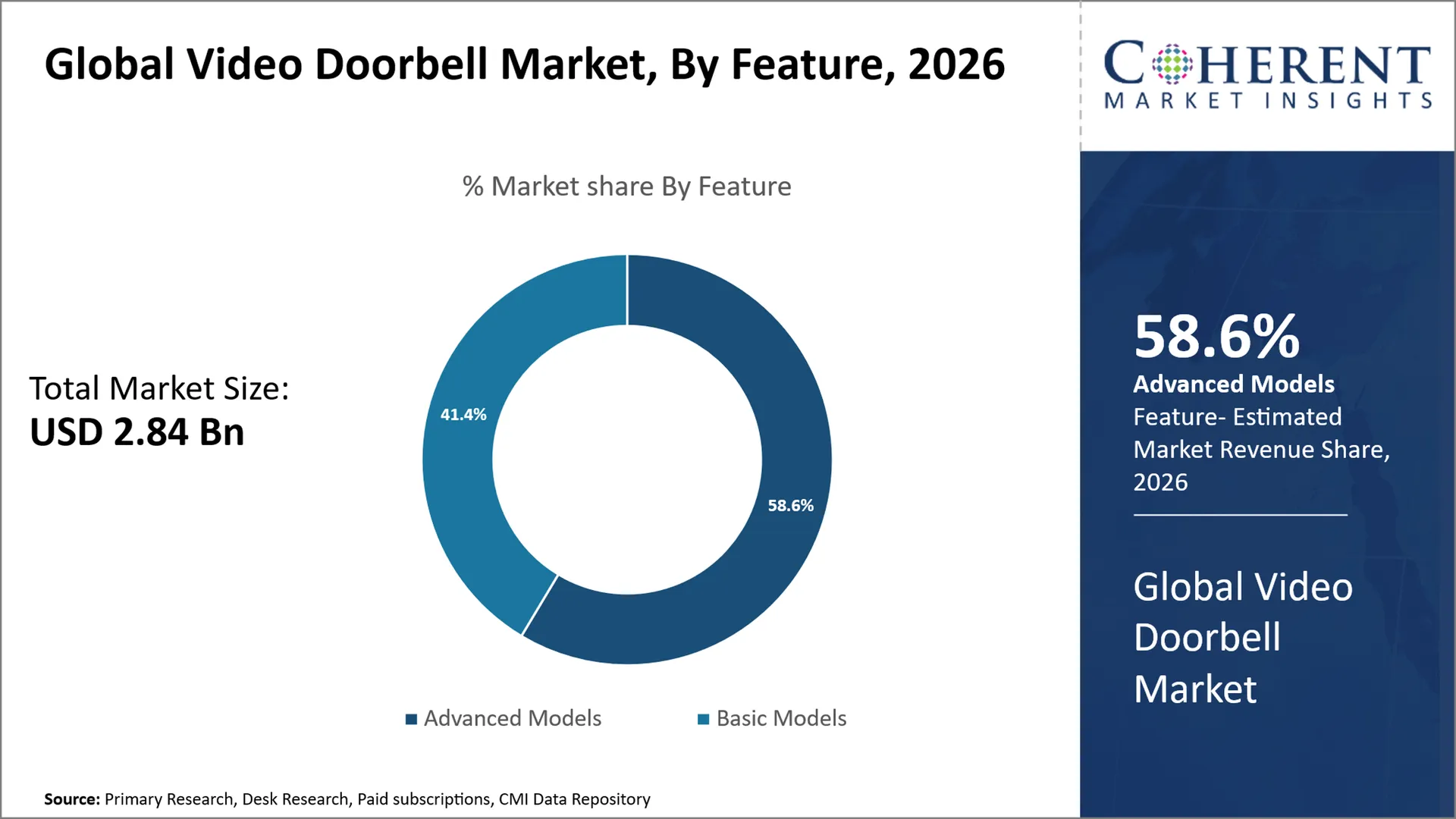
Advanced Models are expected to represent 58.6% of the global video doorbell market in 2026 as purchasing decisions shift from simple remote viewing toward richer doorstep interpretation. Buyers increasingly value clearer imaging, package visibility, visitor screening, fewer nuisance alerts, night performance, local recording, and intelligent responses that reduce the need to review every motion event manually. These functions justify higher device value and create room for optional software, storage, and service monetization, while component suppliers benefit from demand for better sensors, processors, microphones, and edge-computing capability. Advanced models are particularly relevant at parcel-heavy residential entrances where identifying intent and activity matters more than receiving a basic alert. In January 2025, Swann highlighted its SwannBuddy4K video doorbell with 4K imaging, a 165-degree vertical view, and an AI voice assistant for automated visitor interaction.
Why Does Self Owned Dominate the Ownership Category of the Global Video Doorbell Market?
Self Owned video doorbells are expected to hold 77.4% of the global video doorbell market in 2026 because a one-time hardware purchase gives households greater control over installation, storage, upgrades, and long-term operating cost than rental-based access. The economics are especially favorable for owner-occupied homes, where devices can remain installed for several years and integrate with privately managed cameras, hubs, locks, and local storage. Suppliers reinforce this model through direct retail availability, app-based setup, replaceable accessories, firmware support, and optional rather than compulsory service layers. The commercial advantage is a larger upfront hardware pool that can later generate accessory and elective service revenue. In September 2026, eufy documented its Video Doorbell S4 as supporting local storage for core recording without a monthly subscription, strengthening the case for customer-controlled ownership.
Current Events and Their Impact
Current Event | Description and Its Impact |
EU Cyber Resilience Act vulnerability-reporting obligations – September 2026 |
|
UK consumer connectable product security regime – April 2024 |
|
U.S. Cyber Trust Mark framework established – March 2024 |
|
Global Video Doorbell Market Dynamics
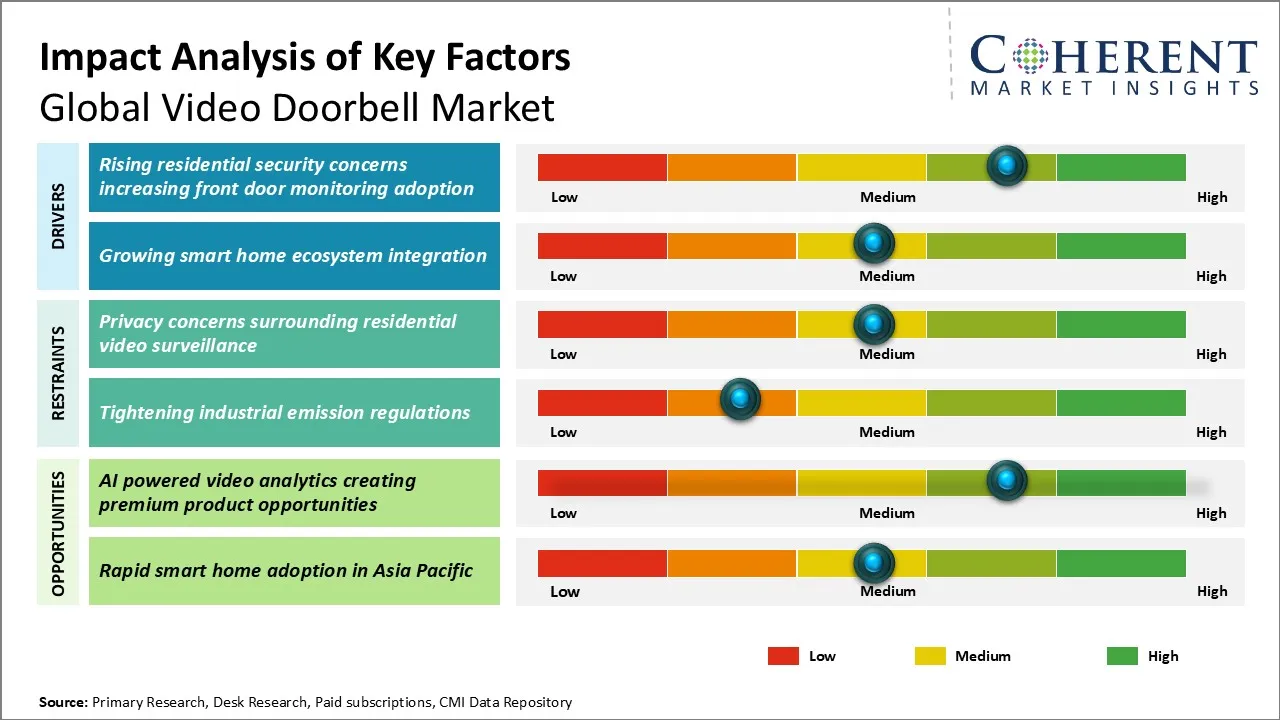
Key Market Drivers
- Rising residential security concerns increasing front door monitoring adoption: Residential security concerns are widening the role of video doorbells from convenience devices to evidence-capture and deterrence tools, supporting adoption among homeowners seeking continuous visibility without full CCTV installations. This benefits device vendors, installers, retailers, and monitoring providers by making the front entrance a priority security point and increasing demand for clearer imaging, remote alerts, and reliable recording. In May 2025, Cambridgeshire Constabulary warned residents after a burglary spike and specifically advised homeowners to consider installing a video doorbell, other CCTV, or an alarm.
- Growing smart home ecosystem integration: Smart home integration is increasing the commercial value of video doorbells because buyers increasingly expect entry monitoring to coordinate with locks, displays, sensors, hubs, and automation routines rather than operate as a stand-alone camera. This favors vendors with broad interoperability and device-management capabilities while raising switching costs once households build connected ecosystems. In July 2025, Aqara announced global availability of its Doorbell Camera Hub G410, combining a video doorbell with Matter control, Thread border routing, Zigbee connectivity, and major smart-home platform support.
Emerging Market Trends
- Doorstep Intelligence Is Moving from Detection to Event Interpretation: Video doorbells are shifting from simple motion-triggered recording toward systems that interpret who or what is at the entrance and prioritize meaningful events. Product development is moving toward richer classification, package awareness, visitor context, and fewer nuisance alerts. This raises the value of processing quality, sensor fusion, and user-controlled automation. Vendors that improve relevance without making the interface more complex should gain pricing power and stronger retention, while basic alert-only models risk becoming concentrated in entry-level channels over the forecast period.
- Local-First Storage Is Reshaping Lifetime Cost and Subscription Strategy: Buyers are placing greater weight on whether useful security functions remain available without an ongoing cloud plan. This is pushing suppliers to combine local recording, optional cloud backup, and selectively paid services instead of locking core functionality behind subscriptions. The shift changes margin architecture because hardware economics, storage design, and service packaging must work together. Brands with credible privacy controls and flexible retention choices can differentiate more clearly, while cloud-dependent models may face greater resistance from value-conscious and privacy-sensitive households during replacement cycles.
Regional Insights
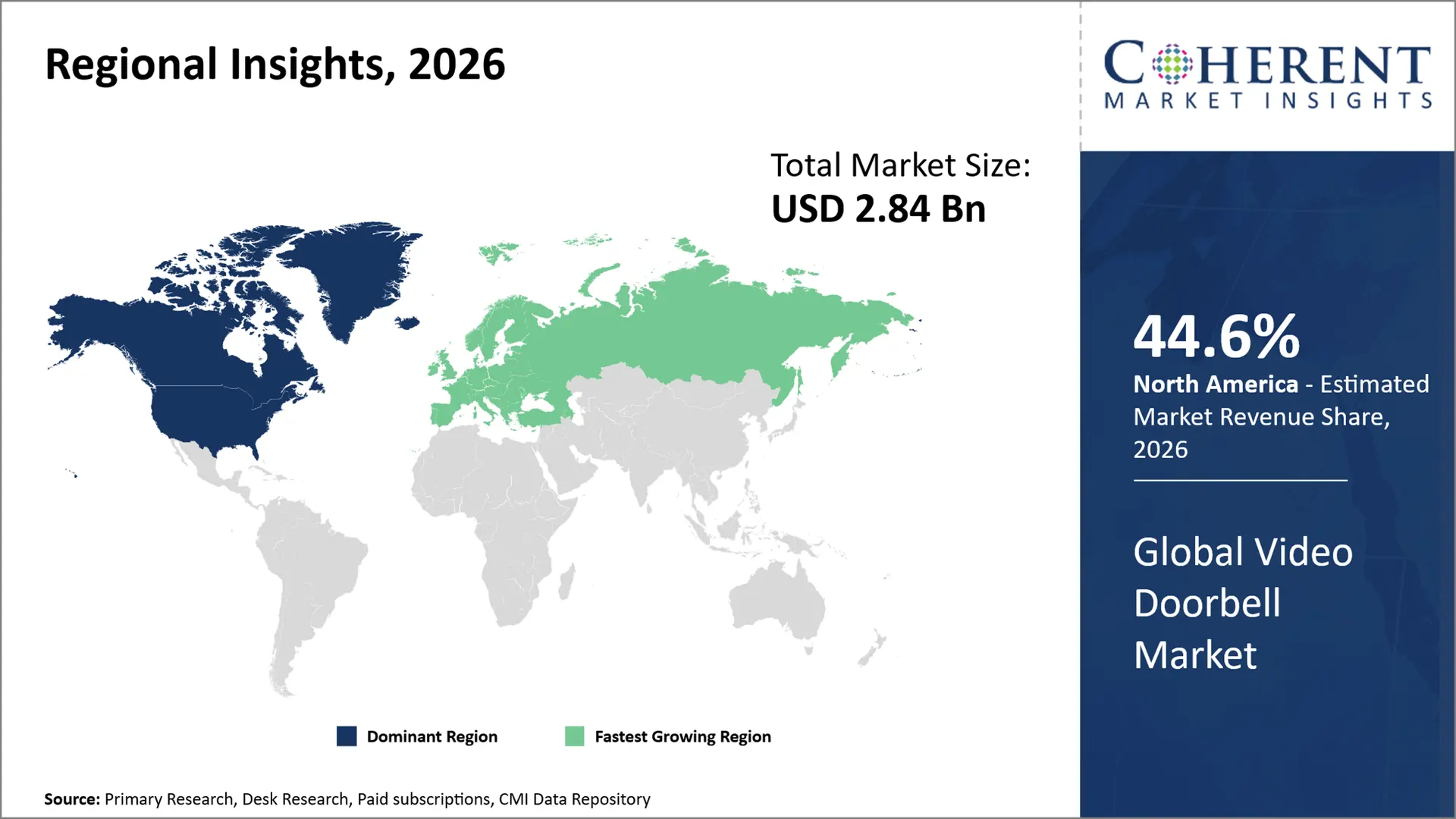
Why Does North America Dominate the Global Video Doorbell Market?
North America is expected to account for 44.6% of the global video doorbell market in 2026 because connected front-door security is already embedded in both DIY and professionally monitored home-security purchasing. High broadband availability, detached housing, frequent parcel deliveries, mature e-commerce channels, and widespread use of mobile security apps give suppliers multiple routes to customers. The region also supports recurring revenue through cloud storage and professional monitoring, encouraging vendors to improve detection, video quality, and ecosystem integration. In February 2025, Resideo showcased its First Alert VX Series at the International Builders’ Show, including a video doorbell with intelligent event detection, HD video, real-time alerts, and compatibility with broader security systems. This illustrates how builders and security dealers are taking video doorbells beyond stand-alone retail devices and positioning them within whole-home protection packages.
Why Is Europe Emerging as the Fastest-Growing Region in the Global Video Doorbell Market?
Europe is expected to hold 24.2% of the global video doorbell market in 2026 and emerge as the fastest-growing region as conventional doorbells and intercoms are progressively replaced by connected entry systems. Demand is shaped by dense urban housing, established wired entry infrastructure, strong privacy expectations, smart-lock adoption, and buyer preference for products that work across multiple platforms. This favors supplier offering privacy controls, flexible power options, and integrations that extend the doorbell into wider smart-home routines. In September 2025, Signify announced the Philips Hue Secure video doorbell, with European availability scheduled for October, combining wide-angle viewing, two-way talk, smart notifications, and lighting-triggered responses. The launch illustrates how European competition is expanding beyond security-only brands toward broader connected-home ecosystems. Europe’s faster growth therefore reflects replacement-led upgrading, interoperability, and feature convergence as much as first-time adoption.
Global Video Doorbell Market Outlook for Key Countries
Why Is the U.S. a Key Market for the Global Video Doorbell Market?
The U.S. is estimated to represent 38.4% of the global video doorbell market in 2026, making it the single most important country market. Demand is reinforced by detached-home layouts, high parcel-delivery activity, strong direct-to-consumer electronics sales, and a well-developed ecosystem of smart speakers, streaming devices, alarm platforms, and mobile security subscriptions. U.S. buyers also have broad access to self-install and professional-install models, allowing vendors to serve value, mainstream, and premium households through different channels. Mainstream electronics merchandising further broadens category visibility. In December 2025, Roku included its Wire-free Video Doorbell & Chime in its U.S. holiday offers alongside streaming hardware. That positioning shows how video doorbells are moving beyond specialist security retail and becoming part of connected-home purchasing, creating cross-selling opportunities for platform owners and consumer-electronics brands.
Why Does China Support Growth in the Global Video Doorbell Market?
China is estimated to hold 9.4% of the global video doorbell market in 2026, supported by a strong domestic supply base for cameras, connectivity modules, batteries, sensors, smart locks, and edge-AI components. Large-scale electronics manufacturing allows local brands to refresh specifications quickly while maintaining competitive hardware pricing. Demand is particularly relevant in apartment living, where doorbells, digital peepholes, smart locks, and indoor smart displays increasingly operate as one entrance-control ecosystem. Security lifecycle management is also becoming more important as connected cameras handle sensitive household data. In August 2026, Xiaomi’s Product Security Center listed Xiaomi Smart Doorbell 3 among camera-category devices covered by the company’s security-update framework. The development matters because sustained firmware and security support can differentiate products as Chinese buyers compare not only camera specifications, but also device longevity, privacy protection, and ecosystem reliability.
Why Is India Important in the Global Video Doorbell Market?
India is estimated to account for 5.2% of the global video doorbell market in 2026, with growth centered on urban apartments, gated communities, villas, and digitally managed households. The strongest local use case is not simply surveillance; it is remote entrance management for deliveries, domestic staff, visitors, and family members when residents are away or unable to answer the door. Smartphone-led control, Wi-Fi installation, AI person detection, and integration with smart locks make the category more practical than traditional indoor-only video doorphones. Local service coverage also matters because many buyers prefer assisted installation rather than pure DIY setup. In February 2026, Qubo’s official Smart Home guidance detailed remote answering, event logs, motion-triggered recording, tamper alerts, and voice-assistant integration for its Smart Video Doorbell. This reflects India’s shift toward app-managed entrance security built around everyday household workflows.
Why Is Germany a Strategic Country in the Global Video Doorbell Market?
Germany is estimated to account for 6.1% of the global video doorbell market in 2026, supported by a strong installed base of wired door-entry systems, premium home-security spending, and a mature network of electrical and security installers. German buyers place considerable weight on product durability, privacy controls, dependable local operation, and compatibility with established building infrastructure rather than low upfront price alone. This creates room for higher-value video door stations that combine identification, communication, and access control. In August 2026, Berlin-based DoorBird launched its D22x Series of IP video door intercoms, offering more than 30 models, a 5 MP HDR camera, a 180-degree lens, and remote management options. The launch illustrates Germany’s move toward integrated entrance security in which video communication increasingly converges with access-control functions for residential and larger-building applications.
Why Is the U.K. an Important Growth Market for the Global Video Doorbell Market?
The U.K. is estimated to represent 5.0% of the global video doorbell market in 2026, supported by strong online electronics purchasing, frequent home-delivery activity, widespread DIY security adoption, and demand for practical upgrades to established housing stock. Buyers benefit from products that can operate wirelessly or reuse existing doorbell wiring, reducing installation friction while retaining smartphone control. Privacy settings and software support also matter because front-door cameras can capture neighbouring property or public pathways. Product design increasingly reflects these requirements. In June 2025, Arlo’s U.K. support documentation for its second-generation video doorbells detailed 1080p and 2K models with rechargeable power, optional hardwiring, a 180-degree viewing angle, and two-way audio. This combination supports a broad retrofit market by allowing households to choose installation format and video specification without rebuilding entrance wiring.
AI and Connected Entry Technology Adoption Landscape
Technology | Adoption Direction | Role in Video Doorbells | Commercial Impact |
On-Device Computer Vision AI | Accelerating | Classifies people packages vehicles animals and other entrance activity locally | Improves alert relevance while supporting privacy-focused and subscription-light positioning |
mmWave Radar and Multi-Sensor Detection | Emerging to expanding | Combines radar motion and imaging inputs to distinguish genuine approach events from background movement | Reduces nuisance notifications and supports premium differentiation beyond camera resolution |
Head-to-Toe and Dual-Camera Imaging | Expanding | Provides simultaneous coverage of visitors doorstep areas and delivered packages | Makes field of view and package visibility important purchasing criteria rather than resolution alone |
Hybrid Battery and Wired Power Architecture | Broadening | Allows quick wire-free installation while enabling continuous power or advanced recording where wiring exists | Enables one product platform to address multiple housing types and installation environments |
Edge and Local Video Storage | Accelerating | Keeps recordings or selected intelligence within the device hub or local memory | Reduces dependence on recurring cloud fees and strengthens privacy and total-cost-of-ownership positioning |
Matter Thread and Cross-Ecosystem Connectivity | Early commercial expansion | Links entry monitoring with hubs displays sensors locks lighting and automation environments | Raises ecosystem value and makes interoperability capability more important in vendor selection |
How Are Managed Multifamily Security Workflows Creating New Growth Opportunities in the Global Video Doorbell Market?
Managed multifamily housing is an underdeveloped opportunity because property operators need more than a consumer doorbell installed at each unit. They require fleet provisioning, role-based administration, resident turnover workflows, shared-entry coordination, privacy separation, and dependable support across many doors. Suppliers can capture this opportunity by creating property-management dashboards, installer-friendly hardware, reusable mounting and power options, API connections to access-control platforms, and account structures that transfer cleanly when tenants change. Build-to-rent operators, student housing providers, senior living communities, and professionally managed apartment portfolios are particularly relevant customer groups. The strongest offerings will balance resident control with property-level maintenance visibility while avoiding unnecessary access to private video. Participation requires cybersecurity engineering, device lifecycle management, field-service partnerships, clear compliance processes, and scalable onboarding tools at scale. Established security vendors have channel advantages, but proptech specialists and vertically integrated device-platform providers can compete effectively if they solve deployment economics and administration better than consumer-focused products.
Market Players, Key Development, and Competitive Landscape
Key Developments
- In July 2026, Reolink released its Video Doorbell 2nd Gen using Qualcomm QCC730 micro-power Wi-Fi technology alongside head-to-toe imaging on-device detection and battery or wired operating modes. This matters because lower maintenance requirements and local intelligence can strengthen adoption among users resisting frequent charging or recurring service fees.
- In August 2024, TP-Link's Tapo brand launched the D225 and D210 smart video doorbells combining dual-power or battery configurations with AI detection local storage and 24/7 recording on the flagship model. This matters because it intensifies price-performance competition while broadening access to advanced front-door monitoring features.
- In October 2024, Wyze released the Duo Cam Doorbell with separate visitor and package views 2K imaging local microSD recording and flexible wire-free or hardwired installation. This matters because dual-view hardware addresses package monitoring as a dedicated use case while extending feature competition into comparatively accessible consumer price tiers.
Competitive Landscape
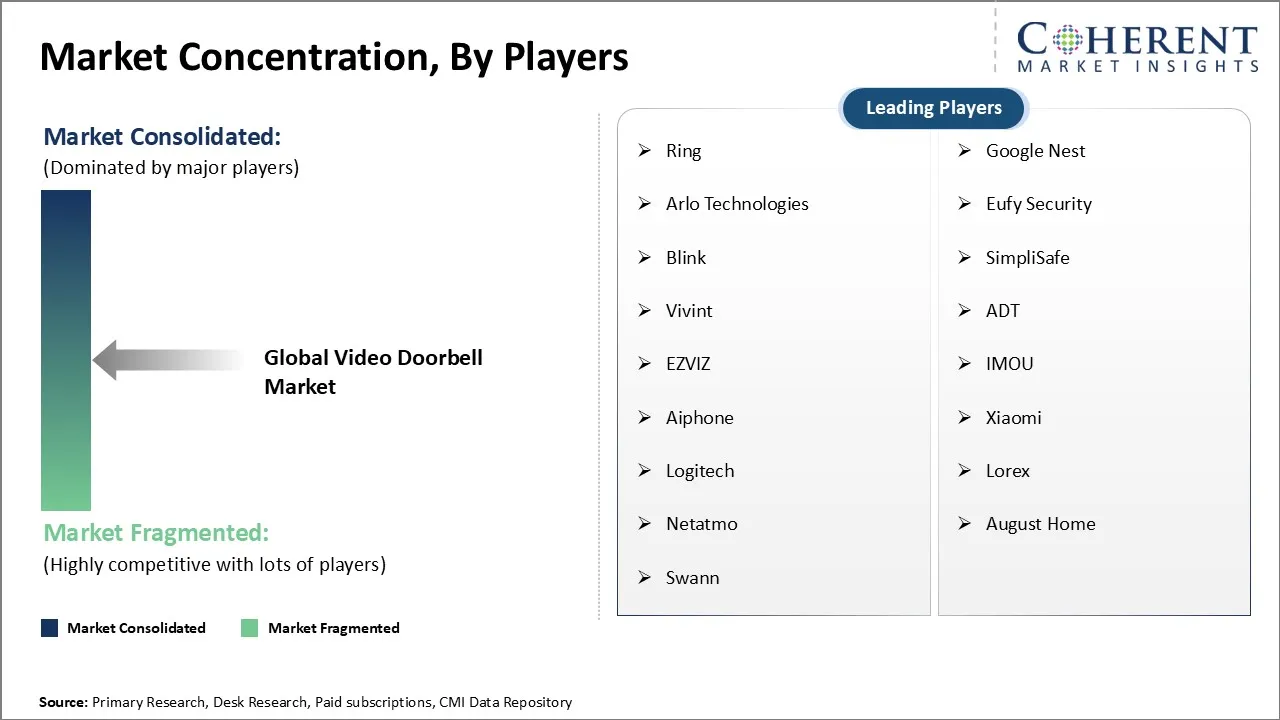
The global video doorbell market is fragmented, with smart-home platform owners, specialist security brands, networking-device vendors, monitoring providers, and regional value players competing across overlapping price tiers. Competition increasingly depends on detection quality, image coverage, power flexibility, privacy, cybersecurity, app reliability, storage economics, interoperability, retail reach, and support. Regional specialists can remain relevant through localized pricing, installer relationships, and subscription-light propositions.
Key focus areas include
- Detection accuracy and alert quality: Reducing false alerts while correctly identifying relevant doorstep activity increasingly separates premium systems from basic motion cameras.
- Imaging architecture: Wider vertical coverage dual-camera designs night performance and package visibility influence perceived security value more than resolution alone.
- Ownership economics: Hardware price local storage cloud fees and premium-service structures collectively determine lifetime customer cost.
- Installation flexibility: Battery wired and hybrid configurations enable suppliers to address existing homes new builds apartments and difficult retrofit conditions.
- Cybersecurity and privacy assurance: Secure software architecture update support encryption and transparent data handling are becoming stronger purchasing and compliance considerations.
- Distribution and installer access: Online marketplaces electronics retailers security dealers installers and direct-to-consumer channels influence both acquisition cost and brand visibility.
- After-sales software support: App stability firmware maintenance device longevity and customer service can materially influence retention within connected-home ecosystems.
Market Report Scope
Video Doorbell Market Report Coverage | |||
Report Coverage | Details | ||
Base Year | 2025 | Market Size in 2026: | USD 2.84 Bn |
Historical Data For: | 2020 To 2024 | Forecast Period: | 2026 To 2033 |
Forecast Period 2026 To 2033 CAGR: | 10.7% | 2033 Value Projection: | USD 5.79 Bn |
Geographies covered: |
| ||
Segments covered: |
| ||
Companies covered: | Ring, Google Nest, Arlo Technologies, Eufy Security, Blink, SimpliSafe, Vivint, ADT, EZVIZ, IMOU, Aiphone, Xiaomi, Logitech, Lorex, Netatmo, August Home, Swann | ||
Growth Drivers: |
| ||
Restraints & Challenges: |
| ||
Analyst Opinion (Expert Opinion)
- The global video doorbell market leadership is likely to depend less on selling an isolated camera and more on controlling the complete lifecycle of connected entry security. Device onboarding software maintenance automation compatibility cybersecurity support and service flexibility should increasingly determine customer retention. Suppliers that treat the doorbell as a continuously managed security endpoint rather than a replacement for a conventional bell are likely to create more defensible customer relationships.
- Interoperability could gradually weaken closed hardware ecosystems by making connected-home components easier to combine across brands. If buyers gain greater freedom to mix doorbells locks sensors hubs and displays hardware differentiation alone will become harder to defend. Participants with superior device intelligence dependable software APIs security credentials and seamless automation capabilities should therefore be better positioned than vendors relying primarily on ecosystem lock-in.
- Suppliers should prioritize reliable edge intelligence cybersecurity long-life power architecture and software support while developing differentiated propositions for homeowners property managers and professional installers. Pricing strategies should avoid making essential security capabilities overly dependent on recurring fees because this can create churn and replacement risk. Investment should remain disciplined around marginal camera-resolution upgrades unless those improvements materially strengthen identification package visibility or low-light performance.
Speak to the analyst
Want personalized insights?
Take the findings above to one of our principal consultants, or have the report rebuilt around the segments, geographies and competitors you actually track.
Market Segmentation
- Product Type Insights (Revenue, USD Bn, 2021 - 2033)
- Wireless Video Doorbells
- Wired Video Doorbells
- Feature Insights (Revenue, USD Bn, 2021 - 2033)
- Advanced Models
- Basic Models
- Ownership Insights (Revenue, USD Bn, 2021 - 2033)
- Self Owned
- Rental
- End User Insights (Revenue, USD Bn, 2021 - 2033)
- Residential
- Non Residential
- Sales Channel Insights (Revenue, USD Bn, 2021 - 2033)
- Online
- Offline
- Regional Insights (Revenue, USD Bn, 2021 - 2033)
- North America
- U.S.
- Canada
- Latin America
- Brazil
- Argentina
- Mexico
- Rest of Latin America
- Europe
- Germany
- U.K.
- Spain
- France
- Italy
- Russia
- Rest of Europe
- Asia Pacific
- China
- India
- Japan
- Australia
- South Korea
- ASEAN
- Rest of Asia Pacific
- Middle East
- GCC Countries
- Israel
- Rest of Middle East
- Africa
- South Africa
- North Africa
- Central Africa
- North America
- Key Players Insights
- Ring
- Google Nest
- Arlo Technologies
- Eufy Security
- Blink
- SimpliSafe
- Vivint
- ADT
- EZVIZ
- IMOU
- Aiphone
- Xiaomi
- Logitech
- Lorex
- Netatmo
- August Home
- Swann
Sources
Primary Research Interviews
- Video doorbell and smart security device manufacturers
- Smart home platform providers system integrators and security installers
- Residential developers property managers retailers and connected home professionals
Stakeholders
- Video doorbell camera sensor chipset and connectivity module manufacturers
- Smart lock alarm access control and home automation providers
- Security service providers distributors installers retailers and e-commerce platforms
- Residential developers multifamily operators homeowners and commercial property users
End-use Sectors
- Residential households
- Multifamily housing and apartments
- Commercial and small business premises
- Property management and real estate
- Smart home and monitored security applications
Regulatory and Industry Bodies
- Federal Communications Commission FCC
- Federal Trade Commission FTC
- European Commission
- UK Department for Science Innovation and Technology DSIT
- National Institute of Standards and Technology NIST
- European Union Agency for Cybersecurity ENISA
- National data protection and consumer protection authorities
Databases
- Company annual reports investor presentations and product filings
- FCC equipment authorization database
- UN Comtrade connected security and electronics trade data
- Eurostat national housing and digital adoption databases
- Patent smart camera IoT and computer vision databases
- Residential construction broadband smart home and e-commerce databases
Magazines and Journals
- IEEE Internet of Things Journal
- IEEE Access
- Sensors
- Computers & Security
- Journal of Cybersecurity and Privacy
- Security Management
- Security Sales & Integration
Associations
- Connectivity Standards Alliance CSA
- Security Industry Association SIA
- Consumer Technology Association CTA
- ASIS International
- Z-Wave Alliance
- Wi-Fi Alliance
- Regional smart home and electronic security associations
Public Domain Sources
- Residential burglary and property crime statistics
- Housing stock homeownership and residential construction data
- Broadband Wi-Fi and smart home adoption statistics
- E-commerce parcel delivery and doorstep delivery data
- Consumer IoT cybersecurity and privacy guidance
- Smart home interoperability and connected device developments
- Residential surveillance and data protection policy updates
Key Standards and Regulations
- EU General Data Protection Regulation GDPR
- EU Cyber Resilience Act CRA
- UK Product Security and Telecommunications Infrastructure PSTI regime
- ETSI EN 303 645 consumer IoT cybersecurity standard
- NISTIR 8259 IoT device cybersecurity guidance
- FCC U.S. Cyber Trust Mark framework
- Wi-Fi Matter and connected device interoperability standards
- National residential surveillance privacy and data protection requirements
Proprietary Elements
- CMI Data Analytics Tool and proprietary CMI repository containing 10+ years of video doorbell demand product types feature adoption ownership models residential and non-residential usage pricing distribution channels smart home integration AI video analytics cybersecurity developments regional adoption competitive intelligence product launches and regulatory changes.
Get access to 250+ pages report
Every segment, forecast, competitor profile and data table behind the analysis above — available for instant download.
- ESOMAR Member
- ISO 9001:2015 Certified
- D-U-N-S Registered
- GDPR & CCPA Compliant
Frequently Asked Questions
The CAGR of global video doorbell market is projected to be 10.7% from 2026 to 2033.
The global video doorbell market is estimated to be valued at USD 2.84 billion in 2026 and is expected to reach USD 5.79 billion by 2033.
Rising concerns about residential security and the growing integration of video doorbells with smart home ecosystems are the major factors supporting the growth of the global video doorbell market.
Privacy concerns surrounding residential video surveillance and Tightening industrial emission regulations are the major factor hampering the growth of global video doorbell market.
In terms of product type, wireless video doorbells are estimated to dominate the market revenue share in 2026.
Ring, Google Nest, Arlo Technologies, Eufy Security, Blink, SimpliSafe, Vivint, ADT, EZVIZ, IMOU, Aiphone, Xiaomi, Logitech, Lorex, Netatmo, August Home, Swann are the major players.
North America is expected to lead the global video doorbell market in 2026.