

Global VR Medical Training Market Size and Forecast – 2026 To 2033
The global VR medical training market is expected to grow from USD 1,620.0 Mn in 2026 to USD 7,724.8 Mn by 2033, registering a compound annual growth rate (CAGR) of 25% from 2026 to 2033. The market for global VR medical training is poised for significant expansion, fueled by the growing government investment in technology-enabled healthcare workforce training.
In February 2026, NHS Supply Chain launched a Medical Simulation Devices and Technologies framework with a potential value of USD 278 million (£210 million), explicitly covering physical and immersive training aids for healthcare organizations. This large-scale public procurement supports wider deployment of immersive technologies across healthcare education and workforce training.
Key Takeaways of the Global VR Medical Training Market
- Hardware is projected to hold 45.6% of the global VR medical training market share in 2026, making it dominant component segment across North America due to regulatory development around medical extended-reality hardware. For instance, the U.S. Food and Drug Administration (FDA) operates a Medical Extended Reality Program that specifically evaluates HMD hardware, sensors, image quality, usability, and safety considerations for medical XR applications, including surgery. This regulatory focus supports institutional confidence in deploying VR hardware for clinical training and related medical applications.
- Fully Immersive VR is projected to hold 61.7% of the global VR medical training market share in 2026, making it dominant technology segment across Europe rising public-sector investment in immersive and simulation-based workforce training. For instance, NHS England made USD 19.9 million (£15 million) available to higher-education institutions to expand simulation capacity for allied health professionals and doctors, while its workforce plan supports greater use of immersive technologies in healthcare education. This government-backed investment is strengthening the infrastructure required for wider adoption of VR medical training.
- Surgical training is projected to hold 45.3% of the global VR medical training market share in 2026, making it dominant application segment across Europe due to government-backed development of procedure-specific immersive simulation. For instance, NHS Education for Scotland commissioned an immersive VR endoscopy-room simulation designed to rehearse clinical scenarios, non-technical skills, dynamic problem-solving, and patient-management decisions during colonoscopy procedures. Such public healthcare training initiatives support the use of VR for structured surgical and procedural skills development.
- North America market maintains dominance with an expected share of 41.3% in 2026, bolstered by the region’s deployment of government-developed VR platforms for healthcare workforce training. For instance, the U.S. Centers for Disease Control and Prevention (CDC) operates OneLab VR, a virtual laboratory containing more than 100 training scenarios that allow laboratory professionals to practice equipment, safety, and clinical procedures in a controlled environment. This federal deployment demonstrates the integration of VR into healthcare workforce training beyond conventional medical-school simulation.
- Asia Pacific is expected to exhibit the fastest growth in the global VR medical training market, registering an estimated CAGR of 21.6% during 2026–2033, driven by government investment in immersive training infrastructure for healthcare professionals. For instance, in May 2026, the New South Wales Government introduced a mixed augmented-virtual reality (MAV) trainer at its Aeromedical Crewing Excellence Training Centre, enabling helicopter paramedics, doctors, and aircrew to rehearse complex rescue and clinical scenarios in immersive environments. This expansion of government-operated VR training infrastructure is broadening adoption across healthcare workforce development in the region.
Segmental Insights
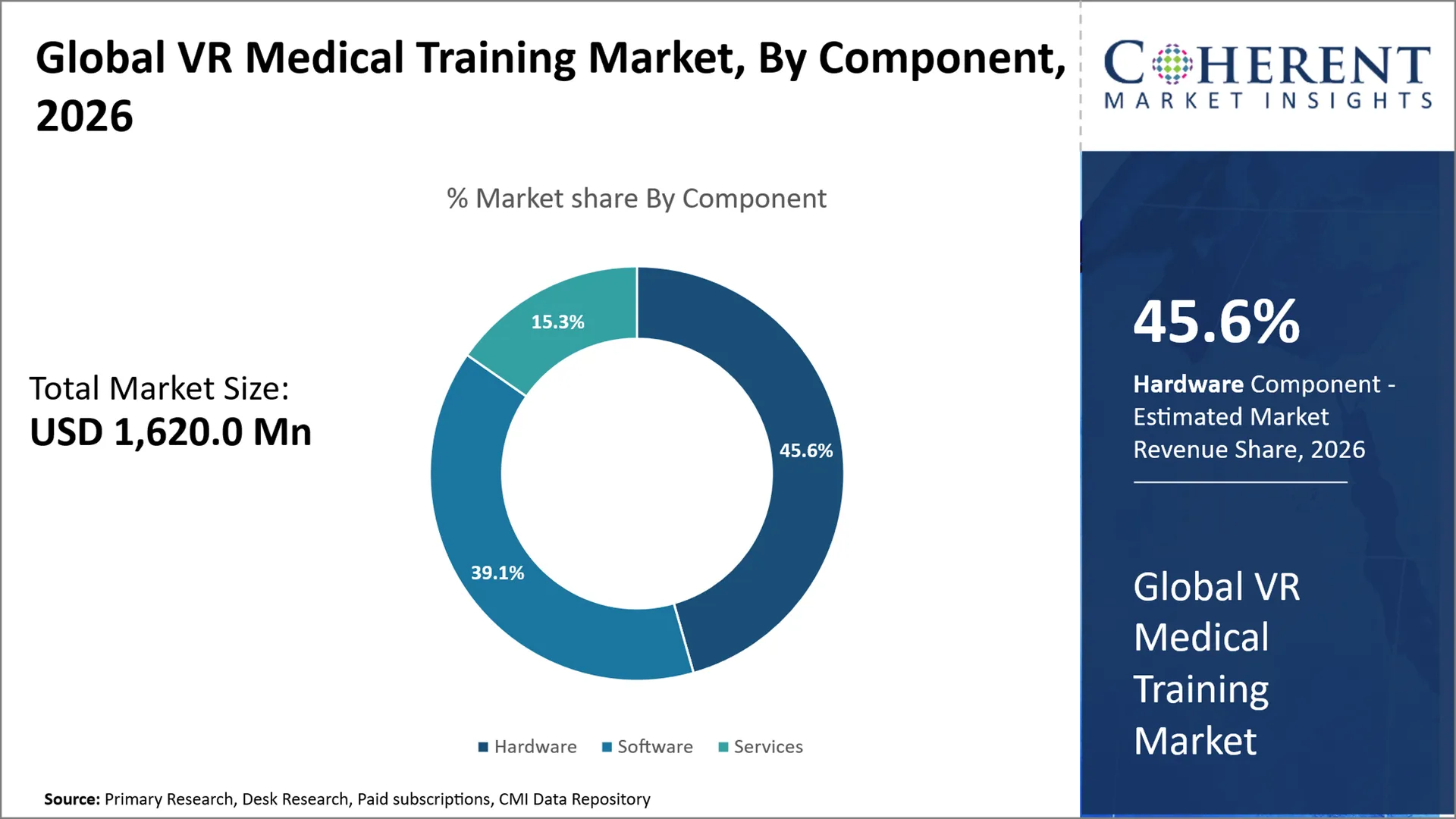
Why Do Hardware Dominate the Global VR Medical Training Market?
Hardware is projected to hold the market share of 45.6% in 2026, as high-resolution headsets, motion trackers, and haptics systems are required for realistic, hands-on procedural training. However, increased demand for dedicated VR hardware from medical centers can be anticipated to drive the demand for hardware. For instance, U.S. Department of Veterans Affairs reported that its VA Immersive program had expanded VR technology across more than 145 VA healthcare facilities, supporting healthcare education and clinical applications.
- Current Industry Events of 2026
- Market Size Estimation
- Regional Breakdown
- Competitive Landscape
- Customer Intelligence
- Segmental Analysis
- Pricing Analysis
- Key Market Drivers, Challenges & Future Trends
- Customized Insights Section
Why Do Fully Immersive VR Represent the Largest Technology Segment in the VR Medical Training Market?
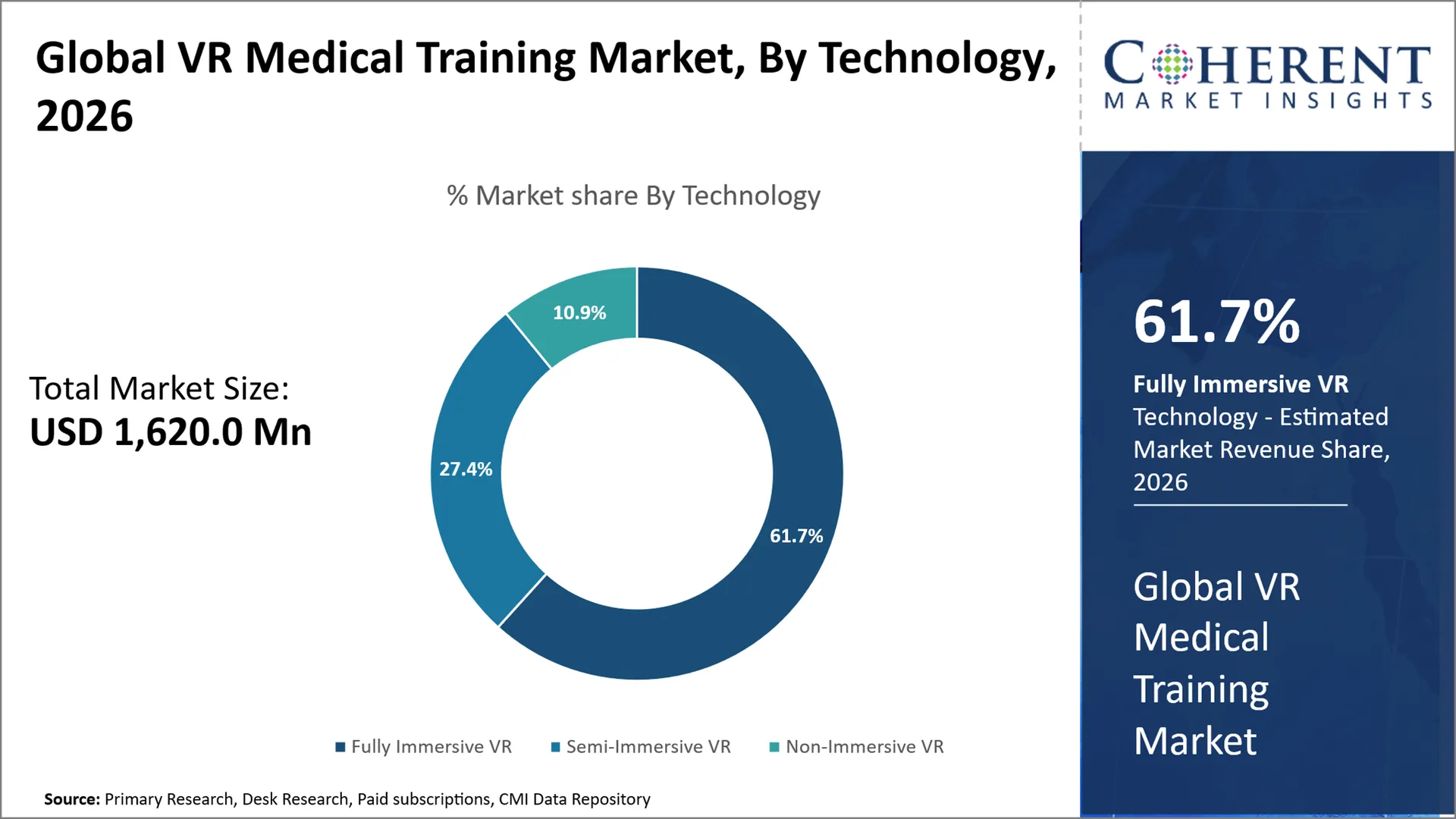
Fully Immersive VR is projected to hold a market share of 61.7% in 2026, because it can deliver immersive, interactive environments that facilitate repeatable training in a clinical and emergency-response setting. Government healthcare purchasing of dedicated VR training systems is also tipping the scales in its favor. For instance, in August 2026, the North East Ambulance Service NHS Foundation Trust, sought a platform for immersive ten-second triage, mass-casualty and complex emergency-response scenarios, specifically requiring scalable, repeatable environment for front-line clinical staff and students.
Surgical Training Segment Dominates the Global VR Medical Training Market
The surgical training segment is projected to hold a market share of 45.3% in 2026, due to its ability to teach complex procedures repeatedly, instrument manipulation and decision-making skills in a safe environment. Its role may be most significant where training in the actual operating room is limited and patient exposure must be minimized. For instance, the Northern Ireland Medical and Dental Training Agency (NIMDTA) has a simulation suite which includes 10 Simodont haptic virtual reality units, permitting dental trainees to repeatedly practice procedures on 3D models with performance feedback.
Current Events and their Impact
Current Events | Description and its Impact |
U.S. Department of Veterans Affairs Pilots VR for Suicide-Prevention Training (July 2026) |
|
NHS England Expands Funding Framework for Simulation-Based Learning (2025–2026) |
|
Australian Government Advances AR/VR Training for Aged-Care Staff (November 2025) |
|
VR Medical Training Market Dynamics
Market Drivers
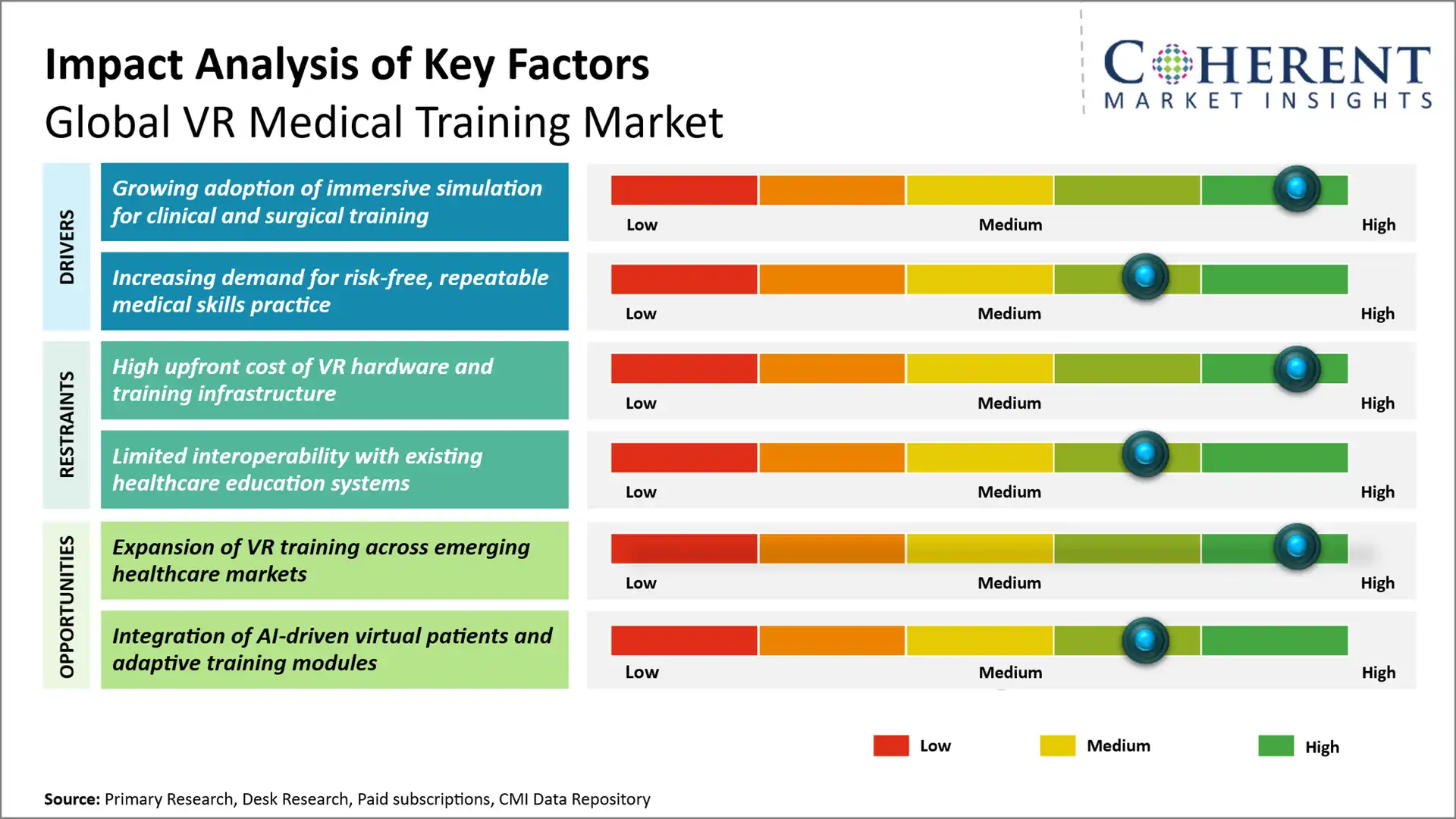
- Growing adoption of immersive simulation for clinical and surgical training: Medical institutions are increasingly incorporating immersive VR simulation into structured training to provide repeatable, controlled environments for developing procedural skills. For instance, in June 2025, a multicenter study was published by the National Library of Medicine, across three hospitals trained 60 junior surgical trainees using high-fidelity VR modules for laparoscopic procedures, including dissection and intracorporeal suturing. This demonstrates the increasing use of immersive simulation for structured, repeatable clinical skills development.
- Increasing demand for risk-free, repeatable medical skills practice: VR-based training enables learners to rehearse clinical procedures repeatedly without exposing patients to training-related risks, while reducing dependence on physical simulation resources. For instance, in December 2025, a study at Nanjing Medical University evaluated VR-based cataract surgery training among 71 undergraduate students, demonstrating its use for repeated practice of surgical skills in an immersive environment.
- Expansion of VR training across nursing education programs: Medical and nursing schools are increasingly integrating VR into formal curricula to expand simulation capacity and provide realistic clinical decision-making experiences. For instance, in May 2025, the University of Vermont integrated VR simulation into its nursing curriculum and recorded 1,138 VR sessions, adding 321 hours of simulation practice.
Emerging Trends
- AI-enabled adaptive training: VR platforms are increasingly integrating AI to adjust training scenarios based on learner performance, provide real-time feedback, and enable personalized competency assessment. This is shifting VR from static simulation toward adaptive medical education.
- Haptic and high-fidelity simulation: Advanced haptic interfaces, motion tracking, and realistic virtual environments are improving tactile interaction and procedural accuracy. These technologies are strengthening VR applications for surgical and clinical skills training.
- Expansion of remote and cloud-based VR training: Cloud-based content delivery is enabling medical institutions to deploy VR training across multiple locations without extensive on-site infrastructure. This supports scalable training programs and broader access to standardized clinical simulations.
Regional Insights
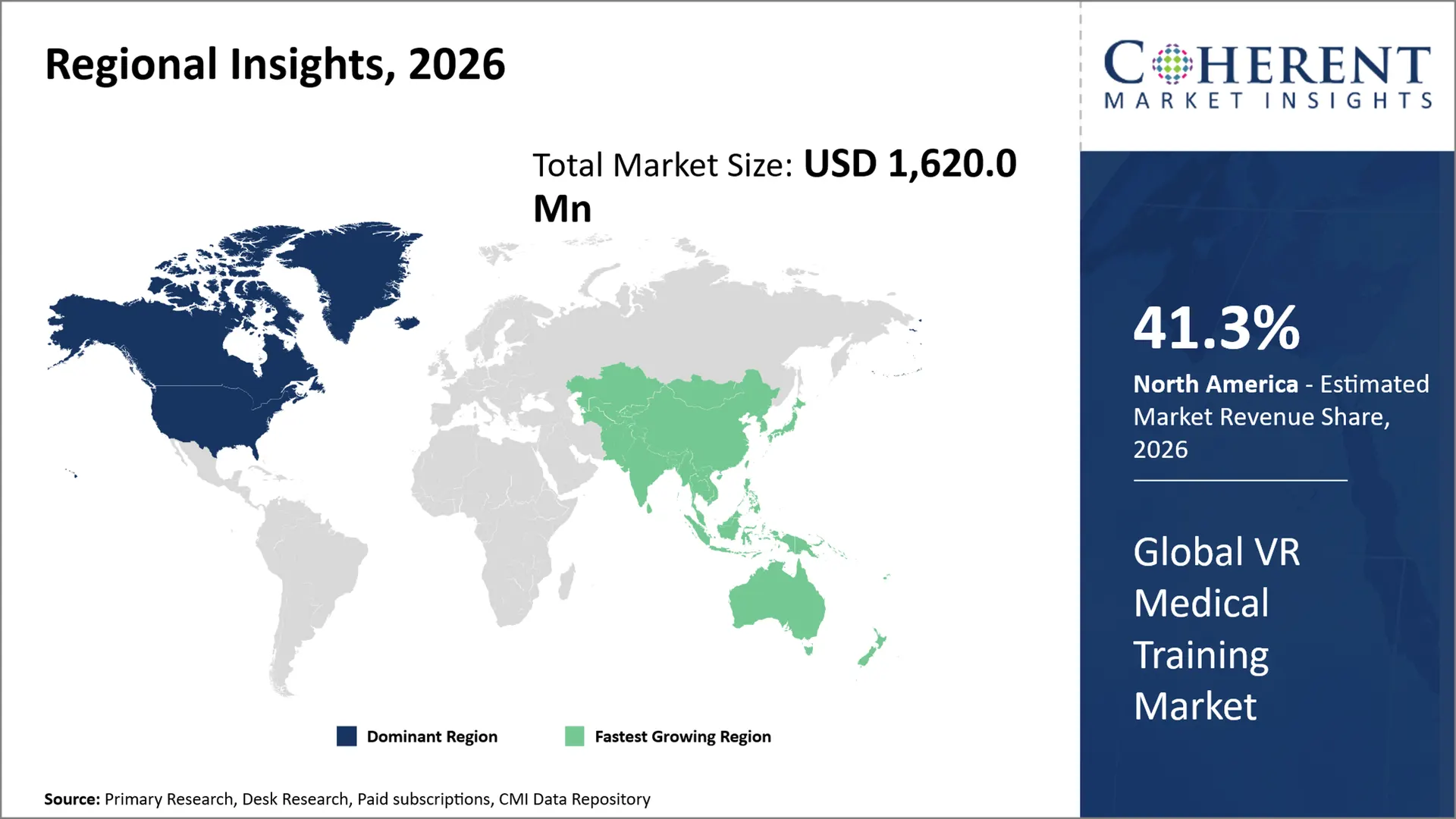
Why is North America a Strong Market for VR Medical Training?
North America leads the global VR medical training market, accounting for an estimated 41.3% share in 2026, due to increased adoption of emerging technology trends such as digitization and simulation in healthcare, besides the presence of advanced healthcare infrastructure and digital-health ecosystem. The region also showcases a well-established medical education system that is utilizing VR to train students and physicians in simulated environments.
Furthermore, favorable government policies enabling more innovations in the sector of medical technology, digital health and workforce training through simulation are also expected to contribute towards institutional VR adoption. For instance, the U.S. Health Resources and Services Administration (HRSA) operates the NEPQR-Simulation Education Training (SET) Program that improves experiential learning through simulation-based technology use in nursing education in medically underserved and rural areas.
Why Does Asia Pacific VR Medical Training Market Exhibit High Growth?
Asia Pacific is expected to exhibit the fastest growth in the global VR medical training market, registering an estimated CAGR of 21.6% during 2026–2033. The region is projected to account for 22.4% of the global market in 2026, owing to increasing healthcare spending, rapid digitization of medical education, and enhancement of medical training infrastructure. The increasing government support through healthcare reforms, digital health initiatives and innovation incentive schemes are also predicted to boost VR adoption in medical education.
For instance, in September 2024, Singapore's Ministry of Health highlighted Project VRx, a virtual reality simulation program used as part of pharmacy education to increase learning about medication safety. This project demonstrates the government's support for the application of virtual reality in the training of healthcare professionals. Furthermore, due to the large population, an expanding healthcare workforce, increasing medical education institutions, and the adoption of technology based clinical training have augmented the region's VR market.
Global VR Medical Training Market Outlook for Key Countries
Why is the U.S. Leading Innovation and Adoption in the VR Medical Training Market?
The VR medical training market in the U.S. is expected to witness substantial innovations and faster adoption rates, largely owing to the integration of the latest virtual/augmented/mixed reality technology by clinical educators and the focus on upskilling the clinical workforce with simulation tools. The need for advanced surgical simulation, medical training in various specializations, and patient simulation by utilizing VR tech will likely boost the VR market adoption by various U.S-based institutions.
Is Japan a Favorable Market for VR Medical Training Market?
Japan’s VR medical training market is expected to be a potential market by virtue of the country’s high-quality healthcare system, high adoption of medical simulation, and emphasizes the importance of technology-based clinical education. Aging population as well as a need to train healthcare staff efficiently and effectively are other factors indicating the need for and thus a market for repeatable and scalable simulation-based training.
Is China Emerging as a Key Growth Hub for the VR Medical Training Market?
China is gradually emerging as the newest growth driver for the VR medical training market due to rapid digitization of medical training and increasing availability of medical simulation facilities. Moreover. growing number of hospitals and increasing adoption of digitization in medical education will offer good demand for soft skills (interpersonal skills) training in the emerging market.
Why Does Germany Top the European VR Medical Training Market?
Germany leads the European VR medical training market owing to the well-developed medical education system, thriving healthcare technology ecosystem and sizeable focus on simulation based clinical training systems. Germany boasts of a large number of hospitals and teaching hospitals that would provide an enabling ecosystem for the adoption of VR solutions for surgical, nursing and procedural training. The digitally progressive healthcare system in the country may also help promote the use of VR in professional medical training systems.
Is VR Medical Training Market Developing in UK?
The UK VR medical training market is on a growth trajectory, driven by increased use of immersive and simulation solutions to deliver clinical training by the National Health Service (NHS). The use of immersive technology for healthcare education allows practice of complex scenarios in a standardized manner and reduces the use of facilities for simulation. Furthermore, a highly developed NHS training system and rise of tech-enabled workforce development are expected to give rise to a thriving UK VR healthcare market.
VR Medical Training Application By Learner Type
Learner Type | Surgical Training | Emergency Response Training | Anatomy & Physiology Education | Nursing & Patient Care Training | Diagnostic Training |
Medical Students | ✓ | ✓ | ✓ | — | ✓ |
Nursing Students | — | ✓ | ✓ | ✓ | ✓ |
Residents & Surgical Trainees | ✓ | ✓ | ✓ | — | ✓ |
Practicing Physicians | ✓ | ✓ | — | — | ✓ |
Allied Healthcare Professionals | — | ✓ | ✓ | ✓ | ✓ |
How is the expansion of VR training across emerging healthcare markets creating new growth opportunities in the VR medical training market?
The demand for training will likely increase and facilities will seek scalable, low-risk ways to expand clinical expertise, which will likely lead to other options for VR instructional medication as healthcare markets expand. Rising overseas funding in simulation infrastructure and wider diffusion of digital studying may also protect VR use in medical, nursing, and different healthcare fields. Additionally, the flexibility to supply standardized, repeatable coaching makes VR appropriate to nations the place there’s sporadic entry to medical coaching assets. For instance, in March 2025, the All-India Institute of Medical Sciences (AIIMS) Guwahati established its Centre for Experiential Learning and Simulation (CELS). The Centre is equipped with state-of-the-art Virtual Reality based learning equipment for students of the MBBS course, nursing students, paramedical staff and clinicians. (Source: Press Information Bureau)
Market Players, Key Development, and Competitive Landscape
Key Developments
- In April 2026, AIIMS New Delhi partnered with MediSim VR to integrate AI-enabled VR-based skill training into medical and nursing education. The collaboration focuses on evaluating VR for skill development, assessment, and standardization of clinical training, supporting broader adoption of immersive technologies in healthcare education.
- In October 2025, MediSim VR and the Himalayan Institute of Medical Sciences (HIMS), Dehradun, launched Uttarakhand’s first Center of Excellence in AI- and VR-based Medical Simulation. The center supports immersive training for medical, nursing, and allied-health professionals, including virtual surgeries, emergency simulations, and competency assessments.
- In January 2023, SimX, Inc. was awarded a USD 1.7 million, multi-year U.S. Space Force contract to adapt its VR medical simulation system for astronaut recovery and space-launch medicine. The program covers scenario-based training for pararescuers, combat rescue officers, and flight surgeons, demonstrating the use of immersive VR for specialized medical training.
Competitive Landscape
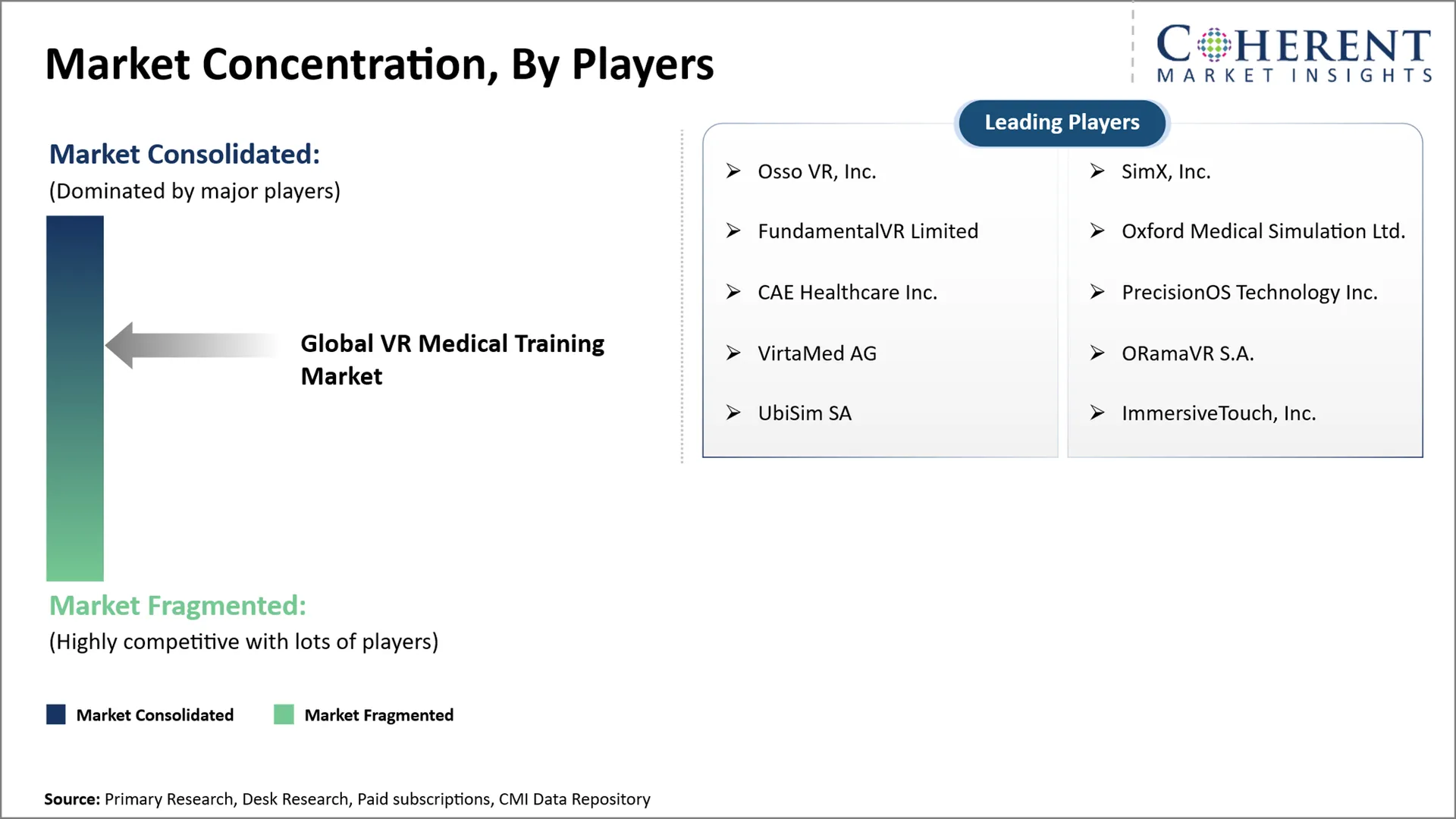
The global VR medical training market is moderately competitive, with market dynamics shaped by advances in immersive simulation, AI-enabled training, haptic interaction, and real-time performance assessment. Market participants are increasingly focusing on improving training realism, expanding clinical skill applications, and enabling standardized, repeatable learning experiences across healthcare education. Key focus areas include:
- Development of AI-enabled adaptive learning and competency assessment
- Expansion of VR platforms across surgical, emergency, nursing, and clinical skills training
- Integration of haptic feedback and high-fidelity virtual simulation
- Development of specialty-specific and scenario-based training modules
- Enhancement of real-time performance tracking and personalized learner feedback
Market Report Scope
VR Medical Training Market Report Coverage | |||
Report Coverage | Details | ||
Base Year | 2025 | Market Size in 2026: | USD 1,620.0 Mn |
Historical Data For: | 2020 To 2024 | Forecast Period: | 2026 To 2033 |
Forecast Period 2026 To 2033 CAGR: | 25% | 2033 Value Projection: | USD 7,724.8 Mn |
Geographies covered: |
| ||
Segments covered: |
| ||
Companies covered: | Osso VR, Inc., SimX, Inc., FundamentalVR Limited, Oxford Medical Simulation Ltd., CAE Healthcare Inc., PrecisionOS Technology Inc., VirtaMed AG, ORamaVR S.A., UbiSim SA, ImmersiveTouch, Inc. | ||
Growth Drivers: |
| ||
Restraints & Challenges: |
| ||
Analyst Opinion (Expert Opinion)
- In the coming years, global VR medical training market is expected to evolve from basic immersive simulation toward AI-enabled, adaptive, competency-based training platforms. Future systems will increasingly combine VR, haptic feedback, real-time performance analytics, and intelligent virtual patients to provide personalized training pathways. VR is also likely to expand across surgical, emergency, nursing, anatomy, and other clinical training applications, making simulation a more integrated component of medical education.
- The maximum opportunities are foreseen within fully immersive VR for surgical training in the U.S. Fully immersive systems can deliver realistic procedural environments and repeatable practice, while surgical training requires extensive hands-on skill development without exposing patients to training-related risks. The U.S. also provides a substantial institutional base of medical schools, hospitals, and specialized training programs that can support adoption of advanced VR simulation.
- In order to gain a competitive advantage market players should differentiate through high-fidelity simulation, advanced haptic interaction, AI-driven competency assessment, and specialty-specific training content rather than relying solely on immersive visualization. Platforms should provide measurable learner outcomes, real-time feedback, and customizable scenarios that align with institutional curricula. Seamless integration with learning-management systems and scalable deployment across multiple clinical specialties can further strengthen long-term customer value.
Speak to the analyst
Want personalized insights?
Take the findings above to one of our principal consultants, or have the report rebuilt around the segments, geographies and competitors you actually track.
Market Segmentation
- Component Insights (Revenue, USD Mn, 2021 - 2033)
- Hardware
- Software
- Services
- Technology Insights (Revenue, USD Mn, 2021 - 2033)
- Fully Immersive VR
- Semi-Immersive VR
- Non-Immersive VR
- Application Insights (Revenue, USD Mn, 2021 - 2033)
- Surgical Training
- Emergency Response Training
- Anatomy and Physiology Education
- Patient Care and Nursing Training
- Diagnostic Training
- Others
- End User Insights (Revenue, USD Mn, 2021 - 2033)
- Medical Schools and Universities
- Hospitals and Healthcare Institutions
- Research Institutes
- Training and Simulation Centers
- Others
- Regional Insights (Revenue, USD Mn, 2021 - 2033)
- North America
- U.S.
- Canada
- Latin America
- Brazil
- Argentina
- Mexico
- Rest of Latin America
- Europe
- Germany
- U.K.
- Spain
- France
- Italy
- Russia
- Rest of Europe
- Asia Pacific
- China
- India
- Japan
- Australia
- South Korea
- ASEAN
- Rest of Asia Pacific
- Middle East
- GCC Countries
- Israel
- Rest of Middle East
- Africa
- South Africa
- North Africa
- Central Africa
- North America
- Key Players Insights
- Osso VR, Inc.
- SimX, Inc.
- FundamentalVR Limited
- Oxford Medical Simulation Ltd.
- CAE Healthcare Inc.
- PrecisionOS Technology Inc.
- VirtaMed AG
- ORamaVR S.A.
- UbiSim SA
- ImmersiveTouch, Inc.
Sources
Primary Research Interviews
- Medical educators and simulation specialists implementing VR-based clinical training
- Surgical educators and simulation-center directors using immersive procedural training
- Nursing and allied-health educators involved in VR-based skills development
- Clinical skills assessment and competency-based medical education specialists
- VR/AR developers and instructional-design specialists developing medical simulation content
Stakeholders
- VR medical training platform and medical simulation technology developers
- VR hardware, haptic technology, motion-tracking, and immersive-display providers
- Medical schools, teaching hospitals, and healthcare simulation centers
- Learning-management, assessment, and healthcare technology integration providers
- Research and academic institutions involved in simulation-based medical education
- End-use Sectors
- Hospitals & Cancer Centers
- Oncology Clinics
- Diagnostic Centers
- Pharmaceutical & Biotechnology Companies
- Research & Academic Institutions
- Other Healthcare Facilities
- Regulatory & Health Bodies
- U.S. Food and Drug Administration (FDA) – medical devices, digital health, software, and VR-related technologies
- European Commission – medical devices, digital health, artificial intelligence, and healthcare technology
- Medicines and Healthcare products Regulatory Agency (MHRA), UK – medical devices, software, and digital health technologies
- Pharmaceuticals and Medical Devices Agency (PMDA), Japan – medical devices and software-based healthcare technologies
- National Medical Products Administration (NMPA), China – medical devices and software-based medical technologies
- Central Drugs Standard Control Organisation (CDSCO), India – medical devices and software-based healthcare technologies
- World Health Organization (WHO) – digital health, health workforce education, and simulation-based training frameworks
- International Organization for Standardization (ISO) – VR-based clinical practice simulation standards
Databases
- ClinicalTrials.gov
- WHO International Clinical Trials Registry Platform (ICTRP)
- Scopus
- Web of Science
- FDA Medical Device Databases
- EU Clinical Trials Information System (CTIS)
Journals
- Journal of Medical Internet Research (JMIR)
- JMIR Medical Education
- Simulation in Healthcare
- Advances in Simulation
- Journal of Surgical Education
Associations
- Society for Simulation in Healthcare (SSH)
- International Nursing Association for Clinical Simulation & Learning (INACSL)
- Association for Simulated Practice in Healthcare (ASPiH)
- International Society for Virtual Rehabilitation (ISVR)
- Association of American Medical Colleges (AAMC)
- American College of Surgeons (ACS)
- Association for Surgical Education (ASE)
Public Domain Sources
- U.S. Food and Drug Administration (FDA) – medical-device and digital-health regulatory information
- National Institutes of Health (NIH) – medical education, simulation, and healthcare technology research
- National Center for Biotechnology Information (NCBI) – VR medical education and simulation literature
- World Health Organization (WHO) – digital health and healthcare workforce training resources
- European Commission – medical-device, AI, digital-health, and healthcare technology information
- International Organization for Standardization (ISO) – VR-based clinical practice simulation standards
Proprietary Elements
- CMI Data Analytics Tool, Proprietary CMI Existing Repository of information for last 10 years.
Get access to 250+ pages report
Every segment, forecast, competitor profile and data table behind the analysis above — available for instant download.
- ESOMAR Member
- ISO 9001:2015 Certified
- D-U-N-S Registered
- GDPR & CCPA Compliant
Frequently Asked Questions
The global VR medical training market is estimated to be valued at USD 1,620.0 Mn in 2026 and is expected to reach USD 7,724.8 Mn by 2033.
Hardware dominates due to the high demand for VR headsets, motion-tracking systems, and haptic devices required for immersive medical simulation.
VR medical training uses immersive virtual environments to simulate clinical procedures, anatomy, and patient scenarios for risk-free, repeatable healthcare education.
The CAGR of global VR medical training market is projected to be 25% from 2026 to 2033.
Growing adoption of immersive simulation for clinical and surgical training, and increasing demand for risk-free, repeatable medical skills practice are the major factors driving the growth of the global VR medical training market.
High upfront cost of VR hardware and training infrastructure, and limited interoperability with existing healthcare education systems are the major factors hampering the growth of the global VR medical training market.
In terms of technology, fully immersive VR is estimated to dominate the market revenue share in 2026.