

Global Welding Robotics Market Size and Forecast – 2026 To 2033
The global welding robotics market is expected to grow from USD 9 Bn in 2026 to USD 24 Bn by 2033, registering a compound annual growth rate (CAGR) of 8.6% from 2026 to 2033. The global welding robotics market is driven by increasing adoption of Industry 4.0 manufacturing. On June 11, 2025, Siemens and NVIDIA announced an expansion of their partnership to accelerate the next era of industrial AI and digitalization.
Key Takeaways of the Global Welding Robotics Market
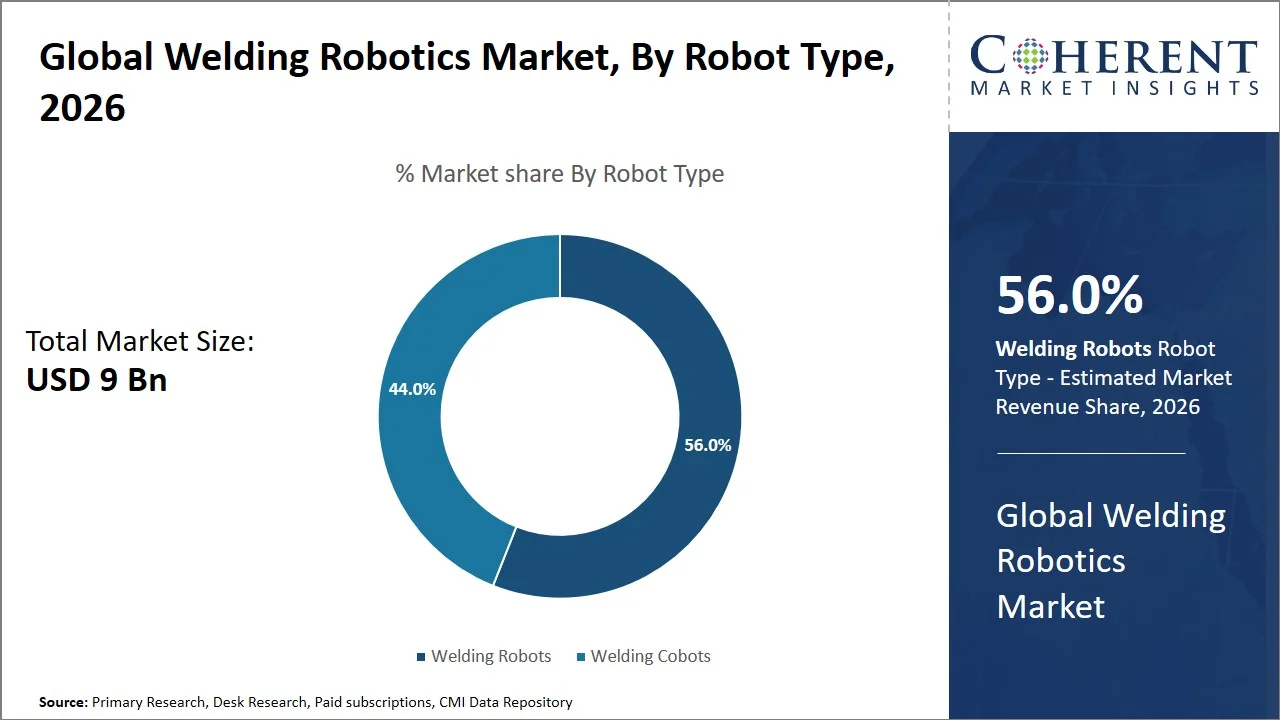
- The Welding Robots segment is expected to account for 56.0% of the global welding robotics market share in 2026. Growing deployment of welding robots in manufacturing is driving the growth of the segment. On February 17, 2026, HII and Path Robotics signed a memorandum of understanding to explore integrating Path's physical AI for welding into shipbuilding operations.
- The Arc Welding segment is estimated to capture 39.0% Of the market share in 2026. Growing demand for consistent weld quality is majorly driving the growth of the segment. In May 2025, Novarc Technologies introduced NovAI for robotic and mechanized welding. The system combines machine vision with AI and real-time welding adaptation.
- The Automotive and Transportation segment is estimated to capture 29.0% of the market share in 2026. Rising electric vehicle production is majorly driving the growth of the segment. In February 2026, Volkswagen Group announced production of its five-millionth electric drive. The milestone covered plants in Germany, Hungary, China, and Germany.
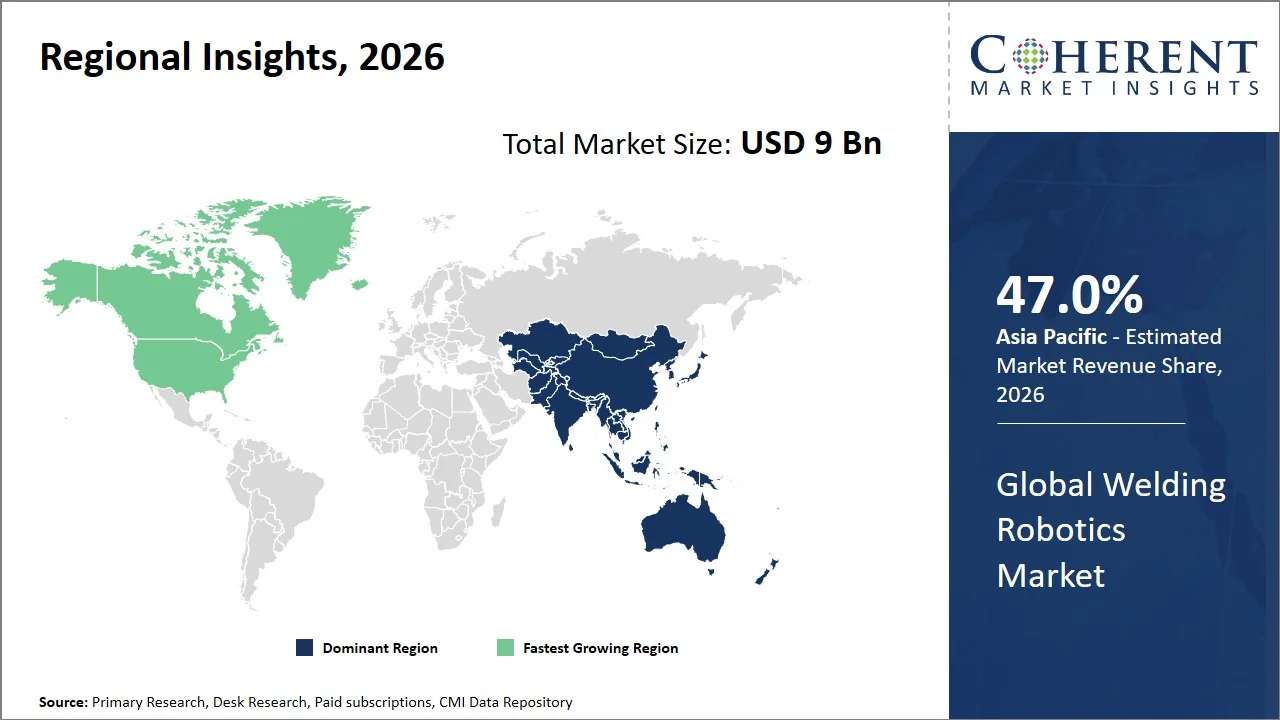
- Asia Pacific is expected to dominate the welding robotics market in 2026 with a market share of 47.0%. Expansion of automated weld programming in Asia Pacific is driving the growth of the regional market. In February 2025, Panasonic Connect updated its Virtual Robot Programming System documentation. The system uses virtual reality to program welding robots directly around actual workpieces.
- North America is expected to account for 21.0% share in 2026 and is projected to record the fastest growth over the forecast period. Growing development of cloud connected robotic welding systems in North America is driving the growth of the regional market. On June 2, 2026, ESAB released Next LP17 with deeper robotic integration and expanded WeldCloud capabilities. The update added AI assisted digitalization, analytics, and role-based workflows.
Segmental Insights
Why Does Welding Robots Dominate the Global Welding Robotics Market?
The welding robots segment is expected to account for 56.0% of the global welding robotics market share in 2026. The main driver is the rising need for high-volume automated welding in car manufacture. Industrial welding robots offer repeatable quality in welding for repetitive manufacturing cycles. Precise torch location and controlled welding conditions are maintained for challenging applications. Robots are increasingly being used by automotive makers as part of their automated material handling and inspection systems. This mixture helps to increase production consistency and eliminates the need for hand welding labor. On March 18, 2025, General Motors announced an expanded partnership with NVIDIA that would build next-generation vehicles, factories and robotics powered by AI simulation and accelerated computing. General Motors already has been investing in NVIDIA GPU platforms for AI model training.
- Current Industry Events of 2026
- Market Size Estimation
- Regional Breakdown
- Competitive Landscape
- Customer Intelligence
- Segmental Analysis
- Pricing Analysis
- Key Market Drivers, Challenges & Future Trends
- Customized Insights Section
Why is Arc Welding the Most Preferred Welding Technology?
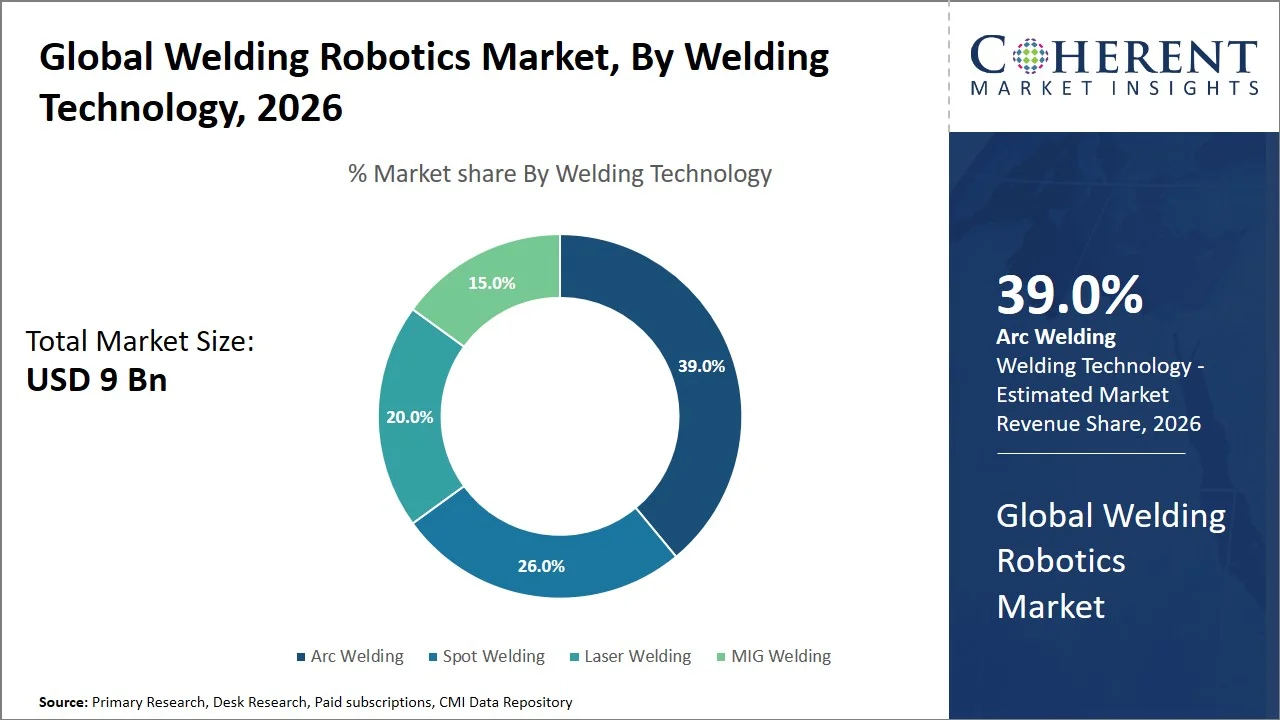
The arc welding segment is expected to account for 39.0% of the global welding robotics market share in 2026. Arc welding provides excellent adaptability for automotive, equipment, construction and heavy fabrication applications. It provides reliable joining of different metal grades, thickness and component shapes. Automated arc welding also allows fine control of current, voltage, travel speed and torch location. Manufacturers can also combine these systems with robotic arms, sensors and automated inspection equipment. This kind of versatility lends itself to big volume production or sophisticated industrial assemblies. On February 26, 2026, FANUC introduced its H-Frame positioner for automated arc welding systems. The positioner can carry loads of up to 1,500 kg, and can handle the movement in synch with six-axis robots. The dual-station design enables welding on one side while loading occurs on the other.
Automotive and Transportation Dominates the Global Welding Robotics Market
The automotive and transportation segment is expected to account for 29.0% of the global welding robotics market share in 2026. Automotive OEMs demand highly repeatable welding of car bodywork, chassis, exhaust systems and structural components. Automated welding is desirable for high volumes of manufacturing to provide uniform cycle durations and weld quality. Robotic systems can execute thousands of repetitive welds with precision torch placement. Also, the production of electric vehicles raises the requirement for automated joining in battery structures and lightweight car components. The integration with automatic assembly lines also enables continuous production and increases the efficiency of the manufacturing process. On July 9, 2025, KUKA secured an order for 12 robotic friction welding cells. The follow-on order added to an earlier electric car production installation of 23 cells. KUKA robots weld battery casings and cooling jackets in production lines The systems also include aluminum battery structures through 3D friction stir welding.
Current Events and their Impact
Current Events | Description and its Impact |
European Union - Regulation (EU) 2023/1230 on Machinery |
|
U.S. - Occupational Safety and Health Administration Robotics Requirements |
|
Welding Robotics Market Dynamics
Market Drivers
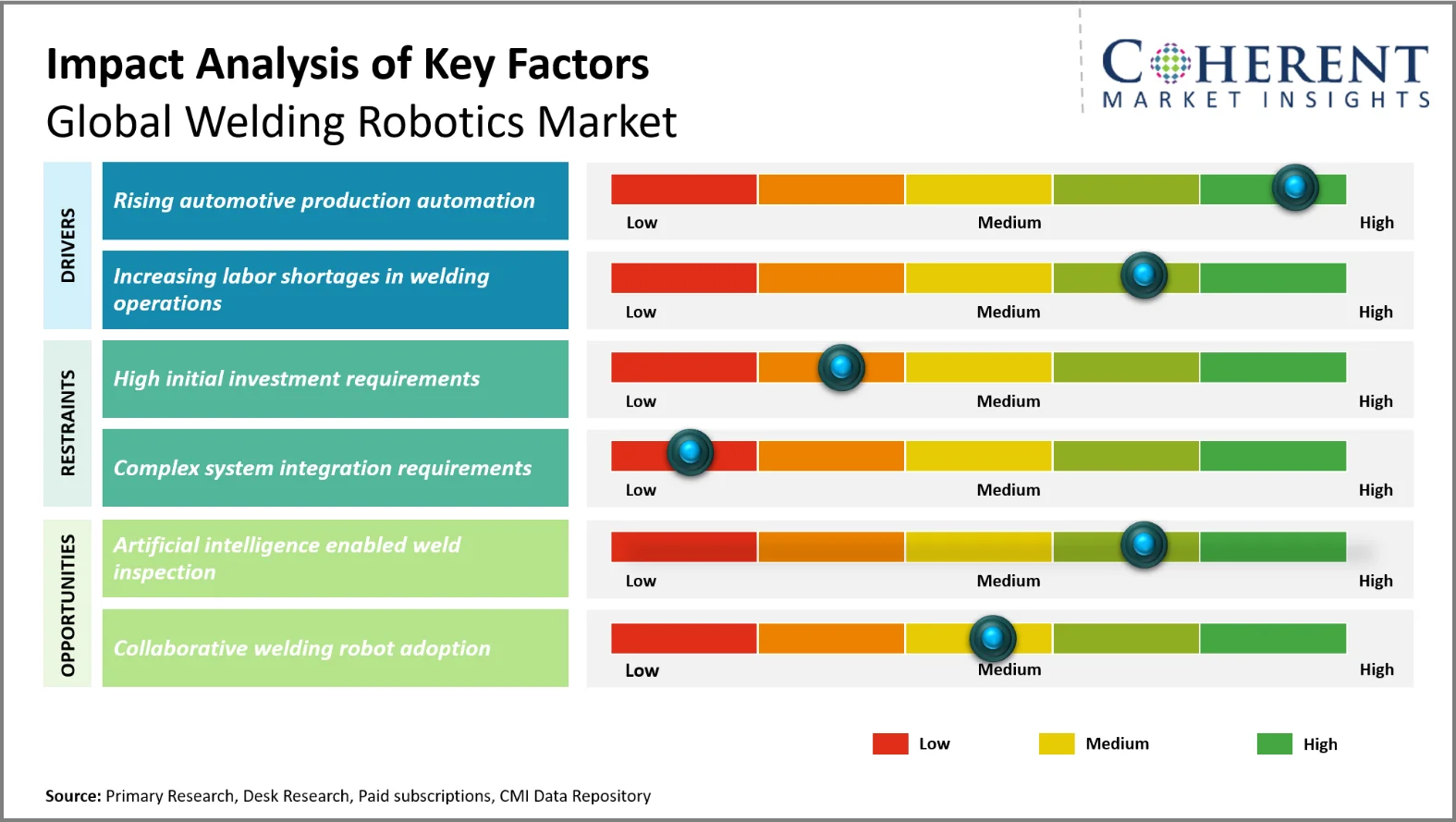
Rising automotive production automation
Automotive makers are deploying more robotic welding to enable faster and more consistent vehicle production. Robotic systems do body, chassis and structural welding, repetitive work, with controlled positioning and parameters. Automation also plays a part in the manufacture of electric vehicles, where battery housings have to be joined with high precision and repeatability. Integration with automatic assembly systems allows producers to coordinate welding with material handling and inspection activities. This increases production efficiency, and the weld quality is consistent throughout huge volumes of manufacture. On September 18, 2025, Hyundai Motor Group announced plans to boost its production capacity by adding 1.2 million cars by 2030. These consist of an extra 500,000 units from HMGMA, 250,000 units from the Pune multi-model export center in India and 200,000 units from the dedicated EV factory in Ulsan, South Korea.
Increasing labor shortages in welding operations
Manufacturers are finding it challenging to find and retain skilled welders for repetitive industrial production activities. Welding robots can assist overcome these shortages by automating hard, repetitive welding tasks. Operators can concentrate on programming, supervision, maintenance and quality control instead of constant manual welding. Automated systems also lessen reliance on workforce availability throughout long production schedules. This is making robotic welding more appealing to firms who require dependable production capacity and uniform operational performance. On December 2, 2025, LAD Services announced a partnership with Path Robotics to use their Physical AI for welding throughout its shipbuilding operations. This is a direct result of the global shortage of competent welders and LAD’s increasing need for specialist vessels.
Emerging Trends
Artificial Intelligence Enabled Welding
AI enabled welding is gaining traction with manufacturers incorporating machine vision, adaptive control and predictive algorithms. Such technologies enable autonomous adjustment of welding parameters, flaw detection and consistency improvement under changing production conditions.
Collaborative Welding Robots
Collaborative robots in welding are gaining popularity with manufacturers wanting flexible automation capabilities without the need for costly production-cell redesigns. These solutions facilitate tighter human-machine collaboration, ease of implementation and allow smaller enterprises to automate repetitive welding processes efficiently.
Vision Guided Robotic Welding
Vision guided robotic welding is increasingly used to control component variances and improve the accuracy of positioning. Advanced cameras and sensors allow robots to see weld joints, compensate for misalignment and ensure uniform welding performance.
Cloud Connected Robotic Welding
Manufacturers are increasingly focusing on remote monitoring, predictive maintenance, and production analytics, and cloud connected robotic welding is gaining traction. Connected systems give operational data to optimize equipment, reduce downtime, track quality and control manufacturing centrally.
Regional Insights
Why is Asia Pacific a Strong Market for Welding Robotics?
Asia Pacific is expected to account for a market share of 47.0% in 2026. In the Asia Pacific, automotive, electronics, shipbuilding and industrial industry are heavily concentrated. China made up 54% of global industrial robot deployments in 2024. India had 9,100 installations, with 45% of deployments in automotive applications. And China produced 14.9 million industrial and service robots in first quarter 2025. The Republic of Korea and Japan offer advanced welding automation ecosystems. Shipbuilding, especially in China, Japan and the Republic of Korea, is another key opportunity. In 2025, China’s shipyards delivered 53.69 million deadweight tons, or 56.1% of the world total. These manufacturing clusters support large-scale robotic welding deployment.
Why Does North America Welding Robotics Market Exhibit High Growth?
North America is expected to register the fastest growth with a CAGR of 9.4% over the forecast period. The region is projected to account for 21.0% of the global welding robotics market in 2026. North American demand is strongly supported by automotive reshoring, aerospace production, and manufacturing labor constraints. In 2024, 68% of industrial robot deployments in North America was in the U.S. In 2025, U.S. automotive makers installed 13,500 industrial robots. It was the largest deployment of industrial robots in the country. Robotic cells for body structures, chassis components and battery assemblies are being progressively used in automotive facilities. Automotive and electronics production also supports regional demand in Mexico. System integrators in North America serve enterprises with different production quantities by creating specialized welding cells. The conditions are favorable to flexible robotic welding systems, as opposed to set manual production arrangements.
Global Welding Robotics Market Outlook for Key Countries
Why is China Emerging as a Major Hub in the Welding Robotics Market?
China benefits from exceptionally large automotive, shipbuilding, machinery, and electric vehicle manufacturing ecosystems. In 2024, the country installed 295,000 industrial robots, accounting for 54% of the global installations. Chinese manufacturers had a share of 47% of all domestic robot installations in 2023. In the first quarter of 2025, 14.9 million industrial and service robots were developed, the Ministry of Industry and Information Technology said. More need for automated joining and battery manufacturing is being generated by the new energy vehicle production. Another key application for welding automation is shipbuilding. Chinese shipyards delivered 53.69 million deadweight tons in 2025, accounting for 56.1% of global completions.
Is U.S. the Next Growth Engine for the Welding Robotics Market?
The U.S. welding robotics market is well served by automotive automation, aerospace manufacturing, metal fabrication and production reshoring. In 2025, new industrial robot installations were 38,000 units, an 11% growth each year. Automotive installations were 13,500 units, still the largest application for industrial robotics in the country. Fabrication industries are moving to robotic welding for chassis, structural frames, exhaust components and battery enclosures, among other things. In the country, system integrators are quite significant because a lot of robots are imported from Japan and Europe. By 2025, there were 307 robots for every 10,000 manufacturing workers. The increasing demand for flexible production is also a driver for robotic systems that can accommodate numerous vehicle platforms.
Germany Welding Robotics Market Analysis and Trends
Germany has the advantage of an automotive manufacturing base and excellent machinery engineering capabilities. In 2024, Germany manufactured over four million vehicles, making it the fourth largest vehicle manufacturer in the world. Historically, automotive industry has represented more than 40% of domestic yearly robot installations. More and more German industries combine robotic welding with automated material handling, inspection and digital production systems. Major automobile manufacturers have highly automated body shops that need accurate joining of steel and lightweight frameworks. Germany also possesses a broad machine-building know-how for specific robotic welding cells. Its industrial robot density was 449 robots per 10,000 manufacturing workers. This developed automation infrastructure allows for complex welding applications in automotive and industrial machinery manufacture.
Japan Welding Robotics Market Analysis and Trends
Japan has considerable competence in industrial robots, automotive production and factory automation. Japanese car makers put in about 13,000 industrial robots in 2024. This was an 11% increase and the greatest level of automobile installations since 2020. Japan also has a huge installed base of industrial robots in manufacturing facilities. FANUC Corporation, for example, offers robot systems, welders, controllers and factory automation technology. Japanese car makers are reshaping their production to focus on battery electric and fuel-cell cars. This change involves automated joining for lightweight structures, battery parts and modified vehicle platforms. In 2023, Japan had 1,531 robots per 10,000 workers in the automotive industry.
South Korea Welding Robotics Market Analysis and Trends
South Korea benefits from exceptionally high manufacturing automation across automotive and electronics industries. The country recorded 1,220 industrial robots per 10,000 manufacturing employees, the world's highest robot density. Hyundai Motor Group and Kia provide substantial automotive demand for automated body and component welding. Shipbuilding also creates opportunities because Korean yards manufacture large vessels requiring extensive structural welding. Samsung Electronics are backing sophisticated automation capabilities in industrial supply chains. About 30,600 industrial robots were added in South Korea in 2024. Its robotics ecosystem includes homegrown enterprises that manufacture industrial robots, controllers and automation equipment. These are ideal for highly automated welding situations that need precision and continuous production.
Global Welding Robotics Market - Artificial Intelligence Based Weld Defect Classification by Country (2025)
Application | Manual Welding Time | Robotic Welding Time | Cycle-Time Reduction | Productivity Improvement |
Stainless-steel vessels and joints | 60+ minutes | 10 minutes | Up to 83% | Up to 6× |
Centerline Brackets components | 7-8 minutes | Less than 1 minute | More than 87% | More than 7× |
Dodge Motorsports chassis | 156 minutes equivalent | 39 minutes | Approximately 75% | Approximately 4× |
Industrial welded components | 1.23 minutes | 0.61 minutes | 50% | Approximately 2× |
Typical manual arc welding | 10-hour shift | Robotic continuous operation | Not directly comparable | Up to 3× arc-on time |
How is Artificial Intelligence Enabled Weld Inspection Creating New Growth Opportunities in the Welding Robotics Market?
New opportunities for weld inspection are created by transforming inspection data into real-time production choices using artificial intelligence powered weld inspection. ABB Robotics uses ultrasonic inspection, machine learning, machine vision and historical weld databases to identify suspect spot welds and welding spatter. Fronius also offers ArcView3 as a means of continuous weld pool monitoring and documented process analysis. These technologies enable robotic cells to detect faults earlier and eliminate reliance on subjective manual inspection. The inspection data so obtained can be used for automated parameter adjustments, traceability, predictive maintenance and closed loop quality control, thereby extending robotic welding to higher value applications. On January 7, 2026, SmartRay, Grid Dynamics and Wandelbots showed off an AI robotic weld inspection platform. The technology automatically analyzes computer aided design data and generates efficient inspection paths. It also generalizes inspection algorithms across robot platforms. This minimizes engineering work when manufacturers launch new welded parts.
Market Players, Key Development, and Competitive Intelligence
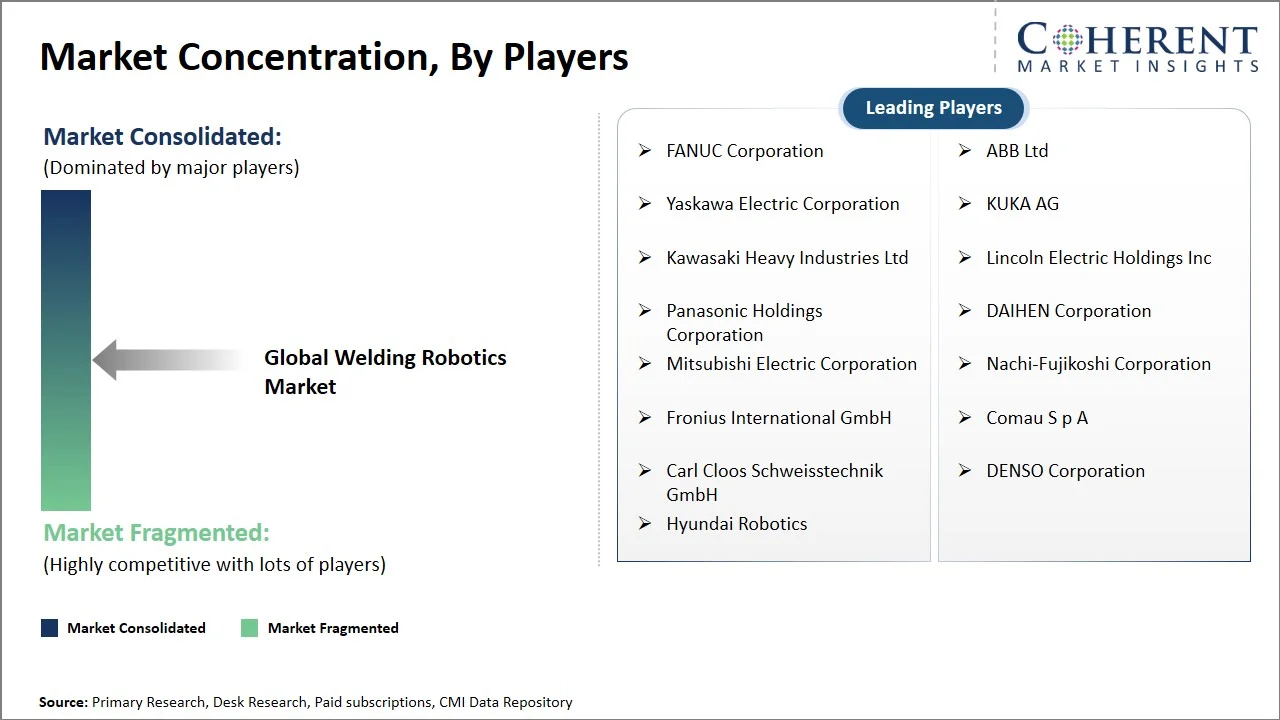
Key Developments
- On April 16, 2026, Path Robotics announced the launch of Rove, a mobile robotic welding system that pairs the company's Obsidian physical AI model with a quadruped robot. Rove unlocks new, large-format applications in high-variability manufacturing environments like shipbuilding, heavy industry, and construction.
- On April 10, 2025, Panasonic Factory Solutions announced that it has enabled automotive manufacturer, Thyssenkrupp Bilstein, a global leader in automotive shock absorbers, to digitize its damper shopfloor in Romania utilizing Panasonic’s TAWERS G4 Welding Robot System.
Competitive Landscape
The competitive landscape is led by companies combining robot hardware, welding software, sensors, and turnkey integration capabilities. KUKA focuses strongly on automotive welding, battery manufacturing, aluminum joining, and pre-engineered cells. Its ready2_spot package targets high-strength steel and aluminum automotive applications. KUKA developed RoboSpin as an answer to the difficulties of electrode sticking and tip life in aluminum spot welding. ABB differentiates with integrated weld control and automated ultrasonic spot weld inspection. The inspection system allows for weld traceability and fast quality screening for production use. Other leading companies increasingly emphasize adaptive welding, digital programming, collaborative robots, and application-specific automation. Competitive advantage is therefore shifting toward complete welding ecosystems rather than robot arms alone.
Market Report Scope
Welding Robotics Market Report Coverage
| Report Coverage | Details | ||
|---|---|---|---|
| Base Year: | 2025 | Market Size in 2026: | USD 9 Bn |
| Historical Data for: | 2020 To 2024 | Forecast Period: | 2026 To 2033 |
| Forecast Period 2026 to 2033 CAGR: | 8.60% | 2033 Value Projection: | USD 24 Bn |
| Geographies covered: |
| ||
| Segments covered: |
| ||
| Companies covered: | FANUC Corporation, ABB Ltd, Yaskawa Electric Corporation, KUKA AG, Kawasaki Heavy Industries Ltd, Lincoln Electric Holdings Inc, Panasonic Holdings Corporation, DAIHEN Corporation, Mitsubishi Electric Corporation, Nachi-Fujikoshi Corporation, Fronius International GmbH, Comau S p A, Carl Cloos Schweisstechnik GmbH, DENSO Corporation, Hyundai Robotics | ||
| Growth Drivers: |
| ||
| Restraints & Challenges: |
| ||
Analyst Opinion (Expert Opinion)
- The industry's future is expected to center on intelligent welding cells rather than standalone robotic arms. Artificial intelligence, machine vision, adaptive welding, and automated inspection will increasingly operate within connected production cells. The strongest opportunity should emerge around automotive battery structures, aluminum components, and electric vehicle body manufacturing. KUKA’s friction stir-welding technology is already being used for battery housings and components for electric transportation. For these applications heat input, dimensional correctness and reliable sealing are required.
- The largest geographic opportunities should remain concentrated in China, Japan, the Republic of Korea, Germany, and the U.S. China offers particularly strong opportunities because automotive, battery, machinery, and shipbuilding production create diverse welding applications. The U.S. should provide opportunities for flexible welding cells supporting reshoring and varied production volumes. Germany should stay attractive for advanced automotive welding and particular machinery applications. Japan and the Republic of Korea are advised to choose advanced systems integrating welding robots with sensors and factory automation.
- Players seeking an edge should focus on application specific software rather than just robot specifications. Seam tracking, automatic parameter modification, weld inspection and predictive maintenance can provide a greater distinction. Modular cells can also reduce integration complexity for automotive suppliers and smaller manufacturers. KUKA demonstrates this approach through pre-engineered arc welding and spot-welding packages. ABB demonstrates another route by integrating ultrasonic weld inspection directly into robotic production environments.
Speak to the analyst
Want personalized insights?
Take the findings above to one of our principal consultants, or have the report rebuilt around the segments, geographies and competitors you actually track.
Market Segmentation
- Robot Type Insights (Revenue, USD Billion, 2021 - 2033)
- Welding Robots
- Welding Cobots
- Welding Technology Insights (Revenue, USD Billion, 2021 - 2033)
- Arc Welding
- Spot Welding
- Laser Welding
- MIG Welding
- End User Insights (Revenue, USD Billion, 2021 - 2033)
- Automotive and Transportation
- Aerospace and Defense
- Metal and Machinery
- Electrical and Electronics
- Shipbuilding
- Construction
- Others
- Regional Insights (Revenue, USD Billion, 2021 - 2033)
- North America
- U.S.
- Canada
- Latin America
- Brazil
- Argentina
- Mexico
- Rest of Latin America
- Europe
- Germany
- U.K.
- Spain
- France
- Italy
- Russia
- Rest of Europe
- Asia Pacific
- China
- India
- Japan
- Australia
- South Korea
- ASEAN
- Rest of Asia Pacific
- Middle East
- GCC Countries
- Israel
- Rest of Middle East
- Africa
- South Africa
- North Africa
- Central Africa
- North America
Sources
Primary Research Interviews
- Welding Robot Manufacturers & OEMs
- Automotive & Aerospace Industry Executives
- Industrial Automation & Robotics System Integrators
- Welding Technology R&D Specialists
Magazines
- The Fabricator Magazine
- Welding Journal (AWS Publication)
- Industrial Robot: The International Journal Magazine
- Robotics Business Review
Journals
- Journal of Manufacturing Processes
- International Journal of Advanced Manufacturing Technology
- Journal of Materials Processing Technology
Associations
- American Welding Society (AWS)
- Robotic Industries Association (RIA) / A3 – Association for Advancing Automation
- European Welding Federation (EWF)
Public Domain Sources
- U.S. Bureau of Labor Statistics (BLS) – Manufacturing & Automation Data
- European Commission – Industrial Automation & Robotics Policy Reports
- World Trade Organization (WTO) – Trade Data on Industrial Machinery
- U.S. Department of Commerce – Manufacturing Industry Reports
Proprietary Elements
- CMI Data Analytics Tool
- Proprietary CMI Existing Repository of Information for the Last 10 Years
Get access to 250+ pages report
Every segment, forecast, competitor profile and data table behind the analysis above — available for instant download.
- ESOMAR Member
- ISO 9001:2015 Certified
- D-U-N-S Registered
- GDPR & CCPA Compliant
Missing comfort of reading report in your local language? Find your preferred language:
Frequently Asked Questions
The global welding robotics market is expected to stand at USD 9 Bn in 2026 and is expected to reach USD 24 Bn by 2033.
The CAGR of the global welding robotics market is projected to be 8.6% from 2026 to 2033.
Rising automotive production automation and Increasing labor shortages in welding operations are the major factors driving the growth of the global welding robotics market.
High initial investment requirements and Complex system integration requirements are the major factors hampering the growth of the global welding robotics market.
In terms of robot type, welding robots segment is estimated to dominate the market revenue share in 2026.
Welding robots are programmable robotic systems designed to automate welding operations with controlled movement and repeatable accuracy.
Welding robots maintain consistent torch positioning, travel speed, welding angles, and process parameters throughout production.