

Global Zero Trust Network Access Market Size and Forecast – 2026 To 2033
The global zero trust network access market is expected to grow from USD 2.40 Bn in 2026 to USD 11.00 Bn by 2033, registering a compound annual growth rate (CAGR) of 24.2% from 2026 to 2033. The global zero trust network access market is driven by rising cybersecurity threats targeting remote workforces. On September 25, 2025, WatchGuard Technologies announced FireCloud Total Access, the first hybrid secure access service edge (SASE) that breaks through the enterprise-only model and makes zero trust and cloud-delivered security practical for managed service providers (MSPs) and lean IT teams.
Key Takeaways of the Global Zero Trust Network Access Market
- The Solutions segment is expected to account for 62.0% of the global zero trust network access market share in 2026. Increasing demand for identity-based access management is driving the growth of the segment. On May 28, 2025, Cisco introduced Duo Identity and Access Management to strengthen protection against identity-based cyberattacks. The platform combines password-less authentication, phishing-resistant security, and identity intelligence.
- The Cloud-Based segment is estimated to capture 59.0% of the market share in 2026. Growing adoption of hybrid and multi-cloud environments is majorly driving the growth of the segment. On April 29, 2025, Hewlett Packard Enterprise expanded HPE Aruba Networking and GreenLake cloud security capabilities. The announcement introduced cloud-based access controls and threat-adaptive protection for private cloud infrastructure.
- The Remote Workforce Access segment is estimated to capture 36.0% of the market share in 2026. Rising regulatory requirements for enterprise network security is driving the growth of the segment. On January 17, 2025, Teleport revealed compliance preparation capabilities for enterprises subject to the European Union’s Digital Operational Resilience Act. Its infrastructure access platform supports dynamic permissions, short-lived certificates, and centralized access monitoring.
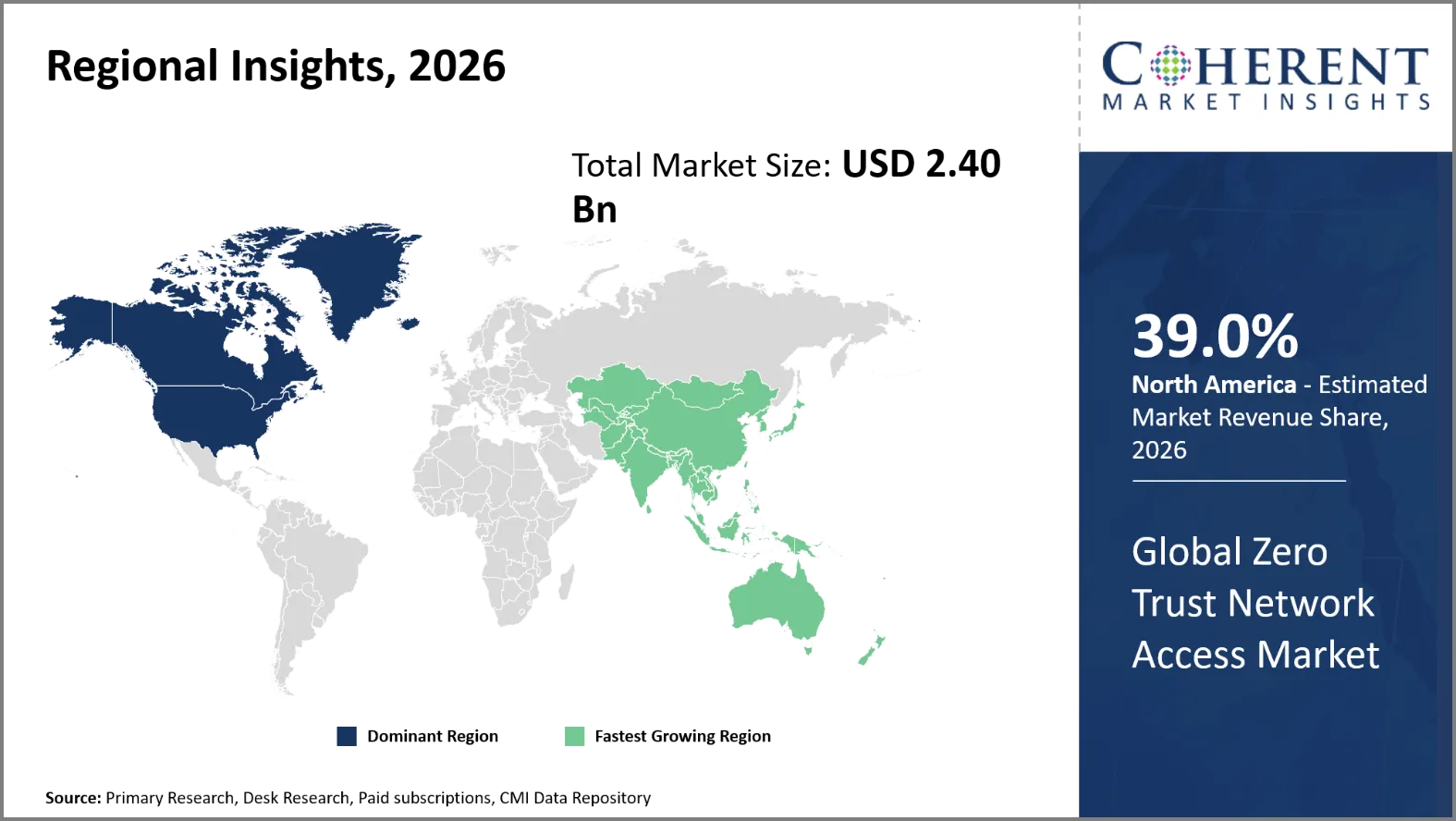
- North America is expected to dominate the zero trust network access market in 2026 with a market share of 39.0%. Expansion of secure access for Internet of Things devices in North America is driving the growth of the regional market. On February 25, 2025, Aeris launched IoT Watchtower to improve security across cellular-connected devices. The platform provides real-time device visibility, traffic monitoring, and risk-based access enforcement.
- Asia Pacific is expected to account for 24.0% share in 2026. Increasing demand for cloud-native security architectures in Asia Pacific is driving the growth of the regional market. On January 9, 2025, Orca Security announced substantial business expansion in India. The company announced 100% year-over-year consumer growth and increased its regional partner network.
Segmental Insights
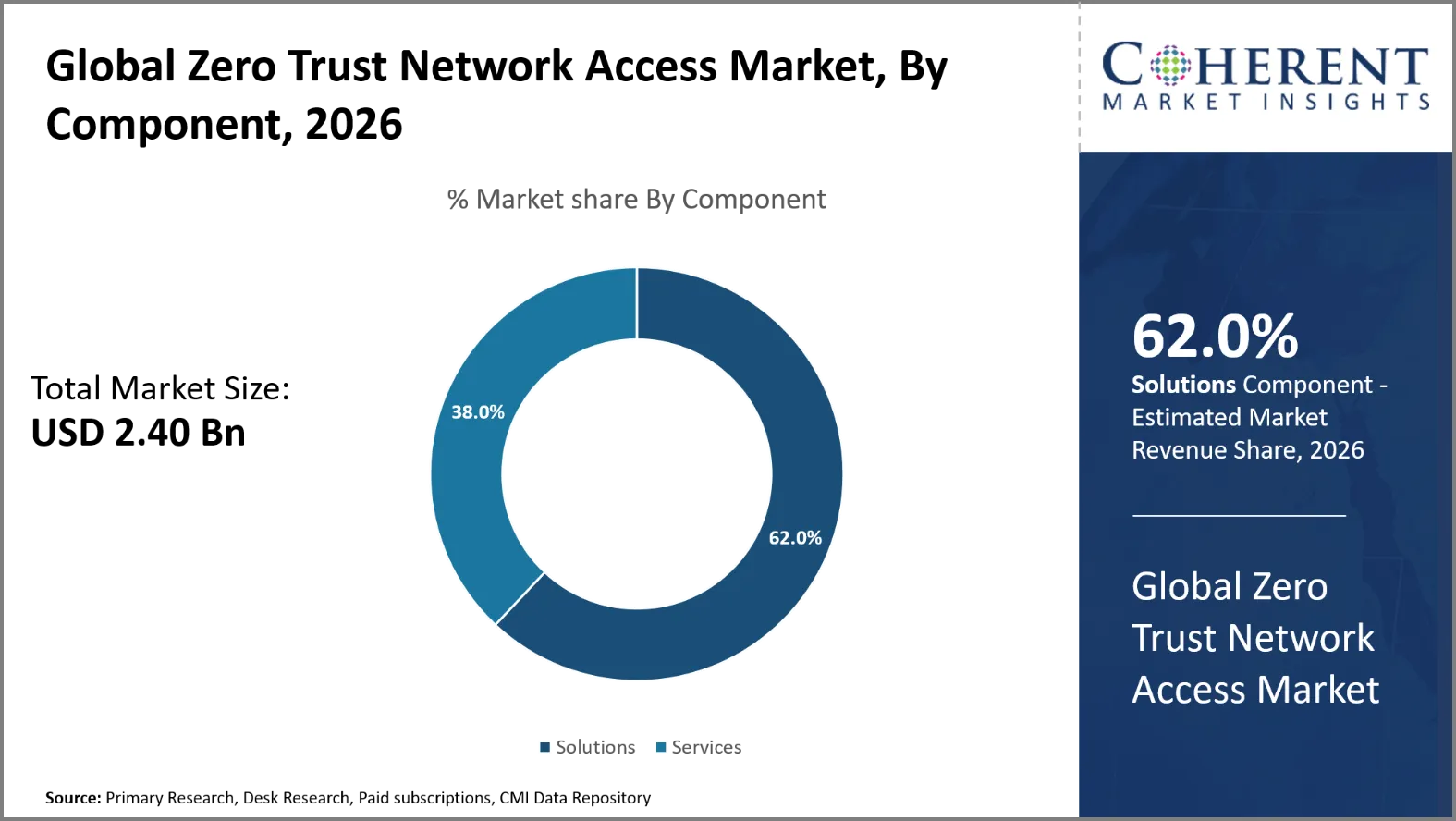
Why Does Solutions Dominate the Global Zero Trust Network Access Market?
The solutions segment is expected to account for 62.0% of the global zero trust network access market share in 2026. Organizations demand full security platforms and solutions prevail due to that. Solutions allow identity verification, application-level control of access, and ongoing authentication. Companies are moving away from legacy network security solutions toward identity-based protection. Integrate threat detection and policy enforcement to bolster enterprise security. Solutions also provide centralized access management across distributed IT environments. As cyberattacks grow in complexity, organizations are encouraged to use new security systems.
On May 28, 2025, Cisco unveiled Duo Identity and Access Management (IAM), their new security solution that changes the way enterprises protect themselves against the ever-increasing identity-based attacks in the AI era. Bad actors target identity the most, accounting for 60% of Cisco Talos Incident Response incidents in 2024 as attackers exploit large loopholes in systems
- Current Industry Events of 2026
- Market Size Estimation
- Regional Breakdown
- Competitive Landscape
- Customer Intelligence
- Segmental Analysis
- Pricing Analysis
- Key Market Drivers, Challenges & Future Trends
- Customized Insights Section
Why is Cloud-Based the Most Preferred Deployment Type?
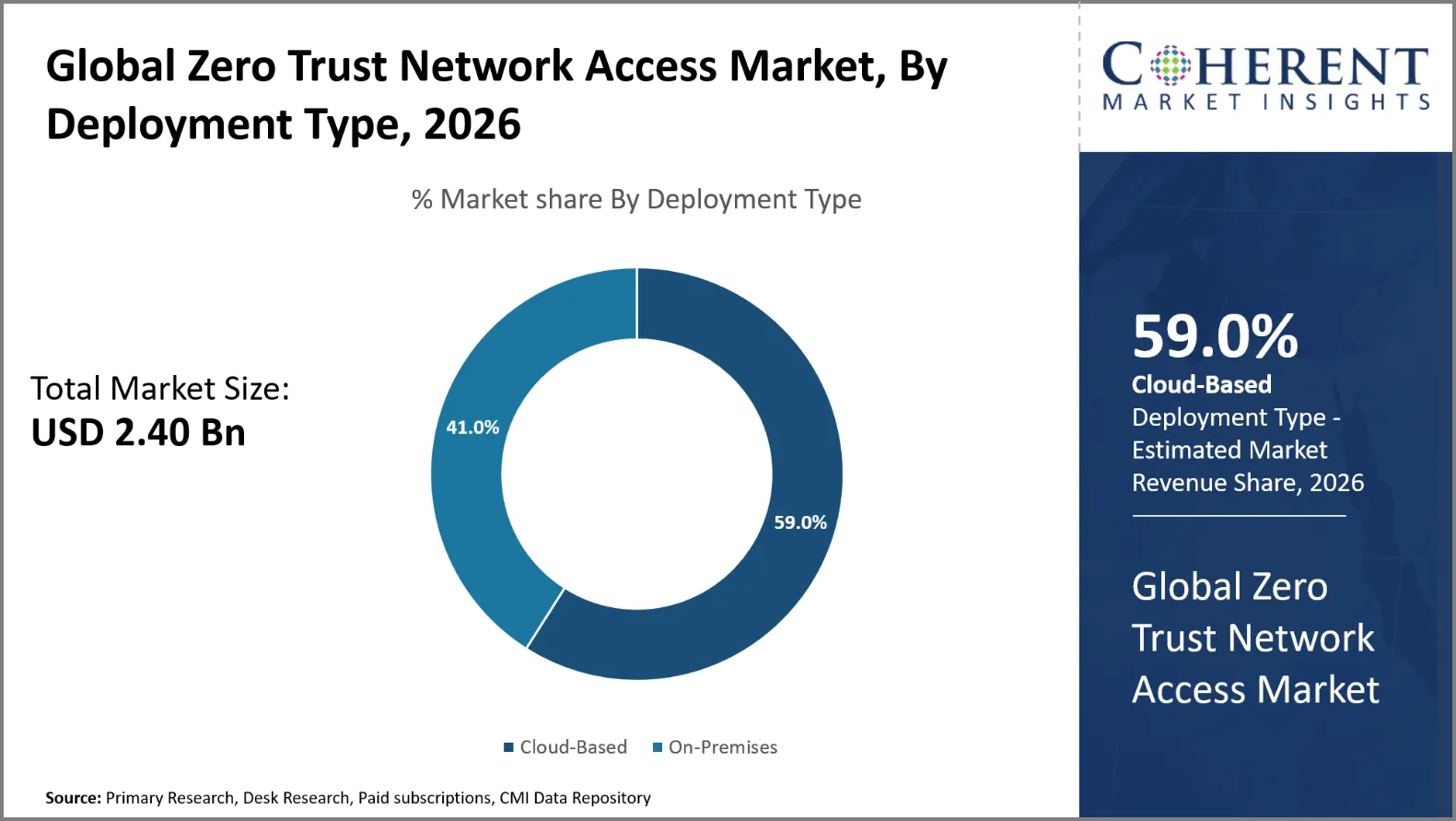
The cloud-based segment is expected to account for 59.0% of the global zero trust network access market share in 2026. Companies are turning to cloud-based deployment due to the need for scalability, flexibility and simplified security management. Cloud solutions can be accessed remotely and do not require a hefty infrastructure on site. They enable centralized policy enforcement for internationally dispersed workforces. It is integrated with cloud applications to improve access and operation. The subscription-based pricing also helps in reducing the initial cost of infrastructure. The use of cloud is expanding and the demand for cloud based Zero Trust Network Access solutions is growing.
On November 12, 2025, Aryaka announced Unified SASE as a Service 2.0 for remote companies. The platform introduced Universal ZTNA and AI security capabilities. It supports secure application connectivity across geographically distributed workforces.
Remote Workforce Access Dominates the Global Zero Trust Network Access Market
The remote workforce access segment is expected to account for 36.0% of the global zero trust network access market share in 2026. Remote workforce access is the most common use case since enterprises need secure connectivity beyond the usual office networks. The rise of hybrid working has created a need for location-independent application access Zero Trust Network Access authenticates the user’s identity and device security to provide access. This strategy limits unwanted access and lateral movement within enterprise networks. Organizations use centralized access restrictions to protect employees, contractors, and third parties as well. Increasing usage of dispersed work environments is further supporting this application category.
On May 7, 2026, Bharti Airtel introduced Airtel Secure Workforce through its enterprise arm Airtel Business. This managed zero trust platform is built for enterprises with hybrid work. It incorporates safe communication, endpoint security, continual monitoring, and remote access management.
Current Events and their Impact
Current Events | Description and its Impact |
European Union - Network and Information Security Directive 2 (NIS2) |
|
European Union - Digital Operational Resilience Act (DORA) |
|
Zero Trust Network Access Market Dynamics
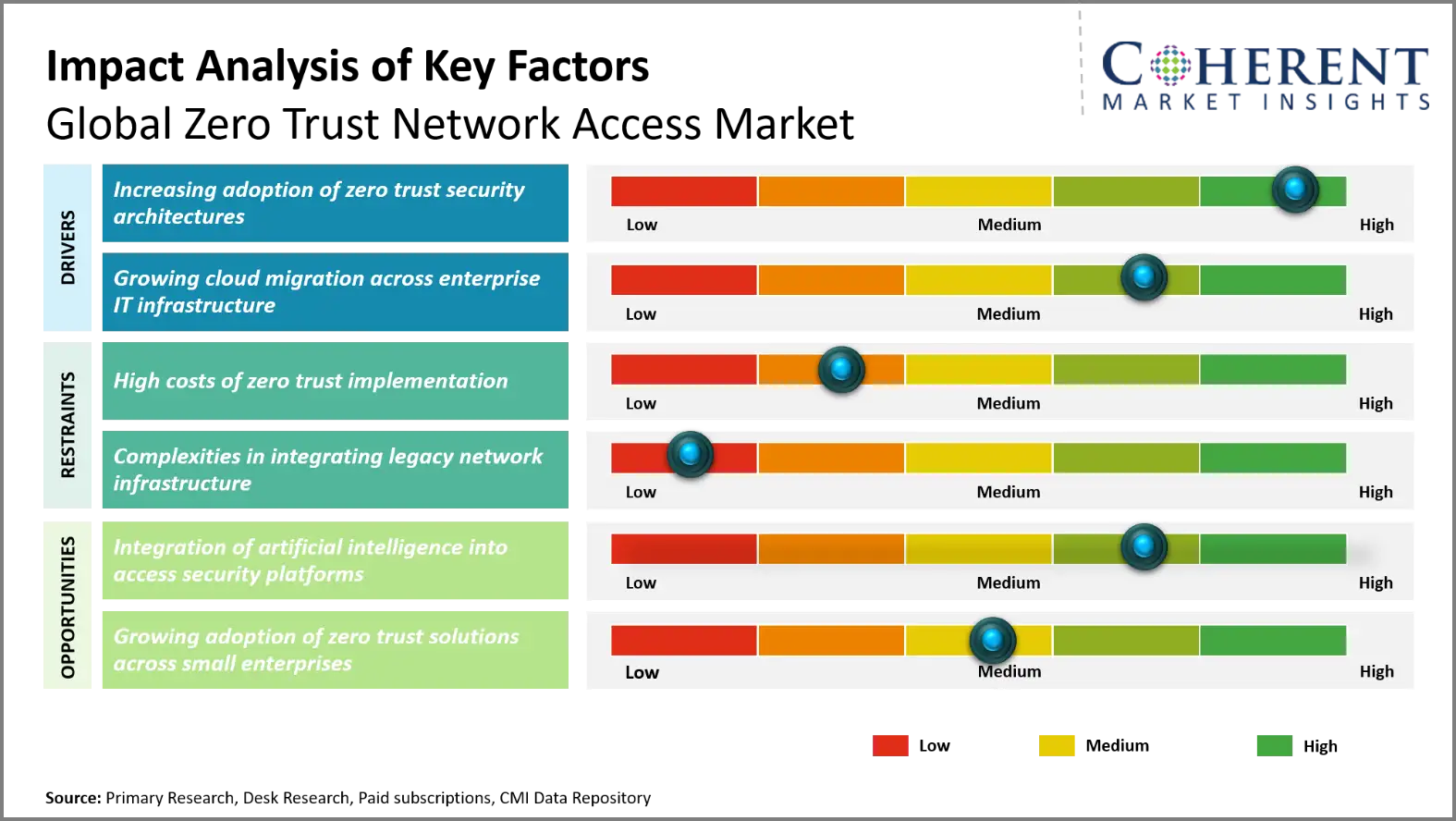
Market Drivers
Increasing adoption of zero trust security architectures
Organizations are increasingly adopting Zero Trust security architectures to enhance protection against sophisticated cyberattacks. Distributed organizational environments are not adequately protected by traditional perimeter-based security models. Zero Trust continuously verifies user identity, device health and application access rights. Organizations are looking at least-privilege access to help stop unauthorized network entrance. There is also a drive for better identity management and access monitoring due to increased regulatory obligations. Adoption is further helped by integration with endpoint security and identity management technologies. Progress is driving demand for Zero Trust Network Access solutions across enterprise cybersecurity environments.
On October 16, 2025, HCLTech, a leading global technology company, announced the expansion of its strategic partnership with Zscaler, the leader in cloud security, to deliver AI-driven network transformation and enhanced zero-trust security services to enterprises globally.
Growing cloud migration across enterprise IT infrastructure
Businesses are increasingly shifting business applications, databases and workloads to cloud infrastructure. But with this shift comes security challenges as employees access business information from many locations and devices. Traditional network security methods often struggle in dispersed cloud environments due to a lack of visibility. Zero Trust Network Access offers secure identity-based access to specific cloud applications. Organizations may impose centralized access controls without exposing entire corporate networks. Also, the growing use of hybrid cloud systems is driving the requirement for application-level security. These are the key drivers of Zero Trust Network Access deployment in cloud-dependent companies.
On May 22, 2025, Finnish telecom provider DNA struck a five-year cloud migration deal with Tata Consultancy Services. The cooperation is to transition as much as 80% of DNA’s enterprise applications to public cloud infrastructure by 2030.
Emerging Trends
- Integration of Artificial Intelligence in Zero Trust Access Management: AI is enhancing identity verification through behavioral analytics, adaptive authentication, and automated threat detection. Security platforms are beginning to look at what the user is doing and the state of the device before letting the application in.
- Impact: AI is able to help security teams discover anomalous login patterns and questionable access requests. Automated risk assessments reduce manual investigations and enhance authentication decisions across enterprise contexts.
- Relevance to the market: Vendors, such as Palo Alto Networks and Zscaler, are injecting artificial intelligence into their cybersecurity offerings. These capabilities augment the unique Zero Trust Network Access offerings for organizations.
- Convergence of Zero Trust Network Access with Secure Service Edge: Enterprises are increasingly converging Zero Trust Network Access with Secure Web Gateway and Cloud Access Security Broker capabilities. This convergence enables a single protection across the cloud applications and dispersed users.
- Impact: Integrated security designs reduce dependency on fragmented network protection solutions. Centralized policy enforcement improves visibility, management and protection of applications in distributed enterprise environments.
- Relevance to the market: Cisco, Netskope and Fortinet provide unified security architectures with Zero Trust Network Access capabilities. Their platforms fuel enterprise need for integrated security solutions offered through the cloud.
Regional Insights
Why is North America a Strong Market for Zero Trust Network Access?
North America is expected to account for a market share of 39.0% in 2026. North America benefits from federal cybersecurity upgrading, a wide base of enterprise security infrastructure and established cybersecurity technology vendors. The U.S. government continues to fortify identity-centric security across civilian agencies. Canada’s 2025 National Cyber Security Strategy focuses on protecting vital infrastructure and building public-private cybersecurity collaborations. Remote control systems need to be strengthened for energy grids, pipelines, healthcare networks and telecommunications infrastructure. The Government of Canada likewise views zero trust as an important element of enterprise cybersecurity transformation. Increasing protection requirements for interconnected industrial systems create additional opportunities.
Why Does Asia Pacific Zero Trust Network Access Market Exhibit High Growth?
Asia Pacific is expected to register the fastest growth with a CAGR of 25.2% over the forecast period. It is projected to account for 24.0% of the global zero trust network access market in 2026. The region has a high level of digital infrastructure development, government cybersecurity efforts, and increasing cross-border technological operations. Japan’s cyber security activities foster collaboration between government bodies and operators of key infrastructure. The Smart Nation infrastructure in Singapore is driving need for stronger identity management across digital public services. In Australia, the Essential Eight security framework likewise aims to inspire enterprises to better secure their identity and applications. Regional manufacturers increasingly connect production systems with suppliers and cloud platforms. This creates demand for controlled access to industrial applications and operational technology environments.
Global Zero Trust Network Access Market Outlook for Key Countries
Why is U.S. Emerging as a Major Hub in the Zero Trust Network Access Market?
The benefits to the U.S. industry include federal implementation requirements, deep cybersecurity research and increased adoption of identity-based security by enterprises. The Government Accountability Office reported that all 22 civilian agencies it surveyed had produced strategies to implement zero trust. But by August 2026, only five had addressed all selected federal implementation guidance. This indicates continued need for installation services and sophisticated access management. The National Institute of Standards and Technology published Special Publication 1800-35 in June 2025. It demonstrates 19 practical zero trust architectures developed with 24 industry collaborators.
Is China the Next Growth Engine for the Zero Trust Network Access Market?
Cybersecurity modernization benefits China in manufacturing, telecommunications, financial services, and networked industrial infrastructure. The State Council’s Regulations on the Administration of Network Data Security enhance the responsibility of enterprises that process network data. Domestic enterprises also demand safe links between production sites, suppliers and centralized industrial platforms. With the growth of China’s semiconductor and artificial intelligence businesses, protecting proprietary research environments is more important than ever. Industrial enterprises increasingly demand granular control of access for engineers, contractors and equipment vendors. These requirements support demand for locally compliant security platforms and application-level connectivity solutions.
Germany Zero Trust Network Access Market Analysis and Trends
Germany's market benefits from industrial cybersecurity investments, manufacturing digitalization, and demand for greater technological sovereignty. Siemens launched SINEC Secure Connect in October 2025 to secure operational technology networks. The platform offers encrypted, identity validated connectivity between industrial equipment and approved platforms. Its architecture enables machine-to-machine and machine-to-cloud connectivity without traditional VPNs. Germany’s Federal Ministry for Digital Transformation and Government Modernization likewise promotes secure domestic cloud infrastructure. These innovations are adding to the demand for granular access management in automotive, chemicals, machinery and industrial automation contexts.
Japan Zero Trust Network Access Market Analysis and Trends
Updating the cybersecurity of industry, financial services and government technology infrastructure is good for Japan. The Japan External Trade Organization cites the increase of Zero Trust acceptance, as well as increasing Internet of Things deployments and cloud services. Japanese corporations are also teaming up with multinational cybersecurity suppliers. For example, Macnica collaborated with Axonius to deploy cyber asset attack surface management solutions. Cato Networks has set up a Japanese subsidiary focusing on manufacturing and critical infrastructure security. These advances are driving demand for application visibility, secure industrial connectivity and identity-based access management.
India Zero Trust Network Access Market Analysis and Trends
The growing digital payment infrastructure in the Indian market, cybersecurity audit activities, and need for increased protection in important industries are benefiting the Indian industry. In 2025, the Indian Computer Emergency Response Team (ICERT) dealt with over 2.94 million cybersecurity events. The Government of India also recorded over 9,700 cybersecurity audits for the fiscal year 2024-25. Banking, power, transport and digital service operators need better access governance. The rapid growth of software development centers also fuels the need for limited access to proprietary code repositories. These innovations provide avenues of identity-based application security across Indian organizations.
Global Zero Trust Network Access Market - ZTNA Deployment Penetration (2025)
Metric | Penetration Share |
Organizations currently using ZTNA | 34% |
Organizations currently using traditional VPNs | 41% |
Organizations replacing or planning to replace VPNs | 65% |
Organizations already replacing VPNs | 24% |
Organizations planning VPN replacement within six months | 27% |
Organizations planning VPN replacement within twelve months | 14% |
Organizations considering VPN replacement without a timeline | 12% |
Organizations with no VPN replacement plans | 23% |
Organizations planning to eliminate VPN concentrators | 62% |
Organizations beginning SSE adoption with ZTNA | 46% |
How is Integration of Artificial Intelligence into Access Security Platforms Creating New Growth Opportunities in the Zero Trust Network Access Market?
Growth prospects are presented by the integration of artificial intelligence within access security platforms due to the capability of real-time risk assessment across complicated organizational environments. AI-powered systems can correlate identity signals, endpoint vulnerabilities, geolocation anomalies and application behavior prior to authorizing access requests. For example, Microsoft uses risk-based Conditional Access with Microsoft Entra ID Protection to detect compromised identities and demand further authentication. Similarly, CrowdStrike’s Charlotte AI enhances security investigation by combining threat intelligence with endpoint telemetry. These capabilities enable organizations to automate access decisions, evaluate suspicious sessions and prohibit compromised accounts faster. This allows manufacturers to stand out in their Zero Trust Network Access services through intelligent authentication and adaptive policy enforcement.
On June 6, 2025, IBM announced the general availability of AskIAM, a generative AI capability within the IBM Consulting Advantage delivery platform, designed specifically to help clients update their identity and access management (IAM) systems. AskIAM, deployed and managed by IBM security experts, may help streamline identity management activities like as provisioning and access requests, while delivering advanced intelligence and automation to improve identity protection.
Market Players, Key Development, and Competitive Landscape
Key Developments
- On February 26, 2026, Forescout Technologies Inc. and Netskope announced an integration providing Zero Trust security for every device, managed and unmanaged IT, OT, IoT and IoMT devices. By combining Forescout’s real-time device intelligence with Netskope’s intelligent AI and cloud security, the joint solution continuously and dynamically adapts access decisions based on device posture and risk, ensuring that Zero Trust is enforced regardless of where an asset connects.
- On July 8, 2025, Portnox announced the launch of its innovative Zero Trust Network Access (ZTNA) solution. In modern distributed work environment, employees require access to critical applications from various locations and devices, often over untrusted networks. This expanded threat landscape presents significant security challenges for IT teams.
- On April 9, 2025, Menlo Security announced the inclusion of Menlo Secure Application Access into Cloud WAN, a new wide area network solution from Google Cloud. This integration delivers turnkey Zero Trust Access for enterprises’ SaaS and private applications, eliminating the need for the deployment of additional network components and simplifying configuration for managed, BYOD, and unmanaged users and devices.
Competitive Landscape
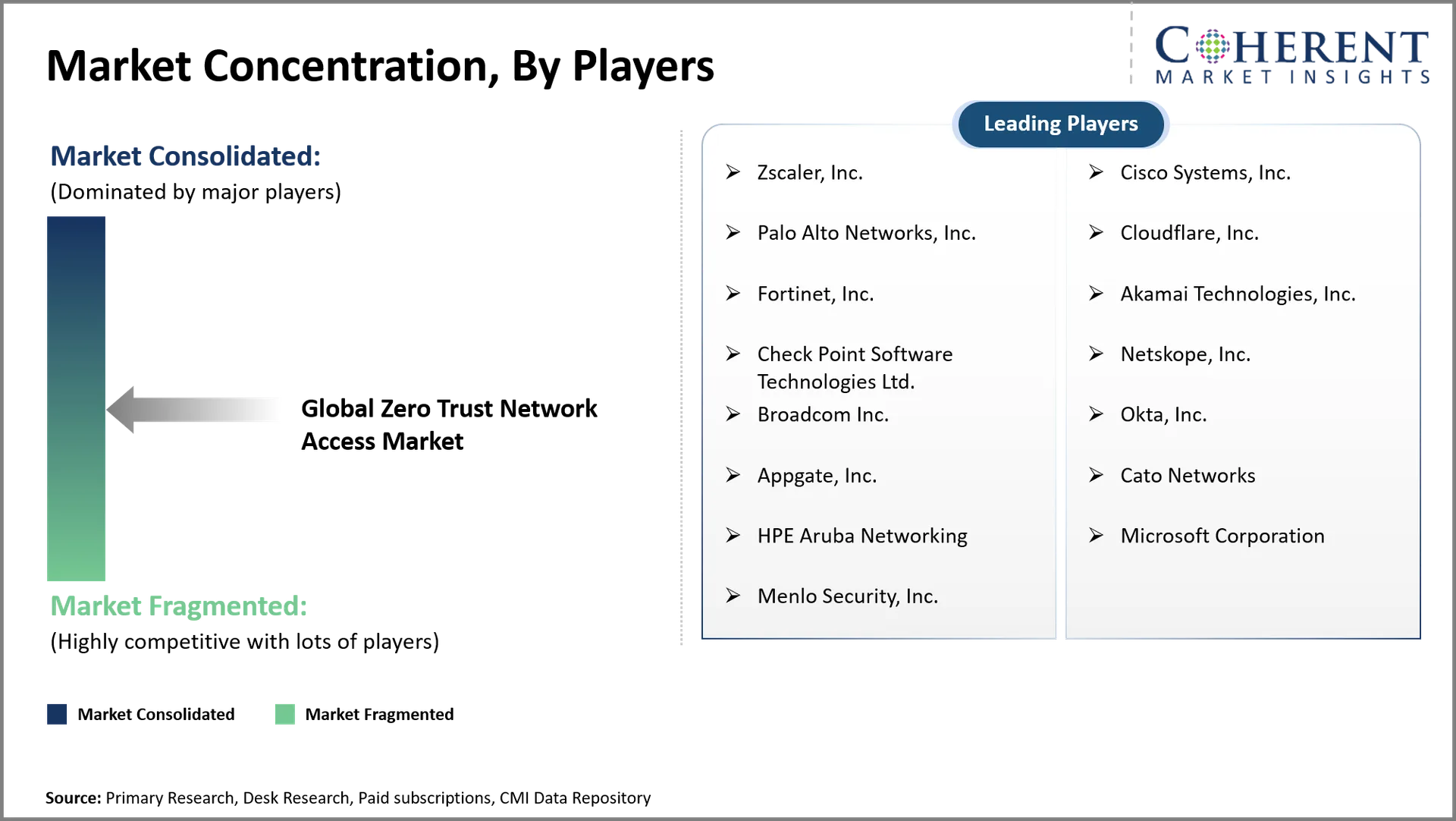
The global zero trust network access market features established cybersecurity providers competing through integrated security platforms, identity management, and cloud-delivered access protection. Zscaler’s position is strengthened by Zscaler Private Access, which offers application-specific connectivity while hiding corporate networks. Palo Alto Networks is focusing on Prisma Access and its ZTNA 2.0 architecture, which is built on continuous trust verification and least-privilege access. Cisco Systems strengthens Cisco Secure Access with Zero Trust Network Access with Secure Web Gateway, identity protection and digital experience monitoring. Netskope One Private Access and continuous device posture evaluation target hybrid companies. Microsoft uses Entra Private Access and Conditional Access integration to provide identity-based protection for enterprise applications. Cloudflare Access is focused on developer access, application security and its worldwide connection infrastructure. Fortinet focuses on integration with Fortinet ZTNA, FortiGate firewalls and its Security Fabric ecosystem. These strategies reflect growing competition around unified security delivery, application visibility, and simplified enterprise deployment
Top Manufacturers and Notable Products/Solutions in the Zero Trust Network Access Market
Manufacturer | Notable Product/Solution | Key features |
Zscaler | Zscaler Private Access (ZPA) | Application-level access, identity verification, device posture assessment, continuous policy enforcement, clientless access, protection against lateral movement |
Palo Alto Networks | Prisma Access | ZTNA 2.0, continuous trust verification, least-privilege access, application discovery, threat prevention, integrated cloud security |
Netskope | Netskope One Private Access | Identity-based access, continuous device posture checks, private application connectivity, clientless browser access, data protection, cloud security integration |
Cisco Systems | Cisco Secure Access | Identity-based access policies, multifactor authentication integration, application-level connectivity, secure web gateway, cloud-delivered security, digital experience monitoring |
Cloudflare | Cloudflare Access | Identity-aware application access, global edge network, browser-based access, application authentication, device posture checks, integration with identity providers |
Zero Trust Network Access Market | |||
Report Coverage | Details | ||
Base Year | 2025 | Market Size in 2026: | USD 2.40 Bn |
Historical Data For: | 2020 To 2024 | Forecast Period: | 2026 To 2033 |
Forecast Period 2026 To 2033 CAGR: | 24.2% | 2033 Value Projection: | USD 11.00 Bn |
Geographies covered: |
| ||
Segments covered: |
| ||
Companies covered: | Zscaler, Inc., Cisco Systems, Inc., Palo Alto Networks, Inc., Cloudflare, Inc., Fortinet, Inc., Akamai Technologies, Inc., Check Point Software Technologies Ltd., Netskope, Inc., Broadcom Inc., Okta, Inc., Appgate, Inc., Cato Networks, HPE Aruba Networking, Microsoft Corporation, Menlo Security, Inc. | ||
Growth Drivers: |
| ||
Restraints & Challenges: |
| ||
Analyst Opinion (Expert Opinion)
- The future of the Zero Trust Network Access industry will increasingly depend on application-level security rather than traditional network perimeter protection. Enterprises will prioritize continuous identity verification, device posture assessment, and contextual access decisions. Vendors will increasingly combine Zero Trust Network Access with Secure Access Service Edge, endpoint security, and identity governance. AI-assisted policy recommendations and automated session risk evaluation will become important product differentiators. Solutions supporting legacy applications and operational technology environments will also gain importance because organizations cannot replace entire infrastructure systems immediately.
- The strongest opportunities will emerge in cloud-delivered Zero Trust Network Access solutions serving hybrid enterprises and critical infrastructure operators. The growth of application-level access protection is expected to spur investment in banking, healthcare, manufacturing and government services. India has potential in scaling digital banking and modernizing enterprise technology. Germany offers some interesting opportunities in car production and industrial automation. There’s promise in Japan for connected manufacturing, supplier access protection. Vendors should focus on solutions for operational technology, privileged access and third-party connectivity. Such applications demand fine-grained permission without disturbing the existing production settings.
- Market participants should differentiate themselves through interoperability, deployment flexibility and industry-specific security capabilities. Vendors should create connections for legacy applications, industrial control systems, and multi-cloud settings. Alliances with managed security service providers can increase access to regional enterprise customers. Companies could also simplify licensing and policy administration for enterprises replacing traditional VPN infrastructure. Local data residency choices and compliance-ready settings can help drive adoption in regulated industries. Meaningful competitive benefits will be faster implementation, transparent access policies and reliable application performance.
Speak to the analyst
Want personalized insights?
Take the findings above to one of our principal consultants, or have the report rebuilt around the segments, geographies and competitors you actually track.
Market Segmentation
- Component Insights (Revenue, USD Billion, 2021 - 2033)
- Solutions
- Services
- Deployment Type Insights (Revenue, USD Billion, 2021 - 2033)
- Cloud-Based
- On-Premises
- Application Insights (Revenue, USD Billion, 2021 - 2033)
- Remote Workforce Access
- Third-Party Access
- Secure Application Access
- Data Center Access
- Cloud Application Access
- End User Insights (Revenue, USD Billion, 2021 - 2033)
- BFSI
- IT and Telecommunications
- Healthcare
- Government and Public Sector
- Retail and E-Commerce
- Manufacturing
- Education
- Energy and Utilities
- Others
- Regional Insights (Revenue, USD Billion, 2021 - 2033)
- North America
- U.S.
- Canada
- Latin America
- Brazil
- Argentina
- Mexico
- Rest of Latin America
- Europe
- Germany
- U.K.
- Spain
- France
- Italy
- Russia
- Rest of Europe
- Asia Pacific
- China
- India
- Japan
- Australia
- South Korea
- ASEAN
- Rest of Asia Pacific
- Middle East
- GCC Countries
- Israel
- Rest of Middle East
- Africa
- South Africa
- North Africa
- Central Africa
- North America
- Key Players Insights
- Zscaler, Inc.
- Cisco Systems, Inc.
- Palo Alto Networks, Inc.
- Cloudflare, Inc.
- Fortinet, Inc.
- Akamai Technologies, Inc.
- Check Point Software Technologies Ltd.
- Netskope, Inc.
- Broadcom Inc.
- Okta, Inc.
- Appgate, Inc.
- Cato Networks
- HPE Aruba Networking
- Microsoft Corporation
- Menlo Security, Inc.
Sources
Primary Research Interviews
- Chief Information Security Officers (CISOs)
- Network Security Architects & Engineers
- Cloud Infrastructure & IT Managers
- Zero Trust Solution Vendors & Technology Providers
Magazines
- SC Magazine (Cybersecurity)
- Dark Reading
- Infosecurity Magazine
- CSO Online
Journals
- IEEE Transactions on Information Forensics and Security
- Journal of Cybersecurity (Oxford Academic)
- International Journal of Network Security & Its Applications (IJNSA)
Associations
- Cloud Security Alliance (CSA)
- Information Systems Security Association (ISSA)
- National Institute of Standards and Technology (NIST)
- Cybersecurity and Infrastructure Security Agency (CISA)
Public Domain Sources
- U.S. Department of Homeland Security (DHS) – Cybersecurity Publications
- European Union Agency for Cybersecurity (ENISA)
- National Cybersecurity Center of Excellence (NCCoE)
- NIST Special Publication 800-207 (Zero Trust Architecture)
Proprietary Elements
- CMI Data Analytics Tool
- Proprietary CMI Existing Repository of Information for the Last 10 Years
Get access to 250+ pages report
Every segment, forecast, competitor profile and data table behind the analysis above — available for instant download.
- ESOMAR Member
- ISO 9001:2015 Certified
- D-U-N-S Registered
- GDPR & CCPA Compliant
Frequently Asked Questions
The global zero trust network access market is expected to stand at USD 2.40 Bn in 2026 and is expected to reach USD 11.00 Bn by 2033.
The CAGR of the global zero trust network access market is projected to be 24.2% from 2026 to 2033.
Increasing adoption of zero trust security architectures and Growing cloud migration across enterprise IT infrastructure are the major factors driving the growth of the global zero trust network access market.
High costs of zero trust implementation and Complexities in integrating legacy network infrastructure are the major factors hampering the growth of the global zero trust network access market.
In terms of component, solutions segment is estimated to dominate the market revenue share in 2026.
The zero trust network access market covers technologies providing identity-based, application-level access to private enterprise resources.
Zero trust network access verifies identities and contextual security conditions before permitting connections to individual applications.