

Artificial Kidney Market Size and Forecast — 2026-2033
The Global Artificial Kidney Market size is estimated to be valued at USD 4.37 billion in 2026 and is expected to reach USD 9.7 billion by 2033, exhibiting a compound annual growth rate (CAGR) of 15.0% from 2026 to 2033.
Overview
Artificial kidneys are advanced biomedical devices that replicate the natural filtration and waste removal functions of biological kidneys. The main types include hemodialysis machines, portable wearable dialysis devices, and implantable bioartificial kidneys under development. These systems use semipermeable membranes and sorbent-based filters to remove toxins, urea, and excess electrolytes from the bloodstream. Modern models feature smart sensors, automated flow control, and real-time data monitoring for improved patient safety. Technological progress has shifted the focus toward miniaturization and continuous wearable dialysis, enabling better mobility and quality of life for chronic kidney disease patients. Biohybrid artificial kidneys incorporating living renal cells represent the next stage in biomimetic filtration design.
Key Takeaway
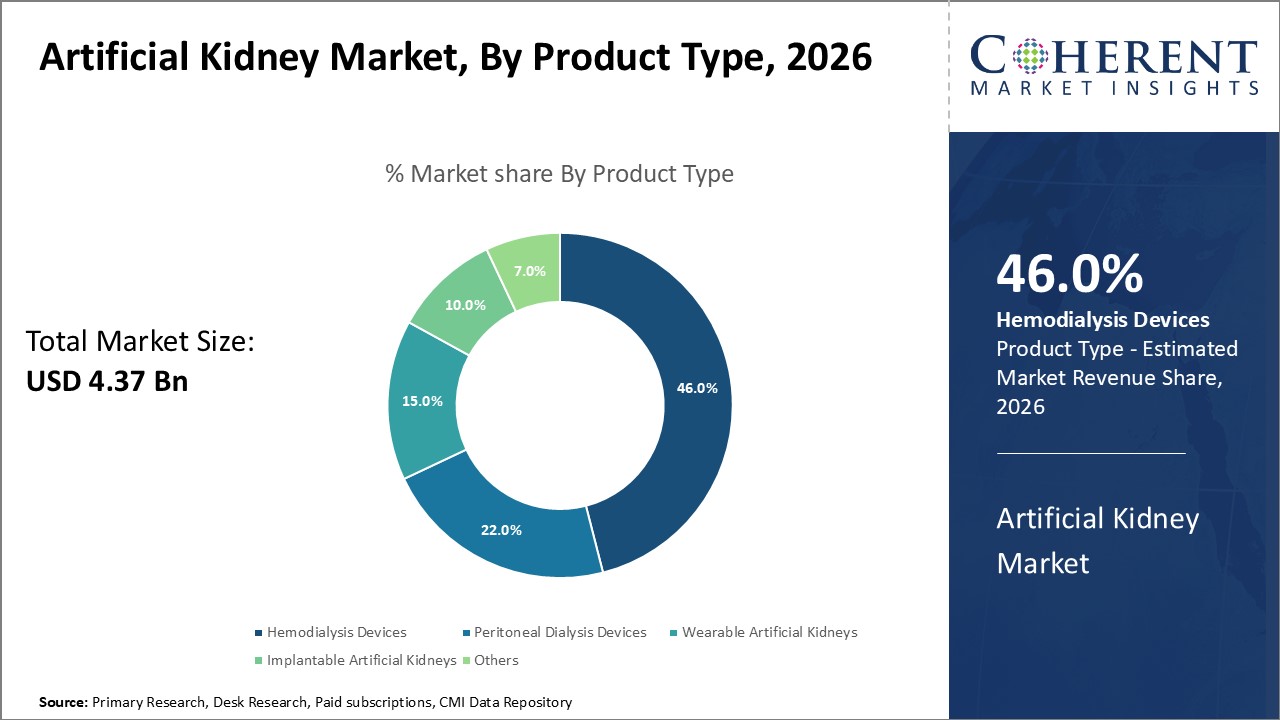
The Hemodialysis Devices segment dominates the artificial kidney market share, reflecting over 46% of industry revenue driven by high clinical adoption rates and technological improvements.
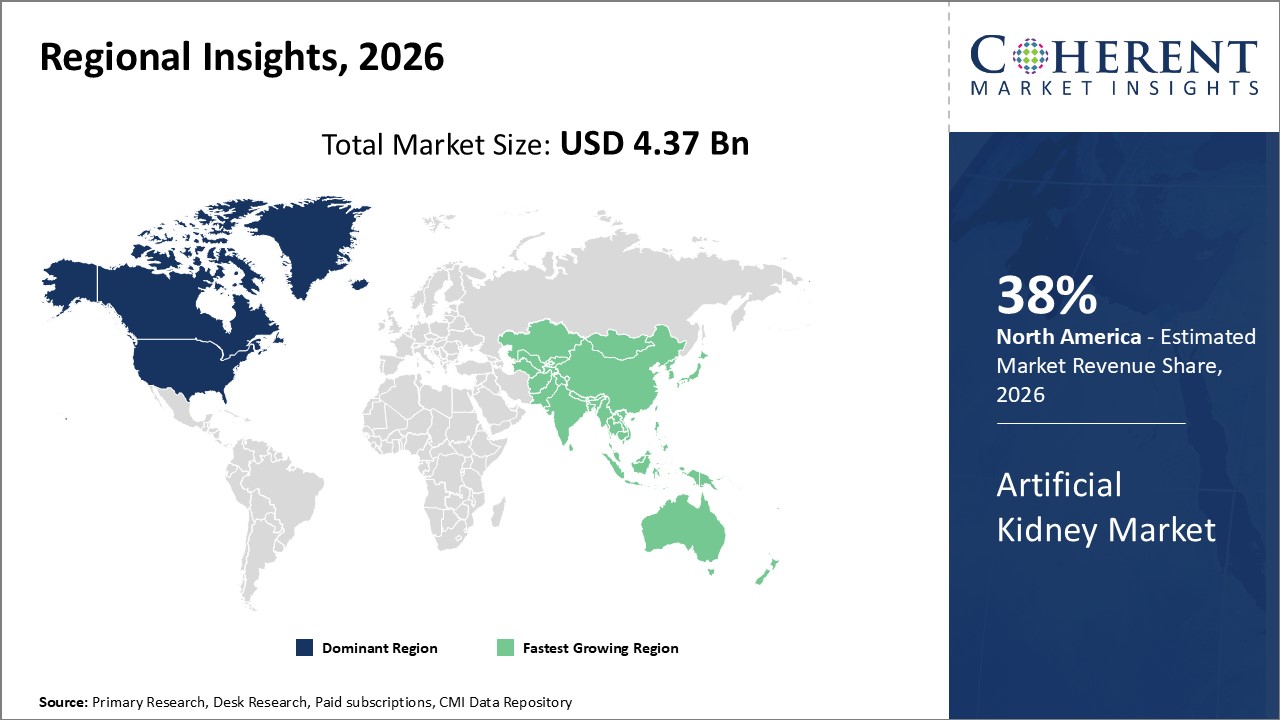
North America holds the leading regional market position, accounting for over 38% market share, supported by a strong healthcare infrastructure and ongoing investments.
Asia Pacific is the fastest-growing region, with a CAGR exceeding 18%, fueled by expanding diabetic and CKD populations, and localized manufacturing expansions.
Artificial Kidney Market Segmentation Analysis
Artificial Kidney Market Insights, By Product Type
Hemodialysis Devices dominate the market share due to widespread clinical use and continual technological enhancements, such as high-flux membranes and hemodiafiltration capabilities. Wearable Artificial Kidneys are the fastest-growing subsegment, benefiting from patient demand for mobility and emerging technological integration, which reduces hospital visits significantly. Peritoneal Dialysis Devices maintain steady demand thanks to the minimally invasive nature and suitability for home care, while Implantable Artificial Kidneys are nascent but hold promising potential in long-term renal failure treatment.
Artificial Kidney Market Insights, By End-User
Hospitals & Clinics hold the dominant market share due to their infrastructure suitability for managing complex dialysis procedures and acute kidney failure cases. Home Care Settings are the fastest growing, driven by technological advancements enabling safe and efficient at-home dialysis, improving patient comfort, and lowering treatment costs. Ambulatory Surgical Centers and Specialty Nephrology Clinics cater to niche segments such as outpatient care and specialized patient monitoring. Others include research centers and rehabilitation facilities with limited but growing roles.
Artificial Kidney Market Insights, By Technology
Conventional Dialysis retains dominance as the most prevalent and cost-effective method for renal failure management worldwide. Bioartificial Kidneys represent the fastest-growing technology, driven by advancements in tissue engineering and regenerative medicine, aiming to replicate natural kidney functions. Continuous Renal Replacement Therapy is increasingly adopted in critical care for hemodynamically unstable patients, while Portable Dialysis Devices have gained traction alongside wearable tech trends, facilitating continuous patient mobility. Others cover emerging tech such as sorbent-based dialysis evolving through ongoing R&D.
Artificial Kidney Market Trends
The Artificial Kidney market is moving toward smarter, patient-centric technologies that emphasize portability, automation, and improved physiological compatibility.
Recent AI-enabled dialysis machines launched in 2026 have decreased treatment times while enhancing toxin clearance, reflecting technological trends prioritizing efficacy.
Furthermore, increasing home healthcare solutions driven by telemedicine adoption showcase a paradigm shift from hospital-dependent dialysis, significantly affecting market growth strategies.
Artificial Kidney Market Insights, By Geography
North America Artificial Kidney Market Analysis and Trends
In North America, the dominance in the Artificial Kidney market is attributed to advanced healthcare infrastructure, substantial government funding for CKD patient management, and the robust presence of leading market companies such as Baxter International and Fresenius Medical Care. North America accounts for approximately 38% of the global market share, underscoring its key role.
Asia Pacific Artificial Kidney Market Analysis and Trends
Meanwhile, the Asia Pacific exhibits the fastest growth with a CAGR of over 18%, propelled by large patient populations affected by diabetes-induced kidney failure, rising healthcare spending, and supportive governmental initiatives fostering local manufacturing and innovation. China and India are central markets with notable contributions from companies like Nipro Corporation, expanding production.
Artificial Kidney Market Outlook for Key Countries
USA Artificial Kidney Market Analysis and Trends
The USA leads with substantial investments in artificial kidney research and adoption of state-of-the-art dialysis technologies. Government programs increasing funding by over 12% in 2025, and private sector innovation have driven extensive advancements. Major players, including Medtronic plc and NxStage Medical, aggressively expanded product lines focused on home-based and AI-integrated solution deployment, capturing significant market revenue.
India Artificial Kidney Market Analysis and Trends
India’s artificial kidney market is rapidly evolving due to increasing CKD incidence, rising healthcare accessibility, and growing domestic production capabilities led by companies such as Diality Healthcare Pvt Ltd. Government initiatives aimed at subsidizing dialysis costs and improving rural healthcare infrastructure have accelerated market growth, contributing to the Asia Pacific’s overall fast CAGR.
Analyst Opinion
There is a clear upward trajectory in the production capacity of artificial kidney devices, with key manufacturers scaling operations to meet increasing global demand. For instance, recent data from leading producers shows a 21% increase in manufacturing output in 2025, correlating strongly with an 19% revenue uplift year-over-year. This supply-side dynamic is pivotal in shaping overall market revenue and expanding the industry share internationally.
Demand-side analysis reveals a diversification of use cases for artificial kidneys beyond traditional hemodialysis, including wearable and implantable devices for home care. The adoption of wearable artificial kidneys grew by 13% in 2025 as patients and healthcare systems seek more mobility-friendly options, reflecting evolving market dynamics and user preferences.
Pricing strategies have evolved significantly with technology maturation, where premium devices command higher price points due to enhanced features like AI-enabled filtration and biocompatible materials. Pricing flexibility, coupled with insurance reimbursement policies has influenced market penetration, particularly in developed countries where government healthcare spending on renal care increased by 16% in 2025.
Import-export patterns depict growing cross-border trade volumes in artificial kidney components and finished devices, with the Asia Pacific emerging as a critical hub. China and India expanded their export capacities by approximately 25% in early 2026, serving as both production centers and markets, thus impacting global market growth strategies.
- Current Industry Events of 2026
- Market Size Estimation
- Regional Breakdown
- Competitive Landscape
- Customer Intelligence
- Segmental Analysis
- Pricing Analysis
- Key Market Drivers, Challenges & Future Trends
- Customized Insights Section
Market Scope
| Report Coverage | Details | ||
|---|---|---|---|
| Base Year: | 2025 | Market Size in 2026: | USD 4.37 billion |
| Historical Data for: | 2020 To 2024 | Forecast Period: | 2026 To 2033 |
| Forecast Period 2026 to 2033 CAGR: | 15.0% | 2033 Value Projection: | USD 9.7 billion |
| Geographies covered: |
| ||
| Segments covered: |
| ||
| Companies covered: | Fresenius Medical Care, Baxter International Inc., B. Braun Melsungen AG, Nipro Corporation, Medtronic plc, NxStage Medical, Inc., Asahi Kasei Corporation, Toray Industries, Inc., Kaneka Corporation, HemoCue AB, Medica S.p.A. | ||
| Growth Drivers: |
| ||
Artificial Kidney Market Growth Factors
Key growth drivers include the increasing prevalence of chronic kidney disease (CKD), which the World Health Organization reported affected over 850 million individuals globally in 2025. Second, technological breakthroughs in biocompatible membrane technology and miniaturization of dialysis devices have profoundly enhanced patient compliance and comfort. Another growth factor is the rising healthcare expenditure, with countries like the U.S. raising kidney-related healthcare budgets by 12% in 2025 to accommodate innovations in artificial kidney technologies. Lastly, expanding home-based dialysis care facilitated by telehealth and remote monitoring systems attracts patient preference shifts, accelerating market growth.
Artificial Kidney Market Development
In 2023, Baxter International announced that its proposed kidney-care spinoff will be named “Vantive.” The company stated that Vantive will focus on integrated kidney-care solutions, including home dialysis systems, chronic kidney-disease management technologies and access services, and is expected to become a standalone publicly-traded entity in late 2026. The announcement underscores Baxter’s strategic intention to sharpen its focus on renal technologies by creating an independent business dedicated to kidney-care innovation and growth.
In April 2023, Mozarc Medical was launched, a new independent kidney-care company co-owned by Medtronic plc and DaVita Inc., created to accelerate innovation in kidney health technologies. The company will focus on patient-centric kidney-care solutions—including dialysis access, home dialysis technologies and acute-care kidney-disease platforms—and is positioned to deliver enhanced access and in-home options. The launch was officially announced on 1 April 2023.
Key Players
Leading Companies of the Market
Fresenius Medical Care
Baxter International Inc.
B. Braun Melsungen AG
Nipro Corporation
Medtronic plc
NxStage Medical, Inc.
Asahi Kasei Corporation
Toray Industries, Inc.
Kaneka Corporation
HemoCue AB
Medica S.p.A.
Several market players have adopted technology-driven growth strategies; for example, Fresenius Medical Care invested over USD 120 million in 2025 towards R&D for implantable artificial kidneys, resulting in a 25% increase in product pipeline offerings by mid-2026. Baxter International’s strategic acquisitions in the Asia Pacific have enhanced local manufacturing and distribution, significantly expanding their reach in emerging markets and increasing revenue by 18% in the last fiscal year.
Artificial Kidney Market Future Outlook
The future market is poised for major innovation with the emergence of wearable and implantable artificial kidneys. Efforts to create compact, energy-efficient, and patient-friendly devices will shape product development. Integration of real-time biosensors, automated flow control, and AI-based monitoring will improve safety and personalization. Growing cases of end-stage renal disease (ESRD) and global shortages in donor organs are expected to drive adoption. With supportive regulatory pathways and funding for biohybrid organ development, artificial kidneys are expected to transition from clinical prototypes to viable long-term renal replacement solutions in the coming decade.
Artificial Kidney Market Historical Analysis
The market originated with the invention of hemodialysis in the mid-20th century, revolutionizing treatment for chronic kidney disease patients. Early devices were large, stationary machines that required specialized supervision. Over decades, miniaturization and material innovation have transformed dialysis systems, allowing for more efficient toxin removal and fluid regulation. The late 20th and early 21st centuries saw significant advances in portable dialysis units and sorbent-based systems, improving patient mobility and reducing treatment time. Government funding and the growing global prevalence of renal disorders sustained consistent R&D investments, with bioartificial kidneys emerging as a new research frontier combining mechanical filtration and living cells for near-natural renal function.
Sources
Primary Research Interviews:
Nephrologists
Biomedical Device Engineers
Dialysis Center Directors
Hospital Procurement Heads
Databases:
National Kidney Foundation Data
U.S. FDA PMA Database
WHO Renal Disease Statistics
ClinicalTrials.gov
Magazines:
Renal & Urology News
Medical Device + Diagnostic Industry (MD+DI)
Nephrology Times
MedPage Today
Journals:
Kidney International
American Journal of Kidney Diseases
Journal of Artificial Organs
Nature Biomedical Engineering
Newspapers:
The Guardian (Health)
The Economic Times (Healthcare)
USA Today (Science)
Hindustan Times (Health)
Associations:
International Society of Nephrology (ISN)
American Society of Nephrology (ASN)
European Renal Association (ERA)
World Health Organization (WHO)
Get access to 250+ pages report
Every segment, forecast, competitor profile and data table behind the analysis above — available for instant download.
- ESOMAR Member
- ISO 9001:2015 Certified
- D-U-N-S Registered
- GDPR & CCPA Compliant
Missing comfort of reading report in your local language? Find your preferred language:
Transform your Strategy with Exclusive Trending Reports
Frequently Asked Questions
The market leaders include Fresenius Medical Care, Baxter International, and B. Braun Melsungen AG, known for significant R&D investments and broad product portfolios.
The market size is anticipated to rise from USD 4.37 billion in 2026 to approximately USD 9.7 billion by 2033, demonstrating robust growth indicators.
Hospitals and clinics continue to dominate, though home care settings are rapidly expanding given advancements in portable and wearable dialysis devices.
Technological convergence involving AI, biocompatible materials, and remote monitoring will shape the competitive landscape and market dynamics profoundly.
Market competitiveness arises from innovation race, regulatory compliance complexities, and distinct go-to-market strategies emphasizing regional adaptation and cost-efficiency.
Companies focus on strategic partnerships, product diversification, and geographic expansions to capitalize on emerging opportunities and market trends.