

Magnesite Market Size and Forecast – 2026 to 2033
The Magnesite Market is anticipated to grow at a CAGR of 4.7% with USD 3.6 Bn in 2026 and is expected to reach USD 5.3 Bn in 2033. Infrastructure development and urbanization drive consumption, while rising steel production and expanding manufacturing activities further strengthen market growth. Approximately 56% of the global population lives in urban areas today, and this share is projected to rise to 68% by 2050.
Key Takeaways
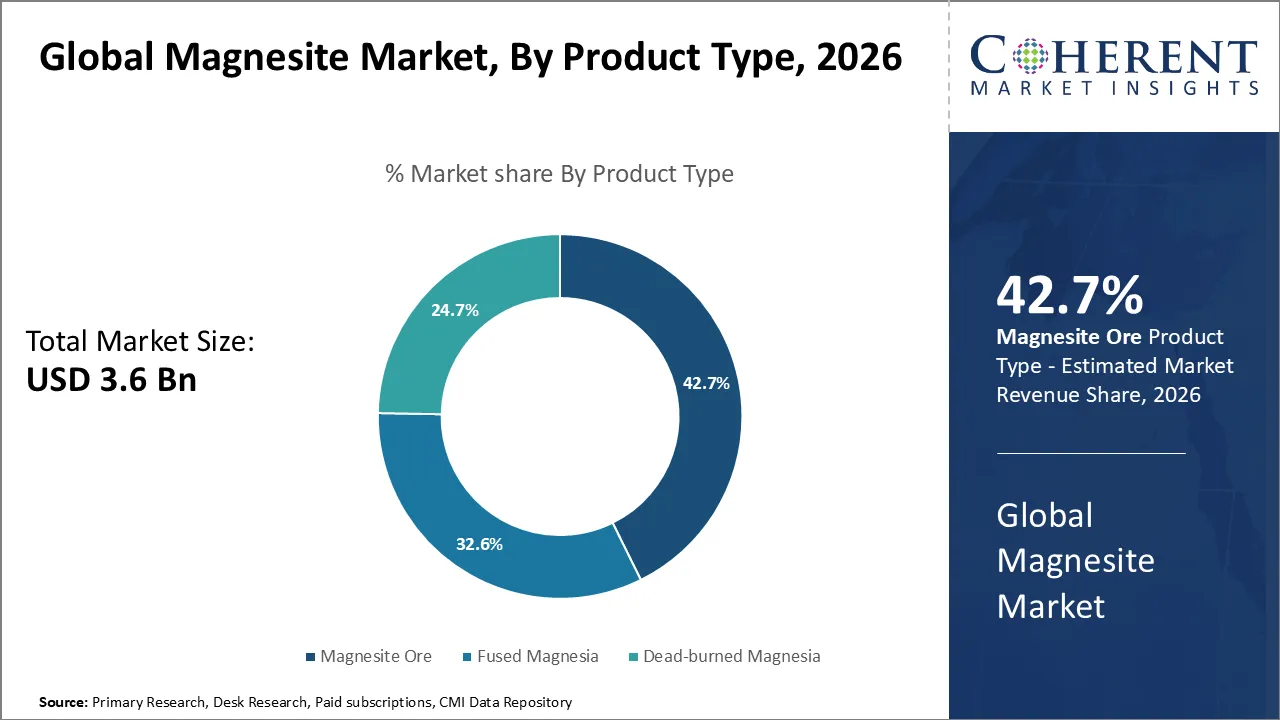
- Magnesite Ore hold the largest market share of 42.7% in 2026 owing to the growing demand from refractories.
- Construction expected to hold largest market share of 38.8% in 2026 owing to its rapid infrastructure development. As of March 2026, 2.98 crore houses have been completed under the Pradhan Mantri Awas Yojana–Gramin (PMAY-G), marking a significant expansion of rural housing construction.
- Asia Pacific is expected to acquire the dominant share of 42.8% in 2026 owing to the strong steel and metal-processing industries. India’s steel production increased from 14.1 million tonnes in June 2026 to 14.4 million tonnes in July 2026.
Current Events and Their Impact on the Magnesite Market
Current Event | Description and its Impact |
China’s Export-Licensing Requirements for Magnesium-Bearing Mineral Products |
|
EU Critical Raw Materials Policy and Magnesium Supply Security |
|
Segmental Insights
- Current Industry Events of 2026
- Market Size Estimation
- Regional Breakdown
- Competitive Landscape
- Customer Intelligence
- Segmental Analysis
- Pricing Analysis
- Key Market Drivers, Challenges & Future Trends
- Customized Insights Section
Why is Magnesite Ore Acquiring the Largest Market Share?
Magnesite Ore hold the largest market share of 42.7% in 2026. The magnesite ore market is driven by growing demand for magnesia-based refractories in steel, cement, and other high-temperature industries. Expanding infrastructure and construction activities stimulate steel and cement production, increasing the need for magnesite-derived refractory materials. Manufacturers also use magnesite to produce magnesium compounds for chemical processing, agriculture, environmental treatment, and industrial applications. Urbanization, industrial development, and investments in manufacturing facilities further support demand for high-purity magnesite ore, while advances in mining, processing, and calcination improve product quality and broaden its applications.
Which End Use Industry segment dominates the market?
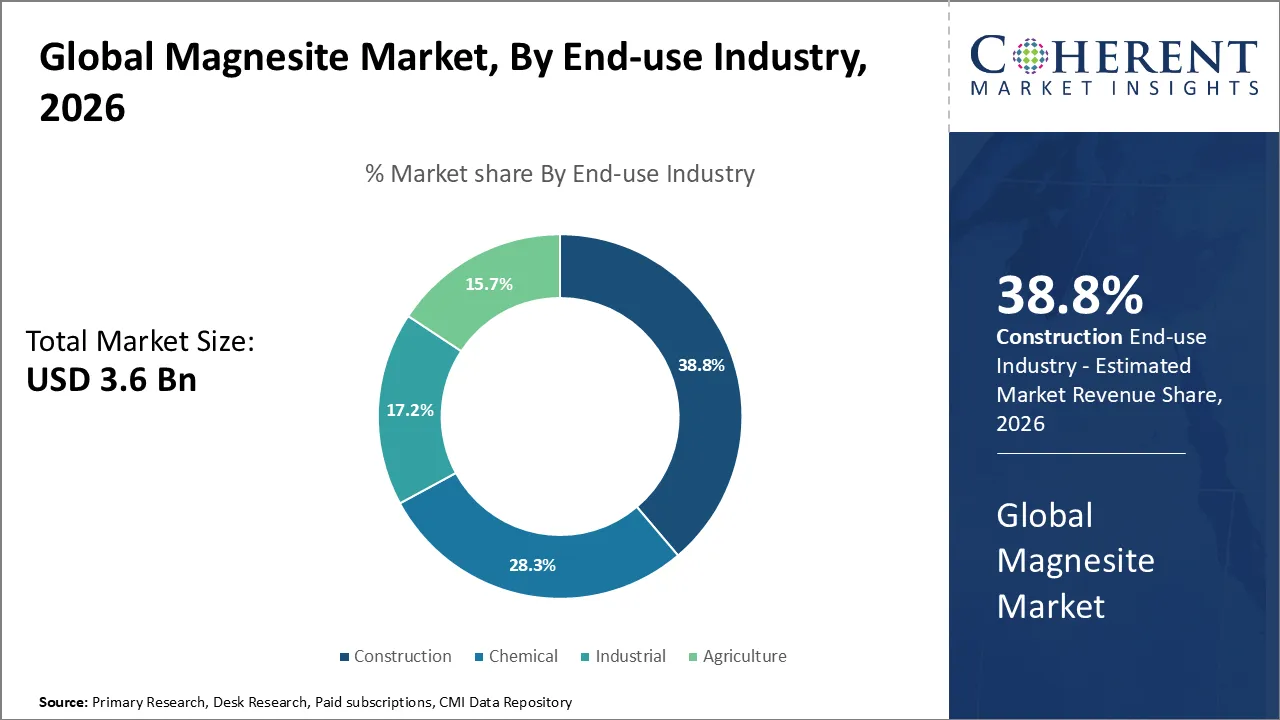
Construction expected to hold largest market share of 38.8% in 2026. Construction growth is driving the magnesite market by increasing demand for steel, cement, and refractory materials. Developers use large quantities of steel and cement in infrastructure projects, residential buildings, commercial facilities, and industrial plants, which boosts the use of magnesia-based refractories in high-temperature operations. Urbanization and government spending on roads, bridges, transportation systems, and public infrastructure further increase construction activity. For 2026–27, INR 1,21,999 crore has been allocated for roads and bridges, representing a 5% increase over the revised 2025–26 estimates. Cement manufacturers are also expanding production capacity, creating greater demand for durable refractory linings and supporting opportunities for magnesite producers and magnesium product manufacturers.
Magnesite Market Trends
- Rising demand for magnesia-based refractories in steel, cement, glass, and non-ferrous metal industries continues to support the use of magnesite-derived products. The U.S. Geological Survey (USGS) states that magnesium compounds, particularly magnesium oxide, are used mainly as refractory materials in furnace linings for iron and steel, nonferrous metals, glass, and cement production.
- Strong global steel production supports refractory demand. World crude steel production reached approximately 1.85 billion tonnes in 2025, according to the World Steel Association. Asia and Oceania accounted for about 1.32 billion tonnes, while China and India produced approximately 960.8 million tonnes and 165.6 million tonnes, respectively. The scale of steel production supports continued demand for refractory materials used in high-temperature steelmaking operations.
- Growth in steel production in India is an important demand factor for refractory materials. India produced approximately 165 million tonnes of crude steel in 2025, representing growth of about 10% from 2024, according to World Steel Association data. Continued expansion of steelmaking capacity and output can support consumption of magnesia-based refractory products.
- China remains a major source of magnesite and magnesia products. USGS reported that China was the leading producer and principal source of magnesia and magnesite imports into the United States in 2025. U.S. imports of caustic-calcined magnesia from China increased 66% to 201,000 tonnes during January–August 2025, while imports of dead-burned and fused magnesia increased 9% to 77,200 tonnes over the same period.
Regional Insights
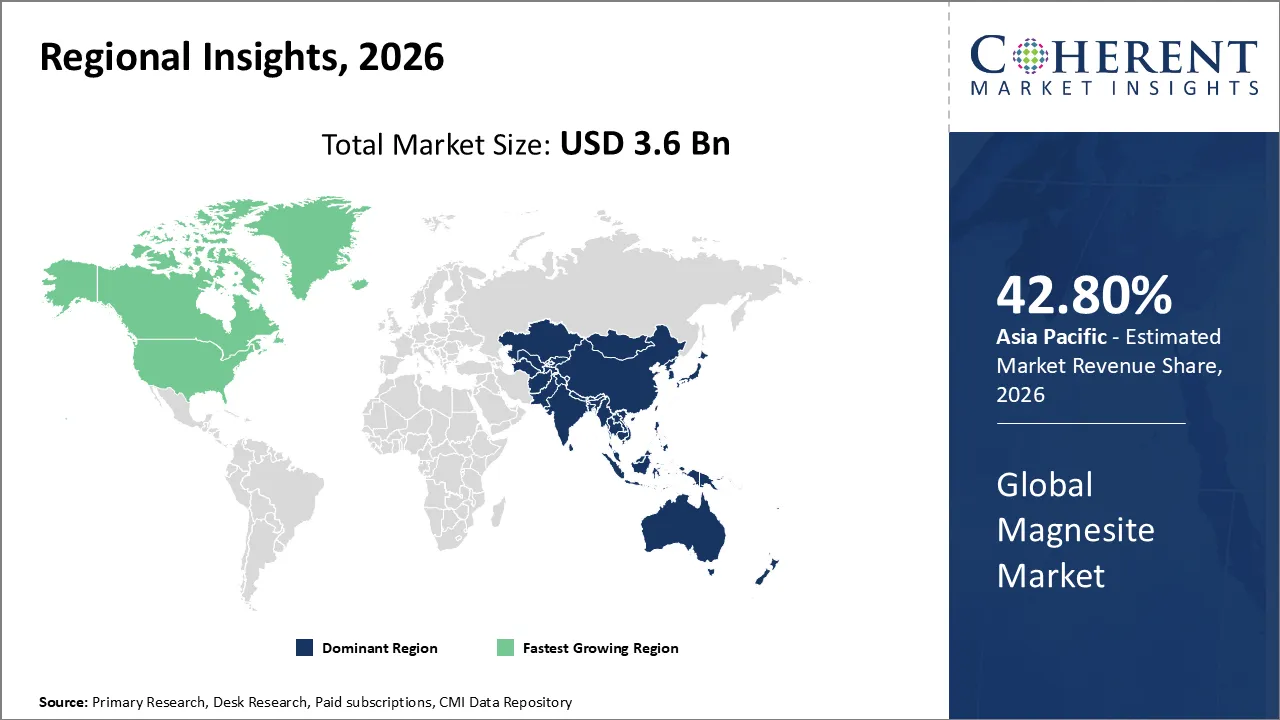
Asia Pacific dominates owing to preference for high-performance refractories
Asia Pacific is expected to acquire the dominant share of 42.80% in 2026. Rapid industrialization, urbanization, and expanding steel and cement production drive the Asia-Pacific magnesite market. China, India, Japan, and Southeast Asian countries are developing infrastructure and increasing steel and cement output, which boosts demand for magnesia-based refractories. Manufacturers across the region also use magnesium compounds in chemical processing, agriculture, and environmental applications, strengthening market demand. Furthermore, companies are investing in industrial facilities, construction projects, and energy infrastructure, increasing the need for high-performance refractory products and encouraging magnesite mining and processing. In February 2026, Valley Magnesite Company reported improved Q3 FY26 results, with total income rising to 22.46 and net profit reaching 19.00, compared with losses of 34.39 and 6.42, respectively, in Q3 FY25.
North America Magnesite Market Trends
Strong demand for refractory materials in the steel, cement, glass, and non-ferrous metal industries primarily drives the North America magnesite market. Manufacturers use magnesite-based products for their high-temperature resistance and durability, which helps improve furnace and kiln performance. Rising construction activity also boosts demand for fireproofing and insulation materials. Expanding environmental applications, such as wastewater treatment and flue-gas control, further support market growth.
China Magnesite Market Trends
China’s magnesite market continues to grow as the refractory industry increases its use of magnesia-based materials in steelmaking, cement, and glass production because of their ability to withstand high temperatures. China’s extensive magnesite reserves and advanced processing facilities enable producers to meet domestic demand and expand exports. Construction, agriculture, environmental applications, and magnesium production further support demand. At the same time, environmental regulations and tighter mining controls encourage companies to consolidate operations, enhance processing quality, and improve efficiency. China is the world’s largest magnesium producer, supplying approximately 40–50% of global magnesium demand. Producers also increasingly develop low-carbon and high-purity magnesia products, supporting market expansion.
United States Magnesite Market Trends
Demand for refractory materials drives the United States magnesite market, particularly in steelmaking, cement, glass, and nonferrous metal processing. Manufacturers use magnesia derived from magnesite to produce heat-resistant furnace linings, supporting market consumption. Chemical, agricultural, construction, and environmental industries also create demand through applications such as wastewater treatment and industrial neutralization. Domestic steel production, electric arc furnace operations, regular refractory replacement, and the need for dependable magnesium-based materials further strengthen demand for magnesite across the United States. U.S. steel production increased to 7.4 million tonnes in July 2026, up from 7.2 million tonnes in June 2026.
Who are the Major Companies in Magnesite Industry
- Some of the major key players in Magnesite are Calix, Magnezit, Grecian Magnesite Houying Group, Baymag, Grecian Magnesite, Magnesium Group, Liaoning Wancheng, Queensland Magnesia Ltd., Liaoning Jinding Magnesite Group, BeiHai Group, and Haicheng Magnesite.
Key News
- In June 2026, Bulova expanded its Super Seville collection with three 35mm models featuring natural Jade, Magnesite, and Sodalite stone dials. The watches retain the signature television-cushion case, fluted bezel, and integrated bracelet from the original 1970s design.
Market Report Scope
Magnesite Market Report Coverage
Report Coverage | Details | ||
Base Year: | 2025 | Market Size in 2026: | USD 3.6 Bn |
Historical Data for: | 2020 to 2024 | Forecast Period: | 2026 to 2033 |
Forecast Period 2026 to 2033 CAGR: | 4.7% | 2033 Value Projection: | USD 5.3 Bn |
Geographies covered: |
| ||
Segments covered: |
| ||
Companies covered: | Calix, Magnezit, Grecian Magnesite Houying Group, Baymag, Grecian Magnesite, Magnesium Group, Liaoning Wancheng, Queensland Magnesia Ltd., Liaoning Jinding Magnesite Group, BeiHai Group, and Haicheng Magnesite. | ||
Analyst Opinion
- Refractory demand remains the strongest structural driver. In my view, the U.S. magnesite market is fundamentally tied to the performance of steel and other high-temperature industries rather than discretionary mineral consumption. USGS identifies magnesium oxide compounds as key refractory materials for furnace linings used in iron and steel, nonferrous metals, glass, and cement production. In 2024, U.S. apparent consumption of magnesium compounds reached an estimated 890 thousand metric tons, up from 830 thousand metric tons in 2023, demonstrating the underlying industrial pull.
- Steelmaking will continue to determine the direction of refractory-grade magnesite demand. The U.S. produced approximately 88 million net tons of raw steel in 2024, while domestic steel mill shipments reached 87 million net tons. Although production declined from the previous year, USGS specifically linked lower U.S. demand for dead-burned and fused magnesia imports to the reduction in crude steel output. Steel production and refractory replacement cycles as the most immediate demand indicators for magnesite-derived products.
- Supply-chain dependence is becoming a strategic market driver, not merely a procurement issue. The United States mined magnesite in Nevada in 2024, but most domestic magnesium compounds came from seawater and natural brines. At the same time, China remained the leading global producer of magnesia and magnesite and the principal exporter of magnesia to the United States. Notably, U.S. imports of Chinese caustic-calcined magnesia increased sharply during the first eight months of 2024, while imports of dead-burned and fused magnesia declined substantially. This divergence highlights how strongly product grade, end use, and international supply conditions influence U.S. demand.
- Environmental and chemical applications as an increasingly important demand stabilizer. USGS reported that about 78% of U.S. magnesium compounds were consumed in caustic-calcined magnesia, magnesium chloride, magnesium hydroxide, and magnesium sulfate across environmental, chemical, agricultural, and deicing applications. This matters because these uses diversify demand away from steel alone. Wastewater treatment, chemical processing, and agricultural applications can provide a more resilient consumption base when construction or steel activity weakens.
- Domestic supply security will increasingly shape purchasing decisions. The U.S. magnesium-compound supply chain remains structurally exposed to imports, with USGS estimating net import reliance at 52% of apparent consumption in 2024. Meanwhile, domestic magnesite mining remained limited to one company in Nevada. This imbalance will encourage U.S. buyers to prioritize diversified sourcing, inventory security, and alternative magnesium feedstocks, making supply reliability nearly as important as price when purchasing refractory-grade magnesite and magnesia products.
Speak to the analyst
Want personalized insights?
Take the findings above to one of our principal consultants, or have the report rebuilt around the segments, geographies and competitors you actually track.
Market Segmentation
- By Product Type (Revenue, USD Bn, 2021-2033)
- Magnesite Ore
- Fused Magnesia
- Dead-burned Magnesia
- By End-Use Industry (Revenue, USD Bn, 2021-2033)
- Construction
- Chemical
- Industrial
- Agriculture
- By Region (Revenue, USD Bn, 2021-2033)
- North America
- U.S.
- Canada
- Latin America
- Brazil
- Mexico
- Argentina
- Rest of Latin America
- Europe
- Germany
- U.K.
- France
- Italy
- Spain
- Russia
- Rest of Europe
- Asia Pacific
- China
- India
- Japan
- Australia
- South Korea
- ASEAN
- Rest of Asia Pacific
- Middle East
- GCC
- Israel
- Rest of Middle East
- Africa
- South Africa
- Central Africa
- North Africa
- North America
- Key Players
- Calix
- Magnezit
- Grecian Magnesite Houying Group
- Baymag, Grecian Magnesite
- Magnesium Group
- Liaoning Wancheng
- Queensland Magnesia Ltd.
- Liaoning Jinding Magnesite Group
- BeiHai Group
- Haicheng Magnesite.
Sources
Primary Research interviews
- Magnesite ore producers and mining companies
- Magnesia and refractory material manufacturers
- Steel and cement industry procurement managers
- Refractory manufacturers and distributors
- Magnesium compound producers
- Industrial mineral traders and raw-material suppliers
- Environmental-treatment and chemical-industry professionals
- Industry experts specializing in magnesium minerals and refractory applications
Databases
- U.S. Geological Survey (USGS) – National Minerals Information Center
- USGS Minerals Yearbook – Magnesium Compounds
- USGS Mineral Commodity Summaries
- U.S. Census Bureau – International Trade Data
- UN Comtrade Database
- International Trade Centre (ITC) Trade Map
- World Steel Association – Steel Data Viewer
- Eurostat – Mining and mineral products statistics
- National statistical databases of major magnesite-producing countries
Magazines
- Industrial Minerals
- Refractories Worldforum
- Steel Times International
- World Cement
- Glass International
- Mining Journal
- International Mining
- Metal Bulletin / Fastmarkets publications
Journals
- Journal of Materials Research and Technology
- Ceramics International
- Journal of the European Ceramic Society
- Construction and Building Materials
- Minerals Engineering
- International Journal of Mineral Processing
- Journal of Cleaner Production
- Materials
- Applied Sciences
Newspapers
- Reuters
- Financial Times
- The Wall Street Journal
- Bloomberg
- Nikkei Asia
- China Daily
- The Economic Times
- The Hindu BusinessLine
Associations
- World Steel Association
- International Magnesium Association
- American Ceramic Society
- National Mining Association
- European Association of Mining Industries, Metal Ores & Industrial Minerals
- China Magnesium Corporation / relevant Chinese magnesium industry associations
- Refractory industry associations
- Cement industry associations
Public Domain sources
- U.S. Geological Survey (USGS) – Magnesium Compounds Statistics and Information
- USGS – Mineral Commodity Summaries
- USGS – Minerals Yearbook
- USGS – Mineral Industry Surveys
- U.S. Census Bureau
- U.S. Department of Commerce
- U.S. International Trade Commission
- U.S. Department of Energy
- European Commission statistical publications
- Eurostat
- UN Comtrade
- World Bank commodity and economic databases
- National geological surveys and mining ministries of major producing countries
- World Steel Association publicly available steel statistics
- Government publications and regulatory filings from China, India, Australia, Greece, Canada, and the United States
Proprietary Elements
- CMI Data Analytics Tool
- Proprietary CMI Existing Repository of information for last 10 years
Get access to 250+ pages report
Every segment, forecast, competitor profile and data table behind the analysis above — available for instant download.
- ESOMAR Member
- ISO 9001:2015 Certified
- D-U-N-S Registered
- GDPR & CCPA Compliant
Missing comfort of reading report in your local language? Find your preferred language:
Transform your Strategy with Exclusive Trending Reports
Frequently Asked Questions
The Magnesite Market is primarily driven by rising demand for magnesia-based refractories in steelmaking, cement, glass, and nonferrous metal processing.
The Magnesite Market is projected to reach USD 5.3 billion by 2033, compared with USD 3.6 billion in 2026.
Magnesite Ore is expected to hold the leading position among product types in 2026.
Magnesite Ore benefits from strong demand for refractory applications and its use as a feedstock for producing magnesium compounds.
Construction is expected to represent the largest end-use industry segment in 2026.