

Manual Stair Climbing Wheelchair Market Size and Forecast — 2026 - 2033
The Global Manual Stair Climbing Wheelchair Market size is estimated to be valued at USD 215 million in 2026 and is expected to reach USD 370 million by 2033, exhibiting a compound annual growth rate (CAGR) of 7.8% from 2026 to 2033.
Overview
Manual Stair Climbing Wheelchair Market drivers include the rising prevalence of mobility impairments due to aging populations, spinal cord injuries, and musculoskeletal disorders. Increasing demand for home-based care and independent living solutions is further boosting adoption. Growth in accessibility regulations and disability support initiatives is encouraging product usage across public and private infrastructure. Technological advancements in lightweight materials, ergonomic designs, and enhanced safety mechanisms are improving user comfort and reliability. Expanding rehabilitation needs and growing healthcare awareness also support demand. Additionally, limited elevator access in developing regions and the cost-effectiveness of manual solutions compared to powered alternatives are driving market growth.
Key Takeaways
Lightweight Manual Wheelchairs lead the market with around 32% share, driven by their portability, ease of handling, and affordability.
Rehabilitation Centers account for approximately 40% of market demand, fueled by increasing investments in rehabilitation services and therapy programs.
North America holds over 38% of global market revenue, supported by advanced healthcare systems, favorable reimbursement policies, and strong accessibility initiatives.
Asia Pacific is the fastest-growing regional market, registering a CAGR above 9% through 2033 due to expanding healthcare infrastructure, growing elderly populations, and rising mobility assistance needs in countries such as India and China.
Manual Stair Climbing Wheelchair Market Segmentation Analysis
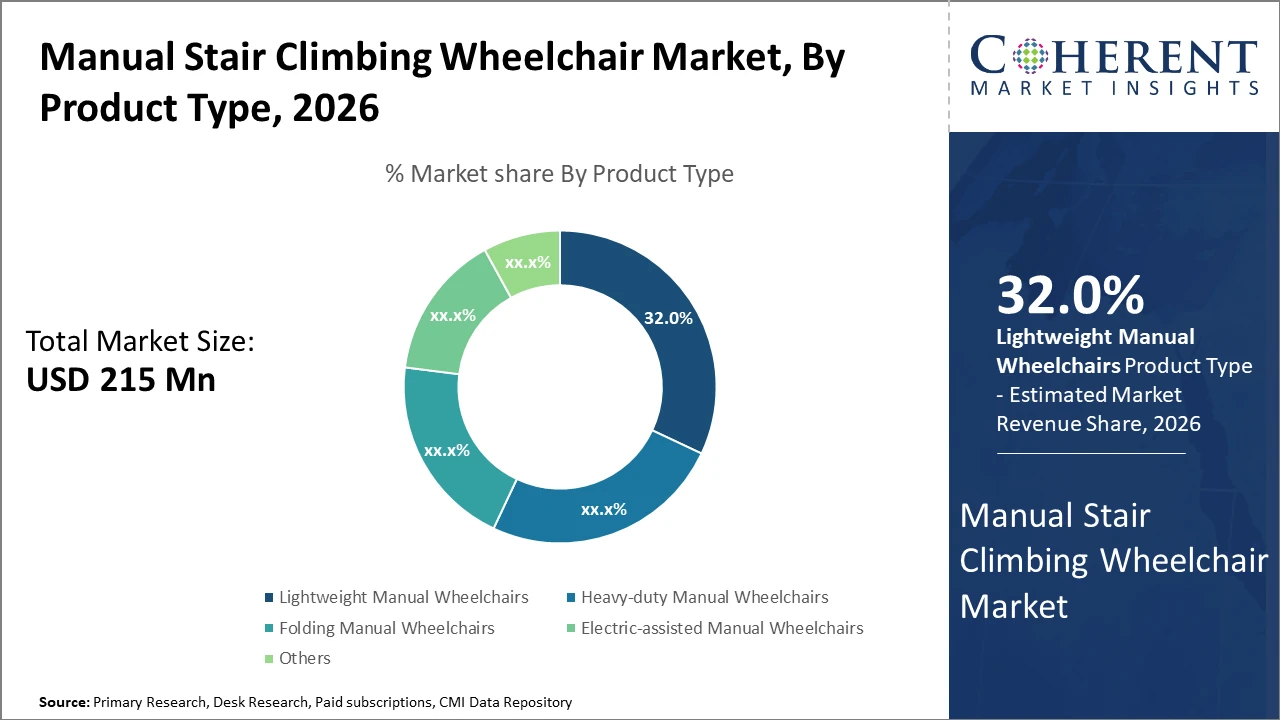
Manual Stair Climbing Wheelchair Market Insights, By Product Type
Lightweight Manual Wheelchairs dominate the Manual Stair Climbing Wheelchair market, accounting for approximately 32% of total market share. Their popularity is driven by ease of handling, portability, and suitability for both indoor and outdoor use, making them a preferred choice among users and caregivers. Electric-Assisted Manual Wheelchairs represent the fastest-growing segment, supported by rising demand for mobility solutions that reduce physical effort and improve user independence, particularly among elderly and rehabilitation patients. Heavy-Duty Manual Wheelchairs serve users requiring greater durability and weight capacity, while Folding Manual Wheelchairs offer enhanced convenience for transportation and storage. Specialized and customized wheelchair designs further address niche mobility requirements.
Manual Stair Climbing Wheelchair Market Insights, By Application
Rehabilitation Centers hold the largest share of the Manual Stair Climbing Wheelchair market, accounting for approximately 40% of total demand. Their dominance is supported by increasing investments in rehabilitation infrastructure, mobility recovery programs, and specialized disability care services. Clinical recommendations and government-supported healthcare initiatives further strengthen adoption within this segment. Residential usage is emerging as a rapidly growing application area, driven by aging populations and the increasing preference for home-based mobility assistance. Healthcare facilities continue to generate steady demand by integrating mobility aids into patient care programs. Additionally, outdoor accessibility services and institutional applications contribute to market growth by improving mobility and independence for individuals with physical limitations.
Manual Stair Climbing Wheelchair Market Insights, By End User
Elderly individuals represent the largest end-user segment in the Manual Stair Climbing Wheelchair market, driven by the growing global aging population and increasing need for mobility assistance to support independent living. This demographic continues to be a key contributor to market demand as age-related mobility limitations become more prevalent. Disability Support Services are the fastest-growing end-user category, supported by expanding rehabilitation programs, accessibility initiatives, and favorable government regulations promoting inclusive mobility solutions. Medical institutions utilize these wheelchairs for patient transportation and recovery assistance, while personal use is increasing due to greater awareness of mobility needs.
Manual Stair Climbing Wheelchair Market Trends
Integration of AI-assisted navigation and mobility support technologies is improving wheelchair efficiency, safety, and user experience.
Smart mobility features have contributed to higher adoption rates, with manufacturers reporting increased user acceptance and satisfaction.
Sustainability is becoming a major focus, with companies adopting eco-friendly materials and environmentally responsible manufacturing processes.
Personalized wheelchair designs tailored to individual mobility requirements are gaining popularity, enhancing comfort and functionality.
Growing clinical evidence supporting customized mobility solutions is encouraging wider adoption among rehabilitation centers and healthcare providers.
Increasing emphasis on accessibility, independence, and quality of life is driving innovation in advanced manual stair climbing wheelchair technologies.
Manual Stair Climbing Wheelchair Market Insights, By Geography
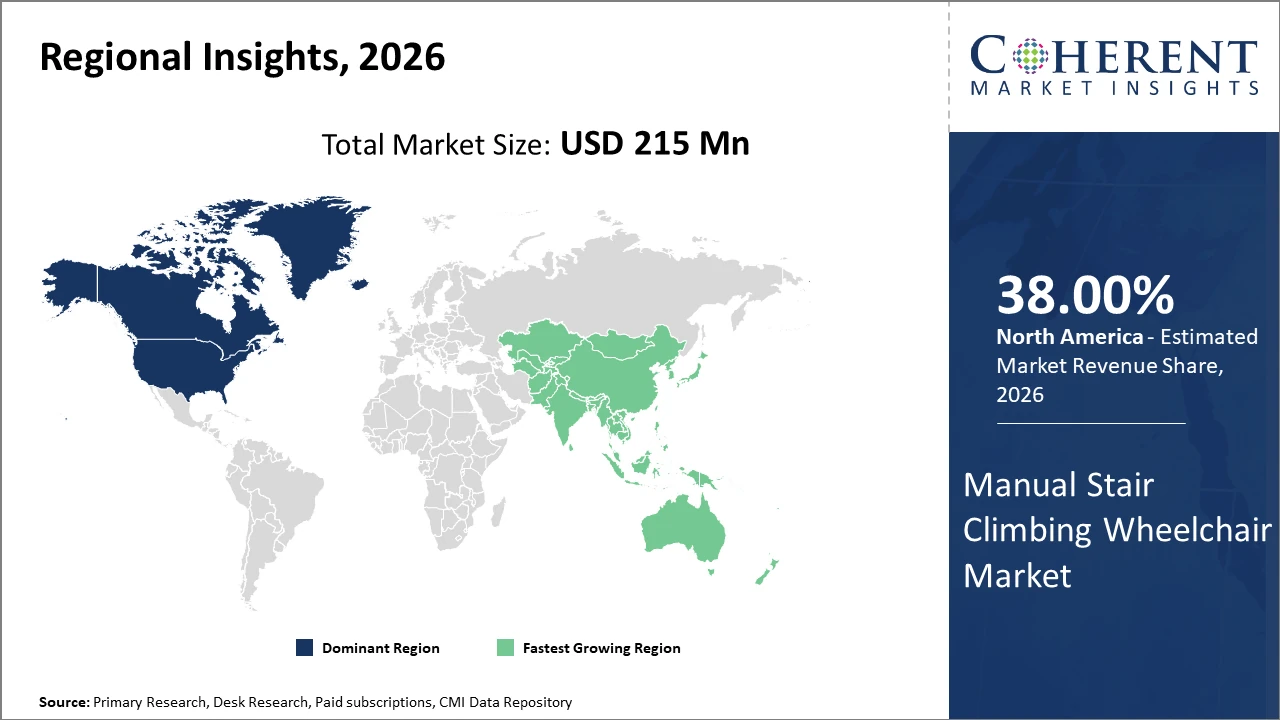
North America Manual Stair Climbing Wheelchair Market Analysis and Trends
North America holds approximately 38% of the global Manual Stair Climbing Wheelchair market share, supported by a well-established healthcare infrastructure and strong regulatory frameworks for assistive mobility devices. Favorable reimbursement policies and government initiatives promoting disability inclusion further encourage product adoption. The growing elderly population in the U.S. and Canada is a key demand driver, increasing the need for advanced mobility solutions. Leading manufacturers actively invest in research and development, technological innovation, and strategic partnerships with healthcare providers to strengthen their market position. These factors collectively reinforce North America’s dominance and ensure steady market growth across the region.
Asia Pacific Manual Stair Climbing Wheelchair Market Analysis and Trends
Asia Pacific is expected to be the fastest-growing region in the Manual Stair Climbing Wheelchair market, registering a CAGR of over 9% during the forecast period. Growth is driven by expanding healthcare infrastructure, increasing awareness of mobility assistance solutions, and a rapidly growing elderly population, particularly in countries such as India and China. Rising disposable incomes and improving access to healthcare services are further supporting product adoption. Government initiatives promoting accessibility, disability inclusion, and elderly care are creating favorable market conditions. Additionally, collaborations between regional companies and international manufacturers are enhancing product availability, technological advancement, and market penetration across the region.
Manual Stair Climbing Wheelchair Market Outlook for Key Countries
USA Manual Stair Climbing Wheelchair Market Analysis and Trends
The United States is a key revenue contributor in the Manual Stair Climbing Wheelchair market, driven by early adoption of advanced mobility assistive technologies and a strong reimbursement ecosystem. Growing awareness of accessibility solutions and well-developed healthcare infrastructure further support market expansion. In 2025, healthcare institutions recorded a 15% increase in procurement of stair climbing mobility aids, reflecting rising demand across rehabilitation and elderly care settings. Leading companies benefit from extensive distribution networks and strategic partnerships with hospitals and rehabilitation centers. Additionally, supportive regulatory frameworks and the high prevalence of mobility impairments continue to drive sustained demand growth in the U.S. market.
Germany Manual Stair Climbing Wheelchair Market Analysis and Trends
Germany represents a significant market for Manual Stair Climbing Wheelchairs in Europe, supported by its advanced healthcare infrastructure, strong social welfare system, and high awareness of mobility assistive technologies. The country’s aging population and rising incidence of mobility impairments are key factors driving demand. Hospitals and rehabilitation centers are the primary end users, benefiting from government-backed healthcare funding and reimbursement policies. A key trend is the increasing adoption of innovative, lightweight, and electrically assisted manual stair climbing wheelchairs designed to improve patient independence and caregiver convenience. Additionally, Germany’s focus on accessibility standards and inclusive infrastructure supports steady market growth and technological adoption.
Analyst Opinion
Rising elderly populations are a key demand driver, with countries like Japan and Germany recording around 15% year-over-year growth in mobility aid procurement in 2024.
Manufacturing capacity has expanded significantly, with Asia-based production hubs increasing output by over 20% in 2025 to meet global demand, while competitive pricing strategies are shaping adoption in key markets like the U.S.
Product innovation is accelerating, with lightweight materials, improved battery efficiency, and AI-assisted navigation features driving a 30% increase in adoption of advanced models in 2026.
Expanding end-use applications across homecare, hospitals, and rehabilitation centers are boosting market penetration, including a 25% rise in imports to Canadian rehabilitation centers in 2025.
- Current Industry Events of 2026
- Market Size Estimation
- Regional Breakdown
- Competitive Landscape
- Customer Intelligence
- Segmental Analysis
- Pricing Analysis
- Key Market Drivers, Challenges & Future Trends
- Customized Insights Section
Market Scope
| Report Coverage | Details | ||
|---|---|---|---|
| Base Year: | 2025 | Market Size in 2026: | USD 215 million |
| Historical Data for: | 2020 To 2024 | Forecast Period: | 2026 To 2033 |
| Forecast Period 2026 to 2033 CAGR: | 7.8% | 2033 Value Projection: | USD 370 million |
| Geographies covered: |
| ||
| Segments covered: |
| ||
| Companies covered: | Invacare Corporation, Permobil AB, Convaid Inc., Meyra GmbH, Karman Healthcare, Apex Medical Corporation, SpinLife LLC, Medline Industries Inc., Carex Health Brands | ||
| Growth Drivers: |
| ||
Manual Stair Climbing Wheelchair Market Growth Factors
The Manual Stair Climbing Wheelchair market is primarily driven by the rising global aging population, with the World Health Organization reporting a 12% increase in elderly individuals requiring mobility assistance between 2024 and 2026. Advancements in lightweight materials and compact designs have improved portability and reduced user fatigue, leading to a 22% rise in foldable model sales across North America and Europe in 2025. Government initiatives supporting accessibility and disability inclusion, along with enhanced reimbursement policies in the U.S., are improving affordability and adoption rates. Additionally, growing awareness campaigns and healthcare infrastructure investments in emerging markets like India and Brazil are expanding market reach.
Manual Stair Climbing Wheelchair Market Development
In March 2026, a wheelchair user and mechanical engineering graduate from Veermata Jijabai Institute of Technology (VJTI), Mumbai, developed a compact robotic wheelchair capable of climbing stairs and navigating uneven terrain.
Key Players
Leading Companies of the Market
Invacare Corporation
Permobil AB
Convaid Inc.
Meyra GmbH
Karman Healthcare
Apex Medical Corporation
SpinLife LLC
Medline Industries Inc.
Carex Health Brands
Market players in the Manual Stair Climbing Wheelchair market are increasingly focusing on product innovation, technological integration, and strategic collaborations to strengthen their competitive position. Companies are investing in advanced mobility solutions such as AI-enabled navigation systems, lightweight materials, and improved safety mechanisms to enhance user experience and differentiate their offerings. For instance, partnerships between manufacturers and technology firms are enabling smarter and more efficient wheelchair designs, driving higher adoption across healthcare facilities. Additionally, mergers and acquisitions are being used to expand regional presence and distribution capabilities, particularly in North America and Europe, resulting in significant revenue growth and improved market penetration.
Manual Stair Climbing Wheelchair Market Future Outlook
The Manual Stair Climbing Wheelchair market is expected to witness steady growth in the coming years, driven by rising elderly populations, increasing mobility impairments, and growing demand for independent living solutions. Technological advancements such as lightweight materials, foldable designs, and AI-assisted navigation systems are anticipated to enhance product efficiency and user convenience. Expanding healthcare infrastructure and supportive government policies for disability inclusion will further boost market adoption, particularly in developed and emerging economies. Increasing investments in rehabilitation services and homecare solutions are also expected to support demand. Overall, the market outlook remains positive with strong growth potential across global regions.
Manual Stair Climbing Wheelchair Market Historical Analysis
The Manual Stair Climbing Wheelchair market has shown steady historical growth, driven by increasing awareness of mobility assistance solutions and rising global aging populations. Earlier adoption was concentrated in developed regions such as North America and Europe, where advanced healthcare systems and reimbursement policies supported accessibility. Over time, technological improvements in lightweight materials, folding mechanisms, and safety features enhanced product usability and expanded adoption. Growing prevalence of mobility impairments and increased rehabilitation needs further strengthened demand. Additionally, gradual expansion into emerging economies, supported by improving healthcare infrastructure and affordability of assistive devices, contributed to consistent market growth over the historical period.
Sources
Primary Research Interviews:
Orthopedic specialists, rehabilitation physicians, geriatric care experts, physiotherapists, hospital procurement managers, assistive device manufacturers, distributors, and caregivers involved in mobility aid selection and deployment.
Biomedical engineers, rehabilitation technology researchers, assistive mobility device designers, regulatory consultants, clinical investigators, and R&D directors specializing in stair climbing wheelchairs, mobility assistive technologies, ergonomic design, and rehabilitation equipment innovation.
Magazines:
Mobility Management – Insights into mobility solutions, assistive device innovations, and rehabilitation equipment trends.
Rehabilitation Management – Coverage of rehabilitation technologies, patient mobility solutions, and assistive care advancements.
Occupational Therapy Products – Updates on assistive devices, homecare mobility solutions, and accessibility technologies.
Journals:
Disability and Rehabilitation – Research on mobility impairment solutions, assistive technologies, and rehabilitation outcomes.
Journal of Rehabilitation Research and Development – Studies focused on assistive mobility devices, wheelchair innovation, and functional independence solutions.
Assistive Technology – Research related to mobility aids, accessibility solutions, and user-centered assistive device design.
Newspapers:
Financial Times – Coverage of healthcare investments, mergers and acquisitions, and medical device industry growth trends.
Reuters – Reporting on assistive device launches, regulatory approvals, and healthcare accessibility developments.
Bloomberg – Insights into strategic partnerships, technological innovation, and expansion activities among mobility aid manufacturers.
Associations:
RESNA – Research on assistive technology standards, mobility devices, and rehabilitation engineering innovations.
World Federation of Occupational Therapists – Global perspectives on rehabilitation practices, assistive mobility solutions, and occupational therapy standards.
International Society for Prosthetics and Orthotics – Research and guidelines on mobility aids, assistive devices, and rehabilitation technologies.
Get access to 250+ pages report
Every segment, forecast, competitor profile and data table behind the analysis above — available for instant download.
- ESOMAR Member
- ISO 9001:2015 Certified
- D-U-N-S Registered
- GDPR & CCPA Compliant
Missing comfort of reading report in your local language? Find your preferred language:
Transform your Strategy with Exclusive Trending Reports
Frequently Asked Questions
The market is led by key manufacturers such as Invacare Corporation, Sunrise Medical, and Permobil AB. These companies maintain strong market positions through continuous product innovation, global distribution networks, and strategic partnerships across healthcare systems.
The Manual Stair Climbing Wheelchair market is projected to grow from USD 215 million in 2026 to USD 370 million by 2033, reflecting a CAGR of 7.8% during the forecast period.
Elderly individuals represent the largest growth opportunity.
Market trends will be shaped by AI-enabled mobility assistance, lightweight and eco-friendly materials, ergonomic customization, and improved foldable designs, enhancing user convenience and adoption across both residential and institutional applications.
Market trends will be shaped by AI-enabled mobility assistance, lightweight and eco-friendly materials, ergonomic customization, and improved foldable designs, enhancing user convenience and adoption across both residential and institutional applications.
Companies primarily adopt strategies such as strategic collaborations, distribution partnerships, technological advancements, and expansion into emerging regions with high unmet mobility needs, alongside targeted healthcare institutional engagement.