

Medical Robots Market Size and Forecast — 2026 - 2033
The Global Medical Robots Market size is estimated to be valued at USD 17.8 billion in 2026 and is expected to reach USD 41.5 billion by 2033, exhibiting a compound annual growth rate (CAGR) of 12.4% from 2026 to 2033.
Overview
The Medical Robots market encompasses a wide range of robotic systems designed to assist in surgical, diagnostic, and therapeutic procedures. Surgical robots, including robotic-assisted laparoscopic and orthopedic systems, enable precision, minimally invasive operations, and reduced recovery times. Rehabilitation robots support physical therapy, aiding patient mobility and recovery through exoskeletons and assistive devices. Laboratory and pharmacy robots automate sample handling, drug dispensing, and repetitive lab tasks, improving efficiency and accuracy. Additionally, diagnostic robots utilize imaging and AI-driven analysis for early disease detection. Emerging telesurgery and robotic telepresence systems expand access to remote care, reflecting ongoing innovation and diverse product applications across healthcare settings.
Key Takeaways
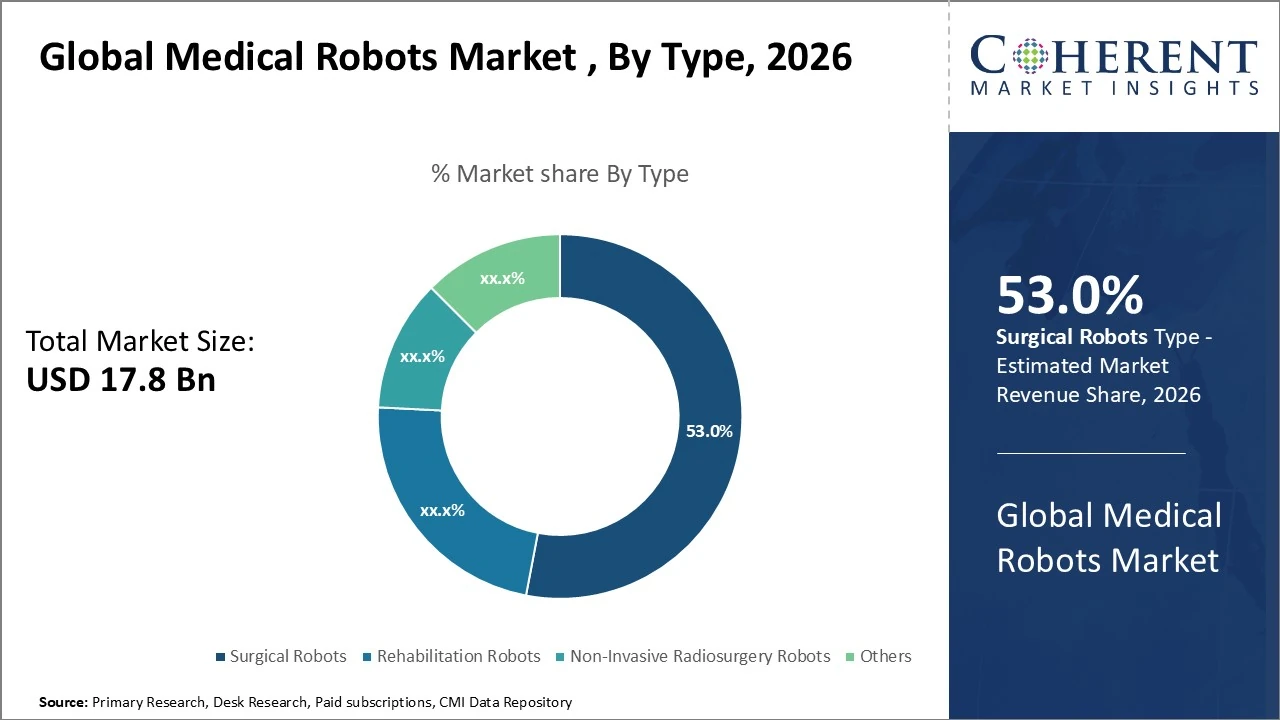
Surgical robots segment dominates the medical robots market, capturing over 53% industry share, driven by high adoption in orthopedics and general surgery.
Hospitals maintain the largest end-user segment, accounting for over 71% market share, supported by expanded budgets and infrastructure for advanced robotic systems.
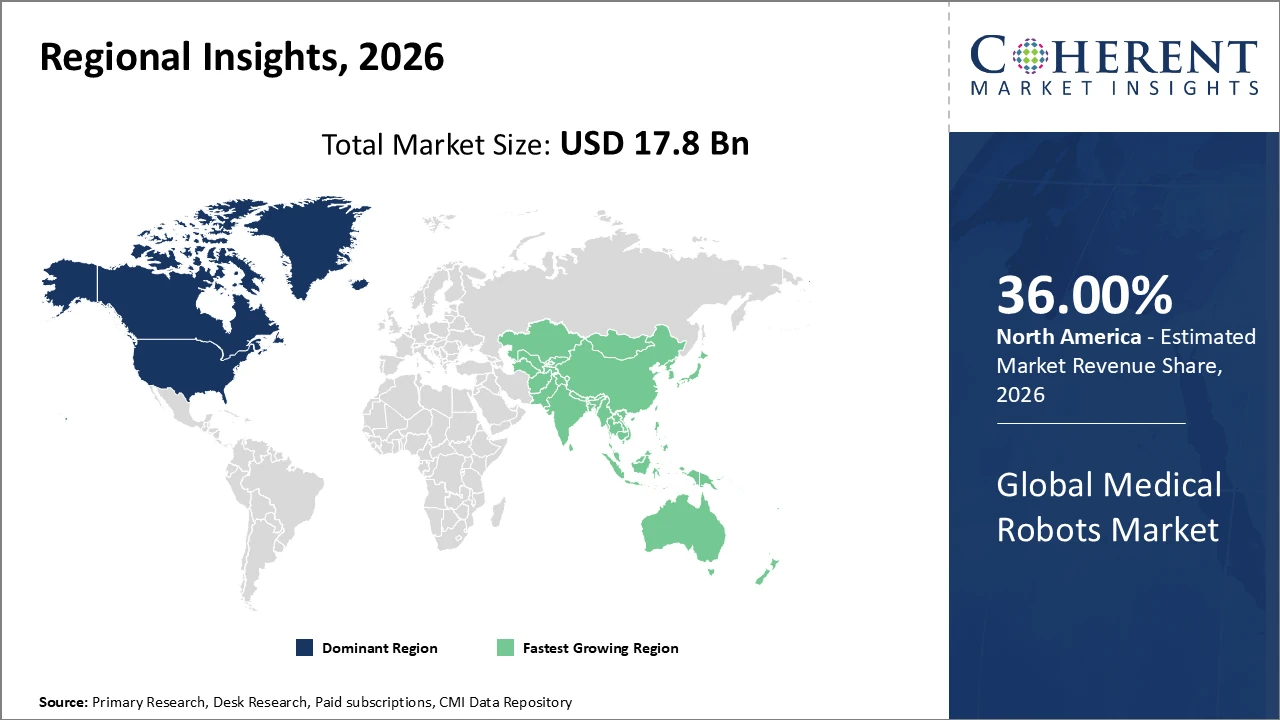
Asia Pacific is the fastest-growing region, driven by increased government initiatives in healthcare modernization and a growing number of medical facilities adopting advanced robotics.
North America remains the dominant region with approximately 36% market share, owing to early adoption, strong reimbursement frameworks, and the presence of leading market companies.
Medical Robots Market Segmentation Analysis
Medical Robots Market Insights, By Type
Surgical Robots dominate the market share, driven primarily by their extensive use in minimally invasive surgeries and continuous advancements in robotic arms and imaging technologies that enhance precision. Their ability to reduce hospital stays and accelerate patient recovery has fueled adoption across both developed and developing regions. Rehabilitation Robots are emerging as the fastest-growing subsegment, responding to increasing demand for automated therapy solutions after surgery or stroke, improving patient mobility and recovery outcomes, particularly in aging populations. Non-Invasive Radiosurgery Robots enable precise tumor ablation without traditional incisions and show promising potential through pilot programs in leading oncology centers. The ‘Others’ segment, including robotic catheter systems and diagnostic robots, adds versatility but currently accounts for a smaller share of the market.
Medical Robots Market Insights, By Application
General Surgery dominates the market share, driven by strong demand for robot-assisted laparoscopic procedures and bariatric surgeries worldwide. Its effectiveness in performing complex operations has led to increased adoption in both hospital and ambulatory settings. Orthopedics is the fastest-growing segment, benefiting from advanced robotic joint replacement systems and precise bone-cutting technologies that minimize surgical errors and open significant business opportunities. Neurosurgery employs highly specialized robotic systems for intricate brain and spinal procedures, improving outcomes in complex tumor removals. Cardiovascular applications, such as robotic-assisted coronary artery bypass and valve repair, are expanding through ongoing clinical trials, while the ‘Others’ category, including urology and gynecology procedures, continues to grow but remains relatively niche.
Medical Robots Market Insights, By End-User
Hospitals dominate the market share, driven by their ability to invest in high-cost robotic systems and provide a wide range of surgical and rehabilitative services. Strong government funding and insurance reimbursements further support the adoption of sophisticated medical devices. Ambulatory Surgery Centers are the fastest-growing subsegment, reflecting a shift toward less invasive, outpatient procedures that increasingly rely on robotic assistance. Specialty Clinics focus primarily on neurological and orthopedic robotic interventions and are expanding through partnerships with medical robot manufacturers to address niche markets. The ‘Others’ category includes rehabilitation centers and research institutions engaged in trials and training applications of medical robots.
Medical Robots Market Trends
Integration of Artificial Intelligence in robotic platforms is enhancing procedural accuracy, with 2025 data showing an 18% reduction in surgery time due to AI-assisted decision-making.
Teleoperated robotic solutions are advancing remote surgery capabilities, exemplified by successful cross-border robotic procedures in Europe during 2025, expanding access to specialized care.
Hybrid robots that combine imaging and therapeutic functions are gaining traction, as seen in Japan’s 33% increase in deploying hybrid robotic systems in 2026, enabling surgeons to perform complex interventions with improved visualization and better patient outcomes.
Medical Robots Market Insights, By Geography
North America Medical Robots Market Analysis and Trends
In North America, the Medical Robots market is dominated by advanced healthcare infrastructure, substantial research and development investment, and supportive regulatory frameworks. The United States accounts for over 28% of global market revenue, driven by the strong presence of leading companies such as Intuitive Surgical and Medtronic. Adoption of innovative robotic procedures across hospitals and specialty clinics, coupled with favorable government reimbursements, has accelerated procedural volumes and market penetration. High clinical expertise and early technology adoption further strengthen the region’s leadership. These factors collectively position North America as the largest and most mature market for medical robotics globally, with continued growth expected.
Asia Pacific Medical Robots Market Analysis and Trends
Meanwhile, the Asia Pacific region is experiencing the fastest growth in the Medical Robots market, with a CAGR exceeding 15%, fueled by expanding healthcare infrastructure and government initiatives to modernize medical facilities. Rising demand from emerging economies such as China and India, combined with an increasing prevalence of complex surgeries, is driving adoption of robotic systems. Strategic partnerships between local companies and global market leaders are facilitating technology transfer and improving accessibility. Additionally, the region benefits from growing medical tourism and a rising patient pool seeking advanced treatments, further accelerating market expansion and positioning Asia Pacific as a key growth hub for medical robotics.
Medical Robots Market Outlook for Key Countries
USA Medical Robots Market Analysis and Trends
The USA’s Medical Robots market maintains global leadership due to a well-established healthcare ecosystem, substantial investment in advanced medical technologies, and supportive reimbursement policies. Expansion of robotic surgery programs across top-tier hospitals has increased procedural volumes and driven adoption of innovative systems. Leading companies, including Intuitive Surgical, contribute over 30% of the U.S. market revenue, reflecting their strong presence and influence. By 2026, the country is projected to perform over 400,000 robotic-assisted surgeries annually, underscoring widespread clinical acceptance. These factors collectively position the USA as a key driver of global medical robotics market trends and growth.
Germany Medical Robots Market Analysis and Trends
Germany’s Medical Robots market is marked by advanced healthcare infrastructure, high adoption of robotic-assisted procedures, and strong clinical research support. Hospitals and specialty clinics are increasingly integrating surgical robots for orthopedics, neurosurgery, and general surgery, driven by precision, reduced recovery times, and improved patient outcomes. Government funding and favorable reimbursement policies encourage procurement of high-cost robotic systems, while collaborations between domestic and international companies accelerate innovation and product availability. Minimally invasive and hybrid robotic technologies are gaining traction, supporting complex interventions. These factors, combined with Germany’s skilled surgical workforce and focus on technological advancement, position the country as a leading European market for medical robotics.
Analyst Opinion
The rise in demand for minimally invasive surgeries has been a key demand-side driver, with 2024 reports showing a 26% increase in robotic-assisted surgeries in the United States, reflecting growing preference for precision-based medical interventions.
On the supply side, leading medical robot manufacturers expanded production capacity by over 30% in 2025 to meet increasing global demand, particularly in emerging healthcare markets across Asia Pacific and the Middle East.
Market pricing strategies have adapted to increased automation and AI integration, resulting in a 15% reduction in procedural costs for hospitals adopting these robots in 2026, boosting revenue.
Expanding use cases beyond surgery, including rehabilitation robots for post-stroke patients and hospital automation, increased import volumes by 21% globally in 2024, broadening market scope and share across new medical segments.
- Current Industry Events of 2026
- Market Size Estimation
- Regional Breakdown
- Competitive Landscape
- Customer Intelligence
- Segmental Analysis
- Pricing Analysis
- Key Market Drivers, Challenges & Future Trends
- Customized Insights Section
Market Scope
| Report Coverage | Details | ||
|---|---|---|---|
| Base Year: | 2025 | Market Size in 2026: | USD 17.8 billion |
| Historical Data for: | 2020 To 2024 | Forecast Period: | 2026 To 2033 |
| Forecast Period 2026 to 2033 CAGR: | 12.4% | 2033 Value Projection: | USD 41.5 billion |
| Geographies covered: |
| ||
| Segments covered: |
| ||
| Companies covered: | Intuitive Surgical, Medtronic, Stryker Corporation, Zimmer Biomet, Smith & Nephew, Johnson & Johnson, Globus Medical, CMR Surgical, Auris Health, Renishaw PLC | ||
| Growth Drivers: |
| ||
Medical Robots Market Growth Factors
The widespread adoption of minimally invasive surgical procedures continues to be the primary growth driver for the Medical Robots market, supported by a 35% increase in surgical robot installations in emerging economies in 2025. Technological advancements in AI and machine learning have enhanced robotic precision and autonomy, reducing human error and improving procedure outcomes, as evidenced by 2024 clinical trials. Regulatory support and expanding reimbursement policies in developed markets have encouraged hospitals to invest significantly in robotic technologies. Additionally, rising awareness and acceptance of robotic rehabilitation devices post-orthopedic surgeries are accelerating revenue growth, highlighted by a 29% year-over-year increase in Asia Pacific.
Medical Robots Market Development
In February 2026, King Chulalongkorn Memorial Hospital and the Faculty of Medicine, Chulalongkorn University partnered with True Digital to implement robotic solutions powered by Physical AI, enhancing patient services and advancing their transition to a fully digital hospital.
Key Players
Leading Companies of the Market
Intuitive Medical
Medtronic
Stryker Corporation
Zimmer Biomet
Johnson & Johnson
Smith & Nephew
Globus Medical
Auris Health
CMR Surgical
Renishaw PLC
Several market players have pursued aggressive growth strategies, including mergers and acquisitions, technology collaborations, and expansion of manufacturing capabilities. In 2025, Intuitive Surgical acquired CMR Surgical, enhancing its portfolio with flexible robotic arms and resulting in a 22% increase in U.S. surgical robot deployments. Similarly, Medtronic partnered with AI startups to integrate predictive analytics into its robotic systems, reducing procedure times by 18% as reported in 2024 datasets. These strategic initiatives demonstrate how leading companies leverage innovation and partnerships to strengthen market presence, improve clinical outcomes, and drive broader adoption of medical robotics globally.
Medical Robots Market Future Outlook
The Medical Robots market is expected to experience strong growth over the coming years, driven by rising demand for minimally invasive surgeries, an aging population, and expanding healthcare infrastructure in emerging economies. Advances in AI, machine learning, and hybrid robotic systems will enhance surgical precision, autonomy, and procedural efficiency. Increasing adoption of rehabilitation robots and teleoperated systems will broaden applications beyond surgery. Supportive regulatory frameworks, favorable reimbursement policies, and strategic collaborations between global and regional companies will further accelerate market penetration. Continuous innovation, reduced procedural costs, and growing awareness of robotic benefits position the market for sustained long-term expansion.
Medical Robots Market Historical Analysis
The Medical Robots market has witnessed steady growth over the past decade, driven by increasing adoption of minimally invasive and precision-based surgical procedures. Early developments focused on surgical robots for urology and general surgery, gradually expanding to orthopedics, neurosurgery, and cardiovascular applications. Technological advancements, including improved robotic arms, imaging systems, and AI integration, enhanced procedural accuracy and patient outcomes, fueling wider acceptance. North America and Europe initially dominated the market due to advanced healthcare infrastructure, strong clinical research, and supportive reimbursement frameworks. Rising awareness, growing geriatric populations, and expansion into emerging markets set the foundation for the current surge in medical robot adoption globally.
Sources
Primary Research Interviews:
Hospital procurement and surgical department managers
Rehabilitation and therapy device developers
Medical robot manufacturers and distributors
Biomedical engineers and clinical research consultants
Magazines:
Medical Device & Diagnostic Industry (MD+DI)
Orthopedics Today
Spine Technology Review
Becker’s Hospital Review – Medical Technology
Journals:
Journal of Robotic Surgery
Journal of Medical Robotics and Computer Assisted Surgery
Surgical Endoscopy
IEEE Transactions on Medical Robotics and Bionics
Newspapers:
The Wall Street Journal – Healthcare Technology
Financial Times – Medical Devices & Robotics
Reuters – Medical Technology & Robotics
Bloomberg – Healthcare Technology & Innovation
Nikkei Asia – Medical Technology & Robotic Surgery
Associations:
North American Spine Society (NASS)
International Society for the Advancement of Spine Surgery (ISASS)
American Academy of Orthopaedic Surgeons (AAOS)
European Spine Society (EuroSpine)
International Society of Medical Robotics (ISMR)
Get access to 250+ pages report
Every segment, forecast, competitor profile and data table behind the analysis above — available for instant download.
- ESOMAR Member
- ISO 9001:2015 Certified
- D-U-N-S Registered
- GDPR & CCPA Compliant
Missing comfort of reading report in your local language? Find your preferred language:
Transform your Strategy with Exclusive Trending Reports
Frequently Asked Questions
Leading market companies include Intuitive Surgical, Medtronic, Stryker Corporation, and Zimmer Biomet, all noted for their innovation-driven growth strategies.
The Medical Robots market size is projected to reach USD 41.5 billion by 2033, growing at a CAGR of 12.4% from 2026 to 2033.
Hospitals dominate end-user adoption with the most significant growth potential due to increasing surgical and rehabilitation robot investments.
Adoption of AI-enabled autonomous robots, teleoperated systems, and hybrid robotic technologies are expected to accelerate market growth and diversification.
The landscape is highly competitive with aggressive mergers and technology collaborations, while challenges include regulatory approvals and high initial capital expenditure.
Strategies include acquisitions, strategic partnerships, and enhancing product portfolios with AI and imaging integrations to sustain market leadership.