

Audiology Devices Market Size and Forecast — 2026-2033
The Audiology Devices Market size is estimated to be valued at USD 14.47 billion in 2026 and is expected to reach USD 24.80 billion by 2033, exhibiting a compound annual growth rate (CAGR) of 8.0% from 2026 to 2033.
Overview
Deafness may result from an impairment in the ear or damage to the nerves involved in hearing. Among the causes of these problems are congenital deformities, traumas, illnesses, pharmacological side effects, age-related factors, and exposure to loud noises. Audiology devices are assistive technology that improves hearing in people. These devices vary in terms of size, form, features, and hearing issues. These devices are intended to be used both for the diagnosis and treatment of hearing problems. Better diagnostic performance and treatment choices can be achieved by integrating these devices technological advancements, such as PC-based and hybrid audiometers, with standard computers and operating systems. This in turn, is expected to boost growth of the global audiology devices market in the near future.
Key Takeaways
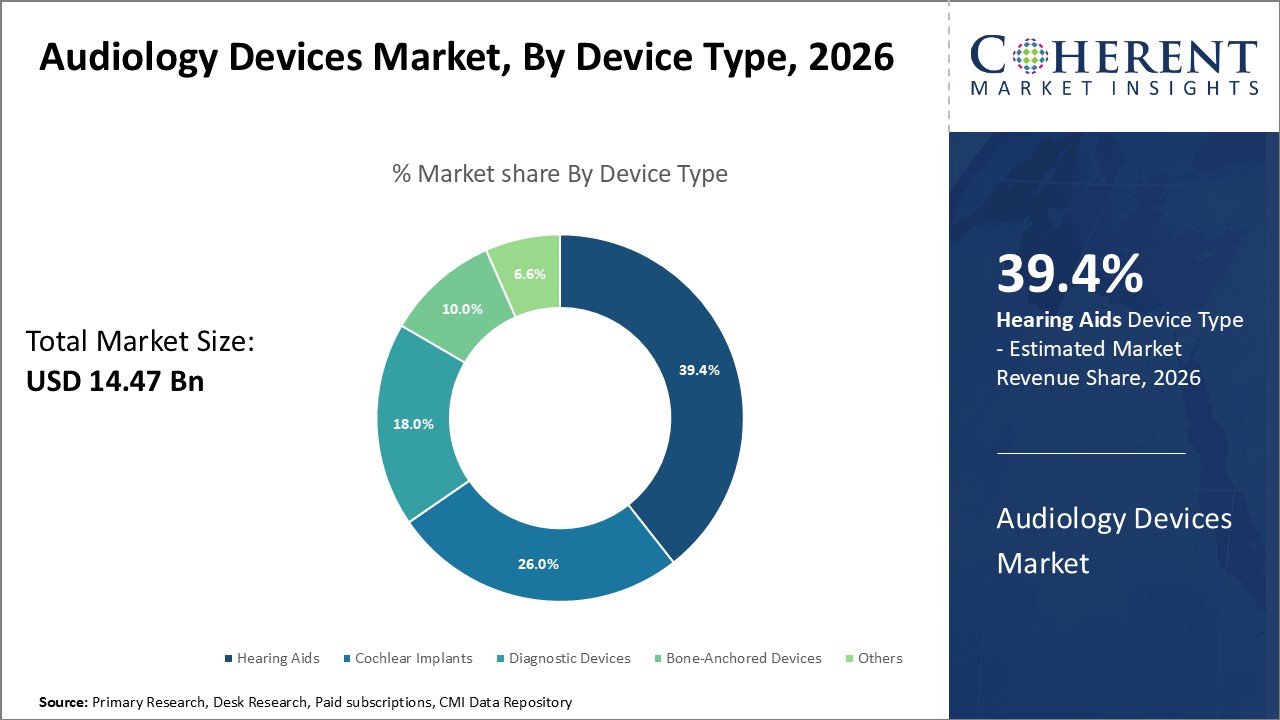
The Hearing Aids segment dominates with 39.4% industry share given its wide adoption and technological innovations like AI integration improving user customization.
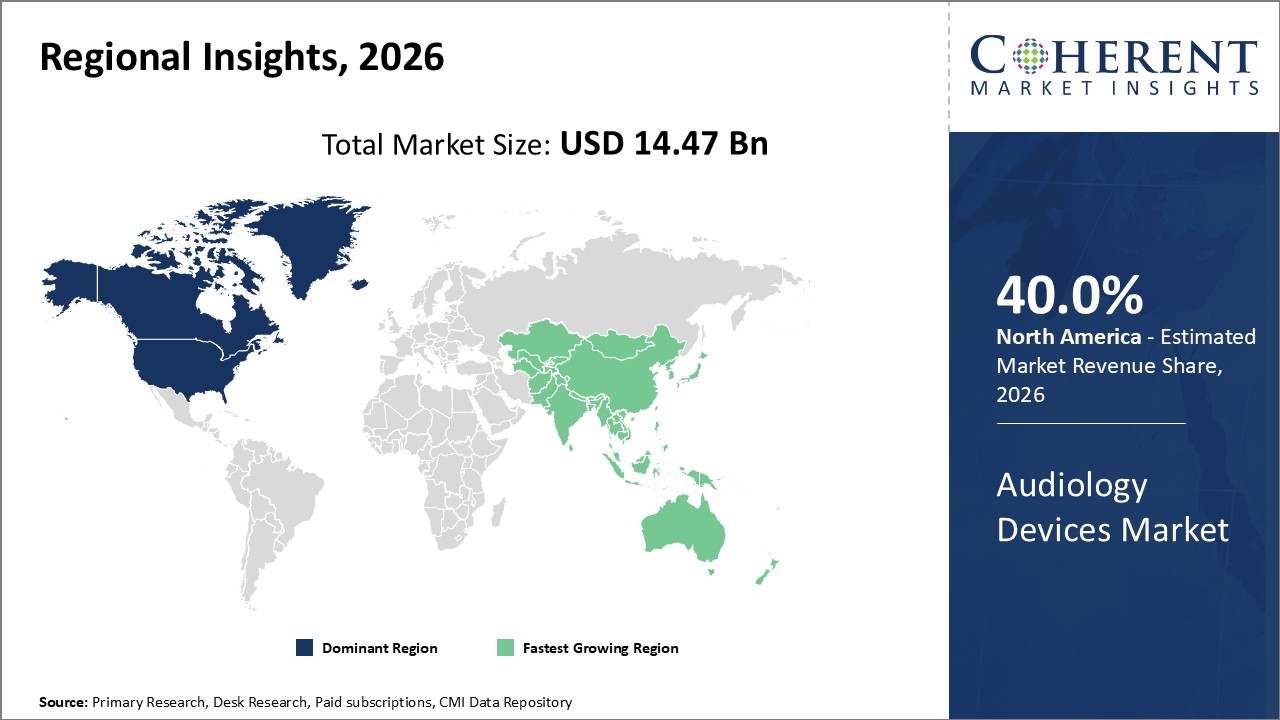
Regionally, North America holds the highest market share reflecting advanced healthcare infrastructure and reimbursement policies supporting audiology device adoption. Asia Pacific represents the fastest-growing region due to increasing healthcare investments, rising disposable income, and expanding geriatric population. Europe maintains steady growth influenced by stringent regulatory frameworks ensuring device quality and safety.
Audiology Devices Market – Segmentation Analysis
Audiology Devices Market Insights, By Device Type
Hearing aids hold a 39.4% market share, making them the most popular device kind. The dominance is ascribed to adoption-promoting technology developments like wireless networking and digital signal processing. The broad applicability of the hearing aid market across age groups and hearing loss severity highlights its significant market share. The rising incidence of hearing loss, especially in the elderly population, and developments in hearing aid technology such as AI integration, Bluetooth connectivity, rechargeable batteries, and teleaudiology services are the main causes of it.
Audiology Devices Market Insights, By Age Group
In terms of Age Group, the Geriatric segment holds the leading industry share driven by the global increase in age-related hearing impairment. Aging population data and increased health awareness contribute to sustained demand for customized audiology devices in this group. The global population aged 60 and above is expected to grow substantially in the coming years, which directly contributes to the expansion of this market segment. Additionally, technological advancements in audiology devices, including the development of smart, discreet, and AI-enabled hearing aids, are enhancing user experience and adoption rates among elderly patients.
Audiology Devices Market Insights, By Application
Due to its great incidence worldwide and the widespread usage of digital hearing aids and implants in this field of treatment, sensorineural hearing loss leads in terms of application. Better coverage of the frequency spectrum and noise filtration specific to sensorineural circumstances are guaranteed by technological progress. Damage to the auditory nerve or inner ear causes this kind of hearing loss, which is usually treated with cochlear implants and sophisticated hearing aids. The efficiency and user experience of digital hearing aids are being improved by technological developments including AI-assisted sound processing, Bluetooth connectivity, and upgraded models.
Audiology Devices Market Trends
Innovation around smart hearing devices that integrate AI and IoT capabilities is redefining user experiences.
In 2025, multi-channel streaming and adaptive noise reduction features became standard in premium hearing aids, resulting in a 16% sales increase compared to prior models.
Additionally, the rise of over-the-counter (OTC) hearing aids in the U.S., supported by new FDA regulations effective 2023, has democratized access and expanded consumer choice, triggering a market shift towards direct consumer sales and remote fitting services.
Audiology Devices Market Insights, By Geography
North America Audiology Devices Market Analysis and Trends
Strong healthcare infrastructure, insurance reimbursement rules, and a high level of knowledge regarding hearing health all contribute to the market dominance of audiology devices in North America. The U.S., where regulatory backing for over-the-counter hearing aids and telehealth reimbursements has expanded market scope, is the primary driver of the region's present over 40% market share.
Asia Pacific Audiology Devices Market Analysis and Trends
Due to growing senior populations, rising healthcare costs, and developing domestic manufacturing centers in China, Asia Pacific is growing at the quickest rate, with a compound annual growth rate (CAGR) of over 9%. This increased adoption is fueled by favorable government programs to promote hearing health and rising disposable incomes.
Audiology Devices Market Outlook for Key Countries
United States Audiology Devices Market Analysis and Trends
The USA remains the largest audiology devices market driven by high prevalence of hearing loss among its aging population and advanced reimbursement frameworks. Over 38 million Americans reportedly suffer from hearing loss, with hearing aid penetration rates steadily growing, partly due to the FDA’s 2023 OTC hearing aid regulation. Major companies such as Sonova and William Demant have intensified direct-to-consumer marketing strategies here, reflecting in a 7% year-on-year revenue growth in 2025. The USA also benefits from a comprehensive audiology ecosystem that supports early diagnosis and advanced surgical interventions like cochlear implantation.
Japan Audiology Devices Market Analysis and Trends
Japan’s audiology devices market is notable for its sizable geriatric demographic, with more than 28% of the population aged 65 and above. Government-backed hearing aid subsidies and public healthcare coverage have propelled adoption rates. Local players and subsidiaries of global market players have focused on device miniaturization and discreet designs to suit user preferences in Japan, which contributed to a 10% growth in cochlear implant sales in 2025. Innovative home-based hearing assessment programs further support expanding market revenue.
Analyst Opinion
Pricing dynamics within the audiology devices market are pivotal indicators of growth. For instance, in 2025, the average unit price for advanced hearing aids saw a marginal 4% decrease due to economies of scale from leading manufacturers, encouraging broader adoption in price-sensitive regions. This price adjustment has contributed significantly to the market revenue expansion by enabling access to mid-income groups.
Production capacity growth, especially in Asia Pacific, surged by approximately 12% year-over-year in 2025, largely driven by expanding manufacturing hubs in India and China. This increase has helped balance supply chain disruptions witnessed earlier in the decade while meeting the escalating demand for entry-level audiology devices.
From a demand-side perspective, the rise in age-related hearing loss is a strong driver. Recent health data from 2026 indicates a 25% uptick in the adult population (age 65+) seeking hearing assessments, predominantly in North America and Europe. This demographic shift is expected to fuel robust market share gains for hearing aids and implantable devices.
Import/export trends also highlight emerging markets’ appetite for audiology products. For example, Southeast Asia’s import volume of cochlear implants increased by 19% in 2025, signalling untapped geographic segments with promising growth potential.
- Current Industry Events of 2026
- Market Size Estimation
- Regional Breakdown
- Competitive Landscape
- Customer Intelligence
- Segmental Analysis
- Pricing Analysis
- Key Market Drivers, Challenges & Future Trends
- Customized Insights Section
Market Scope
| Report Coverage | Details | ||
|---|---|---|---|
| Base Year: | 2025 | Market Size in 2026: | USD 14.47 billion |
| Historical Data for: | 2020 To 2024 | Forecast Period: | 2026 To 2033 |
| Forecast Period 2026 to 2033 CAGR: | 8.0% | 2033 Value Projection: | USD 24.80 billion |
| Geographies covered: |
| ||
| Segments covered: |
| ||
| Companies covered: | Sonova Holding AG, William Demant Holding A/S, GN Store Nord A/S, Cochlear Limited, Starkey Hearing Technologies, Sivantos Pte. Ltd., Med-El, Amplifon S.p.A., Widex A/S, Oticon A/S. | ||
| Growth Drivers: |
| ||
Audiology Devices Market Growth factors
The increasing prevalence of hearing disorders globally remains a principal growth driver. According to WHO data from 2026, over 430 million people suffer from moderate to profound hearing loss, accelerating demand for audiology devices. Secondly, technological advancements such as digitization, miniaturization, and wireless connectivity have enhanced device performance, attracting tech-savvy consumers.
Thirdly, the growing geriatric population, particularly in developed nations, is a consistent demand booster; countries like Japan and Germany have seen over 30% of their senior population adopt hearing aids by 2025. Lastly, rising government healthcare initiatives and insurance reimbursements for hearing care are improving affordability and accessibility, especially in North America and Europe.
Audiology Devices Market Developments
In July 2026, An Australian implant manufacturer is taking use of Hainan's unique medical tourism zone to offer quicker access to its newest gadget, as the number of Chinese people suffering from hearing loss continues to rise. Through Hong Kong and the southern island province of Hainan, Cochlear launched its new smart system in China.
In August 2025, A new age of hearing aids based on real-time AI technology has begun with the announcement by Sonova Holding AG of the debut of two new platforms under the company's main brand, Phonak: Audéo Infinio and Audéo Sphere Infinio. Sonova's innovative and exclusive dual-chip technology is the foundation of Audéo Sphere Infinio. One of the two new chips processes sound using real-time artificial intelligence. In addition to helping to enhance speech comprehension and conversation quality, this innovation establishes new benchmarks for sound quality, connectivity, and battery management all essential requirements for those who have hearing loss.
Key Players
Sonova Holding AG
William Demant Holding A/S
GN Store Nord A/S
Cochlear Limited
Starkey Hearing Technologies
Sivantos Pte. Ltd.
Med-El
Amplifon S.p.A.
Widex A/S
Oticon A/S
Numerous prominent businesses have put aggressive market expansion plans into place, emphasizing product innovation and growing direct-to-consumer sales channels. As an illustration, Sonova Holding AG's 2025 introduction of AI-powered customized hearing aids boosted its market share in North America by more than 5% in only a single year. Strategic acquisitions are another noteworthy approach.
Cochlear Limited increased its market share in emerging regions by purchasing regional distributors, which resulted in a 21% increase in sales from Asia Pacific and Latin America in 2025. These rivalry tactics show how the market environment for audiology equipment is still being shaped by innovation and global expansion.
Audiology Devices Market Future Outlook
The market for audiology devices will grow significantly in the future due to rising global demand for hearing care products and technological advances.
Device performance and user experience will be greatly improved by innovations like rechargeable hearing aids, AI-driven sound optimization, and improved wireless connectivity.
The integration of tele-audiology and remote monitoring platforms will enhance accessibility, especially in remote and underserved regions.
Aging populations worldwide, coupled with rising awareness of hearing health and early detection programs, will continue to fuel market growth.
Additionally, expanding newborn hearing screening and school-based programs, alongside supportive government policies and improved reimbursement frameworks, will further boost adoption.
Emerging markets, particularly in Asia-Pacific, will witness accelerated growth due to increasing healthcare investments and rising middle-class populations.
Overall, the market will benefit from personalized, discreet, and smart hearing devices embedded in comprehensive digital healthcare ecosystems, leading to sustained expansion in the coming years.
Historical Analysis
According to a historical review, the market for audiology devices grew steadily due to technological advancements and growing awareness of hearing problems. Recent demographic changes, including aging populations and an increase in the prevalence of hearing loss in all age groups, contributed to the market's notable growth. Improved neonatal screening programs and early intervention for pediatric hearing loss helped the market grow.
Technological advancements, including digital hearing aids and bone-anchored hearing systems, enhanced device functionality, led to wider adoption. North America and Europe were dominant regions historically, benefited from advanced healthcare infrastructure and government initiatives. The market's compound annual growth rate (CAGR) was in the range of approximately 5.5% to over 7% across different reports in recent years, highlighted consistent demand for diagnostic, treatment, and management devices in auditory health. Overall, market growth reflected a combination of increased patient acceptance, expanding product portfolios by key players, and supportive healthcare policies.
Sources
Primary Research interviews:
Hearing Aid Dispensers
Hospital Procurement Managers
Retail Hearing Aid Centers
Databases:
Web of Science
ScienceDirect
JSTOR
Magazines:
Hearing Health Magazine
ENT & Audiology News
Hearing Loss Magazine
Journals:
Trends in Hearing
Hearing Research
Journal of Speech, Language, and Hearing Research
Newspapers:
The Guardian (Health Section)
The Times of India (Health Section)
The Wall Street Journal (Health & Science)
Associations:
European Federation of Audiology Societies
American Speech-Language-Hearing Association
British Society of Audiology
Get access to 250+ pages report
Every segment, forecast, competitor profile and data table behind the analysis above — available for instant download.
- ESOMAR Member
- ISO 9001:2015 Certified
- D-U-N-S Registered
- GDPR & CCPA Compliant
Missing comfort of reading report in your local language? Find your preferred language:
Transform your Strategy with Exclusive Trending Reports
Frequently Asked Questions
The market leaders include Sonova Holding AG, William Demant Holding A/S, GN Store Nord A/S, Cochlear Limited, and Starkey Hearing Technologies among others, commanding significant market share through innovative products and expansion strategies.
The audiology devices market size is anticipated to grow from USD 14.47 billion in 2026 to USD 24.80 billion by 2033, driven by rising hearing impairment cases and technological advances.
The geriatric population segment offers the largest opportunity due to increased age-related hearing loss prevalence and improved adoption of advanced hearing devices.
Trends such as AI-enabled devices, OTC hearing aids, and tele-audiology will gain prominence, shifting market dynamics towards consumer-centric and remote healthcare models.
Competition emphasizes innovation, product differentiation, and geographic expansion, while challenges include high device costs and regulatory complexities across regions.
Strategies focus on product innovation, market expansion through acquisitions, direct-to-consumer sales, and partnerships with healthcare providers to enhance distribution networks.