

Medical Computer Cart Market Size and Forecast — 2026 - 2033
The Global Medical Computer Cart Market size is estimated to be valued at USD 1.2 billion in 2026 and is expected to reach USD 2.3 billion by 2033, exhibiting a compound annual growth rate (CAGR) of 9.6% from 2026 to 2033.
Overview
Medical computer cart market products include mobile workstations designed to support point-of-care computing in healthcare settings. These carts typically integrate medical-grade computers, monitors, keyboards, barcode scanners, and power systems such as lithium-ion or hot-swappable batteries. They are used for electronic health record (EHR) access, medication administration, telehealth, and clinical documentation. Products vary by configuration, including powered and non-powered carts, wall-mounted or height-adjustable designs, and specialty carts for anesthesia or medication dispensing. Key features emphasize mobility, ergonomic design, infection control, durability, and seamless integration with hospital IT systems.
Key Takeaways
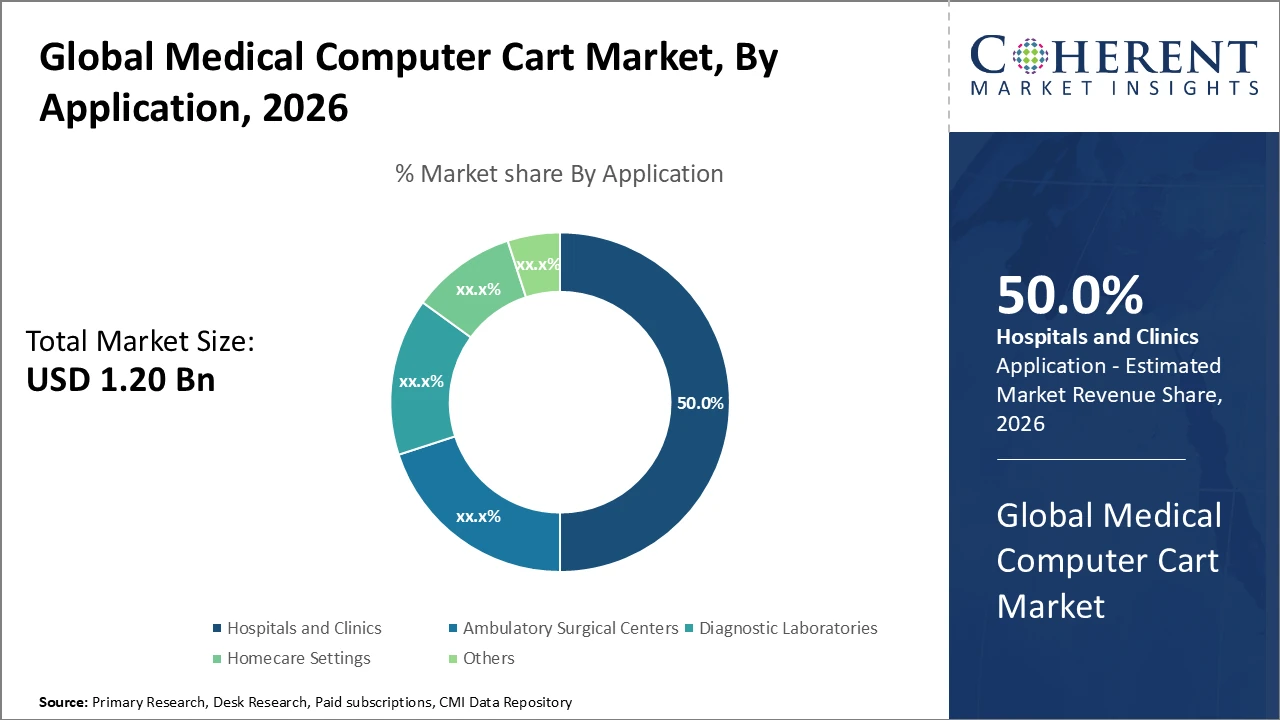
Hospital and clinics remain the dominant application segment in the Medical Computer Cart market, accounting for nearly 50% of total market revenue due to the widespread use of mobile nursing stations and bedside charting solutions.
Medical computer carts equipped with monitors represent approximately 42% of the market share, supported by improved usability, better visualization, and enhanced multitasking capabilities in clinical environments.
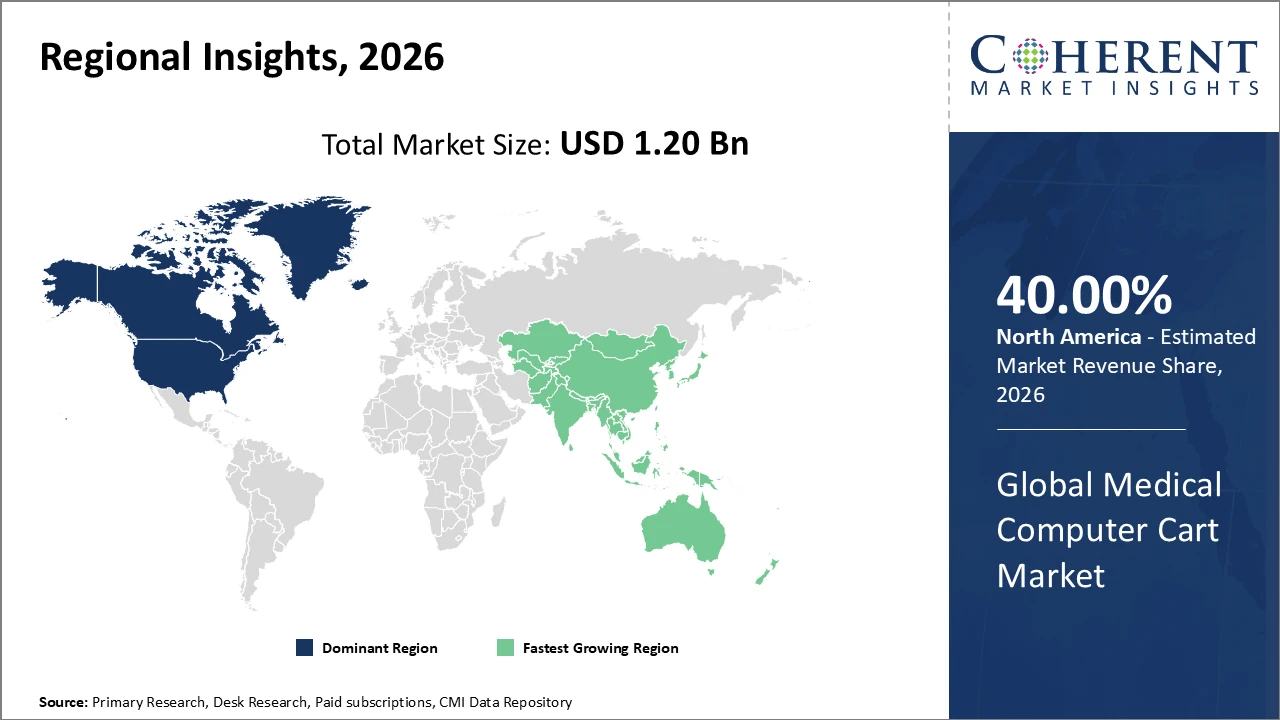
North America leads the global market with close to 40% share, driven by advanced healthcare infrastructure, high technology adoption, and strong regulatory support for digital health solutions.
The Asia Pacific region is the fastest-growing market, registering a CAGR of over 12%, fueled by rapid healthcare digitization, expansion of healthcare facilities, and increasing government healthcare investments.
Medical Computer Cart Market Segmentation Analysis
Medical Computer Cart Market Insights, By Application
Hospitals and clinics dominate the market share due to their extensive use of mobile computing solutions that enhance nursing workflows and improve bedside care documentation. The fastest-growing subsegment is ambulatory surgical centers, where the rise in outpatient procedures drives the need for mobility, efficiency, and accurate real-time data access. Diagnostic laboratories present strong growth potential, supported by increasing automation and the demand for rapid data retrieval to enable faster testing and reporting. Home care settings are gradually adopting medical computer carts to support telehealth services and remote patient monitoring. Other applications include specialized uses across pharmaceutical, research, and veterinary environments.
Medical Computer Cart Market Insights, By Product Type
Medical computer carts with monitors dominate the market with a 42% share, driven by enhanced usability for healthcare professionals who require simultaneous access to digital patient records and visualization tools, making them essential in clinical environments. The fastest-growing subsegment is mobile medical carts, supported by rising demand for flexibility in patient monitoring and efficient supply delivery across healthcare facilities. These carts are particularly suited for applications requiring lightweight, adaptable solutions in confined spaces. Medical computer carts without monitors continue to play a vital role in basic data entry and inventory management. Battery backup carts enable uninterrupted mobility during power outages, while other categories include modular and specialized carts designed for niche clinical applications.
Medical Computer Cart Market Insights, By End-User
Nurses dominate the market share due to their continuous need for mobile access to patient data, medication administration systems, and clinical documentation tools that directly influence patient outcomes. The fastest-growing subsegment is technicians, driven by their expanding involvement in diagnostics, equipment operation, and data-intensive workflows requiring reliable digital interfaces. Physicians primarily use medical computer carts for electronic health record access during ward rounds and clinical decision-making. Administrative staff employ these carts for operational activities, scheduling, and data management. Other users include ancillary healthcare professionals who benefit from mobile computing solutions across diverse clinical and support functions.
Medical Computer Cart Market Trends
The Medical Computer Cart market has experienced significant innovation through modular designs that enable multi-functionality and support a wide range of clinical workflows.
Increasing adoption of seamless software integration, including AI-enabled solutions for predictive maintenance and real-time asset tracking, is transforming operational efficiency and market dynamics.
By 2025, more than 35% of medical computer carts deployed in North American hospitals were equipped with IoT sensors connected to centralized asset management systems, helping reduce equipment downtime by approximately 20%.
A growing shift toward energy-efficient and environmentally sustainable cart designs is aligning with healthcare sustainability objectives, accelerating adoption across European and Asia Pacific markets.
Medical Computer Cart Market Insights, By Geography
North America Medical Computer Cart Market Analysis and Trends
In North America, dominance in the Medical Computer Cart market is driven by advanced healthcare infrastructure, high adoption of mobile healthcare IT solutions, and a stringent regulatory framework that supports technological innovation. The region accounts for approximately 40% of the global market share, reinforced by the strong presence of leading market players and sustained investments in digital health and hospital automation initiatives.
Asia Pacific Medical Computer Cart Market Analysis and Trends
Meanwhile, the Asia Pacific region demonstrates the fastest growth in the Medical Computer Cart market, registering a CAGR exceeding 12%. This growth is supported by rising healthcare expenditures, rapid expansion of hospital networks in emerging economies such as India and China, and increasing government initiatives aimed at accelerating healthcare digitization. Additionally, several prominent companies have expanded their manufacturing and distribution capabilities across the region to capitalize on the growing demand for mobile healthcare computing solutions.
Medical Computer Cart Market Outlook for Key Countries
USA Medical Computer Cart Market Analysis and Trends
The USA market maintains its leadership position, supported by advanced healthcare infrastructure, early adoption of digital technologies, and substantial investment in hospital IT systems. Leading companies such as Ergotron Inc. and Capsa Healthcare have broadened their product portfolios across the country, enabling greater mobility and automation in clinical settings. As of 2026, more than 65% of hospitals in the United States were using medical computer carts to enhance clinical workflow efficiency, contributing significantly to overall market revenue. Additionally, government incentives through initiatives such as the Health IT Modernization Act continue to accelerate digital transformation, further driving market growth and expansion.
Germany Medical Computer Cart Market Analysis and Trends
Germany’s Medical Computer Cart market is supported by strong healthcare funding and a decisive shift toward digitized patient care environments. Stringent medical device regulations encourage manufacturers to focus on quality, safety, and innovation. Market growth is largely driven by hospitals adopting mobile workstations to enhance patient care and clinical efficiency. Leading European companies have strengthened their presence through partnerships with German healthcare providers. By 2025, deployment of antimicrobial and energy-efficient carts increased by 10%, highlighting Germany’s significant contribution to the European market and its role in promoting advanced, sustainable healthcare solutions.
Analyst Opinion
Enhanced mobility and ergonomics drive market growth: Medical computer carts with adjustable heights and ergonomic designs have improved usability and reduced clinician fatigue. In 2025, hospitals reported a 15% increase in clinician efficiency after integrating these carts, boosting market revenue through better equipment deployment and user acceptance.
Rising demand from ambulatory and acute care settings: Adoption is increasing in ambulatory surgical centers and acute care hospitals due to the need for mobile charting and bedside diagnostics. By 2026, mobile nursing stations accounted for nearly 40% of cart usage in North American hospitals, reflecting notable market share expansion.
Integration capabilities with hospital IT ecosystems: Interoperability with EHR systems and telemedicine platforms has become critical. In 2024, over 60% of new medical carts included wireless connectivity features, enabling seamless data exchange and remote monitoring, driving market growth.
Regulatory compliance and infection control boost demand: Emphasis on medical device hygiene has increased the adoption of carts with antimicrobial surfaces. In 2025, select European hospitals reported a 20% reduction in hospital-acquired infections, highlighting demand for innovative, compliant solutions.
- Current Industry Events of 2026
- Market Size Estimation
- Regional Breakdown
- Competitive Landscape
- Customer Intelligence
- Segmental Analysis
- Pricing Analysis
- Key Market Drivers, Challenges & Future Trends
- Customized Insights Section
Market Scope
| Report Coverage | Details | ||
|---|---|---|---|
| Base Year: | 2025 | Market Size in 2026: | USD 1.2 billion |
| Historical Data for: | 2020 To 2024 | Forecast Period: | 2026 To 2033 |
| Forecast Period 2026 to 2033 CAGR: | 9.6% | 2033 Value Projection: | USD 2.3 billion |
| Geographies covered: |
| ||
| Segments covered: |
| ||
| Companies covered: | Ergotron Inc., Capsa Healthcare, JACO Inc., Anthro Corporation, Rubbermaid Healthcare, AFC Industries, Humancart, Hess Corporation, Medline Industries Inc., Mobile Medical Solutions | ||
| Growth Drivers: |
| ||
Medical Computer Cart Market Growth Factors
The rising prevalence of chronic diseases and an increasing geriatric population are driving demand for more efficient healthcare delivery systems, boosting the adoption of Medical Computer Carts. Integration of mobile computing solutions with EHRs improves hospital workflow efficiency, creating strong market pull. Technological advancements—such as enhanced wireless connectivity, longer battery life, and antimicrobial surfaces—have addressed key challenges related to mobility and hygiene, increasing healthcare provider confidence. Government initiatives promoting healthcare digitization, especially in developed regions, further support market growth. A 2024 survey reported that over 70% of hospitals in North America and Europe planned to expand investments in mobile technologies, driving market revenue and share.
Medical Computer Cart Market Development
In 2025, Ergotron Inc. launched a new line of ultra-lightweight, height-adjustable medical computer carts designed specifically for bedside care in hospitals and ambulatory surgical centers. These carts feature enhanced battery life, integrated wireless connectivity, and modular compartments for medical supplies, allowing healthcare professionals to access patient data and perform clinical tasks more efficiently. The innovation aimed to improve clinician mobility and reduce fatigue during long shifts, and early adoption in North American hospitals showed a measurable 12% increase in workflow efficiency.
Key Players
Leading Companies of the Market
Ergotron Inc.
Capsa Healthcare
JACO Inc.
Anthro Corporation
Rubbermaid Healthcare
AFC Industries
Humancart
Hess Corporation
Medline Industries, Inc.
Mobile Medical Solutions
Several leading companies have actively pursued growth strategies by expanding their product portfolios to include wireless-enabled and battery-integrated medical computer carts. For instance, Ergotron’s launch of compact, lightweight carts in 2025 led to a 12% increase in their market revenue, driven by higher adoption in hospitals and ambulatory care settings. Similarly, Capsa Healthcare strengthened its market presence through strategic partnerships with major hospital chains in the Asia Pacific region, enhancing distribution networks, capturing significant market share, and securing a strong competitive position in the rapidly growing mobile healthcare solutions sector.
Medical Computer Cart Market Future Outlook
The Medical Computer Cart market is poised for robust growth, driven by increasing healthcare digitization, rising chronic disease prevalence, and expanding geriatric populations. Future trends include the adoption of AI-powered carts, IoT-enabled asset tracking, and enhanced integration with EHR and telemedicine platforms to streamline clinical workflows. Demand for ergonomic, lightweight, and antimicrobial designs will continue to rise, supporting clinician efficiency and infection control. Emerging markets in Asia Pacific and Latin America are expected to witness rapid expansion due to growing hospital networks and government healthcare initiatives. Overall, innovation, sustainability, and digital integration will define the market’s trajectory in the coming years.
Medical Computer Cart Market Historical Analysis
The Medical Computer Cart market has experienced steady growth over the past decade, driven by increasing adoption of electronic health records (EHRs) and the need for mobile clinical workstations. Hospitals and clinics historically dominated demand, leveraging carts for bedside charting, medication administration, and workflow optimization. Early innovations focused on basic mobility and durability, while later developments introduced powered carts, ergonomic designs, and integrated monitors. North America led the market, supported by advanced healthcare infrastructure and high technology adoption, while Europe followed with a focus on regulatory compliance and hygiene. This historical growth set the stage for current technological advancements and global expansion.
Sources
Primary Research Interviews:
Hospital IT Managers
Nurses and Clinicians
Biomedical Engineers
Medical device Manufacturers
Databases:
WHO Health Statistics
OECD Health Data
Global Health Observatory
Magazines:
Medical Design & Outsourcing
Healthcare IT News
Healthcare Innovation
HealthTech Magazine
Journals:
International Journal of Medical Informatics
Journal of Medical Systems
Health Informatics Journal
Biomedical Engineering Online
Applied Clinical
Newspapers:
The New York Times (Health)
The Guardian (Health)
Financial Times (Healthcare)
The Hindu (Health)
Reuters Health
Associations:
Healthcare Information and Management Systems Society (HIMSS)
American Hospital Association (AHA)
Medical Device Manufacturers Association (MDMA)
European Federation of Medical Informatics (EFMI)
Get access to 250+ pages report
Every segment, forecast, competitor profile and data table behind the analysis above — available for instant download.
- ESOMAR Member
- ISO 9001:2015 Certified
- D-U-N-S Registered
- GDPR & CCPA Compliant
Missing comfort of reading report in your local language? Find your preferred language:
Transform your Strategy with Exclusive Trending Reports
Frequently Asked Questions
Leading companies include Ergotron Inc., Capsa Healthcare, JACO Inc., and Anthro Corporation, known for their robust innovation and widespread distribution.
The market is expected to grow from USD 1.2 billion in 2026 to USD 2.3 billion by 2033, driven by technological integration and expanding healthcare digitization.
Nurses represent the largest opportunity due to their ongoing need to streamline workflows and improve patient care efficiency.
Trends will center on increasing wireless connectivity, modular designs, and integration of AI-enabled asset management tools enhancing operational efficiency.
The market is competitive, with players focusing on product differentiation through technology and compliance with hygiene standards, while challenges include high initial costs and integration with legacy systems.
Strategies include partnerships with healthcare providers, expanding product innovation pipelines, and regional market penetration focused on emerging economies.