

Microhydro-Electric Systems Market Size and Forecast – 2026 to 2033
The Microhydro-Electric Systems Market is anticipated to grow at a CAGR of 3.3% with USD 3.2 Bn share in 2026 and is expected to reach USD 4.3 Bn in 2033. Rising demand for decentralized renewable energy, supportive government incentives, and growing investments in sustainable energy infrastructure drive the growth of the Microhydro-Electric Systems Market. According to our research, the Global Renewable Energy Technologies industry size is estimated to surpass USD 1,930 Bn by 2033.
Key Takeaways
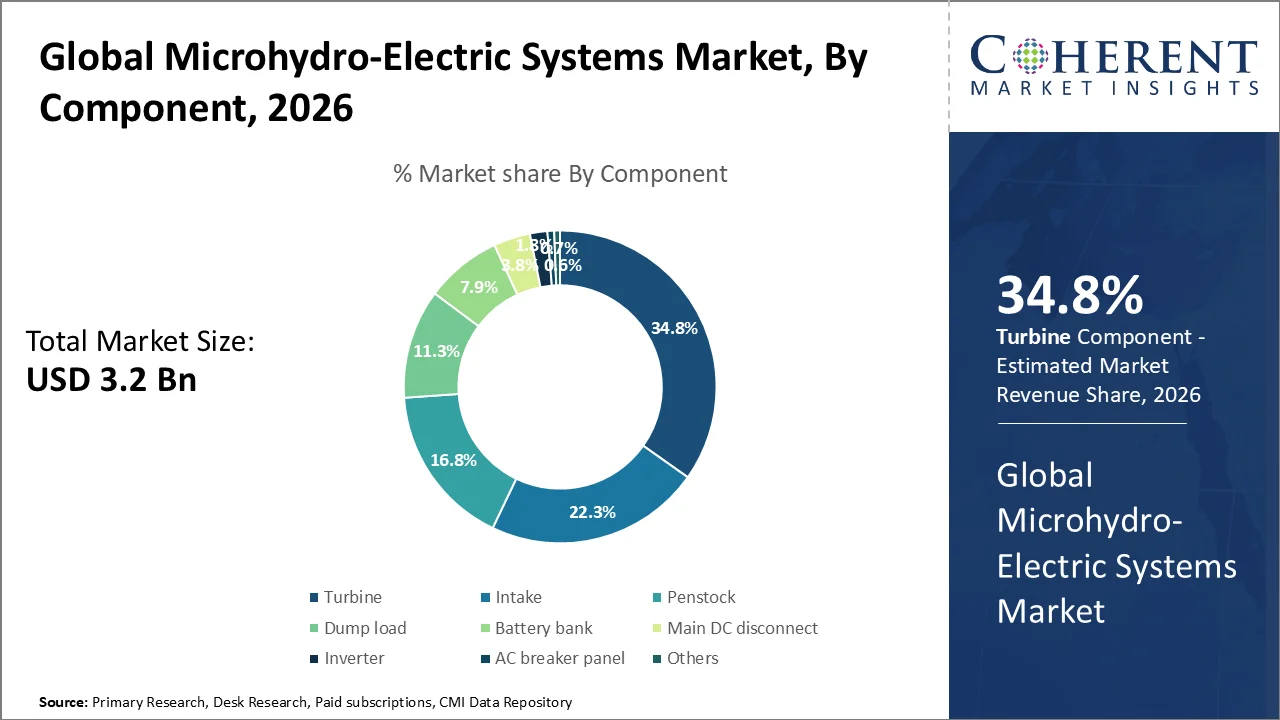
- Turbine hold the largest market share of 34.8% in 2026 owing to its growing demand for renewable energy. Global wind turbine capacity surpassed 1,346 GW, with a record 178 GW installed in 2025.
- Less than 30 kW expected to hold largest market share of 42.2% in 2026 owing to the low installation and capital costs.
- Europe is expected to acquire the dominant share of 43.3% in 2026 owing to the strong renewable energy and decarbonization policies. The European Union has set climate targets to reduce greenhouse gas emissions by 55% by 2030 and achieve net-zero emissions by 2050.
Current Events and Their Impact on the Microhydro-Electric Systems Market
Current Event | Description and its Impact |
India launched the Small Hydro Power (SHP) Development Scheme (2026–2031) |
|
European Commission introduced recommendations to expand renewable Power Purchase Agreements (PPAs) (2026). |
|
Segmental Insights
- Current Industry Events of 2026
- Market Size Estimation
- Regional Breakdown
- Competitive Landscape
- Customer Intelligence
- Segmental Analysis
- Pricing Analysis
- Key Market Drivers, Challenges & Future Trends
- Customized Insights Section
Why is Turbine Acquiring the Largest Market Share?
Turbine hold the largest market share of 34.8% in 2026. Manufacturers and project developers are driving the turbine segment of the Microhydro-Electric Systems Market by delivering efficient and reliable renewable energy solutions for both remote and grid-connected locations. They continue to improve turbine designs, increasing energy conversion efficiency, durability, and performance under varying water flow conditions while reducing maintenance requirements and overall operating costs. Governments and private investors are strengthening market growth through investments in rural electrification, decentralized power generation, and sustainable infrastructure. Furthermore, stakeholders are integrating modern turbines with hybrid renewable energy systems and existing water infrastructure, expanding their adoption across residential, commercial, agricultural, and community applications. In May 2026, Wisconsin-based startup Cadens partnered with Oak Ridge National Laboratory’s Manufacturing Demonstration Facility to develop a 3D-printed turbine system that can reduce costs and speed up deployment of small hydropower plants at existing dams.
Which Capacity segment dominates the market?
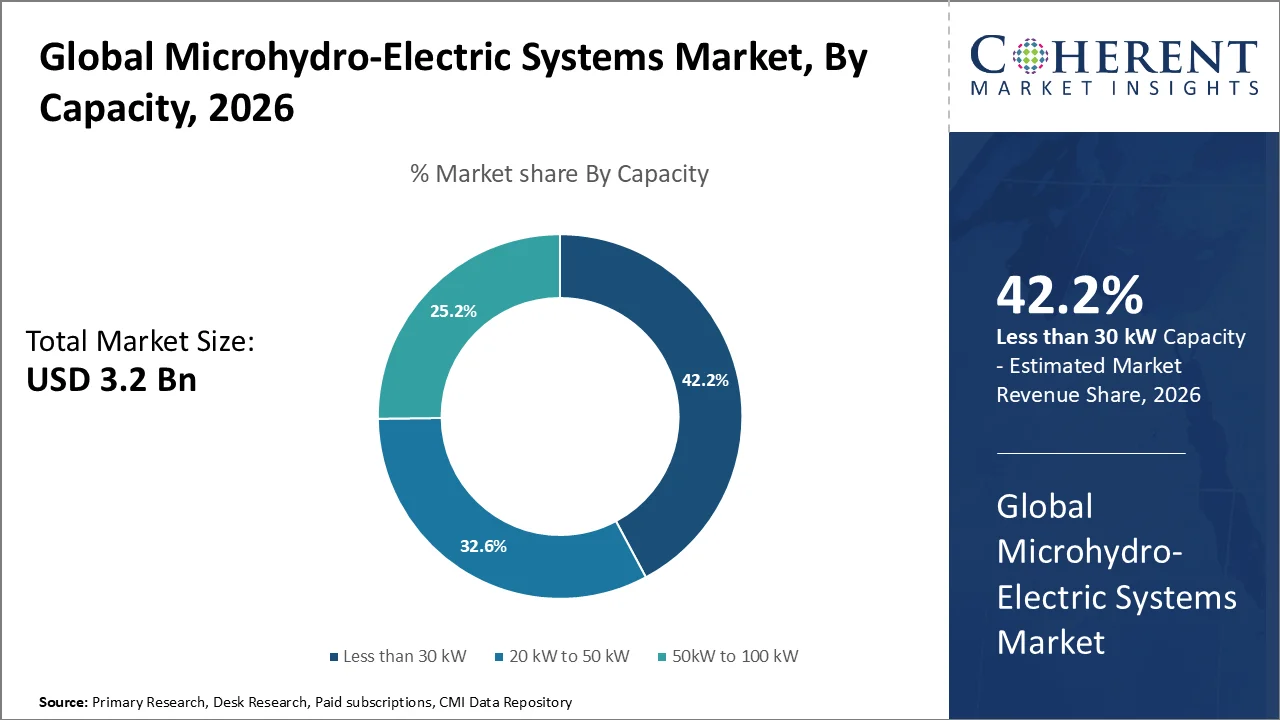
Less than 30 kW expected to hold largest market share of 42.2% in 2026. Governments, local communities, and private organizations are driving the less than 30 kW segment of the Microhydro-Electric Systems Market by investing in affordable, small-scale renewable energy solutions for rural and off-grid areas. They are expanding electricity access and reducing dependence on conventional fuels through the deployment of compact microhydro systems. Manufacturers are advancing compact turbine technology, simplifying installation processes, and reducing maintenance requirements to encourage wider adoption. End users are increasingly deploying these systems across residential, agricultural, and community applications while integrating them with hybrid renewable energy systems to improve energy reliability and efficiency.
Microhydro-Electric Systems Market Trends
- Growing adoption of decentralized renewable energy systems supports rural electrification and reliable power supply in remote and off-grid communities, reducing dependence on fossil fuel-based electricity generation. According to the International Energy Agency (IEA), approximately 685 million people worldwide lacked access to electricity in 2022, with around 80% living in Sub-Saharan Africa, highlighting the continued need for decentralized renewable energy solutions, including microhydro systems.
- The increasing investments in rural electrification and clean energy infrastructure continue to drive market growth. According to the World Bank, achieving universal electricity access by 2030 will require annual investments of approximately USD 30 billion in electrification, with decentralized renewable energy systems expected to play a significant role in reaching remote populations. In addition, the International Hydropower Association (IHA) reports that hydropower remains the largest source of renewable electricity globally, accounting for approximately 14% of global electricity generation and more than 50% of renewable electricity generation.
- Government incentives, green financing, and supportive renewable energy policies are encouraging the deployment of microhydro projects. Many countries provide capital subsidies, concessional financing, grants, and feed-in tariffs for small hydropower development. Furthermore, the World Bank, Asian Development Bank (ADB), and United Nations Development Programme (UNDP) continue to finance community-scale hydropower and rural electrification projects across Asia and Africa, supporting the deployment of decentralized renewable energy systems in underserved regions.
Regional Insights
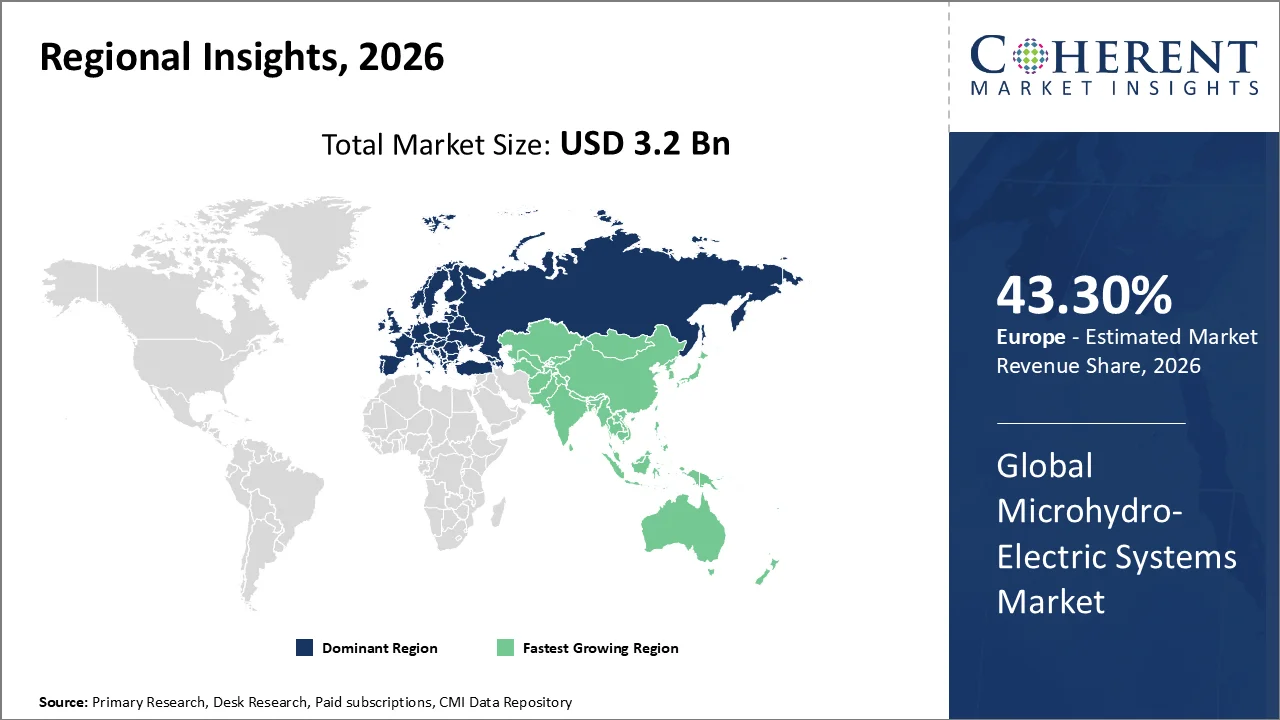
Europe dominates owing to modernization of existing hydropower infrastructure
Europe is expected to acquire the dominant share of 43.30% in 2026. Governments, utilities, and private investors are driving the Europe Microhydro-Electric Systems Market by increasing investments in renewable energy, improving energy security, and promoting decentralized power generation. They are supporting microhydro projects through favorable policies, infrastructure modernization initiatives, and sustainable energy programs. Developers are leveraging existing water resources and upgrading aging hydropower facilities to meet the growing demand for clean electricity solutions. Furthermore, manufacturers are enhancing turbine technology, smart monitoring systems, and hybrid renewable energy integration, enabling wider adoption of microhydro systems across residential, commercial, and community applications. In April 2026, Scottish Water Horizons launched Europe’s first siphon-fed hydropower project at Whiteadder Reservoir, using natural water flow to generate 199 kW of clean energy while improving reservoir compliance.
Asia Pacific Microhydro-Electric Systems Market Trends
The Asia Pacific microhydro-electric systems market gains momentum as consumers and industries seek renewable energy solutions, governments expand rural electrification programs, and communities require dependable power sources in remote locations. Countries across the region leverage abundant water resources to develop small-scale hydropower projects. Governments actively promote clean energy technologies, reduce carbon emissions, and improve energy accessibility, driving market adoption. Increasing awareness of sustainable electricity generation and continuous improvements in microhydro system efficiency further strengthen the deployment of these solutions. For instance, in December 2025, Union Minister Shri Manohar Lal inaugurated the commercial operation of Unit-2 (250 MW) of the 2,000 MW Subansiri Lower Hydroelectric Project virtually, highlighting its role in strengthening India’s clean energy transition, regional development, and Net Zero goals.
United Kingdom Microhydro-Electric Systems Market Trends
The United Kingdom microhydro-electric systems market expands as the country promotes renewable energy, decentralized power generation, and reduced reliance on conventional sources. Government initiatives, clean energy investments, and demand for sustainable electrification and energy resilience drive the adoption of microhydro-electric solutions. The UK's 2035 Clean Growth vision aims to attract clean energy investment, expand exports, accelerate commercialization of emerging technologies, strengthen resilient supply chains, and create high-quality jobs.
China Microhydro-Electric Systems Market Trends
China’s microhydro-electric systems market gains momentum as consumers and organizations seek renewable energy solutions, expand rural electrification programs, and address the need for dependable power sources in remote areas. The government promotes clean energy development, raises environmental awareness, and encourages the shift away from conventional fuels, driving wider adoption of these systems. China's 15th Five-Year Plan (2026–2030) introduces binding clean energy targets, expands large-scale solar and wind deployment, and strengthens industrial carbon-efficiency measures. Technological advancements in small-scale hydropower, enhanced system efficiency, and better integration with local energy networks further strengthen market expansion. Sustainable infrastructure initiatives also increase demand for microhydro-electric systems throughout China.
Who are the Major Companies in Microhydro-Electric Systems Industry
Some of the major key players in Microhydro-Electric Systems are Addnew Technologies Limited, Alps Power Technologies (P) Limited, Brownell Micro Hydro, Canyon Industries, Inc., Hebden Bridge Alternative Technology Centre Ltd., K.C. Larson, Inc., PowerSpout, and Rainbow Power Company Ltd.
Key News
- In June 2026, the government of India launched an online portal and a INR 2,585 crore scheme to boost small hydropower projects, attract investments, and create rural employment, especially in hill states and the Northeast.
Market Report Scope
Microhydro-Electric Systems Market Report Coverage
| Report Coverage | Details | ||
|---|---|---|---|
| Base Year: | 2025 | Market Size in 2026: | USD 3.2 Bn |
| Historical Data for: | 2020 To 2024 | Forecast Period: | 2026 To 2033 |
| Forecast Period 2026 to 2033 CAGR: | 3.3% | 2033 Value Projection: | USD 4.3 Bn |
| Geographies covered: |
| ||
| Segments covered: |
| ||
| Companies covered: | Addnew Technologies Limited, Alps Power Technologies (P) Limited, Brownell Micro Hydro, Canyon Industries, Inc., Hebden Bridge Alternative Technology Centre Ltd., K.C. Larson, Inc., PowerSpout, and Rainbow Power Company Ltd. | ||
Analyst Opinion
- Microhydro-electric systems are moving from niche rural applications to strategic decentralized energy solutions. The strongest market driver is not simply the renewable energy transition but the urgent need for resilient power infrastructure in areas where grid expansion remains costly or unreliable. The International Energy Agency highlights that hundreds of millions of people globally still lack reliable electricity access, creating a sustained opportunity for small-scale hydropower solutions that can provide continuous power with minimal environmental impact compared with diesel-based alternatives.
- The real competitive advantage of microhydro-electric systems lies in their ability to deliver stable, 24/7 renewable power rather than intermittent generation. Unlike solar and wind systems that depend on weather conditions, microhydro installations can achieve high operational availability when supported by consistent water flow. For example, projects across mountainous regions of China, Nepal, and India have demonstrated that community-scale hydropower can support households, agricultural activities, and local businesses while reducing dependence on fossil-fuel generators.
- Technological improvements are reshaping the adoption outlook for microhydro-electric systems, particularly through modular turbines, improved control systems, and low-maintenance designs. Industry experience shows that modern microhydro systems can operate effectively in small streams and irrigation channels without requiring large dam infrastructure. China’s continued investment in rural clean energy programs and decentralized power networks demonstrates how policy support and local energy needs are combining to accelerate deployment of small-scale hydropower technologies.
- The market’s future growth will depend more on project suitability and local energy economics than on broad renewable energy trends. Analysts believe regions with strong water resources, remote communities, and high diesel dependence will remain the most attractive markets. As energy security becomes a priority, microhydro-electric systems are likely to gain importance as a practical solution for reliable, community-level renewable power generation.
Speak to the analyst
Want personalized insights?
Take the findings above to one of our principal consultants, or have the report rebuilt around the segments, geographies and competitors you actually track.
Market Segmentation
- By Component (Revenue, USD Bn, 2021-2033)
- Intake
- Penstock
- Turbine
- Dump load
- Battery bank
- Main DC disconnect
- Inverter
- AC breaker panel
- Others
- By Capacity (Revenue, USD Bn, 2021-2033)
- Less than 30 kW
- 20 kW to 50 kW
- 50kW to 100 kW
- By Region (Revenue, USD Bn, 2021-2033)
- North America
- U.S.
- Canada
- Latin America
- Brazil
- Mexico
- Argentina
- Rest of Latin America
- Europe
- Germany
- U.K.
- France
- Italy
- Spain
- Russia
- Rest of Europe
- Asia Pacific
- China
- India
- Japan
- Australia
- South Korea
- ASEAN
- Rest of Asia Pacific
- Middle East
- GCC
- Israel
- Rest of Middle East
- Africa
- South Africa
- Central Africa
- North Africa
- North America
Sources
Primary Research Interviews
- Industry professionals involved in microhydro-electric system manufacturing, installation, operation, and maintenance
- Renewable energy project developers and technology providers
- Hydropower engineers, consultants, and technical experts
- Utility representatives and rural electrification stakeholders
- Government officials and regulatory representatives involved in renewable energy programs
- End users, including rural communities, agricultural operators, and industrial users adopting microhydro-electric solutions
Databases
- International Energy Agency (IEA) renewable energy and hydropower databases
- International Renewable Energy Agency (IRENA) renewable energy statistics and publications
- World Bank energy and infrastructure databases
- United Nations energy and sustainable development databases
- International Hydropower Association (IHA) data resources
- Government energy ministry and renewable energy department databases
- National electricity and power generation statistics databases
Magazines
- Renewable energy industry publications
- Hydropower technology and engineering magazines
- Energy infrastructure and sustainability magazines
- Electrical power and automation industry publications
- Rural electrification and decentralized energy magazines
Journals
- Renewable energy and sustainable energy journals
- Hydropower engineering and water resource management journals
- Energy policy and environmental science journals
- Electrical engineering and power systems journals
- Distributed generation and rural energy research journals
- Academic publications covering small-scale hydropower technologies
Newspapers
- Energy and infrastructure sections of national and regional newspapers
- Renewable energy development news sources
- Government policy and regulatory announcement platforms
- Technology and industrial development news publications
- Climate and sustainability-focused news platforms
Associations
- International Hydropower Association
- International Renewable Energy Agency
- National hydropower associations
- Renewable energy industry associations
- Electrical engineering and power sector associations
- Rural electrification and sustainable energy networks
Public Domain Sources
- Government renewable energy policies, reports, and statistical publications
- National energy plans and electricity development reports
- Environmental and sustainability reports from public institutions
- Hydropower project databases and regulatory filings
- International energy transition reports and open-access datasets
- Academic research papers and publicly available technical studies
- Publicly available feasibility studies and project documentation
Proprietary Elements
- CMI Data Analytics Tool
- Proprietary CMI Existing Repository of information for last 10 years
Get access to 250+ pages report
Every segment, forecast, competitor profile and data table behind the analysis above — available for instant download.
- ESOMAR Member
- ISO 9001:2015 Certified
- D-U-N-S Registered
- GDPR & CCPA Compliant
Missing comfort of reading report in your local language? Find your preferred language:
Transform your Strategy with Exclusive Trending Reports
Frequently Asked Questions
The microhydro-electric systems market is driven by increasing demand for decentralized renewable energy, rural electrification efforts, and the need for reliable power solutions in remote locations.
Microhydro-electric systems offer consistent power generation because they can operate continuously with a suitable water source.
Microhydro-electric systems are used for rural electrification, community power generation, agricultural operations, small industries, remote infrastructure, and hybrid renewable energy projects.
Advancements in turbine design, automation, monitoring systems, and compact modular solutions are improving efficiency and reducing maintenance requirements.
The market faces challenges such as high initial installation costs, dependence on suitable water resources, environmental regulations, and site-specific feasibility requirements.