

Wind Turbine Inspection Drones Market Size and Forecast – 2026 to 2033
The Wind Turbine Inspection Drones Market is anticipated to grow at a CAGR of 22.8% with USD 649.7 Mn in 2026 and is expected to reach USD 3,278.6 Mn in 2033. Growing wind energy installations, advances in AI, and stricter safety regulations, and the need to minimize downtime actively drive the wind turbine inspection drones market. According to the GWEC 2026 report, India ranked fourth globally in cumulative installed wind power capacity as of December 31, 2025.
Key Takeaways
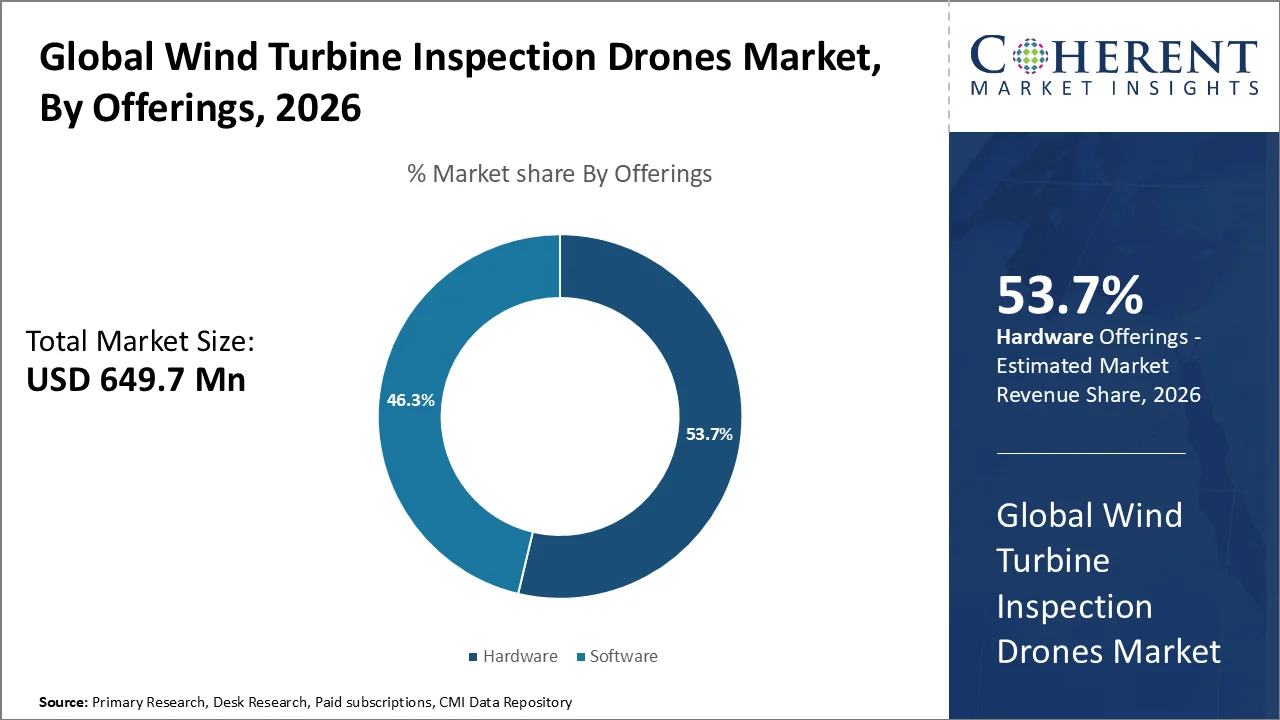
- Hardware holds the largest market share of 53.7% in 2026 owing to its expansion of global wind power capacity.
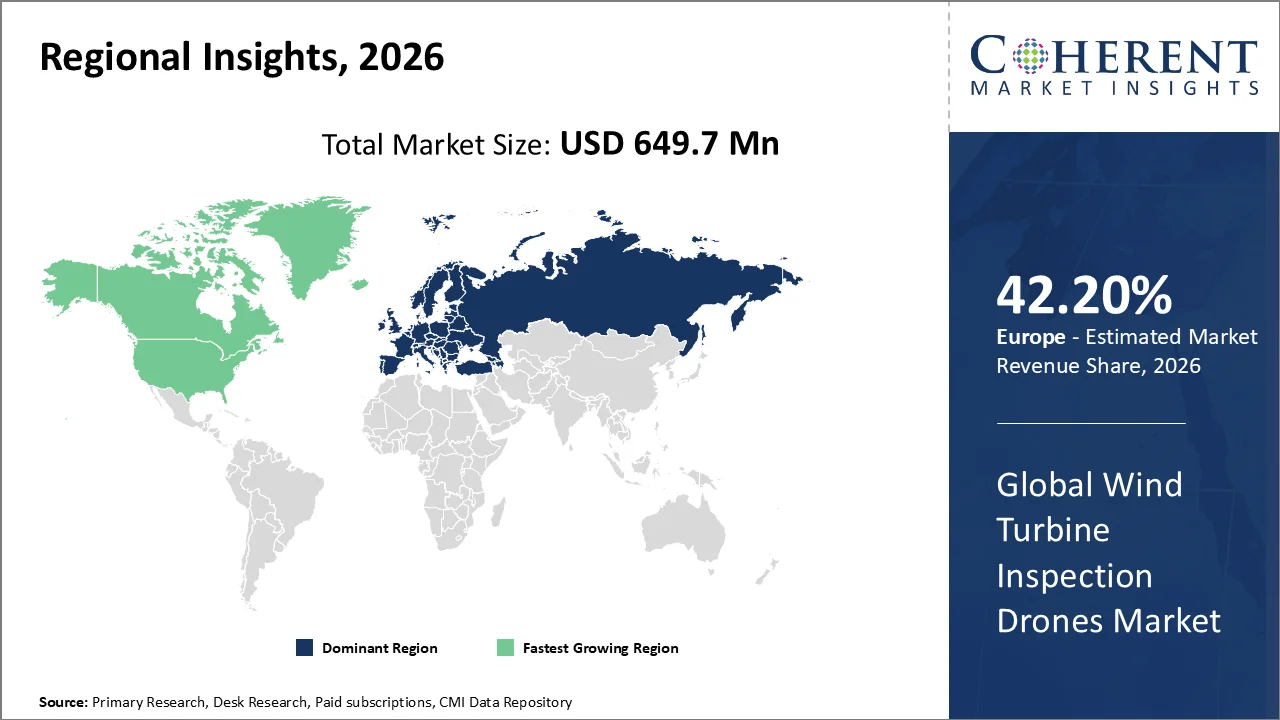
- Europe is expected to acquire the dominant share of 42.2% in 2026 owing to its large and mature installed wind-turbine base. In 2025, Europe added 19.1 GW of wind capacity, including 15.1 GW in the EU-27. Around 90% was onshore, while 2 GW was offshore. Europe’s total wind capacity reached 304 GW, including 265 GW onshore and 39 GW offshore.
Current Events and Their Impact on the Wind Turbine Inspection Drones Market
Current Event | Description and its Impact |
FAA Proposes a National Framework for Beyond Visual Line of Sight (BVLOS) Drone Operations
|
|
UK Government Moves to Reduce Regulatory Barriers for Robotic Wind-Turbine Inspection
|
|
Segmental Insights
- Current Industry Events of 2026
- Market Size Estimation
- Regional Breakdown
- Competitive Landscape
- Customer Intelligence
- Segmental Analysis
- Pricing Analysis
- Key Market Drivers, Challenges & Future Trends
- Customized Insights Section
Why is Hardware Acquiring the Largest Market Share?
Hardware holds the largest market share of 53.7% in 2026. The hardware segment of the Wind Turbine Inspection Drones Market is growing as operators demand high-performance drones equipped with advanced cameras, thermal imaging systems, LiDAR, and other sensors. Expanding wind farms, especially in remote and offshore areas, drive demand for reliable, weather-resistant, and long-endurance drone platforms. Operators use advanced hardware to enhance inspection accuracy, protect workers from hazardous conditions, reduce turbine downtime, and enable predictive maintenance. Continuous advances in autonomous navigation, imaging capabilities, and sensor integration further accelerate the adoption of sophisticated drone hardware. In April 2026, Skydio launched next-generation inspection platforms, accelerating the shift toward autonomous and scalable drone solutions. The company’s AI-powered systems help infrastructure, energy, utilities, and public safety operators improve safety, lower costs, and enhance inspection data quality.
Wind Turbine Inspection Drones Market Trends
- Growing use of advanced imaging and sensor technologies, including high-resolution cameras, thermal imaging, LiDAR, and other inspection technologies, enables operators to identify blade and structural defects more effectively. DOE's offshore-wind Operations and Maintenance Roadmap specifically identifies advanced camera systems for monitoring blade and lightning-protection-system condition and notes the use of ultrasonic inspection for nondestructive evaluation of blade damage.
- Expansion of offshore wind farms increases demand for specialized inspection drones capable of operating in remote and challenging environments. The IEA expects global offshore wind capacity additions to reach 140 GW during 2025–2030, with the annual offshore wind market increasing from 9.2 GW in 2024 to more than 37 GW by 2030. This expanding offshore asset base increases the potential requirement for inspection and condition-monitoring services.
- Increasing adoption of BVLOS and autonomous drone operations is creating opportunities for larger-scale inspection programs. Ofgem's RIIO-3 draft determination for National Grid Electricity Transmission specifically includes the planned deployment of BVLOS drones for thermographic inspections and condition-monitoring-system data collection, with delivery scheduled by 31 March 2031. Although this example concerns electricity-transmission infrastructure rather than wind turbines, it provides direct evidence of regulated infrastructure investment in BVLOS inspection technology.
Regional Insights
Europe dominates owing to advanced drone regulations and professionalization of UAV operations
Europe is expected to acquire the dominant share of 42.20% in 2026. Europe’s Wind Turbine Inspection Drones Market is expanding as governments and energy companies increase investments in offshore and onshore wind capacity and clean-energy infrastructure. Europe’s extensive and aging turbine fleet drives operators to adopt efficient inspection and maintenance solutions. Offshore wind projects further accelerate drone adoption because operators face remote locations, harsh weather, and costly vessel access. Wind-farm operators also prioritize worker safety, predictive maintenance, reduced downtime, and advanced inspection technologies, while Europe’s growing drone-service ecosystem strengthens the deployment of drone-based turbine inspection solutions. In May 2026, Dutch NDT specialist Ned Marine launched drone- and ROV-based inspection services for vessels, offshore installations, and industrial assets, combining aerial and subsea technologies with visual inspections and ultrasonic thickness measurements.
North America Wind Turbine Inspection Drones Market Trends
North America’s wind turbine inspection drone market is gaining momentum as wind energy infrastructure expands, turbine fleets age, and operators seek to lower maintenance costs and minimize downtime. Companies increasingly use AI-powered cameras, thermal imaging, LiDAR, and automated analytics to detect defects more accurately and efficiently. AVES Wind Onshore uses an AI-powered camera system to detect birds and track their flight paths. When a potential collision is identified, the system temporarily stops the turbine’s rotor until the bird has moved out of the danger zone, helping reduce bird collisions while supporting continued wind-energy development. Drones also improve worker safety by limiting the need for rope-access inspections. Expanding offshore wind projects, growing demand for predictive maintenance, stronger safety requirements, and evolving BVLOS regulations continue to encourage adoption across the United States and Canada.
United Kingdom Wind Turbine Inspection Drones Market Trends
The United Kingdom wind turbine inspection drones market is gaining momentum as offshore wind capacity expands and operators seek safer, faster, and more cost-effective maintenance solutions. Companies increasingly use drones to minimize inspection downtime and operating expenses, particularly for offshore turbines where vessel access and limited weather windows complicate conventional inspections. Improvements in high-resolution cameras, thermal imaging, AI-powered defect detection, and autonomous flight technologies help operators identify faults more accurately. Meanwhile, evolving UK Civil Aviation Authority regulations supporting beyond-visual-line-of-sight operations are encouraging wider adoption of drone-based turbine inspections. BAE Systems successfully test-fired a low-cost precision weapon from a Eurofighter Typhoon in the UK with RAF support, demonstrating efforts to develop affordable weapons against uncrewed aerial systems.
United States Wind Turbine Inspection Drones Market Trends
The United States wind turbine inspection drones market is gaining momentum as wind energy capacity expands and operators seek safer, faster, and more efficient maintenance methods. Wind farm operators increasingly deploy drones to inspect extensive onshore turbine fleets while reducing the risks associated with manual inspections. Technological advances in high-resolution imaging, thermal sensors, LiDAR, and AI-powered defect detection enable operators to identify faults accurately and improve maintenance planning. Stronger safety requirements and evolving Federal Aviation Administration regulations, including provisions supporting beyond-visual-line-of-sight operations, further promote drone adoption.
Who are the Major Companies in Wind Turbine Inspection Drones Industry
Some of the major key players in Wind Turbine Inspection Drones are Aeryon Labs, Hexagon, Strat Aero, Cyberhawk Innovations, UpWind Solutions, AIRPIX, AeroVision Canada, Aerialtronics, DJI, AutoCopter, DroneView Technologies, HUVr, Eagle Eye Solutions, Intel, Monarch, and Romax Technology.
Key News
- In June 2026, WaiV Robotics launched its autonomous drone launch and recovery platform in the U.S., helping offshore operators expand UAV use for inspection, maintenance, and emergency response.
Market Report Scope
Wind Turbine Inspection Drones Market Report Coverage
| Report Coverage | Details | ||
|---|---|---|---|
| Base Year: | 2025 | Market Size in 2026: | USD 649.7 Mn |
| Historical Data for: | 2020 To 2024 | Forecast Period: | 2026 To 2033 |
| Forecast Period 2026 to 2033 CAGR: | 22.8% | 2033 Value Projection: | USD 3,278.6 Mn |
| Geographies covered: |
| ||
| Segments covered: |
| ||
| Companies covered: | Aeryon Labs, Hexagon, Strat Aero, Cyberhawk Innovations, UpWind Solutions, AIRPIX, AeroVision Canada, Aerialtronics, DJI, AutoCopter, DroneView Technologies, HUVr, Eagle Eye Solutions, Intel, Monarch, and Romax Technology. | ||
Analyst Opinion
- Wind turbine inspection drones are moving from a convenience tool to a core O&M technology because the economics are already compelling. A peer-reviewed offshore wind study found that replacing rope-access inspections with drones can reduce inspection costs by up to 70% and revenue losses from downtime by up to 90%. In my view, these savings make drones particularly difficult for offshore operators to ignore, where every avoided turbine stoppage directly protects generation revenue.
- The strongest evidence of commercial maturity comes from actual deployment rather than technology demonstrations. Clobotics reported nearly 40,000 wind turbines inspected through its drone-based system in 2023, bringing cumulative inspections to almost 115,000 turbines. I believe this scale proves that automated drone inspection has crossed the experimental stage and is becoming a repeatable fleet-management process rather than a niche service.
- Speed is becoming the next major competitive differentiator. A 2024 automated trajectory study reported a 78% reduction in inspection time compared with traditional inspection approaches, while RES reported in 2026 that its automated Smart Pilot system cuts inspection time by approximately 25% by completing blade capture during a single turbine stop. In my assessment, operators will increasingly prioritize solutions that combine rapid data capture with automated defect analysis rather than simply buying better cameras.
- A European Commission-backed offshore demonstration achieved a maximum output of 11 turbines inspected per day, while another autonomous inspection project reported more than 3,900 commercial inspections and a six-fold reduction in inspection downtime. Offshore wind to remain the most compelling application because drones directly address vessel logistics, technician exposure, and turbine-access constraints simultaneously.
Speak to the analyst
Want personalized insights?
Take the findings above to one of our principal consultants, or have the report rebuilt around the segments, geographies and competitors you actually track.
Market Segmentation
- By Offerings (Revenue, USD Mn, 2021-2033)
- Hardware
- Solution
- By Region
- North America
- U.S.
- Canada
- Latin America
- Brazil
- Mexico
- Argentina
- Rest of Latin America
- Europe
- Germany
- U.K.
- France
- Italy
- Spain
- Russia
- Rest of Europe
- Asia Pacific
- China
- India
- Japan
- Australia
- South Korea
- ASEAN
- Rest of Asia Pacific
- Middle East
- GCC
- Israel
- Rest of Middle East
- Africa
- South Africa
- Central Africa
- North Africa
- North America
Sources
Primary Research interviews
- Wind farm operators and asset owners
- Wind turbine inspection and maintenance engineers
- Drone inspection service providers
- UAV pilots and autonomous drone specialists
- Wind turbine OEM technical and O&M teams
- Blade inspection and structural integrity specialists
- Renewable energy project developers
- Drone software, AI, and computer-vision specialists
Databases
- U.S. Department of Energy (DOE) Wind Energy Technologies Office
- National Renewable Energy Laboratory (NREL) databases and publications
- International Energy Agency (IEA) data
- Global Wind Atlas
- U.S. Energy Information Administration (EIA) datasets
- European Commission CORDIS database
- FAA aviation and drone regulatory databases
- NASA technical reports and scientific databases
Magazines
- Windpower Monthly
- Wind Systems Magazine
- Windtech International
- Renewable Energy Magazine
- Offshore Wind
- Wind Energy Network
- Drone Industry Insights publications
Journals
- Renewable Energy
- Renewable Energy Focus
- Ocean Engineering
- Journal of Field Robotics
- Robotics
- Sensors
- Drones
- Nondestructive Testing and Evaluation
- International Journal of Renewable Energy Development
- Measurement
Newspapers
- The Guardian
- Financial Times
- Reuters
- The New York Times
- The Wall Street Journal
- The Telegraph
- The Times
- The Independent
Associations
- Global Wind Energy Council (GWEC)
- American Clean Power Association (ACP)
- WindEurope
- American Wind Energy Association (AWEA) historical publications
- European Wind Energy Association (EWEA) historical publications
- International Electrotechnical Commission (IEC)
- International Organization for Standardization (ISO)
- Aircraft Owners and Pilots Association (AOPA)
- Association for Uncrewed Vehicle Systems International (AUVSI)
Public Domain sources
- U.S. Department of Energy
- National Renewable Energy Laboratory
- U.S. Energy Information Administration
- Federal Aviation Administration
- European Commission
- Eurostat
- International Energy Agency
- International Renewable Energy Agency
- National Oceanic and Atmospheric Administration
- UK Civil Aviation Authority
- UK Department for Energy Security and Net Zero
- Office for National Statistics
- CORDIS
- PubMed
- NASA Technical Reports Server
- Government energy and aviation regulatory publications
Proprietary Elements
- CMI Data Analytics Tool
- Proprietary CMI Existing Repository of information for last 10 years
Get access to 250+ pages report
Every segment, forecast, competitor profile and data table behind the analysis above — available for instant download.
- ESOMAR Member
- ISO 9001:2015 Certified
- D-U-N-S Registered
- GDPR & CCPA Compliant
Missing comfort of reading report in your local language? Find your preferred language:
Transform your Strategy with Exclusive Trending Reports
Frequently Asked Questions
The Wind Turbine Inspection Drones Market is anticipated to grow at a CAGR of 22.8% with USD 649.7 Mn in 2026 and is expected to reach USD 3,278.6 Mn in 2033.
Operators are adopting drones primarily to reduce inspection costs, improve worker safety, and minimize turbine downtime.
Offshore turbines present difficult access conditions, harsh weather, and expensive vessel logistics.
Drones can identify issues such as blade cracks, leading-edge erosion, delamination, corrosion, missing components, and structural abnormalities.
AI is shifting drone inspections from simple image collection toward automated defect recognition and condition assessment.
Yes, but the commercial value depends on the application.