

Wireless Visual Cortical Stimulator Market Size and Forecast – 2026 To 2033
The Wireless Visual Cortical Stimulator Market is anticipated to grow at a CAGR of 4.8% with USD 11.7 Bn in 2026 and is expected to reach USD 16.4 Bn in 2033. The Wireless Visual Cortical Stimulator Market is driven by the growing prevalence of severe visual impairment, rising cases of diabetic retinopathy and glaucoma, and expanding clinical research in visual prosthetics. Approximately 2.2 billion people worldwide have near or distance vision impairment.
Key Takeaways
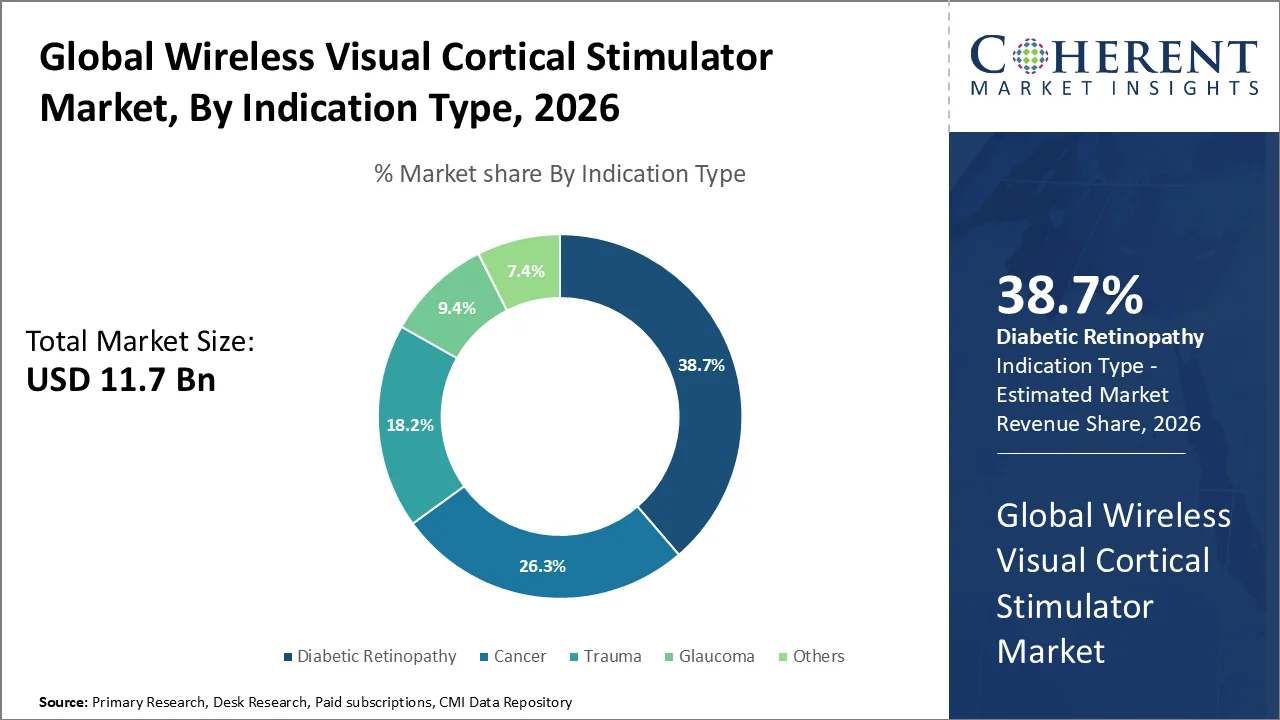
- Diabetic Retinopathy holds the largest market share of 38.7% in 2026 owing to the rising prevalence of diabetes. Globally, diabetes prevalence exceeds 20% among people aged 65–95 years, while it remains below 1% among those younger than 20 years.
- Hospital expected to hold largest market share of 39.6% in 2026 owing to its requirement for specialized neurosurgical infrastructure.
- North America is expected to acquire the dominant share of 42.7% in 2026 owing to the strong clinical research ecosystem.
Current Events and Their Impact
Current Event | Description and its Impact |
FDA Breakthrough Device Designation for ReVision Implant’s visual cortical prosthesis – 2026 |
|
NIH BRAIN Initiative funding for next-generation neural recording and stimulation devices – 2025–2026 |
|
Segmental Insights
- Current Industry Events of 2026
- Market Size Estimation
- Regional Breakdown
- Competitive Landscape
- Customer Intelligence
- Segmental Analysis
- Pricing Analysis
- Key Market Drivers, Challenges & Future Trends
- Customized Insights Section
Why is Diabetic Retinopathy Acquiring the Largest Market Share?
Diabetic Retinopathy holds the largest market share of 38.7% in 2026. The rising prevalence of diabetic retinopathy drives the wireless visual cortical stimulator market by increasing the number of patients experiencing severe or irreversible vision loss. Cortical visual prostheses can bypass damaged retinal structures and directly stimulate the visual cortex, offering a potential option for patients who cannot regain vision through conventional treatments. Increasing demand for vision-restoration solutions, technological advances in wireless stimulation and neural engineering, and expanding clinical research further encourage the development and potential adoption of these devices for diabetic retinopathy-related blindness. In December 2025, India has launched its first AI-driven community screening program for diabetic retinopathy, led by the Armed Forces Medical Services in collaboration with AIIMS’ Dr. Rajendra Prasad Centre for Ophthalmic Sciences and the Health Ministry’s eHealth AI Unit.
Which End Users segment dominates the market?
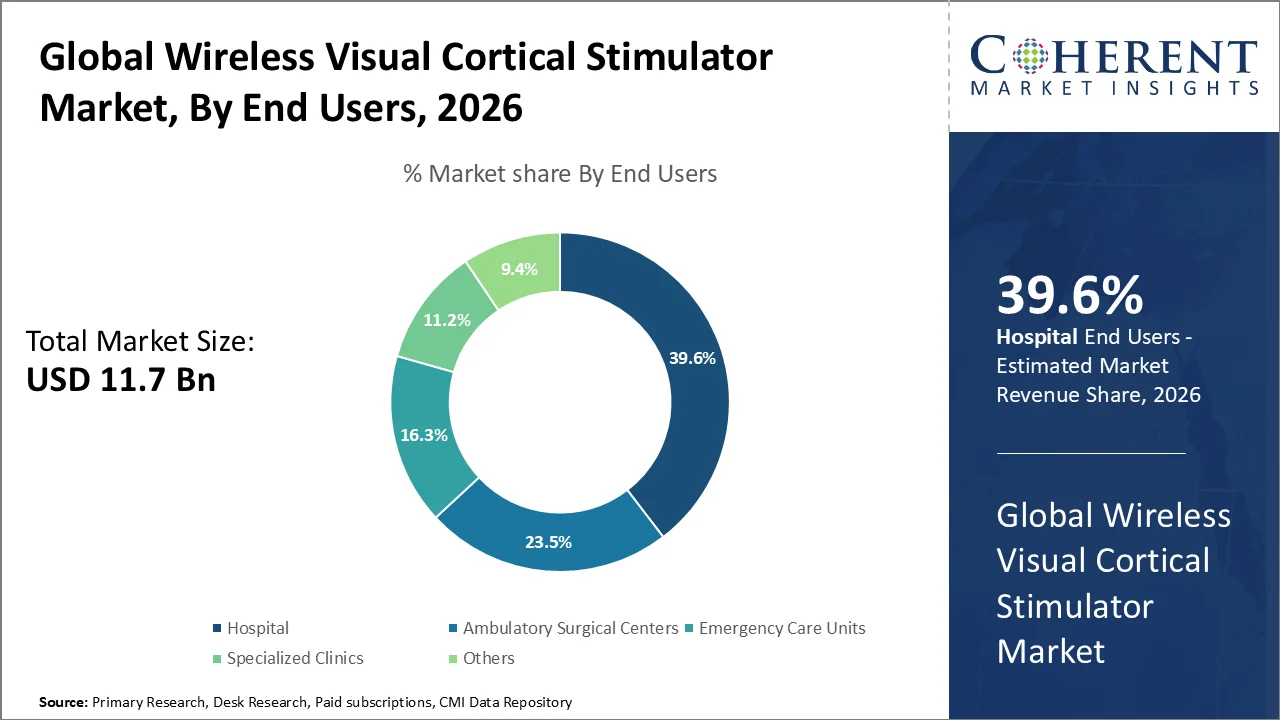
Hospital expected to hold largest market share of 39.6% in 2026. Hospitals support the wireless visual cortical stimulator market by offering specialized neurosurgical infrastructure, advanced imaging technologies, and multidisciplinary expertise for cortical implant procedures. They also conduct clinical trials, screen patients, perform device implantation, provide rehabilitation, and monitor patients over the long term. Institutions such as UCLA and Baylor College of Medicine have helped advance this technology through clinical evaluation of the Orion system. Increasing investment in neuroprosthetics and growing demand for innovative vision-restoration solutions further encourage hospitals to adopt these technologies.
Wireless Visual Cortical Stimulator Market Trends
- Advances in wireless neurostimulation technologies improve device flexibility, reduce dependence on wired connections, and support more convenient visual cortical stimulation for patients. The NIH BRAIN Initiative has supported development of next-generation neural devices capable of streaming data without requiring patients to carry a large external computer, reflecting a broader shift toward more portable and naturalistic neural-interface systems.
- Increasing prevalence of profound and irreversible vision impairment caused by conditions such as diabetic retinopathy, glaucoma, and other ocular disorders increases the potential need for technologies capable of bypassing damaged portions of the visual pathway and directly stimulating the visual cortex. The World Health Organization estimates that at least 2.2 billion people globally have a near or distance vision impairment, with at least 1 billion cases considered preventable or yet to be addressed.
- Advances in cortical mapping and neuroimaging improve identification of visual-cortex regions and can support more precise electrode placement, stimulation control, and individualized treatment strategies. NIH BRAIN Initiative programs support development of advanced technologies for recording from and stimulating the human central nervous system, including technologies intended for translation into human studies.
Regional Insights
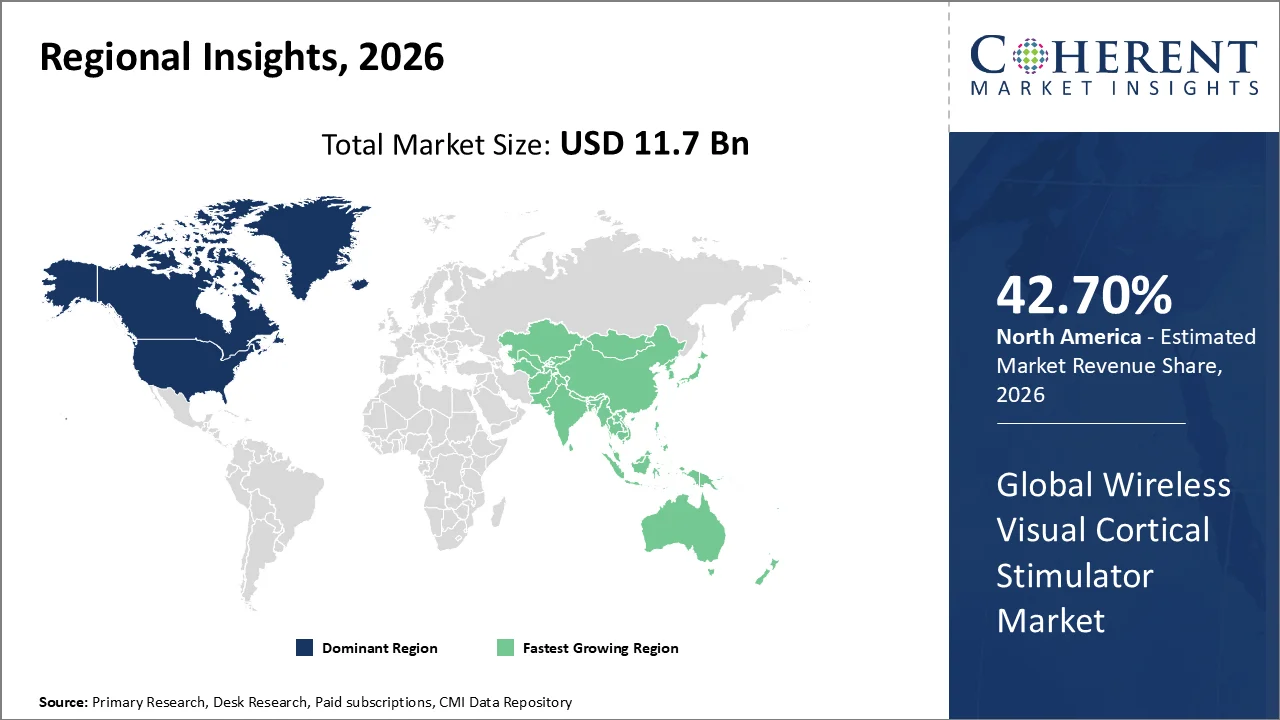
North America dominates owing to positive long-term clinical evidence
North America is expected to acquire the dominant share of 42.70% in 2026. North America strengthens the wireless visual cortical stimulator market through its advanced healthcare infrastructure, established neurotechnology research, and expanding clinical development. Leading institutions, including UCLA and Baylor College of Medicine, conduct clinical studies that advance cortical visual prostheses. The FDA’s Breakthrough Device designation for Orion also encourages technological development. Furthermore, growing demand for solutions that address profound blindness, combined with advances in wireless neurostimulation, artificial intelligence, and brain-computer interfaces, supports innovation and expands market opportunities across the region. Researchers at Rush University Medical Center successfully implanted the Intracortical Visual Prosthesis (ICVP) in the first participant of its Phase I feasibility study, connecting directly to the brain’s visual cortex while bypassing the retina and optic nerves.
Asia Pacific Wireless Visual Cortical Stimulator Market Trends
The Asia Pacific wireless visual cortical stimulator market is gaining momentum as healthcare providers pursue advanced vision-restoration solutions and researchers address neurological and visual disorders. Companies and research institutions across China, Japan, South Korea, India, and Australia are investing in brain-computer interfaces, medical robotics, and wireless implantable technologies. Advances in electrode design, wireless power and data transmission, and artificial intelligence are improving device performance. Clinical research, specialized healthcare facilities, and government initiatives further support innovation and expand opportunities for market development.
United States Wireless Visual Cortical Stimulator Market Trends
The United States wireless visual cortical stimulator market is driven by growing demand for vision-restoration solutions for severe blindness caused by glaucoma, diabetic retinopathy, optic nerve damage, and eye injuries. Technological advances in wireless neurostimulation, brain-computer interfaces, electrode arrays, and image processing are improving device performance. Federal research funding and clinical trials support innovation, while FDA programs encourage the development of advanced medical devices. Rising neurotechnology investment and a large patient pool further strengthen market opportunities.
China Wireless Visual Cortical Stimulator Market Trends
China’s wireless visual cortical stimulator market is advancing through government-backed brain-computer interface programs, increased neuroscience funding, and rapid progress in AI, neural decoding, wireless technologies, and miniaturized medical devices. Growing clinical trials, streamlined regulatory processes, strong semiconductor capabilities, and collaboration among hospitals, research institutions, technology companies, and medical-device manufacturers are accelerating the development, validation, and commercialization of wireless cortical stimulation systems.
Who are the Major Companies in Wireless Visual Cortical Stimulator Industry
Some of the major key players in Wireless Visual Cortical Stimulator are Cortigent, Neuralink, Sigenics and the Illinois Institute of Technology (IIT), CORTIVIS/Biomedical Technologies, and Monash Vision Group (Gennaris).
Key News
- In May 2025, Gabe Newell’s neural chip company, Starfish Neuroscience, developed a custom chip to power next-generation, minimally invasive brain-computer interfaces.
Market Report Scope
Wireless Visual Cortical Stimulator Market Report Coverage
| Report Coverage | Details | ||
|---|---|---|---|
| Base Year: | 2025 | Market Size in 2026: | USD 11.7 Bn |
| Historical Data for: | 2020 To 2024 | Forecast Period: | 2026 To 2033 |
| Forecast Period 2026 to 2033 CAGR: | 4.8% | 2033 Value Projection: | USD 16.4 Bn |
| Geographies covered: |
| ||
| Segments covered: |
| ||
| Companies covered: | Cortigent, Neuralink, Sigenics and the Illinois Institute of Technology (IIT), CORTIVIS/Biomedical Technologies, and Monash Vision Group (Gennaris). | ||
Analyst Opinion
- The market’s strongest driver is the scale of irreversible vision loss that conventional ocular treatments cannot address. The WHO estimates that at least 2.2 billion people have near or distance vision impairment, with at least 1 billion cases preventable or yet to be addressed. However, the addressable opportunity for cortical stimulation is far narrower: it specifically targets patients whose visual pathways cannot be restored through conventional ophthalmic treatment. This makes patient selection and neurological eligibility more important market drivers than the overall prevalence of vision impairment.
- Wireless stimulation is becoming a critical technical differentiator because developers are moving beyond proof-of-concept toward implantable systems that can operate without conventional wired connections. The Illinois Institute of Technology’s Phase I ICVP study is evaluating wireless floating microelectrode arrays implanted in the visual cortex, with five participants planned for the study and follow-up testing extending up to three years.
- Regulatory recognition is another decisive catalyst, but investors should distinguish regulatory acceleration from clinical success. Neuralink’s Blindsight received FDA Breakthrough Device Designation in 2024, highlighting the agency’s recognition of the technology’s potential for people with vision impairment. In my assessment, this milestone strengthens the competitive landscape for cortical visual prostheses, but it should not be interpreted as evidence of established efficacy; breakthrough designation is intended to facilitate development and review rather than confirm that a device has restored functional vision.
Speak to the analyst
Want personalized insights?
Take the findings above to one of our principal consultants, or have the report rebuilt around the segments, geographies and competitors you actually track.
Market Segmentation
- By Indication Type: (Revenue, USD Bn, 2021-2033)
- Cancer
- Diabetic Retinopathy
- Trauma
- Glaucoma
- Others
- By End Users: (Revenue, USD Bn, 2021-2033)
- Hospital
- Ambulatory Surgical Centers
- Emergency Care Units
- Specialized Clinics
- Others
- By Region: (Revenue, USD Bn, 2021-2033)
- North America
- U.S.
- Canada
- Latin America
- Brazil
- Mexico
- Argentina
- Rest of Latin America
- Europe
- Germany
- U.K.
- France
- Italy
- Spain
- Russia
- Rest of Europe
- Asia Pacific
- China
- India
- Japan
- Australia
- South Korea
- ASEAN
- Rest of Asia Pacific
- Middle East
- GCC
- Israel
- Rest of Middle East
- Africa
- South Africa
- Central Africa
- North Africa
- North America
- Key Players
- Cortigent
- Neuralink
- Sigenics and the Illinois Institute of Technology (IIT)
- CORTIVIS/Biomedical Technologies
- Monash Vision Group (Gennaris).
Sources
Primary Research interviews
- Neurosurgeons and ophthalmic surgeons involved in cortical visual prosthesis implantation
- Neurologists and neurotechnology researchers
- Biomedical engineers specializing in brain-computer interfaces and neural stimulation
- Clinical investigators involved in Orion, ICVP, and CORTIVIS trials
- Medical-device regulatory and clinical-development specialists
- Researchers specializing in visual cortex stimulation, neural decoding, and implantable electronics
Databases
- ClinicalTrials.gov
- PubMed/MEDLINE
- National Library of Medicine databases
- FDA medical-device databases
- NIH RePORTER
- IEEE Xplore
- Scopus
- Web of Science
Magazines
- IEEE Spectrum
- Nature Biotechnology
- MIT Technology Review
- Scientific American
- MedTech Dive
- Medical Device Network
Journals
- Journal of Neural Engineering
- Journal of NeuroEngineering and Rehabilitation
- Nature Biomedical Engineering
- Nature Reviews Neuroscience
- Brain
- Vision Research
- IEEE Transactions on Biomedical Engineering
- International Journal of Neural Systems
- Frontiers in Neuroscience
Newspapers
- The New York Times
- The Wall Street Journal
- Financial Times
- The Guardian
- Reuters
- The Washington Post
Associations
- IEEE
- Society for Neuroscience
- American Academy of Ophthalmology
- American Academy of Neurology
- Association for Research in Vision and Ophthalmology (ARVO)
- Biomedical Engineering Society (BMES)
Public Domain sources
- U.S. Food and Drug Administration (FDA)
- National Institutes of Health (NIH)
- ClinicalTrials.gov
- National Library of Medicine (NLM)
- Centers for Disease Control and Prevention (CDC)
- World Health Organization (WHO)
- European Medicines Agency (EMA)
- U.S. Patent and Trademark Office (USPTO)
- European Patent Office (EPO)
- Government clinical-trial registries and regulatory publications
Proprietary Elements
- CMI Data Analytics Tool, and Proprietary CMI Existing Repository of information for last 10 years
Get access to 250+ pages report
Every segment, forecast, competitor profile and data table behind the analysis above — available for instant download.
- ESOMAR Member
- ISO 9001:2015 Certified
- D-U-N-S Registered
- GDPR & CCPA Compliant
Missing comfort of reading report in your local language? Find your preferred language:
Transform your Strategy with Exclusive Trending Reports
Frequently Asked Questions
The Wireless Visual Cortical Stimulator Market is anticipated to grow at a CAGR of 4.8% with USD 11.7 Billion in 2026 and is expected to reach USD 16.4 Billion in 2033.
A wireless visual cortical stimulator is an implantable neuroprosthetic system that delivers electrical stimulation directly to the visual cortex, bypassing damaged portions of the eye or optic nerve.
The technology primarily targets people with severe or irreversible blindness where conventional ophthalmic treatments cannot restore vision, particularly when the retina or optic nerve is damaged but relevant visual-cortex function remains intact.
Wireless power and data transmission reduce dependence on wired connections and enable implanted stimulation modules to communicate with external processors.
Notable programs include the Orion Visual Cortical Prosthesis, the Intracortical Visual Prosthesis (ICVP), CORTIVIS, and Blindsight.