

Digital Pregnancy Test Kits Market Size and Forecast: 2026-2033
The Digital Pregnancy Test Kits Market is anticipated to grow at a CAGR of 5.2% with USD 12.2 Bn share in 2026 and is expected to reach USD 17.6 Bn in 2033. Rising awareness of early pregnancy detection drives the Digital Pregnancy Test Kits Market. Increasing demand for accurate, easy-to-use home testing also fuels growth.
Key Takeaways
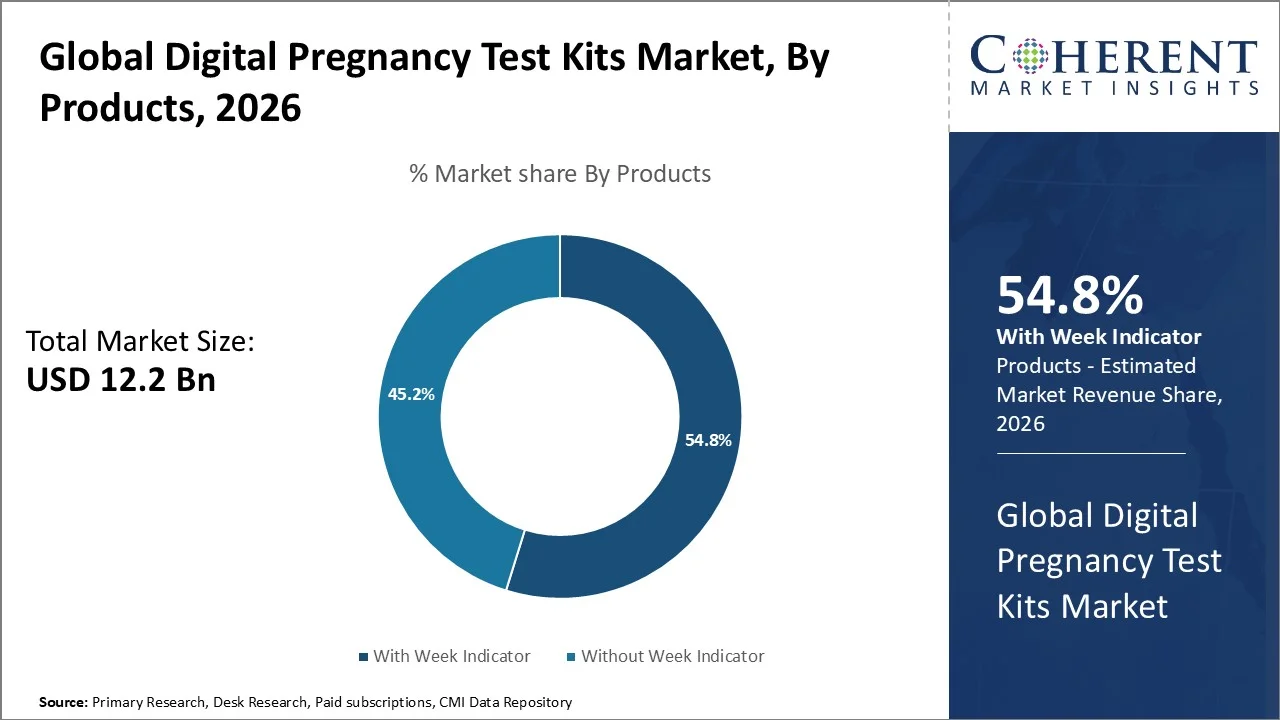
- With Week Indicator hold the largest market share of 54.8% in 2026 owing to the demand for more informative results.
- Online Pharmacies expected to hold the largest market share of 38.8% in 2026 owing to its high demand for privacy and discretion.
- North America is expected to acquire the dominant share of 42.30% in 2026 owing to its high awareness of reproductive and maternal health. In 2024, the U.S. recorded about 3.63 million live births, with a fertility rate of 53.8 births per 1,000 women aged 15–44.
Current Events and Their Impact on the Digital Pregnancy Test Kits Market
Current Event | Description and its Impact |
U.S. FDA Grants Clearance for Digital Pregnancy Tests with Bluetooth Connectivity |
|
European CE Mark Approvals for AI-Enhanced Pregnancy Tests |
|
Segmental Insights
- Current Industry Events of 2026
- Market Size Estimation
- Regional Breakdown
- Competitive Landscape
- Customer Intelligence
- Segmental Analysis
- Pricing Analysis
- Key Market Drivers, Challenges & Future Trends
- Customized Insights Section
Why is With Week Indicator Acquiring the Largest Market Share?
With Week Indicator hold the largest market share of 54.8% in 2026. Consumers drive the With Week Indicator segment in the digital pregnancy test kits market by seeking more detailed and informative results beyond basic pregnancy confirmation. They prefer products that estimate gestational age, as these help them understand early pregnancy stages more clearly. Growing awareness of reproductive health and a stronger preference for early and accurate testing further support demand. Advances in hCG detection technology also enhance adoption. At-home testing convenience and the appeal of premium, user-friendly digital diagnostics additionally strengthen market growth.
Which Distribution Channel segment dominates the market?
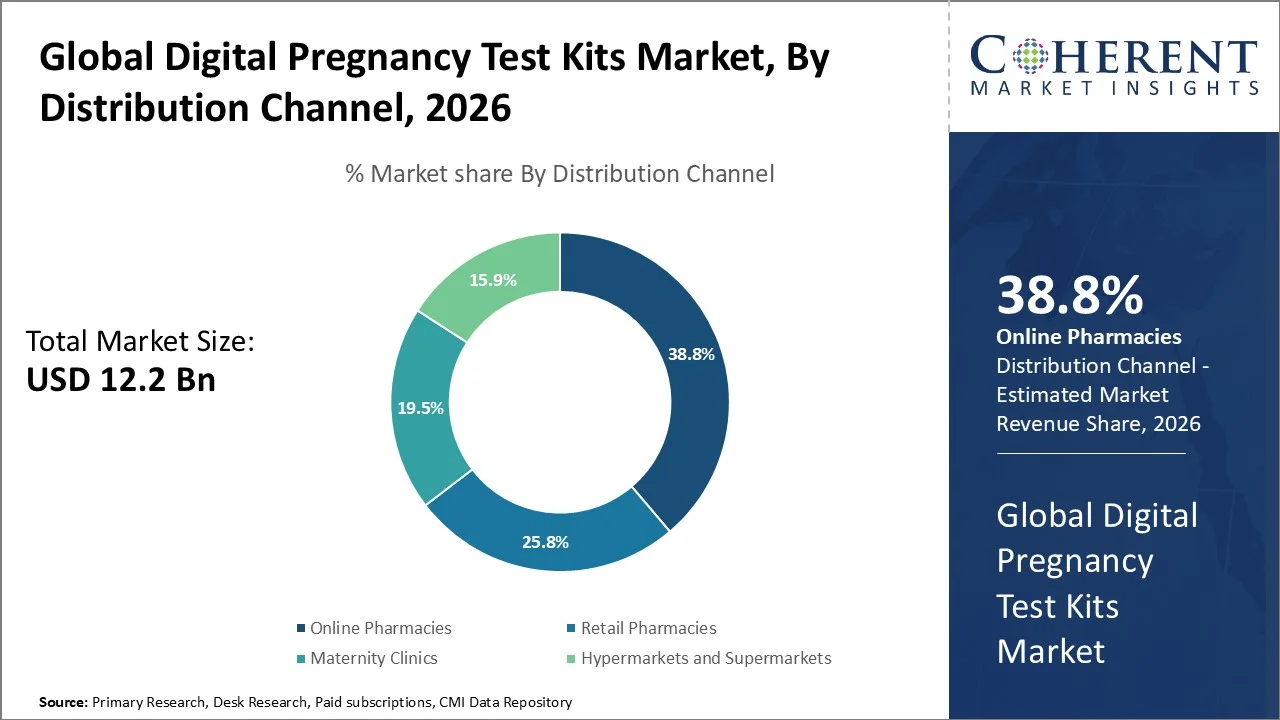 Online Pharmacies expected to hold the largest market share of 38.8% in 2026. Consumers drive the digital pregnancy test kits market through online pharmacies by seeking convenient access, privacy, and doorstep delivery. They increasingly choose discreet purchasing options for sensitive healthcare products, which boosts online sales. They also benefit from wider product availability, easy brand comparison, and customer reviews that support better decision-making. Growing use of e-commerce platforms, digital payments, and smartphones further encourages adoption. As of April 2026, 2.86 billion people worldwide are shopping online via e-commerce platforms or social media stores. Competitive pricing, discounts, and subscription models attract more users, while expanding direct-to-consumer channels improve overall accessibility and convenience.
Digital Pregnancy Test Kits Market Trends
- Growing preference for digital pregnancy test kits with week indicator features enhances understanding of early pregnancy stages and improves result interpretation. Over 65% of women in the U.S. prefer digital tests with week indicators for clarity and reassurance.
- Rising demand for at-home self-diagnostic solutions increases adoption of pregnancy kits, as consumers value privacy, convenience, and quick results. In 2025, 61% of U.S. women purchased pregnancy tests online or at retail without consulting a clinician, highlighting preference for self-testing.
- Expanding e-commerce platforms and online pharmacy channels improve accessibility, offering discreet purchase and wider selection. In 2025, 2.86 billion people globally shopped online, with online pharmacies accounting for 12% of at-home diagnostics sales.
- Increasing awareness of reproductive health and family planning encourages early testing. WHO reports that nearly 75% of women in high-awareness regions test within the first week of a missed period, driving demand for informative and easy-to-use kits.
Regional Insights
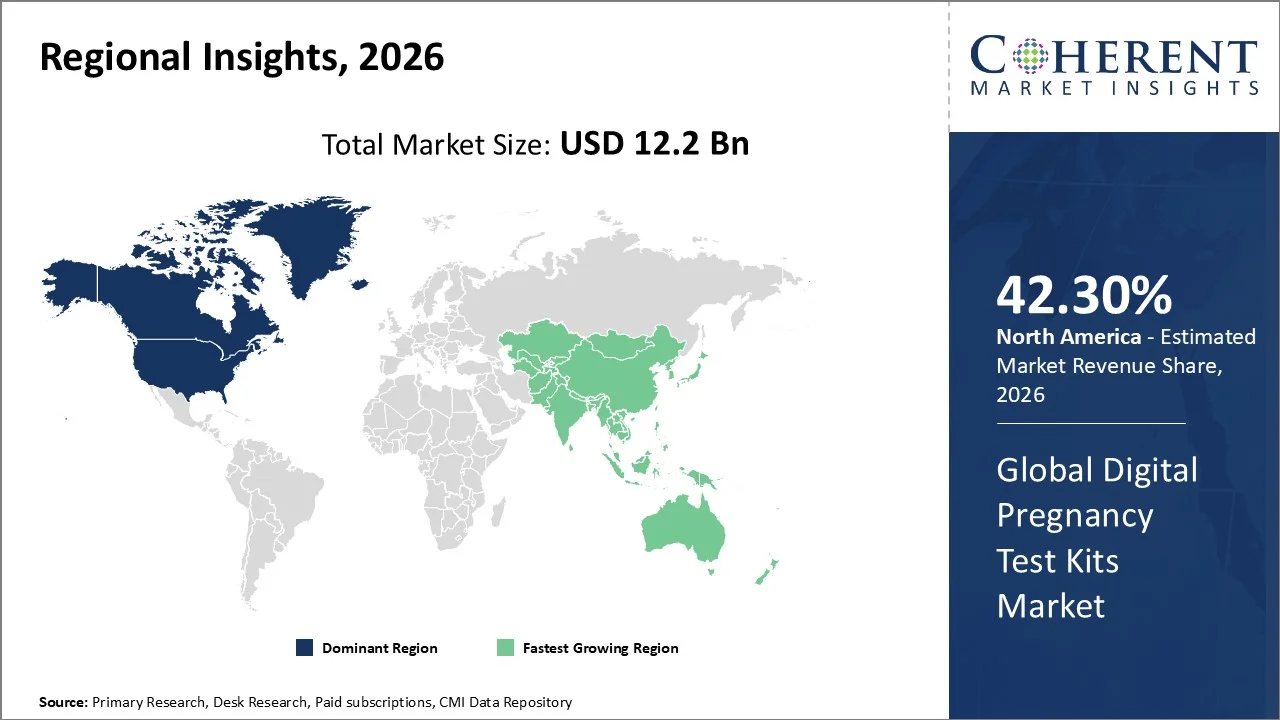
North America dominates owing to rising demand for self-testing and home diagnostics
North America is expected to hold the dominant share of 42.3% in 2026. Consumers in the region drive the digital pregnancy test kits market through high reproductive health awareness—over 75% of women aged 18–45 in the U.S. use at-home pregnancy tests within the first week of a missed period. Strong adoption of advanced self-diagnostic products and preference for accurate, convenient, and privacy-focused solutions increases demand for digital kits. Widespread pharmacy networks, well-developed healthcare infrastructure, and online retail channels enhance accessibility, with 61% of U.S. women purchasing tests online or in-store without clinician consultation. High disposable income enables selection of premium products featuring week indicators, while ongoing product innovation and presence of major healthcare companies further support regional market growth. For instance, Labcorp has launched an FDA-cleared blood test to help assess risk and manage severe preeclampsia, a serious blood pressure condition during pregnancy and postpartum.
Asia Pacific Digital Pregnancy Test Kits Market Trends
Rising awareness of early pregnancy detection drives the Asia Pacific digital pregnancy test kits market as consumers increasingly adopt home-based diagnostic solutions available through pharmacies and online platforms. Urbanization, higher female workforce participation, and improved healthcare access boost demand for convenient digital kits. Manufacturers introduce advanced technologies, including app-connected and highly accurate devices, to enhance user experience. Strong production bases in countries such as China and India, along with growing e-commerce penetration, improve product availability and expand adoption across the region. For instance, in April 2026, Anondita Medicare Limited has re-launched its pregnancy test kit under the “COBRA Shubh Samachar” brand through its subsidiary Anondita Healthcare & Rubber Products India Ltd. The upgraded version features improved formulation, lower costs, and better scalability.
United States Digital Pregnancy Test Kits Market Trends
The United States digital pregnancy test kits market is growing steadily as consumers actively seek accurate, simple, and private home testing options. Users increasingly choose digital kits because they deliver clear results and reduce the uncertainty of traditional line-based methods. Manufacturers are enhancing product appeal by introducing improved sensitivity, smartphone connectivity, and app-based tracking features. Retail pharmacies and online platforms are expanding availability. Rising awareness of early pregnancy detection and greater adoption of branded diagnostic products are driving broader use across diverse consumer groups in the country. For instance, Church & Dwight Co., Inc., maker of First Response pregnancy and ovulation tests, has partnered with four women to launch a digital content series that shares real-life trying-to-conceive experiences.
China Digital Pregnancy Test Kits Market Trends
Rising awareness of reproductive health is driving steady changes in China’s digital pregnancy test kits market, while consumers increasingly prefer convenient home-based diagnostic tools. Users actively choose digital devices because they deliver clear, easy-to-read results and reduce the risk of misinterpretation compared to traditional tests. Expanding e-commerce channels and improved healthcare education are increasing product availability across urban and semi-urban regions. Manufacturers actively invest in innovation to improve accuracy and add user-friendly features. Strengthened regulations and higher quality standards are building consumer trust and encouraging wider adoption in both retail and clinical environments.
Who are the Major Companies in Digital Pregnancy Test Kits Industry
Some of the major key players in Digital Pregnancy Test Kits are Precision Diagnostics GmbH, Church & Dwight Co., Inc., Gregory Pharmaceutical Holdings, Inc., and Sugentech, Inc.
Key News
- In February 2026, Carea has launched a digital support feature for patients undergoing IVF, IUI, and egg freezing to address rising clinic demand and improve continuity of care between appointments in the UK.
Market Report Scope
Digital Pregnancy Test Kits Market Report Coverage
| Report Coverage | Details | ||
|---|---|---|---|
| Base Year: | 2025 | Market Size in 2026: | USD 12.2 Bn |
| Historical Data for: | 2020 To 2024 | Forecast Period: | 2026 To 2033 |
| Forecast Period 2026 to 2033 CAGR: | 5.2% | 2033 Value Projection: | USD 17.6 Bn |
| Geographies covered: |
| ||
| Segments covered: |
| ||
| Companies covered: | Precision Diagnostics GmbH, Church & Dwight Co., Inc., Gregory Pharmaceutical Holdings, Inc., and Sugentech, Inc | ||
Analyst Opinion
- Digital pregnancy test kits are not expanding due to lifestyle preference alone, but because diagnostic uncertainty in early pregnancy remains a persistent clinical gap. Studies show that around 10–20% of early pregnancies may initially produce unclear or false-negative results with low-sensitivity tests, which drives demand for more accurate digital readouts.
- The usage scale is substantial because pregnancy detection is a frequent, first-line diagnostic need. Globally, there are an estimated 140 million births annually, meaning hundreds of millions of pregnancy tests are performed each year, with repeat testing common due to early testing before hCG levels stabilize.
- Digital formats are gaining stronger clinical and consumer trust because of their improved interpretability. Clinical evaluations indicate that modern digital pregnancy kits can detect hCG levels as low as 10–25 mIU/mL, enabling earlier detection compared to many conventional strip-based tests, which often require higher hormone thresholds. This earlier and clearer detection is pushing adoption in both home-care and pharmacy-led testing ecosystems.
Speak to the analyst
Want personalized insights?
Take the findings above to one of our principal consultants, or have the report rebuilt around the segments, geographies and competitors you actually track.
Market Segmentation
- By Products (Revenue, USD Bn, 2021-2033)
- With Week Indicator
- Without Week Indicator
- By Distribution Channel (Revenue, USD Bn, 2021-2033)
- Retail Pharmacies
- Online Pharmacies
- Maternity Clinics
- Hypermarkets and Supermarkets
- By Region (Revenue, USD Bn, 2021-2033)
- North America
- U.S.
- Canada
- Latin America
- Brazil
- Mexico
- Argentina
- Rest of Latin America
- Europe
- Germany
- U.K.
- France
- Italy
- Spain
- Russia
- Rest of Europe
- Asia Pacific
- China
- India
- Japan
- Australia
- South Korea
- ASEAN
- Rest of Asia Pacific
- Middle East
- GCC
- Israel
- Rest of Middle East
- Africa
- South Africa
- Central Africa
- North Africa
- North America
- Key Players
- Precision Diagnostics GmbH
- Church & Dwight Co., Inc.
- Gregory Pharmaceutical Holdings, Inc.
- Sugentech, Inc.
Sources
Primary Research Interviews
- Obstetricians and gynecologists (OB-GYNs)
- Retail pharmacists and pharmacy chain managers
- Healthcare product distributors and wholesalers
- End users (expectant mothers and family planning consumers)
- Hospital procurement and maternal health department staff
Databases
- National health statistics databases (government health portals)
- World health demographic databases
- Clinical trials registries related to reproductive health products
- Patent databases for digital diagnostic devices
- Hospital procurement and supply chain databases (aggregated sources)
Magazines
- Healthcare and medical device industry magazines
- Women’s health and wellness publications
- Pharmaceutical trade magazines
- Consumer health and lifestyle magazines
- Retail and pharmacy industry magazines
Journals
- Obstetrics and gynecology journals
- Reproductive health and fertility journals
- Medical diagnostics and biotechnology journals
- Public health and epidemiology journals
- Clinical laboratory science journals
Newspapers
- National and regional newspapers covering healthcare trends
- Business newspapers reporting on medical device markets
- Health and science sections of leading newspapers
- Financial newspapers covering consumer healthcare growth
Associations
- Gynecology and obstetrics professional associations
- Reproductive health advocacy organizations
- Pharmaceutical and medical device industry associations
- Public health organizations focused on maternal health
- Family planning and fertility support organizations
Public Domain Sources
- Government health ministry publications and reports
- WHO and UN population and maternal health data
- Public hospital and healthcare system reports
- Open-access research papers and academic repositories
- Regulatory authority safety and approval documentation
Proprietary Elements
- CMI Data Analytics Tool
- Proprietary CMI Existing Repository of information for last 10 years
Get access to 250+ pages report
Every segment, forecast, competitor profile and data table behind the analysis above — available for instant download.
- ESOMAR Member
- ISO 9001:2015 Certified
- D-U-N-S Registered
- GDPR & CCPA Compliant
Missing comfort of reading report in your local language? Find your preferred language:
Transform your Strategy with Exclusive Trending Reports
Frequently Asked Questions
The global digital pregnancy test kits market is estimated to surpass USD 17.6 Bn by 2033.
Major players operating in the global digital pregnancy test kits market include Precision Diagnostics GmbH, Church & Dwight Co., Inc., Gregory Pharmaceutical Holdings, Inc., and Sugentech, Inc.
High price point as compared to alternative pregnancy test kits is one of the major factors that is expected to hamper growth of the market over the forecast period
Advantages offered by digital pregnancy test kits over conventional products is one of the major factors that is expected to propel growth of the market over the forecast period.
The global digital pregnancy test kits market is estimated to exhibit a CAGR of 5.2% over the forecast period.
Among regions, North America is expected to witness significant growth over the forecast period