

Global 3D Gaussian Splatting Market Size and Forecast – 2026 To 2033
The global 3D gaussian splatting market is expected to grow from USD 1.85 Bn in 2026 to USD 7.80 Bn by 2033, registering a compound annual growth rate (CAGR) of 11% from 2026 to 2033. The global 3D gaussian splatting market is driven by increasing use of gaussian splatting in gaming and interactive entertainment. On June 3, 2026, PlayCanvas expanded SuperSplat from a 3DGS editing tool into a web publishing platform, enabling Gaussian Splat scenes to be published as interactive browser experiences using the PlayCanvas Engine.
Key Takeaways of the Global 3D Gaussian Splatting Market
- The Software segment is expected to account for 49.0 % of the global 3D gaussian splatting market share in 2026. Growing deployment of digital twins and spatial computing is driving the growth of the segment. On August 11, 2025, NVIDIA introduced new Omniverse NuRec libraries and AI models that use RTX ray traced 3D Gaussian Splatting to capture, reconstruct and simulate real world environments from sensor data, specifically positioning the technology for physically accurate digital twins and robotics simulation.
- The Cloud segment is estimated to capture 58.0 % of the market share in 2026. Expansion of AI assisted 3D content creation is majorly driving the growth of the segment. On January 8, 2025, Stability AI launched SPAR3D, enabling complete 3D object structure generation and real time editing from a single image in less than one second, combining point cloud sampling with mesh generation.
- The Conventional 3D Gaussian Splatting segment is estimated to capture 51.0 % of the market share in 2026. Increasing integration with game engines and 3D production pipelines is driving the growth of the segment. On January 27, 2025, Chaos added Gaussian Splat support to V-Ray 7 for Maya and Houdini, allowing artists to bring real-world captured environments into established ray-traced production workflows and combine them with conventional CG assets.
- North America is expected to dominate the 3D gaussian splatting market in 2026 with a market share of 38.0 %. Growing popularity of spatial computing and mixed reality applications in North America is driving the growth of the regional market. On October 15, 2025, Apple introduced an upgraded Vision Pro with the M5 chip, improving display rendering, AI-powered workflows and battery life, while visionOS 26 added new spatial experiences, Personas and spatial widgets.
- Asia Pacific is expected to account for 23.0 % share in 2026. Growth of virtual tourism and digital heritage preservation across Asia Pacific is driving the growth of the regional market. In September 2025, Huawei and Shaanxi Culture Industry Investment Group launched BoGuan, described as the world’s first commercial multimodal LLM specifically developed for cultural tourism and China’s first industry focused model for cultural heritage preservation.
Segmental Insights
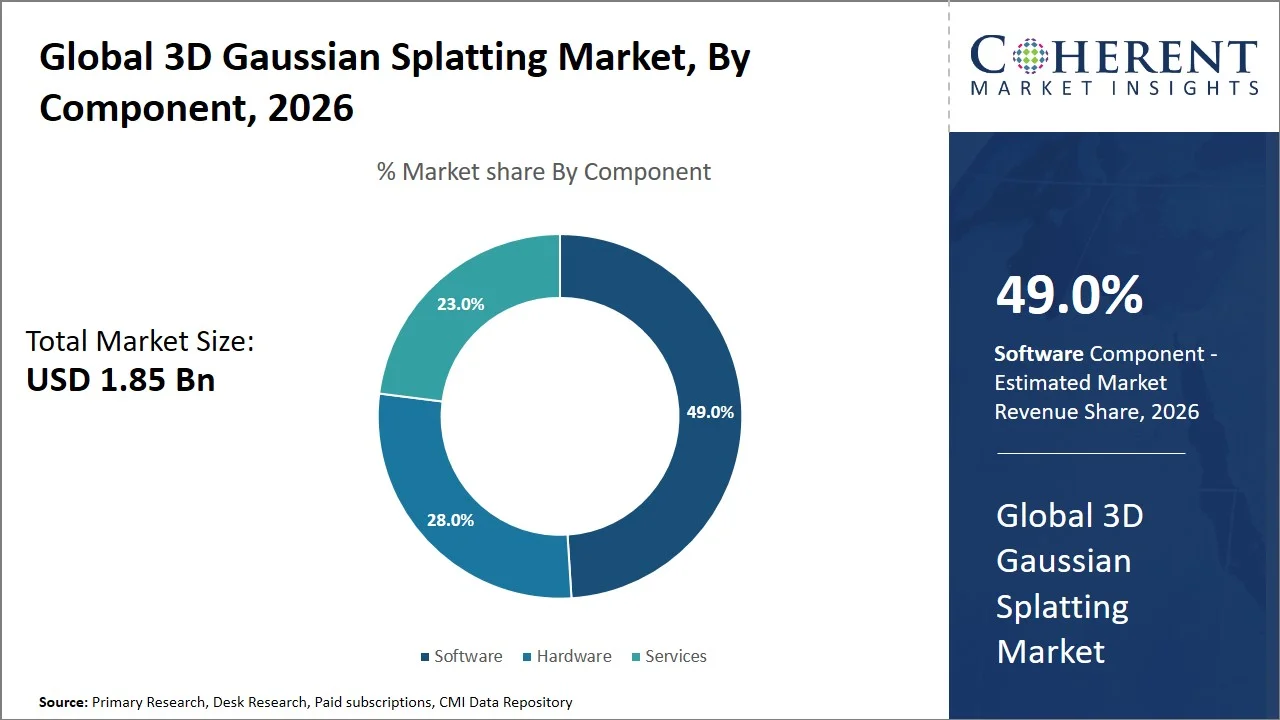
Why Does Software Dominate the Global 3D Gaussian Splatting Market?
The software segment is expected to account for 49.0% of the global 3D gaussian splatting market share in 2026. Software is strongly adopted because it provides the core algorithms required to transform captured images or video into optimized Gaussian representations and then render those scenes interactively, while also enabling editing, compression, optimization, and integration with existing 3D production workflows. Unlike hardware, which primarily provides the computing and capture infrastructure, software can be deployed across multiple applications such as gaming, virtual reality, digital twins, animation and spatial computing, making it easier for developers and enterprises to incorporate 3D Gaussian Splatting into existing pipelines. The technology’s explicit scene representation and efficient rasterization also support high-quality real-time rendering, strengthening the need for specialized software tools and development frameworks. For instance, Autodesk expanded 3ds Max with editable Gaussian Splat capabilities, allowing real world captures to be brought into an established professional 3D environment and incorporated into broader digital production workflows. The move is important because it places Gaussian Splatting inside a widely used modelling and visualization application, reducing the need for users to rely on separate specialist software for manipulating captured environments.
- Current Industry Events of 2026
- Market Size Estimation
- Regional Breakdown
- Competitive Landscape
- Customer Intelligence
- Segmental Analysis
- Pricing Analysis
- Key Market Drivers, Challenges & Future Trends
- Customized Insights Section
Why is Cloud the Most Preferred Deployment Type?
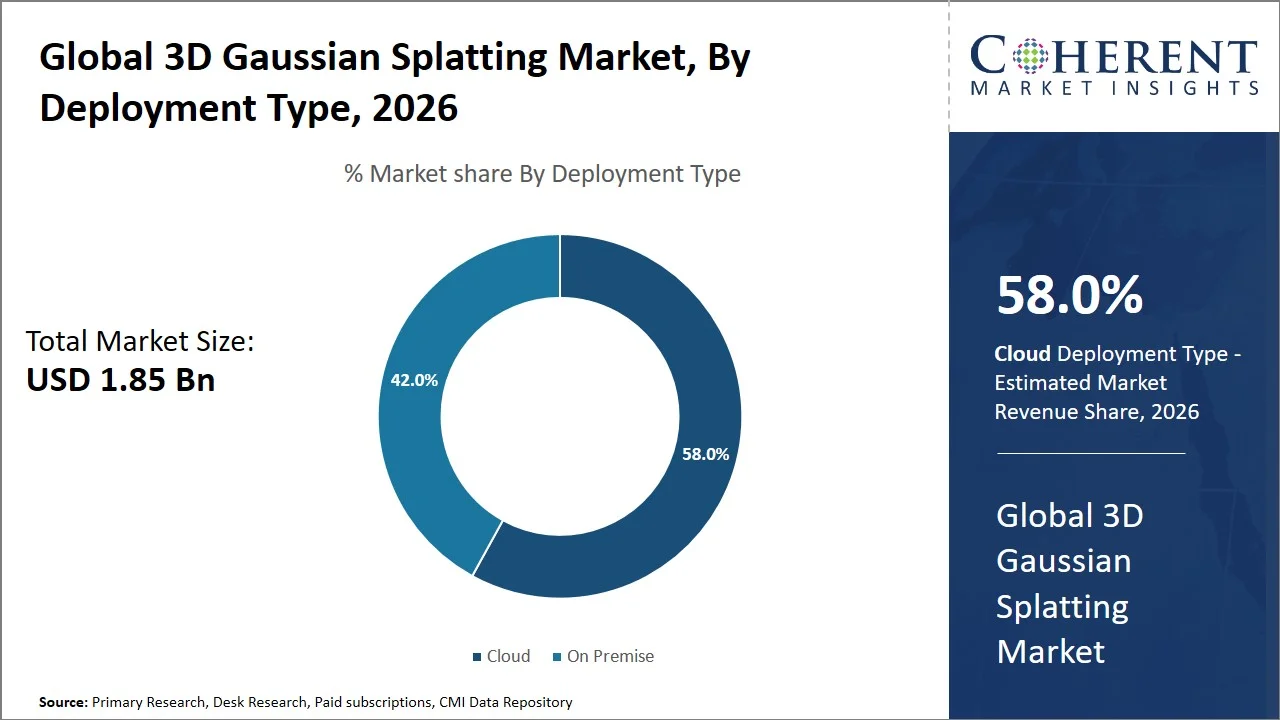
The cloud segment is expected to account for 58.0% of the global 3D gaussian splatting market share in 2026. Cloud deployment is preferred because 3D Gaussian Splatting workloads can require substantial GPU memory and computing resources, particularly when reconstructing and rendering large or highly detailed scenes containing millions of Gaussian primitives. Cloud infrastructure allows users to access GPU accelerated computing on demand, scale processing across multiple machines when required, and avoid purchasing and maintaining expensive high-performance hardware, while cloud storage and content delivery services also support centralized management and distribution of large 3D assets across users and devices. On April 24, 2025, Varjo announced Teleport 2.0, a major upgrade to its spatial capture platform that delivers a generational leap in 3D capture fidelity and creative capability for professional users. Powered by enterprise-grade GPU processing and the latest advancements in Gaussian Splatting reconstruction, Teleport 2.0 matches the fidelity of high-end photogrammetry technology, while drastically accelerating the workflow and lowering the barrier to entry.
Conventional 3D Gaussian Splatting Dominates the Global 3D Gaussian Splatting Market
The conventional 3D gaussian splatting segment is expected to account for 51.0% of the global 3D gaussian splatting market share in 2026. Conventional 3D gaussian splatting benefits from an established and relatively mature workflow for reconstructing photorealistic scenes from multi-view images while delivering high-quality real-time rendering, making it suitable for applications such as gaming, virtual reality, visualization and digital twins. The original 3DGS approach introduced an efficient representation based on 3D Gaussians, adaptive density control and visibility-aware rendering, enabling high-quality novel-view synthesis at real-time frame rates without relying on computationally intensive neural rendering during inference. On July 1, 2026, LichtFeld Studio released version 0.5.3 with Vulkan rendering, RAD/LOD workflows, an upgraded asset manager and viewport export, while retaining its complete local workflow covering Gaussian training, editing and rendering. The company's continued focus on real-time rasterization of millions of Gaussians illustrates the maturation of conventional 3DGS into a dedicated production-grade reconstruction and visualization application.
Current Events and their Impact
Current Events | Description and its Impact |
European Union - EU Artificial Intelligence Act |
|
European Union - Cyber Resilience Act |
|
3D Gaussian Splatting Market Dynamics
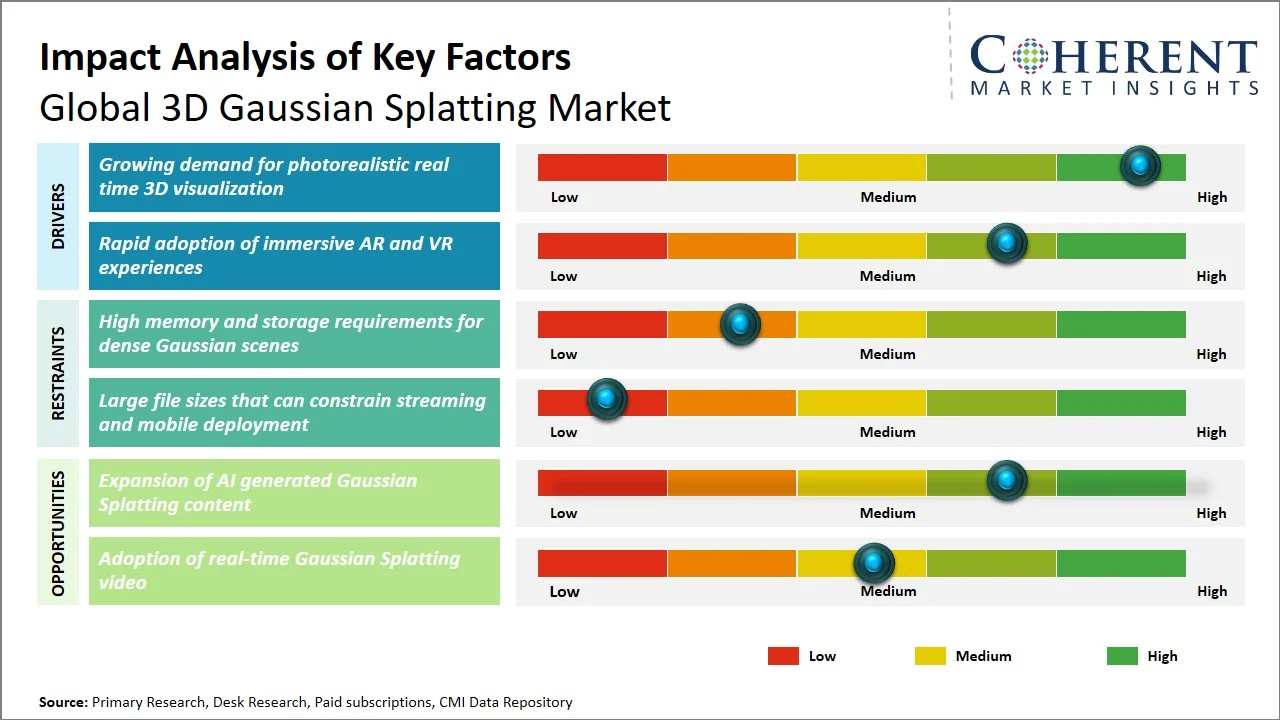
Market Drivers
- Growing Demand for Photorealistic Real Time 3D Visualization: The growing requirement for highly realistic yet interactive 3D environments is driving adoption of 3D Gaussian Splatting because it can represent complex real-world scenes using large collections of 3D Gaussian primitives and render them efficiently through GPU rasterization. This enables applications such as gaming, digital twins, virtual production, architectural visualization and interactive media to reproduce detailed environments with realistic appearance while maintaining real time or near real time interaction, creating an attractive alternative for workflows where conventional 3D modelling and rendering can be more time intensive. On May 15, 2026, at NAB 2026, Zero Density demonstrated its Reality 5 platform operating simultaneously with Chaos Vantage, NVIDIA 3D Gaussian Splatting and Unreal Engine, allowing photorealistic captured environments to be combined with camera tracking, reflections, shadows, occlusion and Z-depth.
- Rapid Adoption of Immersive AR And VR Experiences: The expansion of AR and VR experiences is creating demand for 3DGS because immersive applications require detailed environments to be rendered from changing viewpoints with low latency and high visual quality. Research during 2025 has specifically focused on optimizing Gaussian Splatting for VR and resource constrained edge devices, including techniques that achieved more than 72 FPS in VR testing and hardware approaches designed to enable real time AR and VR rendering, demonstrating the technology’s growing suitability for immersive applications. On August 11, 2026, Meta launched a dedicated Threads application for Meta Quest headsets, bringing feed browsing, posting, replies, profiles and video consumption into a VR environment and extending everyday social-media activity into immersive computing.
Emerging Trends
- Increasing Adoption of Dynamic and 4D Gaussian Splatting: 3D Gaussian Splatting is increasingly being extended from static environments to dynamic scenes containing moving people, objects and changing environments, with 4D Gaussian Splatting enabling spatial representations that evolve over time. This development is creating opportunities across volumetric video, gaming, AR and VR, virtual production and interactive digital environments, while ongoing research is focused on reducing the computational burden associated with dynamic scene reconstruction and rendering.
- Growing Focus on Compression And lightweight 3DGS: Compression and model compaction are becoming important development priorities because conventional 3DGS scenes can require substantial storage and memory, limiting deployment on smartphones, AR glasses, VR headsets and other resource constrained devices. Recent approaches are combining Gaussian pruning, quantization and temporal compression to reduce model size while retaining visual quality, with research demonstrating substantial reductions in storage requirements for both static and dynamic scenes.
- Expansion Of Real Time Immersive and Streaming Applications: The technology is increasingly moving toward real time streaming of interactive 3D environments rather than being restricted to offline scene reconstruction, supporting applications such as free viewpoint video, immersive entertainment, AR, VR, and mixed reality. NVIDIA Research, for example, demonstrated compressed dynamic 3D video streaming using Gaussian Splatting with rendering exceeding 300 FPS, highlighting the potential for interactive delivery of photorealistic scenes across immersive devices.
- Shift Toward Mobile and Edge Based Gaussian Splatting: Development is increasingly focused on running Gaussian Splatting directly on mobile and edge hardware to reduce dependence on high end GPU infrastructure and enable more responsive spatial computing experiences. Lightweight frameworks and hardware acceleration techniques are being developed to reduce memory consumption, DRAM access and power requirements, supporting potential deployment across smartphones, AR and VR devices, robotics and autonomous systems.
Regional Insights
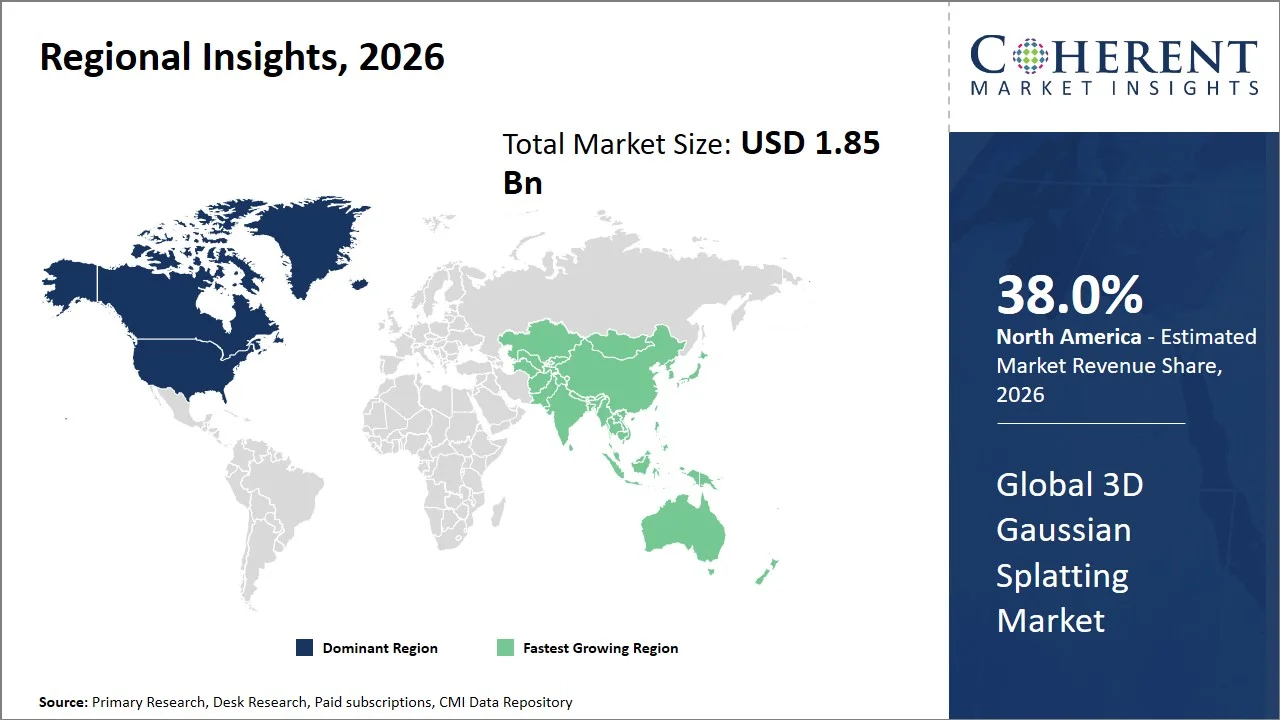
Why is North America a Strong Market for 3D Gaussian Splatting?
North America is expected to account for a market share of 38.0% in 2026. The region’s growth is propelled by the rapid commercialization of Gaussian Splatting across spatial computing, gaming, robotics and AI simulation, with NVIDIA playing a particularly important role through research such as 3DGUT, which was presented at CVPR 2025 and extends 3DGS to distorted cameras, rolling shutter effects, reflections and refractions while retaining real time rendering efficiency. NVIDIA has also demonstrated Gaussian Splatting for physical AI applications covering robotics and autonomous vehicles and introduced streaming research that renders compressed dynamic 3D video at more than 300 FPS, creating a direct pathway from research into immersive simulation and real time spatial experiences. Additionally, adoption of Gaussian Splatting by companies including Niantic, Google, Snap and Meta for mapping, AR and VR applications, with Niantic incorporating the technology into Scaniverse and Meta demonstrating spatial experiences through Hyperscape supports region’s growth.
Why Does Asia Pacific 3D Gaussian Splatting Market Exhibit High Growth?
Asia Pacific is expected to register the fastest growth with a CAGR of 12.2% over the forecast period. It is projected to account for 23.0% of the global 3D gaussian splatting market in 2026. The region’s growth is being driven by the convergence of advanced gaming, animation, robotics, semiconductor and AI ecosystems, with China, Japan, and South Korea developing particularly active 3D content and spatial technology pipelines. Chinese companies are combining generative AI with 3D creation, exemplified by Tencent's Hunyuan3D initiative, which introduced open-source models capable of producing 3D visuals from text and images, while Alibaba has demonstrated research into lifelike full body avatars using Gaussian Splatting. Japan is developing industrial applications through Sony's XYN spatial content initiative, where Sony presented photogrammetry, NeRF and 3DGS alongside industrial DX applications at the 2025 Unity Industrial DX Conference in Tokyo. The region is, therefore, progressing beyond research experimentation toward applications in digital humans, industrial visualization, game development, robotics and spatial content creation.
Global 3D Gaussian Splatting Market Outlook for Key Countries
Why is U.S. Emerging as a Major Hub in the 3D Gaussian Splatting Market?
The U.S. is being differentiated by the integration of Gaussian Splatting with GPU computing, physical AI, autonomous systems and immersive content rather than relying primarily on conventional 3D visualization. NVIDIA's U.S.-based research ecosystem has developed 3DGUT for nonlinear camera models and secondary ray effects, while its physical AI program is applying 3DGS to robotics and autonomous vehicle simulation. NVIDIA research has also shown that enhancing conventional GPU rasterizers can produce a 23× processing speed improvement and a 24 times reduction in energy consumption for 3DGS workloads, with end-to-end performance reaching 24 FPS for the original implementation and 46 FPS for an efficiency improved pipeline, directly addressing the hardware efficiency barrier for edge deployment.
Is China the Next Growth Engine for the 3D Gaussian Splatting Market?
China is being driven by the combination of large-scale generative AI development, gaming production and rapid commercialization of AI based 3D content creation. Tencent launched Hunyuan3D 2 0 in early 2025 and subsequently released five open-source models, with turbo versions reported to generate high-quality 3D visuals in around 30 seconds, providing game developers and designers with an increasingly automated route from text or images to 3D assets. Tencent also increased its AI infrastructure investment, while ByteDance entered the text to 3D and image to 3D space with its VeOmniverse model, creating a strong domestic ecosystem for AI generated spatial content that can complement Gaussian based reconstruction and rendering workflows.
Japan 3D Gaussian Splatting Market Analysis and Trends
Japan is being driven by the integration of Gaussian Splatting with industrial digital transformation, spatial content and high-fidelity 3D measurement rather than solely by entertainment applications. Sony's XYN initiative is a specific example, with Sony participating in the 2025 Unity Industrial DX Conference in Tokyo and presenting technologies including photogrammetry, NeRF and 3DGS for spatial content generation and playback, while a 2025 Japanese Photogrammetry and Remote Sensing Society publication specifically examined the path toward industrial adoption of Gaussian Splats in Japan. The country's established capabilities in robotics, precision manufacturing, computer vision and digital content provide additional application pathways for 3DGS in factory visualization, inspection, simulation, cultural preservation and immersive industrial training.
South Korea 3D Gaussian Splatting Market Analysis and Trends
South Korea is being supported by the intersection of advanced semiconductor infrastructure, gaming, digital entertainment, computer vision and immersive content development, creating a strong environment for computationally intensive 3D rendering technologies. Korean researchers are also contributing directly to the efficiency problem surrounding Gaussian Splatting, with Sung-Ho Bae among the authors of a 2025 survey examining compression methods that address the substantial memory and storage requirements of 3DGS, particularly for resource constrained devices. This research direction is strategically relevant for South Korea because efficient compression can enable Gaussian based environments to move from workstation and cloud environments toward smartphones, AR glasses, VR headsets and other consumer electronics manufactured and developed within the country.
India 3D Gaussian Splatting Market Analysis and Trends
India is being driven by the rapid expansion of AI and computer vision research alongside its large software development, gaming, animation and digital content workforce, with the strongest opportunity emerging from lower cost 3D content production and AI assisted spatial applications. Indian developers can access increasingly mature open-source Gaussian Splatting frameworks and consumer capture devices, allowing smartphones and conventional cameras to be used for creating photorealistic 3D scenes without dedicated volumetric capture studios. The country's growing interest in robotics, autonomous systems, virtual production, gaming and digital twins also creates multiple practical use cases, while the broader global movement toward compressed and lightweight 3DGS is particularly relevant for India because reducing GPU, storage and bandwidth requirements can make advanced spatial content more accessible beyond high end production environments.
Global Gaussian Splatting Market - GPU VRAM Requirement by Scene Complexity
Scene Complexity | Typical Gaussian Count | Recommended GPU VRAM | Suitable GPU Class |
Low | Up to 1 million | 4-8 GB | RTX 3060 12GB / RTX 4060 Ti 16GB |
Moderate | 1-5 million | 8-12 GB | RTX 4070 / RTX 4070 Super |
High | 5-10 million | 12-20 GB | RTX 4080 Super / RTX 4090 |
Very High | 10-30 million | 20-24 GB | RTX 4090 / RTX 5090 |
Ultra-High | 30-100 million | 24-48 GB | RTX 4090 / RTX 5090 / RTX A6000 |
Massive | Above 100 million | 48 GB+ | NVIDIA A6000 / A100 / H100 class |
How is Expansion of AI Generated Gaussian Splatting Content Creating New Growth Opportunities in the 3D Gaussian Splatting Market?
The expansion of AI generated Gaussian Splatting content is creating a growth opportunity by reducing the need for physical scene capture and enabling 3D environments to be produced directly from text, images and generated video. Research such as CompGS, presented at CVPR 2025, uses 3D Gaussians for compositional text to 3D generation, while VideoRFSplat, presented at ICCV 2025, generates scene level 3DGS from text using video generation models, Turbo3D demonstrated high-quality Gaussian Splatting asset generation in under one second, showing how generative workflows can substantially accelerate asset production. Commercial adoption is also emerging through Tencent, whose Hunyuan 3D platform supports text to 3D, image to 3D and sketch to 3D generation and had been integrated by more than 150 enterprises in China by November 2025, creating opportunities for 3DGS platforms to supply rapidly generated assets for games, virtual environments, e commerce, film effects and spatial applications.
On November 12, 2025, World Labs launched Marble Labs, a creative hub where imagination meets experimentation. It is where artists, engineers, and designers push the boundaries of world models, showcasing bold ideas, real-world workflows, and new possibilities across gaming, VFX, design, robotics, and beyond. Marble Labs is also home to in-depth case studies, tutorials, and documentation that give anyone the tools to learn, build, and share their own 3D worlds.
Market Players, Key Development, and Competitive Landscape
Key Developments
- On June 8, 2026, SideFX announced Gaussian Splat capabilities as part of Houdini 22, including the ability to train splats through TOPs after external camera solving, perform procedural cleanup and use Copernicus rasterization for compositing, depth extraction and image based editing; SideFX also demonstrated rigging and animation workflows for Gaussian Splats, extending the technology from static visualization into VFX and procedural production.
- On May 11, 2026, PIX4D integrated Gaussian Splatting into PIX4Dmatic, uniting desktop, mobile, and cloud environments into a georeferenced pipeline. This update blends terrestrial data from PIX4Dcatch and aerial drone datasets to produce dense point clouds, clear orthomosaics, and accurate 3D models with fewer iterative corrections.
- On February 26, 2026, Foundry released Nuke 17.0, the latest version of its powerful compositing tool for visual effects and animation. Marking one of the toolset’s most significant evolutions, Nuke 17.0 has been designed to better meet the needs of artists and studios, while providing a strong foundation for future workflows.
Competitive Landscape
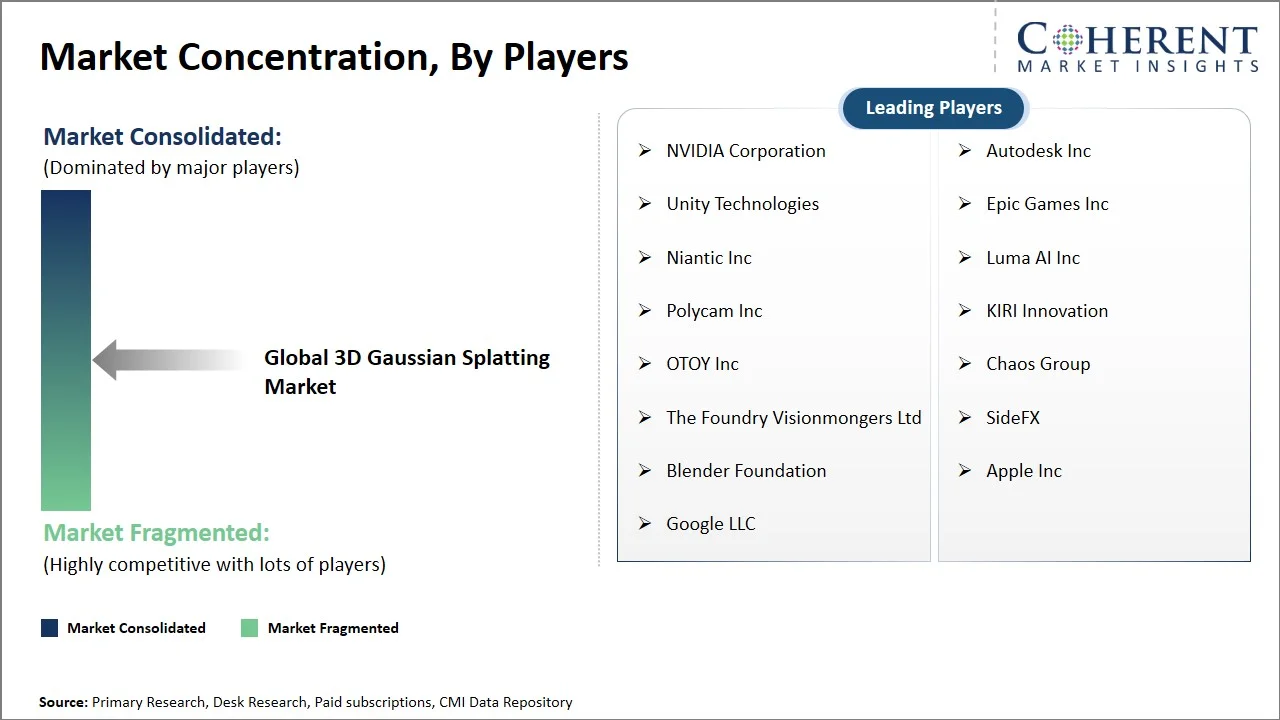
The competitive landscape is evolving around companies that are attempting to move 3D Gaussian Splatting from research implementations into complete capture, reconstruction, rendering and spatial computing workflows, with NVIDIA currently occupying a particularly strong technology position through its 3DGUT and 3DGRT work, which extends Gaussian Splatting to distorted cameras, rolling shutter effects, reflections and refractions while retaining real time rendering efficiency; NVIDIA has also positioned 3DGS for physical AI through its NuRec APIs and tools for robotics and autonomous vehicle simulation. Niantic has pursued a consumer capture strategy through Scaniverse, integrating Gaussian Splatting into location scanning and its broader spatial mapping ecosystem, while Meta, Google and Snap have explored the technology for AR, VR and mapping applications.
Tencent is pursuing a different competitive route by combining generative AI with 3D creation through Hunyuan 3D, offering text, image and sketch-based 3D asset generation and making its Hunyuan 3D Model API available through Tencent Cloud, thereby targeting the upstream content creation process that can feed future Gaussian based workflows. Sony is simultaneously building a spatial content ecosystem through XYN, including a spatial capture solution aimed at converting real world imagery into photorealistic 3D assets for film, animation and games.
Market Report Scope
3D Gaussian Splatting Market Report Coverage
| Report Coverage | Details | ||
|---|---|---|---|
| Base Year: | 2025 | Market Size in 2026: | USD 1.85 Bn |
| Historical Data for: | 2020 To 2024 | Forecast Period: | 2026 To 2033 |
| Forecast Period 2026 to 2033 CAGR: | 11% | 2033 Value Projection: | USD 7.80 Bn |
| Geographies covered: |
| ||
| Segments covered: |
| ||
| Companies covered: | NVIDIA Corporation, Autodesk Inc, Unity Technologies, Epic Games Inc, Niantic Inc, Luma AI Inc, Polycam Inc, KIRI Innovation, OTOY Inc, Chaos Group, The Foundry Visionmongers Ltd, SideFX, Blender Foundation, Apple Inc, Google LLC | ||
| Growth Drivers: |
| ||
| Restraints & Challenges: |
| ||
Analyst Opinion (Expert Opinion)
- The industry is expected to move from static scene reconstruction toward dynamic, generative and interactive spatial content, with the strongest technical differentiation increasingly coming from the ability to combine Gaussian representations with generative AI, temporal reconstruction, ray effects and real time rendering rather than simply producing higher quality static splats. NVIDIA's 3DGUT already demonstrates the direction by supporting nonlinear cameras and secondary rays such as reflections and refractions, while its physical AI work shows how reconstructed environments can become simulation assets rather than merely visual outputs.
- The greatest opportunity is expected to be concentrated in Dynamic and 4D Gaussian Splatting, particularly for robotics, autonomous driving, volumetric video, AR/VR and physical AI, while the U.S., China and Japan are likely to remain important innovation centers because of their concentration of GPU computing, AI research, gaming, spatial computing and industrial 3D capabilities. Applications that connect real world capture directly with operational systems, such as robotic simulation, autonomous vehicle environments and industrial digital twins, are expected to offer stronger commercial potential than applications limited to visual experimentation. NVIDIA's NuRec positioning around robotics and autonomous vehicles provides a concrete indication of this transition from 3D visualization toward machine usable spatial environments.
- Market players should focus on building end to end Gaussian Splatting platforms rather than isolated rendering tools, combining mobile or camera-based capture, automated reconstruction, compression, editing, generative asset creation, cloud processing and real time deployment into a single workflow. Open-source distribution can also accelerate ecosystem adoption, as demonstrated by NVIDIA's open sourcing of 3DGUT and 3DGRT and Tencent's open-source Hunyuan 3D models, but differentiation should ultimately be created through superior compression, dynamic scene handling, interoperability with major game engines and enterprise APIs.
Speak to the analyst
Want personalized insights?
Take the findings above to one of our principal consultants, or have the report rebuilt around the segments, geographies and competitors you actually track.
Market Segmentation
- Component Insights (Revenue, USD Billion, 2021 - 2033)
- Software
- 3D Gaussian Splatting Reconstruction Software
- Gaussian Splatting Rendering Engines
- Gaussian Splatting Editing Software
- Others
- Hardware
- GPUs
- Workstations
- High-Performance Computing Systems
- Depth cameras
- Others
- Services
- Digital Twin Development
- 3D Asset Creation
- Cloud Rendering
- Others
- Software
- Deployment Type Insights (Revenue, USD Billion, 2021 - 2033)
- Cloud
- On Premise
- Technology Type Insights (Revenue, USD Billion, 2021 - 2033)
- Conventional 3D Gaussian Splatting
- Dynamic Gaussian Splatting
- 4D Gaussian Splatting
- Semantic Gaussian Splatting
- Compressed Gaussian Splatting
- Generative Gaussian Splatting
- Output Type Insights (Revenue, USD Billion, 2021 - 2033)
- Static 3D Scenes
- Dynamic 3D Scenes
- 4D Scenes
- Digital Twins
- Digital Humans
- Others
- Application Insights (Revenue, USD Billion, 2021 - 2033)
- 3D Graphics and Visualization
- Gaming
- Virtual Reality and Augmented Reality
- Film And Animation
- Scientific Visualization
- Medical Imaging
- Architecture and Engineering
- Digital Twins
- Mapping and Geospatial Visualization
- Others
- End User Insights (Revenue, USD Billion, 2021 - 2033)
- Media and Entertainment
- Gaming
- Architecture and Engineering
- Healthcare
- Automotive
- Education
- Aerospace and Defense
- Others
- Regional Insights (Revenue, USD Billion, 2021 - 2033)
- North America
- U.S.
- Canada
- Latin America
- Brazil
- Argentina
- Mexico
- Rest of Latin America
- Europe
- Germany
- U.K.
- Spain
- France
- Italy
- Russia
- Rest of Europe
- Asia Pacific
- China
- India
- Japan
- Australia
- South Korea
- ASEAN
- Rest of Asia Pacific
- Middle East
- GCC Countries
- Israel
- Rest of Middle East
- Africa
- South Africa
- North Africa
- Central Africa
- North America
- Key Players Insights
- NVIDIA Corporation
- Autodesk Inc
- Unity Technologies
- Epic Games Inc
- Niantic Inc
- Luma AI Inc
- Polycam Inc
- KIRI Innovation
- OTOY Inc
- Chaos Group
- The Foundry Visionmongers Ltd
- SideFX
- Blender Foundation
- Apple Inc
- Google LLC
Sources
Primary Research Interviews
- Gaussian Splatting, Virtual Production and Unreal Engine Specialists
- Spatial Mapping, Scaniverse and 3DGS Specialists
Journals
- IEEE Transactions on Circuits and Systems for Video Technology
- ACM Transactions on Graphics
- IEEE Computer Society Conference Proceedings
Associations
- Open Geospatial Consortium
- Unreal Engine / Epic Games Ecosystem
Public Domain Sources
- U.S. National Science Foundation
- European Commission
Proprietary Elements
- CMI Data Analytics Tool
- Proprietary CMI Existing Repository of Information for the Last 10 Years
Get access to 250+ pages report
Every segment, forecast, competitor profile and data table behind the analysis above — available for instant download.
- ESOMAR Member
- ISO 9001:2015 Certified
- D-U-N-S Registered
- GDPR & CCPA Compliant
Missing comfort of reading report in your local language? Find your preferred language:
Transform your Strategy with Exclusive Trending Reports
Frequently Asked Questions
The global 3D gaussian splatting market is expected to stand at USD 1.85 Bn in 2026 and is expected to reach USD 7.80 Bn by 2033.
The CAGR of the global 3D gaussian splatting market is projected to be 11% from 2026 to 2033.
3D Gaussian Splatting is a scene representation technique that uses millions of optimized 3D Gaussian primitives to reconstruct and render photorealistic environments from captured images.
Robotic systems can use Gaussian based scene representations to reconstruct environments for perception, simulation, navigation and manipulation tasks.
It can transform captured physical environments into photorealistic spatial representations that can be explored, monitored and integrated into simulation workflows.
AI is increasingly being combined with Gaussian representations to automate scene reconstruction, generate 3D assets, understand scenes and create dynamic environments.
Compression reduces the memory and storage requirements of Gaussian scenes, making deployment more practical on smartphones, AR glasses, VR headsets and edge devices.