

Global Active Smart Glass Market Size and Forecast – 2026 To 2033
The global active smart glass market is expected to grow from USD 8 Bn in 2026 to USD 15 Bn by 2033, registering a compound annual growth rate (CAGR) of 9% from 2026 to 2033. The global active smart glass market is driven by the increasing use of smart glass in luxury and electric vehicles. On July 14, 2025, Gauzy Ltd. in collaboration with Research Frontiers, announced the first customer delivery of General Motors’ Cadillac CELESTIQ, its first fully electric vehicle sedan featuring patented Suspended Particle Device (SPD) smart glass technology supplied by Gauzy. (Source: Gauzy)
Key Takeaways of the Global Active Smart Glass Market
- The electrochromic glass segment is expected to account for 47.0 % of the global active smart glass market share in 2026. Advancements in electrochromic, SPD, and polymer dispersed liquid crystal technologies is driving the growth of the segment. On January 30, 2025, SageGlass launched RealTone, a neutral electrochromic glass solution. RealTone is created using architectural feedback to reduce the blue tone often associated with electrochromic glass, resulting in a neutral look.
- The architectural and construction segment is estimated to capture 34.0 % of the market share in 2026. Increasing integration of IoT-enabled building management systems is driving the growth of the segment. On November 5, 2025, Siemens Smart Infrastructure unveiled Building X, a new solution for smart buildings that is open, interoperable, and entirely cloud-based. It is the first next-generation offering built on the design principles of Siemens Xcelerator, the open digital business platform to accelerate digital transformation and value creation in industry, transportation, grids, and buildings. (Source: Siemens)
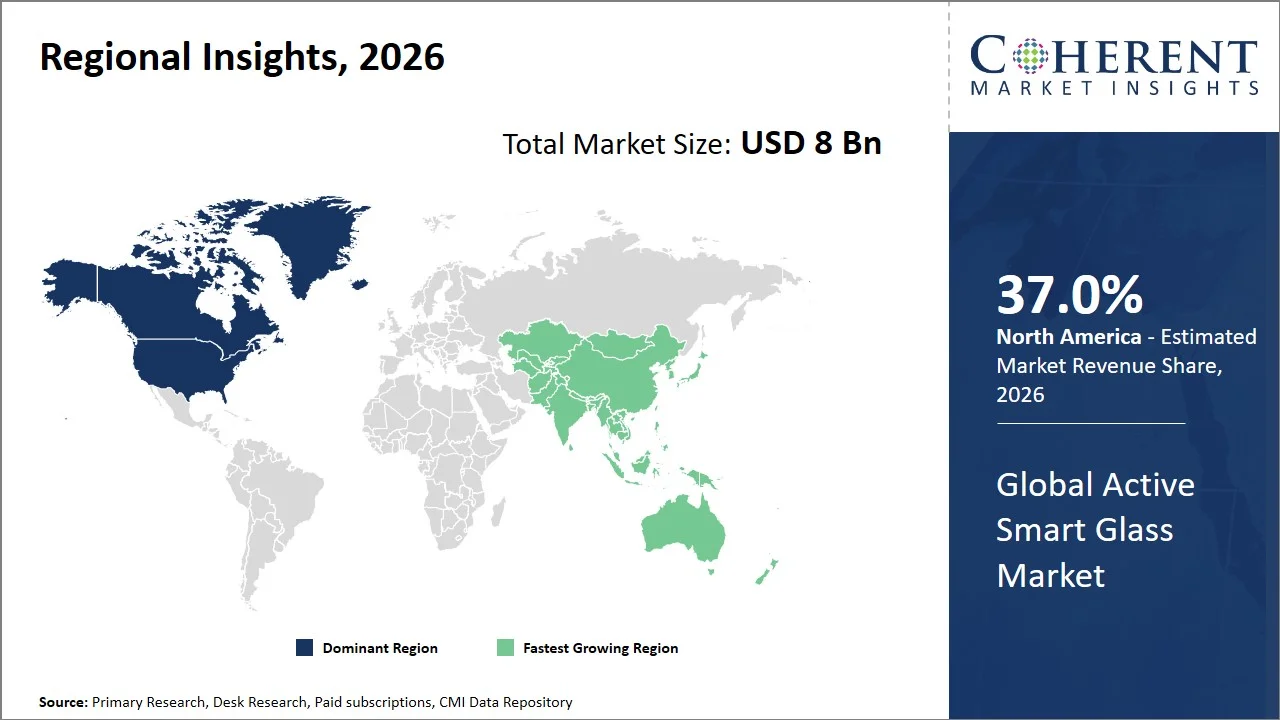
- North America is expected to dominate the active smart glass market in 2026 with a market share of 37.0 %. Expansion of smart glass use in healthcare facilities in North America is driving the growth of the regional market. In July 2024, Gauzy successfully installed a revolutionary laminated PDLC smart glass system in an intensive care unit, elevating patient care with sophisticated technology. The installation involves 30 m2 of PDLC adhesive smart film installed in 25 glass units in 15 rooms.
- Asia Pacific is expected to account for 28.0 % share in 2026 and is projected to record the fastest growth over the forecast period. Rising investments in smart offices and intelligent workplaces in Asia Pacific is driving the growth of the regional market. On August 19, 2025, KDDI announced that it will begin offering KDDI Smart Space Design in Japan and internationally with a focus on Southeast Asia. (Source: KDDI)
- Rapid Adoption of Electrochromic Glass in Sustainable Buildings: Electrochromic smart glass is experiencing significant adoption in commercial buildings, airports, hospitals, and educational institutions, owing to its capacity to dynamically regulate solar heat gain and daylight entry. Governments and developers are increasingly turning their attention to net-zero and energy efficient buildings and electrochromic glazing is being included into green building projects to reduce heating, ventilation and air conditioning and lighting energy use and enhance occupant comfort.
- Growing Integration of Smart Glass in Electric and Premium Vehicles: Car manufacturers are increasingly turning to active smart glass for sunroofs, side windows, rear windows and panoramic sunroofs. The technology helps to make passengers more comfortable, reduces heat build-up in the cabin and makes the car more energy efficient, which is especially crucial for electric vehicles. This trend is intensifying, as automakers seek innovative features to differentiate premium and next-generation mobility platforms.
Segmental Insights
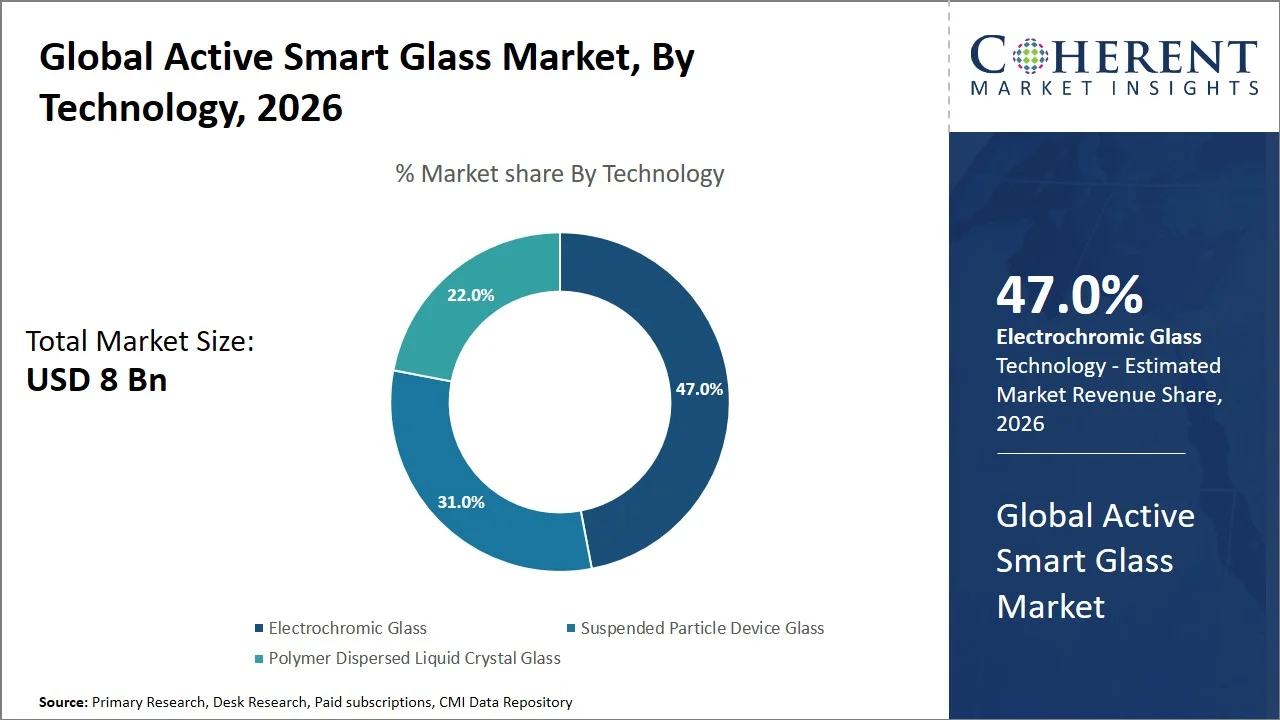
Why Does Electrochromic Glass Dominate the Global Active Smart Glass Market?
The electrochromic glass segment is expected to account for 47.0% of the global active smart glass market share in 2026. Electrochromic glass held the greatest share in the active smart glass market owing to its high energy-saving capabilities and compatibility with new sustainable building designs. Electrochromic glass automatically or manually changes its color based on sunshine and heat to reduce cooling load, minimize glare and enhance natural daylight without the need for blinds or shades. These benefits allow building owners to reduce energy consumption and enhance occupant comfort, making electrochromic technology the go-to choice for commercial offices, airports, healthcare facilities, and other large-scale infrastructure projects that prioritize energy efficiency and environmental sustainability.
- Current Industry Events of 2026
- Market Size Estimation
- Regional Breakdown
- Competitive Landscape
- Customer Intelligence
- Segmental Analysis
- Pricing Analysis
- Key Market Drivers, Challenges & Future Trends
- Customized Insights Section
Why is Architectural and Construction the Most Widespread Application?
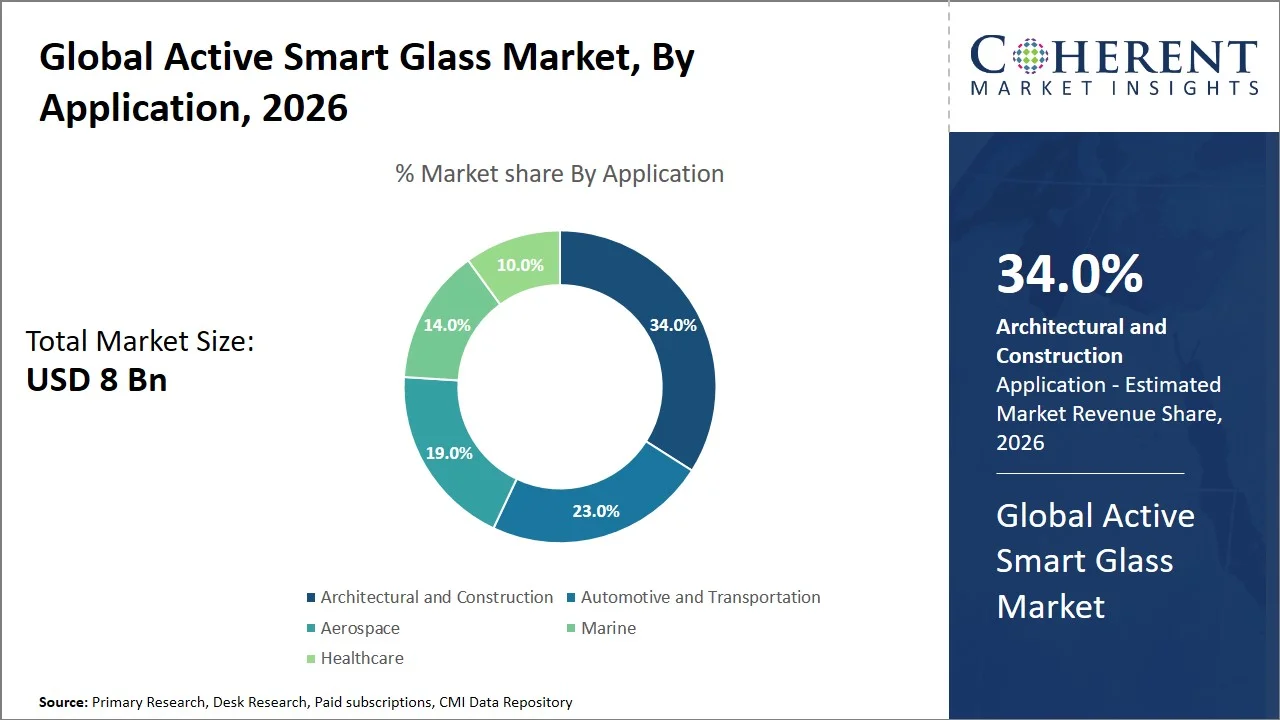
The architectural and construction segment is expected to account for 34.0% of the global active smart glass market share in 2026. Active smart glass has the largest market in architectural and construction applications. Modern buildings are more and more in need of solutions to improve energy efficiency, occupant comfort, and sustainability. Active smart glass dynamically controls sunlight, heat and glare while allowing natural daylight and outdoor vistas, reducing dependence on air conditioning and artificial lighting. The benefits line up with green building certifications and energy conservation goals, making smart glass an attractive option for commercial offices, airports, healthcare facilities, schools and luxury residential projects where long-term operational efficiency is a top priority. In November 2025, Saint-Gobain broadened the implementation of its SageGlass electrochromic facades to address growing global demand for sustainable construction, ESG compliance and biophilic design. This intelligent dynamic glass cuts solar heat gain by up to 91%, thus leading to major reductions in HVAC energy loads and earning important LEED certification points.
Currents Events and their Impact
Current Events | Description and its Impact |
European Union Energy Performance of Buildings Directive (EPBD) 2024/1275 |
|
EU Zero-Emission Building Requirements |
|
Active Smart Glass Market Dynamics
Market Drivers
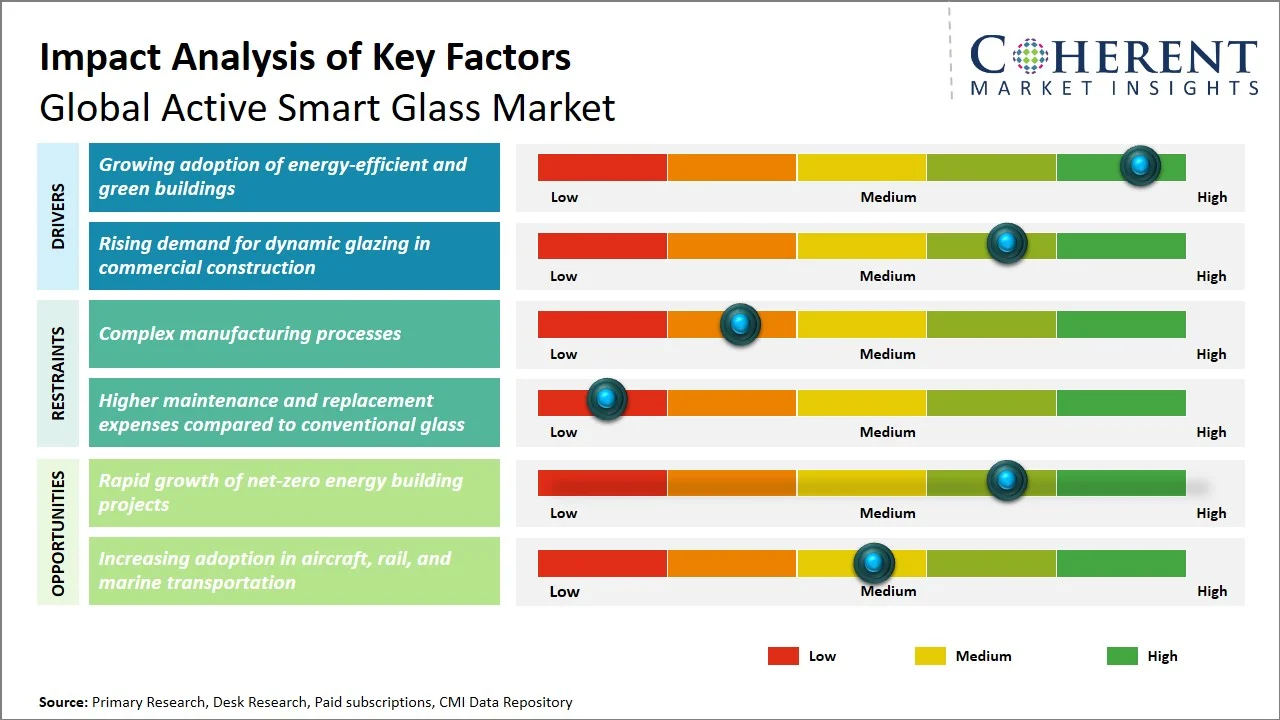
- Growing adoption of energy-efficient and green buildings: Increasing adoption of energy efficient and green buildings is a major driver for the active smart glass market, as building owners and developers are looking for technologies that can help reduce energy consumption and enhance occupant comfort. Active smart glass can dynamically control the quantity of sunshine and heat entering a structure, which reduces the need for air conditioning, heating and artificial lighting systems. This feature assists in reducing operational expenses, enhancing the quality of the indoor environment and allows compliance with tough sustainability criteria and green building certifications such as LEED and BREEAM. The market for active smart glass in commercial, institutional and residential projects is predicted to expand with the increasing government initiatives for low-carbon construction and net-zero building projects around the world. For example, Cochin International Airport Ltd (CIAL) advanced its status as one of the world’s largest fully solar-powered airport systems, with its terminals and operational buildings generating and consuming renewable energy at scale. The project demonstrates large-scale adoption of green building principles in critical infrastructure while maintaining operational efficiency.
- Rising demand for dynamic glazing in commercial construction: The rising demand for dynamic glazing in commercial construction is a major factor driving the active smart glass market as modern office buildings, airports, hotels, healthcare facilities, and educational institutions have a focused approach on energy efficiency, occupant comfort, and architectural aesthetics. Dynamic glazing technologies allow for the automatic alteration of tint levels in windows and facades according to changing sunlight and environmental circumstances, helping to eliminate glare, regulate inside temperatures and optimize natural illumination without sacrificing outside vistas. These advantages result in improved building performance, enhanced user experience and reduced energy costs, positioning active smart glass as an attractive choice for developers to create high-performance, sustainable commercial infrastructure.
Emerging Trends
- Expansion of Smart Glass Combined with IoT and Building Automation Systems: Active smart glass is increasingly integrated with smart building management systems, sensors and IoT platforms. Real time optimization of indoor environments is carried out by automating tint, based on sunshine intensity, temperature, occupancy and energy usage data. This integration enables smart buildings to focus on energy efficiency, occupant health and reduction of operational costs.
- Increasing Deployment in Healthcare, Transportation, and Specialized Infrastructure: Active smart glass is finding growing use beyond traditional architecture, with increasing use in hospitals, airports, railways, airplane cabins and high-security infrastructures. Instant switching between transparent and opaque states provides privacy, hygienic benefits, glare control and increased user experience. As infrastructure modernization projects develop worldwide, the demand for multifunctional smart glazing solutions is anticipated to grow dramatically.
Regional Insights
Why is North America a Strong Market for Active Smart Glass?
North America is expected to account for a market share of 37.0% in 2026. North America continues to be an important market for active smart glass, due to the extensive use of electrochromic glazing in big commercial and institutional buildings. View, Inc. has installed smart windows in airports, healthcare institutions, educational campuses and office buildings around the U.S., including major airport terminals and medical clinics. The region is also experiencing increased building efficiency standards and corporate sustainability programs that are creating demand for dynamic glazing systems that minimize solar heat gain and enhance interior environmental quality.
Why Does the Asia Pacific Active Smart Glass Market Exhibit High Growth?
Asia Pacific is projected to account for 28.0% of the global active smart glass market and is expected to register the fastest growth. Asia Pacific is seeing considerable increase in active smart glass adoption, driven by large scale smart city plans and high-performance building projects. Smart glazing is finding greater use in luxury business towers, transportation hubs and technology parks in China, Japan and Singapore. Dynamic glass technologies have been installed in a number of smart building projects in Singapore’s business districts to improve daylighting and reduce cooling loads in the tropical climate. China’s new-generation green building projects are accelerating the application of advanced façade materials.
Global Active Smart Glass Market Outlook for Key Countries
Why is the U.S. Emerging as a Major Hub in the Active Smart Glass Market?
The U.S. has a great deal of active smart glass used in airports, healthcare facilities and business campuses. View, Inc. has installed smart windows at projects like the terminal extension at San Francisco International Airport and many hospital projects trying to increase patient comfort and energy efficiency. Furthermore, a growing number of technology businesses and real estate developers are selecting electrochromic glass in new office complexes to meet environmental standards and employee health initiatives.
Is China the Next Growth Engine for the Active Smart Glass Market?
The China active smart glass market is propelled by country’s ambitious green construction strategy and large-scale urban infrastructure spending. Smart glass is being used by domestic manufacturers and construction firms in high-rise office skyscrapers, mixed-use developments and public infrastructure projects in cities such as Shanghai and Shenzhen. The government’s focus on energy efficient buildings and carbon reduction targets has led developers to employ sophisticated facade technologies that can improve the thermal performance and reduce building energy consumption.
Germany Active Smart Glass Market Analysis and Trends
Germany is a leading European market for active smart glass, driven by stringent energy efficiency rules and a robust culture of sustainable building. Smart glass is widely employed in offices, laboratories and public buildings built to high environmental performance standards. Demand is also being driven by Germany’s automotive industry as premium vehicle manufacturers are integrating switchable glass technology into panoramic roofs and glazing systems for luxury vehicles to improve comfort and energy management for passengers.
Japan Active Smart Glass Market Analysis and Trends
The Japan active smart glass market is supported by the country's focus on advanced building technologies, smart infrastructure, and architectural innovation. Active smart glass is being utilized in modern office towers, transportation facilities, and premium hospitality projects where daylight control and energy efficiency are critical considerations. Japanese manufacturers have also been active in developing high-performance electrochromic and liquid crystal technologies, while smart glazing solutions are increasingly incorporated into railway stations, commercial complexes, and next-generation urban redevelopment projects.
U.K. Active Smart Glass Market Analysis and Trends
The U.K. is seeing more smart glass being put to active use in sustainable building projects and commercial office refurbishments. One relevant example is 30 Duke Street St James's in London, where developer Great Portland Estates (GPE), contractor Mace, and Saint-Gobain Glass UK & Ireland used ORAÉ low-carbon glass as part of a major sustainable office redevelopment. Dynamic glazing is being used more and more in projects with high environmental certification standards to increase occupant comfort and decrease energy consumption. Developers are also integrating smart glass into premium office buildings and mixed-use complexes in key locations such as London and Manchester to fulfill evolving sustainability standards and enable net-zero carbon building strategy.
Global Active Smart Glass Market - Energy Savings Generated by Smart Glass Installations
Region | Typical Annual Building Energy Savings | Typical HVAC Energy Savings |
North America | 18-25% | 20-30% |
Europe | 15-22% | 18-28% |
Asia Pacific | 20-28% | 25-35% |
Middle East & Africa | 25-35% | 30-40% |
Latin America | 15-23% | 18-30% |
Global Active Smart Glass Market - Smart Glass Replacing Blinds in Grade-A Office Towers
Company / Project | Location | Building Type |
Saint-Gobain (SageGlass installations) | U.S., Europe | Grade-A office towers |
View Inc. smart window deployments | North America | Commercial office towers |
AGC Inc. smart façade systems | Japan, Global | High-rise Grade-A commercial buildings |
Gauzy smart glass projects | U.S., Asia | Corporate office campuses & headquarters |
Research Frontiers (SPD ecosystem deployments) | U.S., retrofit commercial buildings | U.S., retrofit commercial buildings |
How is the Rapid Growth of Net-Zero Energy Building Projects Creating New Growth Opportunities in the Active Smart Glass Market?
The burgeoning number of net-zero energy building projects is a major growth opportunity for the active smart glass industry, as developers are increasingly looking for building materials that may help cut energy consumption while ensuring occupant comfort and architectural aesthetics. Active smart glass is a key enabling technology for net-zero buildings, dynamically managing solar heat gain, glare and daylight penetration to reduce reliance on air conditioning, heating and artificial lighting systems and thus assist net-zero buildings reach energy-performance objectives. Increased investment in net-zero offices, airports, hospitals, educational facilities and mixed-use developments by governments, corporations and real estate developers is expected to significantly increase the need for innovative glazing technologies that support reduced carbon emissions and better building efficiency.
On March 6, 2024, Mahindra Group, and Johnson Controls announced a first of its kind Net Zero Buildings Initiative to decarbonize India’s commercial, urban residential and public buildings. The joint initiative will simplify access to key information and resources to help organizations start their net zero buildings journeys. (Source: Johnson Controls)
Market Players, Key Development, and Competitive Intelligence
Key Developments
- On January 9, 2025, Gauzy Ltd. unveiled its latest suspended particle device (SPD) Smart Glass technology at CES 2025, the most influential tech event in the world. Gauzy’s first-ever black SPD Smart Glass technology has a distinguishable black appearance and was created to accommodate the robust demand from the three strong and growing markets that the company targets, the automotive, aeronautics, and architecture industries.
- On January 7, 2025, Gentex Corporation announced that it is set to debut a host of “next-gen” products, including display-integrated dimmable sun visors, digital rearview mirrors with OLED displays, mirror-integrated driver and in-cabin monitoring systems, and enhancements to HomeLink, the industry’s most comprehensive and versatile car-to-home automation system.
Competitive Landscape
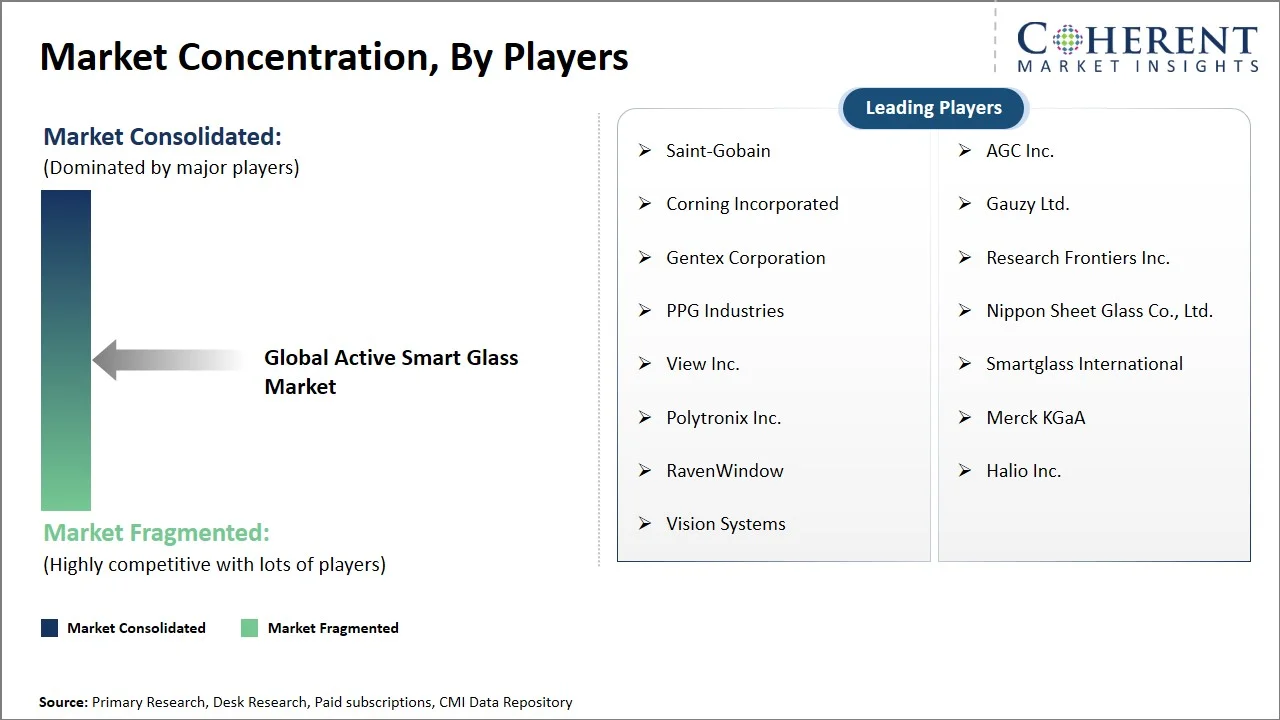
The global active smart glass market is marked by the dominance of established glass makers, specialist smart glass technology suppliers, and new players working on electrochromic, suspended particle device (SPD), and polymer dispersed liquid crystal (PDLC) technologies. Key companies such as Saint-Gobain, AGC Inc., Gentex Corporation, Gauzy Ltd., View, Inc., and Research Frontiers Inc. are competing through product innovation, strategic collaborations, manufacturing growth, and integration with smart building platforms. In addition, energy efficiency, switching speed, durability and large-scale architectural applications are increasingly determining market competition, with increased cooperation between technology developers, construction companies and automotive manufacturers bolstering commercialization efforts.
Market Report Scope
Active Smart Glass Market Report Coverage
| Report Coverage | Details | ||
|---|---|---|---|
| Base Year: | 2025 | Market Size in 2026: | USD 8 Bn |
| Historical Data for: | 2020 To 2024 | Forecast Period: | 2026 To 2033 |
| Forecast Period 2026 to 2033 CAGR: | 9% | 2033 Value Projection: | USD 15 Bn |
| Geographies covered: |
| ||
| Segments covered: |
| ||
| Companies covered: | Saint-Gobain, AGC Inc., Corning Incorporated, Gauzy Ltd., Gentex Corporation, Research Frontiers Inc., PPG Industries, Nippon Sheet Glass Co., Ltd., View Inc., Smartglass International, Polytronix Inc., Merck KGaA, RavenWindow, Halio Inc., and Vision Systems | ||
| Growth Drivers: |
| ||
| Restraints & Challenges: |
| ||
Analyst Opinion (Expert Opinion)
- The active smart glass market is viewed as entering a period of larger commercial adoption as a growing number of global sustainability mandates, building-efficiency standards, and smart infrastructure projects are implemented. There is increasing interest in technology that can enhance both the energy performance and occupant comfort, and also the appearance of buildings. Active smart glass is an important component in future generation construction and transportation projects. Gradual reduction of adoption hurdles related to high installation costs are projected due to technological advancements, economies of scale, and improved production capacity.
- The proliferation of net-zero energy buildings, smart cities, intelligent transportation systems and premium automotive applications are likely to generate strong growth possibilities. The value proposition for commercial and residential sectors is expected to increase with the increasing integration of active smart glass with IoT-enabled building management systems, automated shading controls, and energy optimization platforms. Ongoing investments in electrochromic technology, along with enabling energy-efficiency regulations and increasing corporate sustainability commitments, are expected to fuel growth and drive active smart glass into mainstream architectural and transportation applications over the next few years.
Speak to the analyst
Want personalized insights?
Take the findings above to one of our principal consultants, or have the report rebuilt around the segments, geographies and competitors you actually track.
Market Segmentation
- Technology Insights (Revenue, USD Billion, 2021 – 2033)
- Electrochromic Glass
- Suspended Particle Device Glass
- Polymer Dispersed Liquid Crystal Glass
- Application Insights (Revenue, USD Billion, 2021 - 2033)
- Architectural and Construction
- Automotive and Transportation
- Aerospace
- Marine
- Healthcare
- Regional Insights (Revenue, USD Billion, 2021 - 2033)
- North America
- U.S.
- Canada
- Latin America
- Brazil
- Argentina
- Mexico
- Rest of Latin America
- Europe
- Germany
- U.K.
- Spain
- France
- Italy
- Russia
- Rest of Europe
- Asia Pacific
- China
- India
- Japan
- Australia
- South Korea
- ASEAN
- Rest of Asia Pacific
- Middle East
- GCC Countries
- Israel
- Rest of Middle East
- Africa
- South Africa
- North Africa
- Central Africa
- North America
- Key Players Insights
- Saint-Gobain
- AGC Inc.
- Corning Incorporated
- Gauzy Ltd.
- Gentex Corporation
- Research Frontiers Inc.
- PPG Industries
- Nippon Sheet Glass Co., Ltd.
- View Inc.
- Smartglass International
- Polytronix Inc.
- Merck KGaA
- RavenWindow
- Halio Inc.
- Vision Systems
Sources
Primary Research Interviews
- Smart Glass Manufacturers & Product Engineers
- Construction & Architecture Specialists
- Automotive Industry Experts
- Electronics & Display Technology Developers
Magazines
- Glass Magazine
- Architectural Record
- Smart Glass World Magazine
- Automotive Engineering International
Journals
- Journal of Applied Electrochemistry
- Solar Energy Materials and Solar Cells (Elsevier)
- Advanced Materials Journal
Associations
- Glass Association of North America (GANA)
- National Glass Association (NGA)
- Smart Glass Industry Association (SGIA)
- International Commission on Glass (ICG)
Public Domain Sources
- U.S. Department of Energy (DOE) – Building Technologies Office
- European Commission – Energy Efficiency in Buildings Reports
- U.S. Environmental Protection Agency (EPA)
- World Green Building Council (WGBC) Publications
Proprietary Elements
- CMI Data Analytics Tool
- Proprietary CMI Existing Repository of Information for the Last 10 Years
Get access to 250+ pages report
Every segment, forecast, competitor profile and data table behind the analysis above — available for instant download.
- ESOMAR Member
- ISO 9001:2015 Certified
- D-U-N-S Registered
- GDPR & CCPA Compliant
Missing comfort of reading report in your local language? Find your preferred language:
Transform your Strategy with Exclusive Trending Reports
Frequently Asked Questions
The global active smart glass market is expected to stand at USD 8 Bn in 2026 and is expected to reach USD 15 Bn by 2033.
The CAGR of the global active smart glass market is projected to be 9% from 2026 to 2033.
In terms of technology, the electrochromic glass segment is estimated to dominate the market revenue share in 2026.
It reduces energy consumption by controlling solar heat gain and minimizing reliance on HVAC systems.
It can automatically adjust tint levels through integration with building management systems.
Growing adoption of energy-efficient and green buildings and rising demand for dynamic glazing in commercial construction are the major factors driving the growth of the global active smart glass market.
Complex manufacturing processes and Higher maintenance and replacement expenses compared to conventional glass are the major factors hampering the growth of the global active smart glass market.