

Smart Governments Market Size and Forecast — 2026 - 2033
The Global Smart Governments Market size is estimated to be valued at USD 46.8 billion in 2026 and is expected to reach USD 112.4 billion by 2033, exhibiting a compound annual growth rate (CAGR) of 12.7% from 2026 to 2033.
Overview
The Smart Governments market is expanding rapidly as public sector agencies adopt digital technologies to improve governance, citizen services, and operational efficiency. Key drivers include the rise of IoT, AI, and big data analytics for real-time decision-making, enhanced transparency, and predictive policy planning. Growing demand for smart city initiatives, e-governance platforms, and automated public service delivery fuels market growth. Additionally, increasing investment in cybersecurity, cloud infrastructure, and mobile solutions supports the digital transformation of government operations. The market is further boosted by government initiatives worldwide to enhance citizen engagement, reduce administrative costs, and optimize urban management through connected, data-driven solutions.
Key Takeaways
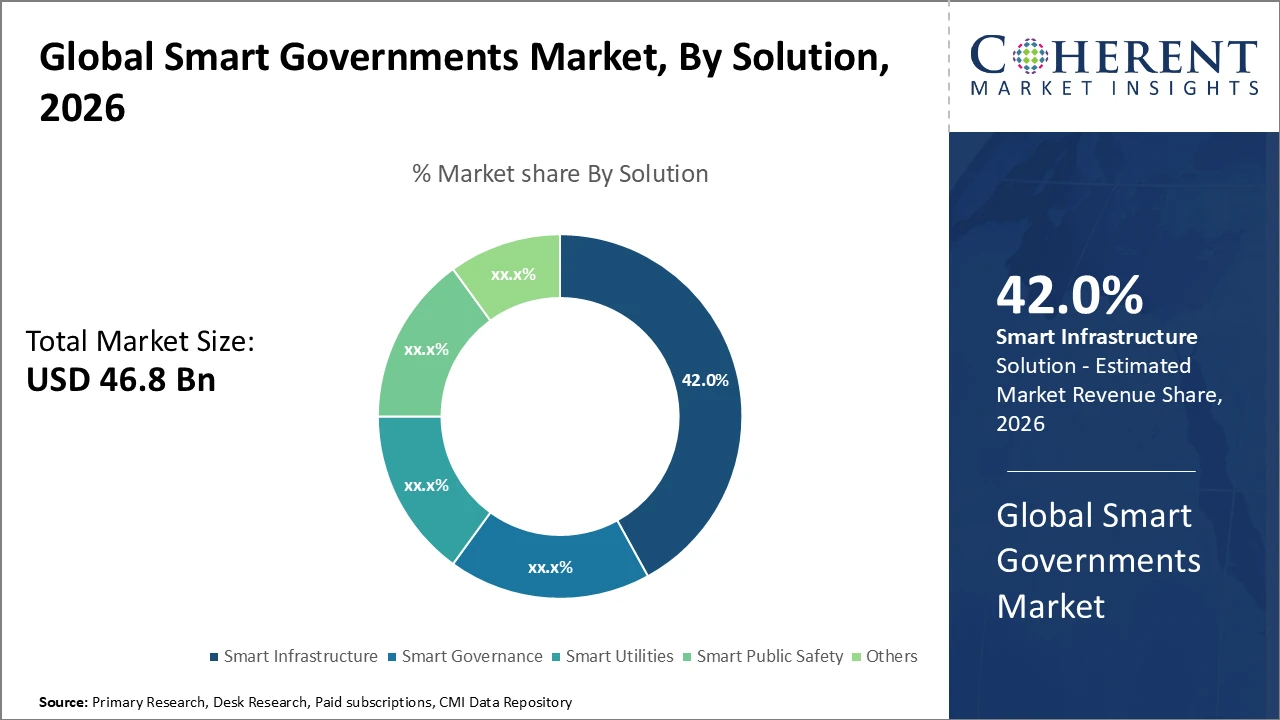
The Smart Infrastructure segment dominates the market with a 42% share, driven by rising investments in urban mobility and utility systems.
Smart Public Safety is the fastest-growing subsegment, fueled by increasing demand for AI-based surveillance solutions.
IoT remains the leading technology segment, essential for real-time data collection, while AI technologies enable dynamic governance automation, with strong adoption in Europe and North America.
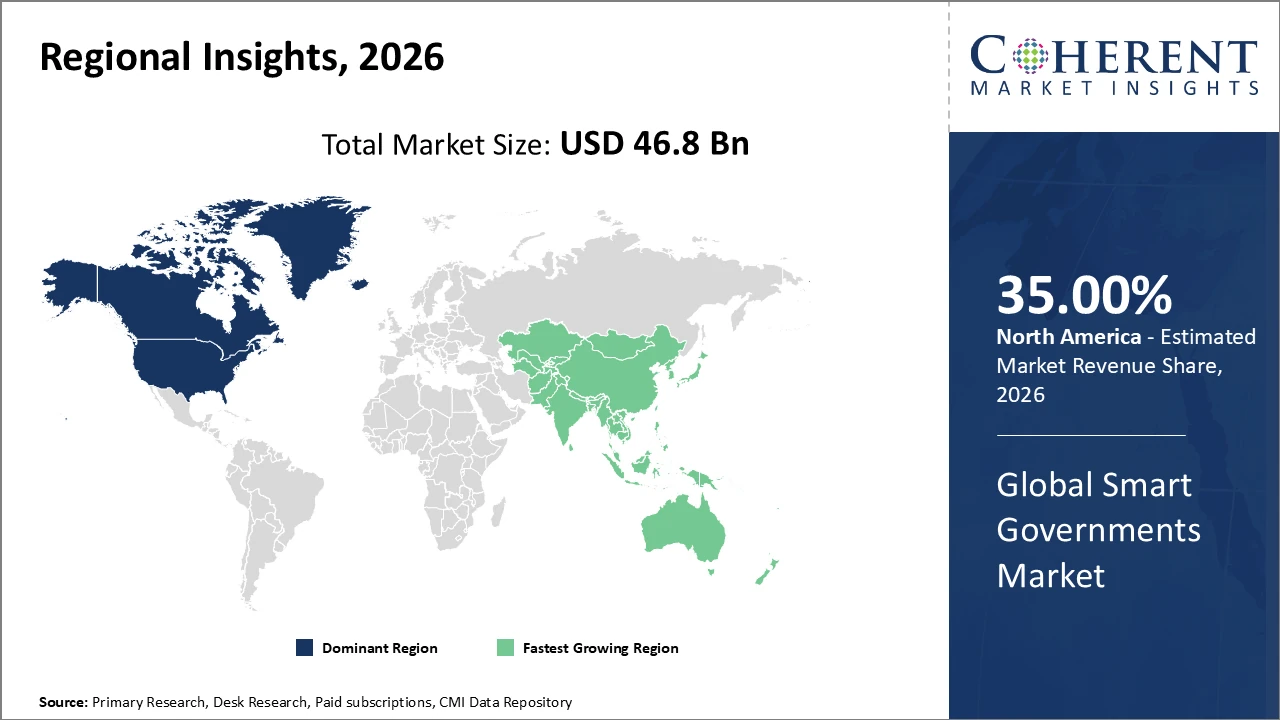
North America leads globally with over 35% market share, supported by mature technology infrastructure and robust government initiatives.
Asia Pacific exhibits the fastest CAGR, exceeding 15%, driven by rapid urbanization and government-led smart city projects in China and India.
Europe shows steady growth, emphasizing data privacy and citizen engagement platforms.
Latin America and MEA are emerging markets, with strategic investments indicating future growth potential.
Smart Governments Market Segmentation Analysis
Smart Governments Market Insights, By Solution
Smart Infrastructure dominates the Smart Governments market with a 42% share, driven by growing demand for integrated urban systems that optimize transportation, utilities, and facilities management. Its leadership is supported by large-scale investments in intelligent transport systems, smart grids, and connected public infrastructure worldwide. The fastest-growing subsegment is Smart Public Safety, fueled by rising security concerns and adoption of AI-driven surveillance and monitoring solutions across cities. Smart Governance solutions improve administrative efficiency and citizen services, while Smart Utilities focus on energy and resource management.
Smart Governments Market Insights, By Application
Urban Planning dominates the Smart Governments applications segment, driven by the urgent need for smart city development and optimized resource management in rapidly growing urban areas. It holds the largest market share due to substantial investments in infrastructure digitization, intelligent building systems, and sustainable urban growth initiatives. Transport Management is the fastest-growing application, fueled by demand for intelligent traffic control, mobility solutions, and congestion reduction strategies. Citizen Engagement platforms enhance government transparency and service delivery, while Public Health solutions integrate telemedicine and pandemic response technologies. Environment Management focuses on sustainability and resource efficiency, and Others include diverse sector-specific applications supporting specialized governance needs.
Smart Governments Market Insights, By Technology
IoT holds the dominant position in the Smart Governments market, driven by its essential role in real-time data collection across infrastructure, public services, and citizen-facing applications. Extensive deployment of IoT sensors in transportation, utilities, and public amenities reinforces its leadership. The fastest-growing technology is Artificial Intelligence, enabling predictive analytics, decision support, and automated governance services. Cloud computing facilitates scalable deployments and secure data sharing, while data analytics transforms collected information into actionable insights for policymakers.
Smart Governments Market Trends
The Smart Governments market is witnessing rapid adoption of AI and 5G-enabled platforms, transforming public infrastructure management.
South Korea and the U.S. pioneered AI-based public safety networks with real-time analytics since 2025, improving emergency response and governance transparency.
Sustainable governance is a key trend, exemplified by China’s deployment of data-driven environmental monitoring systems, significantly reducing urban pollution levels.
Enhanced citizen engagement through mobile e-governance applications is expanding globally, with the EU recording a 25% increase in citizen participation via these platforms in 2026.
Overall, AI, 5G, sustainability, and digital citizen services are shaping future smart government strategies.
Smart Governments Market Insights, By Geography
North America Smart Governments Market Analysis and Trends
In North America, the Smart Governments market is dominated by strong government IT infrastructure and proactive policy frameworks that encourage the adoption of smart governance technologies. The U.S. alone accounts for over 35% of the global market, driven by significant investments in public safety, urban planning, and digital governance solutions. Leading companies such as IBM and Cisco play a pivotal role by providing advanced platforms and integrated services. The region’s mature ecosystem, coupled with collaboration between public and private sectors, fosters innovation, accelerates technology deployment, and enhances operational efficiency, reinforcing North America’s position as a global leader in smart government initiatives.
Asia Pacific Smart Governments Market Analysis and Trends
Asia Pacific is the fastest-growing Smart Governments market, with a CAGR exceeding 15%, driven by rapid urbanization and large-scale government-led smart city initiatives in countries like China and India. The region’s growth is supported by strategic partnerships, substantial investments in next-generation IoT and AI technologies, and favorable regulatory reforms promoting digital governance. Rising digital literacy and increasing adoption of cloud-based and data-driven solutions further accelerate market expansion. Key players such as Huawei and NEC are actively expanding their presence, deploying advanced infrastructure and integrated platforms, which contributes significantly to regional market revenue and establishes Asia Pacific as a dynamic growth hub in smart government solutions.
Smart Governments Market Outlook for Key Countries
USA Smart Governments Market Analysis and Trends
The USA’s Smart Governments market is driven by advanced digital infrastructure and substantial federal and state funding for technology initiatives. In 2026, government expenditure on smart city and e-governance projects exceeded USD 12 billion, focusing on intelligent transportation systems, public safety networks, and digital citizen services. Leading companies such as Microsoft and IBM provide cloud-based, AI-driven platforms specifically designed for government applications, enhancing efficiency and decision-making. Emphasis on cybersecurity, data privacy, and regulatory compliance presents both challenges and growth opportunities, reinforcing the USA’s role as a global pioneer in smart governance and setting benchmarks for technological adoption and innovation in public sector management.
Germany Smart Governments Market Analysis and Trends
Germany’s Smart Governments market is expanding steadily, driven by strong governmental focus on digitalization, e-governance, and sustainable urban development. Investments in smart city infrastructure, including intelligent transportation, energy-efficient utilities, and AI-driven public safety systems, support market growth. The adoption of IoT and cloud-based platforms enables real-time data collection, predictive analytics, and improved decision-making across municipal and federal operations. Emphasis on data privacy and compliance with EU regulations shapes technology deployment and governance strategies. Partnerships between government agencies and technology providers, along with citizen engagement initiatives, further strengthen the market, positioning Germany as a leader in efficient, secure, and digitally enabled public administration.
Analyst Opinion
The increasing adoption of IoT-enabled devices by public agencies is a key supply-side driver, directly impacting market size. In 2025, over 65% of smart city projects in Asia Pacific integrated IoT for traffic management and public safety, significantly boosting market share. Government expenditures are expected to rise by 18% in 2026, continuing this trend.
Demand-side dynamics are driven by expanding digitalization initiatives aimed at transparency and citizen engagement. In 2024, EU member states invested over USD 7 billion in e-governance projects, marking a 20% year-over-year increase and supporting market growth.
Micro-indicators such as pricing strategies show a shift toward value-based contracting. In 2025, several North American states adopted outcome-based models for smart infrastructure projects, reducing expenditures by 15% and enhancing market efficiency.
Nano-level trends highlight rapid urban adoption. Brazilian smart city initiatives grew by 25% in 2026, driven by demand for smart water management and energy conservation, positively influencing market growth strategies.
- Current Industry Events of 2026
- Market Size Estimation
- Regional Breakdown
- Competitive Landscape
- Customer Intelligence
- Segmental Analysis
- Pricing Analysis
- Key Market Drivers, Challenges & Future Trends
- Customized Insights Section
Market Scope
| Report Coverage | Details | ||
|---|---|---|---|
| Base Year: | 2025 | Market Size in 2026: | USD 46.8 billion |
| Historical Data for: | 2020 To 2024 | Forecast Period: | 2026 To 2033 |
| Forecast Period 2026 to 2033 CAGR: | 12.7% | 2033 Value Projection: | USD 112.4 million |
| Geographies covered: |
| ||
| Segments covered: |
| ||
| Companies covered: | Siemens AG, IBM Corporation, Cisco Systems, Software Corporation, NEC Corporation, Hitachi, SAP SE, Ericsson, Honeywell International, Accenture | ||
| Growth Drivers: |
| ||
Smart Governments Market Growth Factors
Government mandates for digital transformation are a key driver of the Smart Governments market, with over 70 countries launching national smart governance frameworks by 2026, boosting revenue and business growth. Rapid urbanization and rising demand for efficient resource management accelerate investments in smart infrastructure, reflected by a 28% global increase in smart utility projects in 2025. Technological advancements in AI and cloud computing enable scalable governance solutions, reducing operational costs by up to 22%, as seen in South Korea’s 2024 national rollout. Growing cybersecurity concerns drive blockchain adoption for secure governance, with Middle East & Africa investments rising 30% in 2026.
Smart Governments Market Development
In November 2025, the Delhi government launched the ‘Pink Saheli Smart Card,’ enabling women and transgender commuters to travel free on DTC and cluster buses, promoting safety, accessibility, and inclusivity in public transport.
Key Players
Leading Companies of the Market
Siemens AG
IBM Corporation
Cisco Systems
Software Corporation
NEC Corporation
Hitachi
SAP SE
Ericsson
Honeywell International
Accenture
Siemens AG has leveraged public-private partnerships to advance smart infrastructure projects across Europe, resulting in a 9% increase in its regional market share in 2025. IBM’s AI-driven solutions for citizen engagement experienced a 15% revenue growth in 2026, following the deployment of cloud platforms in North America’s largest metropolitan areas. Meanwhile, Huawei expanded aggressively into Asia Pacific smart city initiatives through strategic collaborations with governments in China and Malaysia, significantly enhancing its market presence, with new contracts valued at over USD 1 billion in 2026, reinforcing its position as a key player in regional smart governance solutions.
Smart Governments Market Future Outlook
The Smart Governments market is poised for robust growth, driven by increasing urbanization, government digitalization mandates, and rising investments in AI, IoT, and cloud-based governance solutions. Future developments will focus on enhancing citizen engagement, improving public safety, and optimizing urban infrastructure through predictive analytics and real-time monitoring. Sustainability and smart utility management will gain prominence as environmental concerns and resource efficiency become central to urban planning. Additionally, emerging technologies such as blockchain and edge computing will strengthen data security and operational efficiency. Overall, global smart governance adoption is expected to accelerate, creating significant opportunities for technology providers and public-private collaborations.
Smart Governments Market Historical Analysis
The Smart Governments market has experienced significant growth over the past decade, driven by increasing urbanization, government digitalization initiatives, and rising demand for efficient public services. Early adoption of IoT-enabled infrastructure and cloud-based platforms enabled real-time data collection and analytics, improving decision-making and operational efficiency. Investments in intelligent transportation, public safety, and energy management systems laid the foundation for integrated smart city solutions. Europe and North America initially led market development due to mature technology ecosystems and supportive regulatory frameworks, while Asia Pacific emerged later, fueled by rapid urban growth and government-led smart city projects. These historical trends set the stage for ongoing market expansion.
Sources
Primary Research Interviews:
Government officials and policymakers involved in smart city and e-governance initiatives
Urban planners, IT managers, and project leads overseeing smart infrastructure and public safety systems
Technology providers for AI, IoT, cloud computing, and data analytics solutions used in smart governance
Magazines:
Government Technology – Innovations in Smart City and E-Governance Solutions
Smart Cities Dive – Advances in Urban IoT and Intelligent Infrastructure
Public Sector Technology – Trends in Digital Governance and Citizen Services
Information Age – Updates on AI, Cloud, and IoT Adoption in Government
Journals:
Government Information Quarterly – Smart Governance and Public Service Technology Applications
Journal of Urban Technology – Innovations in Smart Infrastructure and IoT Integration
International Journal of E-Government Research – Digital Transformation and Citizen Engagement Studies
IEEE Access – Smart Cities, AI, and IoT Implementation in Public Sector
Newspapers:
The Wall Street Journal – Public Sector Technology Investments and Market Trends
Financial Times – Smart Cities and Government Digitalization Developments
Government Technology News – Smart Governance Projects and Technology Updates
The Economist – Trends in Urban Digital Transformation and Policy Initiatives
Associations:
International Telecommunication Union (ITU) – Smart City Standards and Guidelines
United Nations E-Government Survey (UN DESA) – Global E-Governance Practices
World Economic Forum – Smart Cities and Digital Governance Research
European Commission – Smart City and Digital Government Policy Guidelines
Get access to 250+ pages report
Every segment, forecast, competitor profile and data table behind the analysis above — available for instant download.
- ESOMAR Member
- ISO 9001:2015 Certified
- D-U-N-S Registered
- GDPR & CCPA Compliant
Missing comfort of reading report in your local language? Find your preferred language:
Transform your Strategy with Exclusive Trending Reports
Frequently Asked Questions
The Smart Governments market is dominated by companies such as Siemens AG, IBM Corporation, Cisco Systems, Microsoft, and Huawei Technologies, which lead through technological innovation and collaborations with government agencies.
The market is projected to grow from USD 46.8 billion in 2026 to USD 112.4 billion by 2033, driven by increasing digital government mandates, smart city projects, and investments in urban infrastructure.
Urban Planning, especially in utilities and transport management, offers the largest growth opportunity due to rising urban populations and government initiatives focused on sustainable development.
Trends will focus on AI-enabled citizen services, blockchain-based data security, and widespread adoption of 5G networks for real-time governance, enhancing market revenue and scope.
The landscape is highly competitive, emphasizing R&D, strategic partnerships, and digital innovation, while challenges include data privacy regulations, integration complexities, and interoperability issues.
Companies typically employ public-private partnerships, outcome-based contracting, and region-specific portfolio adaptations to address varying governance requirements and regulatory frameworks.