

Advanced Polymers and Additive Manufacturing Market Size and Share Analysis – 2026 To 2033
The Advanced Polymers and Additive Manufacturing Market size is anticipated to grow at a CAGR of 21.4%, from USD 299.5 Mn in 2026 to USD 1,164.7 Mn by 2033. The primary growth drivers include the rising adoption of advanced polymer-based 3D printing technologies, increasing demand for lightweight and high-performance materials in aerospace and automotive applications, growing utilization of biocompatible polymers in medical implants, and advancements in engineering thermoplastics, photopolymers, and polymer composites. According to the U.S. Department of Energy's Oak Ridge National Laboratory, in October 2026, researchers reported that integrating additive manufacturing reinforcement with polymer thermoforming could reduce levelized manufacturing costs by approximately 5.6% compared with a standalone approach.
Key Takeaways of the Global Advanced Polymers and Additive Manufacturing Market
- The Thermoplastics segment is estimated to account for 48.0% of the global advanced polymers and additive manufacturing market in 2026. Increasing use of high-performance thermoplastics in automotive, aerospace, and industrial tooling applications is driving segment growth. On May 7, 2025, the U.S. Department of Energy's Oak Ridge National Laboratory (ORNL) reported that its vacuum-assisted extrusion technique reduced internal porosity in large-scale 3D-printed polymer components by up to 75%, improving the potential quality of fiber-reinforced thermoplastic composites.
- The Material Extrusion segment is estimated to capture 42.0% of the market in 2026. Increasing demand for cost-efficient polymer prototyping, customized manufacturing, and large-format composite printing is supporting adoption. According to ORNL's January 2025 research, vacuum-assisted extrusion reduced internal porosity by 35%–75% compared with conventional extrusion, achieving porosity levels below 2% across different processing conditions.
- The Automotive segment is estimated to account for 29.0% of the global market in 2026. Increasing applications in lightweight components, tooling, customized parts, and low-volume production are supporting segment demand. In its November 2025 research, ORNL reported polymer composite porosity measurements of 2.55% using X-ray computed tomography, compared with 2.73%–2.79% using optimized image-processing techniques, highlighting advances in printed-component quality evaluation.
- North America is predicted to be the largest advanced polymers and additive manufacturing market worldwide in 2026 with a 38.0% share. The region's market growth is driven by strong advanced manufacturing infrastructure, demand for aerospace and ongoing investment in advanced materials. On October 26, 2026, the U.S. Department of Commerce announced its plan to invest USD 24.8 Mn in Virginia’s Additive Manufacturing and Advanced Materials (AM2) coalition to improve manufacturing workforce development and equipment capabilities.
- Asia Pacific is expected to hold 29.0% of the global advanced polymers and additive manufacturing market in 2026 and is expected to be the fastest growing region during 2026-2033. The regional growth is supported by growing acceptance of polymer 3D printing, growing manufacturing capabilities and government initiatives. India’s Ministry of Information and Broadcasting reported that as of October 7, 2026, the National Strategy for Additive Manufacturing had supported 56 additive manufacturing startups, trained more than 154,000 people, and assisted in the development of 65 India-specific technologies, including materials, machinery, and printed products.
Segmental Insights
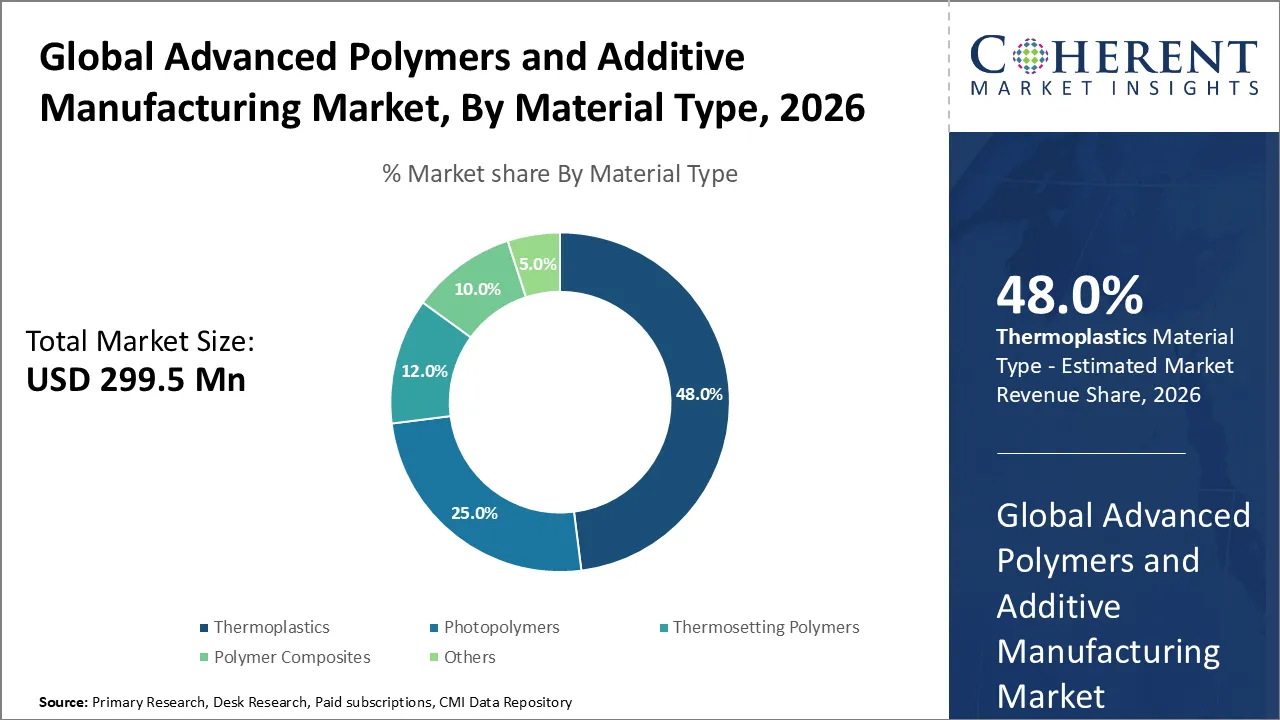
Why Do Thermoplastics Dominate the Global Advanced Polymers and Additive Manufacturing Market?
The thermoplastics segment is estimated to account for 48.0% share of the global advanced polymers and additive manufacturing market in 2026. Thermoplastics are popular due to their durability, recyclability, chemical resistance, and compatibility with a variety of additive manufacturing technologies. Materials such as polyamide (PA), polyether ether ketone (PEEK), polyetherimide (PEI) and acrylonitrile butadiene styrene (ABS) enable the production of lightweight, high-strength components with complex geometries. Increasing demand for customized industrial tooling, aerospace components, automotive parts and medical devices is supporting the adoption of advanced thermoplastics. The industrial applications of carbon fiber reinforced polymers are further extended by the developments in this field and in the high temperature processing technologies.
According to the Wohlers Report 2026, released in February 2026, global additive manufacturing polymer filament revenues increased by 18.5% in 2025, compared with 4.7% growth in 2024, while polymer powder revenues rose by 8.7%.
- Current Industry Events of 2026
- Market Size Estimation
- Regional Breakdown
- Competitive Landscape
- Customer Intelligence
- Segmental Analysis
- Pricing Analysis
- Key Market Drivers, Challenges & Future Trends
- Customized Insights Section
Why Is Material Extrusion the Most Preferred Technology in the Advanced Polymers and Additive Manufacturing Market?
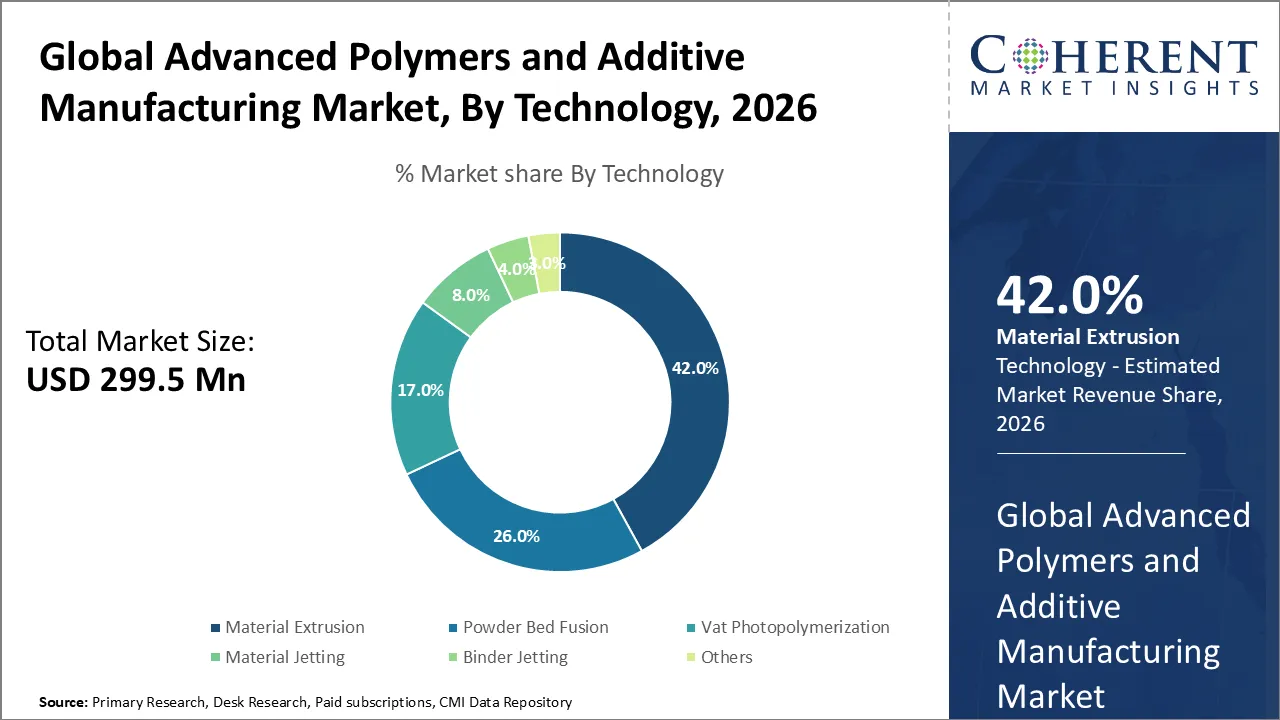
The material extrusion segment is projected to account for 42.0% share of the global advanced polymers and additive manufacturing market in 2026. Material extrusion is widely adopted due to its relatively low equipment costs, simplified production workflows and compatibility with a range of engineering-grade thermoplastics. Technologies such as fused deposition modeling (FDM) and fused filament fabrication (FFF) enable manufacturers to produce custom prototypes, industrial tools, jigs, fixtures and functional parts with less tooling. Automated extrusion systems, heated build chambers and reinforced polymer filaments are increasingly integrated, improving dimensional accuracy and consistency of manufacture. The growth of large-format additive manufacturing in aerospace, automotive and industrial applications is also supporting demand.
On October 9, 2026, Formnext reported that Stratasys launched its F870 large-format material extrusion system, featuring a fully heated build chamber of 1,000 × 610 × 610 mm. The system is compatible with industrial polymers such as Nylon 12CF, ASA and ABS. Toyota and Rivian were exploring early systems for manufacturing aids, tooling and prototyping, demonstrating how material extrusion is expanding into industrial production settings.
Why Does Automotive Dominate the Global Advanced Polymers and Additive Manufacturing Market?
The automotive segment is expected to account for 29.0% of the global advanced polymers and additive manufacturing market by 2026. Polymer-based additive manufacturing is increasingly being used by automotive manufacturers to produce lightweight components, customized vehicle parts, functional prototypes and production tooling. Advanced polymers provide design flexibility, corrosion resistance and opportunities to reduce component weight while maintaining required performance characteristics. Additive manufacturing allows for quick design modifications, localized manufacturing of components, and less reliance on traditional molds and tooling. Further, increasing investments in electric vehicles, vehicle customizing and automated manufacturing are driving polymer additive manufacturing applications in the automotive value chain.
The BMW Group announced on July 15, 2026, that its Additive Manufacturing Campus has produced more than 1.6 million components since it opened, and its vehicle plants produce another 100,000 components each year via decentralized additive manufacturing. The company said the integration of 3D printing in vehicle development, production and aftersales operations was a sign of the increasing industrial adoption of additive manufacturing in the automotive industry.
Current Events and Their Impact on the Advanced Polymers and Additive Manufacturing Market
Current Event | Description and its Impact |
U.S. Department of Commerce Announces USD 24.8 Million for Advanced Manufacturing and Additive Materials (October 2026) |
|
Government of India Advances National Strategy for Additive Manufacturing 2.0 (October 2026) |
|
Advanced Polymers and Additive Manufacturing Market Dynamics
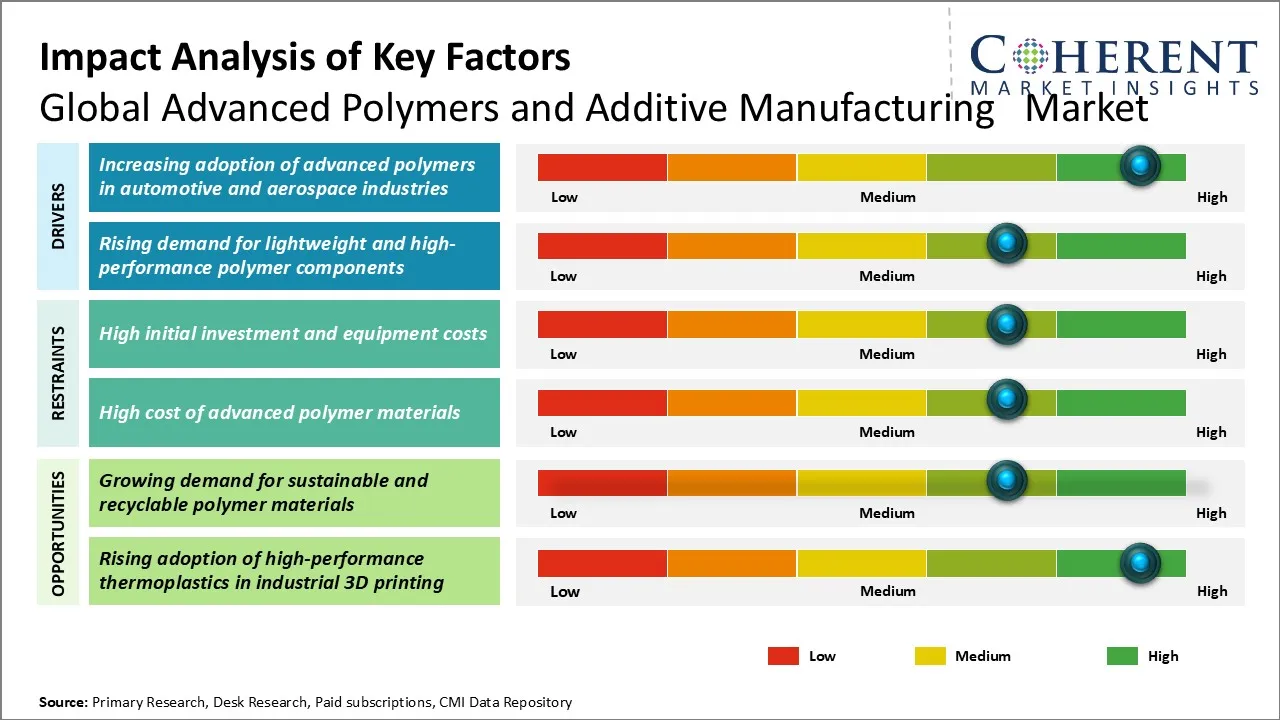
Market Drivers
- Growing Adoption of Lightweight Polymer Components in Aerospace and Defense: The global advanced polymers and additive manufacturing market is also driven by the increasing demand for lightweight and high-strength components in aerospace and defense. The aircraft manufacturers are increasingly using engineering thermoplastics, carbon fiber-based polymers, and high-performance composite materials to reduce the weight of components and enhance operational efficiency. Polymer additive manufacturing provides the means to create complex geometries, custom cabin components, replacement parts and specialized tooling without the need for traditional molds. It enables distributed manufacturing and reduces the need for inventory. The growing demand for aircraft maintenance, production flexibility and material-efficient manufacturing is motivating aerospace manufacturers to augment the use of advanced polymer printing technologies.
- On December 10, 2025, Stratasys announced that Airbus was producing over 25,000 flight-ready 3D-printed polymer parts annually, with more than 200,000 certified Stratasys polymer parts in service. The company also said that its printed parts on the Airbus A350 resulted in a 43% weight reduction and an 85% lead time reduction for the cited applications.
- Increasing Commercialization of Polymer Additive Manufacturing for Industrial Production: The shift from prototype development to industrial scale production is increasing, driving the growth of the advanced polymers and additive manufacturing market. Manufacturers are turning to polymer 3D printing for functional components, replacement parts, production tooling and customized industrial products. Newer printing technologies allow for shorter development cycles, more design flexibility and less tooling for some applications. As material consistency, process automation and engineering polymer performance improvements continue to advance, additive manufacturing is becoming more viable for recurring production. Finally, the growing need for localized production and flexibility in supply chains is driving investment in industrial polymer printing systems and materials.
- Stratasys’ second quarter 2026 financial results included 17% year-over-year growth in aerospace and defense revenue, and record quarterly consumables revenue driven by manufacturing materials. Results show growing adoption of industrial additive manufacturing, and a recurring demand for production-grade materials.
Emerging Trends
- Growing adoption of automated quality monitoring in polymer 3D printing: Manufacturers are turning to sensors, real-time monitoring and digital feedback systems to improve dimensional accuracy and reduce manufacturing defects. A study published on September 19, 2026 in The International Journal of Advanced Manufacturing Technology demonstrated how two complementary monitoring techniques, infrared thermography and acoustic emission, can be used to detect anomalies in the extrusion of PLA material.
- Growing emphasis on recyclable and sustainable polymer printing materials: Increasing focus on circular manufacturing is driving recycling of PLA, development of reusable polymer feedstocks and reduction of failed-print waste. Support structures and failed prints can account for 10%–40% of material weight in academic fused-filament fabrication settings, according to a study published by the Royal Society of Chemistry on April 6, 2026. Researchers showed a recycling process that involves shredding and re-extrusion of PLA waste into printable filament.
- · Increased utilization of patient-specific polymer implants and biomedical devices: The biocompatible polymers are facilitating the manufacture of personalized implants, surgical guides and tissue-engineering scaffolds according to the individual patient requirements. A study released June 24, 2026, from researchers at the University of Basel reported 100% fabrication success for carbon fiber-reinforced PEEK and barium sulfate-filled PEEK implants, and 85.7% for another PEEK composite. The printed implants demonstrated dimensional deviations as small as 0.16–0.29 mm, indicating the potential for accurate polymer-based medical manufacturing.
Regional Insights
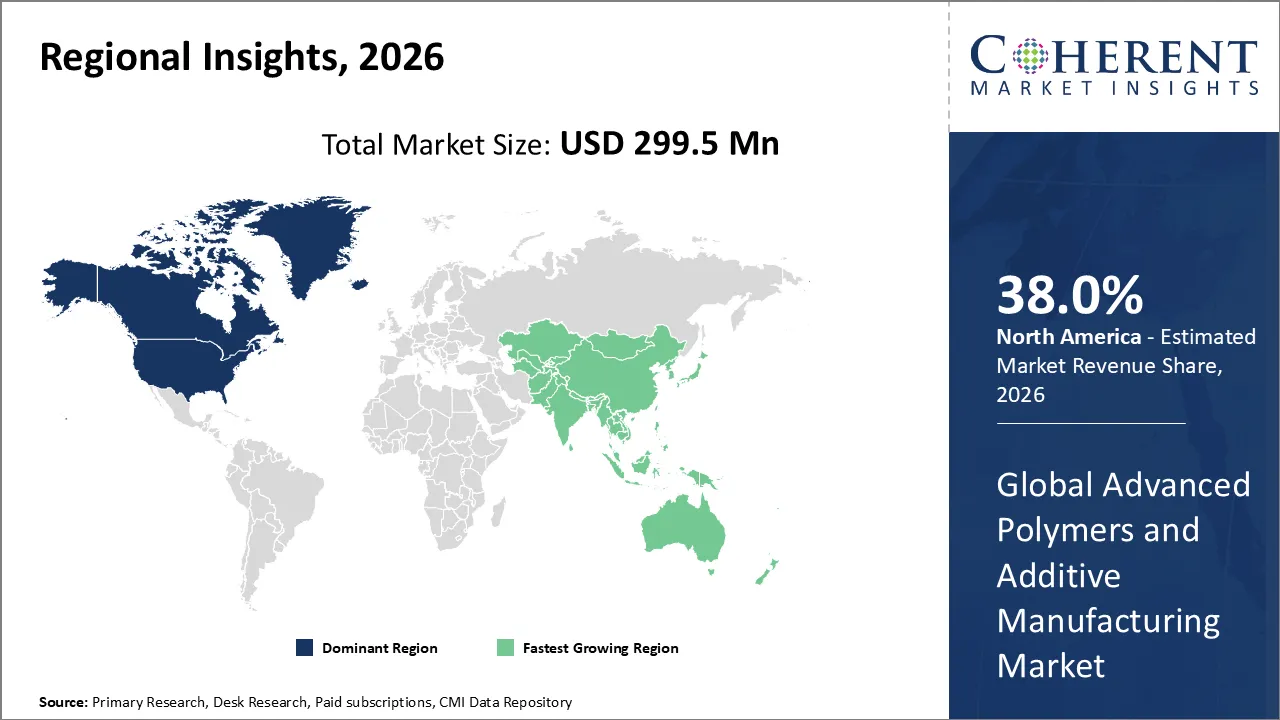
Why Does North America Dominate the Advanced Polymers and Additive Manufacturing Market?
North America is projected to hold 38.0% share of the global advanced polymers and additive manufacturing market in 2026. The area has a well-established aerospace and defense manufacturing ecosystem, a strong research infrastructure, and a growing commercialization of high-performance polymer-based 3D printing technologies. The demand for engineering thermoplastics, carbon fiber-reinforced composites and custom polymer components is increasing in the United States for aerospace, automotive and healthcare applications. Additive manufacturing is being increasingly adopted by manufacturers for lightweight structural components, specialized tooling and low volume production. Also, government-backed research programs, initiatives to qualify advanced materials and collaboration between universities and industrial manufacturers are further bolstering the regional market.
According to the U.S. National Science Foundation (NSF), Z-Polymers LLC was awarded about USD 1.25 Million for Phase II Small Business Innovation in 2026. Supporting research on engineering-grade 3D printing polymers that are durable and high-performing. The project aims to enable reliable production of industrial parts with compact additive manufacturing systems and thus the commercialization of advanced polymer materials.
Why Does Asia Pacific Exhibit the Fastest Growth in the Advanced Polymers and Additive Manufacturing Market?
The Asia Pacific region is projected to witness the fastest growth between 2026 and 2033, with an estimated 29.0% share of the global advanced polymers and additive manufacturing market in 2026. Factors such as rapid industrialization, increasing automotive and electronics manufacturing, and growing investments in advanced manufacturing technologies are contributing to regional market expansion. China, Japan, India and South Korea are all using polymer additive manufacturing for functional prototyping, custom parts and industrial tooling. Rising demand for engineering thermoplastics, reinforced polymer composites and cost effective manufacturing solutions are opening up opportunities for regional suppliers. Further driving adoption are government initiatives that promote domestic 3D printing capabilities, manufacturing automation and technical workforce development. Singapore’s growing additive manufacturing ecosystem is also supporting commercialization of research and collaboration between industrial manufacturers and research institutions.
According to India’s Ministry of Skill Development and Entrepreneurship said in a parliamentary response on August 2026 that there were 243 trainees registered for Additive Manufacturing (3D Printing) Technician trade at industrial training institutes in 2025, up from 135 in 2024, a year-on-year rise of 80.0%. This is reflected in the growing interest in specialized additive manufacturing training, which helps to create a skilled workforce for advanced polymer processing and industrial 3D printing applications.
Global Advanced Polymers and Additive Manufacturing Market Outlook for Key Countries (2026–2033)
Why Is the U.S. Emerging as a Major Hub in the Advanced Polymers and Additive Manufacturing Market?
The U.S. market for advanced polymers and additive manufacturing is driven by the increasing adoption of engineering thermoplastics, advanced composites and industrial 3D printing technologies in aerospace, defense, automotive and healthcare industries. For the development of lightweight components, custom tools and functional parts with complex geometries, manufacturers are turning more and more to high-performance polymers. The country has a well-established research ecosystem, robust cooperation between national laboratories and manufacturers, and government-backed manufacturing programs. The increasing demand for local production, advanced material qualification and resilient supply chains also drives the industrial adoption of polymer additive manufacturing technologies.
On September 15, 2026, the U.S. National Institute of Standards and Technology (NIST) announced over USD 30 Million in grants to 12 Manufacturing Extension Partnership centers in 11 states and Puerto Rico. The initiative is to help small and medium-sized manufacturers adopt advanced technologies including additive manufacturing, robotics and automation, further enhancing the country’s advanced manufacturing capabilities.
Is China the Next Growth Engine for the Advanced Polymers and Additive Manufacturing Market?
The China advanced polymers and additive manufacturing market is expanding owing to the existence of a large manufacturing base, the growth in the production of 3D printing equipment, and the use of advanced materials in electronics, automotive, aerospace, and industrial applications. Domestic producers are developing their capabilities in polymer extrusion and photopolymer processing, engineering thermoplastics and automated manufacturing systems. A greater uptake of additive manufacturing is being driven by the country’s focus on intelligent manufacturing, production efficiency and localized industrial supply chains. The increasing availability of low-cost printing equipment and specialized polymer feedstocks is also opening up opportunities for material suppliers and component manufacturers.
On November 5, 2026, China’s Farsoon Technologies announced the Flight HT1002P-CAMS, a next-generation large-format polymer powder bed fusion system for industrial production. The new platform builds on the company’s proven polymer printing systems and focuses on higher productivity, reliable operation and improved production economics. The development underscores China’s growing capabilities in advanced polymer 3D printing and industrial-scale additive manufacturing.
Germany Advanced Polymers and Additive Manufacturing Market Analysis and Trends
Germany's advanced polymers and additive manufacturing market is powered by its strong automotive engineering industry, sophisticated industrial research infrastructure and increasing use of high-performance polymer composites. Manufacturers are increasingly using polymer powder bed fusion, material extrusion and automated quality monitoring to make precision-engineered parts. Demand for lightweight components, customized industrial tooling and recyclable polymer materials is driving innovation in automotive, medical technology and industrial machinery applications. Research institutions are also working on increasing the reproducibility of production, reducing the costs of processing and establishing reliable procedures for quality assurance in the industrial 3D printing of polymers.
On October 15, 2026, the Fraunhofer Institute for Microstructure of Materials and Systems in Germany reported progress on its AddiQ project to develop quality assurance technologies for large-format polymer printing from plastic granules. Researchers fabricated a demonstration component of 500 mm length, i.e. 38% of the original 1,300 mm railroad component, with process sensors and automated nozzle evaluation. The project shows progress in quality-controlled polymer additive manufacturing of transportation components in Germany.
U.K. Advanced Polymers and Additive Manufacturing Market Analysis and Trends
The U.K. advanced polymers and additive manufacturing market is being supported by increasing investment in advanced materials research, digital manufacturing and high value engineering applications. The aerospace, automotive and medical technology industries in the country are eyeing polymer-based additive manufacturing for custom components, lightweight structures and specialized production tooling. Government attempts to promote commercialization of advanced materials and industrial innovation are fostering cooperation among manufacturers, universities and technology developers. As demand for sustainable thermoplastics, advanced polymer formulations and localized component production continues to increase, new opportunities are opening up for additive manufacturing suppliers.
On September 1, 2026, Innovate UK launches first round of National Materials Innovation Program collaborative R&D competition Up to GBP 12 Million to be made available for advanced materials innovation The program is designed to speed up the commercialization and industrial adoption of materials technologies in high-growth industries. This funding has the potential to drive advanced polymer development, innovation in manufacturing processes and applications in industrial additive manufacturing.
Japan Advanced Polymers and Additive Manufacturing Market Analysis and Trends
Japan’s advanced polymers and additive manufacturing market is underpinned by its strong automotive, electronics, precision engineering and specialty chemical industries. Japanese manufacturers are increasingly developing high-performance thermoplastics, reinforced polymer composites and precision 3D printing technologies to meet demanding industrial applications. Research institutions are working to improve dimensional accuracy, thermal deformation and mechanical properties of the printed components. The adoption of polymer additive manufacturing in automotive, healthcare and industrial equipment applications is being boosted by growing interest in recyclable materials, flexible production systems and small batch manufacturing.
On September 10, 2026, a team from Shizuoka University, Osaka Institute of Technology and industry researchers announced that mixing talc and cellulose nanofibers into polypropylene reduced deformation during 3D printing by 81.8%. In comparison, talc alone reduced it by 31.5% and cellulose nanofibers alone reduced it by 48.5%. Advanced polymer formulations have the potential to improve dimensional stability and expand the application of polypropylene in automotive prototypes and on-demand manufacturing, the research shows.
How Is the Expansion of High-Performance Polymer 3D Printing Creating New Growth Opportunities in the Advanced Polymers and Additive Manufacturing Market?
Growth opportunities are being created by the growing commercialization of high-performance polymer additive manufacturing technologies for aerospace, defense, automotive and industrial applications. Manufacturers are using advanced thermoplastics, carbon fiber-reinforced composites, and specialized polymer powders to produce lightweight components, custom tooling, and complex end-use parts. To make production more flexible and less dependent on traditional tooling, manufacturers are adding large-format printing systems, automated production workflows and open-material platforms.
For instance, on March 17, 2026, Farsoon Technologies announced an expansion of its open-material platform through collaboration with Advanced Laser Materials (ALM). The development introduced compatibility with high-performance polymer powders, including HT-23, PA11 Black, and FR106, for industrial polymer powder bed fusion systems. The initiative enables manufacturers to select specialized materials and optimize printing parameters for demanding applications, creating new commercialization opportunities for advanced polymer materials and industrial additive manufacturing solutions.
Market Players, Key Development, and Competitive Intelligence
Key Developments
- On April 29, 2026, NatureWorks announced the grand opening of its fully integrated Ingeo biopolymer manufacturing facility in Nakhon Sawan, Thailand. The complex combines lactic acid, lactide, and PLA production, expanding the company's manufacturing capabilities for sustainable polymers. PLA is used in 3D-printing filaments, although the announcement does not specify capacity dedicated to additive manufacturing.
- In September 2026, Covestro announced the opening of a polyurethane elastomer recycling pilot plant in Leverkusen, Germany. The process can recycle more than 90% of selected end-of-life Vulkollan material, potentially reducing its carbon footprint by up to two-thirds.
Competitive Landscape
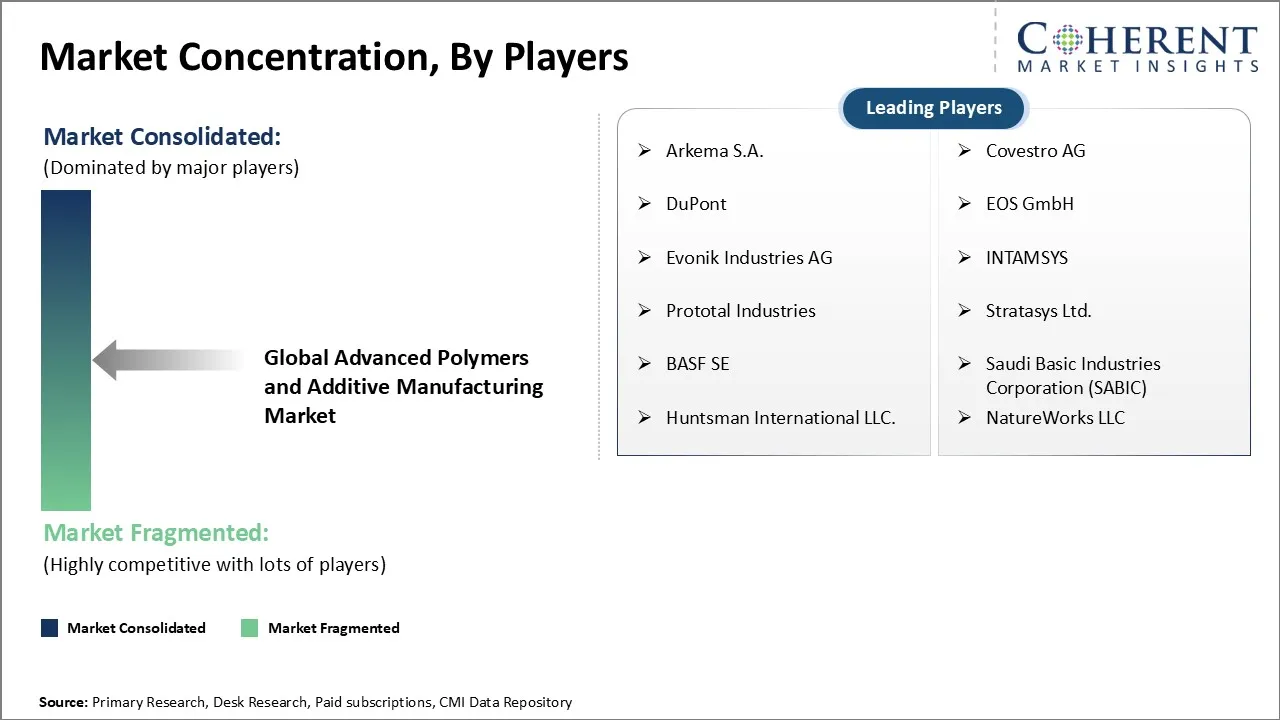
The global advanced polymers and additive manufacturing market is highly competitive, with key players focusing on material innovation, advanced 3D printing technologies, and production efficiency. Arkema and Evonik Industries are strengthening their portfolios of high-performance polymers, including PA11, PA12, and PEKK. Stratasys and EOS GmbH focus on industrial polymer 3D printing solutions, while INTAMSYS specializes in high-temperature printing technologies for PEEK and PEI materials. SABIC offers specialty engineering thermoplastics, NatureWorks develops sustainable PLA materials, and Prototal Industries provides polymer additive manufacturing services. Competitive differentiation increasingly depends on material performance, scalability, sustainability, and cost-effective manufacturing.
Top Manufacturers and Notable Products/Solutions in the Advanced Polymers and Additive Manufacturing Market
Company/Manufacturer | Notable Product/Brand | Key Features |
Arkema S.A. | Rilsan PA11, Kepstan PEKK | High-performance thermoplastics, chemical resistance, impact strength, lightweight components, powder bed fusion compatibility |
Evonik Industries AG | INFINAM PA12 | Industrial polymer powders, mechanical durability, low moisture absorption, chemical resistance, selective laser sintering applications |
EOS GmbH | EOS P3 NEXT | Industrial polymer 3D printing, selective laser sintering, PA11/PA12 compatibility, high-productivity manufacturing, powder reuse |
Stratasys Ltd. | H350 3D Printer | Selective Absorption Fusion technology, PA11/PA12 processing, automated powder handling, production-grade parts, scalable manufacturing |
INTAMSYS | FUNMAT PRO 610HT | High-temperature material extrusion, PEEK/PEKK compatibility, 300°C heated chamber, large-format printing, industrial applications |
Saudi Basic Industries Corporation (SABIC) | ULTEM AM9085F Filament | High-performance PEI thermoplastic, heat resistance, mechanical strength, flame resistance, aerospace applications |
NatureWorks LLC | Ingeo 3D870 | PLA-based biopolymer, improved impact resistance, heat resistance, dimensional stability, low-warping filament applications |
Market Report Scope
Advanced Polymers and Additive Manufacturing Market Report Coverage
Report Coverage | Details | ||
Base Year: | 2025 | Market Size in 2026: | USD 299.5 Mn |
Historical Data for: | 2020 to 2024 | Forecast Period: | 2026 to 2033 |
CAGR: | 21.4% | 2033 Value Projection: | USD 1,164.7 Mn |
Geographies covered: |
| ||
Segments covered: |
| ||
Companies covered: | Arkema S.A., Covestro AG, DuPont, Inc., EOS GmbH, Evonik Industries AG, INTAMSYS, Prototal Industries, Stratasys Ltd., BASF SE, Saudi Basic Industries Corporation (SABIC), Huntsman International LLC., and NatureWorks LLC. | ||
Growth Drivers: |
| ||
Restraints & Challenges: |
| ||
Analyst Opinion (Expert Opinion)
- The global advanced polymers and additive manufacturing market will shift toward high-performance thermoplastics, reinforced polymer composites and industrial scale production over conventional prototyping. Aerospace, automotive and healthcare manufacturers are expected to prefer materials that offer lightweight characteristics, mechanical strength and dimensional stability. Crucial for broadening end-use applications will be advanced polymers such as PEEK, PEKK and PA12. A study by Oak Ridge National Laboratory in April 2026 estimated the feasibility of 3D-printed automotive energy absorbers at an estimated USD 74 per unit, demonstrating the economic viability of additive manufacturing in low- to medium-volume applications.
- High temperature polymer printing, sustainable materials, customized medical devices and automated industrial manufacturing are expected to drive strongest growth opportunities. Aerospace and defense applications are expected to continue to make North America an important market for the region. Asia Pacific is expected to grow through automotive, electronics and industrial manufacturing. Manufacturers should focus on recyclable polymer powders, qualified engineering materials and cost-effective printing technologies. In November 2025, HP showed that its HP 3D HR PA 11 Gen2 material delivers up to 80% powder reuse and up to 40% lower variable part costs, demonstrating the commercial promise of sustainable polymer printing. These are the product performance figures reported by the manufacturer.
- Market participants will increasingly have to differentiate themselves on the basis of verified material performance, production economics, quality assurance and manufacturing scalability rather than just equipment capabilities. Suppliers need to show that they are improving cost per part, production lead time, material utilization, dimensional accuracy and repeatability. Strategic partnerships between polymer manufacturers, printer developers, and industrial end users will become essential for commercialization. According to a 2026 study by Oak Ridge National Laboratory, integrating additive reinforcement with polymer thermoforming could reduce levelized manufacturing costs by approximately 5.6% compared with a standalone manufacturing approach. This highlights the potential value of hybrid manufacturing technologies in improving production economic.
Speak to the analyst
Want personalized insights?
Take the findings above to one of our principal consultants, or have the report rebuilt around the segments, geographies and competitors you actually track.
Market Segmentation
- By Material Type (Revenue, USD Mn, 2021-2033)
- Thermoplastics
- Photopolymers
- Thermosetting Polymers
- Polymer Composites
- Others (Elastomers, Specialty Polymers)
- By Technology (Revenue, USD Mn, 2021-2033)
- Material Extrusion
- Powder Bed Fusion
- Vat Photopolymerization
- Material Jetting
- Binder Jetting
- Others (Sheet Lamination, Hybrid Technologies)
- By End-Use Industry (Revenue, USD Mn, 2021-2033)
- Automotive
- Aerospace & Defense
- Healthcare & Medical Devices
- Consumer Goods
- Electronics
- Industrial Manufacturing
- Construction
- Others (Education, Research, Packaging)
- By Region (Revenue, USD Mn, 2021-2033)
- North America
- U.S.
- Canada
- Latin America
- Brazil
- Mexico
- Argentina
- Rest of Latin America
- Europe
- Germany
- U.K.
- France
- Italy
- Spain
- Russia
- Rest of Europe
- Asia Pacific
- China
- India
- Japan
- Australia
- South Korea
- ASEAN
- Rest of Asia Pacific
- Middle East
- GCC
- Israel
- Rest of Middle East
- Africa
- South Africa
- Central Africa
- North Africa
- North America
- Key Players
- Arkema S.A.
- Covestro AG
- DuPont, Inc.
- EOS GmbH
- Evonik Industries AG
- INTAMSYS
- Prototal Industries
- Stratasys Ltd.
- BASF SE
- Saudi Basic Industries Corporation (SABIC)
- Huntsman International LLC.
- NatureWorks LLC.
Sources
Primary Research Interviews
- Advanced polymer manufacturers and material scientists
- Additive manufacturing researchers and technology developers
- Polymer extrusion and powder bed fusion technology experts
- R&D heads from specialty chemical and advanced manufacturing companies
- Engineering thermoplastics and polymer composite specialists
- Industrial 3D printing equipment manufacturers
- Aerospace, automotive, healthcare, and defense industry procurement managers
- Key opinion leaders (KOLs) in polymer science and additive manufacturing
Databases
- World Bank
- Organisation for Economic Co-operation and Development (OECD)
- National Science Foundation (NSF)
- European Commission – CORDIS Research Database
- U.S. Department of Energy (DOE)
- National Institute of Standards and Technology (NIST)
- United Nations Comtrade Database
- World Intellectual Property Organization (WIPO)
Magazines
- 3D Printing Industry
- Additive Manufacturing Magazine
- TCT Magazine
- Plastics Technology
- CompositesWorld
- Design World
Journals
- Additive Manufacturing
- Polymer
- Advanced Materials
- Composites Science and Technology
- Materials & Design
- Journal of Manufacturing Processes
- International Journal of Advanced Manufacturing Technology
- Polymers
Newspapers
- The New York Times
- The Wall Street Journal
- Financial Times
- The Guardian
- The Economic Times
- Nikkei Asia
Associations
- Additive Manufacturing Users Group (AMUG)
- ASTM International – Additive Manufacturing Standards
- Society of Manufacturing Engineers (SME)
- America Makes
- European Powder Metallurgy Association (EPMA)
- Society of Plastics Engineers (SPE)
- American Composites Manufacturers Association (ACMA)
Public Domain Sources
- Company Annual Reports and Investor Presentations
- Government Research and Advanced Manufacturing Publications
- University Research Publications and Technology Transfer Reports
- Patent Databases such as WIPO, USPTO, and Google Patents
- Publicly Available Polymer Additive Manufacturing Project Reports
- ISO/ASTM Standards and Regulatory Publications
- Government Funding Announcements and Advanced Materials Research Programs
- Company Product Catalogs, Technical Data Sheets, and Official Press Releases
Proprietary Elements
- CMI Data Analytics Tool
- Proprietary CMI Existing Repository of Information for the Last 10 Years
Get access to 250+ pages report
Every segment, forecast, competitor profile and data table behind the analysis above — available for instant download.
- ESOMAR Member
- ISO 9001:2015 Certified
- D-U-N-S Registered
- GDPR & CCPA Compliant
Frequently Asked Questions
The Advanced Polymers and Additive Manufacturing Market is expected to reach USD 1,164.7 Mn by 2033, increasing from USD 299.5 Mn in 2026.
Major players operating in the global Advanced Polymers and Additive Manufacturing Market include Arkema S.A., Covestro AG, DuPont, Inc., EOS GmbH, Evonik Industries AG, INTAMSYS, Prototal Industries, Stratasys Ltd., BASF SE, Saudi Basic Industries Corporation (SABIC), Huntsman International LLC., and NatureWorks LLC.
High initial investment costs, expensive engineering-grade polymer materials, complex manufacturing processes, and stringent quality certification requirements are the major factors hampering market growth.
Increasing adoption of lightweight polymer components in automotive and aerospace industries, advancements in high-performance thermoplastics, rising demand for customized 3D-printed parts, and expanding industrial additive manufacturing applications are driving market growth.
The Advanced Polymers and Additive Manufacturing Market is anticipated to grow at a CAGR of 21.4% between 2026 and 2033.
North America is expected to dominate the global Advanced Polymers and Additive Manufacturing Market, accounting for an estimated 38.0% market share in 2026. Asia Pacific is projected to be the fastest-growing region.
Advanced polymers are high-performance materials with enhanced mechanical, thermal, or chemical properties. Additive manufacturing is a layer-by-layer production process that uses materials such as thermoplastics, photopolymers, and polymer composites to manufacture complex and customized components.