

Global AI Accelerator ASIC Market Size and Forecast – 2026 To 2033
The global AI accelerator ASIC market is expected to grow from USD 29.50 Bn in 2026 to USD 150.00 Bn by 2033, registering a compound annual growth rate (CAGR) of 18.1% from 2026 to 2033. The global AI accelerator ASIC market is driven by rising demand for energy-efficient AI inference processing. On January 7, 2025, Ambarella, Inc. introduced the N1-655 edge GenAI system-on-chip (SoC), which provides on-chip decode of 12x simultaneous 1080p30 video streams, while concurrently processing that video and running a hybrid of multiple, multimodal vision-language models (VLMs) and traditional CNNs.
Key Takeaways of the Global AI Accelerator ASIC Market
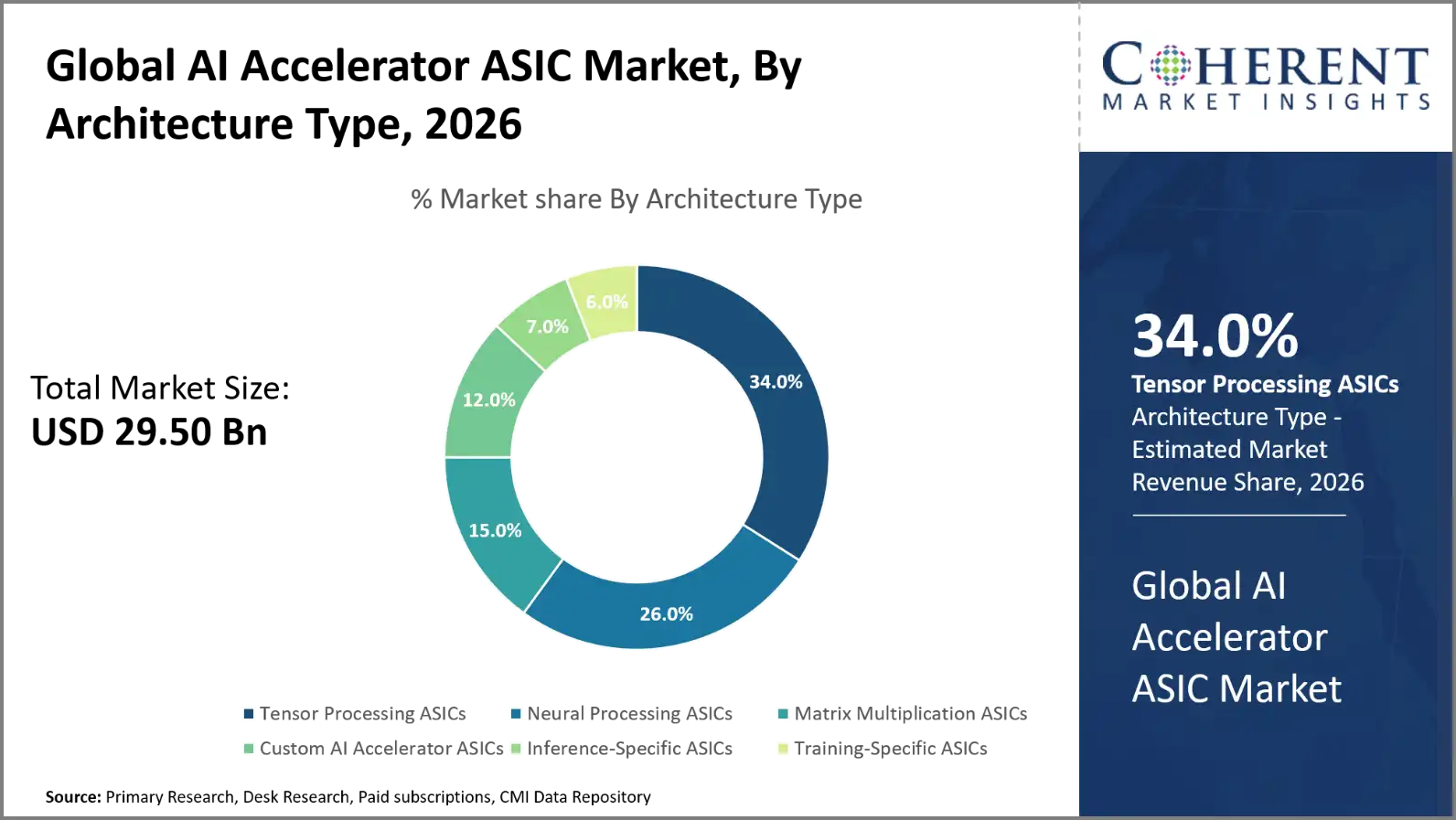
- The Tensor Processing ASICs segment is expected to account for 34.0% of the global AI accelerator ASIC market share in 2026. Increasing investments in custom semiconductor development is driving the growth of the segment. On July 14, 2026, TYLSemi announced an oversubscribed USD 43 million early-stage funding round led by Matter Venture Partners. The company introduced a production-ready chiplet portfolio covering connectivity, power delivery, and memory.
- The AI Training segment is estimated to capture 53.0% of the market share in 2026. Growing deployment of generative AI applications is majorly driving the growth of the segment. On May 29, 2025, Infosys announced over 200 enterprise AI agents under its Infosys Topaz offerings. The agents use Google Cloud Vertex AI to automate complex business workflows.
- The Cloud Data Centers segment is estimated to capture 42.0% of the market share in 2026. Rising demand for high-performance data center accelerators is driving the growth of the segment. On October 28, 2025, Qualcomm unveiled its AI200 and AI250 accelerator cards and rack-scale solutions for data center inference. The AI200 supports 768 GB of LPDDR memory per card.
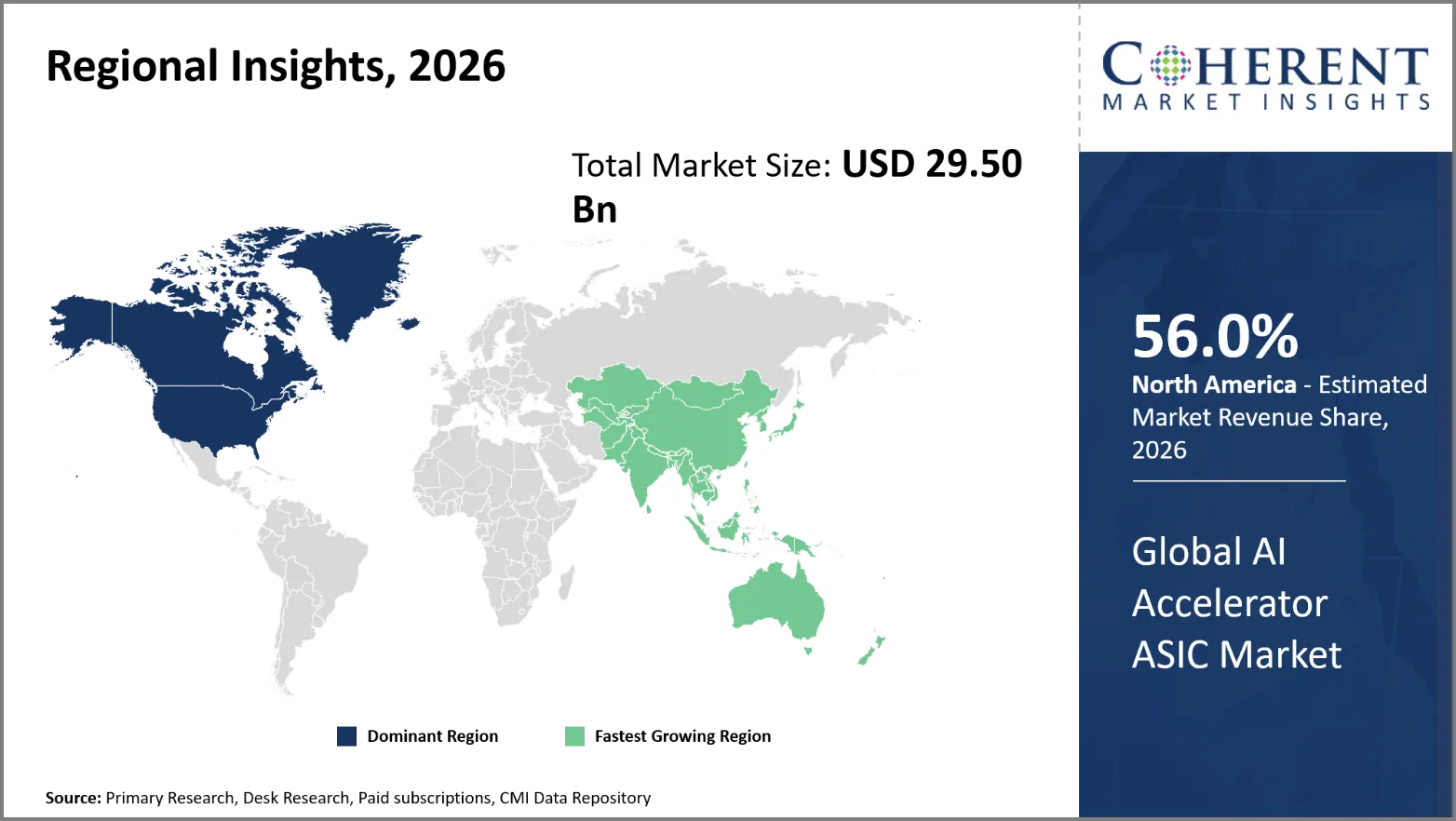
- North America is expected to dominate the AI accelerator ASIC market in 2026 with a market share of 56.0%. Increasing adoption of advanced semiconductor packaging technologies in North America is driving the growth of the regional market. On January 17, 2025, GlobalFoundries announced plans to establish advanced packaging and testing capabilities at its Malta manufacturing facility. The center will support silicon photonics, three-dimensional integration, and heterogeneous integration.
- Asia Pacific is expected to account for 28.0% share in 2026. Development of advanced chiplet-based AI accelerator architectures in Asia Pacific is driving the growth of the regional market. On July 22, 2025, CoAsia SEMI and Rebellions agreed to develop a next-generation chiplet package based on Rebellions’ REBEL architecture. The design combines compute chiplets, input-output dies, and high-bandwidth memory 3E.
Segmental Insights
Why Does Tensor Processing ASICs Dominate the Global AI Accelerator ASIC Market?
The tensor processing ASICs segment is expected to account for 34.0% of the global AI accelerator ASIC market share in 2026. Tensor processing ASICs are the dominant ones because they speed up matrix multiplication and tensor computations needed in artificial intelligence workloads. These are special purpose processors that provide high computational throughput for deep learning models. They are designed to facilitate parallel processing and the efficient implementation of neural network functions. Dedicated hardware means less unneeded overhead calculation than with universal processors. The big IT corporations are rapidly building large scale models with tensor specialized ASICs. Their performance is optimized as such to enhance efficiency of processing, power consumption and infrastructure use. Demand for tensor processing ASICs is further driven by growing generative artificial intelligence use.
On May 6, 2025, Semidynamics, the sole provider of fully configurable RISC-V processor IP, introduced Cervell, a scalable and fully programmable Neural Processing Unit (NPU) based on RISC-V. Cervell blends CPU, vector, and tensor capabilities into a single, all-in-one architecture, delivering zero-latency AI computing across applications ranging from edge AI to datacenter-scale LLMs.
- Current Industry Events of 2026
- Market Size Estimation
- Regional Breakdown
- Competitive Landscape
- Customer Intelligence
- Segmental Analysis
- Pricing Analysis
- Key Market Drivers, Challenges & Future Trends
- Customized Insights Section
Why is AI Training the Most Preferred Processing Type?
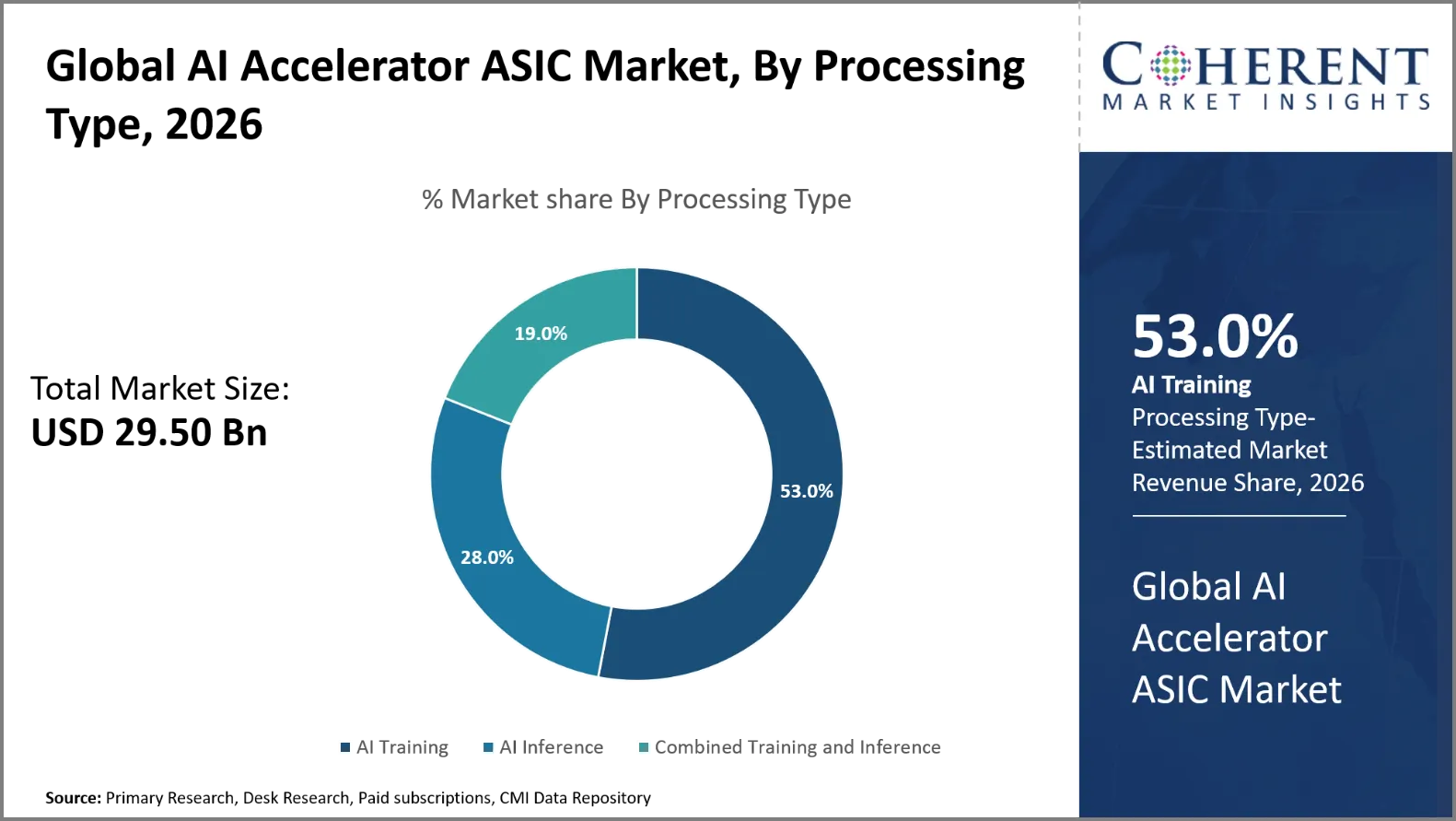
The AI training segment is expected to account for 53.0% of the global AI accelerator ASIC market share in 2026. AI training leads because the development of advanced models requires large computing resources and parallel processing capabilities. Training workloads repeatedly perform matrix computations over large datasets. AI accelerator ASICs optimize these operations in dedicated computation systems. Their high throughput allows for speedier model creation and experimentation. Tech businesses are spending more on bespoke hardware to train big language models. Dedicated accelerators also increase energy efficiency across large computing clusters. The uptick in generative artificial intelligence is driving investment in specialist training infrastructure.
On January 5, 2026, NVIDIA introduced Rubin, a coordinated platform containing six newly developed chips. These include the Rubin GPU, Vera CPU, NVLink 6 switch, ConnectX-9 SuperNIC, BlueField-4 DPU, and Spectrum-6 Ethernet switch. NVIDIA reported up to four times fewer GPUs for training mixture-of-experts models than its Blackwell platform.
Cloud Data Centers Dominates the Global AI Accelerator ASIC Market
The cloud data centers segment is expected to account for 42.0% of the global AI accelerator ASIC market share in 2026. The reason cloud data centers are dominant is because they provide a scalable platform for computationally expensive AI applications. ASICs designed to improve processing efficiency and lower operating costs are used by major cloud providers. They have centralized infrastructure that provides large-scale AI training, inference and model deployment. The inclusion of custom accelerators also enhances hardware usage across massive server networks. Demand for application-specific integrated circuits is fueled by higher investments in hyperscale facilities. More and more cloud providers are designing their own silicon to cut their dependence on traditional graphics processing units. The segment’s dominance is further enhanced by the increasing usage of cloud-based artificial intelligence by enterprises.
On April 25, 2025, Baidu announced that its third-generation Kunlun P800 accelerator cluster had become operational. The system contains 30,000 internally developed AI chips. Baidu stated that the cluster can train models comparable to DeepSeek's large-scale systems. It can also support simultaneous fine-tuning for approximately 1,000 customers.
Current Events and their Impact
Current Events | Description and its Impact |
European Union Artificial Intelligence Act, 2024 Regulation (EU) 2024/1689 |
|
South Korea Artificial Intelligence Basic Act, 2025, Act No. 20676 |
|
AI Accelerator ASIC Market Dynamics
Market Drivers
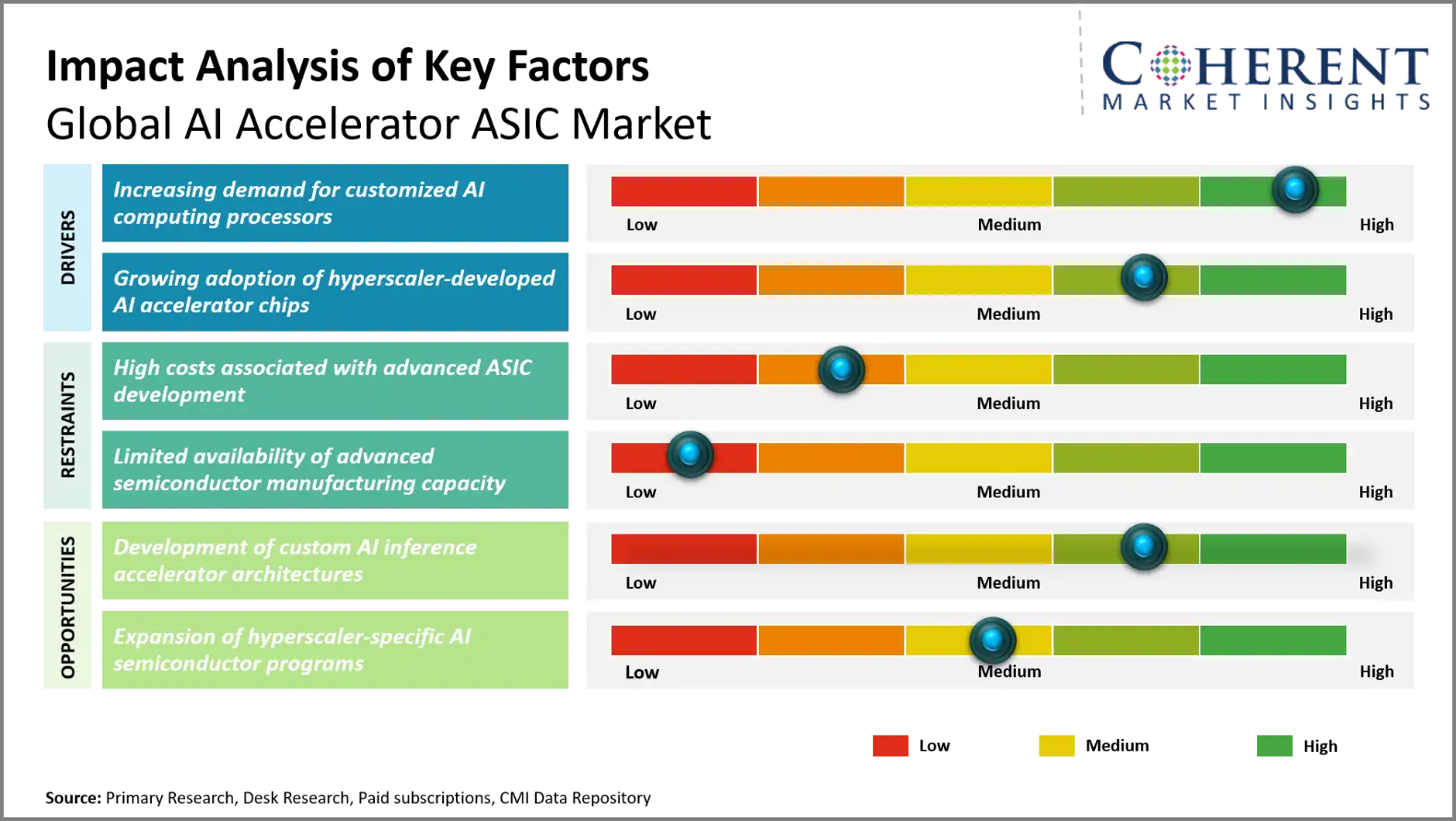
- Increasing demand for customized AI computing processors: Growing AI workloads are raising demand for customized AI computing processors across many industries. Traditional processors sometimes struggle with the performance and energy needs of specialized AI applications. Custom ASIC architectures optimize computing resources for specific neural network operations. These CPUs are more efficient, have lower latency, and better power utilization. More technology companies are creating application-specific processors for generative AI and huge language models. Custom processors also lessen dependence on pricey general-purpose accelerators. The tendency is further boosted by increasing investments in autonomous systems, enterprise AI and intelligent infrastructure.
- On March 24, 2026, Arm Holdings plc announced the future of the Arm computing platform, extending into manufacturing silicon products for the first time in the company’s history. It starts with the announcement of the Arm AGI CPU, an Arm-built CPU for AI data centers geared for an emerging class of agentic AI applications.
- Growing adoption of hyperscaler-developed AI accelerator chips: Hyperscale cloud providers are progressively building their own AI accelerator chips for optimizing large scale computing infrastructure. Companies like Google, Amazon and Microsoft are building bespoke silicon increasingly. Google’s Tensor Processing Units are designed for the most demanding AI training and inference workloads. Amazon Web Services sells Trainium and Inferentia chips for AI applications running in the cloud. Microsoft launched Maia, their family of AI infrastructure optimization accelerators. These proprietary chips allow hyperscalers to boost their energy efficiency and eliminate reliance on third-party semiconductor vendors. Increased investment in generative AI is resulting in increased adoption of custom accelerators across hyperscale data centers.
- On September 18, 2025, Huawei introduced the Atlas 950 SuperPoD, integrating 8,192 Ascend neural processing units. It also announced the Atlas 960 SuperPoD, designed around 15,488 Ascend processors. Huawei presented larger SuperCluster configurations connecting hundreds of thousands of accelerators.
Emerging Trends
- Increasing Development of Chiplet-Based AI Accelerator Architectures: Semiconductor companies are investigating chiplet-based architectures to improve the scalability, processing density and manufacturing flexibility of AI accelerators. These designs integrate specialized compute elements with advanced packaging to run demanding AI workloads.
- Impact: Chiplet integration allows processors to scale and enables manufacturers to mix-and-match processing, memory and connection components. This strategy may increase manufacturing flexibility and enable better performance of accelerator designs.
- Relevance to the market: Heterogeneous integration is an industry trend, with Taiwan Semiconductor Manufacturing Company’s advanced packaging efforts highlighting the increased interest in this area. These technologies offer prospects for distinct AI accelerator ASIC architectures.
- Growing Integration of High-Bandwidth Memory in AI Accelerator ASICs: AI accelerator makers are using high-bandwidth memory to alleviate the bottlenecks of data transfer. More advanced memory architectures enable faster access to model parameters and increase computing efficiency during heavy AI tasks.
- Impact: High bandwidth memory eases the limits on memory access and improves data availability for parallel processing. The connection allows for larger AI models and more efficient use of accelerators.
- Relevance to the market: Google Tensor Processing Units and Broadcom’s sophisticated accelerators emphasize the significance of memory-intensive computing designs. These innovations are driving the demand for ASICs tailored for large-scale AI computing.
Regional Insights
Why is North America a Strong Market for AI Accelerator ASIC?
North America is expected to account for a market share of 56.0% in 2026. North America has a large amount of private investment in the development of artificial intelligence silicon and commercialization of specialized processors. In October 2026, Canadian business Tenstorrent raised USD 1.5 billion in a Series E fundraising round. The financing will fund volume manufacturing, Galaxy server expansion and commercial licensing of AI processor intellectual property. Custom accelerator development also draws multinational semiconductor design alliances. South Korean firm SEMIFIVE obtained a USD 52 million contract from a U.S. fabless company in September 2026. The project features an inference accelerator that utilizes LPDDR6 and PCIe Gen5 technologies. These advances improve the North American custom chip development ecosystem and commercial adoption potential.
Why Does Asia Pacific AI Accelerator ASIC Market Exhibit High Growth?
Asia Pacific is expected to register the fastest growth with a CAGR of 18.3% over the forecast period. The region is projected to account for 28.0% of the global AI accelerator ASIC market in 2026 and benefits from increased semiconductor design capabilities and government-backed expenditures in indigenous chip development. India’s Design Linked Incentive Scheme supports 24 semiconductor design initiatives for strategic technology applications These initiatives resulted in 16 tape-outs, 6 ASIC designs, and 10 patents. India’s Semicon 2.0 also secured investment commitments of almost USD 10.67 billion. GreatAsic Technology is ramping up Malaysia’s front-end design expertise. In June 2026 the business raised USD 6.9 million for the development of bespoke ASIC and AI SoC. This means more regional engagement in the design of customized AI processors and their commercialization.
Global AI Accelerator ASIC Market Outlook for Key Countries
Why is U.S. Emerging as a Major Hub in the AI Accelerator ASIC Market?
Interactive AI applications are driving increased demand for inference-specific CPUs, which is good news for the US industry. Qualcomm debuted its Dragonfly AI300 accelerator in June 2026. The product is extending its AI200 and AI250 roadmap, setting up an annual acceleration development cycle. Qualcomm also announced its High Bandwidth Compute for boosting energy efficiency and token throughput. In June 2026, OpenAI announced its Jalapeño inference processor for big language model workloads. Its first-generation design completed development from initial architecture to manufacturing tape-out within nine months. These developments demonstrate increasing specialization around inference economics, software-hardware integration, and large-scale AI deployment.
Is China the Next Growth Engine for the AI Accelerator ASIC Market?
Domestic semiconductor procurement policies and increasing demand for domestically created AI computing platforms are benefiting the Chinese market. Chinese technology security officials approved nine homegrown AI processors for government acquisition in May 2026. Among the approved products are processors from Huawei, Alibaba, Biren Technology, Hygon Information Technology and Moore Threads. These approvals enhance chances for domestic chip suppliers that serve the government and state-owned businesses. Separately, in June 2026, China Mobile Hubei and Huawei certified an AI inference acceleration solution. Their testing showed token throughput up to 372% greater for several long-sequence workloads. These trends favor the use of localized accelerators and software optimization.
Taiwan AI Accelerator ASIC Market Analysis and Trends
Taiwan is well-positioned with its advanced ASIC design capabilities and emerging research infrastructure in next-generation semiconductor technologies. Alchip Technologies declared progress toward commercial client ASIC development in 2-nanometer technology in March 2026. The company stated that some designs were nearing tape-out and it added more three-dimensional integrated circuit design capabilities. Taiwan’s Ministry of Economic Affairs also sped up the development of its Advanced Semiconductor Research and Development Center in February 2026. The factory will set up the country’s first 12-inch advanced semiconductor pilot line. It is expected to be completed by December 2027 and will allow for chip verification and process development. These efforts bolster Taiwan’s position in complicated accelerator development and commercialization.
South Korea AI Accelerator ASIC Market Analysis and Trends
South Korea benefits from growing domestic inference processor development and telecommunications infrastructure modernization. Rebellions joined with SK Telecom and Arm in April 2026 to build sovereign AI computer infrastructure. They propose a server design that combines Arm’s AGI CPU and Rebellions’ RebelCard accelerator. The firms intend to evaluate the platform using telecommunications-specific AI workloads. SK Telecom’s data center offers a test environment for enterprise and network applications. The collaboration promotes demand for specialized processors for telecom infrastructure. South Korea’s focus on sovereign AI also fosters the creation of domestic accelerators and alliances for international commercialization.
Japan AI Accelerator ASIC Market Analysis and Trends
The Japanese market also benefits from dedicated research on low-power processors and a rising need for small AI computing applications. University of Tokyo created an AI processor based on structured ASIC in 2026. Its prototype reduced development costs to one-fortieth of conventional levels and power consumption to one-eighth-point-four. The processor occupies less than nine square millimeters. The architecture is meant for wearables like smart watches and health monitoring gadgets. Japan likewise uses the framework of R&D and Utilization of Artificial Intelligence-Related Technologies to boost AI research. These advances enable the potential for application-specific processors outside of traditional data center environments.
Global AI Accelerator ASIC Market - HBM Capacity and Performance Comparison
Company | Accelerator | HBM Generation | HBM Capacity | Peak HBM Bandwidth | Peak Compute Specification |
NVIDIA | H100 SXM | HBM3 | 80 GB | 3.35 TB/s | 3.96 PFLOPS FP8 with sparsity |
NVIDIA | H200 SXM | HBM3E | 141 GB | 4.8 TB/s | 3.96 PFLOPS FP8 with sparsity |
NVIDIA | B200 SXM | HBM3E | 180 GB | 8 TB/s | 9 PFLOPS FP8 with sparsity |
AMD | Instinct MI325X | HBM3E | 256 GB | 6 TB/s | 2.61 PFLOPS FP8 |
AMD | Instinct MI350X | HBM3E | 288 GB | 8 TB/s | 9.2 PFLOPS MXFP4 |
TPU v7x Ironwood | HBM | 192 GiB | 7.38 TB/s | 4.614 PFLOPS FP8 | |
Amazon Web Services | Trainium3 | HBM3E | 144 GiB | 4.9 TB/s | 2.517 PFLOPS FP8 |
How is Development of Custom AI Inference Accelerator Architectures Creating New Growth Opportunities in the AI Accelerator ASIC Market?
The development of custom AI inference accelerator architectures creates opportunities for processors optimized for specific model execution requirements. Companies are designing specialized silicon for attention mechanisms, token generation, and memory-intensive inference operations. For example, Etched developed its Sohu ASIC specifically for transformer-based models, eliminating unnecessary support for alternative neural network architectures. This specialization enables higher throughput and improved computational efficiency for targeted workloads. MatX is also working on processors designed to accelerate massive language model execution. These advancements give ASIC designers the ability to differentiate their products through memory bandwidth, interconnect optimization, and workload-specific performance. Consequently, cloud providers and AI developers gain alternatives to general-purpose accelerators.
On January 29, 2025, SiMa.ai announced immediate availability of the Modalix 50 TOPs device, and a new Early Access Program for MLSoC Modalix. Modalix is the industry’s first purpose-built platform that seamlessly integrates multi-modal applications using Transformers, LLMs, LMMs and GenAI at the edge along with traditional computer vision algorithms while delivering power efficiency and cost-effectiveness.
Market Players, Key Development, and Competitive Landscape
Key Developments
- On November 9, 2026, Google introduced two new specialized TPUs in the same generation; 8t for large-scale training and 8i for real-time reasoning. TPU 8t and 8i offer up to 2.7 times better training performance and 80% better inference price performance, respectively, versus Google’s previous generation of TPUs.
- On June 9, 2026, d-Matrix announced that its Corsair inference accelerator platform is in full production, with products to begin shipping in volume to priority customers. Demand for Corsair has surged as agentic AI tools are pushing inference workloads beyond what GPU-only infrastructure was designed to handle.
- On February 23, 2026, Axelera AI announced its latest funding round led by Innovation Industries, with participation from prominent funds and accounts including BlackRock and SiteGround Capital as new investors. Axelera AI has attracted over USD 450 million in equity, grants and venture debt since incorporating in July 2021.
Competitive Landscape
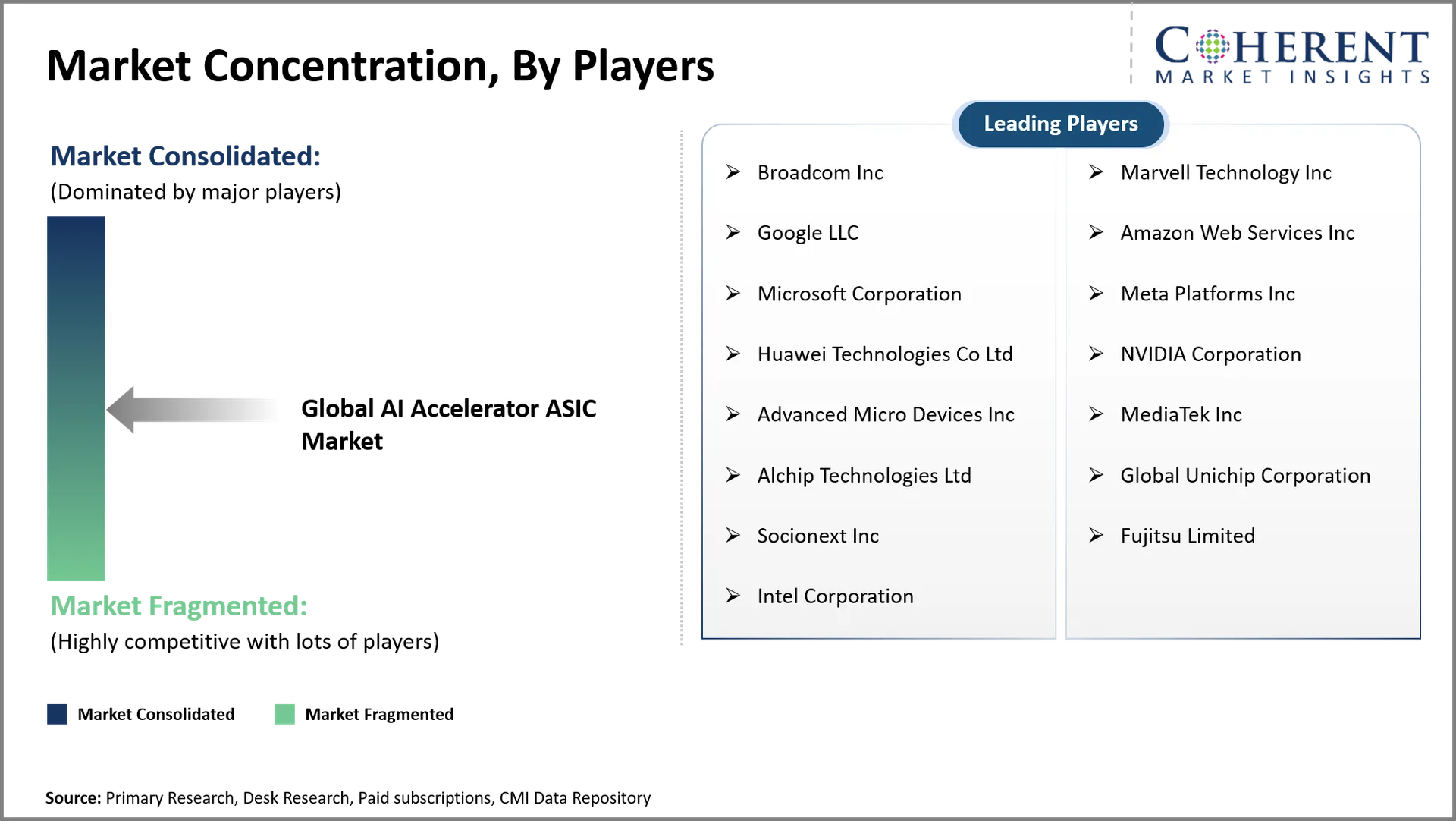
The global AI accelerator ASIC market features intense competition between hyperscalers, semiconductor designers, and custom silicon developers. Broadcom Inc. is in a strong position with bespoke accelerators, sophisticated packaging and high-speed networking. The partnership with Meta enables it to produce several generations of Meta Training and Inference Accelerator Chips. Broadcom also joined hands with Open AI to build Jalapeño, a processor for massive language model inference. Google’s Tensor Processing Unit portfolio helps drive competitiveness for large scale training, inferencing and reasoning workloads. Amazon Web Services rolls out Trainium and Inferentia processors for better cloud computing economics Marvell Technology focuses on bespoke accelerators, memory controllers and networking chips. MediaTek explores data center accelerator development through cloud computing collaborations. Microsoft and Meta are increasing proprietary silicon development to optimize internal AI infrastructure.
Top Manufacturers and Notable Products in the AI Accelerator ASIC Market
Manufacturer | Notable Product | Key features |
Broadcom Inc. | 3.5D XDSiP Custom XPU Platform | Combines 2.5D and 3D chip integration, supports modular custom AI accelerators, improves compute density and power efficiency, and supports large-scale AI infrastructure |
TPU7x Ironwood | Seventh-generation custom AI accelerator, two TensorCores and four SparseCores, 192 GiB HBM, 7.38 TB/s memory bandwidth, optimized for large-scale AI inference | |
Amazon Web Services | Trainium3 | 3nm AI accelerator, 144 GB HBM3E, 4.9 TB/s memory bandwidth, 2.52 PFLOPS FP8 compute, supports training and inference workloads |
Huawei Technologies | Ascend 950DT | Supports FP8, MXFP8, MXFP4 and HiF8 formats, delivers 1 PFLOPS FP8 compute, 144 GB HiZQ 2.0 memory, and 4 TB/s memory bandwidth |
Alibaba Group / T-Head | Zhenwu V900 | AI training and inference processor, 216 GB memory, 1,200 GB/s inter-chip bandwidth, native FP8 and FP4 support, planned commercial release in 2027 |
Market Report Scope
Global AI Accelerator ASIC Market Report Coverage | |||
Report Coverage | Details | ||
Base Year | 2025 | Market Size in 2026: | USD 29.50 Bn |
Historical Data For: | 2020 To 2024 | Forecast Period: | 2026 To 2033 |
Forecast Period 2026 To 2033 CAGR: | 18.10% | 2033 Value Projection: | USD 150.00 Bn |
Geographies covered: |
| ||
Segments covered: |
| ||
Companies covered: | Broadcom Inc, Marvell Technology Inc, Google LLC, Amazon Web Services Inc, Microsoft Corporation, Meta Platforms Inc, Huawei Technologies Co Ltd, NVIDIA Corporation, Advanced Micro Devices Inc, MediaTek Inc, Alchip Technologies Ltd, Global Unichip Corporation, Socionext Inc, Fujitsu Limited, Intel Corporation | ||
Growth Drivers: |
| ||
Restraints & Challenges: |
| ||
Analyst Opinion (Expert Opinion)
- The future of the AI accelerator ASIC industry will increasingly depend on workload-specific processor architectures. General-purpose accelerators will coexist with specialized chips designed for training, inference, and agentic AI. Inference-focused ASICs will gain importance as enterprises deploy continuous AI services and autonomous agents. Memory bandwidth, interconnect efficiency, and processing performance per watt will become critical competitive factors. Commercial differentiation will be higher for chip companies who combine unique silicon with optimized software ecosystems. That Google is building a growing family of TPUs is a sign of the shift in the industry toward specialized accelerator systems.
- The best potential will be in inference-focused ASICs, notably for hyperscale cloud computing and big language model deployment. The U.S. has attractive potential through existing AI developers and hyperscaler infrastructure expenditures. Taiwan can offer advanced packaging, fabrication and complex accelerator manufacture. South Korea has potential for memory integrated accelerator architectures. Look for processors that support recommendation engines, generative AI inference, enterprise copilots and autonomous agents. Telecommunications, automotive computing, and industrial automation needs may also use specialized low-latency processors.
- Manufacturers should create long-term agreements with hyperscalers and AI model developers before committing to accelerator architectures. They need to focus on memory bandwidth, chiplet integration, sophisticated packaging and high-speed connection technology. Making software compatible with PyTorch and existing compiler frameworks can help with customer migration. Companies should also offer modular accelerator platforms with varying levels of precision and workload needs. Through strategic manufacturing collaborations with Taiwan Semiconductor Manufacturing Company, production planning can be improved. Manufacturers will be able to lock in differentiated client contracts by creating dedicated engineering teams for inference optimization.
Speak to the analyst
Want personalized insights?
Take the findings above to one of our principal consultants, or have the report rebuilt around the segments, geographies and competitors you actually track.
Market Segmentation
- Architecture Type Insights (Revenue, USD Billion, 2021 - 2033)
- Tensor Processing ASICs
- Neural Processing ASICs
- Matrix Multiplication ASICs
- Custom AI Accelerator ASICs
- Inference-Specific ASICs
- Training-Specific ASICs
- Processing Type Insights (Revenue, USD Billion, 2021 - 2033)
- AI Training
- AI Inference
- Combined Training and Inference
- Deployment Type Insights (Revenue, USD Billion, 2021 - 2033)
- Cloud Data Centers
- On-Premises Data Centers
- Edge Computing Infrastructure
- Enterprise AI Infrastructure
- Application Insights (Revenue, USD Billion, 2021 - 2033)
- Generative AI
- Natural Language Processing
- Computer Vision
- Recommendation Systems
- Autonomous Systems
- Speech Recognition
- Predictive Analytics
- End User Insights (Revenue, USD Billion, 2021 - 2033)
- Hyperscale Cloud Providers
- AI Research Organizations
- Enterprise Technology Companies
- Telecommunication Companies
- Automotive Manufacturers
- Regional Insights (Revenue, USD Billion, 2021 - 2033)
- North America
- U.S.
- Canada
- Latin America
- Brazil
- Argentina
- Mexico
- Rest of Latin America
- Europe
- Germany
- U.K.
- Spain
- France
- Italy
- Russia
- Rest of Europe
- Asia Pacific
- China
- India
- Japan
- Australia
- South Korea
- ASEAN
- Rest of Asia Pacific
- Middle East
- GCC Countries
- Israel
- Rest of Middle East
- Africa
- South Africa
- North Africa
- Central Africa
- North America
- Key Players Insights
- Broadcom Inc
- Marvell Technology Inc
- Google LLC
- Amazon Web Services Inc
- Microsoft Corporation
- Meta Platforms Inc
- Huawei Technologies Co Ltd
- NVIDIA Corporation
- Advanced Micro Devices Inc
- MediaTek Inc
- Alchip Technologies Ltd
- Global Unichip Corporation
- Socionext Inc
- Fujitsu Limited
- Intel Corporation
Sources
Primary Research Interviews
- AI Chip Designers & Semiconductor Engineers
- Cloud Service Providers & Hyperscale Data Center Operators
- AI Hardware OEMs & System Integrators
- Fabless Semiconductor Companies & ASIC Foundries
Magazines
- IEEE Spectrum
- Semiconductor Engineering Magazine
- EE Times (Electronic Engineering Times)
- MIT Technology Review
Journals
- IEEE Journal of Solid-State Circuits
- ACM Transactions on Reconfigurable Technology and Systems
- Journal of Semiconductor Technology and Science
Associations
- Semiconductor Industry Association (SIA)
- Global Semiconductor Alliance (GSA)
- SEMI (Semiconductor Equipment and Materials International)
- IEEE Solid-State Circuits Society
Public Domain Sources
- U.S. Semiconductor Industry Office – Department of Commerce
- European Commission – Digital Strategy & Chips Act Publications
- World Intellectual Property Organization (WIPO) – Patent Databases on AI Chips
- National Institute of Standards and Technology (NIST) – AI Reports
Proprietary Elements
- CMI Data Analytics Tool
- Proprietary CMI Existing Repository of Information for the Last 10 Years
Get access to 250+ pages report
Every segment, forecast, competitor profile and data table behind the analysis above — available for instant download.
- ESOMAR Member
- ISO 9001:2015 Certified
- D-U-N-S Registered
- GDPR & CCPA Compliant
Frequently Asked Questions
The global AI accelerator ASIC market is expected to stand at USD 29.50 Bn in 2026 and is expected to reach USD 150.00 Bn by 2033.
The CAGR of the global AI accelerator ASIC market is projected to be 18.1% from 2026 to 2033.
Increasing demand for customized AI computing processors and Growing adoption of hyperscaler-developed AI accelerator chips are the major factors driving the growth of the global AI accelerator ASIC market.
Increasing demand for customized AI computing processors and Growing adoption of hyperscaler-developed AI accelerator chips are the major factors hampering the growth of the global AI accelerator ASIC market.
In terms of architecture type, tensor processing ASICs segment is estimated to dominate the market revenue share in 2026.
An AI accelerator ASIC is a dedicated processor designed to execute artificial intelligence workloads efficiently.
Inference-focused ASICs optimize deployed models for faster responses, lower latency, and efficient token generation.