

Global AI Agent Memory Management Platform Market Size and Forecast – 2026 To 2033
The global AI agent memory management platform market is expected to grow from USD 1.25 Bn in 2026 to USD 7.20 Bn by 2033, registering a compound annual growth rate (CAGR) of 28.4% from 2026 to 2033. The global AI agent memory management platform market is driven by rising adoption of retrieval-augmented generation and knowledge graph technologies. On February 16, 2026, Databricks announced that the Databricks Agent Bricks Knowledge Assistant is now Generally Available making it easier than ever to turn enterprise documents into accurate, cited answers powered by AI.
Key Takeaways of the Global AI Agent Memory Management Platform Market
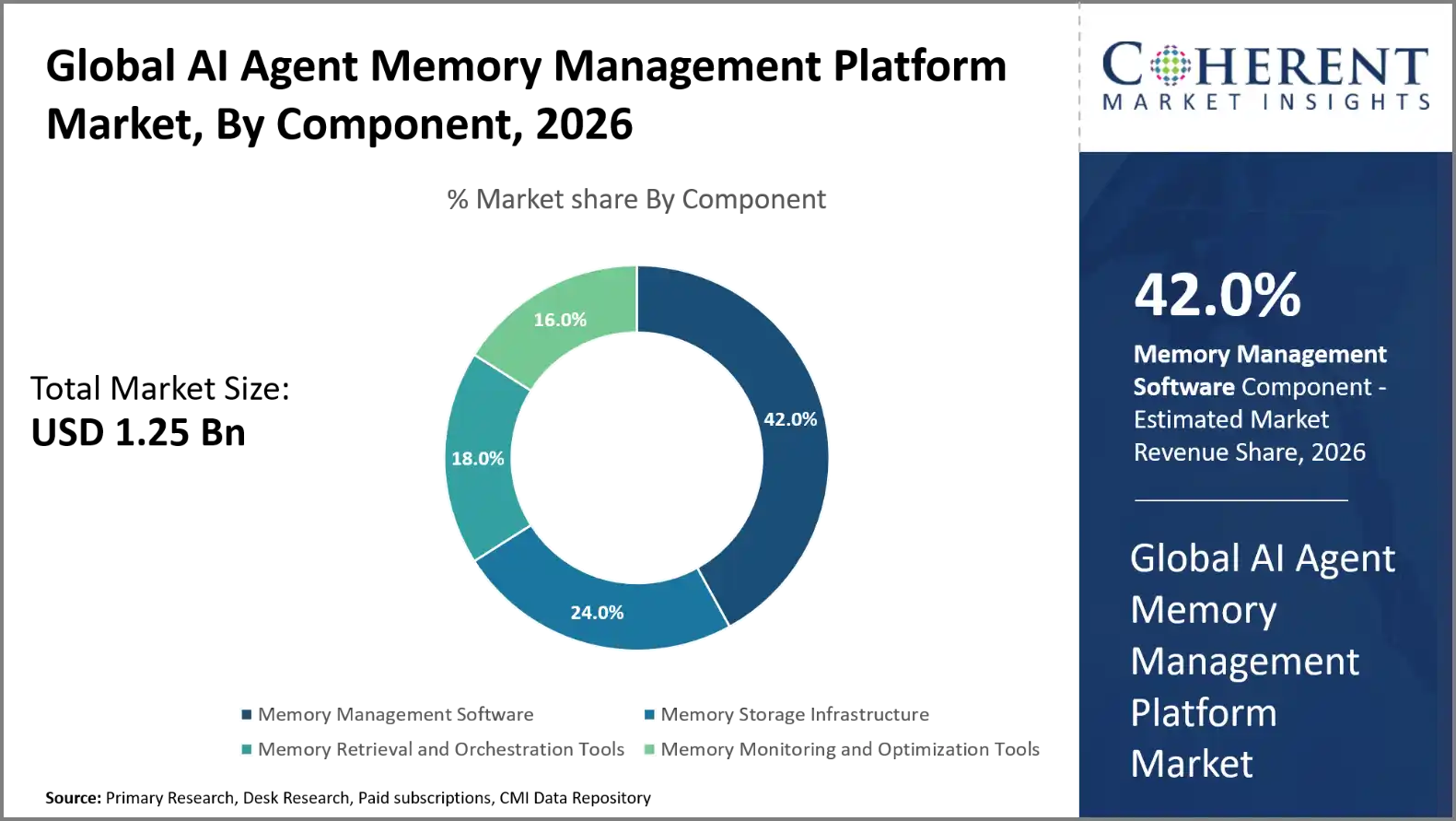
- The Memory Management Software segment is expected to account for 42.0% of the global AI agent memory management platform market share in 2026. Increasing need for personalized and context-aware AI applications is driving the growth of the segment. On November 25, 2025, Microsoft introduced public preview of Memory in Foundry Agent Service. The managed memory service preserves conversation summaries, user preferences, and important context across sessions.
- The Cloud-Based segment is estimated to capture 51.0% of the market share in 2026. Growing enterprise investments in AI infrastructure and intelligent automation is majorly driving the growth of the segment. On January 24, 2025, Meta Platforms announced plans to spend up to USD 65 billion on artificial intelligence infrastructure during 2025. The expansion included a data center exceeding two gigawatts of planned capacity.
- The Short-Term Memory segment is estimated to capture 39.0% of the market share in 2026. Demand for improved accuracy and continuity in agent-driven workflows is driving the growth of the segment. On September 23, 2025, Algolia introduced Agent Studio. The platform combines information retrieval, tool orchestration, and observability for production AI agents.
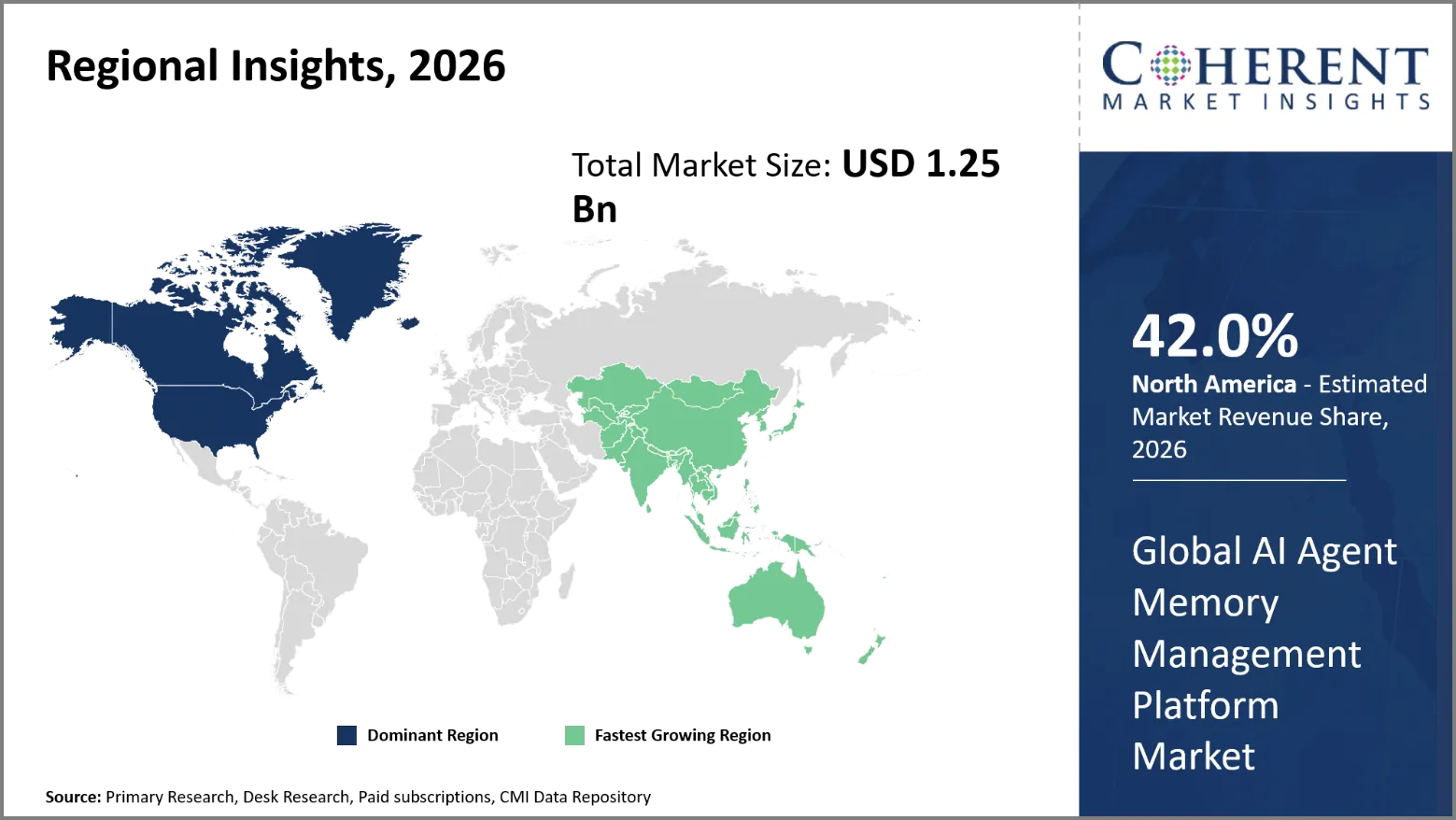
- North America is expected to dominate the AI agent memory management platform market in 2026 with a market share of 42.0%. Growing demand for memory solutions in healthcare in North America is driving the growth of the regional market. On November 12, 2025, InterSystems launched HealthShare AI Assistant on November 12, 2025, to improve clinical information retrieval. The solution enables clinicians to query longitudinal patient records using conversational prompts.
- Asia Pacific is expected to account for 28.0% share in 2026. Development of automated memory compression and optimization technologies in Asia Pacific is driving the growth of the regional market. On November 7, 2025, Seoul National University's research team announced KVzip. The technology selectively removes redundant information from large language model conversation memory while preserving information needed for future questions.
Segmental Insights
Why Does Memory Management Software Dominate the Global AI Agent Memory Management Platform Market?
The memory management software segment is expected to account for 42.0% of the global AI agent memory management platform market share in 2026. Memory management software is ubiquitous because enterprises require dependable systems for storing, organizing, retrieving and updating agent information. These solutions preserve the conversational environment, user’s preferences, history of interactions, and information relevant to tasks. This means that AI agents can produce reliable responses and repetitious processing is reduced. Advanced memory management capabilities also enable contextual retrieval, prioritization of information, and cooperation amongst multiple agents. Increasing use of autonomous AI workflows by enterprises also boosts need for specialist memory management software.
On April 17, 2026, Cloudfare Inc. introduced the private beta of Agent Memory, a managed service that extracts information from agent conversations and makes it available when it’s needed, without filling up the context window.
- Current Industry Events of 2026
- Market Size Estimation
- Regional Breakdown
- Competitive Landscape
- Customer Intelligence
- Segmental Analysis
- Pricing Analysis
- Key Market Drivers, Challenges & Future Trends
- Customized Insights Section
Why is Cloud-Based the Most Preferred Deployment Type?
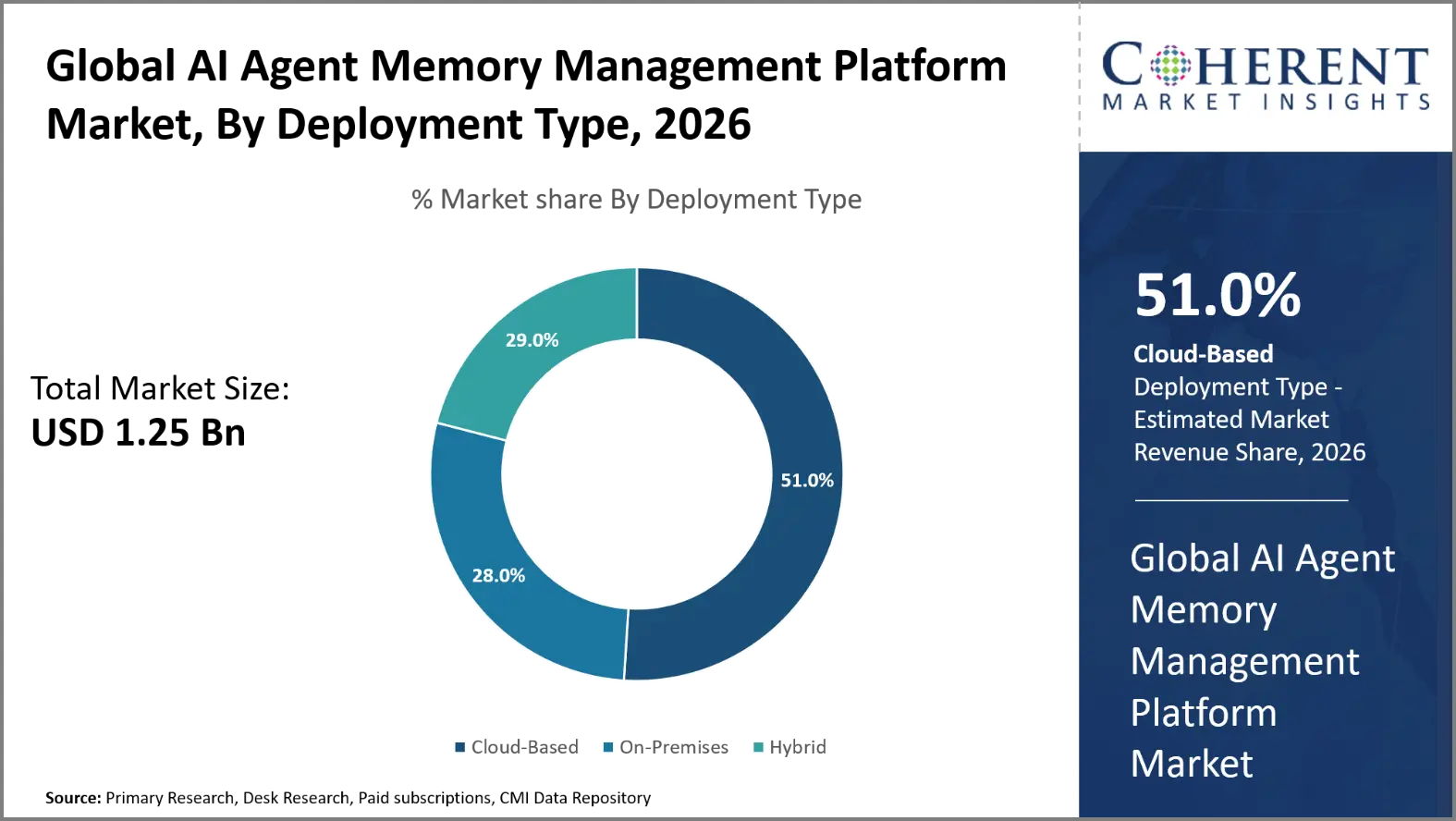
The cloud-based segment is expected to account for 51.0% of the global AI agent memory management platform market share in 2026. The growth reason for cloud-based deployment is that enterprises want flexible infrastructure and scalable AI memory operations. Cloud systems offer central storage, managed databases and computing power to process large volumes of agent interactions. Distributed access, faster deployment and integration with enterprise applications are supported. Organizations can increase their memory capacity without needing to maintain a large on-premise infrastructure. Cloud systems also allow the retrieval of external memories and the coordination of multi-agents. These benefits drive adoption for organizations building scalable, always-on AI agents.
On April 23, 2026, Anthropic launched the public beta of built-in memory for Claude Managed Agents. This capacity enables agents to remember information from previous sessions and to execute long-running activities more effectively. Memories are stored as files within the managed agent environment. Developers can export, manage, and control retained information through an application programming interface.
Short-Term Memory Dominates the Global AI Agent Memory Management Platform Market
The short-term memory segment is expected to account for 39.0% of the global AI agent memory management platform market share in 2026. Short-term memory prevails because AI agents need quick access to active task and ongoing conversation information. It maintains records of recent interactions, intermediate reasoning stages, tool output, and session specific commands. This capability allows agents to keep track of conversations and properly perform multi-step workflows. It also reduces the frequency of repeated information retrieval in active sessions. It is very important in customer care, enterprise automation, multi-agent applications. The growing adoption of interactive AI assistants further strengthens the need for effective short-term memory management.
On February 18, 2025, Tanka rolled out an AI-enabled workplace communications platform, driven by their MemGraph memory technology. The system translates business discussions into structured information that may be reused. Helps teams maintain context of discussions and recover context-relevant information in later encounters.
Current Events and their Impact
Current Events | Description and its Impact |
European Union Artificial Intelligence Act, Regulation (EU) 2024/1689 |
|
European Union General Data Protection Regulation (EU) 2016/679 |
|
AI Agent Memory Management Platform Market Dynamics
Market Drivers
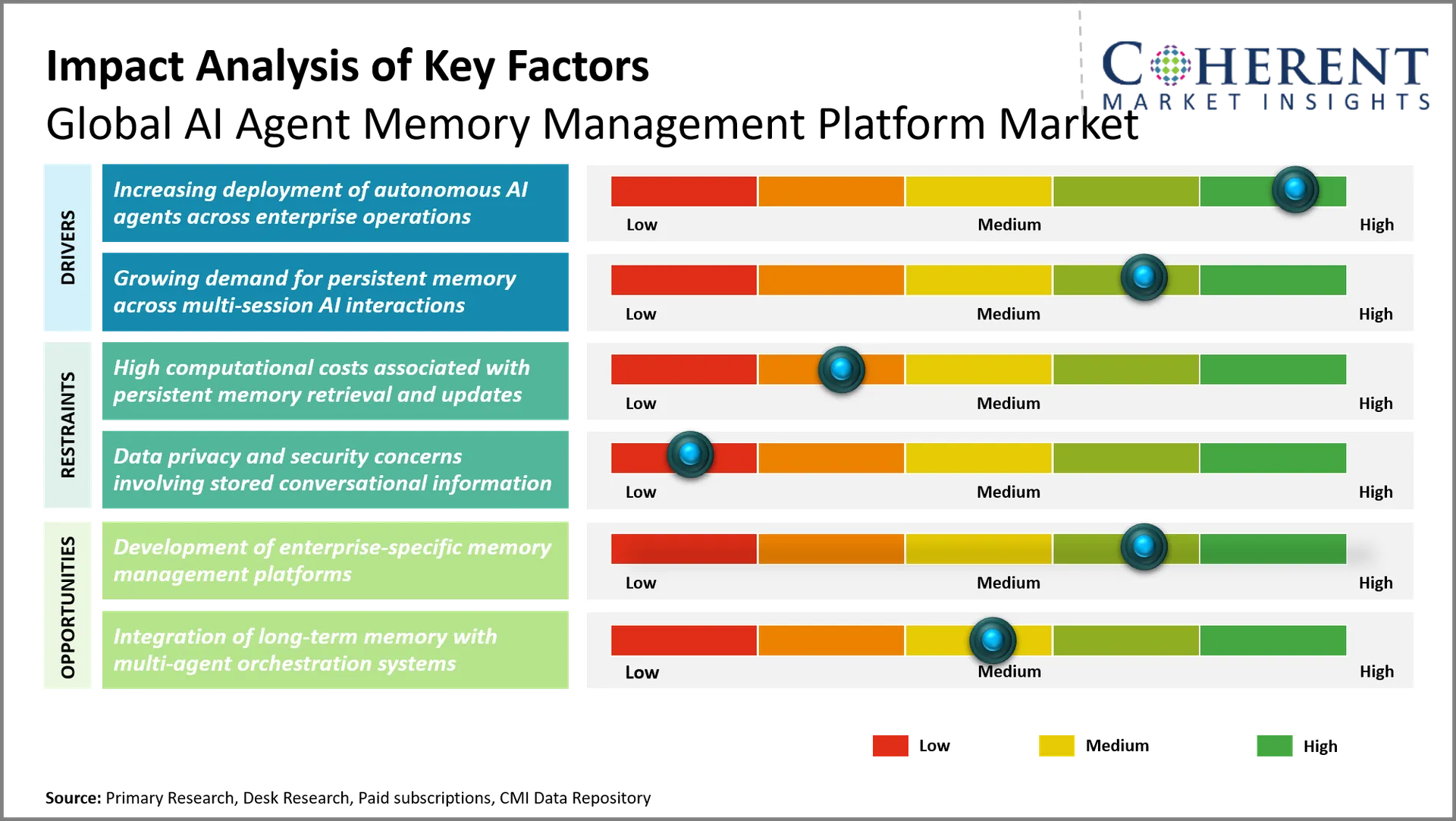
Increasing deployment of autonomous AI agents across enterprise operations
Enterprises are increasingly using autonomous AI agents for automating complicated workflows and reducing manual involvement. The agents are used for customer service, software development, financial analysis, document processing and operational monitoring. Their increasing autonomy calls for memory systems to store instructions, to monitor task progress and to synchronize judgments. Memory management technologies allow agents to access important historical information and continue operations. Integration with enterprise applications further raises the necessity for a centralized memory architecture. The growing deployment of multi-agent automation increases the urgency for scalable memory management solutions.
On May 29, 2025, Infosys announced the introduction of more than 200 business AI agents powered by Infosys Topaz AI solutions and Google Cloud’s Vertex AI Platform. AI agents are built to deliver real business outcomes by transforming difficult workflows and orchestrating complex, multi-agent business processes at scale effectively.
Growing demand for persistent memory across multi-session AI interactions
Businesses are more and more looking for their AI agents to remember information that is important to them over numerous talks and work sessions. Persistent memory allows agents to remember user preferences, instructions given in the past, judgments made, and facts about projects. It avoids repetitive interactions and enhances contextual correctness. Businesses gain from tailored customer experiences and continuous support over long workflows. Persistent memory also enables long-running autonomous tasks that require historical context. Demand for enhanced memory storage and retrieval technology is being driven by the usage of tailored AI assistants and enterprise copilots.
On June 20, 2026, Azeroth Inc., the company behind the AI agent platform Jenova, announced that its persistent memory architecture has contributed to the platform reaching more than USD 1 million in annual recurring revenue, and more than 200,000 users signed up in more than 70 countries, with almost 100% of that growth being organic.
Emerging Trends
- Development of Graph-Based Memory and Knowledge Retrieval Architectures: Graph-based memory architectures are being increasingly embedded in AI platforms to connect entities, relationships, events, and contextual data. These architectures enable knowledge retrieval and enable autonomous agents to understand complicated linkages across enterprise data.
- Impact: Graph-based memory enhances contextual reasoning and decreases fragmented information retrieval. It enables agents to link prior encounters to current activities to deliver more precise responses, and to coordinate decision-making across complicated processes.
- Relevance to the market: Companies such as Neo4j are driving the development of graph database technology. Their technologies show growing industry interest in relationship-based knowledge storage for advanced AI agent memory applications.
- Integration of Long-Term Memory with Retrieval-Augmented Generation: AI developers are integrating persistent memory systems with retrieval-augmented generation architectures. It lets agents pull up pertinent history and inject outside knowledge throughout long conversations and hard jobs.
- Impact: This incorporation increases the relevancy of response, continuity of information and knowledge accessibility. It also mitigates the need on narrow context windows, while allowing for more tailored interactions and more cohesive corporate automation.
- Relevance to the market: Growing commercialization of persistent memory infrastructure with Zep and Mem0. Their technologies target contextual retrieval and information retention across changing AI agent interactions.
Regional Insights
Why is North America a Strong Market for AI Agent Memory Management Platform?
North America is expected to account for a market share of 42.0% in 2026. North America gains from industry investment in autonomous workflows, AI infrastructure and production-grade agent engineering. In November 2025, Capgemini research indicated that 29% of Americas firms are piloting agentic AI. Another 11% had limited deployments and 5% had scaled implementations. Growing demands for observability, contextual precision and operational stability of agents motivate specialized memory infrastructure. 57% of responders in LangChain’s 2026 State of AI Agents study had agents in production. And 89% had implemented agent observability. These developments strengthen demand for persistent context storage, retrieval monitoring, and memory evaluation capabilities across enterprise applications.
Why Does Asia Pacific AI Agent Memory Management Platform Market Exhibit High Growth?
Asia Pacific is expected to register the fastest growth with a CAGR of 29.6% over the forecast period. It is projected to account for 28.0% of the global AI agent memory management platform market in 2026. The region benefits from rapid enterprise automation, expanding digital commerce, and increasing development of autonomous workplace applications. KPMG reported that 67% of Asia Pacific organizations had adopted agentic AI within technology or information technology functions. Another 55% employed agents in operations, 46% in marketing and sales. Singapore is another key example, where ServiceNow says agentic AI use will be 51% of assessed organizations by 2026. These developments increase demand for multilingual memory retrieval, cross-functional knowledge sharing, and persistent context management across distributed business operations.
Global AI Agent Memory Management Platform Market Outlook for Key Countries
Why is U.S. Emerging as a Major Hub in the AI Agent Memory Management Platform Market?
The U.S. has sophisticated enterprise software ecosystems and increasing incorporation of autonomous agents into specialized commercial applications. About 18% of U.S. enterprises had used artificial intelligence as of December 2025, the Federal Reserve reported in research. Around 41% of individuals use generative AI for work purposes as of November 2025. Big companies are also speeding up their deployments of agentic coding to lessen their reliance on software development. In McKinsey’s 2026 poll, 40% of large firms stated they were scaling AI agents. Such advances create a greater need for memory of codebases, holding context for developers, and reliable retrieval of information in complicated software engineering workflows.
Is China the Next Growth Engine for the AI Agent Memory Management Platform Market?
China benefits from the development of domestic AI models, integrated digital ecosystems, and the increasing commercialization of corporate agent platforms. Alibaba stated its workplace agent platform QwenWork had achieved 30 million users a month after its public beta debut. In 2026, Tencent Cloud launched WorkBuddy Enterprise and improved its Agent Development Platform. Its Agent Runtime has native memory and storage capabilities. Tencent stated that it reduced token usage in its memory service by 60%. These advancements point to demand for memory efficiency, enterprise knowledge integration and permanent context across high-volume workplace automation environments.
U.K. AI Agent Memory Management Platform Market Analysis and Trends
The U.K. benefits from increased AI usage in financial services, professional services and information demanding corporate activities. The Bank of England’s 2026 poll indicated that 80% of financial firms responding have deployed AI agents. Another 14% planned deployments within twelve months. However, only 2% reported agents with broad autonomy. This creates demand for controlled memory systems supporting human-supervised financial workflows. Agent memory platforms can store customer interaction histories, compliance evidence, and decision support context. The increase in employment of agents for client communications also results in reliable retrieval within regulated financial processes.
France AI Agent Memory Management Platform Market Analysis and Trends
France has the edge with more generative AI usage, local model creation and more digital transformation among small firms. At the start of 2026, 67% of enterprises polled with at least 20 employees deployed generative AI, the Banque de France reported. Among organizations with 1,000 or more employees, adoption was 83%. Mistral AI’s work on enterprise-centric models and AI assistants opens up prospects for purpose-built memory infrastructure. The 2026 poll by France Num also found that 24% of surveyed small firms employed chatbots, assistants or information search tools. Such apps enable contextual retrieval and long-term knowledge management.
Canada AI Agent Memory Management Platform Market Analysis and Trends
Canada has a strong foundation of artificial intelligence research capacity and growing industry usage of collaborative AI agents. Research by KPMG Canada in 2026 showed 77% of the firms they surveyed were already utilizing AI bots. Further, 20% were designing or deploying multi-agent systems. Infrastructure and data readiness were the top enterprise issues, according to Deloitte’s 2026 report. Only 43% of Canadian leaders stated that they had great infrastructure preparedness and 38% stated that they had strong data preparedness. These limitations present opportunities for memory systems that include organized knowledge repositories, enterprise data integration, and coordinated information retrieval across numerous autonomous agents.
Global AI Agent Memory Management Platform Market - Enterprise AI Agent Adoption
Company size | AI agent adoption / production rate |
100-499 employees | 49% |
500-999 employees | 56% |
1,000+ employees | 52% |
Fewer than 100 employees | 50% |
10,000+ employees | 67% |
Revenue below USD 1 billion | 13% |
Revenue of USD 1 billion or more | 25% |
How is Development of Enterprise-Specific Memory Management Platforms Creating New Growth Opportunities in the AI Agent Memory Management Platform Market?
Opportunities are generated by developing proprietary knowledge requirements in specialized business contexts by developing enterprise-specific memory systems. Financial organizations need transaction histories, client contact history and compliance paperwork in controlled retrieval systems. Manufacturing firms need agents to maintain a record of equipment maintenance history, production parameters, and quality inspection data. Take, for example, Salesforce’s Agentforce Data Library, which links business agents to corporate documents and knowledge sources. Similarly, ServiceNow’s AI Agent Orchestrator orchestrates specialized agents across corporate workflows. Such advancements create a need for flexible memory architectures that accommodate departmental permissions, proprietary knowledge retrieval, and application-specific retention policies.
On March 23, 2026, Oracle introduced the AI Agent Memory software development kit (SDK) for Python. It provides permanent working and long-term memory for enterprise AI agents. It keeps track of conversation states, task summaries, user preferences, learnt rules and past results. It employs the vector, relational, graph, and JSON features of Oracle AI Database.
Market Players, Key Development, and Competitive Landscape
Key Developments
- On September 18, 2024, MongoDB, Inc. launched Atlas Agent Engine, a unified execution, memory, and governance layer for production AI agents, at its Investor Day at the Nasdaq MarketSite in New York City. While AI agents prove their value quickly in proof-of-concept testing, bringing them into production remains a major bottleneck.
- On June 8, 2026, Memori Labs released its integration with Hermes Agent, giving agents long-term persistent memory. The new Memori plugin gives Hermes agents long-term persistent memory that captures not only conversation, but also agent trace and execution context, grounded in what agents actually do.
- On October 6, 2025, Supermemory announced that it has raised USD 3 million led by Susa Ventures to accelerate its mission of building an interoperable, scalable and reliable memory for LLMs and agents.
Competitive Landscape
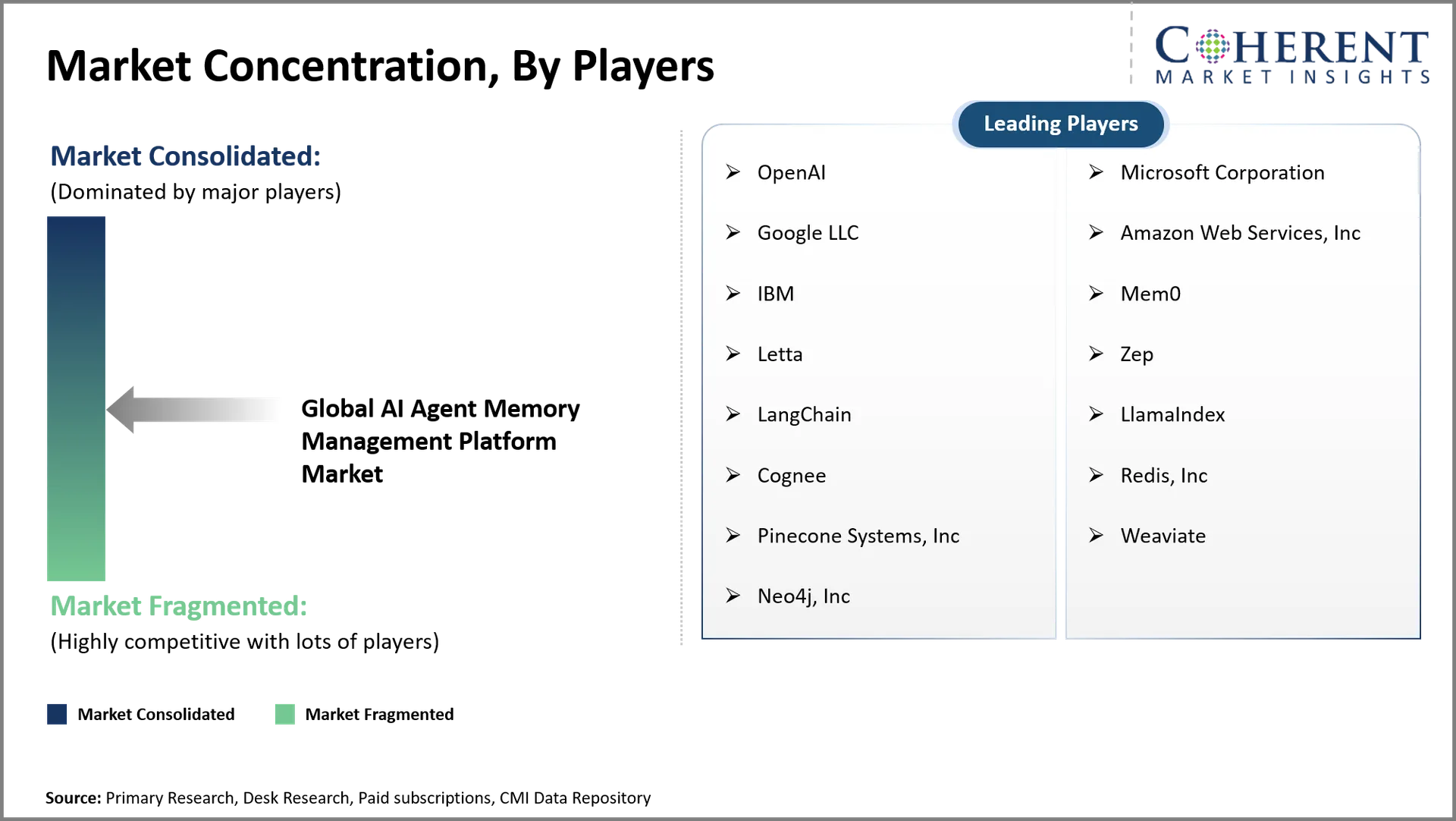
The global AI agent memory management platform market features specialized infrastructure providers competing through persistent memory, contextual retrieval, and enterprise governance capabilities. Mem0 is a model-agnostic memory architecture that provides autonomous memory extraction, entity linkage, and temporal retrieval. Its enterprise solution puts a premium on auditability, private-cloud deployment and security certifications. Zep is unique in temporal knowledge graphs and corporate context management. Deployment options include private virtual clouds, customer-managed encryption keys, and attribute-based restriction of access. Letta is focused on stateful agents with editable memory blocks, while LangChain is deepening its position with agent development frameworks and memory integrations. Competition increasingly centers on retrieval accuracy, memory persistence, interoperability, data isolation, and enterprise deployment flexibility.
Top Manufacturers and Notable Products/Solutions in the AI Agent Memory Management Platform Market
Manufacturer | Notable Product/Solution | Key features |
Mem0 | Mem0 Platform | Persistent cross-session memory, automatic memory extraction, semantic retrieval, user-specific memory, memory updates, vector and graph storage |
Zep | Zep Platform | Temporal knowledge graphs, historical context retrieval, entity relationships, changing fact tracking, contextual search |
Letta | Letta Platform | Stateful AI agents, editable memory blocks, archival memory, conversation history, agent-controlled memory updates |
LangChain | LangMem | Semantic memory, episodic memory, procedural memory, persistent storage, memory creation and updating, LangGraph integration |
Redis | Redis Agent Memory Server | Low-latency memory retrieval, in-memory storage, vector search, session management, semantic caching, real-time context access |
AI Agent Memory Management Platform Market | |||
Report Coverage | Details | ||
Base Year | 2025 | Market Size in 2026: | USD 1.25 Bn |
Historical Data For: | 2020 To 2024 | Forecast Period: | 2026 To 2033 |
Forecast Period 2026 To 2033 CAGR: | 28.4% | 2033 Value Projection: | USD 7.20 Bn |
Geographies covered: |
| ||
Segments covered: |
| ||
Companies covered: | OpenAI, Microsoft Corporation, Google LLC, Amazon Web Services, Inc, IBM, Mem0, Letta, Zep, LangChain, LlamaIndex, Cognee, Redis, Inc, Pinecone Systems, Inc, Weaviate, Neo4j, Inc | ||
Growth Drivers: |
| ||
Restraints & Challenges: |
| ||
Analyst Opinion (Expert Opinion)
- The future of the AI agent memory management platform market will depend on specialized memory infrastructure rather than conventional conversation-history storage. AI agents will increasingly require separate short-term, episodic, semantic, and procedural memory capabilities. Temporal knowledge graphs and hybrid vector-database architectures will become important for maintaining evolving business information. Platforms need to differentiate between facts that are out of date and facts that are up to date, and keep track of the linkages between previous decisions. With the growing interconnectedness of enterprise automation, memory systems that enable many agents across applications will acquire importance.
- The biggest possibilities will be in long-term memory software, enterprise-specific memory infrastructure, and hybrid retrieval systems. Financial services have the possibility of keeping transaction context and retrieving customer history. Healthcare applications require regulated access to longitudinal patient data and administrative interactions. Manufacturing provides a way to maintain histories of equipment, maintenance instructions and knowledge about production. Opportunities exist for the U.S. in enterprise software integration and opportunities for China in large-scale workplace automation. Enterprise deployments needing private cloud infrastructure and stringent information governance will drive extra demand for premium memory solutions.
- For market participants, the priority should be memory accuracy, controlled information updates and reliable retrieval over longer agent interactions. Organizations should build temporal reasoning capabilities that recognize conflicting facts and differentiate historical information from current records. By integrating with platforms like Salesforce, ServiceNow, Microsoft Azure and Amazon Web Services, enterprise accessibility can be improved. Providers should also allow for flexibility of deployment, such as customer-managed encryption keys and private-cloud deployments. Stronger difference will be driven by application-specific memory architectures, measured retrieval performance, transparent audit trails and predictable infrastructure costs.
Speak to the analyst
Want personalized insights?
Take the findings above to one of our principal consultants, or have the report rebuilt around the segments, geographies and competitors you actually track.
Market Segmentation
- Component Insights (Revenue, USD Billion, 2021 - 2033)
- Memory Management Software
- Memory Storage Infrastructure
- Memory Retrieval and Orchestration Tools
- Memory Monitoring and Optimization Tools
- Deployment Type Insights (Revenue, USD Billion, 2021 - 2033)
- Cloud-Based
- On-Premises
- Hybrid
- Memory Architecture Insights (Revenue, USD Billion, 2021 - 2033)
- Short-Term Memory
- Long-Term Memory
- Episodic Memory
- Semantic Memory
- Procedural Memory
- Application Insights (Revenue, USD Billion, 2021 - 2033)
- Customer Service and Virtual Assistants
- Enterprise Knowledge Management
- Software Development
- Research and Data Analysis
- Workflow Automation
- Personalized AI Applications
- End User Insights (Revenue, USD Billion, 2021 - 2033)
- BFSI
- Healthcare
- IT and Telecommunications
- Retail and E-Commerce
- Manufacturing
- Media and Entertainment
- Government
- Regional Insights (Revenue, USD Billion, 2021 - 2033)
- North America
- U.S.
- Canada
- Latin America
- Brazil
- Argentina
- Mexico
- Rest of Latin America
- Europe
- Germany
- U.K.
- Spain
- France
- Italy
- Russia
- Rest of Europe
- Asia Pacific
- China
- India
- Japan
- Australia
- South Korea
- ASEAN
- Rest of Asia Pacific
- Middle East
- GCC Countries
- Israel
- Rest of Middle East
- Africa
- South Africa
- North Africa
- Central Africa
- North America
- Key Players Insights
- OpenAI
- Microsoft Corporation
- Google LLC
- Amazon Web Services, Inc
- IBM
- Mem0
- Letta
- Zep
- LangChain
- LlamaIndex
- Cognee
- Redis, Inc
- Pinecone Systems, Inc
- Weaviate
- Neo4j, Inc
Sources
Primary Research Interviews
- AI/ML Platform Architects & Engineers
- Cloud Infrastructure & DevOps Specialists
- Enterprise AI Solution Providers & Vendors
- Data Scientists & Cognitive Computing Researchers
Magazines
- MIT Technology Review
- AI Business Magazine
- Wired (AI & Technology Edition)
- InfoWorld
Journals
- Journal of Artificial Intelligence Research (JAIR)
- IEEE Transactions on Neural Networks and Learning Systems
- ACM Computing Surveys
Associations
- Association for the Advancement of Artificial Intelligence (AAAI)
- Computing Research Association (CRA)
- IEEE Computer Society
- Cloud Native Computing Foundation (CNCF)
Public Domain Sources
- U.S. National Institute of Standards and Technology (NIST) – AI Publications
- European Commission – AI Policy & Research Reports
- arXiv.org – AI & Machine Learning Preprints
- U.S. Patent and Trademark Office (USPTO) – AI Patent Filings
Proprietary Elements
- CMI Data Analytics Tool
- Proprietary CMI Existing Repository of Information for Last 10 Years
Get access to 250+ pages report
Every segment, forecast, competitor profile and data table behind the analysis above — available for instant download.
- ESOMAR Member
- ISO 9001:2015 Certified
- D-U-N-S Registered
- GDPR & CCPA Compliant
Frequently Asked Questions
The global AI agent memory management platform market is expected to stand at USD 1.25 Bn in 2026 and is expected to reach USD 7.20 Bn by 2033.
The CAGR of the global AI agent memory management platform market is projected to be 28.4% from 2026 to 2033.
Increasing deployment of autonomous AI agents across enterprise operations and Growing demand for persistent memory across multi-session AI interactions are the major factors driving the growth of the global AI agent memory management platform market.
High computational costs associated with persistent memory retrieval and updates and Data privacy and security concerns involving stored conversational information are the major factors hampering the growth of the global AI agent memory management platform market.
In terms of component, memory management software segment is estimated to dominate the market revenue share in 2026.
An AI agent memory management platform stores, organizes, retrieves, and updates information used by autonomous AI agents.
Its primary purpose is maintaining contextual information that enables AI agents to perform tasks consistently across interactions.