

Global AI Clinical Trial Design Market Size and Forecast – 2026 To 2033
The global AI clinical trial design market is expected to grow from USD 3.86 Bn in 2026 to USD 12.97 Bn by 2033, registering a compound annual growth rate (CAGR) of 18.9% from 2026 to 2033. The market for global AI clinical trial design is poised for significant expansion, fueled by the rising need to improve clinical-trial efficiency and shorten drug-development timelines.
According to the U.S. Food and Drug Administration (FDA), high costs and long timelines are among the biggest challenges in drug development. In January 2026, the U.S. FDA issued draft guidance on Bayesian methodologies to help sponsors make better use of available data and conduct more efficient clinical trials, with the stated aim of bringing treatments to patients faster and more affordably.
Key Takeaways of the Global AI Clinical Trial Design Market
- Software is projected to hold 61.4% of the global AI clinical trial design market share in 2026, making it dominant component segment, across Europe due to increasing regulatory acceptance of AI-enabled methodologies in clinical development. For instance, in March 2025, the European Medicines Agency (EMA) issued its first qualification opinion on an AI-based methodology for generating clinical-trial evidence, confirming that AI-assisted analysis of liver-biopsy images could provide scientifically valid evidence under human supervision. This regulatory milestone supports the use of AI software in clinical-trial evidence generation and design workflows.
- Machine learning is projected to hold 41.8% of the global AI clinical trial design market share in 2026, making it dominant technology segment, across North America due to increasing regulatory recognition of AI-based evidence generation and predictive approaches. For instance, the FDA and EMA's January 2026 AI principles specifically address risk-based performance assessment, model development, data governance, and human oversight, providing clearer expectations for deploying machine-learning models in drug development and clinical trials.
- Phase III is projected to hold 39.6% of the global AI clinical trial design market share in 2026, making it dominant clinical trial phase segment, across North America due to the greater complexity of late-stage studies and increasing emphasis on risk-based, technology-enabled trial design. For instance, ICH E6(R3), adopted by regulators including the EMA in 2026, incorporates quality-by-design, risk-based approaches, innovative trial designs, decentralized trials, and real-world data considerations, strengthening the regulatory foundation for technology-assisted Phase III planning.
- North America market maintains dominance with an expected share of 42.1% in 2026, bolstered by its well-established regulatory infrastructure and growing acceptance of AI-enabled clinical development. For instance, in May 2026, the U.S. Food and Drug Administration (FDA) initiated an industry information session on a proposed pilot to evaluate AI-enabled technologies for improving the efficiency, speed, and quality of decision-making in early-phase clinical trials. This regulatory initiative supports the development and adoption of AI-based clinical-trial design and decision-support tools in the region.
- Asia Pacific is expected to exhibit the fastest growth in the global AI clinical trial design market, registering an estimated CAGR of 24.8% during 2026–2033, driven by increasing adoption of AI and generative AI within pharmaceutical regulatory processes. For instance, in April 2026, Japan’s Pharmaceuticals and Medical Devices Agency (PMDA) began using generative AI across its organization and initiated research into automated generation of clinical study reports and regulatory submission documents. The initiative is intended to reduce document-preparation time and improve efficiency across clinical development and regulatory review, supporting the broader AI ecosystem in Japan.
Segmental Insights
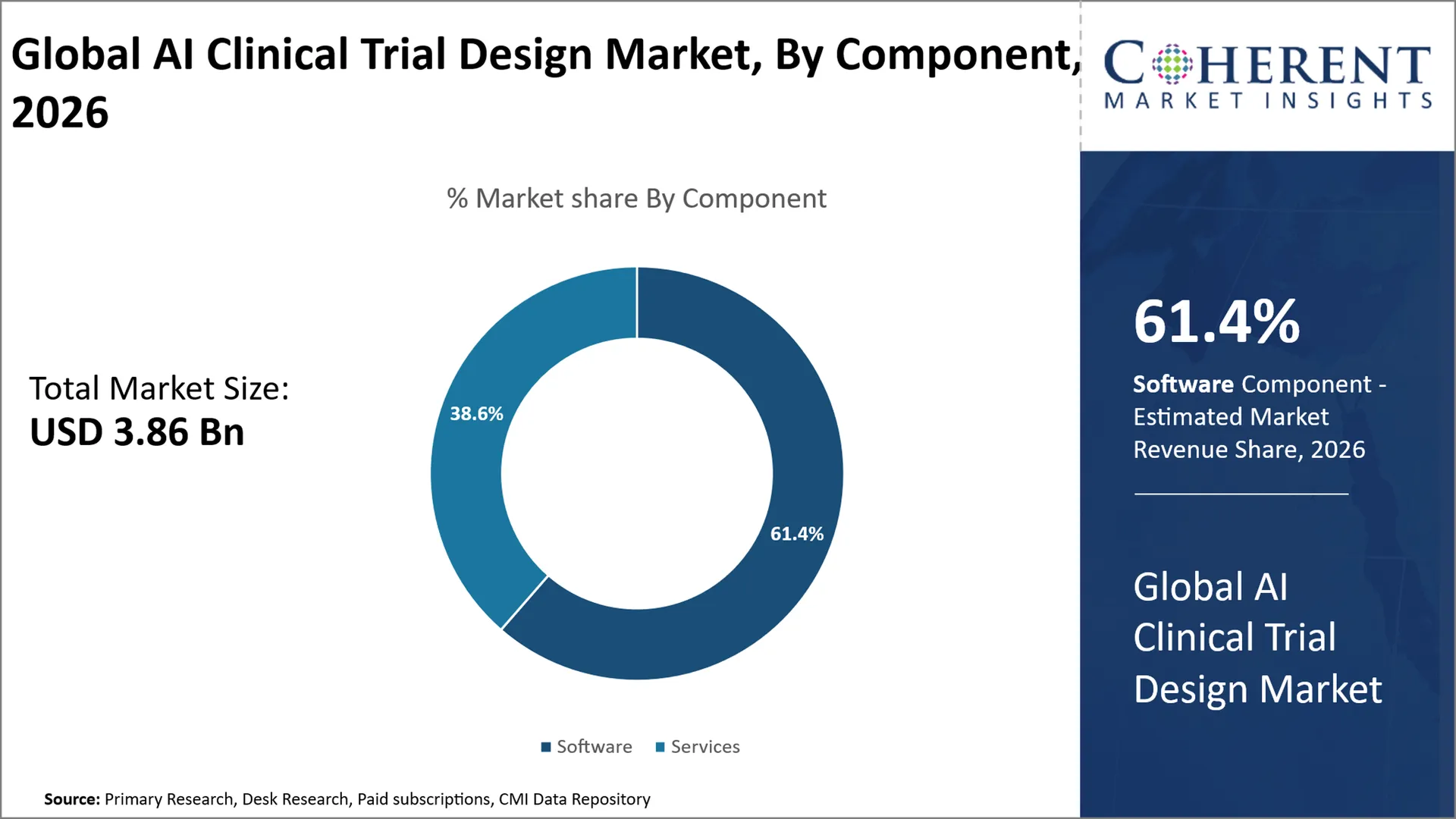
Why Do Software Dominate the Global AI Clinical Trial Design Market?
Software is projected to hold the market share of 61.4% in 2026, supported by its ability to automate protocol development, perform feasibility assessments, select patients and simulate trials. AI software platforms have suggested the potential to assimilate large volumes of clinical and real-world data and allow for quicker analysis and thus, more robust trial-design decision making. Furthermore, they are scalable and are capable of leveraging ML, predictive analytics and NLP, which may drive their adoption by further clinical-development workflows and regulators' push for AI-based evidence generation.
For instance, in February 2025, the European Medicines Agency (EMA) provided its first qualification opinion on clinical-trial data derived from an AI-based human-supervised MASH (metabolic dysfunction-associated steatotic hepatotoxicity) liver-biopsy analysis method. Using this method can potentially provide more robust treatment evidence with fewer patients, and thus show regulators' willingness to accept AI-enabled software in clinical development.
- Current Industry Events of 2026
- Market Size Estimation
- Regional Breakdown
- Competitive Landscape
- Customer Intelligence
- Segmental Analysis
- Pricing Analysis
- Key Market Drivers, Challenges & Future Trends
- Customized Insights Section
Why Does Machine Learning Represent the Largest Technology Segment in the AI Clinical Trial Design Market?
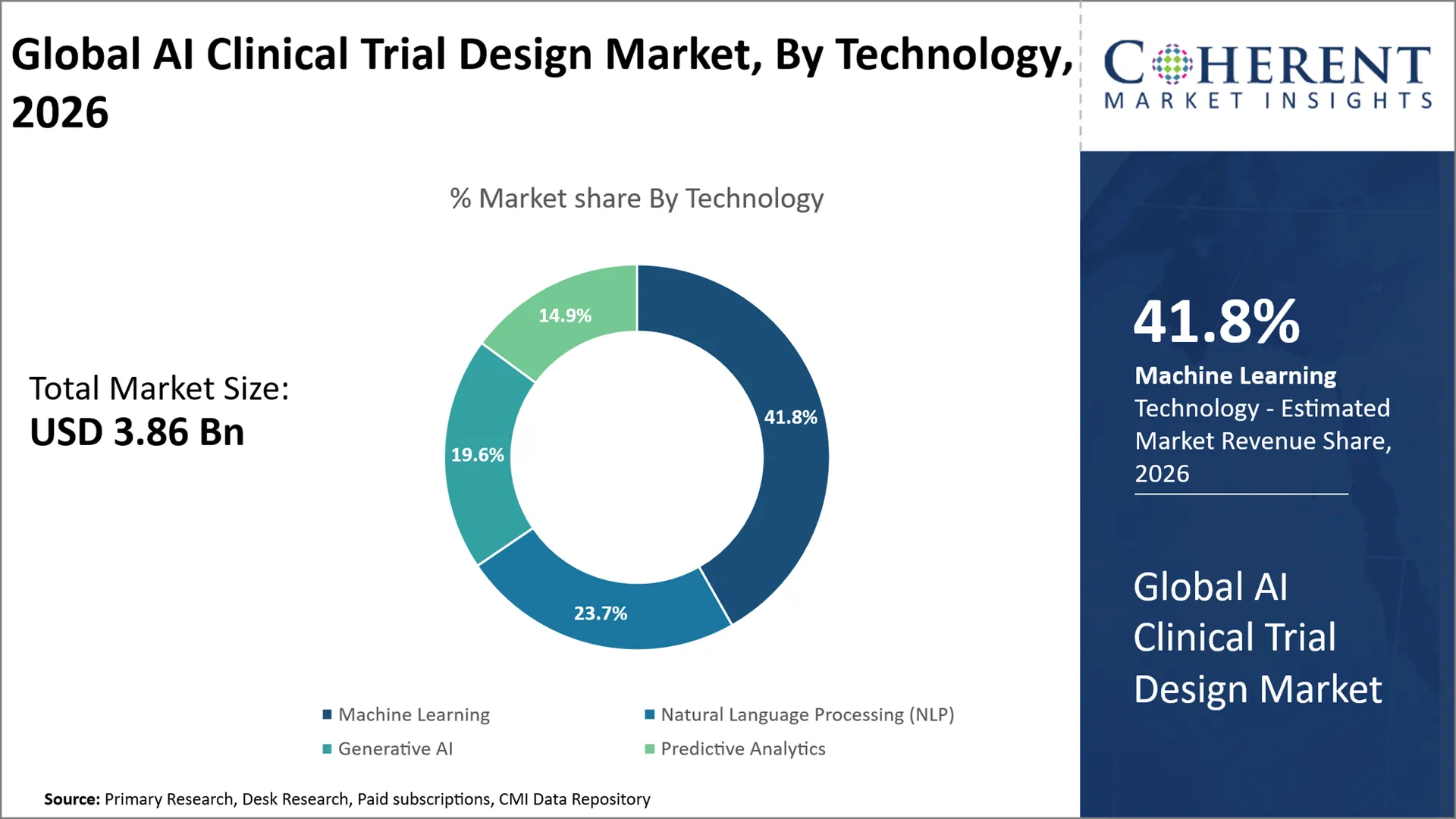
Machine learning is projected to hold a market share of 41.8% in 2026, owing to its potential to leverage large amounts of clinical data, recognize individual patient and trial patterns, and produce predictive insights into factors such as trial eligibility, stratification, feasibility, and outcomes assessment. Its ability to continuously learn from the growing datasets may lead to improved accuracy and data-driven data use decisions in trials. For instance, in June 2026, UK Medicines and Healthcare Products Regulatory Agency (MHRA) launched AI sandbox to test AI approaches to improve the assessment of the safety of medicines and predict risks earlier in the development cycle. The initiative supports regulatory assessment of artificial intelligence-based predictive models for medicine development.
Phase III Segment Dominates the Global AI Clinical Trial Design Market
The Phase III segment is projected to hold a market share of 39.6% in 2026, due to large patient populations, complex endpoints, long study duration and resource intensiveness of pivotal trials. AI/ML has potential to improve Phase III planning via patient stratification, enrollment prediction, endpoint refinement and explore new trial designs. The need to address operational and statistical complexity more cost-effectively could also accelerate adoption of AI-enabled trial design and decision support tools. For instance, in June 2026, the International Council for Harmonisation (ICH) formally approved the adoption of Annex 2 of ICH E6(R3) which addresses the use of innovative and non-traditional clinical trial designs, such as real-world data and decentralized approaches. The new Annex 2 extends regulatory support for technology-enabled approaches to complex late-stage trials. (Source: European Medicines Agency (EMA))
Current Events and their Impact
Current Events | Description and its Impact |
China NMPA Issues Implementation Opinions on “Artificial Intelligence + Drug Regulation” (August 2026) |
|
UK Introduces Clinical Trial Reforms Supporting Computer Model Simulations (April 2026) |
|
EMA and U.S. FDA Establish Common Principles for AI in Medicine Development (January 2026) |
|
AI Clinical Trial Design Market Dynamics
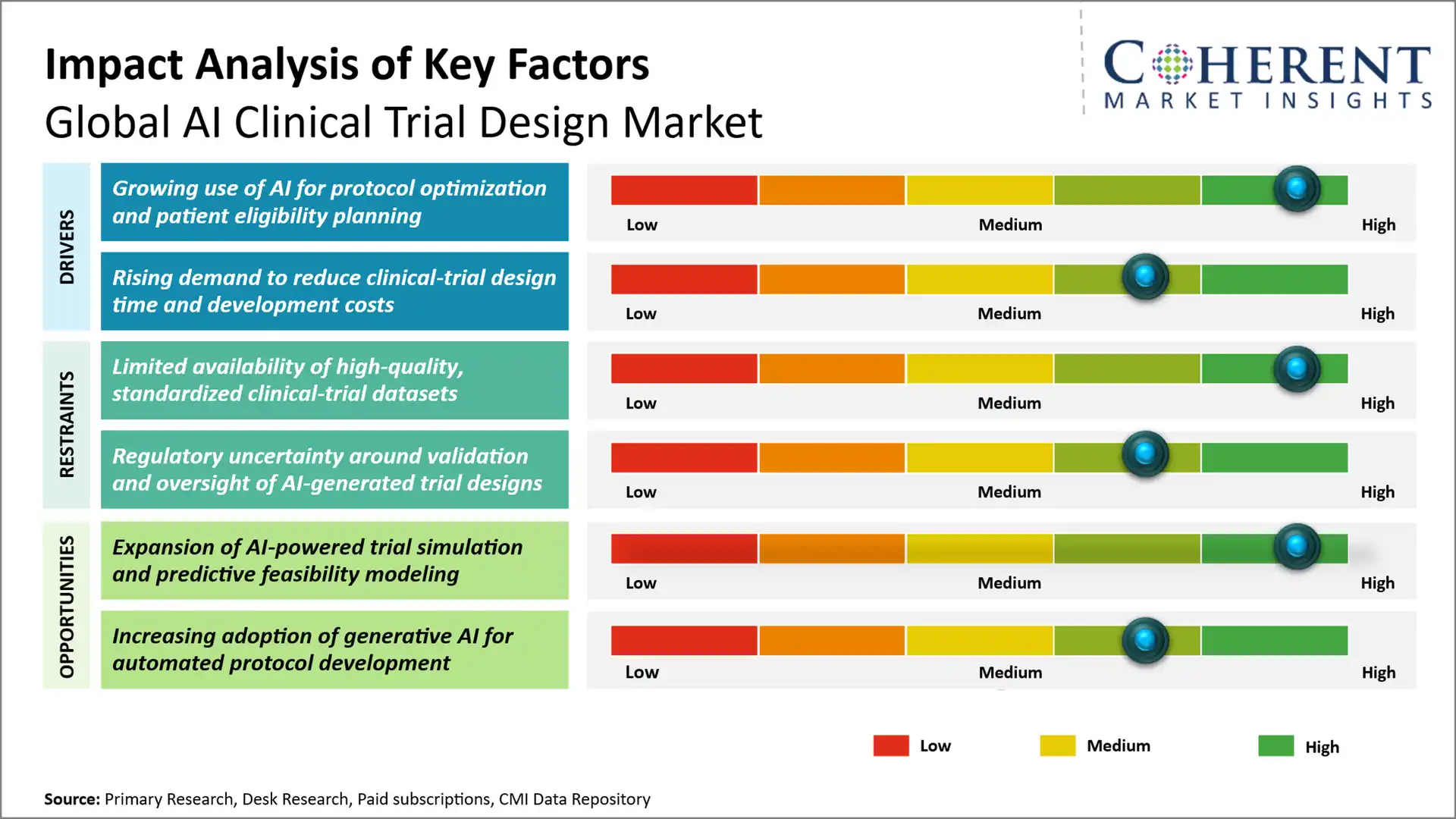
Market Drivers
- Growing use of AI for protocol optimization and patient eligibility planning: AI is increasingly being applied to optimize eligibility criteria by analyzing historical trial protocols and real-world patient data to identify overly restrictive or inefficient criteria. This enables sponsors to improve patient-population feasibility while reducing manual protocol-design effort and potential enrollment constraints. The integration of generative AI and machine learning is further enabling evidence-based drafting and refinement of eligibility criteria. For instance, in May 2026, researchers from Regeneron Pharmaceuticals, Inc. and Keiji.AI presented an AI-assisted platform at ISPOR 2026 that used LLMs, trial similarity ranking, and clustering to generate and refine clinical-trial eligibility criteria. The system achieved 83.3% precision in ranking similar trials and captured 75.7% of evaluated eligibility criteria.
- Rising demand to reduce clinical-trial design time and development costs: AI-enabled clinical-trial design is gaining adoption as sponsors seek to shorten the traditionally lengthy process of protocol development, feasibility assessment, and study optimization. Automated analysis of real-world data and AI-driven simulation can reduce manual design effort while allowing multiple trial scenarios to be evaluated before execution. This creates potential to reduce costly design inefficiencies and accelerate clinical-development timelines. For instance, in July 2026, researchers from Weill Cornell Medicine and collaborating institutions developed EmulatRx, a multi-agent AI framework that automates key clinical-trial design tasks, including protocol specification, data extraction, statistical modeling, and interpretation. The framework completed the full design pipeline in a median 5.75 minutes with GPT-4o, compared with manual workflows that typically require days to weeks.
- Increasing use of AI for trial feasibility and site selection: AI-powered feasibility tools are enabling sponsors to assess site capabilities, patient availability, competing trials, and historical recruitment performance before finalizing site portfolios. By replacing fragmented manual assessments with data-driven site intelligence, these solutions can improve site selection and reduce recruitment-related delays. For instance, in May 2026, American Society of Clinical Oncology (ASCO) announced a collaboration with Ryght AI to use its AI platform to analyze clinical research site data for a metastatic breast cancer trial. The initiative aims to accelerate site activation and patient enrollment for the CDK4/6 Inhibitor Dosing Knowledge Study.
Emerging Trends
- Rise of agentic AI in clinical trial design: Agentic AI is evolving from single-task automation toward multi-agent systems that can coordinate protocol generation, cohort construction, statistical analysis, and iterative trial refinement.
- Integration of real-world data into AI-driven trial planning: AI platforms are increasingly combining EHRs, clinical-trial databases, and other real-world data to refine eligibility criteria, identify feasible patient populations, and inform protocol design before trial initiation.
- Growing use of AI-powered trial simulation and digital twins: Simulation-based AI is gaining traction for testing alternative trial designs, forecasting enrollment and outcomes, and assessing adaptive-study scenarios before implementation. Digital twins and synthetic comparator approaches are also emerging within this workflow.
Regional Insights
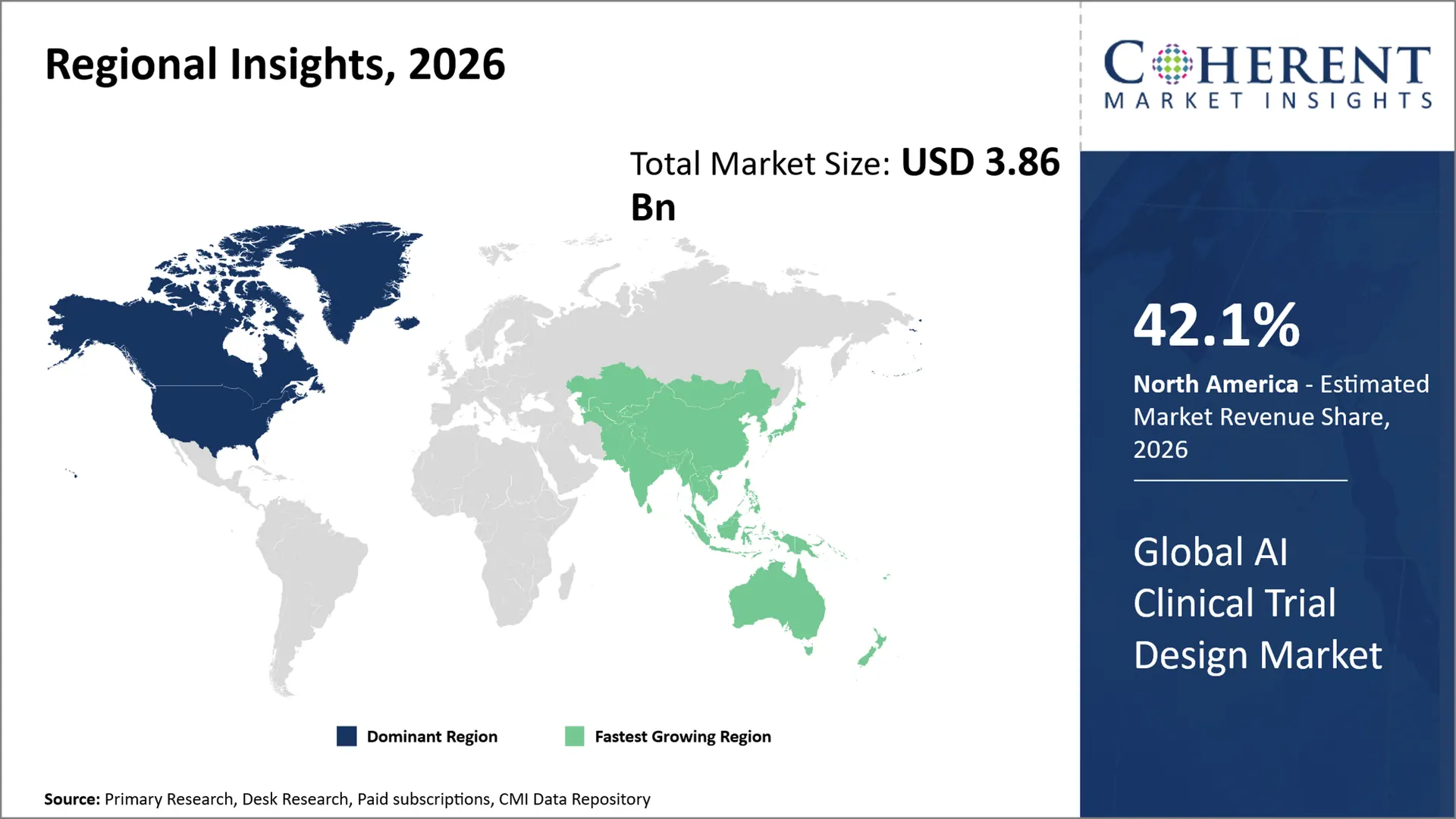
Why is North America a Strong Market for AI Clinical Trial Design?
North America leads the global AI Clinical Trial Design market, accounting for an estimated 42.1% share in 2026, owing to the presence of advanced infrastructure for clinical research, large amount of clinical as well as real-world data, and heavy investment in digital drug development. The potential incentives from public authorities including innovative regulation, adaptive clinical trial protocols, and technology-enabled trial approaches may help advance the region.
For instance, in April 2026, the U.S. Food and Drug Administration (FDA) announced major steps to implement real-time clinical trials, including a pilot framework to evaluate AI-enabled technologies for improving the efficiency, speed, and quality of decision-making in early-phase clinical trials. Moreover, close work between technology developers, regulators, research organizations, and healthcare providers, including for protocol design, patient-trial matching, trial simulation, and predictive analytics is expected to facilitate the adoption of AI.
Why Does Asia Pacific AI Clinical Trial Design Market Exhibit High Growth?
Asia Pacific is expected to exhibit the fastest growth in the global AI Clinical Trial Design market, registering an estimated CAGR of 24.8% during 2026–2033. The region is projected to account for 22.4% of the global market in 2026, attributed to growing healthcare infrastructure, expanding number of clinical research and the availability of large number of patients for clinical trials. In addition, growing government initiatives to incorporate AI and other digital technologies in healthcare and drug development, especially in the countries like China, South Korea, Japan and India, are expected to enable the region to adopt AI-based trial design and data-driven study planning.
For instance, in April 2026, Japan’s Pharmaceuticals and Medical Devices Agency (PMDA) began organization-wide use of generative AI and started research on automating clinical study reports and regulatory submission documents using AI. This initiative encourages more extensive use of AI in Japan’s pharmaceutical development and regulatory processes. Furthermore, burgeoning investments in infrastructure for digital health and clinical research are predicted to bolster the region's AI trials design readiness.
Global AI Clinical Trial Design Market Outlook for Key Countries
Why is the U.S. Leading Innovation and Adoption in the AI Clinical Trial Design Market?
The U.S. is expected to hold a leading position in the AI clinical trial design market ascribed to the high penetration rate of the use of artificial intelligence during various clinical stages of development, the development of clinical data infrastructure and large concentration of pharma/ biotech R&D in the country. The country has a matured ecosystem that links the AI developers, sponsors, contract research organizations (CROs), academic research institutions and clinical-trial networks.
Is China a Favorable Market for AI Clinical Trial Design Market?
China presents a favorable outlook for AI in clinical trial design, buoyed by the rapid expansion of clinical trial activity, improvements in regulatory environments and government investment into the use of AI in pharma. Specifically, the NMPA 2026 AI + Drug Regulation drive is encouraging development of standards of governance around data, high-quality datasets, use of large models and use of intelligent agents. The revision of the good clinical practice standards in China is expected to include more explicit standards on data governance as well as facilitating the application of technologies.
Is UK Emerging as a Key Growth Hub for the AI Clinical Trial Design Market?
The U.K. is emerging as a significant hub for the development of the AI Clinical Trial Design Market, which is presumably being enabled by the policy reforms that support clear guidelines to adopt artificial intelligence, computer-model simulations, and adaptive trial designs. Additionally, the MHRA is developing an AI-enabled solution powered by de-identified regulatory data to optimize trial design for sponsors right at the beginning.
Why Does Germany Top the European AI Clinical Trial Design Market?
Germany leads the European AI clinical trial design market due to its strong clinical research environment, increased ease of access to the standardized health-related databases as well as its regulatory efforts in support of AI enabled in healthcare. The BfArM Health Data Research Centre has provided pseudonymized claims data covering everyone insured by a statutory health insurance to researchers. This will almost certainly lay the foundations for clinical research and trial design based on artificial intelligence. In addition, Germany's participation in FAST-EU indicates an aim to accelerate the evaluation of high-quality clinical trials in Europe.
Is AI Clinical Trial Design Market Developing in Australia?
Australia is transforming into an emerging hub for AI in clinical trial design following the implementation of ICH E6(R3) by Therapeutic Goods Administration (TGA), which incorporates new trial designs and innovative data sources. Additionally, TGA is strengthening the regulatory framework of AI and software tools in a clinical setting with greater transparency and risk-based regulation, which would potentially provide a more clearly defined regulatory space for AI-enabled clinical trial planning, data analysis, and clinical development processes.
AI Applications Across the Clinical Trial Design Process
Clinical Trial Design Stage | AI Application | Key Data Inputs | Primary Output / Decision Support |
Protocol Design | Protocol optimization and scenario generation | Historical trials, clinical guidelines, RWE | Optimized study design and protocol parameters |
Eligibility Design | Eligibility-criteria optimization | EHRs, claims data, trial databases | More feasible inclusion/exclusion criteria |
Patient Stratification | AI-based cohort identification | Clinical, genomic, demographic data | Target patient populations and subgroups |
Trial Feasibility | Recruitment and enrollment prediction | Historical enrollment, site data, patient populations | Enrollment forecasts and feasibility assessment |
Site Selection | AI-enabled site recommendation | Site performance, patient availability, historical trial data | Ranked and risk-adjusted site portfolios |
Trial Simulation | Scenario and outcome simulation | Trial parameters, RWE, historical clinical data | Comparison of alternative trial designs |
Endpoint Planning | Endpoint and outcome prediction | Clinical outcomes, biomarkers, patient-level data | Endpoint selection and outcome projections |
How is the expansion of AI-powered trial simulation and predictive feasibility modeling creating new growth opportunities in the AI clinical trial design market?
Trial simulation and predictive feasibility modeling with AI may enable sponsors to examine alternative protocols, estimate expected recruitment and dropout rates and evaluate site and patient population feasibility before trial initiation. These functionalities can be expected to reduce design uncertainty, enable upfront detection of operational choke points and improve resource utilization. For instance, in May 2026, researchers from ConcertAI, Cambridge, Massachusetts presented an AI-powered approach to site selection at 2026 ASCO Annual Meeting that combined site optimization with Monte Carlo simulations of trial enrollment to project accrual. The approach, which used 54 trials involving colorectal, breast and NSCLC cancer, was used to demonstrate how this technology could support risk-adjusted site selection and planning for enrollment.
Market Players, Key Development, and Competitive Intelligence
Key Developments
- On October 1, 2026, CellCarta and Imagene AI expanded their collaboration to validate, deploy, and scale AI-powered biomarker and companion-diagnostic programs across drug development. The collaboration spans biomarker strategy, assay development, clinical-trial execution, and patient stratification, supporting AI-enabled approaches in biomarker-driven clinical trials.
- In July 2026, Evinova announced a multi-year strategic partnership with Merck KGaA, Darmstadt, Germany, under which Merck will adopt Evinova’s AI-Native platform for clinical development. The platform supports AI-driven study design, endpoint and benchmark selection, timeline feasibility, costing, and multi-scenario study optimization
- In July 2026, Medidata, a Dassault Systèmes brand, launched Medidata Plus, an AI-native foundation designed to provide sponsors and CROs with scalable AI capabilities across clinical-trial portfolios. The platform integrates AI across study build, data management, analytics, and risk monitoring, while its AI capabilities support trial simulation and protocol optimization.
- In February 2026, Evinova announced a strategic collaboration with Bristol Myers Squibb to optimize clinical development using its AI-native platform. BMS will deploy Evinova’s Cost Optimizer module across its global portfolio, using AI to evaluate trial-design scenarios, identify productivity opportunities, and improve trial efficiency.
Competitive Landscape
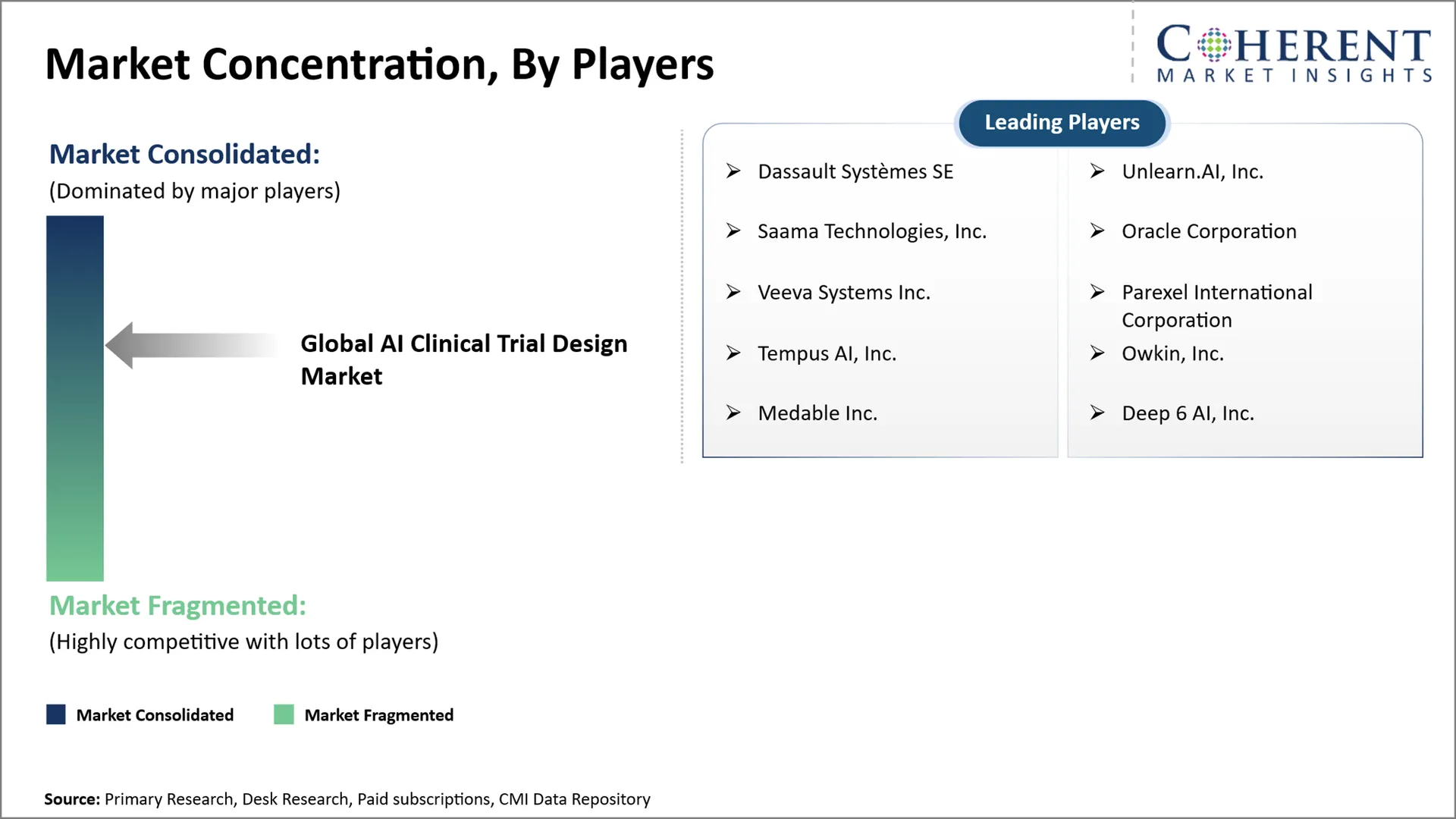
The global AI clinical trial design market is moderately competitive, with competition centered on AI capabilities, clinical-trial workflow integration, predictive modeling, data interoperability, scalability, and regulatory readiness. Market participants are increasingly developing AI-powered solutions to optimize study protocols, patient selection, trial feasibility, and evidence generation.
Key focus areas include
- AI-driven protocol design, optimization, and study scenario modeling
- Patient eligibility, cohort identification, and stratification
- Trial feasibility assessment, site selection, and enrollment forecasting
- Predictive analytics for endpoints, outcomes, and trial success
- Integration of AI with clinical-trial management, EDC, EHR, and real-world data platforms
- Expansion of generative AI for automated protocol development and clinical-trial documentation
Market Report Scope
Global AI Clinical Trial Design Market Report Coverage | |||
Report Coverage | Details | ||
Base Year | 2025 | Market Size in 2026: | USD 3.86 Bn |
Historical Data For: | 2020 To 2024 | Forecast Period: | 2026 To 2033 |
Forecast Period 2026 To 2033 CAGR: | 18.9% | 2033 Value Projection: | USD 12.97 Bn |
Geographies covered: |
| ||
Segments covered: |
| ||
Companies covered: | Dassault Systemes SE, Unlearn.AI, Inc., Saama Technologies, Inc., Oracle Corporation, Veeva Systems Inc., Parexel International Corporation, Tempus AI, Inc., Owkin, Inc., Medable Inc., Deep 6 AI, Inc. | ||
Growth Drivers: |
| ||
Restraints & Challenges: |
| ||
Analyst Opinion (Expert Opinion)
- In the coming years, global AI clinical trial design market will shift from standalone AI tools toward integrated, end-to-end trial-design platforms capable of evaluating multiple study scenarios before trial initiation. Generative AI, predictive modeling, and real-world data integration are expected to increasingly support protocol optimization, patient selection, feasibility assessment, and adaptive study planning, making AI a more embedded component of clinical-development workflows.
- The maximum opportunities are foreseen within Generative AI for protocol design and optimization in the U.S., where sponsors can use AI to automate protocol drafting, identify design inefficiencies, compare alternative study scenarios, and improve trial feasibility. A second opportunity exists in AI-powered patient stratification for oncology in China and India, where complex patient populations and expanding clinical-development activity can create demand for more targeted trial-design approaches.
- In order to gain a competitive advantage market players should move beyond generic AI capabilities and develop clinically validated, interoperable platforms with measurable trial-design outcomes. Building proprietary clinical and real-world data capabilities, integrating with existing clinical-development systems, maintaining human oversight, and offering explainable AI outputs can help providers establish stronger differentiation and long-term customer retention.
Speak to the analyst
Want personalized insights?
Take the findings above to one of our principal consultants, or have the report rebuilt around the segments, geographies and competitors you actually track.
Market Segmentation
- Component Insights (Revenue, USD Bn, 2021 - 2033)
- Software
- Services
- Technology Insights (Revenue, USD Bn, 2021 - 2033)
- Machine Learning
- Natural Language Processing (NLP)
- Generative AI
- Predictive Analytics
- Clinical Trial Phase Insights (Revenue, USD Bn, 2021 - 2033)
- Phase I
- Phase II
- Phase III
- Phase IV
- Application Insights (Revenue, USD Bn, 2021 - 2033)
- Protocol Design and Optimization
- Patient Recruitment and Eligibility
- Trial Feasibility and Site Selection
- Trial Simulation and Predictive Modeling
- Endpoint and Outcome Optimization
- Patient Stratification
- Others
- End User Insights (Revenue, USD Bn, 2021 - 2033)
- Pharmaceutical and Biotechnology Companies
- Contract Research Organizations (CROs)
- Academic and Research Institutions
- Others
- Regional Insights (Revenue, USD Bn, 2021 - 2033)
- North America
- U.S.
- Canada
- Latin America
- Brazil
- Argentina
- Mexico
- Rest of Latin America
- Europe
- Germany
- U.K.
- Spain
- France
- Italy
- Russia
- Rest of Europe
- Asia Pacific
- China
- India
- Japan
- Australia
- South Korea
- ASEAN
- Rest of Asia Pacific
- Middle East
- GCC Countries
- Israel
- Rest of Middle East
- Africa
- South Africa
- North Africa
- Central Africa
- North America
Sources
Primary Research Interviews
- Clinical development executives responsible for clinical-trial strategy, protocol development, and study optimization
- Clinical trial design and operations leaders overseeing feasibility, patient recruitment, site selection, and trial planning
- Biostatisticians and clinical data scientists developing predictive models, adaptive designs, and statistical trial methodologies
- Regulatory affairs and clinical research professionals evaluating AI use, validation, and regulatory requirements in clinical studies
- AI/ML and clinical informatics specialists developing AI applications for protocol optimization, patient stratification, and trial simulation
- CRO executives and clinical research professionals implementing AI-enabled trial-design and feasibility solutions
Stakeholders
- Pharmaceutical and biotechnology companies adopting AI for protocol design, patient selection, feasibility, and trial optimization
- Contract Research Organizations (CROs) providing AI-enabled clinical-development and trial-planning services
- AI and clinical-trial technology companies developing protocol optimization, simulation, and predictive analytics platforms
- Academic medical centers and clinical research institutions conducting AI-enabled clinical research and trial design
- Clinical research networks and trial sites supporting patient recruitment, feasibility assessment, and study execution
- Electronic health record, real-world data, and healthcare data providers supplying datasets for AI-based trial planning
- Technology and cloud infrastructure providers supporting AI model development, data processing, and clinical research platforms
- End-use Sectors
- Pharmaceutical Companies
- Biotechnology Companies
- Contract Research Organizations (CROs)
- Academic and Research Institutions
- Clinical Research Networks and Trial Sites
- Other Life Sciences Organizations
- Regulatory & Health Bodies
- U.S. Food and Drug Administration (FDA) – AI/ML in drug development, clinical-trial design, regulatory decision-making, and clinical data guidance
- European Medicines Agency (EMA) – regulatory and scientific considerations for AI applications in medicines development
- European Commission – European AI governance and regulatory framework relevant to clinical research
- International Council for Harmonisation of Technical Requirements for Pharmaceuticals for Human Use (ICH) – clinical-trial quality, design, and Good Clinical Practice standards
- World Health Organization (WHO) – global clinical-trial registration, research governance, and digital-health resources
- National Medical Products Administration (NMPA), China – regulation of pharmaceuticals, clinical trials, and AI-enabled medical technologies
- Pharmaceuticals and Medical Devices Agency (PMDA), Japan – pharmaceutical development, clinical-trial review, and medical-product regulation
- Medicines and Healthcare products Regulatory Agency (MHRA), UK – clinical research, medicines regulation, and AI-related regulatory considerations
- Central Drugs Standard Control Organisation (CDSCO), India – regulation and oversight of clinical trials and pharmaceutical development
Databases
- ClinicalTrials.gov – registered clinical studies, study characteristics, interventions, eligibility, outcomes, and trial status
- WHO International Clinical Trials Registry Platform (ICTRP) – consolidated access to ongoing and completed clinical-trial registration data from global registries
- Clinical Trials Information System (CTIS) – European Union clinical-trial applications, records, and results
- EU Clinical Trials Register (EU-CTR) – clinical-trial information for studies conducted under the former EU clinical-trial framework
- Clinical Trials Registry–India (CTRI) – registered clinical trials conducted in India
- Chinese Clinical Trial Registry (ChiCTR) – clinical-trial registration data from China
- Japan Primary Registries Network (JPRN/jRCT) – clinical-trial registration data for Japan
- ISRCTN Registry – internationally registered clinical studies and trial information
- OECD Health Statistics – comparative health-system, pharmaceutical-market, healthcare-utilization, and workforce datasets
Associations
- Drug Information Association (DIA) – clinical development, regulatory science, data, and emerging technologies
- Association of Clinical Research Professionals (ACRP) – clinical research workforce, trial conduct, and professional standards
- Clinical Trials Transformation Initiative (CTTI) – clinical-trial innovation, quality, efficiency, and modernization
- TransCelerate BioPharma Inc. – pharmaceutical-industry collaboration on clinical-trial processes, data, and technology
- Pharmaceutical Research and Manufacturers of America (PhRMA) – pharmaceutical R&D and clinical-development industry perspectives
- European Federation of Pharmaceutical Industries and Associations (EFPIA) – European pharmaceutical R&D and clinical-trial ecosystem
- International Society for Pharmaceutical and Outcomes Research (ISPOR) – health economics, outcomes research, real-world evidence, and data analytics
Public Domain Sources
- U.S. Food and Drug Administration (FDA) – AI/ML, clinical-trial design, regulatory guidance, drug development, and clinical research resources
- National Institutes of Health (NIH) – biomedical research, clinical studies, AI research, and clinical-trial resources
- ClinicalTrials.gov – public clinical-trial registration and study information
- World Health Organization (WHO) – global clinical-trial registration, health research, and digital-health resources
- European Medicines Agency (EMA) – medicines development, clinical-trial, and AI-related regulatory information
- European Commission – EU AI governance and health-research policy resources
- OECD – healthcare, pharmaceutical R&D, health expenditure, and health-system datasets
- International Council for Harmonisation (ICH) – Good Clinical Practice and clinical-trial standards
- National Medical Products Administration (NMPA), China – pharmaceutical and clinical-trial regulatory information
Proprietary Elements
- CMI Data Analytics Tool
- Proprietary CMI Existing Repository of information for last 10 years.
Get access to 250+ pages report
Every segment, forecast, competitor profile and data table behind the analysis above — available for instant download.
- ESOMAR Member
- ISO 9001:2015 Certified
- D-U-N-S Registered
- GDPR & CCPA Compliant
Frequently Asked Questions
The global AI clinical trial design market is estimated to be valued at USD 3.86 Bn in 2026 and is expected to reach USD 12.97 Bn by 2033.
Software dominates due to its ability to automate protocol design, feasibility analysis, patient selection, and predictive trial modeling at scale.
AI clinical trial design uses artificial intelligence to optimize study protocols, patient selection, trial feasibility, endpoints, and study planning.
The CAGR of global AI clinical trial design market is projected to be 18.9% from 2026 to 2033.
Growing use of AI for protocol optimization and patient eligibility planning, and rising demand to reduce clinical-trial design time and development costs are the major factors driving the growth of the global AI clinical trial design market.
Limited availability of high-quality, standardized clinical-trial datasets, and regulatory uncertainty around validation and oversight of AI-generated trial designs are the major factors hampering the growth of the global AI clinical trial design market.
In terms of technology, machine learning is estimated to dominate the market revenue share in 2026.