

Global AI Data Center Coolant Monitoring Equipment Market Size and Forecast – 2026 To 2033
The Global AI Data Center Coolant Monitoring Equipment Market is estimated to be valued at USD 164.6 Mn in 2026 and is expected to reach USD 862.7 Mn by 2033, exhibiting a compound annual growth rate (CAGR) of 26.70% from 2026 to 2033. Market expansion is supported by the deployment of high-density AI servers and the transition toward direct-to-chip liquid cooling, which requires continuous monitoring of coolant flow, temperature, pressure, fluid quality, and leakage. Data center operators are increasingly prioritizing reliable monitoring equipment to prevent cooling failures, protect GPU infrastructure, and maintain operational efficiency.
In July 2025, TTK introduced its FG-DLC Direct Liquid Cooling Sensor, specifically designed to detect conductive coolant leaks in direct-to-chip server cooling systems. The sensor provides real-time leak detection and supports integration with centralized monitoring systems, highlighting growing opportunities for specialized coolant monitoring equipment in AI data centers.
Key Takeaways of the Global AI Data Center Coolant Monitoring Equipment Market
- Coolant Flow Sensors and Meters are anticipated to grow at a CAGR of 27.8% during 2026-2033 and have 23.8% global AI data center coolant monitoring equipment market share in 2026. Accurate flow measurement allows operators to identify inadequate circulation and optimize coolant distribution across systems with high GPU utilization. Sensata Technologies announced its FL Series ultrasonic liquid cooling flow sensors for data centers in October 2026.
- Direct-to-Chip Liquid Cooling is expected to dominate the global AI data center coolant monitoring equipment market with 78.5% share in 2026 with an estimated CAGR of 27.4% during 2026-2033. Direct cooling of the processor requires constant monitoring of the fluid conditions to deal with corrosion, contamination and thermal reliability. In May 2025, Ecolab introduced its 3D TRASAR technology that enables real-time monitoring of the health of coolants in direct-to-chip cooling systems.
- Rack-Level Monitoring is expected to grow with an estimated CAGR of 28.6% from 2026 to 2033, and is expected to hold 41.7% of the global AI data center coolant monitoring equipment market in 2026. Localized diagnostics help you pinpoint cooling abnormalities and isolate affected racks faster. In June 2026, Nidec developed an in-rack coolant distribution unit featuring integrated leak sensors and real-time temperature, pressure, flow and liquid-level monitoring.
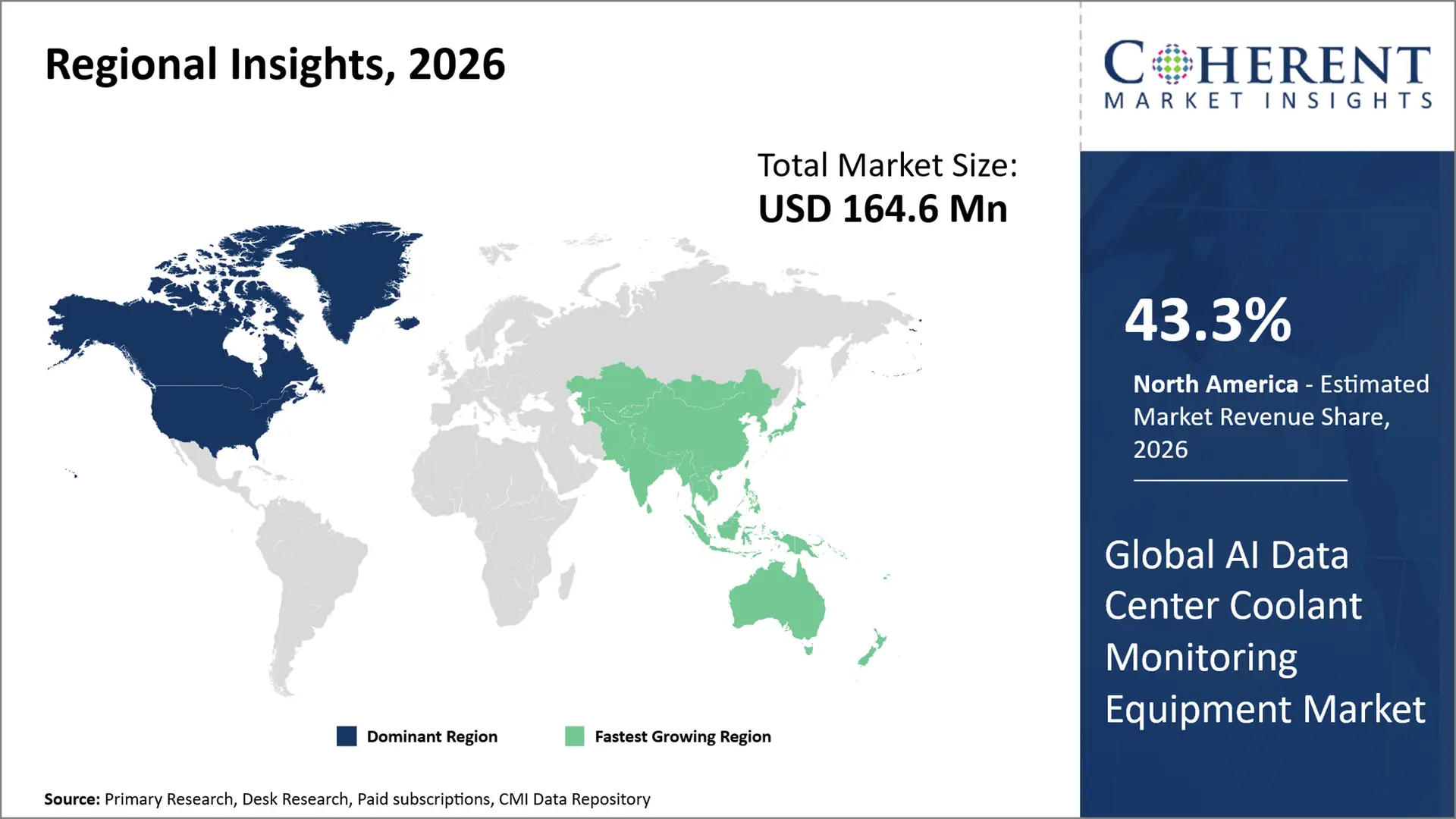
- North America is estimated to account for a share of 43.3% of the global AI data center coolant monitoring equipment market in 2026 and grow at a CAGR of 24.3% from 2026-2033. The adoption of monitoring equipment is facilitated by the rigorous system validation requirements and the integration capabilities of the existing AI infrastructure. In May 2026, AHEAD launched its liquid-cooled rack integration facility in Illinois to enhance its pre-deployment testing capabilities for high-density AI infrastructure.
- Asia Pacific is estimated to account for 31.1% of the global AI data center coolant monitoring equipment market in 2026 with an anticipated regional CAGR of almost 31.8% during the period from 2026 to 2033. As new AI-ready facilities are built, there is an opportunity to embed coolant monitoring into the initial installation of the infrastructure. Nxera opened its DC Tuas facility in Singapore in February 2026, using large-scale direct-to-chip liquid cooling for high-density compute environments.
Segmental Insights
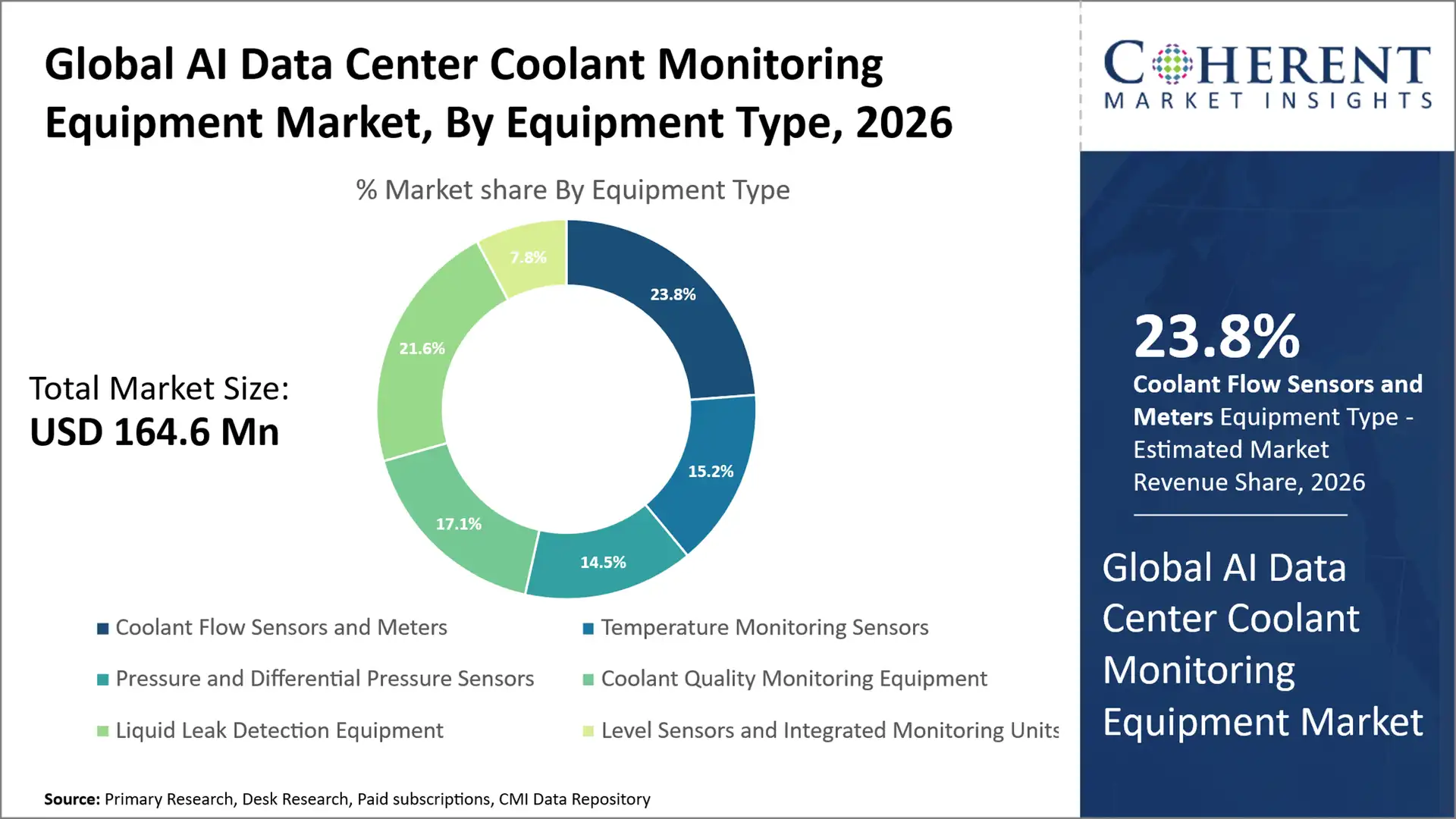
Why Do Coolant Flow Sensors and Meters Dominate the Global AI Data Center Coolant Monitoring Equipment Market?
Coolant Flow Sensors and Meters, with an expected 23.8% share in global AI data center coolant monitoring equipment market, lead the equipment-type category because operators must confirm delivered liquid volume, not simply pump operation. This is due to the need of operators to verify the volume of liquid delivered rather than relying on the pump operation. Parallel cold-plate circuits lead to unequal hydraulic resistance and may jeopardize heat extraction even if the main loop is stable, since there is not enough flow in one branch. Flow instruments help commissioning teams find progressive restrictions from trapped air or clogged strainers, verify design specifications and balance rack manifolds. Compact wetted assemblies, predictable calibration and mechanical integrity improve the potential for qualification in standard cooling packages for OEM’s. In March 2025, SIKA introduced a stainless-steel vortex flow sensor designed specifically for data center rack cooling. This sensor enables smooth integration and uninterrupted operation, meeting the specifications of equipment manufacturers. This development shows the possibility of instrument suppliers to achieve design-in positions by providing application-specific hardware rather than generic process-meter offerings.
- Current Industry Events of 2026
- Market Size Estimation
- Regional Breakdown
- Competitive Landscape
- Customer Intelligence
- Segmental Analysis
- Pricing Analysis
- Key Market Drivers, Challenges & Future Trends
- Customized Insights Section
Why Does Direct-to-Chip Liquid Cooling Represent the Largest Cooling Technology Segment in the Global AI Data Center Coolant Monitoring Equipment Market?
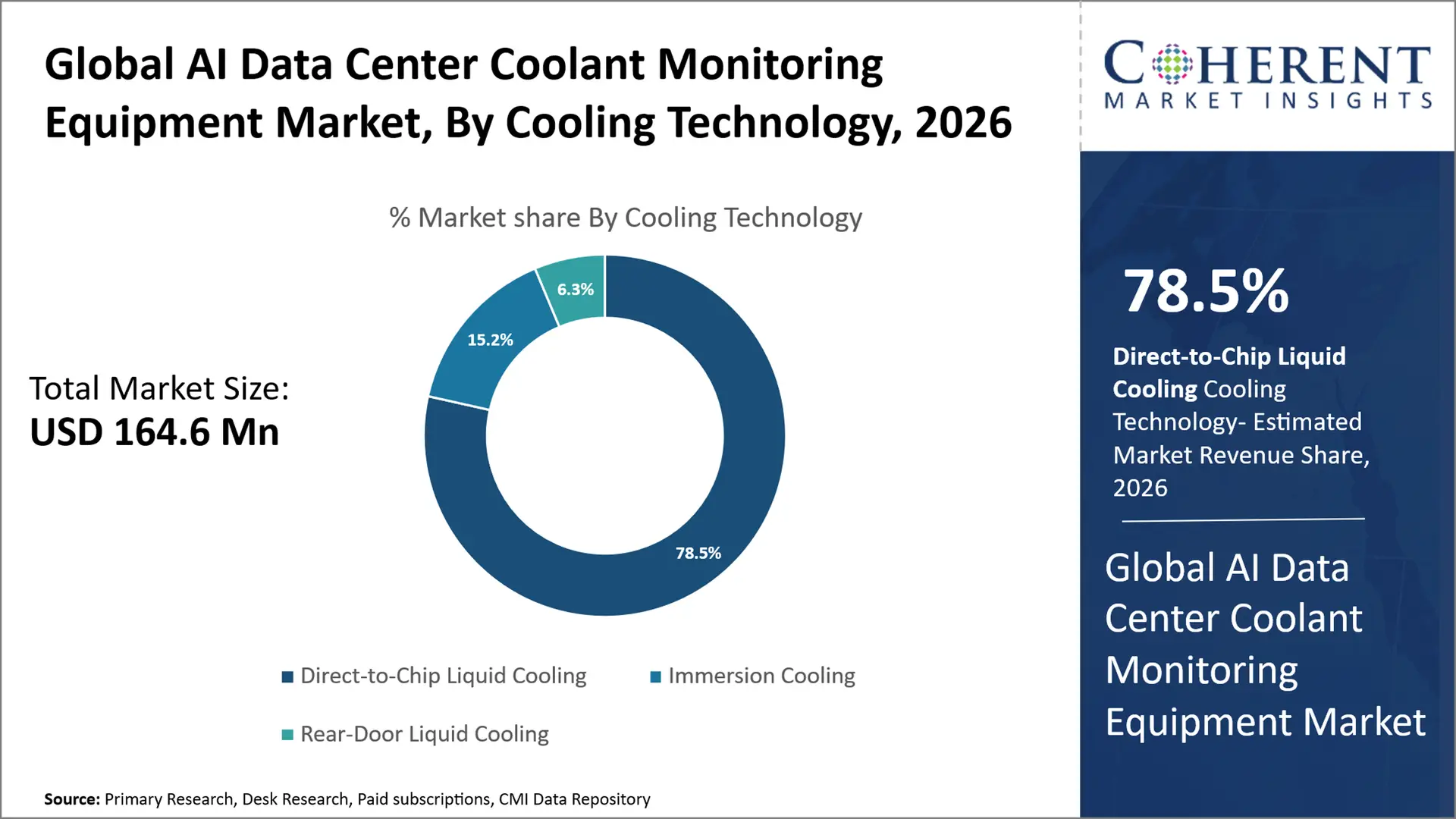
Direct-to-Chip Liquid Cooling is the most popular cooling technology, and is expected to hold a market share of 78.5% in global AI data center coolant monitoring equipment market, as it draws heat away from the cold plates of the GPU and CPU without requiring the server assemblies to be fully submerged. The architecture is well suited for phased upgrades to AI infrastructure. It can be incorporated into conventional cabinet footprints with familiar access to most of the IT components. But it needs proven supply conditions, differential pressure monitoring and reliable leak alarms, because of its many quick-disconnects and tight coolant passages. OEM qualified interfaces and cold-plate circuit sensing give monitoring vendors the opportunity to grow their businesses. In November 2025, Panduit launched its direct-to-chip cooling system, combining FlexFusion cabinets and rack manifolds with automatic air exhaust valves and quick-connect fittings. The launch illustrates the extent to which suppliers of coolant instrumentation can expand their opportunities for integration by tapping into commercially packaged architectures.
Why Does Rack-Level Monitoring Dominate the Monitoring Location Category of the Global AI Data Center Coolant Monitoring Equipment Market?
Rack-Level Monitoring, estimated to hold 41.7% of the global AI data center coolant monitoring equipment market in 2026, leads the monitoring-location category because the rack is the smallest practical unit for assigning cooling accountability to specific GPU clusters. This is because the rack is the smallest practical unit to which cooling accountability can be assigned to specific GPU clusters. Shared CDU readings may not always tell you which enclosure has a leaking connection or failing cooling branch. Rack-mounted sensors and control interfaces enable operations teams to correlate alarms with impacted computing assets, coordinate isolation, and avoid unnecessarily interrupting adjacent racks. Adding those measurements to server management workflows helps the hardware vendors as they won’t have to create separate facility dashboards. In October 2026, Dell Technologies introduced its Integrated Rack Controller, a solution that utilizes OpenManage-based response policies and distributed leak-sensing ropes to identify rack leaks and initiate containment actions. This makes a stronger business case for localized monitoring hardware associated with IT.
Current Events and their Impact
Current Event | Description and Its Impact |
May 2024 – European Union Data Center Sustainability Reporting Regulation |
|
December 2024 – Malaysia's Sustainable Data Center Development Guidelines |
|
August 2026 – Singapore Introduces SS 726:2026 for Liquid Cooling |
|
Global AI Data Center Coolant Monitoring Equipment Market Dynamics
Key Market Drivers
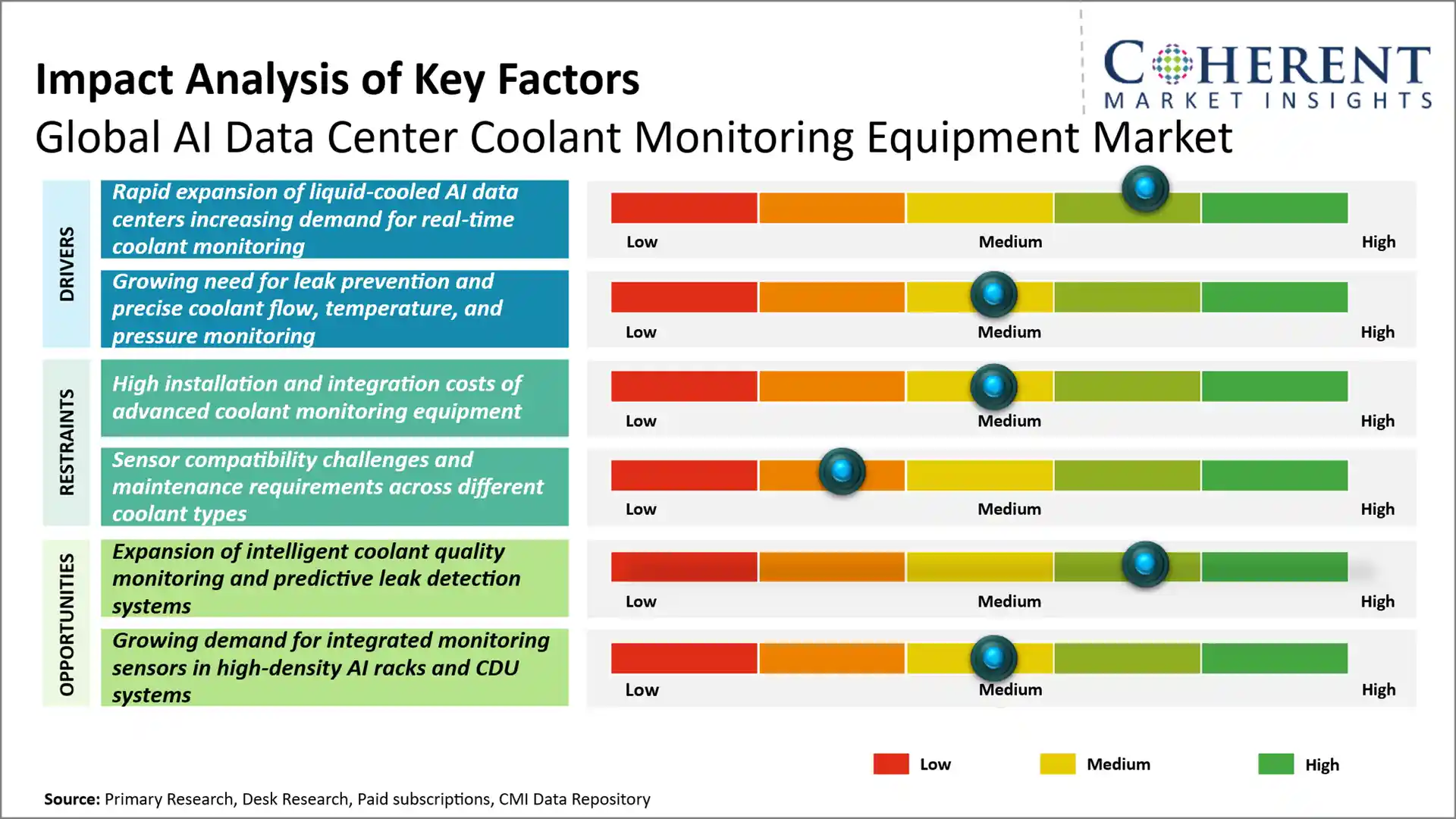
- Rapid expansion of liquid-cooled AI data centers increasing demand for real-time coolant monitoring: Even under specification limits for the ambient room temperature the failure of the coolant can damage the electronics and disrupt computing. Dedicated sensing cables are used to locate escaped liquid near critical connections. Pressure and flow readings are used to identify hydraulic abnormalities. For instrumentation specialists and controls integrators, there is an opportunity to provide a coordinated protection sequence that buyers want, not just separate alarms. In June 2026, Rotork and Parameter partnered to create prototype solutions for liquid-cooled AI data centers that combine electrically actuated valve isolation with real-time leak detection. This partnership emphasizes the value of containing faults before they become bigger problems. In October 2024, NVIDIA contributed its GB200 NVL72 liquid-cooling architecture and thermal specifications to the Open Compute Project, giving equipment manufacturers a more consistent basis for designing and monitoring high-density racks.
- Growing need for leak prevention and precise coolant flow, temperature, and pressure monitoring: Even under specification limits for the ambient room temperature the failure of the coolant can damage the electronics and disrupt computing. Dedicated sensing cables are used to locate escaped liquid near critical connections. Pressure and flow readings are used to identify hydraulic abnormalities. For instrumentation specialists and controls integrators, there is an opportunity to provide a coordinated protection sequence that buyers want, not just separate alarms. In June 2026, Rotork and Parameter partnered to create prototype solutions for liquid-cooled AI data centers that combine electrically actuated valve isolation with real-time leak detection. This partnership emphasizes the value of containing faults before they become bigger problems.
Emerging Market Trends
- Increasing Preference for Coolant-Compatible, Application-Specific Monitoring Instruments: The chemical and physical properties of water-glycol blends, treated water, and dielectric coolants are different, impact sensor accuracy, material compatibility, and the reliability of equipment operation. Manufacturers of cooling equipment are increasingly stressing the importance of monitoring devices designed for specific coolant formulations.
Impact: The change encourages manufacturers to produce fluid-compatible sensors that have been tested for performance and for extended service intervals.
Relevance to Market: Creates opportunities for the development of specialized equipment to monitor the quality, flow and temperature of coolant for AI data center liquid-cooling systems.
- Growing Integration of Coolant Monitoring Data with Open Infrastructure Control Systems: AI data center operators are migrating to centralized monitoring platforms that aggregate data on coolant flow, temperature, pressure and leak detection. The monitoring equipment can interface with the building management systems and the data center infrastructure management using open communication protocols and standardized interfaces.
Impact: This change will motivate sensor makers to prioritize interoperability and the capability to incorporate monitoring. Companies that supply equipment with compatible interfaces can facilitate OEM adoption and simplify the integration process.
Relevance to Market: Fuels the demand for connected coolant monitoring equipment enabling centralized diagnostics, quicker fault detection and optimized management of cooling systems.
Market Restraints
- Complex Sensor Calibration Under Variable Coolant Operating Conditions: Rapid variations in coolant velocity, trapped air, pump cycling and pressure fluctuations can affect the stability of measurements over liquid-cooling circuits. If the alarm thresholds are set incorrectly, it can result in unnecessary maintenance work or failing to discover incipient faults. So, manufacturers must evaluate the performance of sensors in realistic operating environments, which increases engineering costs and qualification requirements. Operators without a history of liquid-cooling maintenance may experience delays in their adoption.
- Fragmented Procurement Responsibilities Between IT and Facility Teams: Installing coolant monitoring typically requires mechanical contractors, manufacturers of cooling equipment, IT infrastructure teams, and facility management personnel. Differences in technical ownership, acceptance criteria and maintenance responsibilities can delay equipment selection and commissioning. If customers are not sure who is responsible for instrument calibration, alarm management and integration with existing control systems infrastructure, suppliers could see their approval process extended.
Regional Insights
Why Does North America Dominate the Global AI Data Center Coolant Monitoring Equipment Market?
North America is expected to hold 43.3% of the global AI data center coolant monitoring equipment market in 2026, driven by the substantial installed base of hyperscale computing infrastructure and the early adoption of liquid-cooling systems in dedicated AI facilities. Uniform coolant temperatures, verified circulation, and rapid detection of abnormal hydraulic conditions across distributed rack groups are required for large GPU clusters. This helps suppliers to integrate monitoring instruments with cooling controls and data center engineering systems. In September 2025, Microsoft Fairwater AI data center in Wisconsin went live, using a facility-scale closed-loop liquid-cooling architecture to enable high-density computing. Such installations create a demand for flow, pressure and temperature monitoring equipment that guaranties operational reliability and minimizes cooling-related interruptions.
Why Is Asia Pacific Emerging as the Fastest-Growing Region in the Global AI Data Center Coolant Monitoring Equipment Market?
Asia Pacific is expected to account for 31.1% of the global AI data center coolant monitoring equipment market in 2026, with the fastest growth anticipated through 2033. Growth opportunities are seen in new AI compute campuses, colocation capacity additions and the move to higher-density server configurations. The demand for modular monitoring systems that can be adapted to different liquid-cooling architectures, while still meeting regional installation and service requirements, can benefit equipment vendors. In August 2026, ST Telemedia Global Data Centers was selected to construct 50 MW of AI-ready data center capacity in Singapore, which will feature liquid cooling as part of the design of the proposed facility. And if all approvals are in place, the project shows how new investment in AI infrastructure could open up procurement opportunities for coolant monitoring equipment across the region.
Global AI Data Center Coolant Monitoring Equipment Market Outlook for Key Countries
Why Is the U.S. a Key Market for AI Data Center Coolant Monitoring Equipment?
The U.S. is a key market because it has large buyers of AI infrastructure and domestic manufacturers that can assemble and validate liquid-cooled server racks. For example, factory-set coolant distribution units and rack manifolds offer equipment suppliers an opportunity to lock in recurring component orders, rather than depending solely on individual installation projects. Domestic engineering support helps operators acquire calibrated sensors and replacement components in a timely manner. In February 2025, Supermicro announced it would expand its Silicon Valley manufacturing footprint with a third campus, tying the investment to liquid-cooled infrastructure and data center building-block solutions. This manufacturing concentration supports opportunities for qualified flow instrumentation, leak detection and thermal monitoring equipment integrated into cooling assemblies prior to shipment.
Why Does China Support Growth in the Global AI Data Center Coolant Monitoring Equipment Market?
China is strategically important in the global AI data center coolant monitoring equipment market because domestic equipment suppliers are increasingly integrating liquid cooling, electrical infrastructure and monitoring controls into modular AI data center systems. This opens up procurement opportunities for compact sensors, automated leak protection and monitoring units integrated during equipment manufacturing. Suppliers must provide competitive pricing and maintain consistent performance on large computing installations. In October 2026, ZTE released the M8000 intelligent computing module, featuring liquid-cooling monitoring and leak protection. The company also reported deliveries for the computing center of a Chinese Internet company in the Yangtze River Delta. This illustrates how modular deployment of infrastructure can serve the need of integrated coolant supervision and equipment-level fault management.
Why Is India Important in the Global AI Data Center Coolant Monitoring Equipment Market?
India is becoming increasingly important through local manufacturing of liquid-cooling equipment and investment in AI-ready data center infrastructure. Operators require higher computing densities, which must be combined with the use of instrumentation compatible with prefabricated coolant distribution systems. Localized production can improve the availability of equipment and technical servicing. Manufacturing partnerships also provide opportunities to monitor component suppliers in both domestic and export markets. In February 2026, Schneider Electric announced the opening of its Motivair liquid-cooling solutions plant in Bengaluru to establish a manufacturing hub intended to serve Indian data centers and global supply chains. This development strengthens opportunities for flow, pressure, temperature and leak-detection equipment manufacturers looking to integrate into locally produced liquid-cooling systems.
Why Is Germany a Strategic Country in the Global AI Data Center Coolant Monitoring Equipment Market?
Germany has a long-standing industrial measurement knowledge, thermal engineering expertise and high-performance requirements in research and high-performance computing facilities. German suppliers can also use measurement accuracy, fluid compatibility testing and integration with advanced coolant distribution systems to differentiate their monitoring equipment. The research facilities also allow testing the reliability of equipment under continuous computing loads. In November 2025, Rittal announced that its water-based direct liquid cooling system had been put into productive use in conjunction with the GSI Helmholtz Center for Heavy Ion Research in Darmstadt. The project shows how operating experience helps to improve cooling equipment and how there is growing demand for reliable fluid circulation and temperature monitoring in advanced computing infrastructure.
Why Is Singapore an Important Growth Market for the Global AI Data Center Coolant Monitoring Equipment Market?
Singapore presents opportunities for global AI data center coolant monitoring equipment market because constrained land availability and high-value colocation services encourage efficient utilization of data center infrastructure. It requires robust thermal management and also has to accommodate multiple enterprise customers with diverse computing requirements. This enables the possibility of measuring the coolant flow, temperature and detecting leaks in shared cooling infrastructure. Equinix announced in November 2024 that it would build an SG6 data center project in Singapore with advanced liquid-cooling capabilities to support compute-intensive workloads including AI. The proposed facility demonstrates how incorporating monitoring equipment into the initial build of purpose-built colocation developments can improve the reliability of cooling and reduce the difficulty of retrofitting equipment at a later date.
Coolant Sensing and Monitoring Technology Landscape
Technology | Monitoring Function | Key Application | Adoption Outlook and Commercial Implications |
Ultrasonic Flow Measurement | The coolant flow rate is measured with ultrasonic signals, either non-invasively or inline depending on the sensor design. | CDU circuits, rack manifolds, and secondary cooling loops. | Attractive for applications requiring limited flow restriction and reduced mechanical wear. |
Electromagnetic Flow Measurement | Measures the volumetric flow of electrically conductive cooling fluids. | Water-based and suitable glycol-based cooling circuits. | Established measurement technology with opportunities for compact OEM integration; unsuitable for nonconductive dielectric coolants. |
Vortex Flow and Temperature Sensing | Uses vortex-shedding principles to measure liquid flow, with temperature measurement available in integrated configurations. | Rack cooling branches and compact coolant distribution assemblies. | Supports multifunction instrumentation, subject to flow-range and installation requirements. |
Differential Pressure Monitoring | Measures pressure differences across filters, manifolds, and other hydraulic components. | CDU filtration systems, cooling distribution networks, and pump circuits. | Valuable for identifying hydraulic restrictions and supporting condition-based equipment servicing. |
Inline Coolant Quality Analysis | Monitors selected fluid properties, including conductivity, pH, and coolant concentration, using suitable probes and analyzers. | Direct-to-chip cooling loops and coolant conditioning systems. | Increasingly relevant for managing fluid degradation, corrosion risk, and maintenance decisions. |
Distributed Liquid Leak Detection | Uses sensing cables, strips, or wireless-enabled detectors to identify escaping coolant and, in suitable systems, its location. | Server racks, quick-disconnect assemblies, piping networks, and CDU installations. | Creates opportunities for localized fault identification and targeted incident response in liquid-cooled facilities. |
How Are Tenant-Specific Cooling Performance Monitoring Solutions Creating New Growth Opportunities in the Global AI Data Center Coolant Monitoring Equipment Market?
Multi-tenant colocation operators represent an underdeveloped customer group for coolant monitoring systems that can support tenant-level cooling accountability. Most shared facilities track central plant performance, but AI tenants may require evidence that contracted coolant conditions were maintained at their allocated equipment boundaries.
Suppliers could deliver calibrated flow and supply-return temperature packages that produce verifiable thermal-service records, allocate fault responsibility and facilitate performance-based commercial agreements. This would open up opportunities beyond just selling basic instrumentation, such as commissioning, data retention and periodic validation services.
Product development should account for secure tenant-level access, clear measurement uncertainty and compatibility with existing facility controls without exposing another tenant’s operational data.
Getting into this niche requires partnering with colocation engineering teams, cooling OEMs and facility software integrators and running demonstration projects that correlate measured coolant performance with contractual outcomes. The biggest winners could be suppliers of specialized monitoring services able to deliver independently auditable measurements without forcing operators to replace established control platforms.
Market Players, Key Development, and Competitive Intelligence
Key Developments
- In October 2026, Vertiv announced a fluid-management ecosystem involving Dow and Solenis, combining infrastructure monitoring with coolant chemistry, treatment, and lifecycle services. The initiative broadens competition beyond equipment supply by making ongoing fluid condition and cooling-system maintenance part of an integrated operational offering for AI facilities.
- In April 2026, RF Code launched its R136 Pinpoint Fluid Detection Sensor for data centers, combining a reusable leak-sensing strip with active RFID reporting. Its ability to indicate where fluid is detected supports more targeted maintenance and gives operators a way to extend leak coverage across installed racks.
- In March 2026, Endress+Hauser introduced a U.S.-market, OEM-configured Picomag electromagnetic flowmeter with factory-disabled Bluetooth. It measures flow, temperature, and conductivity while supporting wired signal integration. The configuration helps cooling-system builders address security-sensitive procurement requirements without developing separate instrumentation for compact liquid-cooling circuits.
Competitive Landscape
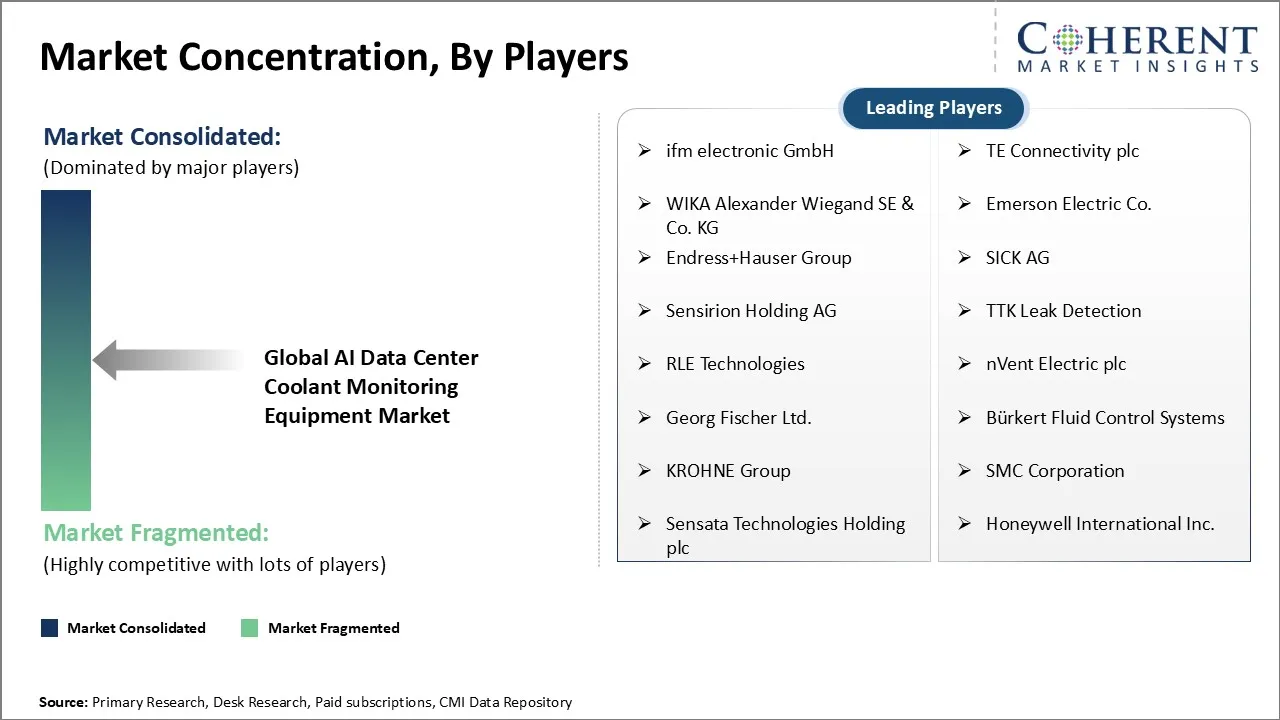
The global AI data center coolant monitoring equipment market looks fragmented at the sensing-device level, with industrial instrumentation groups, liquid-cooling OEMs, leak-detection specialists and controls integrators competing through different procurement routes. Advantage is based on proven measurement performance, documented coolant compatibility, predictable delivery and support during commissioning. Regional specialists compete by customization while the larger suppliers benefit from existing OEM qualifications, wide distribution and multinational service coverage.
Key focus areas include
- Measurement Accuracy and Stability: Suppliers compete on repeatability, response time, calibration stability and performance under varying coolant operating conditions.
- Product Customization: Liquid-cooling OEMs' choice is driven by application-specific sensor dimensions, connection configurations, and measurement ranges.
- Pricing and Total Ownership Cost: Equipment procurement is increasingly looking at costs associated with calibration, replacement, installation and maintenance, beyond initial sensor pricing.
- Manufacturing and Supply Reliability: The availability of qualified instrumentation components is important to the scheduled production and commissioning of cooling equipment.
- Quality Assurance and Certification: Documented testing, electrical safety conformity, ingress protection, and applicable industrial certifications all add to the eligibility of suppliers.
- OEM Supply Agreements: Long-term component qualifications and procurement relationships influence recurring equipment orders and supplier retention.
- Regional Technical Support: Local engineering expertise, troubleshooting capabilities, and timely replacement services help specialist manufacturers compete with multinational suppliers.
Market Report Scope
Global AI Data Center Coolant Monitoring Equipment Market Report Coverage | |||
Report Coverage | Details | ||
Base Year | 2025 | Market Size in 2026: | USD 164.6 Mn |
Historical Data For: | 2020 To 2024 | Forecast Period: | 2026 To 2033 |
Forecast Period 2026 To 2033 CAGR: | 26.70% | 2033 Value Projection: | USD 862.7 Mn |
Geographies covered: |
| ||
Segments covered: |
| ||
Companies covered: | ifm electronic GmbH, TE Connectivity plc, WIKA Alexander Wiegand SE & Co. KG, Emerson Electric Co., Endress+Hauser Group, SICK AG, Sensirion Holding AG, TTK Leak Detection, RLE Technologies, nVent Electric plc, Georg Fischer Ltd., Bürkert Fluid Control Systems, KROHNE Group, SMC Corporation, Sensata Technologies Holding plc, Honeywell International Inc. | ||
Growth Drivers: |
| ||
Restraints & Challenges: |
| ||
Analyst Opinion (Expert Opinion)
- Global AI data center coolant monitoring equipment market leadership is likely to shift to suppliers that can prove consistent instrument performance across successive generations of AI cooling infrastructure. Manufacturers that build repeatable qualification processes, provide reliable component availability, and offer long-term customer support have a better chance of winning recurring OEM business. Suppliers who compete primarily on the basis of low-cost individual devices may find it difficult to maintain preferred-vendor status as customers move toward centralized purchasing.
- Standardized component approval lists from major AI infrastructure buyers could change the nature of competition more profoundly than individual product improvements. Once an instrumentation design is embedded in a widely deployed cooling platform, there are significant qualification barriers to alternate suppliers. This may benefit manufacturers with good engineering documentation, regular production, and early access to development programs for cooling systems while limiting opportunities for unqualified replacement components.
- Manufacturers should concentrate on designs for field-replaceable sensors, robust industrial communication interfaces and qualification over commercial operating conditions. Design-in opportunities can be assisted by partnerships with CDU manufacturers and specialist cooling integrators. Suppliers should also establish alternative sources for critical sensing components and avoid excessive dependence on customized products with limited production volumes, uncertain lifecycle requirements, or insufficient customer qualification commitments.
Speak to the analyst
Want personalized insights?
Take the findings above to one of our principal consultants, or have the report rebuilt around the segments, geographies and competitors you actually track.
Market Segmentation
- Equipment Type Insights (Revenue, USD Mn, 2021 - 2033)
- Coolant Flow Sensors and Meters
- Temperature Monitoring Sensors
- Pressure and Differential Pressure Sensors
- Coolant Quality Monitoring Equipment
- Liquid Leak Detection Equipment
- Level Sensors and Integrated Monitoring Units
- Cooling Technology Insights (Revenue, USD Mn, 2021 - 2033)
- Direct-to-Chip Liquid Cooling
- Immersion Cooling
- Rear-Door Liquid Cooling
- Monitoring Location Insights (Revenue, USD Mn, 2021 - 2033)
- Rack-Level Monitoring
- Coolant Distribution Unit (CDU) Monitoring
- Facility Cooling Loop Monitoring
- System Integration Insights (Revenue, USD Mn, 2021 - 2033)
- OEM-Integrated Monitoring Equipment
- Standalone and Retrofit Monitoring Equipment
- Data Center Type Insights (Revenue, USD Mn, 2021 - 2033)
- Hyperscale AI Data Centers
- Colocation AI Data Centers
- Enterprise AI and HPC Data Centers
- Sales Channel Insights (Revenue, USD Mn, 2021 - 2033)
- Direct Sales to Equipment OEMs
- Direct Sales to Data Center Operators
- System Integrators and Distributors
- Regional Insights (Revenue, USD Mn, 2021 - 2033)
- North America
- U.S.
- Canada
- Latin America
- Brazil
- Argentina
- Mexico
- Rest of Latin America
- Europe
- Germany
- U.K.
- Spain
- France
- Italy
- Russia
- Rest of Europe
- Asia Pacific
- China
- India
- Japan
- Australia
- South Korea
- ASEAN
- Rest of Asia Pacific
- Middle East
- GCC Countries
- Israel
- Rest of Middle East
- Africa
- South Africa
- North Africa
- Central Africa
- North America
Sources
Primary Research Interviews
- Coolant monitoring equipment manufacturers, sensor technology specialists, and liquid-cooling system OEMs
- Data center cooling engineers, CDU manufacturers, procurement managers, and thermal management experts
Stakeholders
- Hyperscale AI data center operators, colocation providers, and HPC facilities
- Liquid-cooling equipment suppliers, system integrators, and monitoring solution providers
End-use Sectors
- Hyperscale AI data centers, colocation facilities, and enterprise AI infrastructure
- High-performance computing (HPC), cloud computing, and GPU-intensive server infrastructure
Regulatory and Industry Bodies
- American Society of Heating, Refrigerating and Air-Conditioning Engineers (ASHRAE)
- International Electrotechnical Commission (IEC), European Commission, and U.S. Department of Energy (DOE)
Databases
- International Energy Agency (IEA), Eurostat, and EU Database on Data Centres
- UN Comtrade, World Bank, and U.S. Energy Information Administration (EIA)
Magazines and Journals
- Data Center Dynamics, Data Centre Review, and IEEE Spectrum
- Applied Thermal Engineering and IEEE Transactions on Components, Packaging and Manufacturing Technology
Associations
- Open Compute Project (OCP)
- The Green Grid, AFCOM, and Uptime Institute
Public Domain Sources
- AI data center capacity, liquid-cooling deployment, and infrastructure investment disclosures
- Coolant sensor specifications, equipment pricing, OEM product portfolios, and company annual reports
Key Standards and Regulations
- ASHRAE TC 9.9 – Liquid Cooling Guidelines for Datacom Equipment Centers
- Open Compute Project (OCP) – Liquid Cooling Guidelines and Cold Plate Cooling Loop Requirements
- Commission Delegated Regulation (EU) 2024/1364 – Data Centre Sustainability Reporting
- Singapore Standard SS 726:2026 – Liquid Cooling in Tropical Data Centres
Proprietary Elements
- CMI Data Analytics Tool
- Proprietary research repository, supplemented by primary interviews, equipment pricing analysis, OEM procurement intelligence, liquid-cooling deployment assessments, and competitive benchmarking.
Get access to 250+ pages report
Every segment, forecast, competitor profile and data table behind the analysis above — available for instant download.
- ESOMAR Member
- ISO 9001:2015 Certified
- D-U-N-S Registered
- GDPR & CCPA Compliant
Frequently Asked Questions
The CAGR of global AI data center coolant monitoring equipment market is projected to be 26.70% from 2026 to 2033.
The global ai data center coolant monitoring equipment market is estimated to be valued at USD 164.6 Mn in 2026 and is expected to reach USD 862.7 Mn by 2033.
Major buyers include OEMs of liquid cooling equipment, coolant distribution unit manufacturers, rack system integrators, data center operators, and engineering contractors responsible for cooling infrastructure.
The key criteria for choosing a supplier are accuracy of measurement, compatibility with coolant, ability to integrate with system, reliability of product, certification requirements, pricing and after sales technical support.
New projects are more likely to focus on factory-integrated monitoring equipment, whereas existing facilities are considering retrofit compatibility, installation complexity, operational disruption, and lifecycle maintenance costs.
Supplier qualification requirements, OEM purchasing relationships, product pricing, distribution networks, customer procurement preferences, and competitor product positioning are essential for evaluating market-entry opportunities.
Rapid expansion of liquid-cooled AI data centers increasing demand for real-time coolant monitoring and growing need for leak prevention and precise coolant flow, temperature, and pressure monitoring are the major factor driving the growth of global ai data center coolant monitoring equipment market.