

Global Automotive Coolant Market Size and Forecast – 2026-2033
Coherent Market Insights estimates that the global automotive coolant market is expected to reach USD 9 Bn in 2026 and will expand to USD 11 Bn by 2033, registering a CAGR of 3.5% between 2026 and 2033.
Key Takeaways of the Automotive Coolant Market
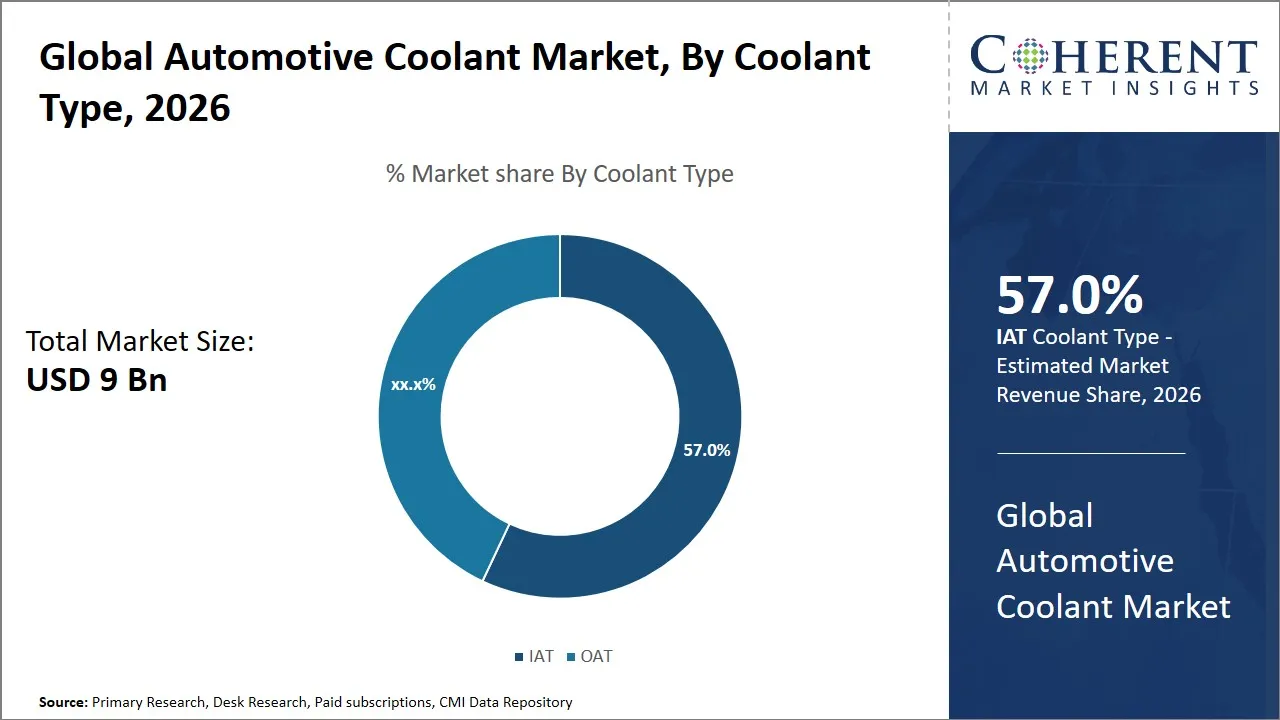
- The IAT segment is expected to account for 57% of the automotive coolant market share in 2026.
- The ethylene glycol segment is estimated to capture 53% of the market share in 2026.
- The passenger vehicles segment is projected to hold 59% share in 2026.
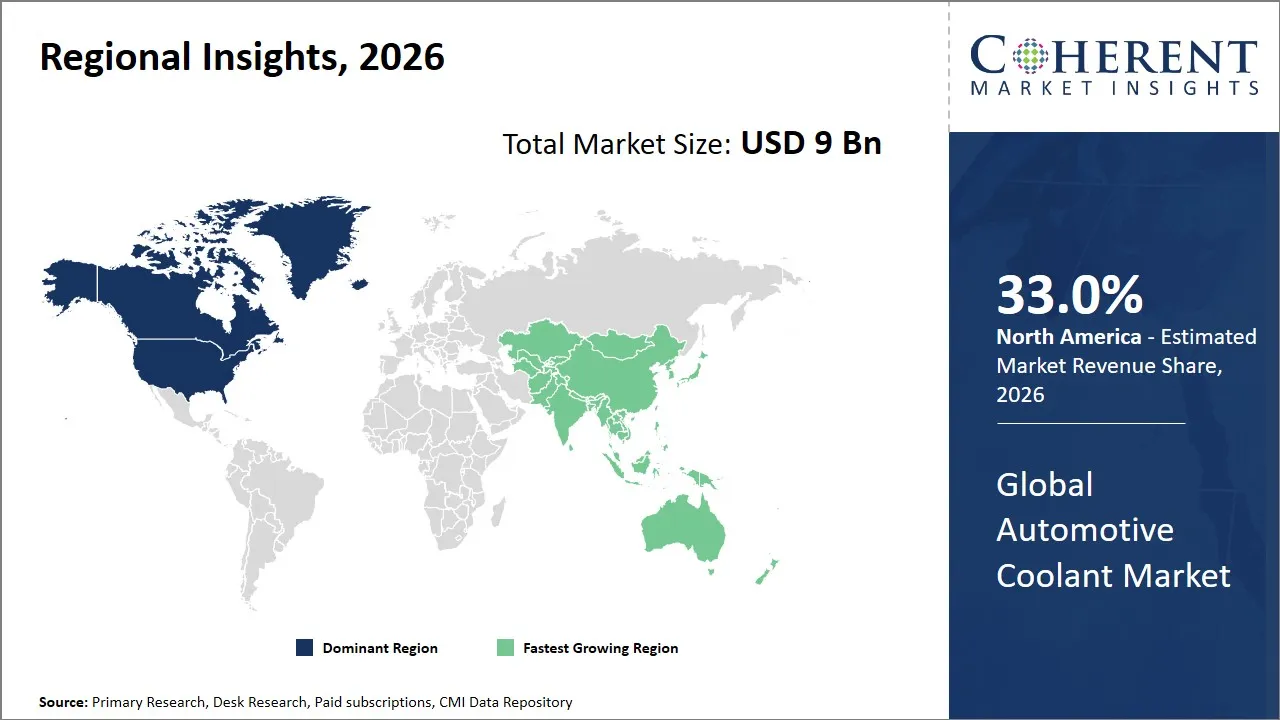
- North America will dominate the automotive coolant market in 2026 with an estimated 33% share.
- Asia Pacific will hold 28% share in 2026 and is expected to record the fastest growth over the forecast period.
Current Events and Its Impact
Current Events | Description and its Impact |
Prestone Platform Launch |
|
Segmental Insights
- Current Industry Events of 2026
- Market Size Estimation
- Regional Breakdown
- Competitive Landscape
- Customer Intelligence
- Segmental Analysis
- Pricing Analysis
- Key Market Drivers, Challenges & Future Trends
- Customized Insights Section
Why Does IAT Segment Dominate the Global Automotive Coolant Market?
The IAT segment is expected to account for 57.0% of the global automotive coolant market share in 2026. The growth is primarily because of its affordability and proven reliability. Over time, IAT coolants gained widespread adoption, remaining common among automakers and consumers alike. What supports their strong market presence is affordability relative to newer alternatives. With formulations based on silicate and phosphate additives, these coolants deliver basic anti-corrosion performance. Their low production expense translates into savings for budget-focused buyers. Especially in developing regions, financial considerations often shape fluid selection choices.
Ethylene Glycol Segment Dominates the Global Automotive Coolant Market
The ethylene glycol segment is expected to account for 53.0% of the global automotive coolant market share in 2026. Owing to reliable temperature regulation, compatibility with numerous engine fluids is maintained. High boiling points together with lower freezing limits ensure consistent performance year-round. Regardless of climate shifts, uninterrupted function follows from dependable thermal management. When heat levels stay even during operation phases, longevity of the engine remains unaffected.
For instance, on September 10, 2025, BASF announced the launch of its new GLYSANTIN ELECTRIFIED low electrical conductivity coolants (LECCs) to enhance the safety and stability of battery systems in electric vehicles.
(Source: basf.com)
Why are Passenger Vehicles the Most Crucial Vehicle Type in the Automotive Coolant Market?
The passenger vehicles segment is expected to account for 59.0% of the automotive coolant market share in 2026. A sharp increase in how many people own vehicles worldwide, together with more complicated designs in their cooling mechanisms. Behind this lies the overwhelming number of private automobiles on roads, dwarfing commercial fleets in scale. As cities grow larger, individual earnings climb, particularly where emerging markets see stronger consumer bases, buying personal transport becomes common. With that shift comes greater need for steady thermal management systems capable of preserving both powertrain efficiency and lifespan.
AI & Predictive Maintenance for Coolant Systems
Metric | Value |
Reduction in vehicle breakdown events | ~75 % |
Increase in asset availability | ~10 %–30 % |
Decrease in fuel costs | ~2 %–10 % |
Reduction in maintenance costs | ~5 %–10 % |
Potential maintenance cost reduction (simulated IoT/AI) | ~30 % |
Predictive maintenance market CAGR (AI vehicle maintenance) | ~11 %–18 % |
Regional Insights
North America Automotive Coolant Market Analysis and Trends
The North America region is projected to lead the market with a 33% share in 2026. Despite its maturity, the North American automotive coolant sector continues shifting under quiet pressures. High adoption persists across original equipment and repair markets alike. Vehicle numbers remain vast, including personal and work-focused models, which sustains baseline need. Cold climates add another layer of necessity. The U.S. holds primary position; Canada follows at a distance.
Replacement routines in service networks keep consumption stable. Products that last longer are becoming more common, including formulations based on organic acids or mixed systems, as well as variants intended to decompose faster in natural environments. Over time, these updated mixtures tend to require less frequent replacement, yet still shield engine components properly. Regulations continue tightening, particularly concerning effects on human health and ecosystems. Because of this pressure, manufacturers lean gradually toward using less hazardous substances. Innovation responds not only to traditional engines but also to powertrains found in electric-drive systems.
For instance, on October 29, 2025, Prestone launched Top-Off Antifreeze and Coolant Pouch, a one-quart flexible pouch format using 60% less plastic and optimized for ease-of-use, at AAPEX, 2025.
(Source: prestone.com)
Asia Pacific Automotive Coolant Market Analysis and Trends
The Asia Pacific region is expected to exhibit the fastest growth in the market contributing 28% share in 2026. Growth stems mainly from solid auto production networks, widespread OEM operations, alongside rising numbers of vehicles on roads. Manufacturing strength appears in nations such as China, Japan, South Korea, and India - each supported by resilient supply routes plus state-backed strategies favoring automotive progress and new technologies. Pressure to meet tighter emissions rules along with efforts to boost fuel economy pushes makers toward modern, environmentally safer cooling fluids. Demand also rises due to an expanding repair and maintenance sector across regions. BASF, Dow Inc., and Clarios of China are increasing research activity, adjusting chemical blends to suit local weather patterns while meeting specific automotive needs. Because export networks already exist across Asia Pacific, trade flows gain advantage - positioning the region at the center of both output and demand.
Global Automotive Coolant Market Outlook for Key Countries
Is China the Next Growth Engine for the Automotive Coolant Market?
Stability marks China’s vehicle coolant sector, rooted deeply in a wide-ranging automobile presence. Whether built for rugged hauls or city commutes, diverse operating conditions require tailored fluid formulations. Rather than relying on overseas sources, companies including Sinopec, units tied to BASF SE, and Dow Inc favor local manufacturing sites - speed matters here. Production stays close, response times shrink. Emission targets set by authorities push automakers toward advanced cooling fluids. As electric models spread quickly across cities, thermal control needs shift accordingly. Distribution strength across regions makes fast adaptation possible. Innovation now centers on fluids that match evolving powertrain demands.
Why is Japan Emerging as a Major Hub in the Automotive Coolant Market?
Still ahead in development, Japan hosts major car makers including Toyota, Honda, and Nissan. Due to strict rules on emissions and safety, high-grade fluids remain essential for reliable engine performance. Instead of traditional options, firms such as Mitsubishi Chemical Corporation and Fujifilm focus on eco-conscious blends suited for hybrids and EVs. These solutions break down more easily, posing less risk to health and nature. Ongoing maintenance routines, backed by regular check-ups, keep replacement cycles consistent. Exports play a role too, where existing distribution networks help maintain an edge abroad.
India Automotive Coolant Market Analysis and Trends
Facilitated by the rising number of vehicles produced and sold, India's market grows quickly as maintenance standards rise. Because conditions change, producers aim at coolants that last long while costing less across different vehicle types. From bikes to heavy trucks, compatibility drives design choices behind these fluids. Domestic firms such as Indian Oil Corporation Ltd. and Atul Ltd. enhance market accessibility through widespread distribution and tailored product offerings. Increasing government emphasis on emission control and fuels efficiency under initiatives such as BS-VI implementation boosts demand for high-performance coolants. Growth in the aftermarket is propelled by a large vehicle parc and consumer education on maintenance practices.
Brazil Automotive Coolant Market Analysis and Trends
Brazil witnesses rising need for automotive coolants as production rebounds alongside public works upgrades. While large firms such as Grupo Petrotemex hold strong positions, global names like Shell tailor offerings to match regional weather patterns along with fleet and personal car requirements. Regional trade deals together with regulations favoring eco-friendly materials encourage uptake of higher-grade fluids. Growing understanding of maintenance needs combined with structured repair networks sustains momentum in sector growth.
Mexico Automotive Coolant Market Analysis and Trends
Mexico advances through extensive automobile manufacturing driven by companies like General Motors, Volkswagen, and Nissan. With stricter environmental regulations emerging, demand grows steadily for reliable coolant solutions capable of meeting enhanced operational standards. Major chemical suppliers like BASF and Dow stay active here, adapting their fluid blends to endure extreme heat and serve diverse types of vehicles. Alongside factory output, maintenance-focused workshops and routine car care habits contribute meaningfully to ongoing coolant consumption. Supported by international trade frameworks, the country remains deeply woven into both vehicle logistics networks and associated component markets.
Market Players, Key Development, and Competitive Intelligence
Key Developments
- On June 5, 2025, Setco Automotive Limited launched its Automotive Water Pump, expanding its product portfolio into engine cooling solutions for Light Commercial Vehicles (LCVs) and Medium & Heavy Commercial Vehicles (MHCVs).
- On April 21, 2024, Schaeffler Korea, launched a new Schaeffler TruPower CV Coolant in Korean market. The commercial vehicle coolant comes in a 4-liter (L) specification and is available for purchase through 'Junwoo APS,' a specialized automotive aftermarket distributor. Schaeffler TruPower commercial vehicle coolant contains additives that prevent corrosion of the engine and internal parts, thus enhancing the engine's lifespan.
Top Strategies Followed by Global Automotive Coolant Market Players
Player Type | Strategic Focus | Example |
Established Market Leaders | Product Launch | On February 21, 2025, Shell Rotella introduced its Shell Rotella ELC HD, a high-performance extended life coolant designed to meet the rigorous demands of heavy-duty diesel, gasoline, natural gas and LNG engines. |
Mid-Level Players | Business Collaboration | On April 4, 2024, FUCHS SE and Mercedes-Benz Global Customer Service & Parts announced a strategic business partnership aimed at fostering innovation, technology, and sustainability in the automotive After-Sales. |
Small-Scale Players | Product Launch | On November 4, 2024, Old World Industries announced that its PEAK brand added PEAK TITANIUM, PEAK All Vehicles, PEAK ECOSHIELD, and PEAK Original Equipment Technology North American Purple to its robust product portfolio. |
Market Report Scope
Automotive Coolant Market Report Coverage
| Report Coverage | Details | ||
|---|---|---|---|
| Base Year: | 2025 | Market Size in 2026: | USD 9 Bn |
| Historical Data for: | 2020 To 2024 | Forecast Period: | 2026 To 2033 |
| Forecast Period 2026 to 2033 CAGR: | 3.5% | 2033 Value Projection: | USD 11 Bn |
| Geographies covered: |
| ||
| Segments covered: |
| ||
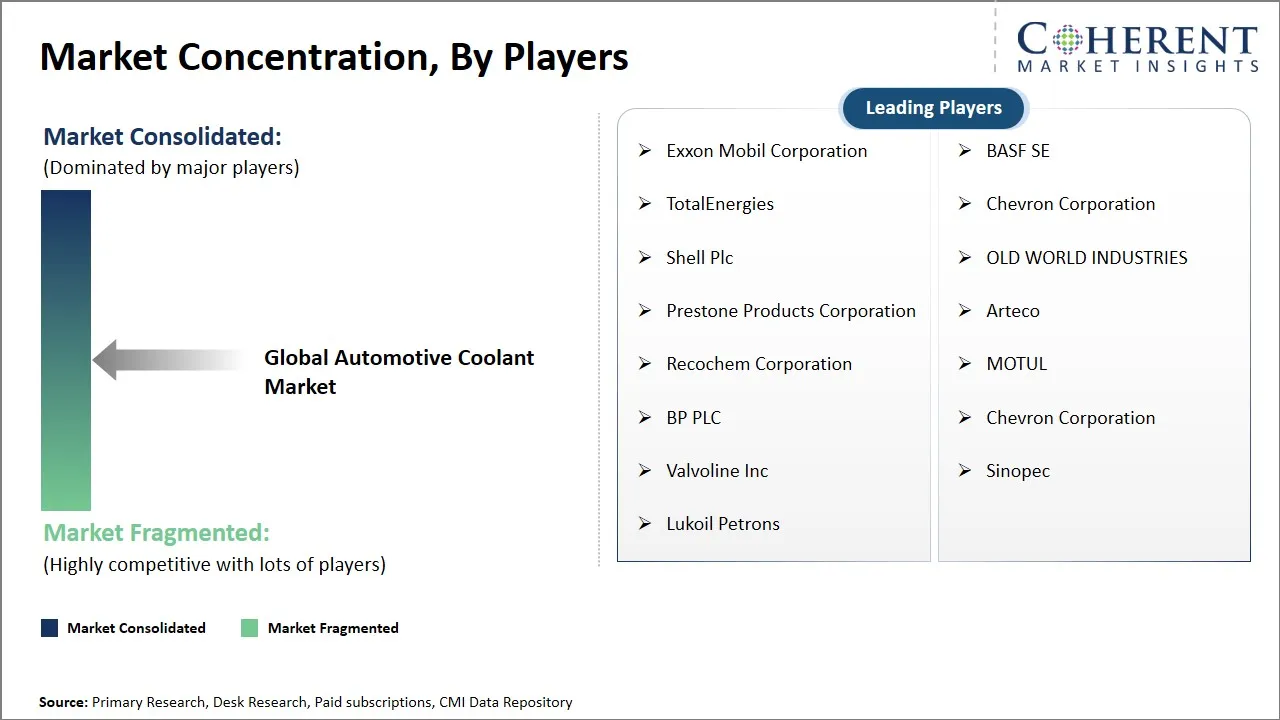
| Companies covered: | Exxon Mobil Corporation, BASF SE, TotalEnergies, Chevron Corporation, Shell Plc, OLD WORLD INDUSTRIES, Prestone Products Corporation, Arteco, Recochem Corporation, MOTUL, BP PLC, Chevron Corporation, Valvoline Inc, Sinopec, and Lukoil Petrons | ||
| Growth Drivers: |
| ||
| Restraints & Challenges: |
| ||
Global Automotive Coolant Market Dynamics
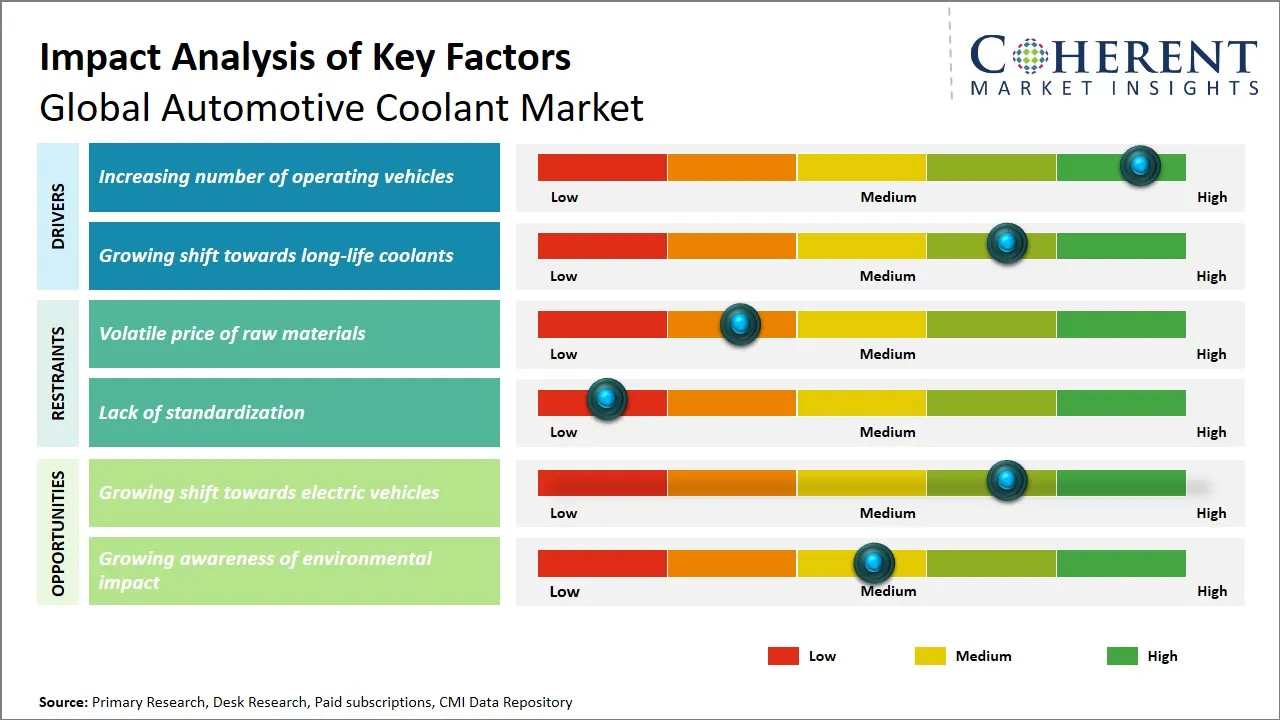
Global Automotive Coolant Market Driver - Increasing Number of Operating Vehicles
The rising number of operating commercial and passenger vehicles worldwide is a significant driver fueling the demand for automotive coolants. As vehicle ownership continues to grow, particularly in emerging economies due to urbanization, rising disposable incomes, and improved infrastructure, the need for efficient engine cooling systems becomes increasingly critical. Automotive coolants play a vital role in maintaining optimal engine temperatures, preventing overheating, and ensuring smooth vehicle performance, which directly correlates with the expanding vehicle base.
For instance, on January 14, 2026, Chinese electric vehicle maker Xpeng announced that it is targeting sales of 550,000-600,000 vehicles in 2026. That would translate into around a 28-40% increase from its sales in 2025, when the automaker delivered 429,445 cars, up 126% from 2024.
(Source: reuters.com)
Global Automotive Coolant Market Opportunity - Growing Shift Towards Electric Vehicles
A shift gaining speed worldwide toward electric vehicles opens new paths for makers of car coolants. With more people choosing these vehicles, pushed by tighter environmental technology and regulations, support from governments, and growing attention to ecological impact, the need for tailored cooling fluids grows stronger. While older models burn fuel inside engines, electric versions depend on large batteries and motors that warm up fast when running. Keeping them at safe temperatures demands smarter ways to control heat, directly affecting how well they work and how long they last.
For instance, on March 5, 2025, KGM introduced its newest midsize electric pickup, the Musso EV. This vehicle marks South Korea’s debut in the electric truck segment, blending car-like ride quality with cargo versatility. Powered by an 80.6 kWh LFP blade battery, it runs on a 152.2 kW motor; delivering around 249 miles per full charge in rear-wheel-drive form.
(Source: kgm-motors.co.uk)
Analyst Opinion (Expert Opinion)
- A shift marks the worldwide coolant sector, driven by growing numbers of vehicles on roads and increasing upkeep demands from older combustion-engine models. At the same time, changes emerge due to new cooling needs in electric powertrains. Though glycol-based fluids still lead in volume - particularly across developing regions - a move gains ground toward extended-life options, reduced electrical conductivity, and manufacturer-endorsed blends. Complexity in modern engines grows; so does the span between services. This shapes what coolants must now deliver.
- Looking ahead, success may hinge less on size and more on distinct tech capabilities, electric-vehicle-compatible offerings, also region-based manufacturing setups. Leading companies could prioritize next-generation battery materials, efficient power systems, environmentally matched compositions, coupled with alliances involving original equipment makers and fleet operators. Meanwhile, smaller or local firms might find openings in replacement markets - supplying tailored, economical coolants adapted to diverse vehicles spreading worldwide.
Speak to the analyst
Want personalized insights?
Take the findings above to one of our principal consultants, or have the report rebuilt around the segments, geographies and competitors you actually track.
Market Segmentation
- Coolant Type Insights (Revenue, USD Billion, 2021 - 2033)
- IAT
- OAT
- Chemical Type Insights (Revenue, USD Billion, 2021 - 2033)
- Ethylene Glycol
- Propylene Glycol
- Vehicle Type Insights (Revenue, USD Billion, 2021 - 2033)
- Passenger Vehicles
- Commercial Vehicles
- Regional Insights (Revenue, USD Billion, 2021 - 2033)
- North America
- U.S.
- Canada
- Latin America
- Brazil
- Argentina
- Mexico
- Rest of Latin America
- Europe
- Germany
- U.K.
- Spain
- France
- Italy
- Russia
- Rest of Europe
- Asia Pacific
- China
- India
- Japan
- Australia
- South Korea
- ASEAN
- Rest of Asia Pacific
- Middle East
- GCC Countries
- Israel
- Rest of Middle East
- Africa
- South Africa
- North Africa
- Central Africa
- North America
- Key Players Insights
- Exxon Mobil Corporation
- BASF SE
- TotalEnergies
- Chevron Corporation
- Shell Plc
- OLD WORLD INDUSTRIES
- Prestone Products Corporation
- Arteco
- Recochem Corporation
- MOTUL
- BP PLC
- Chevron Corporation
- Valvoline Inc
- Sinopec
- Lukoil Petrons
Sources
Primary Research Interviews
- Automotive coolant manufacturers and suppliers
- Automotive OEMs (Original Equipment Manufacturers)
- Automotive aftermarket distributors and retailers
- Automotive maintenance and service providers
Databases
- Ward's Automotive Database
- Euromonitor International Database
Magazines
- Automotive News
- Ward's Auto World
- Automotive Engineering International
- Motor Age Magazine
Journals
- SAE International Journal of Fuels and Lubricants
- International Journal of Automotive Technology
- Journal of Automotive Engineering
Newspapers
- Automotive News Europe
- Automotive News China
- The Wall Street Journal (Automotive Section)
- Financial Times (Automotive Industry Coverage)
- Reuters (Automotive Industry News)
Associations
- Society of Automotive Engineers (SAE)
- Automotive Aftermarket Suppliers Association (AASA)
- Motor & Equipment Manufacturers Association (MEMA)
- International Association of Automotive Manufacturers (OICA)
- Automotive Parts Manufacturers Association (APMA)
Public Domain Sources
- U.S. Environmental Protection Agency (EPA) automotive regulations
- European Chemicals Agency (ECHA) automotive chemical guidelines
- Company annual reports and investor presentations
- Government automotive industry statistics and reports
- Patent databases for automotive coolant technologies
Proprietary Elements
- CMI Data Analytics Tool
- Proprietary CMI Existing Repository of information for last 8 years
Get access to 250+ pages report
Every segment, forecast, competitor profile and data table behind the analysis above — available for instant download.
- ESOMAR Member
- ISO 9001:2015 Certified
- D-U-N-S Registered
- GDPR & CCPA Compliant
Missing comfort of reading report in your local language? Find your preferred language:
Transform your Strategy with Exclusive Trending Reports
Frequently Asked Questions
The global automotive coolant market stood at USD 9 Bn in 2026 and is expected to reach USD 11 Bn by 2033.
The CAGR of global automotive coolant market is projected to be 3.5% from 2026 to 2033.
Increasing number of operating vehicles and growing shift towards long-life coolants are the major factors driving the growth of the global automotive coolant market.
Volatile price of raw materials and lack of standardization are the major factors hampering the growth of the global automotive coolant market.
In terms of coolant type, IAT is estimated to dominate the market revenue share in 2026.
Yes, the aftermarket is critical as coolants require periodic replacement throughout a vehicle’s lifespan.
Cold climates increase coolant demand due to the need for freeze protection and higher replacement frequency.