

Global AI Factory Digital Twin Platform Market Size and Forecast – 2026 To 2033
The global AI factory digital twin platform market is expected to grow from USD 0.70 Bn in 2026 to USD 4.76 Bn by 2033, at a compound annual growth rate (CAGR) of 31.5% over 2026–2033. An AI factory is a data center built to train and run AI models at scale, and a single campus can now draw hundreds of megawatts. Getting one built has become a race for power. NVIDIA estimates that more than USD 300 billion of equipment sits in backlogs and over 200 gigawatts of projects are waiting in U.S. grid interconnection queues. With that much capital waiting, builders cannot afford design mistakes. AI factory digital twin platforms let them model the whole facility, from GPU racks and cooling loops to the grid connection, in software before construction starts, and keep that model running once the site is live. These platforms form a fast-growing part of the wider Digital Twin Market and serve the same build-out that drives the Data Center Infrastructure Market.
The tools are spreading along the whole build chain. In March 2026, Procore reported it is integrating NVIDIA Omniverse libraries and the Omniverse DSX Blueprint into the Procore Platform to create a continuous digital thread across the construction lifecycle. In the same month, Vertiv reported it is using the blueprint to build Vertiv OneCore Rubin DSX, a prefabricated, converged data center infrastructure solution designed to speed up AI factory deployment and raise AI output per watt
Key Takeaways of the Global AI Factory Digital Twin Platform Market
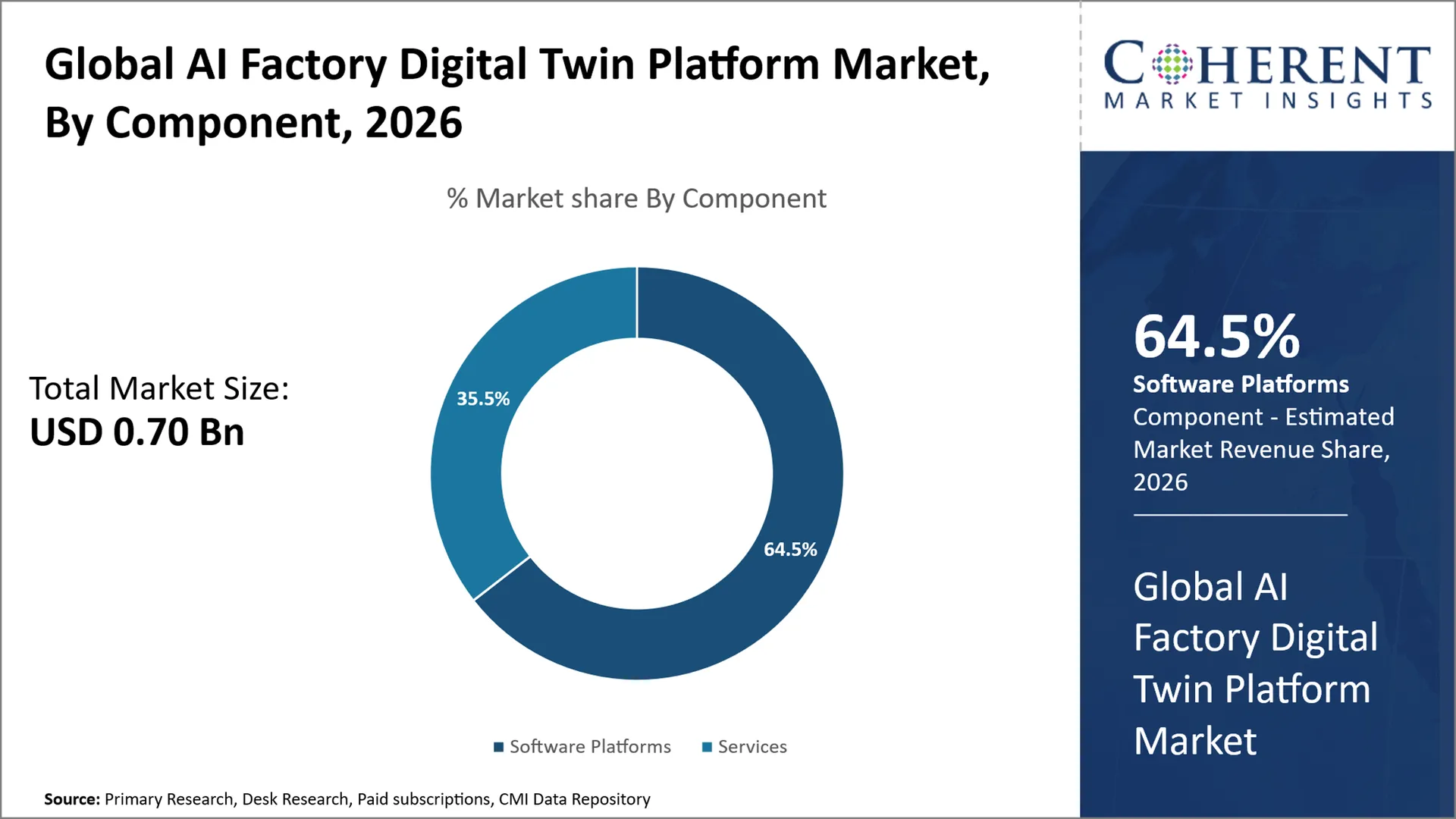
- The software platforms segment is expected to account for 64.5% of the global AI factory digital twin platform market share in 2026. Modeling environments, physics solvers and twin management tools are what every AI factory project licenses first, so software takes the largest share of spending. In March 2026, Dassault Systèmes reported it is integrating NVIDIA’s Vera Rubin DSX reference design and Omniverse DSX Blueprint into its model-based systems engineering platform, powered by CATIA software, to build the Virtual Twin of AI Factory.
- The design and planning segment is expected to account for 47.6% of the market share in 2026. Most twins are built to settle layout, power and thermal questions before a site breaks ground, when changes cost the least. In March 2026, Cadence reported it is integrating simulation-ready models of the NVIDIA GB300 NVL72 system into its Reality Data Center Digital Twin Platform to simulate thermal and fluid behavior for AI factory design.
- The cloud-based segment is expected to hold 46.2% of the deployment mode segment in 2026. Builders want to run large simulations on demand without buying GPU clusters just for modeling. In March 2026, NVIDIA said CoreWeave is using NVIDIA DSX Air to build and test digital twins of AI factories in the cloud, running operational rehearsals well before hardware arrives.
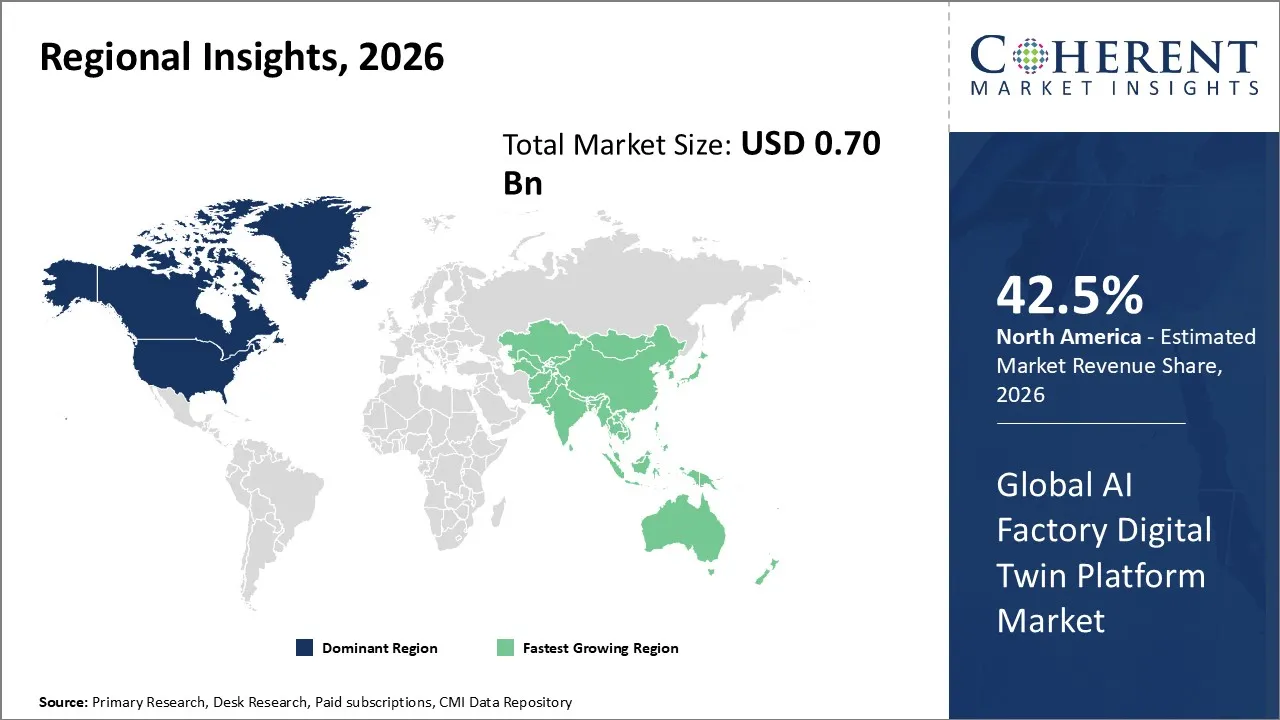
- North America is expected to dominate the AI factory digital twin platform market in 2026, with a share of 42.5%. The region has the largest pipeline of gigawatt-scale AI campuses and is home to most platform vendors. In March 2026, Switch reported it is building its EVO AI Factories and LDC EVO operating system with the Omniverse DSX Blueprint, using real-time telemetry to keep its digital twins continuously updated.
- Asia Pacific is expected to account for 22.9% share in 2026 and to be the fastest-growing region. Sovereign AI programs and new GPU cloud providers across the region are adding capacity quickly and adopting simulation-first deployment. In March 2026, NVIDIA reported Siam.AI, Thailand’s largest AI cloud provider, had accelerated its infrastructure deployment with NVIDIA DSX Air.
Segmental Insights
Why Do Software Platforms Dominate the Global AI Factory Digital Twin Platform Market?
In terms of component, software platforms are expected to account for 64.5% of the global AI factory digital twin platform market share in 2026. A working AI factory twin needs a 3D modeling environment, usually built on OpenUSD, physics solvers for airflow, liquid cooling and electrical load flow, compute and network simulators, and a data layer that streams live telemetry back into the model. Each of these is licensed as software, and large operators often buy several tools to cover different engineering teams. Most licenses are subscriptions that renew every year, so spending builds as each new site comes online.
Platforms are also becoming broader. Vendors are linking twins to the engineering tools teams already use, so that a change to a bill of materials or a cooling layout flows straight into the simulation.
In March 2026, PTC reported it is integrating the Omniverse DSX Blueprint into its Windchill product lifecycle management solution for DSX Accelerator, connecting engineering and product design data with real-time simulation and managing bills of materials across partners and suppliers.
- Current Industry Events of 2026
- Market Size Estimation
- Regional Breakdown
- Competitive Landscape
- Customer Intelligence
- Segmental Analysis
- Pricing Analysis
- Key Market Drivers, Challenges & Future Trends
- Customized Insights Section
Why Do Cloud-Based Platforms Lead the Deployment Mode Segment?
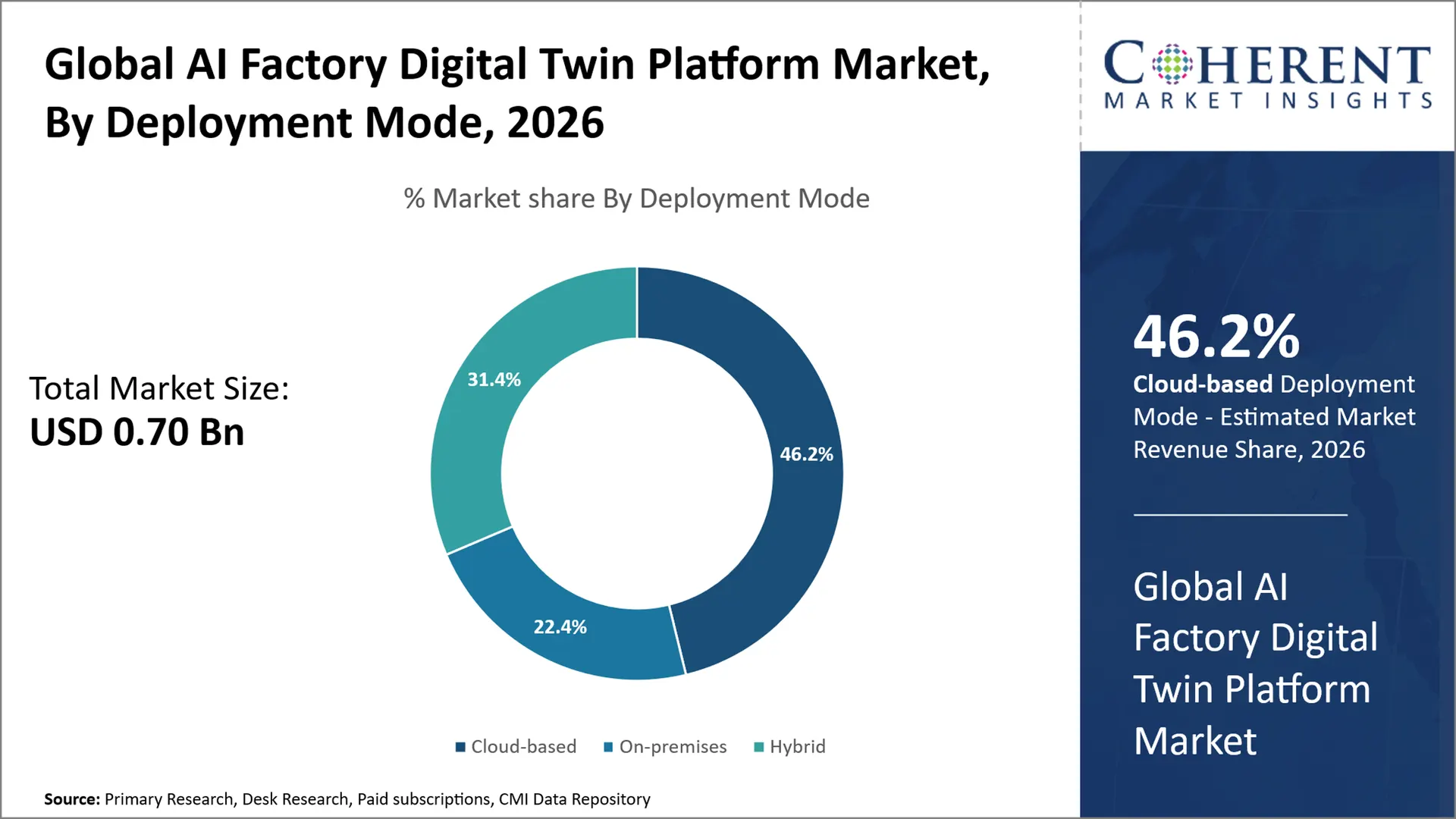
In terms of deployment mode, cloud-based platforms are expected to account for 46.2% of the global AI factory digital twin platform market share in 2026. Simulating a full AI factory, down to individual GPUs and network switches, takes a large amount of computing power. Running that work in the cloud lets builders scale simulations up for a design sprint and back down afterwards, rather than buying modeling hardware that sits idle. Cloud delivery also lets owners, engineering firms, equipment makers and network integrators work on the same model from different locations.
On June 1, 2026, BE Networks and IREN reported they will use NVIDIA DSX Air to simulate and validate the network architecture for IREN’s planned deployment of more than 50,000 NVIDIA Blackwell Ultra GPUs, working on a production-representative digital twin of IREN’s AI cloud environment before the physical infrastructure is installed.
Why Does Design and Planning Lead the Application Segment?
In terms of application, design and planning is expected to account for 47.6% of the global AI factory digital twin platform market share in 2026. An AI factory’s biggest decisions are made before construction: where racks go, how power is distributed, how much cooling the site needs and how it connects to the grid. Mistakes here are expensive, because a gigawatt-scale campus takes years to build and its major equipment is ordered far in advance. A twin lets engineers test many combinations of rack density, coolant temperature and power layout in weeks, and settle on a design that can carry more than one generation of GPUs.
Equipment makers are now packaging this design knowledge into reusable reference designs.
In March 2026, Trane Technologies optimized its thermal management reference design for AI factories, which it describes as industry-first, and introduced two new designs. The company is using the Omniverse DSX Blueprint to optimize thermal management for gigawatt-scale AI factories and reduce cooling plant power use
Current Events and their Impact
Current Events | Description and its Impact |
U.S. Executive Order on Accelerating Federal Permitting of Data Center Infrastructure (July 2025) |
|
EU Data Centre Energy Reporting under the Energy Efficiency Directive (2024 onwards) |
|
AI Factory Digital Twin Platform Market Dynamics
Market Drivers
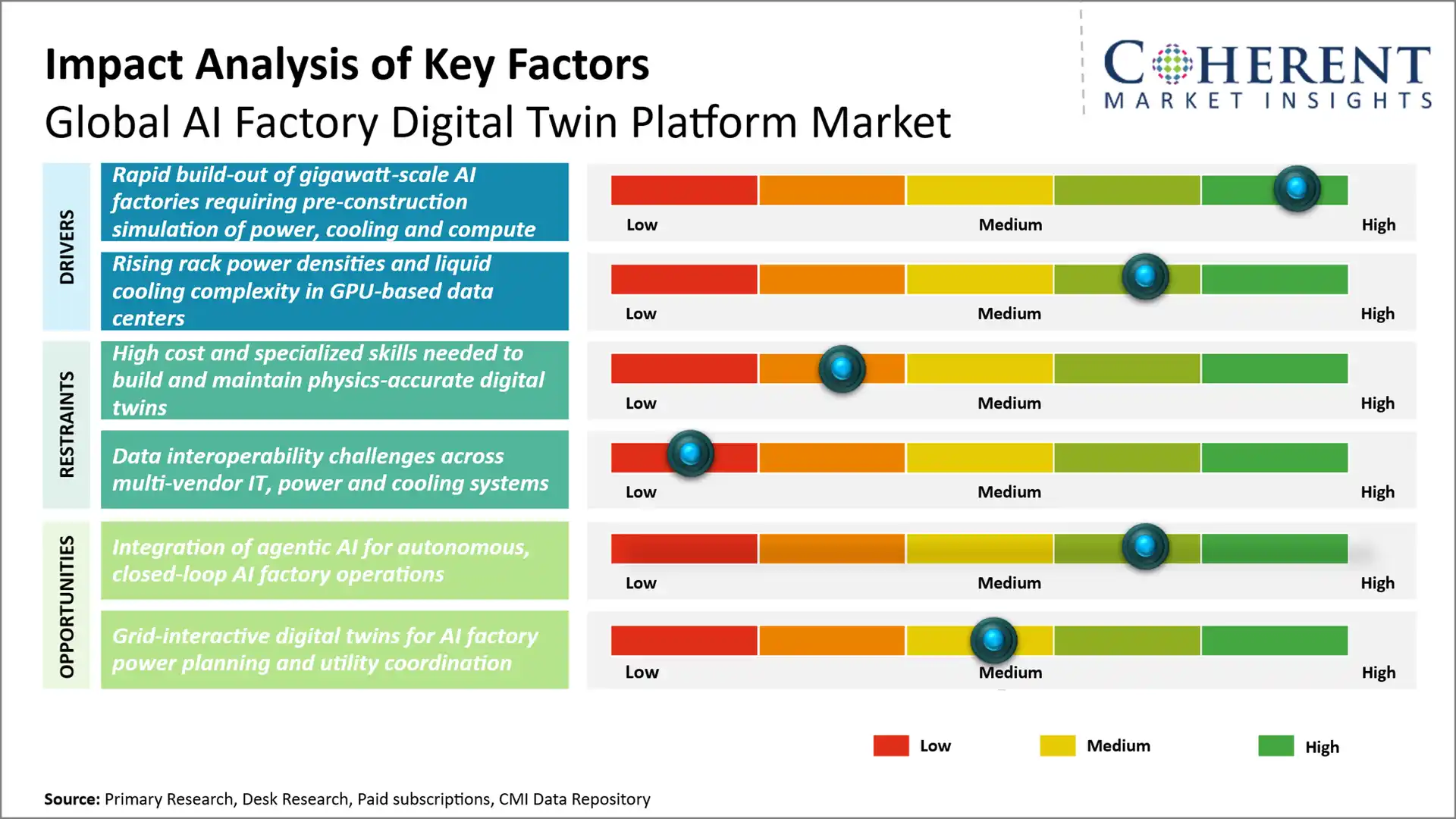
- Rapid build-out of gigawatt-scale AI factories requiring pre-construction simulation of power, cooling and compute: AI factories grow larger and more expensive with every GPU generation. A single campus can draw hundreds of megawatts, and its compute, network, power and cooling are designed to work as one system. Older design methods split this work across separate teams and drawing sets, so conflicts often appear only during construction or commissioning, when they are slowest and costliest to fix. A digital twin brings every discipline into one model, so clashes and capacity gaps show up on screen instead of on site. Builders can also reuse a validated design across several campuses, which shortens each new project. For developers racing to bring capacity online, the time saved turns directly into earlier revenue.
- On March 16, 2026, Jacobs released a Data Center Digital Twin solution developed with the NVIDIA Omniverse DSX Blueprint. It combines a standardized reference design for a gigawatt-scale AI data center with a virtual environment and simulations of compute, power and cooling systems, and its first module is available to owners and operators.
- Rising rack power densities and liquid cooling complexity in GPU-based data centers: Each new GPU system packs more power into a single rack, and air cooling can no longer keep up. Liquid cooling brings its own challenges, because coolant flow, temperature and pressure must stay within tight limits while GPU workloads swing up and down within seconds. A small mismatch can cause throttling or force operators to hold back power they could otherwise sell as compute. Digital twins model these interactions before and after deployment, so operators can size cooling plants correctly and tune how they respond to load spikes.
- In March 2026, Phaidra reported it had integrated NVIDIA DSX Max-Q into its self-learning AI agent for liquid cooling management. NVIDIA reported that the agent delivers about 10% more compute by reducing cooling spikes while maintaining safety.
Emerging Trends
- Equipment makers are publishing simulation-ready models of their products: Power and cooling suppliers now ship digital versions of their equipment alongside the hardware. These SimReady assets carry accurate geometry and performance data, so designers can place real generators, switchgear and chillers into a twin instead of rough placeholders. In March 2026, Eaton collaborated with NVIDIA to unveil its Beam Rubin DSX platform and is providing SimReady assets of its electrical equipment to DSX design and engineering companies.
Impact: Twins are more accurate from the first day, and less modeling time goes into recreating equipment that already exists.
Relevance to the market: This favors equipment makers with strong digital engineering teams and makes their products easier to specify in AI factory designs.
- Digital twins are expanding from the facility into the IT software stack: Early AI factory twins focused on the building, its power and its cooling. Platforms now also simulate the servers, networks, orchestration software and security policies inside the building, so software teams can test their stacks before hardware is installed. In March 2026, NVIDIA said Hydra Host is using DSX Air to speed up development of Brokkr, its AI factory operating system for bare-metal GPU provisioning, which is used by dozens of GPU deployments worldwide.
Impact: Software bring-up starts months earlier, and fewer problems surface when the first racks are powered on.
Relevance to the market: This draws network, orchestration and security vendors into the market and raises spending on simulation software and integration services.
Regional Insights
Why Does North America Lead the Global AI Factory Digital Twin Platform Market?
North America is expected to account for a market share of 42.5% in 2026. The U.S. has the largest number of gigawatt-scale AI campuses under construction, backed by hyperscale cloud providers, GPU cloud companies and large colocation operators. Most leading platform and simulation vendors are based in the region or sell heavily into it, and engineering firms there were early adopters of simulation-first design. Tight power supply in major data center hubs also makes accurate power modeling a priority, because operators must show utilities exactly how and when a site will draw electricity.
Why Is Asia Pacific the Fastest-Growing Region in the AI Factory Digital Twin Platform Market?
Asia Pacific is expected to account for 22.9% of the global market in 2026 and to register the fastest growth over the forecast period, at an estimated 36.4% CAGR (CMI estimate, based on the region’s pipeline of announced AI capacity relative to its current share). Governments in South Korea, Japan, India and Singapore are funding sovereign AI capacity, and new GPU cloud providers are building large clusters across Southeast Asia. Taiwan and South Korea also anchor much of the server, cooling and power equipment supply chain for AI factories, so many equipment makers there are building digital models of their products. Hot and humid climates in much of the region make thermal modeling especially valuable, because cooling takes a larger share of each site’s power.
Global AI Factory Digital Twin Platform Market Outlook for Key Countries
Is the U.S. Driving AI Factory Digital Twin Adoption in North America?
The U.S. AI factory digital twin platform market is projected to reach USD 0.27 Bn in 2026, the largest of any country. The country has the deepest pipeline of multi-gigawatt AI campuses, and developers increasingly treat a validated twin as part of the project from the start. In March 2026, NVIDIA reported Nscale and Caterpillar are bringing DSX Vera Rubin reference designs to a multi-gigawatt site in West Virginia, one of the largest AI factories in the world.
Is China Following Its Own Path in Asia Pacific?
China’s AI factory digital twin platform market is projected to reach USD 0.05 Bn in 2026, the largest in Asia Pacific. Chinese internet companies and state programs are building large AI computing clusters. U.S. export controls limit access to the most advanced GPUs, so Chinese operators rely more on domestic accelerators and local simulation tools. This keeps China’s share of platform spending smaller than its overall data center build-out would suggest.
Germany AI Factory Digital Twin Platform Market Analysis and Trends
Germany’s AI factory digital twin platform market is projected to reach USD 0.04 Bn in 2026 The country combines deep industrial software and automation expertise with rising demand for sovereign AI capacity, and its engineering firms and equipment makers are heavy users of simulation tools. In March 2026, NVIDIA reported Siemens is developing a framework that balances high-density compute with power, cooling and automation for AI infrastructure.
Japan AI Factory Digital Twin Platform Market Analysis and Trends
Japan’s AI factory digital twin platform market is projected to reach USD 0.03 Bn in 2026. The government is supporting domestic AI computing capacity, and the country’s telecom and IT groups are building new AI data centers. Limited land and power in major cities push operators to plan dense, efficient sites, which suits detailed simulation. Japanese operators tend to adopt new tools in careful stages, so growth here is steady rather than fast.
South Korea AI Factory Digital Twin Platform Market Analysis and Trends
South Korea’s AI factory digital twin platform market is projected to reach USD 0.02 Bn in 2026. On June 7, 2026, NVIDIA and NAVER announced that NAVER will expand its sovereign AI infrastructure on the NVIDIA DSX platform, starting at 55 megawatts at its GAK Sejong data center and moving toward gigawatt scale. The country is also home to major memory and electronics makers whose products go into AI factories.
Global AI Factory Digital Twin Platform Market – Key Digital Twin Platforms Used in AI Factory Design and Operations
Platform | Producer | Main Features and Uses |
Omniverse DSX Blueprint | NVIDIA | Open framework for building physically accurate digital twins of AI factories on OpenUSD; brings power, cooling, networking and operations into one simulation |
DSX Air | NVIDIA | Software-as-a-service platform that simulates AI factory compute, networking, storage, orchestration and security before hardware is deployed |
Reality Digital Twin Platform | Cadence | Simulates airflow, thermal and fluid behavior in data centers; integrated with the Omniverse DSX Blueprint |
ETAP electrical digital twin | Schneider Electric | Models power systems from grid to rack for protection coordination, fault and arc-flash studies, and switching scenarios |
How Are Grid-Interactive Digital Twins Creating New Growth Opportunities in the AI Factory Digital Twin Platform Market?
Power is now the hardest resource for AI factories to secure. Utilities are cautious about approving large new connections because they cannot be sure how a data center will behave during peak demand or grid stress. A twin that models both the AI factory and its grid connection can show how much load a site can shift or shed, and how quickly. That creates room for a new product: software that turns an AI factory into a flexible grid resource. A supplier that can prove this behavior in simulation and then deliver it in operation can help customers connect sooner, which matters more to an AI factory developer than almost any efficiency gain. Because utilities and regulators need to trust the model, early movers with proven results are likely to keep their lead.
In March 2026, NVIDIA reported Emerald AI is integrating DSX Flex with its Conductor platform to help AI factories manage power in real time, turning demand up or down on command and coordinating flexible load with new dedicated generation.
Market Players, Key Development, and Competitive Intelligence
Key Developments
- In October 2025, Vertiv announced gigawatt-scale reference architectures for the NVIDIA Omniverse DSX Blueprint.
- In June 2025, NVIDIA expanded its Omniverse Blueprint for AI factory digital twins with new integrations from Delta Electronics, Jacobs and Siemens, joining existing partners Cadence, Schneider Electric with ETAP, and Vertiv.
- In March 2025, Schneider Electric and ETAP introduced a digital twin, built with NVIDIA Omniverse, that simulates AI factory power requirements from the grid down to the chip level
Competitive Landscape
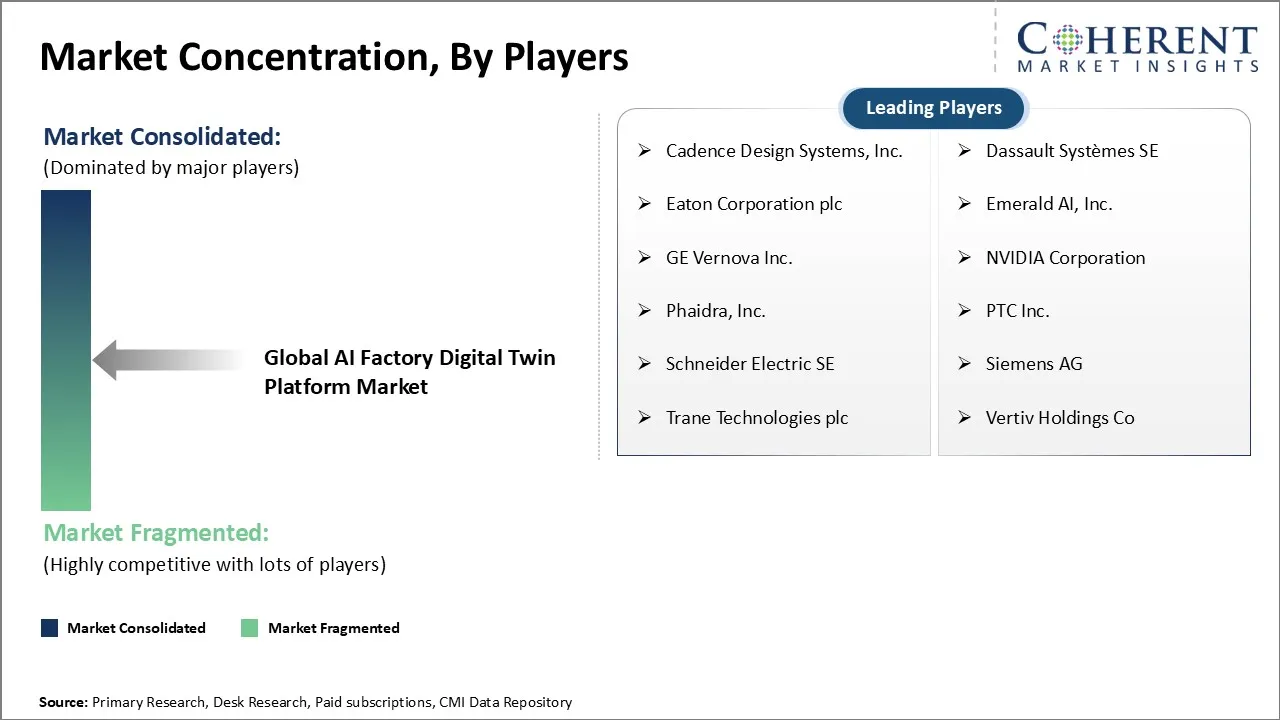
The market is moderately consolidated and shared between three groups that increasingly work together. Platform and simulation software companies such as NVIDIA, Cadence Design Systems, Dassault Systèmes, Siemens and PTC provide the modeling environments, physics solvers and engineering data links. Power, cooling and grid equipment makers such as Schneider Electric, Vertiv, Eaton, Trane Technologies and GE Vernova supply simulation-ready models of their equipment and their own electrical and thermal twins. AI operations specialists such as Phaidra and Emerald AI build agents that are trained in the twin and then run power and cooling at live sites. Much of the market is organized around the NVIDIA Omniverse DSX Blueprint and OpenUSD, so competition centers on depth of physics accuracy, quality of equipment models, links to live site data and the ability to support a customer from design through operations. Strong engineering credentials and long qualification cycles make it hard for new entrants to break in.
Top Companies and Notable Products in the AI Factory Digital Twin Platform Market
Company | Notable Product | Key Features |
Vertiv Holdings Co | Vertiv SmartRun digital twin | Configurable, simulation-ready model of Vertiv’s overhead converged power, cooling and controls infrastructure, integrated with the Omniverse DSX Blueprint |
Schneider Electric SE | EcoStruxure IT | Data center infrastructure management software for monitoring power, cooling and IT assets across sites |
Eaton Corporation plc | Brightlayer Data Centers suite | Software that monitors and manages electrical power and IT assets in data centers |
GE Vernova Inc. | GridOS | Grid orchestration software that helps utilities plan and operate networks with large new loads |
Siemens AG | Simcenter | Simulation portfolio, including computational fluid dynamics for thermal and airflow analysis of equipment and facilities |
Market Report Scope
Global AI Factory Digital Twin Platform Market Report Coverage | |||
Report Coverage | Details | ||
Base Year | 2025 | Market Size in 2026: | USD 0.70 Bn |
Historical Data For: | 2020 To 2024 | Forecast Period: | 2026 To 2033 |
Forecast Period 2026 To 2033 CAGR: | 31.50% | 2033 Value Projection: | USD 4.76 Bn |
Geographies covered: |
| ||
Segments covered: |
| ||
Companies covered: | Cadence Design Systems, Inc., Dassault Systèmes SE, Eaton Corporation plc, Emerald AI, Inc., GE Vernova Inc., NVIDIA Corporation, Phaidra, Inc., PTC Inc., Schneider Electric SE, Siemens AG, Trane Technologies plc, Vertiv Holdings Co | ||
Growth Drivers: |
| ||
Restraints & Challenges: |
| ||
Analyst Opinion (Expert Opinion)
- Software leads, but operations is where the next wave of spending sits. Software platforms make up 64.5% of spending in 2026, against 35.5% for services, and design and planning holds 47.6% of application spending because builders want to settle the design before construction. That balance will shift as the first wave of AI factories comes online and owners start using their twins to run sites day to day. Operations and optimization is the fastest-growing application, at an estimated 35.9% CAGR, as operators connect live telemetry, AI agents and grid signals to the model. Services will stay large because every site still needs custom modeling. Buyers want a twin that keeps working after handover, so suppliers offering the platform, equipment models and ongoing support together tend to win the larger contracts.
- Growth is strongest where AI factory construction is fastest, with two main risks. North America holds 42.5% of the market in 2026, while Asia Pacific, at 22.9%, grows fastest as sovereign AI programs and GPU cloud providers scale up. The first risk is cost and skills: a physics-accurate twin needs scarce specialists in thermal, electrical and network modeling, so smaller operators may limit twins to the design phase. The second risk is interoperability. Most current platforms are built around NVIDIA’s OpenUSD-based Omniverse tools, and operators with mixed-vendor equipment or other accelerators face extra integration work. Vendors that support open formats across hardware ecosystems are the least exposed.
Speak to the analyst
Want personalized insights?
Take the findings above to one of our principal consultants, or have the report rebuilt around the segments, geographies and competitors you actually track.
Market Segmentation
- Component Insights (Revenue, USD Billion, 2021 - 2033)
- Software Platforms
- Services
- Application Insights (Revenue, USD Billion, 2021 - 2033)
- Design and Planning
- Construction and Commissioning
- Operations and Optimization
- Deployment Mode Insights (Revenue, USD Billion, 2021 - 2033)
- Cloud-based
- On-premises
- Hybrid
- End User Insights (Revenue, USD Billion, 2021 - 2033)
- Hyperscale Cloud Providers
- Colocation Providers
- GPU Cloud (Neocloud) Providers
- Sovereign and Government AI Facilities
- Enterprise AI Facilities
- Regional Insights (Revenue, USD Billion, 2021 - 2033)
- North America
- U.S.
- Canada
- Latin America
- Brazil
- Argentina
- Mexico
- Rest of Latin America
- Europe
- Germany
- U.K.
- Spain
- France
- Italy
- Russia
- Rest of Europe
- Asia Pacific
- China
- India
- Japan
- Australia
- South Korea
- ASEAN
- Rest of Asia Pacific
- Middle East
- GCC Countries
- Israel
- Rest of Middle East
- Africa
- South Africa
- North Africa
- Central Africa
- North America
- Key Players Insights
- Cadence Design Systems, Inc.
- Dassault Systèmes SE
- Eaton Corporation plc
- Emerald AI, Inc.
- GE Vernova Inc.
- NVIDIA Corporation
- Phaidra, Inc.
- PTC Inc.
- Schneider Electric SE
- Siemens AG
- Trane Technologies plc
- Vertiv Holdings Co
Sources
Primary Research Interviews
- AI Factory and Data Center Developers
- Hyperscale and GPU Cloud Operators
- Power, Cooling and Grid Equipment Manufacturers
- Simulation and Engineering Software Vendors
- Engineering, Procurement and Construction Firms
Magazines
- Data Center Dynamics
- Data Center Frontier
- Data Center Knowledge
- EE Times
- IEEE Spectrum
Journals
- IEEE Access
- IEEE Transactions on Industrial Informatics
- Applied Thermal Engineering
- Energy and Buildings
Associations
- Alliance for OpenUSD (AOUSD)
- Open Compute Project (OCP)
- ASHRAE (Technical Committee 9.9)
- The Green Grid
- Digital Twin Consortium
Public Domain Sources
- European Commission: Directive (EU) 2023/1791 on energy efficiency and Delegated Regulation (EU) 2024/1364
- The White House: Executive Order on Accelerating Federal Permitting of Data Center Infrastructure, July 2025
- ISO/IEC 30173:2023: Digital twin – Concepts and terminology
- ASHRAE: Thermal Guidelines for Data Processing Environments
- U.S. Securities and Exchange Commission (SEC): Company annual filings
- Company press releases
Proprietary Elements
- CMI Data Analytics Tool
- Proprietary CMI Existing Repository of information for last 10 years
Get access to 250+ pages report
Every segment, forecast, competitor profile and data table behind the analysis above — available for instant download.
- ESOMAR Member
- ISO 9001:2015 Certified
- D-U-N-S Registered
- GDPR & CCPA Compliant
Frequently Asked Questions
The global AI factory digital twin platform market is estimated to be valued at USD 0.70 Bn in 2026 and is expected to reach USD 4.76 Bn by 2033.
The CAGR of the global AI factory digital twin platform market is projected to be 31.5% from 2026 to 2033.
Rapid build-out of gigawatt-scale AI factories requiring pre-construction simulation of power, cooling and compute, and rising rack power densities and liquid cooling complexity in GPU-based data centers, are the major factors driving market growth.
High cost and specialized skills needed to build and maintain physics-accurate digital twins, and data interoperability challenges across multi-vendor IT, power and cooling systems, are the major factors hampering market growth.
In terms of component, software platforms are estimated to dominate the market, with a revenue share of 64.5% in 2026.
It is software that builds and maintains a physically accurate virtual model of an AI data center, covering its compute, networking, power, cooling and building systems. Teams use it to design and test the facility before construction and, once the site is live, to monitor and optimize it with real operating data.
DCIM monitors and reports on equipment that is already installed. A digital twin adds physics-based simulation, so operators can test changes, such as denser racks or a new coolant temperature, before making them on site.