

Global AI Medical Device Post-Market Monitoring Market Size and Forecast – 2026 To 2033
The global AI medical device post-market monitoring market is expected to grow from USD 740.0 Mn in 2026 to USD 1,779.0 Mn by 2033, registering a compound annual growth rate (CAGR) of 13.4% from 2026 to 2033. The market for global AI medical device post-market monitoring is projected to register lucrative growth in the upcoming years owing to the high adoption of AI-enabled medical devices and the requisite of monitoring the safety and efficacy of these devices over time.
According to the U.S. Food and Drug Administration, more than 1,600 AI-enabled medical devices were approved for marketing in the U.S. by September 2026, growing the installed base against which lifecycle management and post-market risk assessments are made.
Key Takeaways of the Global AI Medical Device Post-Market Monitoring Market
- Software is projected to hold 56.8% of the global AI medical device post-market monitoring market share in 2026, making it dominant component segment, across North America due to the growing demand for software based automated post market surveillance and highly developed medical device regulatory system in the region. For instance, the U.S. FDA actively promotes research studies on techniques for post-market surveillance of AI-enabled medical devices.
- AI-Enabled Diagnostic Imaging Devices are projected to hold 31.4% of the global AI medical device post-market monitoring market share in 2026, making it dominant device type segment, across Europe owing to the increased adoption of AI in clinical imaging and the need for managing performance and safety on an ongoing basis. For instance, 2025, guidance from the European Commission explains how the medical device regulation and the EU AI act work together to address the challenges of AI-enabled medical devices.
- Cloud-Based is projected to hold 52.6% of the global AI medical device post-market monitoring market share in 2026, making it dominant deployment mode segment, across Asia Pacific driven by the increased adoption of cloud-based deployment. The proliferation of digital health infrastructure in APAC region enables scalable data management and remote monitoring. For instance, Western Pacific Regional Action Framework on Digital Health by World Health Organization (WHO) highlights the role of digital infrastructure and data governance to reinforce health systems.
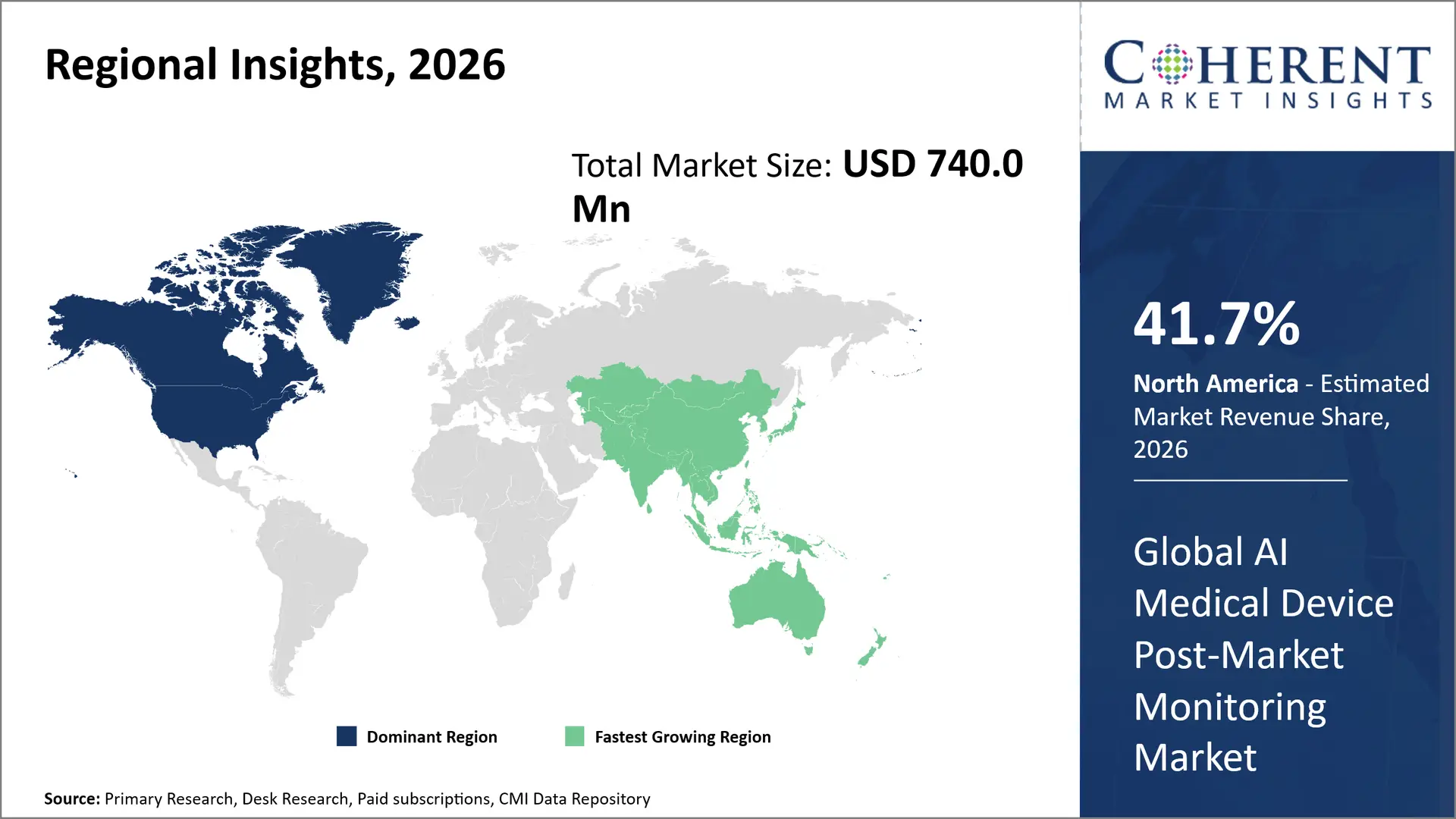
- North America market maintains dominance with an expected share of 41.7% in 2026, due to developed medical device monitoring ecosystem and consistent consumer demand for continuous safety monitoring. For instance, U.S. FDA’s Total Product Life Cycle Advisory Program (TPLC) helps develop an integrated, seamless approach to medical device development and regulation for the oversight of medical devices.
- Asia Pacific is expected to exhibit the fastest growth in the global AI medical device post-market monitoring market, registering an estimated CAGR of 21.4% during 2026–2033, owing to rising AI-enabled healthcare devices and changing regulatory monitoring. For instance, in April 2026, Health Canada has issued pre-market guidance on machine learning in medical devices. This highlights the increasing regulatory focus on AI device safety across the market.
Segmental Insights
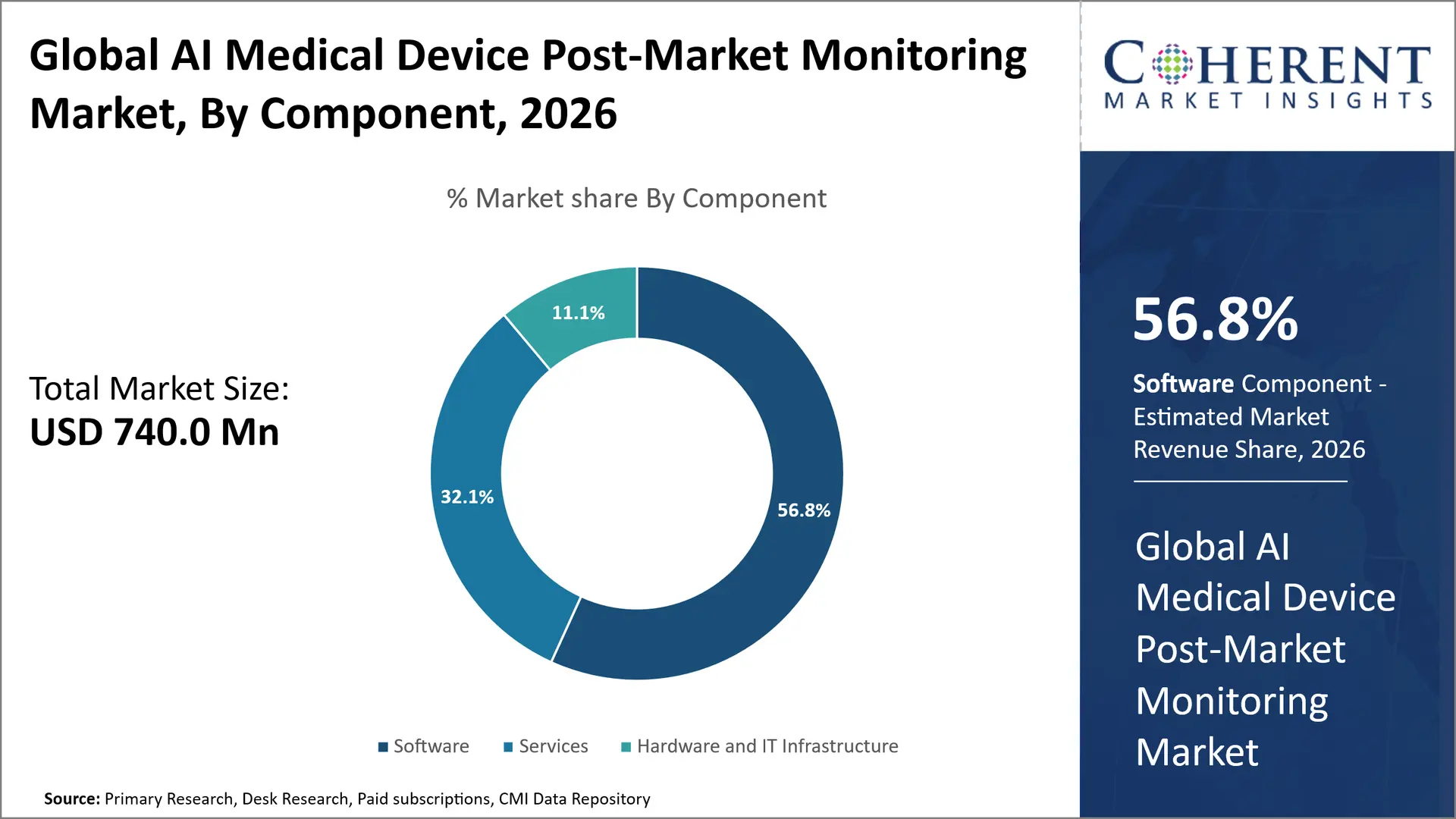
Why Do Software Dominate the Global AI Medical Device Post-Market Monitoring Market?
Software is projected to hold the market share of 56.8% in 2026, owing to its primary applications in the automation of safety surveillance, complaint analysis, and regulatory compliance. The growing need for process automation in the industry is likely to increase the penetration of software for post-market monitoring. For instance, Smarteeva’s AI-powered post-market surveillance platform help medical device companies detect safety signals and monitor post-market surveillance through complaint classification, identification of potential adverse events, and assistance in the generation of regulatory reports.
- Current Industry Events of 2026
- Market Size Estimation
- Regional Breakdown
- Competitive Landscape
- Customer Intelligence
- Segmental Analysis
- Pricing Analysis
- Key Market Drivers, Challenges & Future Trends
- Customized Insights Section
Why Does AI-Enabled Diagnostic Imaging Devices Represent the Largest Device Type Segment in the AI Medical Device Post-Market Monitoring Market?
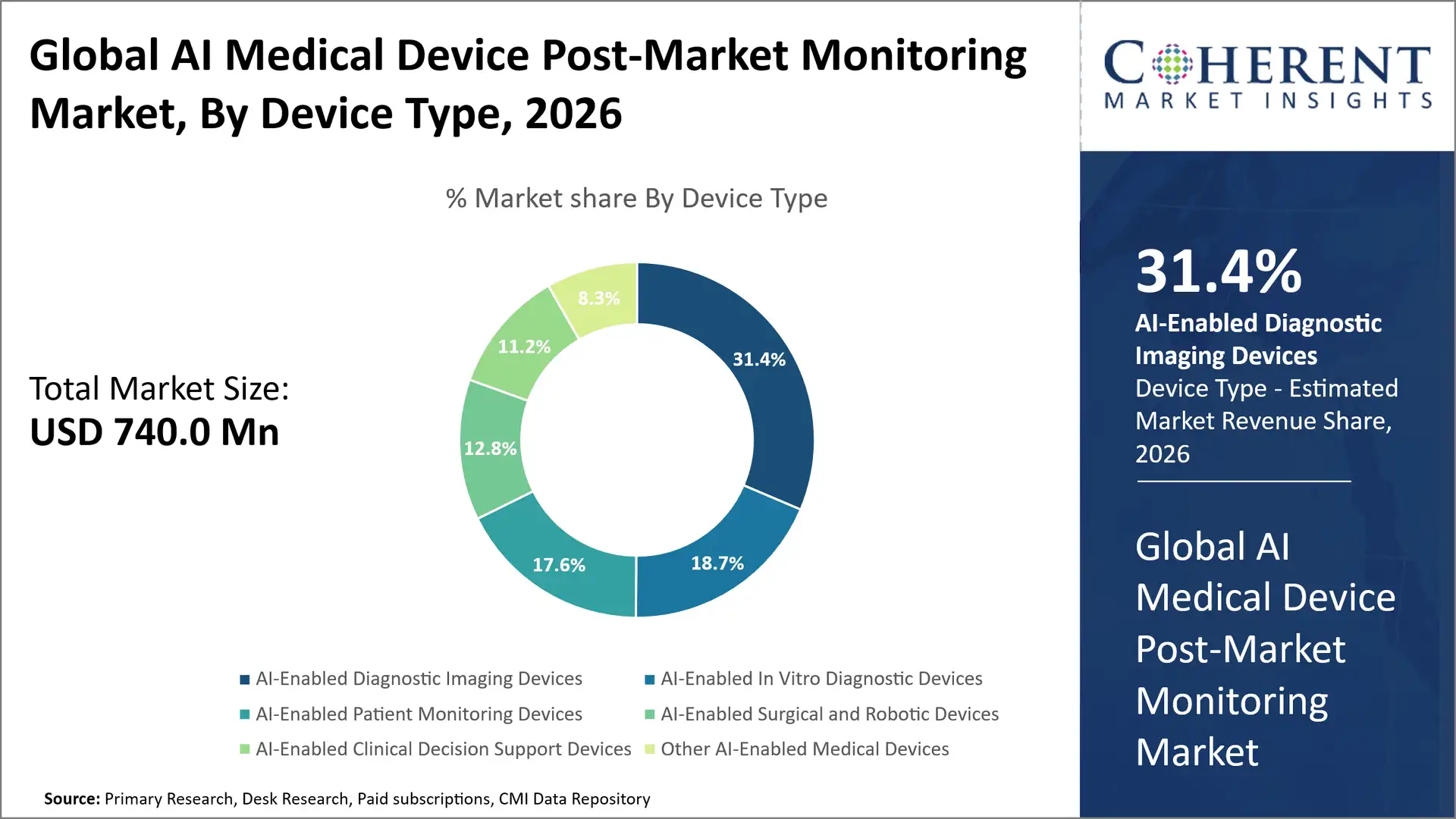
AI-enabled diagnostic imaging devices are projected to hold a market share of 31.4% in 2026, due to their high application in clinical diagnosis as well as monitoring the accuracy and performance of the algorithm post-deployment. For instance, Siemens Healthineers' AI-Rad Companion Brain MR demonstrates the use of AI in aiding MR image analysis, emphasizing the need for continued performance evaluation and safety surveillance of AI-enabled imaging solutions.
Cloud-Based Segment Dominates the Global AI Medical Device Post-Market Monitoring Market
The cloud-based segment is projected to hold a market share of 52.6% in 2026, due to their scalability, centralized data storage, and the availability of post-market performance data across dispersed healthcare sites. For instance, Bosch's Vivasuite platform enables remote device monitoring, post-market surveillance and software updates over-the-air and over-the-net from a secure and connected platform. These enable early problem detection, better management of devices and consistent monitoring of medical device fleets.
Current Events and their Impact
Current Events | Description and its Impact |
Singapore Improves AI-Based Medical Device Adverse-Event Coding (September 2026) |
|
Health Canada Publishes Revised Guidance for Medical Devices with Machine Learning Applications (April 2026) |
|
AI Medical Device Post-Market Monitoring Market Dynamics
Market Drivers
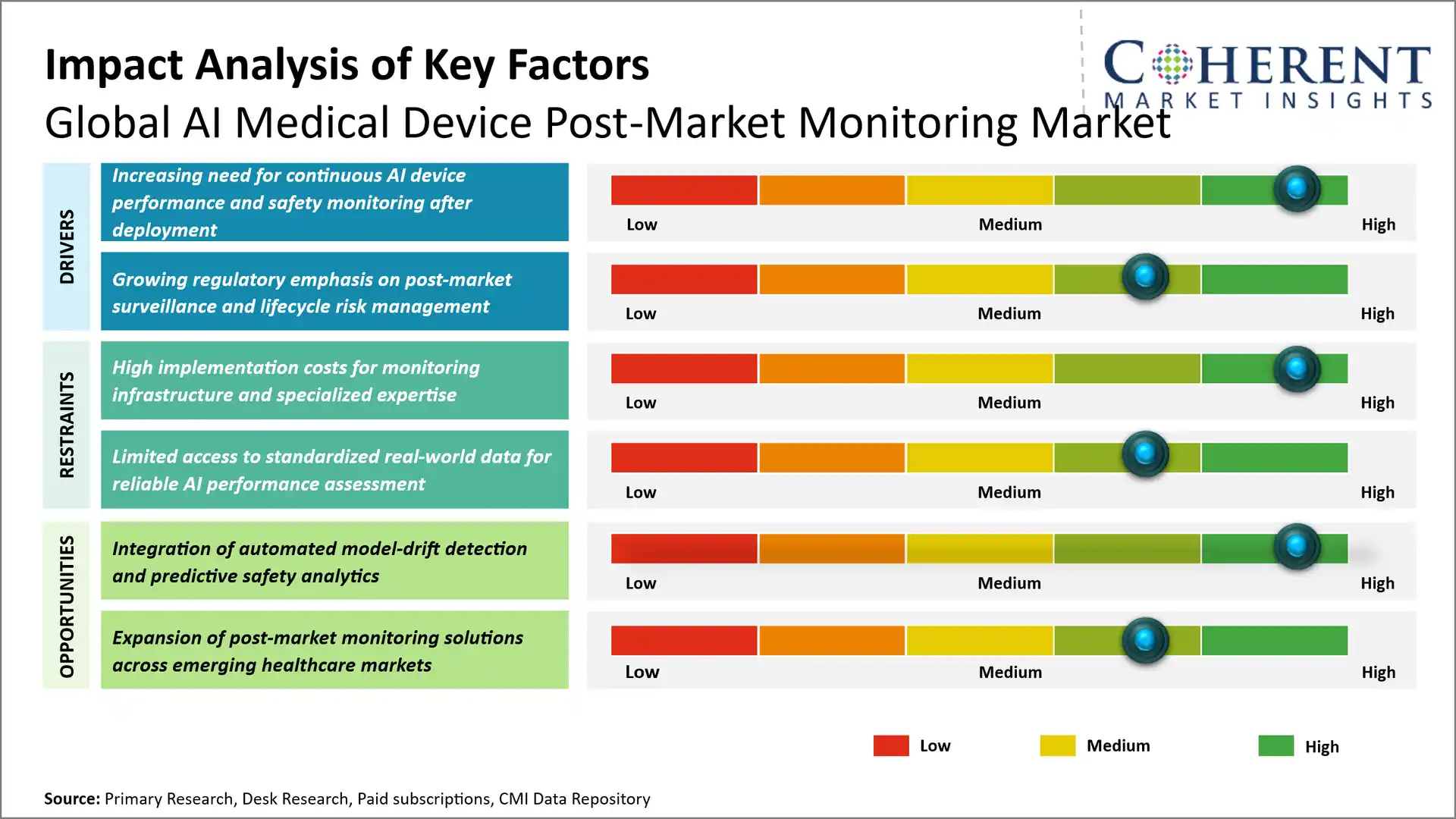
- Increasing need for continuous AI device performance and safety monitoring after deployment: When medical devices using AI are deployed in different settings, patient populations and in the presence of actual data, ongoing monitoring is believed to be an important step in understanding if these devices are experiencing any possible decline in performance or safety. For instance, the U.S. FDA has listed the evaluation of real-world AI device performance and detecting changes over time as one of the key objectives in ensuring safety.
- Growing regulatory emphasis on post-market surveillance and lifecycle risk management: Growing regulatory demands require medical device manufacturers to set up systems for the systematic evaluation of safety, performance, and risk that continues after their devices are launched in the market. For instance, the European Commission has published MDCG 2025-10 in December 2025, which provides updated guidance on post-market surveillance for medical devices and in vitro diagnostic devices.
- Rising adoption of AI-enabled medical devices across healthcare settings: The proliferation of the use of AI-enabled diagnostic, monitoring, and clinical decision-support devices is contributing to the upward trend in post-market data and complexity, leading to a need for automated surveillance. For example, the U.S. FDA’s list of approved AI-enabled medical devices provides a searchable index of AI-enabled devices that are approved for marketing in the U.S.
Emerging Trends
- Automated AI Model Drift Detection: Increasingly, AI medical device monitoring solutions are starting to incorporate automation to capture data about changes in model accuracy and input-data distributions once a model is in production.
- Impact: Early detection of degradation allows manufacturers to weigh the dangers and initiate corrective actions. The use of ongoing monitoring reduces demand on manual inspections.
- Market Relevance: The development creates a demand for software that offers real-time monitoring and automated alerts. This trend fosters a market for niche companies that focus on the continuous monitoring of AI throughout its lifecycle.
- Real-World Data Integration for Predictive Safety Monitoring: The post-market monitoring process is increasingly focusing on combining device performance data, adverse event reporting and real-world clinical information to identify new safety issues.
- Impact: Predictive analytics can help to uncover potential device risks before they turn into widespread safety issues. Additionally, wider data integration can enable more effective risk evaluation and post-market decision-making.
- Market Relevance: This trend favors platforms that can gather and combine structured and unstructured information from a variety of sources. Vendors of predictive safety analytics and interoperable monitoring solutions may gain a competitive advantage.
Regional Insights
Why is North America a Strong Market for AI Medical Device Post-Market Monitoring?
North America leads the global AI medical device post-market monitoring market, accounting for an estimated 41.7% share in 2026, owing to high healthcare infrastructure, implementation of AI-enabled medical devices, and regulatory standards in the region. In addition, government initiatives, regulations and policies for AI-enabled medical devices are expected to encourage innovation and provide better clarity on lifecycle monitoring, safety and post-market performance.
For instance, in August 2026, the U.S. FDA published a discussion paper to collect public comments on regulating generative AI-enabled medical devices, such as risk assessment, post-marketing surveillance and continuous monitoring. Furthermore, increased investments in healthcare technology and collaborations between healthcare providers and developers of medical devices are propelling the market for automated surveillance, predictive risk analytics, and regulatory compliance.
Why Does Asia Pacific AI Medical Device Post-Market Monitoring Market Exhibit High Growth?
Asia Pacific is expected to exhibit the fastest growth in the global AI medical device post-market monitoring market, registering an estimated CAGR of 21.4% during 2026–2033. The region is projected to account for 21.6% of the global market in 2026, attributed to the increasing digitalization of health care, expansion of medical technology infrastructure, and rising implementation of AI. The government initiatives for quality & safety of health care are making the digital health infrastructure and the deployment of AI-enabled post-market surveillance solutions stronger, which is subsequently contributing to the overall industry growth.
For instance, India’s Ayushman Bharat Digital Mission (ABDM) is strengthening digital health infrastructure through interoperable health records and secure data exchange. As of December 2024, around 711.6 million (71.16 crore) ABHA accounts have been created, which enable data-driven healthcare and possible AI-based monitoring applications. (Source: Press Information Bureau) Additionally, huge investments in the healthcare data infrastructure and changing regulations are further expected to propel the regional market.
Global AI Medical Device Post-Market Monitoring Market Outlook for Key Countries
Why is the U.S. Leading Innovation and Adoption in the AI Medical Device Post-Market Monitoring Market?
Innovation and adoption are expected to be centered in the U.S. fueled by the FDA regulatory landscape and its focus on device post-market performance monitoring. With a focus on data drift detection, real-world performance and safety risks, the U.S. provides an effective launching point for intelligence-based post-market monitoring solutions. In addition, the country has an active approach to the development of regulation for generative AI-enabled medical devices.
Is Japan a Favorable Market for AI Medical Device Post-Market Monitoring Market?
Japan is an attractive emerging market for the post-market monitoring of AI Medical Devices, with a strong regulatory infrastructure for AI-based medical software, as well as access to extensive clinical deployment infrastructure. Furthermore, adoption of AI in diagnosis imaging, endoscopy, and cardiology across Japan requires ongoing monitoring of performance and safety, as well as handling post-market modifications. However, this potential will depend on improving access to clinical data applicable to AI, and strengthening oversight of algorithm evolution.
Is China Emerging as a Key Growth Hub for the AI Medical Device Post-Market Monitoring Market?
China is emerging as a major growth hub in the AI medical device post-market monitoring market supported by growing number of AI-powered medical devices and regulatory efforts towards ensuring life-cycle monitoring. In June 2025, the China's National Medical Products Administration (NMPA) announced policies to improve the post-market safety surveillance, improve adverse event reporting, and promote active monitoring of high-risk medical devices. These policies create room for the adoption of AI-enabled devices that automates signal detection and risk assessment and offer monitoring.
Why Does Germany Top the European AI Medical Device Post-Market Monitoring Market?
Germany is one of the key markets for post-market monitoring of AI medical devices, characterized by an established ecosystem of medical tech companies, an advanced healthcare system and a strong culture for medical device safety and compliance. The demand for monitoring software is driven by the requirement to monitor the performance of AI algorithms, uncover new safety issues and maintain the auditable post-market records. In addition, the sophisticated manufacturing sector provides opportunities for the development of monitoring solutions.
Is AI Medical Device Post-Market Monitoring Market Developing in UK?
UK is an emerging market for AI medical device post-market monitoring with regulatory efforts focused on monitoring AI-enabled devices' lifecycle. It is projected that demand will increase among healthcare providers and manufacturers to improve post-deployment performance monitoring, monitoring for safety signals and algorithm change management. Additionally, the UK has a regulatory environment with the potential to be advantageous for companies focused on post-market monitoring solutions.
Global Medical Device Adverse-Event Reporting Framework
Dataset / Resource | Geographic Coverage | Data Available | Relevance to Market |
International Medical Device Regulators Forum (IMDRF) Adverse Event Terminology | International | Standardized coding system for device-related problems, investigation findings, and impact on patient health | Supports harmonized adverse-event classification and AI-driven safety signal detection |
WHO Global Surveillance and Monitoring System | Global | Details on how to monitor substandard and falsified medical products | Supports broader medical product safety surveillance |
European Database on Medical Devices (EUDAMED) | European Union | Device registration information, vigilance and market-surveillance data on devices | Supports post-market compliance and safety monitoring |
FDA MAUDE Database | U.S. | Malfunction details and adverse event reports for medical devices | Provides detailed data for complaint analysis and safety-signal identification |
How is the integration of automated model-drift detection and predictive safety analytics creating new growth opportunities in the AI medical device post-market monitoring market?
The integration of automated model drift detection and predictive safety analytics could be a major opportunity for the overall post-market monitoring of AI medical devices in the global market. There is potential for these combined capabilities to allow early warning to model performance degradation and potential safety risks, to improve continuous monitoring, speed up corrective actions, and improve reliability as the patient population and clinical setting change. For instance, the U. S. Food and Drug Administration 's post-market surveillance research program targets shifts in AI input data, model performance, and data drift to maintain device safety and efficacy in the real-world clinical setting.
Market Players, Key Development, and Competitive Landscape
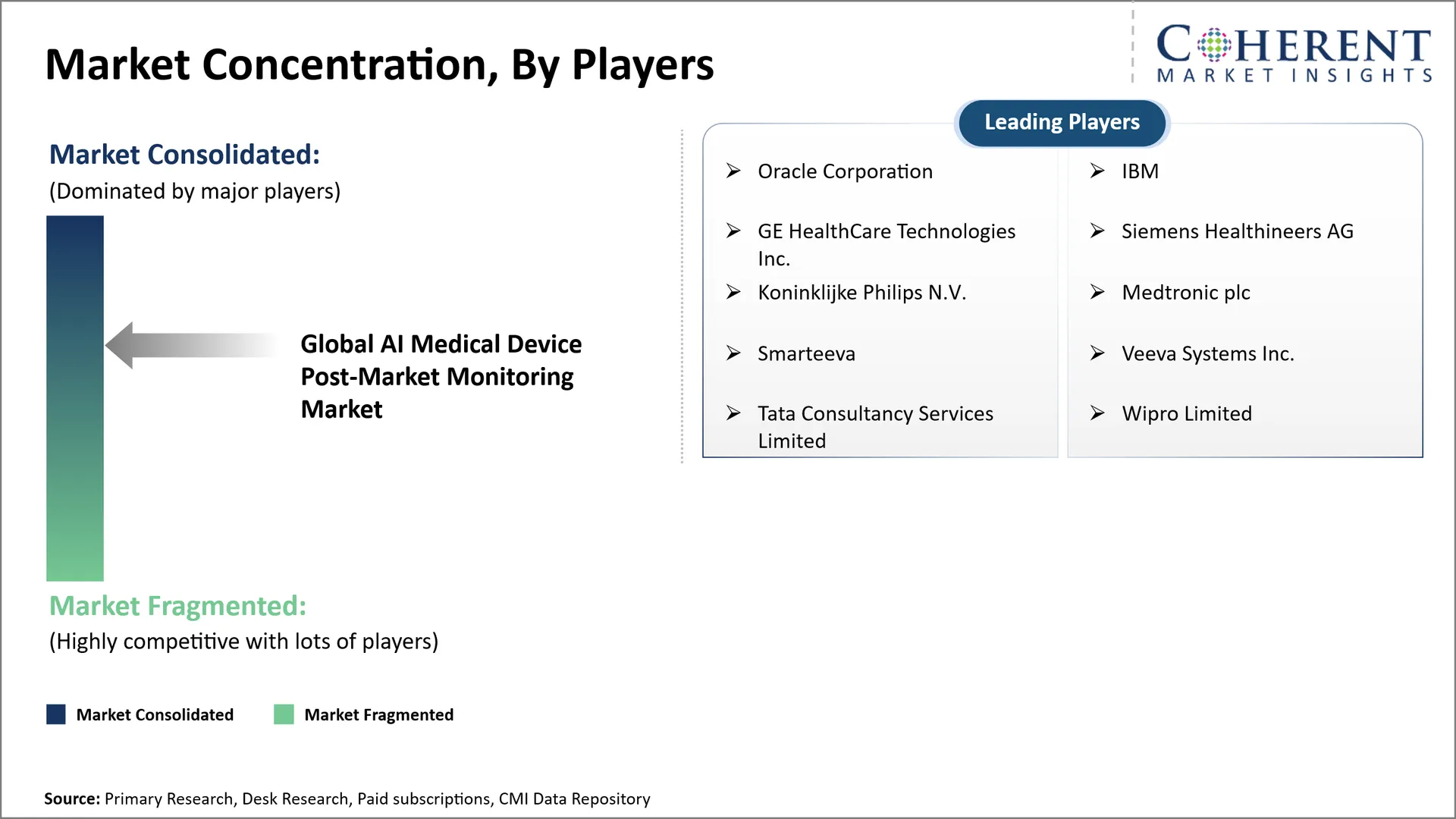
Key Developments
- In May 2026 Tata Elxsi unveiled Ana Tel, a new artificial intelligence-native software development platform and set of tools for use by healthcare and medical technology companies, co-developed with Open Ana. Ana Tel enables automation of software development, documentation, requirements traceability, and verification and validation activities for lifecycle compliance of AI-enabled medical devices.
- In October 2025, Basil Systems, Inc. has launched its latest product, Med Tech Safety Signaling, an AI platform that proactively identifies emerging risks for medical devices by analyzing adverse-event reports, recalls, regulatory submissions and safety data. The goal of this platform is to improve the detection of risks and notifications, allow faster corrective actions and guaranty post-market surveillance and patient safety.
Competitive Landscape
The global AI medical device post-market monitoring market is evolving rapidly as manufacturers of medical devices are adopting artificial intelligence-based solutions to monitor device safety, clinical performance and regulatory compliance during the entire lifecycle of the product. Players in the market also focusing on automated surveillance, real-world outcome analytics, adverse event detection and monitoring of AI models' behavior for early risk identification and support timely corrective actions. Key focus areas include:
- Requisite for integrating AI-powered platforms for the automated adverse-event detection, identification of complaint trends and for the discovery of safety signals.
- Combine machine learning, natural language processing, and predictive analytics for real-world device monitoring and model drift detection.
- Advance lifecycle monitoring capabilities that facilitate regulatory reporting, risk management, audit trails and post market compliance..
Market Report Scope
AI Medical Device Post-Market Monitoring Market Report Coverage | |||
Report Coverage | Details | ||
Base Year | 2025 | Market Size in 2026: | USD 740.0 Mn |
Historical Data For: | 2020 To 2024 | Forecast Period: | 2026 To 2033 |
Forecast Period 2026 To 2033 CAGR: | 13.4% | 2033 Value Projection: | USD 1,779.0 Mn |
Geographies covered: |
| ||
Segments covered: |
| ||
Companies covered: | Oracle Corporation, IBM, GE HealthCare Technologies Inc., Siemens Healthineers AG, Koninklijke Philips N.V., Medtronic plc, Smarteeva, Veeva Systems Inc., Tata Consultancy Services Limited, Wipro Limited | ||
Growth Drivers: |
| ||
Restraints & Challenges: |
| ||
Analyst Opinion (Expert Opinion)
- The industry is expected to evolve from one based on reactive adverse-event reporting, to one that uses artificial intelligence to provide ongoing monitoring of medical device safety and efficacy. Next-generation solutions will likely include more automation in signal detection, model-drift detection, real-world performance and predictive risk evaluation. The market demand will favor automated tools that enable lifecycle-wide device monitoring over standalone compliance tools.
- The maximum opportunities are foreseen within Software for AI Model Performance and Safety Monitoring in the U.S. The abundance of an AI-enabled medical device ecosystem, complex regulations, and the move towards automated surveillance creates a favorable environment for these dedicated monitoring platforms. The systems that can merge performance monitoring, adverse-event tracking and reporting into one workflow are likely to have greater adoption.
- In order to gain a competitive advantage market players should focus on specialist monitoring solutions that unify adverse-event detection, model-drift notifications, explainability and verifiable compliance reports. Common mechanisms for integration into existing quality systems, complaint systems and reporting pipelines can minimize the barriers to implementation. Vendors that can provide consistent detection performance, data security and flexible deployment models will be able to build customer confidence and a durable competitive advantage.
Speak to the analyst
Want personalized insights?
Take the findings above to one of our principal consultants, or have the report rebuilt around the segments, geographies and competitors you actually track.
Market Segmentation
- Component Insights (Revenue, USD Mn, 2021 - 2033)
- Software
- Services
- Hardware and IT Infrastructure
- Device Type Insights (Revenue, USD Mn, 2021 - 2033)
- AI-Enabled Diagnostic Imaging Devices
- AI-Enabled In Vitro Diagnostic Devices
- AI-Enabled Patient Monitoring Devices
- AI-Enabled Surgical and Robotic Devices
- AI-Enabled Clinical Decision Support Devices
- Other AI-Enabled Medical Devices
- Deployment Mode Insights (Revenue, USD Mn, 2021 - 2033)
- Cloud-Based
- On-Premises
- Hybrid
- AI Monitoring Capability Insights (Revenue, USD Mn, 2021 - 2033)
- Predictive Analytics and Risk Forecasting
- Anomaly Detection
- Natural Language Processing (NLP)
- Automated Signal Detection
- Explainability and Audit Trail Management
- Application Insights (Revenue, USD Mn, 2021 - 2033)
- AI Model Performance Monitoring
- Data Drift and Model Degradation Detection
- Adverse Event Detection and Reporting
- Clinical Safety and Risk Monitoring
- Real-World Performance Analytics
- Regulatory Compliance and Reporting
- Cybersecurity and Software Update Monitor
- Others
- End User Insights (Revenue, USD Mn, 2021 - 2033)
- Medical Device Manufacturers
- Hospitals and Healthcare Providers
- Contract Research Organizations (CROs)
- Regulatory Authorities
- Third-Party Compliance and Monitoring Service Providers
- Others
- Regional Insights (Revenue, USD Mn, 2021 - 2033)
- North America
- U.S.
- Canada
- Latin America
- Brazil
- Argentina
- Mexico
- Rest of Latin America
- Europe
- Germany
- U.K.
- Spain
- France
- Italy
- Russia
- Rest of Europe
- Asia Pacific
- China
- India
- Japan
- Australia
- South Korea
- ASEAN
- Rest of Asia Pacific
- Middle East
- GCC Countries
- Israel
- Rest of Middle East
- Africa
- South Africa
- North Africa
- Central Africa
- North America
- Key Players Insights
- Oracle Corporation
- IBM
- GE HealthCare Technologies Inc.
- Siemens Healthineers AG
- Koninklijke Philips N.V.
- Medtronic plc
- Smarteeva
- Veeva Systems Inc.
- Tata Consultancy Services Limited
- Wipro Limited
Sources
Primary Research Interviews
- AI Medical Device Post-Market Monitoring Providers
- Medical Device Manufacturers and Regulatory Affairs Executives
- Healthcare IT and Medical Device Software Specialists
- Clinical Safety, Quality Assurance, and Post-Market Surveillance Professionals
Stakeholders
- Medical Device Manufacturers
- AI Medical Device Software Developers
- Regulatory Affairs and Quality Assurance Professionals
- Clinical Safety and Risk Management Teams
- Healthcare Providers and Clinical Users
- Government and Regulatory Bodies
- Contract Research Organizations and Regulatory Consulting Providers
- End-use Sectors
- Medical Device Manufacturing Companies
- Hospitals and Healthcare Systems
- Diagnostic Imaging Centers
- In Vitro Diagnostic Laboratories
- Medical Device Software and Technology Providers
- Contract Research and Post-Market Surveillance Organizations
- Regulatory & Health Bodies
- U.S. Food and Drug Administration (FDA)
- European Commission – Medical Device Coordination Group (MDCG)
- Medicines and Healthcare products Regulatory Agency (MHRA)
- Pharmaceuticals and Medical Devices Agency (PMDA)
- National Medical Products Administration (NMPA)
- Central Drugs Standard Control Organisation (CDSCO)
- International Medical Device Regulators Forum (IMDRF)
Databases
- FDA AI-Enabled Medical Devices Database
- FDA MAUDE Database
- EUDAMED – European Database on Medical Devices
- ClinicalTrials.gov
- EU Clinical Trials Information System (CTIS)
- WHO Global Health Observatory (GHO)
- OECD Health Statistics
Associations
- International Medical Device Regulators Forum (IMDRF)
- Regulatory Affairs Professionals Society (RAPS)
- Association for the Advancement of Medical Instrumentation (AAMI)
- Healthcare Information and Management Systems Society (HIMSS)
Public Domain Sources
- World Health Organization (WHO)
- U.S. Food and Drug Administration (FDA)
- European Commission
- International Medical Device Regulators Forum (IMDRF)
- International Organization for Standardization (ISO)
- Medicines and Healthcare products Regulatory Agency (MHRA)
Proprietary Elements
- CMI Data Analytics Tool, Proprietary CMI Existing Repository of information for last 10 years.
Get access to 250+ pages report
Every segment, forecast, competitor profile and data table behind the analysis above — available for instant download.
- ESOMAR Member
- ISO 9001:2015 Certified
- D-U-N-S Registered
- GDPR & CCPA Compliant
Frequently Asked Questions
The global AI medical device post-market monitoring market is estimated to be valued at USD 740.0 Mn in 2026 and is expected to reach USD 1,779.0 Mn by 2033.
Software dominates its ability to function in automated safety surveillance, health care artificial intelligence performance monitoring, detect adverse events, and meet reporting.
AI medical device post-market monitoring uses artificial intelligence to monitor the safety, performance, and new risks of a medical device on a continuous basis after commercialization.
The CAGR of global AI medical device post-market monitoring market is projected to be 13.4% from 2026 to 2033.
Increasing need for continuous AI device performance and safety monitoring after deployment, and growing regulatory emphasis on post-market surveillance and lifecycle risk management are the major factors driving the growth of the global AI medical device post-market monitoring market.
High implementation costs for monitoring infrastructure and specialized expertise, and limited access to standardized real-world data for reliable AI performance assessment are the major factors hampering the growth of the global AI medical device post-market monitoring market.
In terms of device type, AI-enabled diagnostic imaging devices are estimated to dominate the market revenue share in 2026.