

Global Generative AI Medical Device Validation Market Size and Forecast – 2026 To 2033
The global generative AI medical device validation market is expected to grow from USD 186.4 Mn in 2026 to USD 612.7 Mn by 2033, registering a compound annual growth rate (CAGR) of 18.5% from 2026 to 2033. The global market for validation of generative AI medical devices is estimated to witness tremendous growth owing to rising demand for a standard method for measuring AI medical devices.
In January 2025, the U.S. Food and Drug Administration (FDA) issued draft guidance on a lifecycle management framework for AI-enabled medical devices. The guidance discusses documentation, performance monitoring, and risk mitigation during the development and deployment of AI-enabled medical devices. Such regulation drives requirements for more structured validation solutions for developers of smarter, more complex AI-enabled devices.
Key Takeaways of the Global Generative AI Medical Device Validation Market
- Generative AI-enabled software as a medical device (SaMD) is projected to hold 43.7% of the global generative AI medical device validation market share in 2026, making it dominant device type segment, particularly in North America, driven by the string focus of the FDA to evaluate software safety and performance across the product lifecycle. For instance, in August 2026, the FDA published a discussion paper titled “Considerations for the Regulation of Generative AI-Enabled Medical Devices” that is focused specifically on risk assessment, premarket review, and post market monitoring.
- Model performance validation is projected to account for 29.4% of the global generative AI medical device validation market share in 2026, thus becoming the dominating validation type segment, across Europe, where manufacturers are required to validate the compliance of the respective medical device safety and performance requirements in the region. For instance, the European Commission issued the MDCG 2025-10 in December 2025, focused on the vigilance and medical devices and In-vitro diagnostic medical devices post-market surveillance.
- Cloud-based is expected to hold the largest share of 48.6% of the global generative AI medical device validation market in 2026, becoming the leading mode of deployment segment, with growth opportunities in Asia Pacific due to the high investments and government regulations in the region for AI-based medical devices. For instance, the South Korea Ministry of Food and Drug Safety issued regulatory guidance on the AI-based medical devices, thus paving the regional policy landscape for risk and validation practices.
- North America market maintains dominance with an expected share of 40.8% in 2026, bolstered by the existing regulation and a growing interest in lifecycle-based artificial intelligence validation. For instance, the pre-market guidance for machine learning-enabled medical devices in Canada was released by the Health Canada on 1st April 2026, which defines the requirements of data quality, testing and evaluation, clinical validation, and post-market activities to strengthen the AI-enabled medical device regulations.
- Asia Pacific is projected to register the fastest growth in the global generative AI medical device validation market with an estimated CAGR of 19.6% during 2026-2033, due to the development of standardized regulatory framework for generative AI providing validation solutions for the challenges faced during validation. For instance, the release of the draft Review Points for Medical Devices Using Generative AI in September 2026 by Pharmaceuticals and Medical Devices Agency (PMDA) of Japan, which addresses clinical performance assessment, uncertainty in generated outputs, and lifecycle-based monitoring.
Segmental Insights
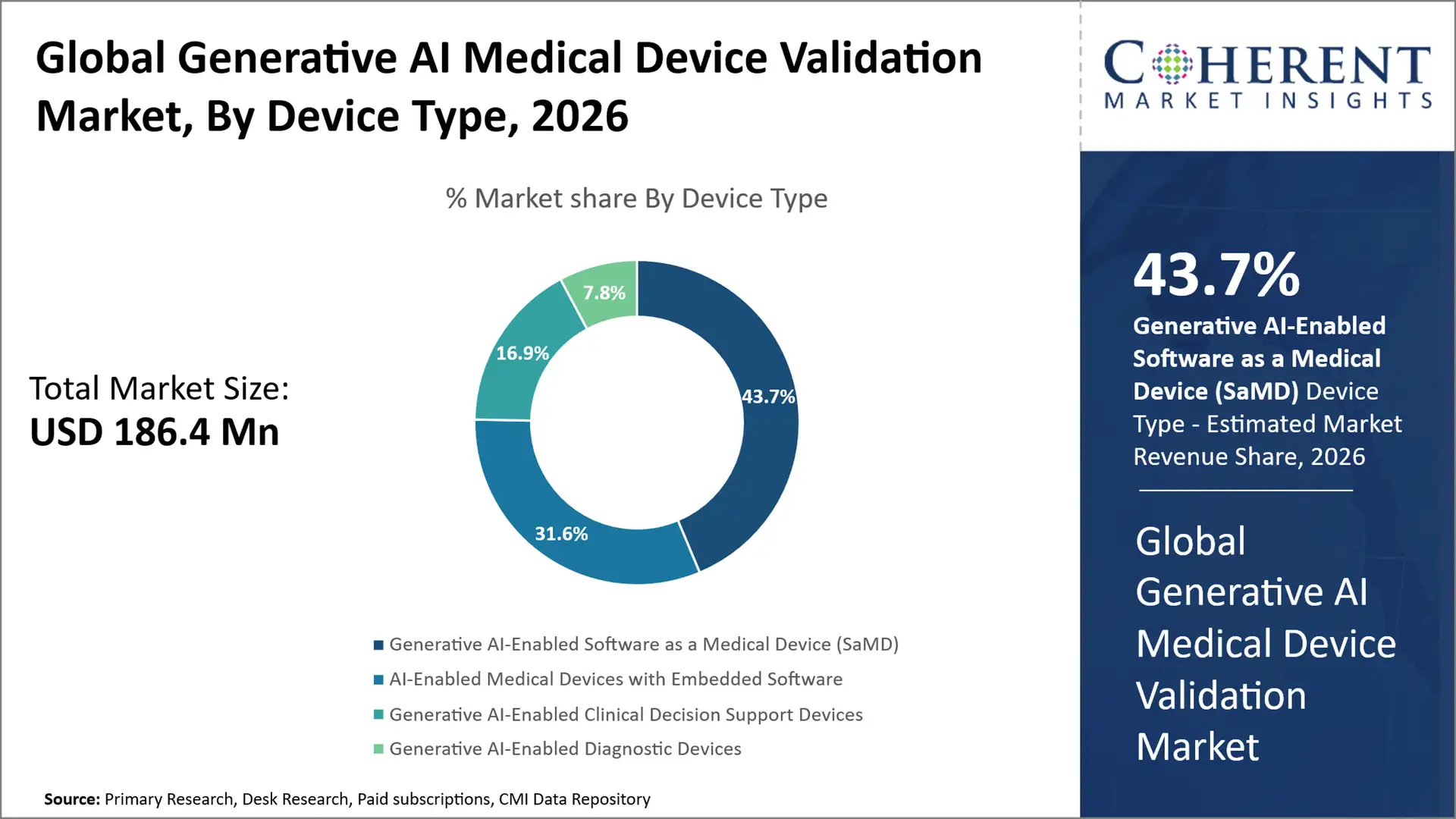
Why Do Generative AI-Enabled Software as a Medical Device (SaMD) Dominate the Global Generative AI Medical Device Validation Market?
Generative AI-enabled software as a medical device (SaMD) is projected to hold the market share of 43.7% in 2026, due to its scalability, software flexibility, and large scope of use in the fields of diagnostics and clinical decision support. Additionally, its ability to enable software upgrades without replacing the hardware indicates a higher demand for safety and performance validation. For instance, Aidoc’s aiOS platform integrates AI-powered medical imaging algorithms to analyze medical scans, prioritize critical findings, and support clinical decision-making.
- Current Industry Events of 2026
- Market Size Estimation
- Regional Breakdown
- Competitive Landscape
- Customer Intelligence
- Segmental Analysis
- Pricing Analysis
- Key Market Drivers, Challenges & Future Trends
- Customized Insights Section
Why Does Model Performance Validation Represent the Largest Validation Type Segment in the Generative AI Medical Device Validation Market?
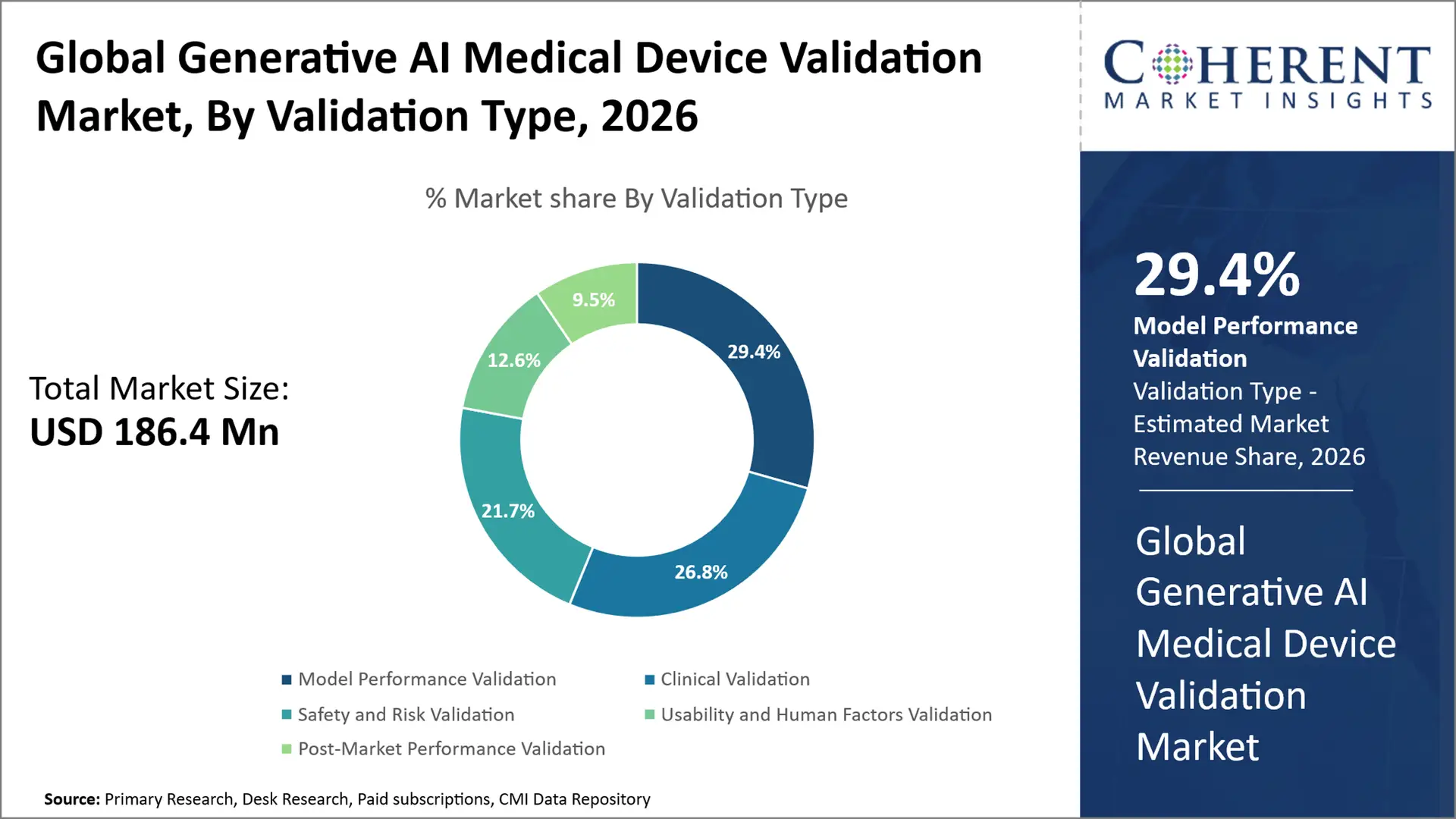
Model performance validation is projected to hold a market share of 29.4% in 2026, since it provides information on the validation of the model regarding the accuracy, consistency, robustness and reliability of its predictions across multiple clinical scenarios. In addition, with the increasing complexity of generative AI models, external testing of datasets and bias evaluation will be prominent to provide trustworthy results before deployment. For instance, the U.S. FDA’s discussion paper on Generative AI-Enabled Medical Devices outlines performance benchmarking using relevant metrics, representative test conditions, and clinical confirmation to assess device reliability.
Cloud-Based Segment Dominates the Global Generative AI Medical Device Validation Market
The cloud-based segment is projected to hold a market share of 48.6% in 2026, owing to the scalability, accessibility and availability of remote collaboration facilities as well as the minimized upfront hardware costs for testing computationally demanding models in the cloud environment. Cloud-based platform offers repeated validation, performance monitoring of the model in relation to dataset, and changing clinical needs. For instance, in July 2025, the ClinValAI framework, published in the National Library of Medicine, demonstrates cloud-based infrastructure for external clinical validation of medical imaging AI models, including performance assessment across diverse patient datasets and analysis of potential biases.
Current Events and their Impact
Current Events | Description and its Impact |
Regulators Update Good Machine Learning Practice Principles for Medical Devices (October 2026) |
|
India Launches SAHI and BODH Frameworks for Evidence-Based Healthcare AI (February 2026) |
|
U.S. FDA seeks public input on real-world AI medical device performance (September 2025) |
|
Generative AI Medical Device Validation Market Dynamics
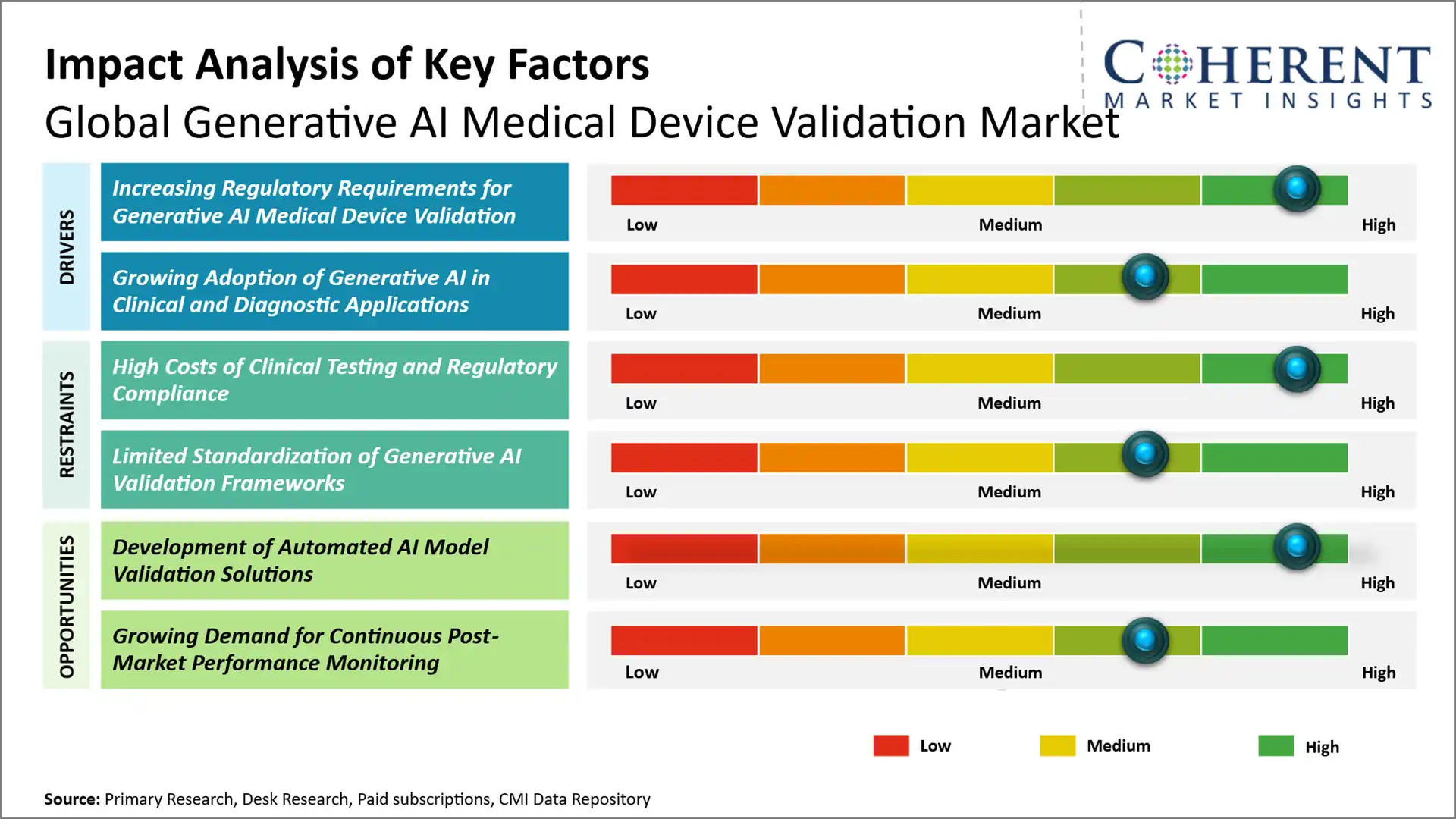
Market Drivers
- Increasing regulatory requirements for generative AI medical device validation: The rising regulatory pressure is creating a high demand for validation of medical devices using generative artificial intelligence which comprises of test model performance, clinical data, risks, and monitoring (post-market controls). For instance, on January 24, 2025, the Ministry of Food and Drug Safety (MFDS) of South Korea announced Guideline for Approval and Review of Generative Artificial Intelligence Medical Devices (GKMGD-G85) which is a guidance for evaluating AI medical technologies with specific criteria for general AI medical technologies. This is driving the manufacturers to adopt advanced validation processes and regulatory documents.
- Growing adoption of generative AI in clinical and diagnostic applications: There has been increasing use of generative artificial intelligence for medical imaging, clinical documentation, and diagnostic decision support, which require systematic validation of the accuracy, reliability, and clinical validity of these tools' output. For instance, in February 2025, United Kingdom Medicines and Healthcare Products Regulatory Agency (MHRA) selected the project of generative artificial intelligence (AI) and large language models (LLM) to generate impressions of radiology reports for the AI Airlock pilot program.
- Growing demand for lifecycle-based validation and post-market monitoring: As generative AI models increase in complexity, it is critical to keep validating the use of the models across the device lifecycle, as the device goes into the clinical environment – model drift, output stability, and safety under changing clinical setting. For instance, in December 2024, the UK Medicines and Healthcare products Regulatory Agency (MHRA) published an updated Software and AI as a Medical Device Change Programme roadmap, addressing regulatory approaches to software and AI modifications, which reinforces the need for robust change management and ongoing performance oversight.
Emerging Trends
- Continuous validation and post-market performance monitoring – Medical device developers are increasingly focused on continuous validation to track the performance of generative artificial intelligence after it has been deployed. This approach is valuable for identifying model drift, unintended outputs, and changes in clinical performance as patient populations and real-world data change.
- Development of standardized validation frameworks for generative AI: Generative AI is emerging as the next potential application area for intelligent medical devices. Regulators and medical technology companies are working together to develop validation frameworks for generative AI, which will cover hallucinations, consistency of output, bias and clinical pertinence. These are expected to help elevate evidence requirements and reassure clinicians about generative AI-enabled devices.
- Automating AI model testing and risk assessment: There are ongoing initiatives to create automated validation tools for testing model validity, robustness, reproducibility, and safety in many clinical use cases. Use of these tools can decrease repetitive testing, decrease time-to-market and streamline documentation processes for regulators.
Regional Insights
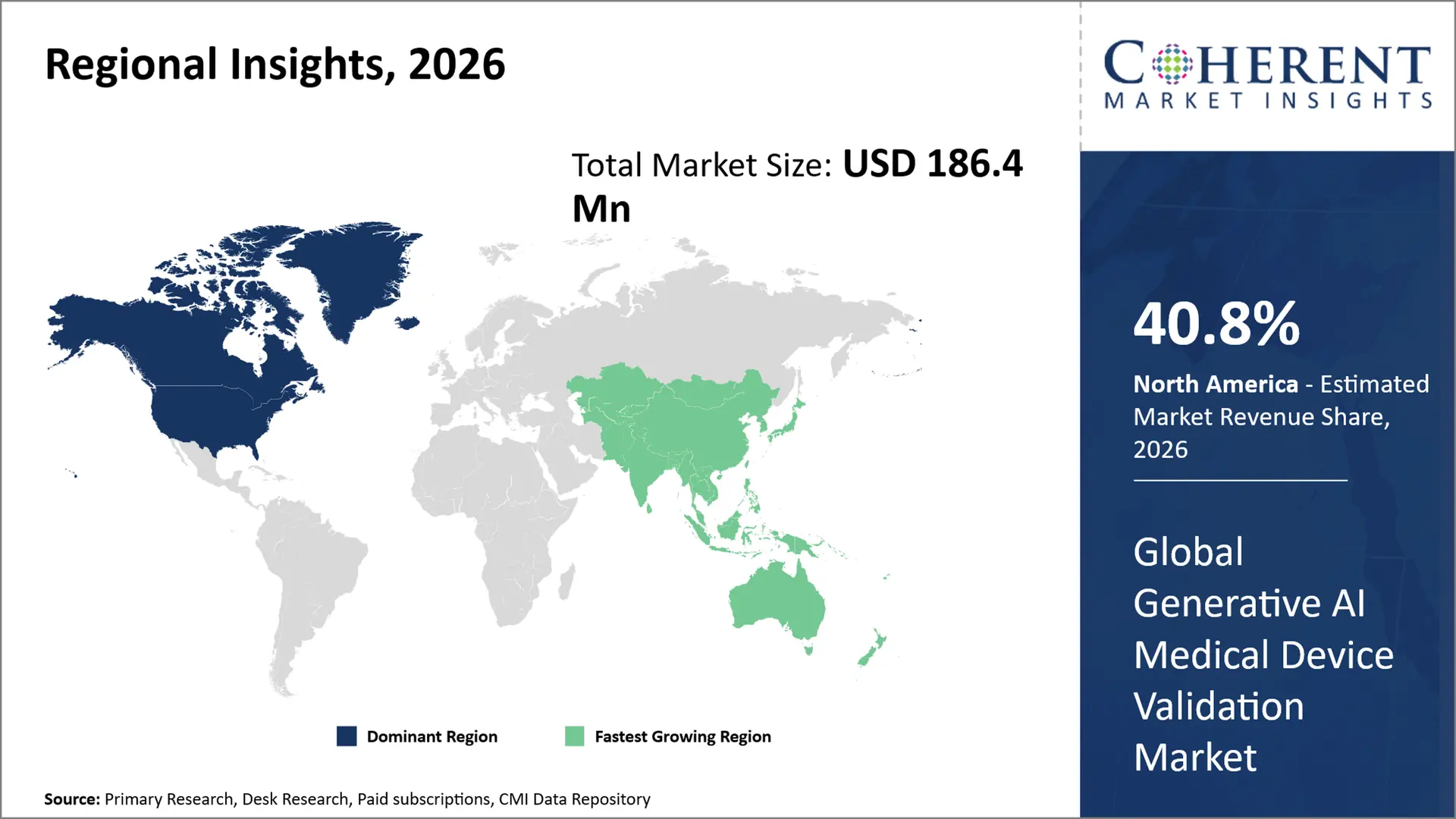
Why is North America a Strong Market for Generative AI Medical Device Validation?
North America leads the global generative AI medical device validation market, accounting for an estimated 40.8% share in 2026, owing to the presence of significant technological progress, strong healthcare infrastructure, and a quick acceptance of breakthrough medical technologies. The U.S. Food and Drug Administration (FDA) has simplified the rules for validating AI-enabled devices, providing a clear regulatory framework encouraging market growth.
For instance, in August 2025, U.S. Food and Drug Administration provided guidance on Predetermined Change Control Plans for software functions of artificial intelligence-enabled devices. This guidance document sets out how planned modifications can be documented and maintained. Furthermore, region’s dominance is supported by growing clinical demand for efficient, reliable and safe generative AI solutions.
Why Does Asia Pacific Generative AI Medical Device Validation Market Exhibit High Growth?
Asia Pacific is expected to exhibit the fastest growth in the global generative AI medical device validation market, registering an estimated CAGR of 19.6% during 2026–2033. The region is projected to account for 23.1% of the global market in 2026, attributed to the strong adoption of healthcare digitization, increasing medical device manufacturing and growing government initiatives promoting AI for healthcare. For instance, in February 2026, India’s Ministry of Health and Family Welfare launched the Strategy for Artificial Intelligence in Healthcare for India (SAHI) and the BODH platform to promote responsible adoption and evaluation of AI in healthcare. (Source: Press Information Bureau)
The adoption of AI-enabled diagnostic and clinical applications in countries such as China, Japan, and South Korea, is expected to drive demand for scalable, inexpensive validation solutions. Moreover, the region's diverse patient population and regulatory landscape are expected to open avenues for clinical validation, model performance testing and post-market monitoring.
Global Generative AI Medical Device Validation Market Outlook for Key Countries
Why is the U.S. Leading Innovation and Adoption in the Generative AI Medical Device Validation Market?
The U.S. is expected to hold a leading position in the generative AI medical device validation market owing to the presence of a well-established ecosystem for medical device design & development, technologically sophisticated AI environment, and established regulatory pathways for software-based medical devices. Moreover, high reliance on generative AI during diagnostic decision support and clinical workflows results in heightened demand for validating the output accuracy, hallucinations, clinical effectiveness, and patient safety. The need to demonstrate consistent performance for various patient populations will drive the demand for validation and post-marketing surveillance solutions.
Is China a Favorable Market for Generative AI Medical Device Validation Market?
China is an attractive market for the generative AI medical device validation due to the growth of the country’s medical AI ecosystem and the use of AI in the healthcare industry along with the rise of regulation for AI-enabled medical devices. Growing validation requirements are projected as developers pay attention to model accuracy, clinical safety and efficacy, data security, algorithm bias and model performance in China's patient population. However, local regulations compliance and adaptation to clinical data in Chinese language can be a key concern for market entry.
Is UK Emerging as a Key Growth Hub for the Generative AI Medical Device Validation Market?
The UK is positioned to be a high growth hub for the generative AI medical device validation market due to the well-developed medical technology ecosystem, and a changing landscape for regulation of AI-enabled healthcare. The demand is supported by the need to validate generative AI results to ensure clinical safety, bias, robustness, and accuracy as pre-market validation and post-market assurance. Additionally, the country’s focus around lifecycle-based assurance and real-world product performance monitoring is likely to lead to the need for market-specific validation services.
Why Does Germany Top the European Generative AI Medical Device Validation Market?
Germany leads the European generative AI medical device validation market owing to its strong presence of healthcare medical devices manufacturing industry along with broad clinical research ecosystem and domain expertise in healthcare medical devices industry, and stringent validation capabilities for new untested and used medical devices technology. The adoption of generative AI in diagnostic imaging & clinical decision support has surged demand for validation of model performance & clinical safety, reliability.
Is Generative AI Medical Device Validation Market Developing in Japan?
Japan is transforming into an emerging hub as health systems and medical technology innovators explore use cases that leverage AI for diagnostic and clinical decision support. The validation is likely to be increasingly called for clinical accuracy, output reliability, patient safety, and reliability of generative AI models in health settings operating in the Japanese language.
Key Validation Dimensions for Generative AI Medical Devices
Validation dimension | Key parameters assessed | Relevance to the market |
Model performance validation | Output accuracy, consistency, hallucination rates, and reproducibility | Defines the veracity of outputs produced by artificial intelligence. |
Clinical validation | Clinical relevance, diagnostic support quality, and performance across patient populations | Evaluates appropriateness for the intended clinical application. |
Safety and risk validation | Bias, harmful outputs, privacy risks, and failure modes | May include potential impact on patients and on medical processes. |
Usability and human factors validation | Clinician interpretation, human oversight, and workflow integration | Studies the ethical principles and policies for interacting with and using AI systems. |
Robustness and interoperability validation | Performance under varied inputs, data quality, and compatibility with clinical systems | Assesses reliability across various real-world settings. |
Post-market performance validation | Model drift, output changes, and performance degradation | Facilitates ongoing monitoring following deployment. |
How is the development of automated AI model validation solutions creating new growth opportunities in the generative AI medical device validation market?
Automated AI model validation solutions are anticipated to be a major opportunity in the global generative AI medical device validation market. The market manufacturers are mainly looking at improving the testing throughput, output quality, and regulatory readiness. Automated platforms may aid in analyzing the performance, bias, and robustness test as well as monitor the model constantly thereby reducing manual intervention. For instance, in August 2026, the U.S. National Institute of Standards and Technology (NIST) introduced the TEVV-Athlon Framework for Evaluating AI Systems to support structured testing, evaluation, verification, and validation of AI systems. This framework offers a relevant foundation for developing automated validation workflows for generative AI medical devices.
Market Players, Key Development, and Competitive Landscape
Key Developments
- In September 2026, Cognita Imaging was granted a USD 1.29 million research contract from the U.S. Food and Drug Administration (FDA) to validate an evaluation framework for radiology reports by artificial intelligence. Through an 18-month project, the framework will evaluate a series of large language models in an evaluation panel, and over about a million patient scans with radiologists conducting assessments of clinically meaningful differences.
- In August 2026, the U.S. Food and Drug Administration (FDA) published a discussion paper inviting input from stakeholders on how to regulate AI-enabled medical devices that generate new data. The paper deals with the risk assessment, benchmark and clinical validation of pre-market testing and post-market monitoring of performance.
Competitive Landscape
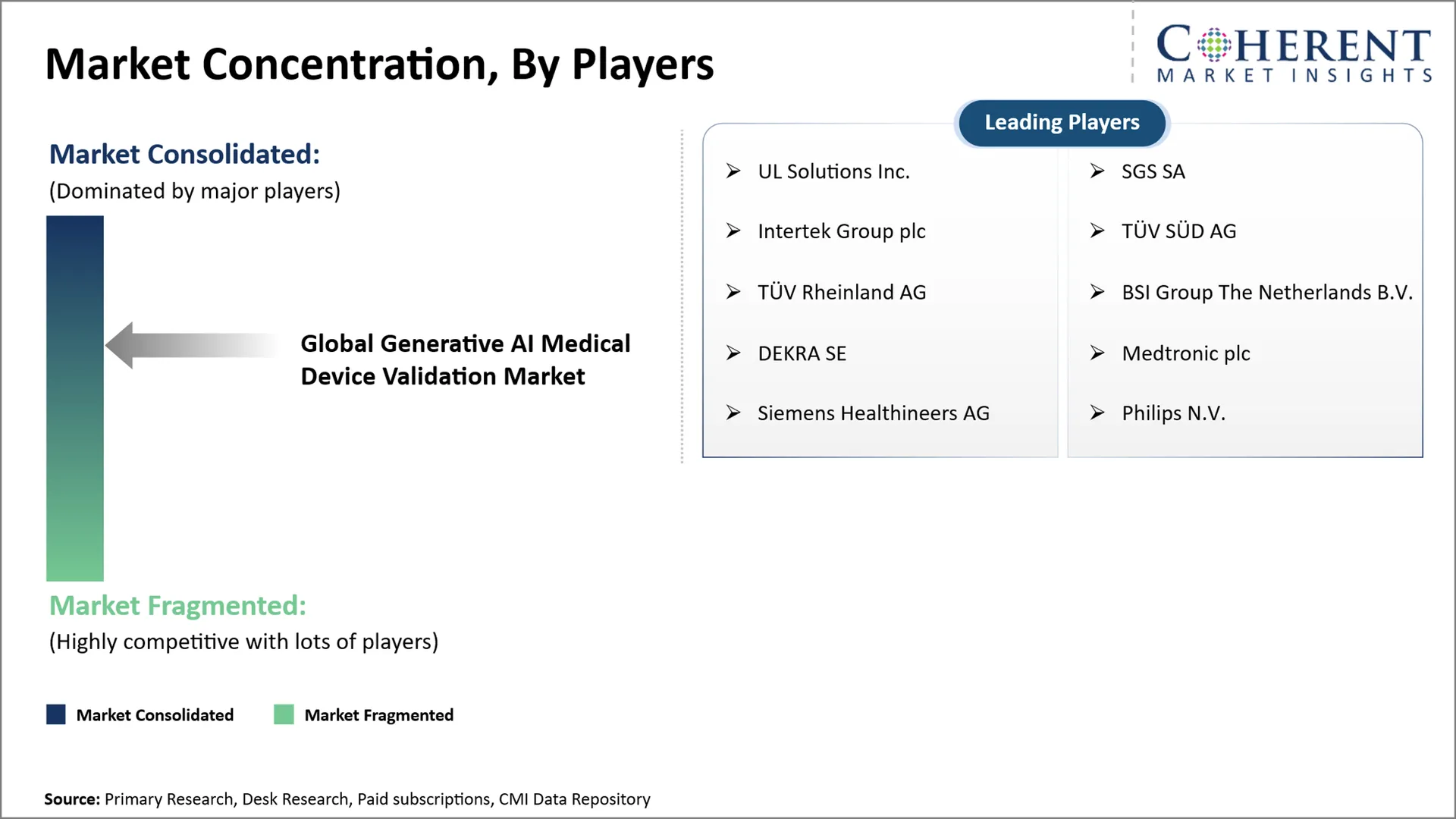
The global market for the validation of generative AI medical devices is currently in development as generative AI-enabled medical technology manufacturers, providers of validation technology, and AI developers seek to validate and ensure the safe and effective, trusted, clinical utility, and regulatory readiness of generative AI-enabled medical technology. Competition is mainly based on validation, clinical evidence generation, model robustness, risk, interoperability, and real-time performance monitoring. Key focus areas include:
- Assessment of generative AI model performance, consistency of output, detection of hallucinations, and reproducibility assessment.
- Safety & risk validation bias detection, data privacy, explainability, and mitigation of potentially hazardous outputs.
- Usability and human factors validation is performed to assess interaction by clinicians, workflow considerations and proper use of the suggested action.
- Automated validation workflows used for regulatory documentation, testing traceability, and evidence generation.
Market Report Scope
Generative AI Medical Device Validation Market Report Coverage | |||
Report Coverage | Details | ||
Base Year | 2025 | Market Size in 2026: | USD 186.4 Mn |
Historical Data For: | 2020 To 2024 | Forecast Period: | 2026 To 2033 |
Forecast Period 2026 To 2033 CAGR: | 18.5% | 2033 Value Projection: | USD 612.7 Mn |
Geographies covered: |
| ||
Segments covered: |
| ||
Companies covered: | UL Solutions Inc., SGS SA, Intertek Group plc, TÜV SÜD AG, TÜV Rheinland AG, BSI Group The Netherlands B.V., DEKRA SE, Medtronic plc, Siemens Healthineers AG, Philips N.V. | ||
Growth Drivers: |
| ||
Restraints & Challenges: |
| ||
Analyst Opinion (Expert Opinion)
- As generative AI proliferates across clinical and diagnostic workflows, the market is ready to move from premarket testing to continuous lifecycle validation. The emergence of hallucinations, clinical impact and appropriateness of output, stability, and tracking real-world results are likely to become more important.
- The maximum opportunities are foreseen within medical imaging and diagnostic decision support SaMD using generative AI in the U.S., where there is existing demand for strong clinical validation. The additional potential lies in India for clinical decision support and documentation validation across diverse healthcare settings.
- Market players need to focus on validation functionality for generative AI, potentially hazing detection, bias testing, adversarial testing, model-drift testing. Leverage access to representative clinical data, validation reports in the same language, working with hospitals and medical device developers will probably make them more credible and drive adoption.
Speak to the analyst
Want personalized insights?
Take the findings above to one of our principal consultants, or have the report rebuilt around the segments, geographies and competitors you actually track.
Market Segmentation
- Device Type Insights (Revenue, USD Mn, 2021 - 2033)
- Generative AI-Enabled Software as a Medical Device (SaMD)
- AI-Enabled Medical Devices with Embedded Software
- Generative AI-Enabled Clinical Decision Support Devices
- Generative AI-Enabled Diagnostic Devices
- Validation Type Insights (Revenue, USD Mn, 2021 - 2033)
- Model Performance Validation
- Clinical Validation
- Safety and Risk Validation
- Usability and Human Factors Validation
- Post-Market Performance Validation
- Deployment Mode Phase Insights (Revenue, USD Mn, 2021 - 2033)
- Cloud-Based
- On-Premises
- Hybrid
- Application Insights (Revenue, USD Mn, 2021 - 2033)
- Medical Imaging and Diagnostics
- Clinical Decision Support
- Patient Monitoring and Predictive Analytics
- Clinical Documentation and Reporting
- Treatment Planning and Personalized Medicine
- Others
- End User Insights (Revenue, USD Mn, 2021 - 2033)
- Medical Device Manufacturers
- Hospitals and Healthcare Systems
- Contract Research Organizations (CROs)
- Academic and Research Institutions
- Regulatory Testing and Validation Laboratories
- Others
- Regional Insights (Revenue, USD Mn, 2021 - 2033)
- North America
- U.S.
- Canada
- Latin America
- Brazil
- Argentina
- Mexico
- Rest of Latin America
- Europe
- Germany
- U.K.
- Spain
- France
- Italy
- Russia
- Rest of Europe
- Asia Pacific
- China
- India
- Japan
- Australia
- South Korea
- ASEAN
- Rest of Asia Pacific
- Middle East
- GCC Countries
- Israel
- Rest of Middle East
- Africa
- South Africa
- North Africa
- Central Africa
- North America
- Key Players Insights
- UL Solutions Inc.
- SGS SA
- Intertek Group plc
- TÜV SÜD AG
- TÜV Rheinland AG
- BSI Group The Netherlands B.V.
- DEKRA SE
- Medtronic plc
- Siemens Healthineers AG
- Philips N.V.
Sources
Primary Research Interviews
- AI/ML validation specialists and biomedical engineers
- Medical device regulatory and quality executives
- Clinical validation and medical affairs leaders
Stakeholders
- Medical device manufacturers developing generative AI-enabled software and SaMD
- AI/ML developers and healthcare software providers
- Independent testing, inspection, and certification organizations
- End-use Sectors
- Medical Device Manufacturers
- Clinical Research and Validation Organizations
- Healthcare Providers and Hospital Networks
- Independent Testing, Inspection, and Certification Organizations
- AI Technology and Healthcare Software Providers
- Academic and Research Institutions
- Other Life Sciences and Healthcare Organizations
- Regulatory & Health Bodies
- U.S. Food and Drug Administration (FDA)
- European Commission and Medical Device Coordination Group (MDCG)
- European Medicines Agency (EMA)
- Health Canada
- Medicines and Healthcare products Regulatory Agency (MHRA)
Databases
- FDA Artificial Intelligence-Enabled Medical Device List
- FDA MAUDE Database
- ClinicalTrials.gov
- WHO International Clinical Trials Registry Platform (ICTRP)
- Clinical Trials Registry–India (CTRI)
- EUDAMED
Associations
- Association for the Advancement of Medical Instrumentation (AAMI)
- Regulatory Affairs Professionals Society (RAPS)
- AdvaMed (Advanced Medical Technology Association)
- MedTech Europe
Public Domain Sources
- U.S. Food and Drug Administration (FDA)
- National Institutes of Health (NIH)
- National Library of Medicine (NLM)
- World Health Organization (WHO)
- European Commission
- European Medicines Agency (EMA)
Proprietary Elements
- CMI Data Analytics Tool, Proprietary CMI Existing Repository of information for last 10 years.
Get access to 250+ pages report
Every segment, forecast, competitor profile and data table behind the analysis above — available for instant download.
- ESOMAR Member
- ISO 9001:2015 Certified
- D-U-N-S Registered
- GDPR & CCPA Compliant
Frequently Asked Questions
The global generative AI medical device validation market is estimated to be valued at USD 186.4 Mn in 2026 and is expected to reach USD 612.7 Mn by 2033.
Generative AI-enabled software as a medical device (SaMD) dominates due to the broad clinical applicability, scalability, and growing need for specialized model performance, safety, and clinical validation.
Generative AI medical device validation is the systematic process of evaluation of generative AI-enabled medical device to ensure safety, accuracy, reliability, and performance of the device in a clinical setting.
The CAGR of global generative AI medical device validation market is projected to be 18.5% from 2026 to 2033.
Increasing regulatory requirements for generative AI medical device validation, and growing adoption of generative AI in clinical and diagnostic applications are the major factors driving the growth of the global generative AI medical device validation market.
High costs of clinical testing and regulatory compliance, and limited standardization of generative AI validation frameworks are the major factors hampering the growth of the global generative AI medical device validation market.
In terms of validation type, model performance validation is estimated to dominate the market revenue share in 2026.