
Flat 45% off this market research report
Nov 26 – 29 · Direct purchase only · Not applicable to customized reports

Global AI-Powered Software Vulnerability Remediation Market Size and Forecast – 2026 To 2033
The global AI-powered software vulnerability remediation market is expected to grow from USD 2.40 Bn in 2026 to USD 10.80 Bn by 2033, registering a compound annual growth rate (CAGR) of 24% from 2026 to 2033. The global AI-powered software vulnerability remediation market is driven by rising demand for automated software patch management. On October 27, 2026, N-able, Inc. announced the launch of AI-accelerated Vulnerability and Patch Management, giving IT teams and service providers a vital defense against increasingly industrialized cybercrime.
Key Takeaways of the Global AI-Powered Software Vulnerability Remediation Market
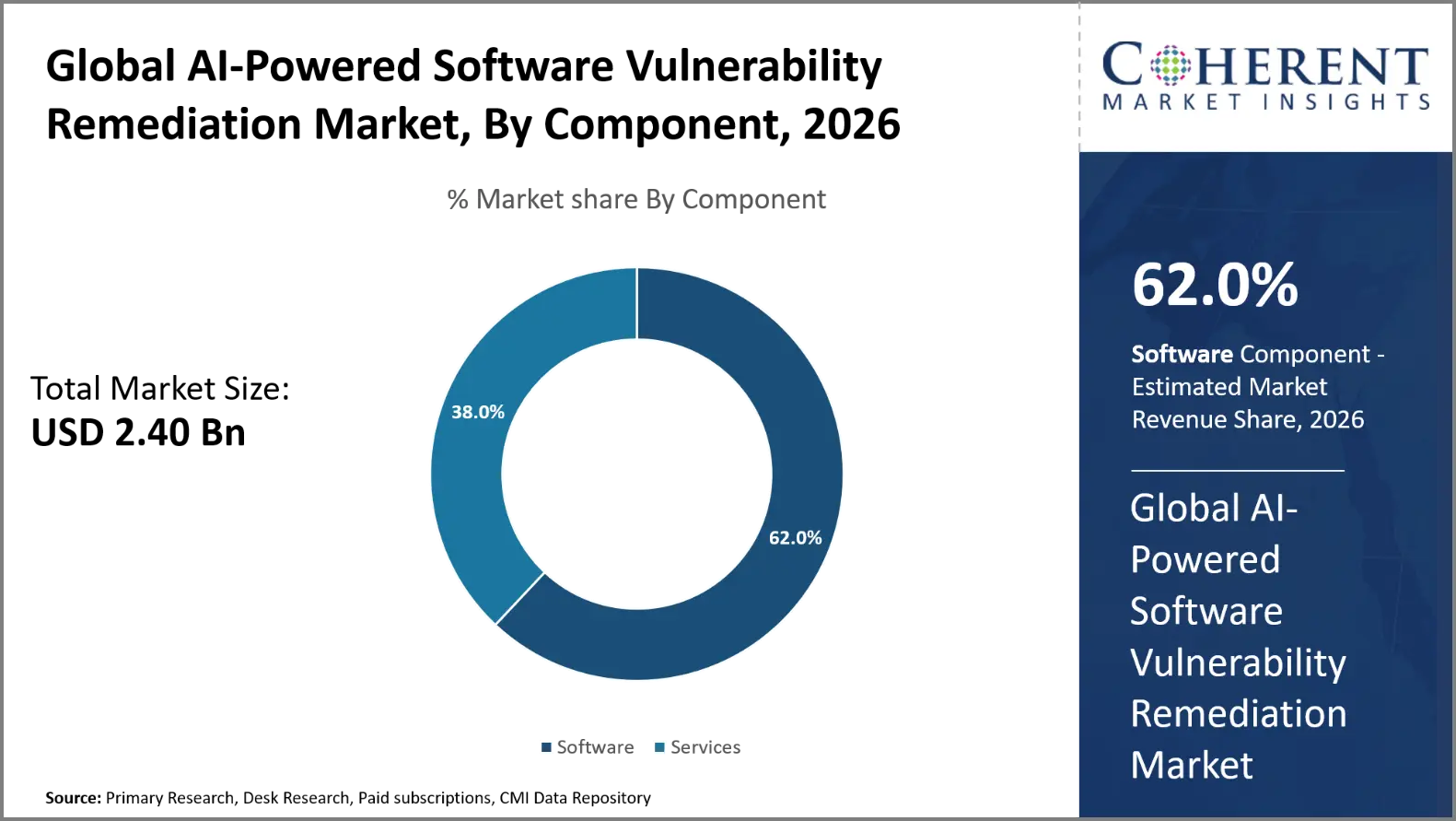
- The Software segment is expected to account for 62.0% of the global AI-powered software vulnerability remediation market share in 2026. Increasing security risks associated with AI-generated application code is driving the growth of the segment. On April 14, 2026, GitLab introduced general availability of Agentic SAST Vulnerability Resolution through GitLab Duo Agent Platform. The agent analyzes confirmed static application security testing findings and generates corrective code changes.
- The Cloud-Based segment is estimated to capture 49.0% of the market share in 2026. Expansion of cloud-native application and container deployments is majorly driving the growth of the segment. On August 31, 2026, RapidFort announced an integration with CrowdStrike Falcon Cloud Security for Kubernetes container vulnerability remediation. The integration combines vulnerability intelligence with automated container image hardening.
- The Machine Learning-Based Remediation segment is estimated to capture 38.0% of the market share in 2026. Growing adoption of continuous integration and continuous delivery pipelines is driving the growth of the segment. On September 2, 2026, JFrog introduced Zero-Touch Remediation for its self-healing software supply chain platform. It automatically discovers accessible vulnerability solutions and applies them using the current software processes.
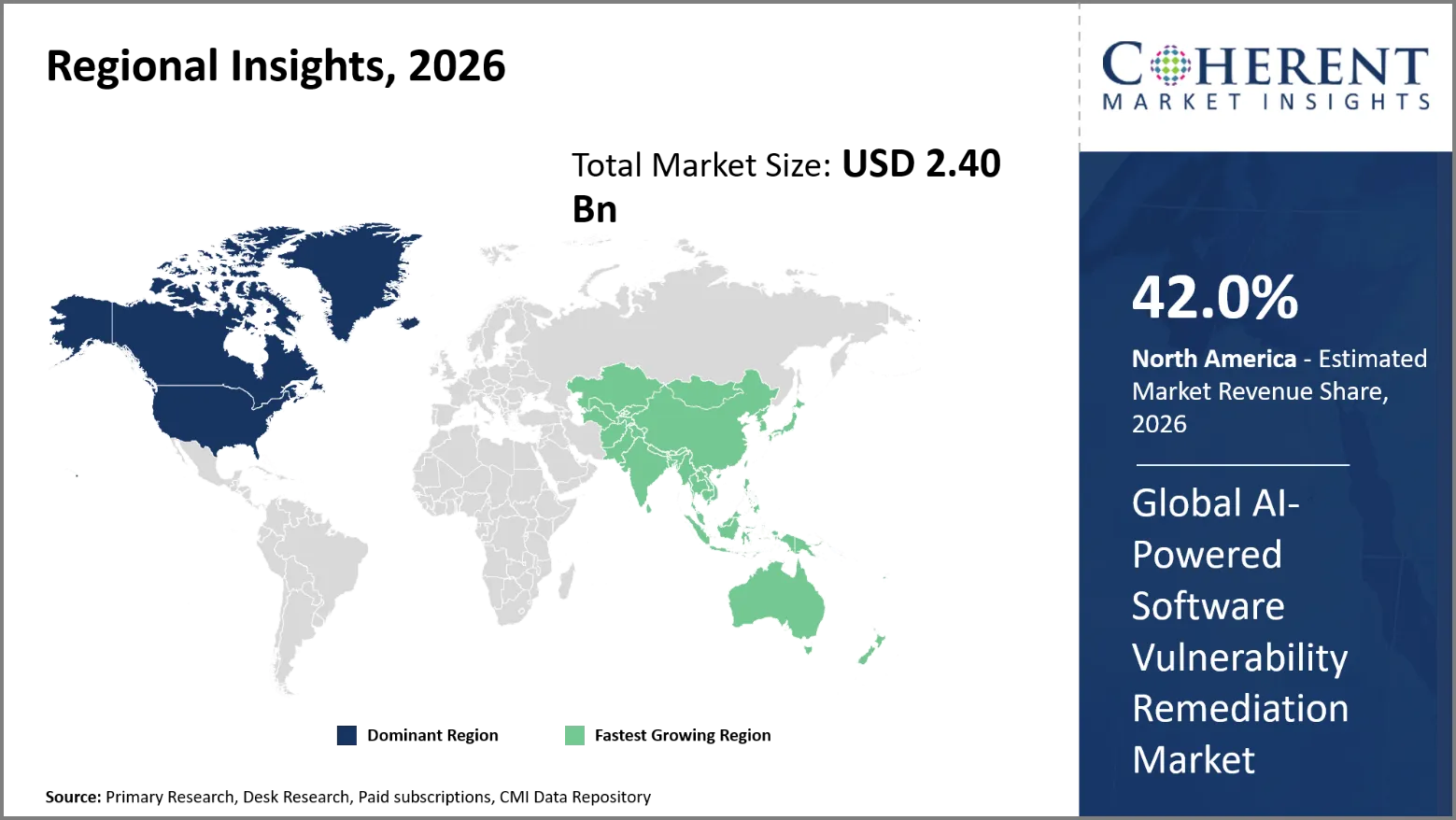
- North America is expected to dominate the AI-powered software vulnerability remediation market in 2026 with a market share of 42.0%. Increasing demand for faster vulnerability resolution and reduced remediation backlogs in North America is driving the growth of the regional market. On March 16, 2026, NinjaOne unveiled NinjaOne Vulnerability Management, to accelerate vulnerability discovery and mitigation for enterprises. The platform combines real-time vulnerability assessment, AI-driven prioritization, patch confidence scoring, and remediation workflows.
- Asia Pacific is expected to account for 23.0% share in 2026. Expansion of AI-powered remediation for cloud-native applications in Asia Pacific is driving the growth of the regional market. On August 4, 2026, Indusface launched SwyftComply AI, an autonomous vulnerability remediation platform for enterprise applications. The solution virtually patches vulnerabilities identified through AI-assisted penetration testing.
Segmental Insights
Why Does Software Dominate the Global AI-Powered Software Vulnerability Remediation Market?
The software segment is expected to account for 62.0% of the global AI-powered software vulnerability remediation market share in 2026. Software dominates because vulnerabilities are mostly introduced in application code and software dependencies. Organizations are increasingly running complex apps, microservices, APIs and open-source components. Security is a perpetual danger in these setups, necessitating constant scanning for vulnerabilities and their remedy. AI-powered software solutions detect insecure coding patterns, generate remediation code and suggest secure dependency upgrades. They also connect with development environments and continuous integration pipelines. This connection allows developers to fix vulnerabilities prior to deploying to production.
On July 22, 2025, Cycode, the leader in AI-native application security, announced the launch of its AI Exploitability Agent, making its premiere at Black Hat 2025. This new tool allows security teams with an AI Teammate to prioritize and remediate high-risk, exploitable issues 99% faster.
- Current Industry Events of 2026
- Market Size Estimation
- Regional Breakdown
- Competitive Landscape
- Customer Intelligence
- Segmental Analysis
- Pricing Analysis
- Key Market Drivers, Challenges & Future Trends
- Customized Insights Section
Why is Cloud-Based the Most Preferred Deployment Type?
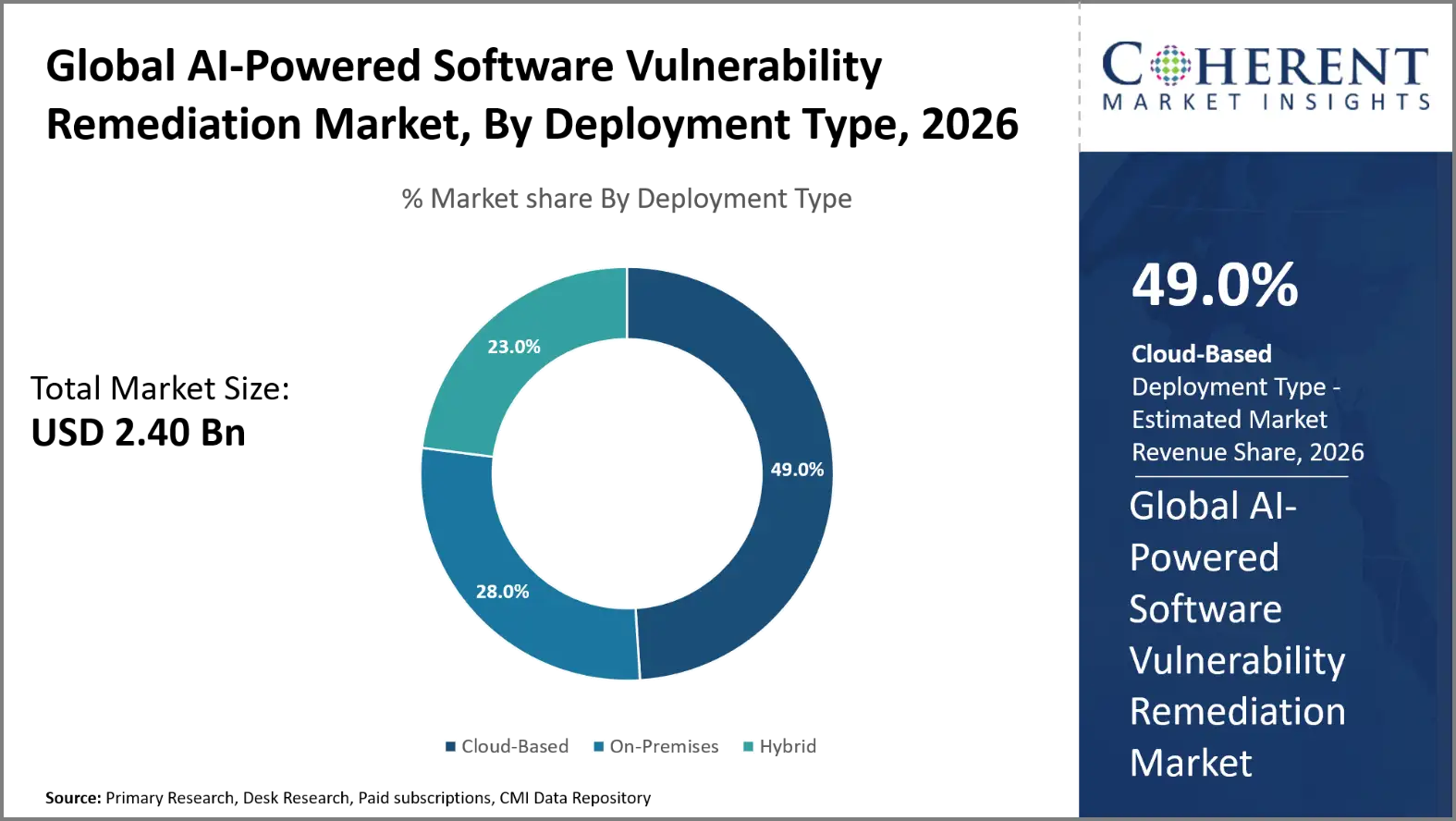
The cloud-based segment is expected to account for 49.0% of the global AI-powered software vulnerability remediation market share in 2026. Cloud-based deployment is preferred as organizations need scalable vulnerability remediation across distributed software development platforms. Cloud platforms offer centralized security monitoring, automatic vulnerability scanning, and ongoing remediation. They reduce the large infrastructure maintenance needs of on-premise deployments. Organizations can incorporate cloud-based remediation solutions into source-code repositories, development environments, and continuous integration pipelines. These interfaces provide speedier security updates for development teams spread across geographies. Cloud implementation also gives access to sophisticated artificial intelligence models and centralized security intelligence.
On June 10, 2025, Datadog announced new security capabilities, to detect and remediate vulnerabilities across cloud and AI applications. It launched its programs Security tool that offers vulnerability detection for custom programs and open-source libraries.
Machine Learning-Based Remediation Dominates the Global AI-Powered Software Vulnerability Remediation Market
The machine learning-based remediation segment is expected to account for 38.0% of the global AI-powered software vulnerability remediation market share in 2026. Machine learning-based remediation is dominant because it can smartly detect vulnerabilities, understand context, and suggest fixes automatically. Machine learning algorithms analyze the source code and detect suspicious patterns, and determine the relationship between vulnerable components. These skills assist security teams prioritize vulnerabilities based on severity and likelihood of exploitation. Models also learn from past patterns of susceptibility, and instances of effective repair. This enhances recommendations for corrective actions across recurring software security problems. Snyk Agent Fix combines security intelligence and huge language models with iterative verification.
On April 9, 2026, Appknox launched KnoxIQ, an artificial intelligence-powered vulnerability prioritization and remediation platform. It reviews security discoveries and prioritizes vulnerabilities based on real-world exploitability. The platform offers per-application contextual remediation code.
Current Events and their Impact
Current Events | Description and its Impact |
European Union - Cyber Resilience Act (Regulation (EU) 2024/2847) |
|
European Union - Network and Information Security Directive 2 (Directive (EU) 2022/2555) |
|
AI-Powered Software Vulnerability Remediation Market Dynamics
Market Drivers
Increasing volume of software vulnerabilities across enterprise applications
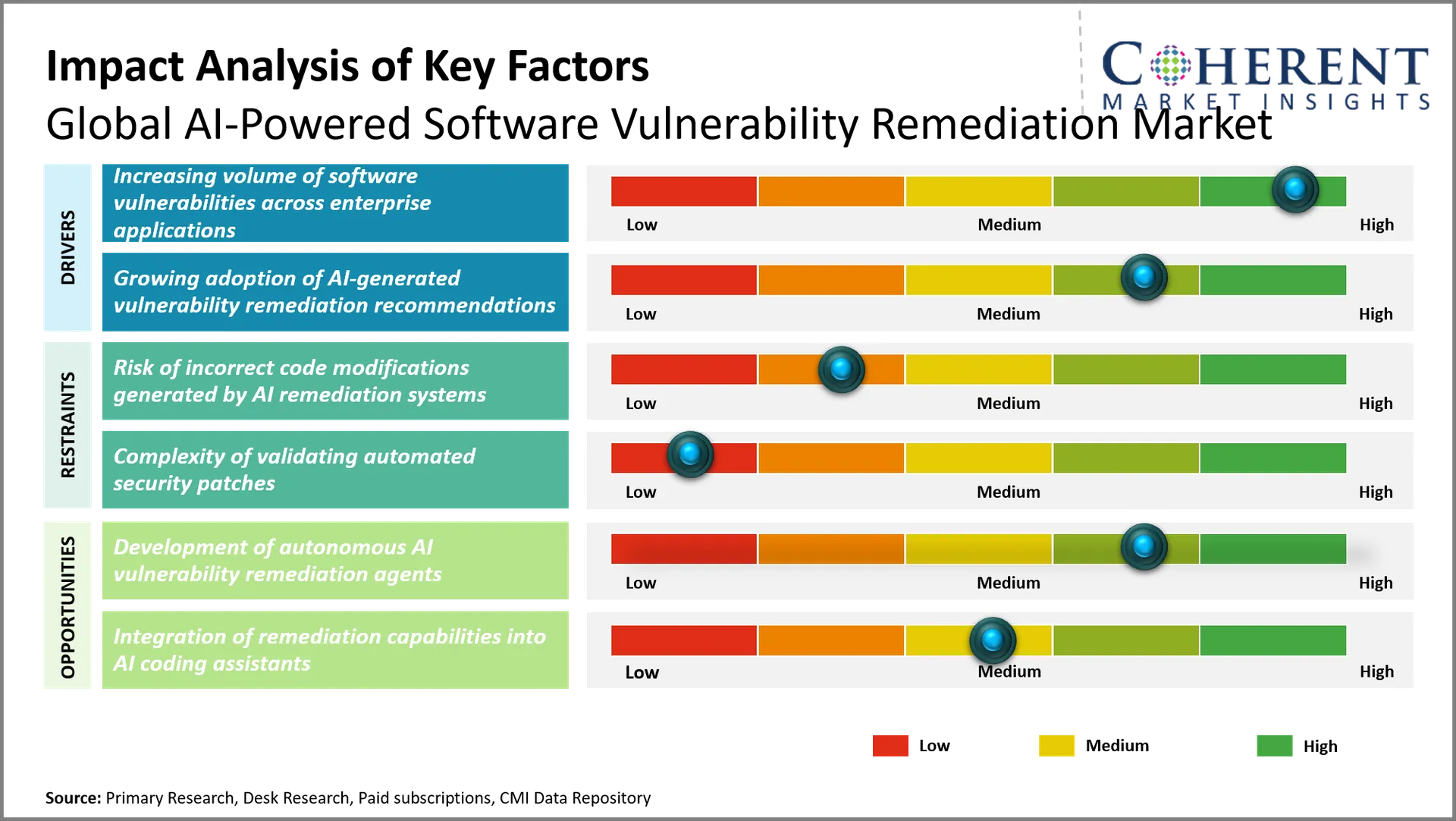
The rising number of software vulnerabilities in enterprise applications is fueling the demand for AI-powered remediation solutions. Enterprises are increasingly running a spider web of interconnected applications, cloud platforms, application programming interfaces and third-party software dependencies. Such settings also create new security vulnerabilities and increase the attack surface for organizations. Also, frequent program changes present potential for code vulnerabilities and configuration mistakes. In 2025, the National Vulnerability Database cataloged thousands of newly revealed vulnerabilities. This is making it harder and harder for security teams to find, prioritize and fix vulnerabilities. AI-powered remediation platforms analyze the application code and suggest specific security fixes.
On May 20, 2026, JFrog announced the disclosure of 48,000+ new Common Vulnerabilities and Exposures in 2025. This was an annual rise of 20%. Its analysis also found 177,000 additional malicious npm packages on software repositories.
Growing adoption of AI-generated vulnerability remediation recommendations
The increasing adoption of AI-generated vulnerability remediation recommendations drives the demand for intelligent application security platforms. More organizations are employing artificial intelligence to convert vulnerability findings into practical repair instructions. Most security tools can discover holes, but they don’t provide enough advise on how to fix them. AI platforms review source code to pinpoint problematic functions and offer corrective programming changes. Large language models can also develop context-aware patches for software vulnerabilities they identify.
On April 30, 2025, HCLSoftware, a global leader in corporate software solutions, announced the launch of HCL AppScan RapidFix, in partnership with Pixee. This novel solution consists of two agentic components, AI-enabled auto-triage and auto-fix, built on a deterministic OSS Codemodder framework.
Emerging Trends
- Agentic AI-Based Autonomous Vulnerability Remediation: Agentic AI is helping security platforms to explore vulnerabilities, create patches, conduct tests and provide recommendation for remedial steps with minimum developer participation. These systems enable speedier remediation across complicated enterprise software landscapes.
- Impact: Self-healing minimizes manual security efforts and shortens vulnerability mitigation cycles. It also allows development teams to manage larger vulnerability backlogs without hiring security staff at the same rate.
- Relevance to the market: This trend is represented by Google’s CodeMender, which features autonomous vulnerability discovery and code repair. Its features give chances for manufacturers to develop agentic security products with automated patch validation.
- Context-Aware Remediation Through Large Language Models: Large language models are being used more to assess source-code context, dependency linkages, and vulnerability descriptions. They create security remedies specifically for the problem, instead of using pre-determined patching criteria.
- Impact: Context-aware remediation enhances fix accuracy and minimizes unnecessary code changes. This also allows developers to identify the vulnerabilities and to make suitable programming changes to correct them.
- Relevance to the market: GitHub Copilot Autofix provides code suggestions to resolve CodeQL security alerts. Snyk Agent Fix enables the creation of patches for particular vulnerabilities, therefore increasing the need for integrated remediation platforms.
Regional Insights
Why is North America a Strong Market for AI-Powered Software Vulnerability Remediation?
North America is expected to account for a market share of 42.0% in 2026. The region has sophisticated application security ecosystems and large enterprise investments in automated software protection. U.S. corporations are using artificial intelligence to prioritize vulnerabilities and handle patching. On September 17, 2025, CrowdStrike announced AI-Powered Risk-based Patching through its Falcon platform, which combines vulnerability prioritization with enterprise patching operations. OpenText, a Canada-based cybersecurity business, offers contextual source-code vulnerability patches with its Fortify Remediation Aviator. Other players in the area ecosystem include AI-native cyber security startup Kai. In 20 hours, the platform evaluated 250 million vulnerability findings. These developments indicate substantial regional demand for intelligent remediation and automated security operations.
Why Does Asia Pacific AI-Powered Software Vulnerability Remediation Market Exhibit High Growth?
Asia Pacific is expected to register the fastest growth with a CAGR of 28.5% over the forecast period. The region is projected to account for 23.0% of the global AI-powered software vulnerability remediation market in 2026 and benefits from expanding artificial intelligence development, semiconductor ecosystems, and large-scale digital infrastructure investments. Singapore is emerging as an important software remediation innovation hub. Sonar developed its SonarQube Remediation Agent using research originating at the National University of Singapore. Its technology supports automated code analysis and developer-approved fixes. Singapore customers include Singapore Airlines, Oversea-Chinese Banking Corporation, Thales Singapore, and YouTrip. Through SoftBank Group’s cybersecurity services, Japan is also making headway in fixing vulnerabilities in enterprises. These initiatives highlight regional demand for intelligent code correction spanning financial services, aviation, telecoms and critical infrastructure.
Global AI-Powered Software Vulnerability Remediation Market Outlook for Key Countries
Why is U.S. Emerging as a Major Hub in the AI-Powered Software Vulnerability Remediation Market?
Focused cybersecurity research, advanced cloud infrastructure, and broad enterprise software development are a boon to the U.S. Federal cybersecurity priorities also support better skills for vulnerability remediation. Google DeepMind created CodeMender to find and fix vulnerabilities at the code level autonomously. Google Cloud adds these features into its AI-driven security procedures. IBM Concert Protect provides contextual vulnerability prioritization and automated patching. IBM reports that its auto-patching capabilities can reduce median critical vulnerability resolution time by up to 90%. Demand for remediation platforms is being driven by these trends across financial institutions, technological businesses, government contractors and cloud infrastructure operators.
Is China the Next Growth Engine for the AI-Powered Software Vulnerability Remediation Market?
China’s market expansion is driven by domestic cybersecurity innovation and extensive software supply-chain security requirements. The Qi-Anxin Technology Group offers sophisticated vulnerability scanning for operating systems, databases, websites and network infrastructure. Its vulnerability management software has around 570,000 vulnerability signatures. The company also sells Qcode Agents for AI-assisted code security activities. These capabilities address enterprise needs for software vulnerability identification and accelerated remediation. China's Multi-Level Protection Scheme further drives enterprises to enhance their risk assessment. Domestic technology procurement also helps to deploy locally designed cybersecurity platforms in government and enterprise sectors.
Germany AI-Powered Software Vulnerability Remediation Market Analysis and Trends
In the German market, industrial software security requirements and large-scale enterprise resource planning deployments are of great significance. Auto suppliers, makers and engineering firms with connected manufacturing systems require unique vulnerability repair. SecurityBridge GmbH offers security solutions tailored for SAP settings. The platform secures SAP NetWeaver, ABAP, Java and SAP S/4HANA systems. The features include code security, vulnerability monitoring, patch management and configuration validation. They meet security needs in complicated enterprise resource planning systems. Germany’s industrial digitization also pushes software vendors to reinforce application security in the course of the production process.
U.K. AI-Powered Software Vulnerability Remediation Market Analysis and Trends
The U.K. benefits from an established ecosystem of cybersecurity technology and dedicated software security companies. In its 2026 sectoral analysis, the Department for Science, Innovation and Technology found 1,141 active software security firms. 97% of the verified vendors provided application security. There are companies like PortSwigger, OnSecurity, Mindgard that have specialized security capabilities. Burp Suite is a web application security testing tool by PortSwigger. His Majesty’s Courts and Tribunals Service also trialed agentic AI remediation with CGI. Their governed methodology lowered vulnerability remediation effort from hours to minutes.
Japan AI-Powered Software Vulnerability Remediation Market Analysis and Trends
Critical infrastructure protection and cybersecurity requirements across industrial firms underpin Japan’s market development. SoftBank Group on June 16, 2026 revealed their Patching as a Service solution. The service combines OpenAI’s technology and SoftBank’s cybersecurity know-how. It provides corporate vulnerability assessment, remediation strategy and implementation advisory. That’s the answer in the Japanese market offered by SB OAI Japan GK. This breakthrough meets security needs across telecommunications, manufacturing and critical infrastructure sectors. Japan’s mature automotive and electronics sectors are also driving demand for software vulnerability repair. These industries operate interconnected production technologies requiring reliable security maintenance.
Global AI-Powered Software Vulnerability Remediation Market - Agentic AI-Based Autonomous Vulnerability Remediation
Company | Product / Platform | Announcement Date | Core Capability | Autonomous Remediation Function | Validation Method |
Qualys | Agent Val | March 23, 2026 | AI-powered exploit validation and exposure remediation | Exploits mitigate and revalidate exposures against security controls | Safe exploit validation and control verification |
Tenable | Tenable Hexa AI | May 20, 2026 | Agentic exposure management and remediation orchestration | Prioritizes exposures creates tickets generates policies and coordinates remediation | Multi-step reasoning and contextual exposure intelligence |
Cogent | Autonomous Remediation | May 27, 2026 | Autonomous vulnerability response | Determines corrective actions assesses business impact and confirms resolution | Post-remediation vulnerability confirmation |
HackerOne | H1 Platform | June 2, 2026 | Agentic continuous threat exposure management | Discovers validates prioritizes and routes exploitable vulnerabilities for remediation | Exploitability validation and attack-path analysis |
ServiceNow | Vulnerability Resolution AI Specialist | August 4, 2026 | AI-driven vulnerability resolution | Orchestrates vulnerability triage and remediation including low-risk patch execution | Governance auditability and business-context enrichment |
How is Development of Autonomous AI Vulnerability Remediation Agents Creating New Growth Opportunities in the AI-Powered Software Vulnerability Remediation Market?
The emergence of autonomous AI vulnerability remediation agents presents new prospects for growth, helping organizations to automate the discovery of vulnerabilities, assess risks, implement patches, and verify repair after it’s done. These agents manage complex security workflows and enforce enterprise-defined approval requirements. On July 15, 2026, Cogent unveiled Autonomous Vulnerability Response, which allows for end-to-end vulnerability treatment without human interaction where policies permit. On March 23, 2026, Qualys released Agent Val, providing safe exploit validation and autonomous risk remediation. ServiceNow Vulnerability Resolution AI Specialist, released August 2026, for enterprise-scale vulnerability triage and repair. These are steps toward providers of policy-controlled autonomous agents, certified patch deployment, and interaction with enterprise change-management systems.
Market Players, Key Development, and Competitive Landscape
Key Developments
- On July 14, 2026, Checkmarx enhanced its Assist Agent family with self-healing application security capabilities. Developer Assist discovers, fixes and validates vulnerabilities in the software development lifecycle. Its Triage and Remediation agents emphasize current vulnerabilities in applications.
- On June 22, 2026, OpenAI announced an expansion of Daybreak, with better defensive cybersecurity capabilities. The announcement also included an updated Codex Security plugin to find and fix vulnerabilities. The platform speeds up security reviews, patch development and validation of vulnerabilities in existing software.
- On December 18, 2025, Apiiro released AI-SAST, to automate vulnerability identification, validation and repair. The platform relies on the synergy of abstract syntax tree scanning, Large Language Models and Deep Code Analysis. The technology investigates application architecture, data flows, dependencies and runtime interactions.
Competitive Landscape
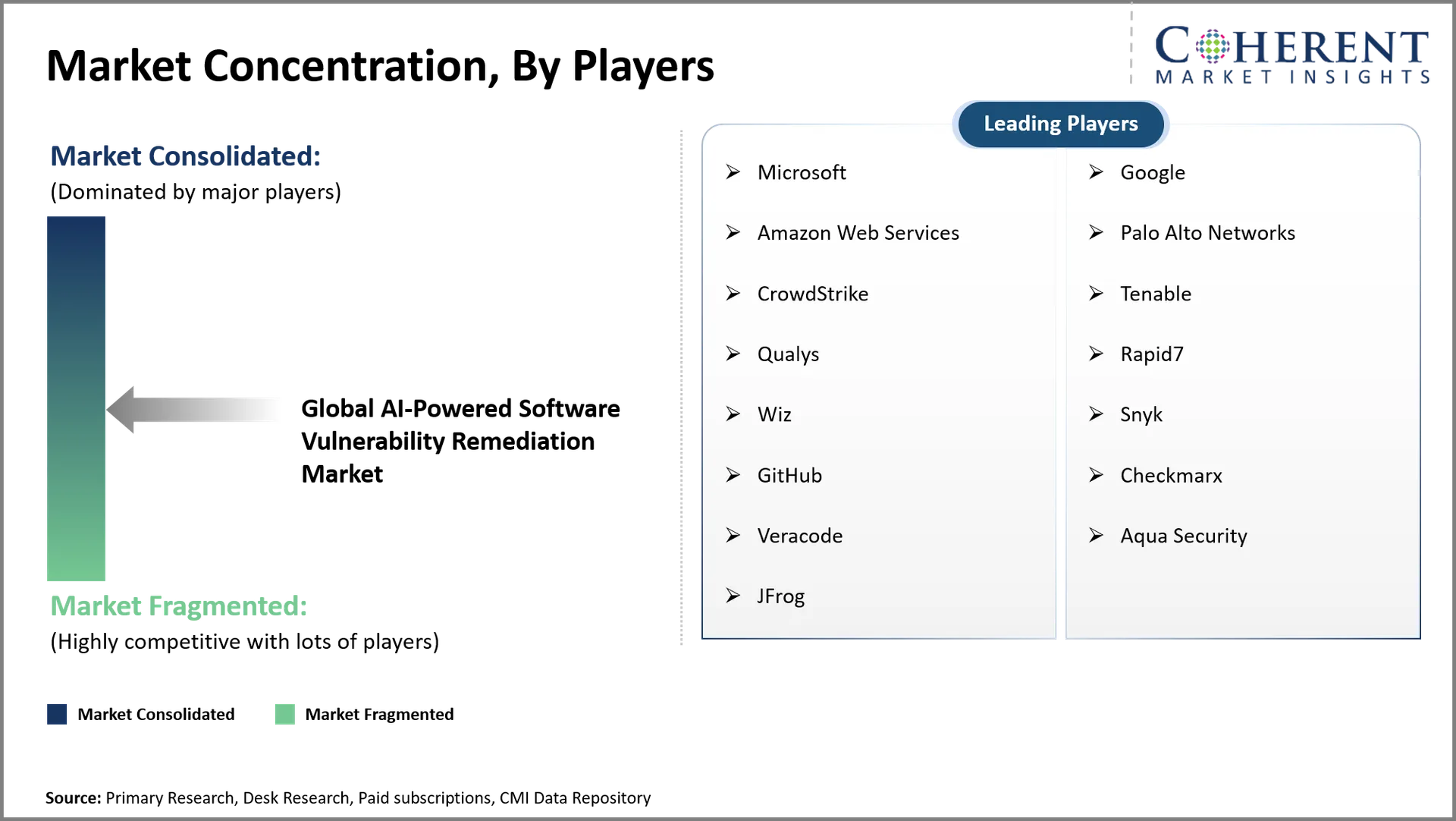
The global AI-powered software vulnerability remediation market consists of established application security providers and new agentic cybersecurity startups. CodeMender gives Google another way to bring together autonomous code analysis, exploit verification and verified patch production. Black Duck stands out with Signal Agentic Fix that combines deterministic static analysis, software composition analysis, AI-driven triage and validated patches. Qualys is focused on exploitability-driven remediation with Agent Val and its Enterprise TruRisk Management platform. Evo’s Remediation Agent bolsters Snyk’s agentic security ecosystem. IBM and Red Hat’s Lightwell tackles open-source dependency problems with 6,500+ remedied application dependencies Cloudflare integrates vulnerability discovery, edge protection and AI-generated patches. These strategies emphasize verified remediation, enterprise integration, dependency security, and developer-controlled automation.
Top Companies/Manufacturers and Notable Products/Solutions in the AI-Powered Software Vulnerability Remediation Market
Company/Manufacturer | Notable Product/Solution | Key features |
Snyk | Snyk Agent Fix | AI-generated code fixes contextual vulnerability analysis iterative fix verification secure dependency upgrades IDE integration |
GitHub | GitHub Copilot Autofix with CodeQL | AI-generated code remediation CodeQL vulnerability detection pull request recommendations developer workflow integration security explanations |
Checkmarx | Checkmarx One | AI-assisted vulnerability remediation static application security testing software composition analysis agentic security workflows risk prioritization |
Veracode | Veracode Fix | AI-generated corrective code vulnerability explanation secure code recommendations automated remediation workflows developer integration |
Qualys | Qualys Agent Val and Agent Sara | Autonomous exploit validation AI-driven remediation planning automated patching mitigation orchestration post-remediation verification |
AI-Powered Software Vulnerability Remediation Market | |||
Report Coverage | Details | ||
Base Year | 2025 | Market Size in 2026: | USD 2.40 Bn |
Historical Data For: | 2020 To 2024 | Forecast Period: | 2026 To 2033 |
Forecast Period 2026 To 2033 CAGR: | 24% | 2033 Value Projection: | USD 10.80 Bn |
Geographies covered: |
| ||
Segments covered: |
| ||
Companies covered: | Microsoft, Google, Amazon Web Services, Palo Alto Networks, CrowdStrike, Tenable, Qualys, Rapid7, Wiz, Snyk, GitHub, Checkmarx, Veracode, Aqua Security, JFrog | ||
Growth Drivers: |
| ||
Restraints & Challenges: |
| ||
Analyst Opinion (Expert Opinion)
- The industry will increasingly transition from vulnerability detection software toward autonomous remediation platforms. AI agents will coordinate vulnerability validation, code correction, dependency replacement, and regression testing. Hybrid architectures combining deterministic security engines with generative AI will become commercially important. Vendors will differentiate through verified fixes, programming-language coverage, and controlled remediation permissions. Enterprises will increasingly look for systems that can repair vulnerabilities without stopping the production applications.
- The biggest opportunity is for software-based, cloud-delivered, machine learning driven remedial solutions. There are economic potential in application security, open-source dependency management and enterprise software maintenance. The U.S. will remain a major market because of its cybersecurity providers and large business software ecosystem. Germany is a land of opportunity for industrial software and automotive applications Japan has prospects for software development and connected operational technology. India too provides promise, with its growing software development services and domestic cyber security platforms.
- Market players ought to give priority to autonomous remediation agents that produce fixes and check application functionality before submission. Vendors should become proficient in Java, Python, JavaScript, C++ and enterprise frameworks. Integrations with GitHub, GitLab, Jenkins, and key cloud environments can help boost developer adoption. Companies should also support private deployment, audit trails, approval workflows and explainable remediation decisions. Partnerships with cloud providers and managed security service providers help speed enterprise distribution. Stronger competitive distinction can be built with specialized dependency remediation and legacy application support.
Speak to the analyst
Want personalized insights?
Take the findings above to one of our principal consultants, or have the report rebuilt around the segments, geographies and competitors you actually track.
Market Segmentation
- Component Insights (Revenue, USD Billion, 2021 - 2033)
- Software
- Services
- Deployment Type Insights (Revenue, USD Billion, 2021 - 2033)
- Cloud-Based
- On-Premises
- Hybrid
- Technology Type Insights (Revenue, USD Billion, 2021 - 2033)
- Machine Learning-Based Remediation
- Generative AI-Based Remediation
- Large Language Model-Based Remediation
- AI Agent-Based Remediation
- Rule-Based Automated Remediation
- Application Insights (Revenue, USD Billion, 2021 - 2033)
- Application Security
- Cloud Security
- Endpoint Security
- Container Security
- API Security
- Open-Source Software Security
- Infrastructure Security
- End User Insights (Revenue, USD Billion, 2021 - 2033)
- BFSI
- Healthcare
- IT and Telecommunications
- Retail and E-Commerce
- Manufacturing
- Government
- Energy and Utilities
- Regional Insights (Revenue, USD Billion, 2021 - 2033)
- North America
- U.S.
- Canada
- Latin America
- Brazil
- Argentina
- Mexico
- Rest of Latin America
- Europe
- Germany
- U.K.
- Spain
- France
- Italy
- Russia
- Rest of Europe
- Asia Pacific
- China
- India
- Japan
- Australia
- South Korea
- ASEAN
- Rest of Asia Pacific
- Middle East
- GCC Countries
- Israel
- Rest of Middle East
- Africa
- South Africa
- North Africa
- Central Africa
- North America
- Key Players Insights
- Microsoft
- Amazon Web Services
- Palo Alto Networks
- CrowdStrike
- Tenable
- Qualys
- Rapid7
- Wiz
- Snyk
- GitHub
- Checkmarx
- Veracode
- Aqua Security
- JFrog
Sources
Primary Research Interviews
- Chief Information Security Officers (CISOs)
- Software Security Engineers & DevSecOps Professionals
- AI/ML Solution Architects & Developers
- Vulnerability Management & Threat Intelligence Analysts
Magazines
- SC Magazine (Cybersecurity)
- Dark Reading
- Infosecurity Magazine
- IEEE Spectrum
Journals
- Journal of Cybersecurity (Oxford Academic)
- IEEE Transactions on Information Forensics and Security
- Journal of Information Security and Applications (Elsevier)
Associations
- International Information System Security Certification Consortium (ISC²)
- Cloud Security Alliance (CSA)
- ISACA (Information Systems Audit and Control Association)
- Open Web Application Security Project (OWASP)
Public Domain Sources
- National Institute of Standards and Technology (NIST) – Cybersecurity Framework
- U.S. Cybersecurity and Infrastructure Security Agency (CISA)
- European Union Agency for Cybersecurity (ENISA)
- MITRE ATT&CK Framework
Proprietary Elements
- CMI Data Analytics Tool
- Proprietary CMI Existing Repository of Information for Last 10 Years
Get access to 250+ pages report
Every segment, forecast, competitor profile and data table behind the analysis above — available for instant download.
- ESOMAR Member
- ISO 9001:2015 Certified
- D-U-N-S Registered
- GDPR & CCPA Compliant
Frequently Asked Questions
The global AI-powered software vulnerability remediation market is expected to stand at USD 2.40 Bn in 2026 and is expected to reach USD 10.80 Bn by 2033.
The CAGR of the global AI-powered software vulnerability remediation market is projected to be 24% from 2026 to 2033.
Increasing volume of software vulnerabilities across enterprise applications and Growing adoption of AI-generated vulnerability remediation recommendations are the major factors driving the growth of the global AI-powered software vulnerability remediation market.
Risk of incorrect code modifications generated by AI remediation systems and Complexity of validating automated security patches are the major factors hampering the growth of the global AI-powered software vulnerability remediation market.
In terms of component, software segment is estimated to dominate the market revenue share in 2026.
It covers software solutions using artificial intelligence to identify, prioritize, and automatically correct software security vulnerabilities.
Large language models interpret security findings and generate context-aware code corrections for identified vulnerabilities.