

Global Large Language Model Market Size and Forecast: 2026-2033
The global large language model market is estimated to be valued at USD 11.55 Bn in 2026 and is expected to reach USD 92.00 Bn by 2033, exhibiting a compound annual growth rate (CAGR) of 34.5% from 2026 to 2033.
Key Takeaways of the Global Large Language Model Market
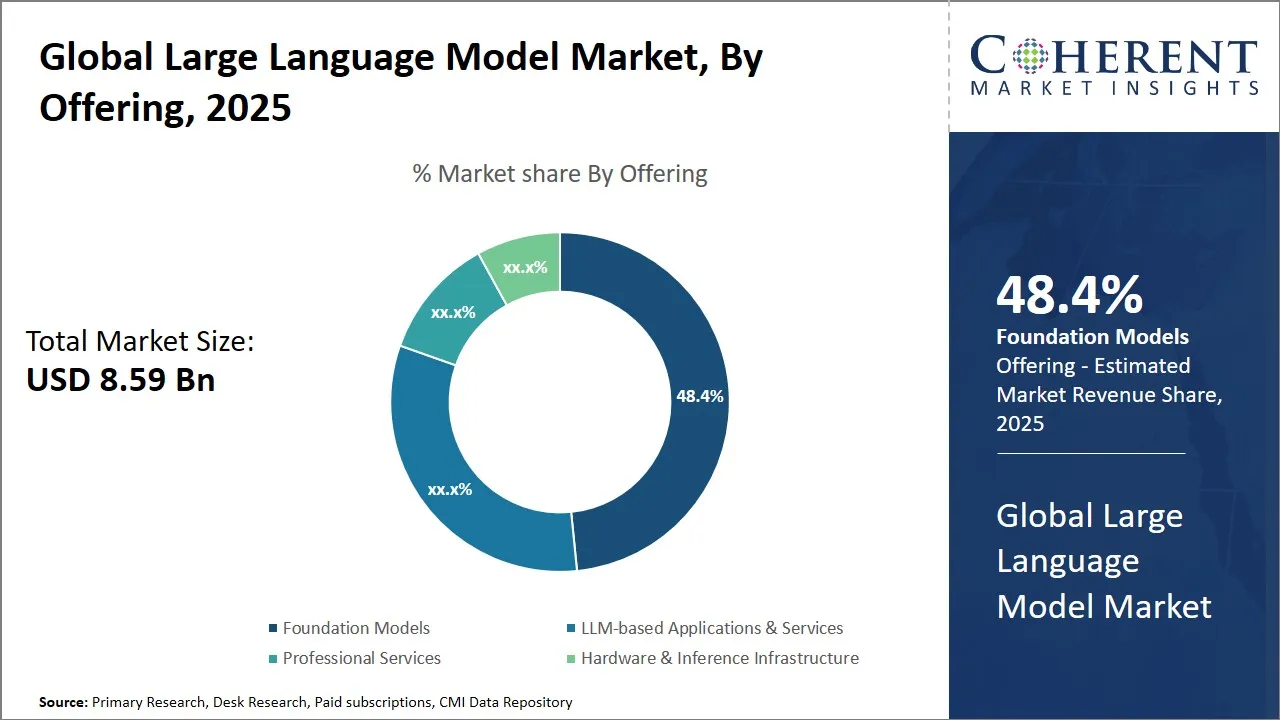
- The foundation models segment leads the market holding an estimated share of 49.4% in 2026.
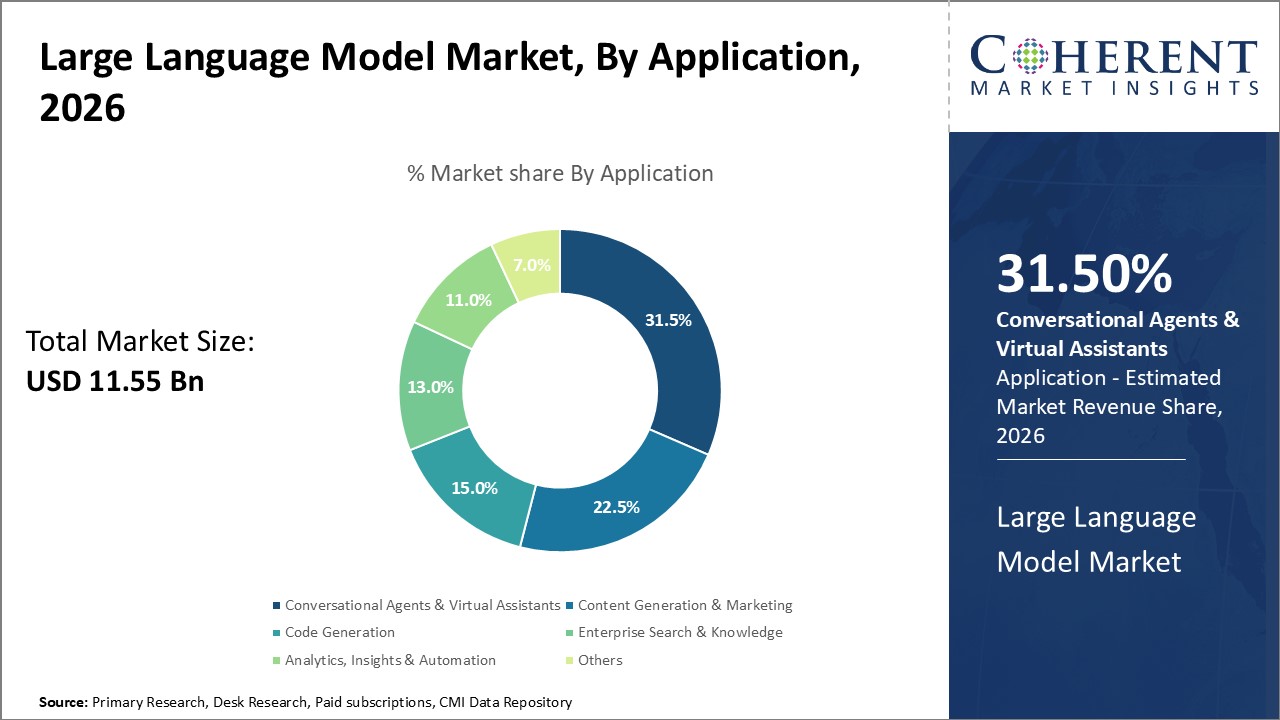
- The conversational agents & virtual assistants segment leads the market holding an estimated share of 31.5% in 2026.
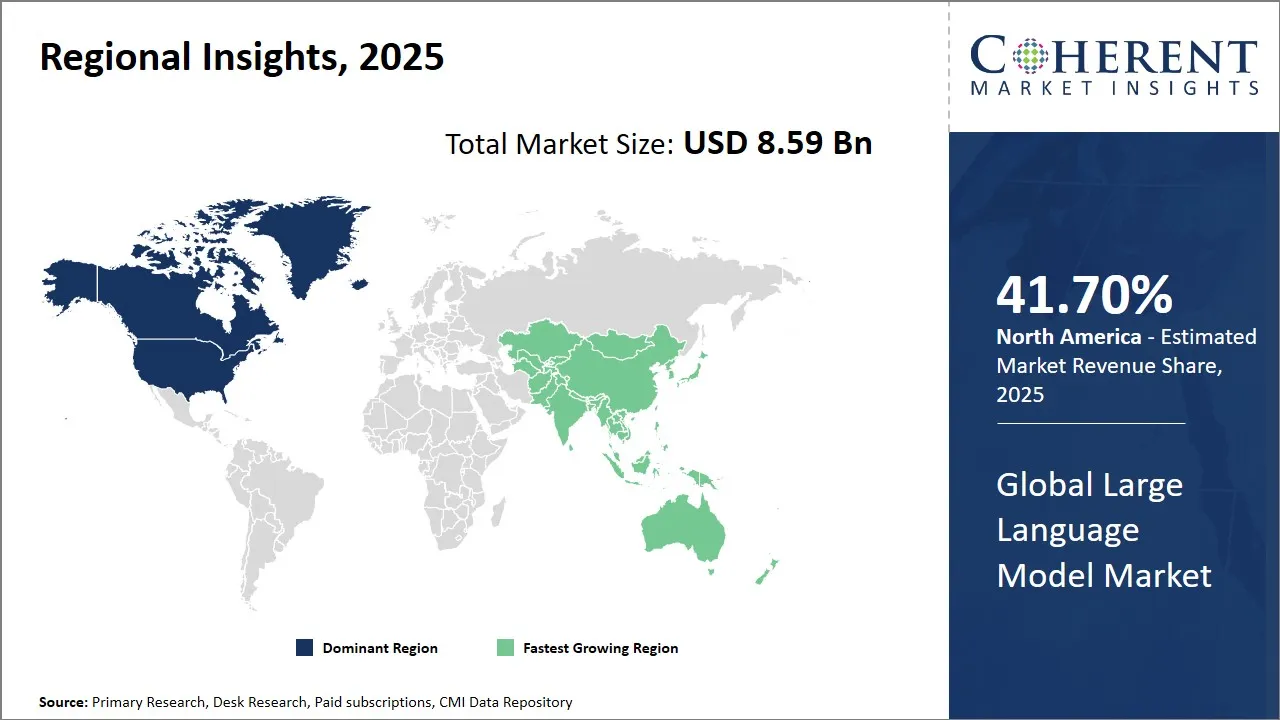
- North America is estimated to lead the market with a share of 41.7% in 2026.
- Asia Pacific, holding an estimated share of 25.2% in 2026, and it is projected to be the fastest growing region.
Market Overview
A market trends highlight a strong shift towards integration of Large Language Models (LLMs) with cloud-based platforms, enabling scalable and cost-effective deployment. Additionally, there is growing focus on enhancing model accuracy and interpretability, driven by advancements in deep learning techniques and the incorporation of multimodal data sources. These trends are expected to propel innovation and create new opportunities, further accelerating the market growth throughout the forecast period.
Current Events and their Impact
Current Events | Description and its Impact |
OpenAI — GPT-5 Public Release |
|
EU AI Act — Guidelines for GPAI and Implementation Milestones |
|
White House — America’s AI Action Plan and Related Executive Steps (2025) |
|
Segmental Insights
- Current Industry Events of 2026
- Market Size Estimation
- Regional Breakdown
- Competitive Landscape
- Customer Intelligence
- Segmental Analysis
- Pricing Analysis
- Key Market Drivers, Challenges & Future Trends
- Customized Insights Section
Global Large Language Model Market Insights, By Offering – Foundation Models Segment Leads Owing to their Unparalleled Adaptability and Versatility
The foundation models segment is expected to capture 49.4% share in 2026. These models serve as the underlying architecture that enables LLMs to understand, generate, and manipulate human language with remarkable precision and fluency. The flexibility of foundation models enables them to be fine-tuned across multiple downstream tasks, reducing the need for developing task-specific models from scratch. This adaptability makes them invaluable for enterprises seeking to implement advanced AI-driven solutions without the prohibitive costs and time associated with custom model development.
Second, advancements in model architectures and training techniques have significantly enhanced the performance of Foundation Models, enabling them to process larger datasets and capture nuanced contextual information. Organizations increasingly leverage these models to automate complex language tasks, including summarization, translation, and sentiment analysis, which previously required significant human effort. Third, the open-source nature and collaborative development of many Foundation Models contribute to their widespread usage. Companies benefit from shared research efforts, allowing them to build upon robust pre-trained models while customizing them for specific industry needs.
Moreover, foundation models form the essential layer upon which increasingly sophisticated LLM-based applications and services are built. Their continual improvement also ensures that hardware and inference infrastructure advances are more effectively utilized, creating a reinforcing cycle of the growth.
Global Large Language Model Market Insights, By Application – Conversational Agents & Virtual Assistants Lead the Market Driven by Increasing Demand for Intelligent, Personalized User Interactions
The conversational agents & virtual assistants segment holds the highest market share of 31.5% in 2026. The surge in digital transformation and remote interactions across industries has created a strong demand for AI-powered conversational tools. Enterprises across retail, banking, healthcare, and telecommunications are incorporating conversational AI to reduce support costs and increase satisfaction. Secondly, advances in Natural Language Understanding (NLU) and context retention have markedly improved the capabilities of conversational agents. Modern LLMs can comprehend nuanced queries, maintain multi-turn conversations, and handle complex user intents, which makes virtual assistants significantly more effective and reliable.
Third, the proliferation of smart devices—from smartphones to home automation hubs—has fueled user expectations for conversational interfaces. Virtual assistants embedded in these devices serve as natural touchpoints for managing daily tasks, accessing information, and controlling environments via voice commands. Moreover, enterprises are increasingly utilizing conversational agents to gather actionable insights from interactions, enabling proactive customer engagement and personalized service. Integration with CRM systems and data analytics platforms allows businesses to refine offerings and anticipate customer needs, further driving the segment’s growth. For instance, in 2023, Bank of America’s Erica virtual assistant, powered by AI and advanced NLP models, surpassed 1.5 billion client interactions, assisting customers with balance inquiries, bill payments, and personalized financial advice.
Impact of Artificial Intelligence (AI) on the Large Language Model Market
Artificial Intelligence (AI) is transforming industries by enhancing efficiency, accuracy, and decision-making across diverse sectors. In healthcare, AI-driven diagnostic tools can process medical images faster and more accurately than traditional methods, enabling earlier detection of diseases. In finance, AI models streamline fraud detection and algorithmic trading, while in customer service, chatbots powered by large language models handle millions of queries simultaneously, reducing costs and improving user experience. The widespread integration of AI is also reshaping the workforce by automating repetitive tasks and freeing human employees to focus on higher-value activities.
A real-world instance of AI’s impact is GitHub Copilot, powered by OpenAI’s Codex model. Since its launch, it has helped developers write code more efficiently by suggesting entire lines or functions in real time, reportedly increasing developer productivity by over 50% in certain tasks.
Regional Insights
North America Large Language Model Market Analysis and Trends
North America region is projected to lead the market with a 41.70% share in 2026, driven by a highly mature technology ecosystem, strong government support for AI research, and the presence of numerous leading tech giants. The U.S., in particular, benefits from robust investments in AI infrastructure, including cloud computing and data centers, which are crucial for training and deploying large models. The collaboration between academia and industry fosters innovation, while regulatory frameworks are increasingly supportive of AI development with emphasis on ethical use and data privacy. Notable companies such as OpenAI, Google (Alphabet), Microsoft, and Meta have been pivotal in advancing LLM capabilities, offering state-of-the-art models and platforms that cater to diverse commercial and research applications.
Asia Pacific Large Language Model Market Analysis and Trends
The Asia Pacific region, holding an estimated share of 25.2% in 2026, exhibits the fastest growth in the market, fueled by expanding digital adoption, government-driven AI initiatives, and a burgeoning base of tech startups alongside major multinational corporations. Countries like China, Japan, South Korea, and India have prioritized AI through national strategies that emphasize large-scale data ecosystems, talent development, and favorable policies for innovation. The large and diverse linguistic landscape in this region also drives the demand for versatile and multilingual LLM applications, from language translation to customer service automation. Key players such as Baidu, Tencent, Alibaba, and Naver are heavily investing in developing proprietary language models tailored for regional languages and industries, positioning Asia Pacific as a dynamic and rapidly evolving hub for LLM technology deployment.
Global Large Language Model Market Outlook for Key Countries
U.S. Large Language Model Market Analysis and Trends
The U.S. remains the epicenter of large language model innovation, supported by top-tier research institutions and leading technology firms. Companies like OpenAI have revolutionized the market with breakthrough models such as GPT series, while Microsoft enhances accessibility through cloud services like Azure AI. The presence of a large venture capital ecosystem and strong intellectual property protections fosters rapid commercialization of LLM technologies. Government initiatives such as the National AI Initiative Act further stimulate R&D. This environment enabled the U.S. to maintain its technological edge and shape global adoption standards.
China Large Language Model Market Analysis and Trends
China is characterized by strong government backing through initiatives like the New Generation Artificial Intelligence Development Plan, enabling substantial investments in AI research and infrastructure. Leading tech giants—Baidu, Alibaba, and Tencent—are at the forefront, developing models optimized for Chinese languages and domain-specific applications across finance, healthcare, and e-commerce sectors. Rapid digital transformation across industries and significant data availability from a vast population contribute to China's accelerating growth. Regulatory focus on data privacy and content governance also shapes the market development uniquely within the country.
India Large Language Model Market Analysis and Trends
India large language model market is rapidly evolving, propelled by a growing IT services sector, startup ecosystem, and government programs such as Digital India and AI-specific frameworks encouraging technology adoption. The multilingual nature of the country creates a unique demand for models capable of understanding and generating content in multiple local languages, which has prompted players like TCS, Infosys, and emerging startups to tailor their solutions accordingly. Increasing cloud penetration and government partnerships further enhance the integration of LLMs in sectors like education, healthcare, and customer support.
Germany Large Language Model Market Analysis and Trends
Germany large language model market benefits from a highly skilled workforce and strong industrial base, particularly in automotive, manufacturing, and finance, where language models support innovation in automation and customer engagement. European tech firms, as well as subsidiaries of global corporations like SAP and Siemens, actively engage in developing AI tools integrating LLMs, emphasizing compliance with stringent EU regulations concerning data protection (GDPR). Public funding for AI research and collaborations between universities and private enterprises bolster development tailored for European languages and use cases.
South Korea Large Language Model Market Analysis and Trends
South Korea presents an advanced and innovative market environment for large language models, supported by government AI strategies such as the Intelligent Informatization Promotion programs. Major conglomerates such as Naver and Kakao invest heavily in LLM research to enhance services including search engines, chatbots, and voice assistants optimized for South Korean linguistics and culture. The nation’s fast internet infrastructure and high smartphone penetration facilitate rapid adoption. Strategic partnerships between academic institutes and industry accelerate deployment in sectors like finance, healthcare, and entertainment, strengthening South Korea’s position as a regional leader in LLM technology.
Market Players, Key Development, and Competitive Intelligence
Key Developments
- In August 2025, Microsoft’s AI division announced its first homegrown AI models: MAI-Voice-1 AI and MAI-1-preview. The company said its new MAI-Voice-1 speech model can generate a minute’s worth of audio in under one second on just one GPU, while MAI-1-preview “offers a glimpse of future offerings inside Copilot.”
- In August 2025, Anthropic announced the formation of the Anthropic National Security and Public Sector Advisory Council, a group of leading bipartisan national security and public policy practitioners who will help Anthropic support the U.S. government and closely allied democracies in building and maintaining enduring technological advantages in an era of strategic competition.
- In August 2025, Microsoft incorporated GPT-5, OpenAI’s best AI system to date, into a wide variety of its products, to bring new reasoning capabilities and improvements to coding and chat across its platforms. GPT-5, which was trained on Azure, includes OpenAI’s latest reasoning models, along with a smart, efficient model, to provide users with the right tool for the task at hand, whether in a consumer, enterprise or developer context.
- In August 2025, Oracle deployed OpenAI GPT-5 across its database portfolio and suite of SaaS applications, including Oracle Fusion Cloud Applications, Oracle NetSuite, and Oracle Industry Applications, such as Oracle Health.
Top Strategies Followed by Large Language Model Market Players
- Established companies dominate the market by committing substantial investments to research and development (R&D), aiming to continuously innovate and develop high-performance models that push the boundaries of natural language processing.
- Google DeepMind continues to invest heavily in its Gemini models, enhancing multimodal reasoning and expanding enterprise-ready features. This sustained R&D focus helps Google remain competitive against OpenAI and Microsoft in the global LLM race.
- Mid-level players in the large language model ecosystem adopt a different approach centered around cost-effectiveness and practical utility. These companies recognize the growing the demand among price-sensitive consumers who require reliable yet affordable LLM solutions.
- Cohere provides enterprise LLMs optimized for Retrieval-Augmented Generation (RAG) with flexible deployment options, including private cloud and on-premise. This makes their solutions more cost-efficient and attractive for organizations concerned about pricing and data privacy compared to larger players’ offerings.
- Small-scale players often differentiate themselves by developing specialized features tailored to specific industries or unique user requirements, such as domain-specific language models for healthcare, legal services, or finance.
- Writer, a startup specializing in enterprise-focused LLMs, builds models fine-tuned for business writing, marketing, and brand voice alignment.
Market Report Scope
Large Language Model Market Report Coverage
| Report Coverage | Details | ||
|---|---|---|---|
| Base Year: | 2025 | Market Size in 2026: | USD 11.55 Bn |
| Historical Data for: | 2020 To 2024 | Forecast Period: | 2026 To 2033 |
| Forecast Period 2026 to 2033 CAGR: | 34.5% | 2033 Value Projection: | USD 92.00 Bn |
| Geographies covered: |
| ||
| Segments covered: |
| ||
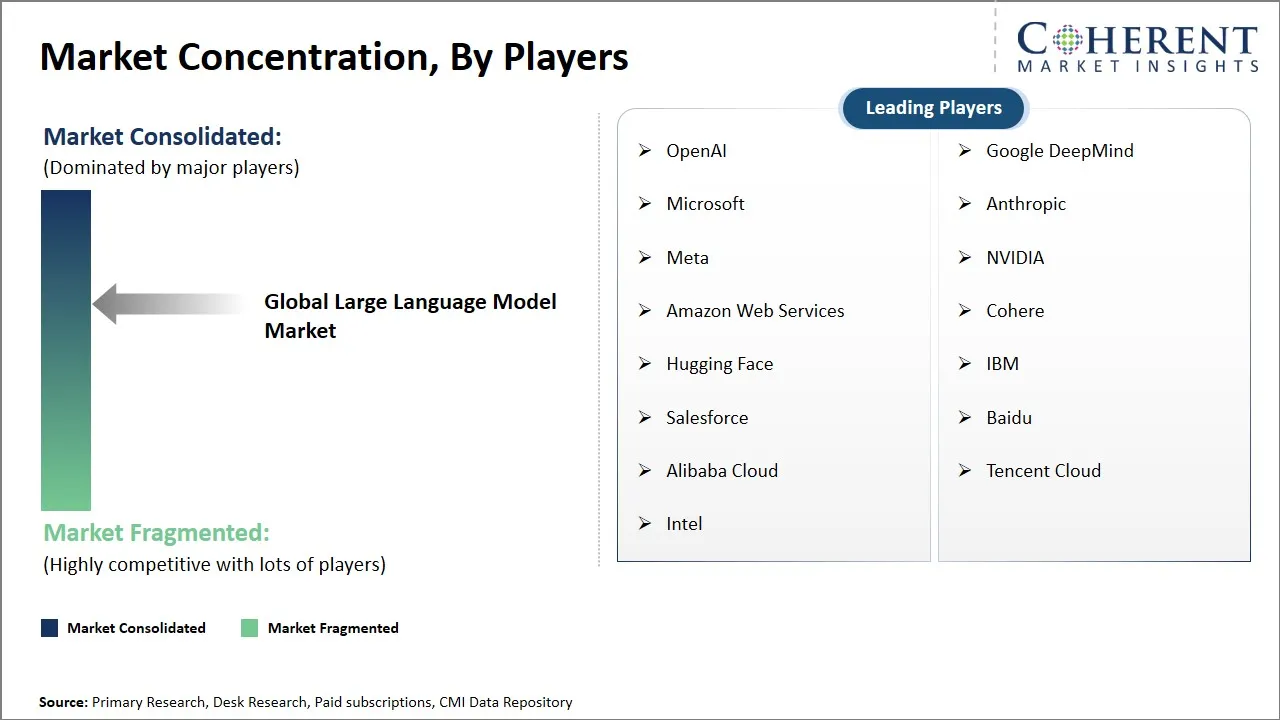
| Companies covered: | OpenAI, Google DeepMind, Microsoft, Anthropic, Meta, NVIDIA, Amazon Web Services, Cohere, Hugging Face, IBM, Salesforce, Baidu, Alibaba Cloud, Tencent Cloud, and Intel | ||
| Growth Drivers: |
| ||
| Restraints & Challenges: |
| ||
Market Dynamics
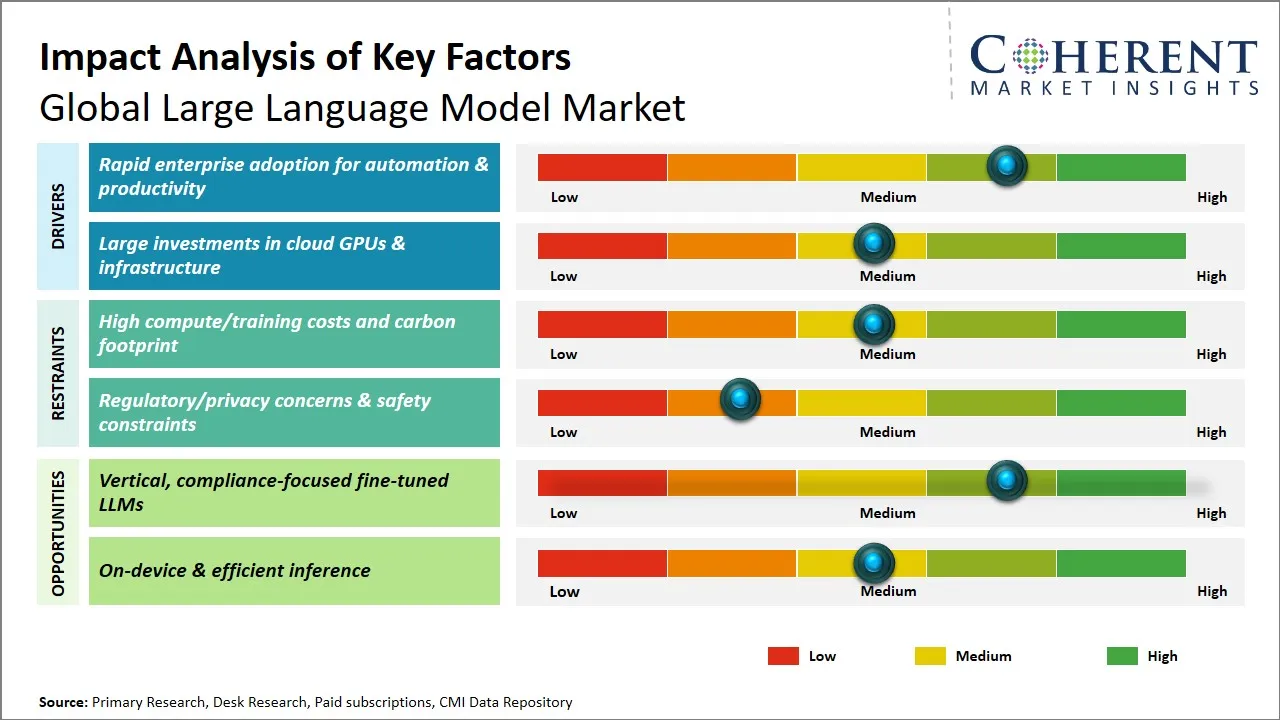
Global Large Language Model Market Driver – Rapid Enterprise Adoption for Automation & Productivity
Enterprises across various sectors are increasingly integrating Large Language Models (LLMs) into their workflows to drive automation and enhance productivity, which serves as a significant catalyst for market expansion. Organizations are leveraging LLMs to automate routine tasks such as customer support, content generation, and data analysis, thereby reducing manual effort and operational costs. The ability of these models to understand and generate human-like text allows businesses to streamline communication processes, provide personalized customer experiences, and accelerate decision-making. In 2023, PwC announced a USD 1 billion investment to integrate OpenAI’s GPT-4 into its tax, audit, and consulting services. This move allowed the firm to automate drafting, compliance checks, and client communication, significantly boosting productivity for its workforce.
Additionally, LLMs facilitate the development of intelligent virtual assistants and chatbots that improve response times and operational efficiency. As companies aim to stay competitive in a dynamic business environment, the growing reliance on AI-powered language models to optimize resource allocation and improve overall productivity is accelerating adoption rates.
Global Large Language Model Market Opportunity – Vertical, Compliance-Focused Fine-Tuned LLMs
As organizations across highly regulated sectors such as finance, healthcare, legal, and pharmaceuticals increasingly adopt AI-driven solutions, there is a growing the demand for LLMs that not only deliver advanced natural language understanding but also adhere strictly to industry-specific compliance standards and data privacy regulations. Custom fine-tuning of LLMs enables models to be optimized for domain-specific jargon, contextual nuances, and unique operational workflows, thereby enhancing accuracy and reliability in critical applications like risk assessment, compliance monitoring, and regulatory reporting. Additionally, these specialized models mitigate risks related to data breaches and non-compliance by integrating robust governance frameworks and audit trails.
This verticalization supports enterprise customers’ efforts to meet stringent regulatory guidelines such as HIPAA, GDPR, SOX, and others, while leveraging the power of AI to automate complex processes and generate actionable insights. In 2024, Mayo Clinic partnered with Google Cloud to deploy Med-PaLM 2, a medical LLM fine-tuned for healthcare use cases. The model was specifically designed to handle sensitive clinical data under strict compliance frameworks such as HIPAA, enabling doctors to use AI for decision support while meeting regulatory standards. The combination of tailored knowledge, compliance assurance, and operational efficiency positions fine-tuned vertical LLMs as a strategic differentiator, unlocking significant growth potential for providers that can deliver bespoke, secure, and regulation-aligned language AI solutions.
Analyst Opinion (Expert Opinion)
- End users frequently express concerns about hallucinations and inconsistent outputs from LLMs. Enterprises, particularly in regulated sectors like healthcare and finance, seek models that provide verifiable and trustworthy responses, pointing to an unmet need for greater accuracy and fact-checking mechanisms.
- Feedback from enterprise users highlights frustration with generic models that fail to capture industry-specific terminology or workflows. There is a rising the demand for verticalized, fine-tuned LLMs that can adapt to compliance-heavy domains such as legal, banking, and clinical care.
- While adoption is accelerating, many small and mid-sized businesses report that the cost of API usage and infrastructure remains a significant barrier. This underlines the unmet need for more cost-efficient, scalable deployment models such as lightweight on-premise LLMs or open-source alternatives that balance performance with affordability.
Speak to the analyst
Want personalized insights?
Take the findings above to one of our principal consultants, or have the report rebuilt around the segments, geographies and competitors you actually track.
Market Segmentation
- Offering Insights (Revenue, USD Bn, 2021 - 2033)
- Foundation Models
- LLM-based Applications & Services
- Professional Services
- Hardware & Inference Infrastructure
- Application Insights (Revenue, USD Bn, 2021 - 2033)
- Conversational Agents & Virtual Assistants
- Content Generation & Marketing
- Code Generation
- Enterprise Search & Knowledge
- Analytics, Insights & Automation
- Others
- Regional Insights (Revenue, USD Bn, 2021 - 2033)
- North America
- U.S.
- Canada
- Latin America
- Brazil
- Argentina
- Mexico
- Rest of Latin America
- Europe
- Germany
- U.K.
- Spain
- France
- Italy
- Russia
- Rest of Europe
- Asia Pacific
- China
- India
- Japan
- Australia
- South Korea
- ASEAN
- Rest of Asia Pacific
- Middle East
- GCC Countries
- Israel
- Rest of Middle East
- Africa
- South Africa
- North Africa
- Central Africa
- North America
- Key Players Insights
- OpenAI
- Google DeepMind
- Microsoft
- Anthropic
- Meta
- NVIDIA
- Amazon Web Services
- Cohere
- Hugging Face
- IBM
- Salesforce
- Baidu
- Alibaba Cloud
- Tencent Cloud
- Intel
Sources
Primary Research Interviews
Stakeholders
- AI Researchers and Data Scientists
- Cloud Service Providers
- Enterprise End-Users
- AI Startups and Independent Model Builders
- GPU/Chip Manufacturers
- Policy and Compliance Experts (specializing in AI governance and regulation)
Databases
- Eurostat
- U.S. Census
- AI Global Index
- OECD
- World Intellectual Property Organization (WIPO) AI Patents Database
Magazines
- AI Business
- Wired (AI & Emerging Tech section)
- MIT Technology Review
- VentureBeat AI
- CIO Magazine
Journals
- Journal of Artificial Intelligence Research
- Nature Machine Intelligence
- AI and Ethics Journal
- IEEE Transactions on Neural Networks and Learning Systems
- Journal of Cloud Computing
Newspapers
- The New York Times (Technology section)
- Financial Times (AI & Tech Coverage)
- The Economic Times (India)
- South China Morning Post (Technology section)
- The Guardian (UK)
Associations
- Partnership on AI (PAI)
- Association for the Advancement of Artificial Intelligence (AAAI)
- European Association for Artificial Intelligence (EurAI)
- AI Infrastructure Alliance (AIIA)
- Cloud Native Computing Foundation (CNCF)
Public Domain Sources
- U.S. Census Bureau
- EUROSTAT
- United Nations Educational, Scientific and Cultural Organization (UNESCO) – AI in Education Reports
- World Bank
- ResearchGate
Proprietary Elements
- CMI Data Analytics Tool
- Proprietary CMI Existing Repository of information for last 8 years
Get access to 250+ pages report
Every segment, forecast, competitor profile and data table behind the analysis above — available for instant download.
- ESOMAR Member
- ISO 9001:2015 Certified
- D-U-N-S Registered
- GDPR & CCPA Compliant
Missing comfort of reading report in your local language? Find your preferred language:
Transform your Strategy with Exclusive Trending Reports
Frequently Asked Questions
The global large language model market is estimated to be valued at USD 11.55 Bn in 2026 and is expected to reach USD 92.00 Bn by 2033.
The CAGR of the global large language model market is projected to be 34.5% from 2026 to 2033.
Rapid enterprise adoption for automation & productivity and large investments in cloud GPUs & infrastructure are the major factors driving the growth of the global large language model market.
High compute/training costs and carbon footprint and regulatory/privacy concerns & safety constraints are the major factors hampering the growth of the global large language model market.
In terms of offering, the foundation models segment is estimated to dominate the market revenue share in 2026.
OpenAI, Google DeepMind, Microsoft, Anthropic, Meta, NVIDIA, Amazon Web Services, Cohere, Hugging Face, IBM, Salesforce, Baidu, Alibaba Cloud, Tencent Cloud, and Intel are the major players.
North America is expected to lead the global large language model market.