

Global Aircraft Health Monitoring Market Size and Forecast – 2026 To 2033
The global aircraft health monitoring market is expected to grow from USD 6.60 Bn in 2026 to USD 10.00 Bn by 2033, registering a compound annual growth rate (CAGR) of 6.2% from 2026 to 2033. The global aircraft health monitoring market is rising commercial aircraft fleet sizes. On January 7, 2026, Boeing and Alaska Airlines announced the carrier's largest-ever airplane order as part of its long-term plan to expand its domestic and international route networks. The order includes 105 737-10 airplanes and options for 35 more of the largest 737 MAX variant to serve high-density routes and renew its existing fleet.
Key Takeaways of the Global Aircraft Health Monitoring Market
- The Hardware segment is expected to account for 48.0% of the global aircraft health monitoring market share in 2026. Expanding connected aircraft infrastructure is driving the growth of the segment. On April 9, 2025, Airbus and Panasonic Avionics announced a connected aircraft partnership. Their planned architecture combines onboard, ground, and cloud capabilities. It also supports applications using aircraft operational data.
- The Civil Aviation segment is estimated to capture 73.0% of the market share in 2026. Rising focus on reducing unplanned aircraft downtime is majorly driving the growth of the segment. On April 8, 2025, Lufthansa Technik signed a multi-year contract with LATAM Airlines Group to implement AVIATAR across its Airbus A320, Boeing 777 and Boeing 787 fleets, covering more than 300 aircraft.
- The Diagnostic Systems segment is estimated to capture 67.0% of the market share in 2026. Increasing deployment of diagnostic and prognostic systems is driving the growth of the segment. On June 12, 2025, Rolls-Royce launched the first of two Durability Enhancement Packages, that will more than double the duration Trent 1000 engines remain in service before needing scheduled maintenance.
- North America is expected to dominate the aircraft health monitoring market in 2026 with a market share of 34.0%. Increasing adoption of digital twin technologies in North America is driving the growth of the regional market. In January 2025, Lockheed Martin expanded its digital twin initiatives. The company highlighted digital twins for complex aerospace systems and operational environments.
- Asia Pacific is expected to account for 29.0% share in 2026. Growing integration of artificial intelligence and machine learning in Asia Pacific is driving the growth of the regional market. On august 14, 2026, Korean Air begun operating a maintenance defect analysis system built on generative artificial intelligence and cloud technology. The new system was developed to support decision-making on the maintenance floor and to accelerate the digital transformation of aircraft maintenance.
Segmental Insights
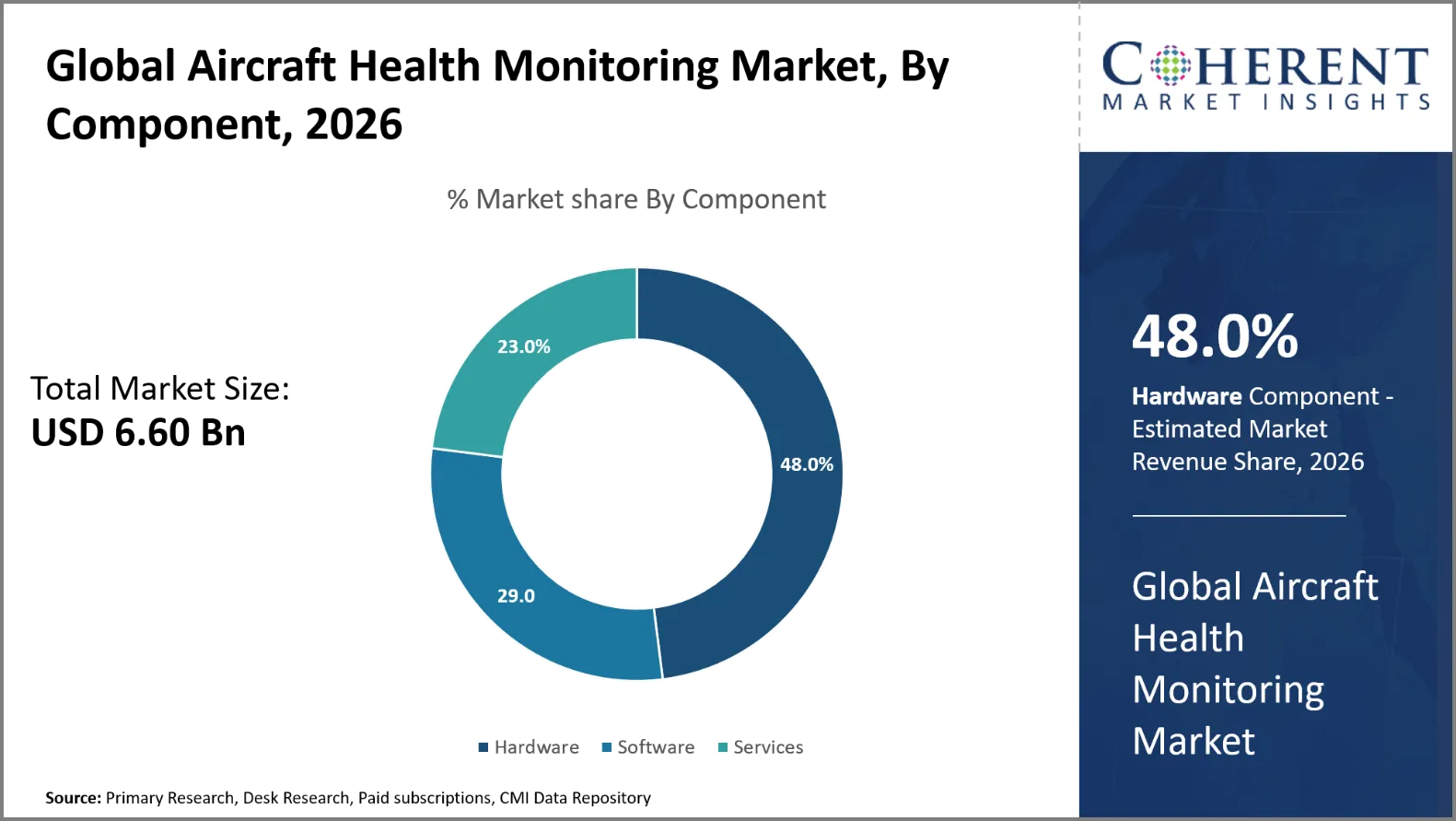
Why Does Hardware Dominate the Global Aircraft Health Monitoring Market?
The hardware segment is expected to account for 48.0% of the global aircraft health monitoring market share in 2026. Hardware dominates because aircraft health monitoring requires continuous physical data collection. Sensors measure vibration, temperature, pressure, strain, speed and other operating factors. Data acquisition units take measurements from engines, structures, avionics and other key systems. Reliable on-board hardware allows continuous condition assessment during the flight operations. The hardware needs are growing as more sensors are put into new airplanes. Retrofitting older airplanes also means more need for sensing equipment. Certification standards also underscore the importance of robust aviation-grade hardware for monitoring applications.
On December 19, 2025, Safran announced the development of a wireless data collecting system, called microMA. The microMA is modular and ultra-compact, can be quickly placed in crucial areas without the need for an external power supply, and will improve test responsiveness, maintenance efficiency and overall aircraft reliability.
- Current Industry Events of 2026
- Market Size Estimation
- Regional Breakdown
- Competitive Landscape
- Customer Intelligence
- Segmental Analysis
- Pricing Analysis
- Key Market Drivers, Challenges & Future Trends
- Customized Insights Section
Why is Civil Aviation the Most Crucial Platform?
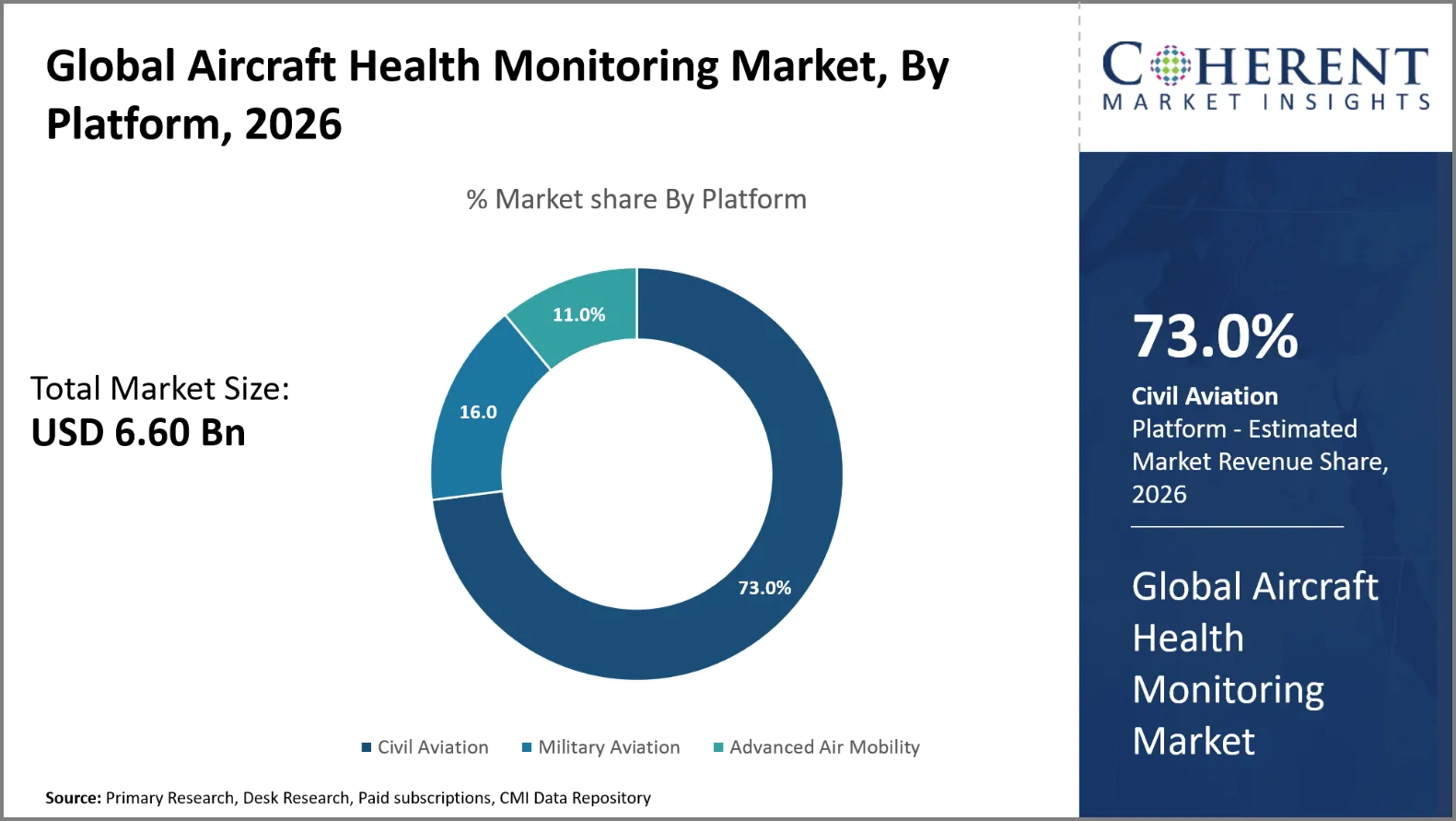
The civil aviation segment is expected to account for 73.0% of the global aircraft health monitoring market share in 2026. Civil aviation continues to be an important platform as commercial aircraft operate frequent and highly scheduled flight cycles. The reliability of passenger services requires a high aircraft availability for the airlines. The health monitoring allows the maintenance crew to detect developing faults of components much before the planned maintenance. Commercial fleets also produce large amounts of operational data with repeated flights. This data is used for predictive maintenance and enhancement of aircraft performance. The increasing digitalization of aviation maintenance operations enhances monitoring adoption. Airlines can integrate aircraft health information with maintenance planning and engineering workflows.
On February 10, 2025, Emirates signed an agreement with Airbus for the implementation of its Skywise Fleet Performance+ (S.FP+) advanced predictive maintenance and fleet health monitoring solution and Core X3 analytics platform. The adoption of Airbus’s cutting-edge S.FP+ solution is set to further improve aircraft dispatch reliability while enabling strategic data-driven decision-making for Emirates’ fleet of commercial Airbus A380 and A350 aircraft.
Diagnostic Systems Dominates the Global Aircraft Health Monitoring Market
The diagnostic systems segment is expected to account for 67.0% of the global aircraft health monitoring market share in 2026. Diagnostic systems dominate because they identify aircraft faults using real-time operating information. These systems analyze sensor measurements to detect abnormal component behavior. The diagnostic capability allows the engine, structural and avionics anomalies to be detected sooner. Diagnostic outputs enable maintenance staff to quickly pinpoint problematic components. Finding a defect early helps reduce the time it takes to troubleshoot maintenance. Diagnostic systems also provide essential inputs to subsequent prognosis evaluations. More sensors in the field means more diagnostics needed. Another benefit is that artificial intelligence can enhance anomaly detection and automated fault classification.
On January 21, 2026, Boeing signed a memorandum of understanding (MOU) with a cybersecurity and predictive maintenance company. Shift5’s onboard hardware captures data with capabilities to feed Boeing’s predictive maintenance analytics and Shift5’s cybersecurity threat detection solutions. Combining Boeing’s deep aircraft expertise with Shift5’s capabilities, the two anticipate monitoring fleet health and security simultaneously.
Current Events and their Impact
Current Events | Description and its Impact |
European Union Commission Implementing Regulation (EU) 2023/203 |
|
European Union Commission Implementing Regulation (EU) 2025/2293 |
|
Aircraft Health Monitoring Market Dynamics
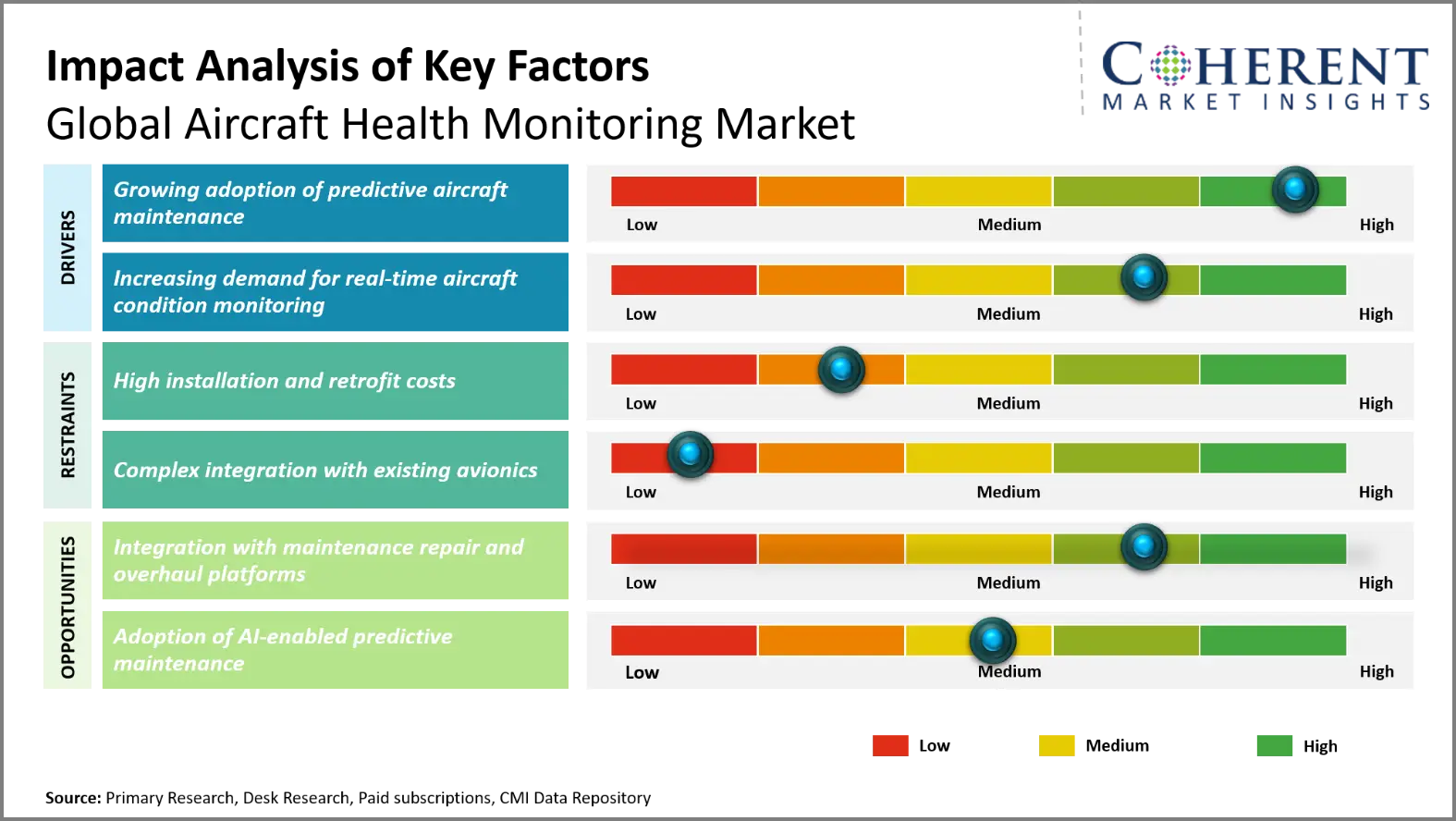
Market Drivers
- Growing adoption of predictive aircraft maintenance: Airlines are looking to predictive maintenance more and more to find developing issues before they create unplanned maintenance events. Aircraft health monitoring systems examine operating parameters and sensor data on a continuous basis. These systems are used to prepare in advance replacement parts, labor and procedures for maintenance prior to the aircrafts arrival. Boeing states that its Airplane Health Management supports predictive and condition-based maintenance. Airbus also identifies predictive maintenance as an important capability for improving maintenance planning. Airbus reports that more than 12,000 aircraft connect to its Skywise platform. Predictive maintenance models are powered by real-time sensor data on the platform.
- On April 22, 2026, Boeing developed an Aircraft Data Reasoner (ADR) for the C-17A Globemaster III aircraft that pulls onboard aircraft data to improve maintenance decision-making across the global fleet. The ADR delivers better visibility into system and component health to target and prevent potential issues, keeping planes mission-ready and reducing risk of aircraft failure during off-station missions.
- Increasing demand for real-time aircraft condition monitoring: Airlines are increasingly demanding real-time visibility into the status of aircraft during flight operations. Real-time monitoring allows maintenance staff to spot faulty situations before the aircraft reaches its destination. Boeing says its health management systems are looking at airplane data all the time when it's flying. Similarly, Airbus defines real-time health monitoring as a way to prioritize troubleshooting and maintenance actions. Real-time warnings enable teams to prepare parts, personnel and maintenance processes in advance of an aircraft’s arrival. This approach can reduce aircraft ground time and support improved dispatch reliability. Boeing reported that its Airplane Health Management platform manages millions of daily aircraft conditions.
- On April 21, 2026, Skywise, the digital services company of Airbus, announced that it has signed an agreement with JetBlue to deploy its advanced Skywise Fleet Performance+ (S.FP+) solution. The contract will extend the digital solution capabilities across JetBlue’s A320 Family aircraft and its growing A220 fleet.
Emerging Trends
- Artificial Intelligence-Enabled Predictive Analytics: Increasingly, artificial intelligence is being used in aircraft health monitoring to detect anomalies, predict faults and forecast maintenance. Operational data sets are complicated and machine learning algorithms use them to find minor equipment degradation patterns. These skills enable earlier interventions, and more tailored maintenance planning.
- Digital Twins for Aircraft Health Management: Digital twins are being developed to provide a way to continuously compare aircraft performance to expected operating parameters. Virtual representations consist of sensor data, maintenance records and operational data. This technique is capable to enable component level diagnostics, performance optimization and predictive maintenance decisions.
- Cloud-Based Fleet Health Monitoring: Cloud technologies are extending centralized aircraft health monitoring across geographically spread fleets. Airlines can combine aircraft data, maintenance information and analytical outputs in common settings. This permits comparisons throughout the fleet, remote engineering help and quicker diagnosis of recurring component problems.
- Integrated Real-Time Aircraft Monitoring: The increasing convergence of onboard sensors, connection systems, diagnostics and maintenance applications for aircraft health monitoring. Integrated designs give constant view into engines, structures, avionics and other items. This trend allows for faster anomaly detection and enhances cooperation between flight crews and maintenance staff.
Regional Insights
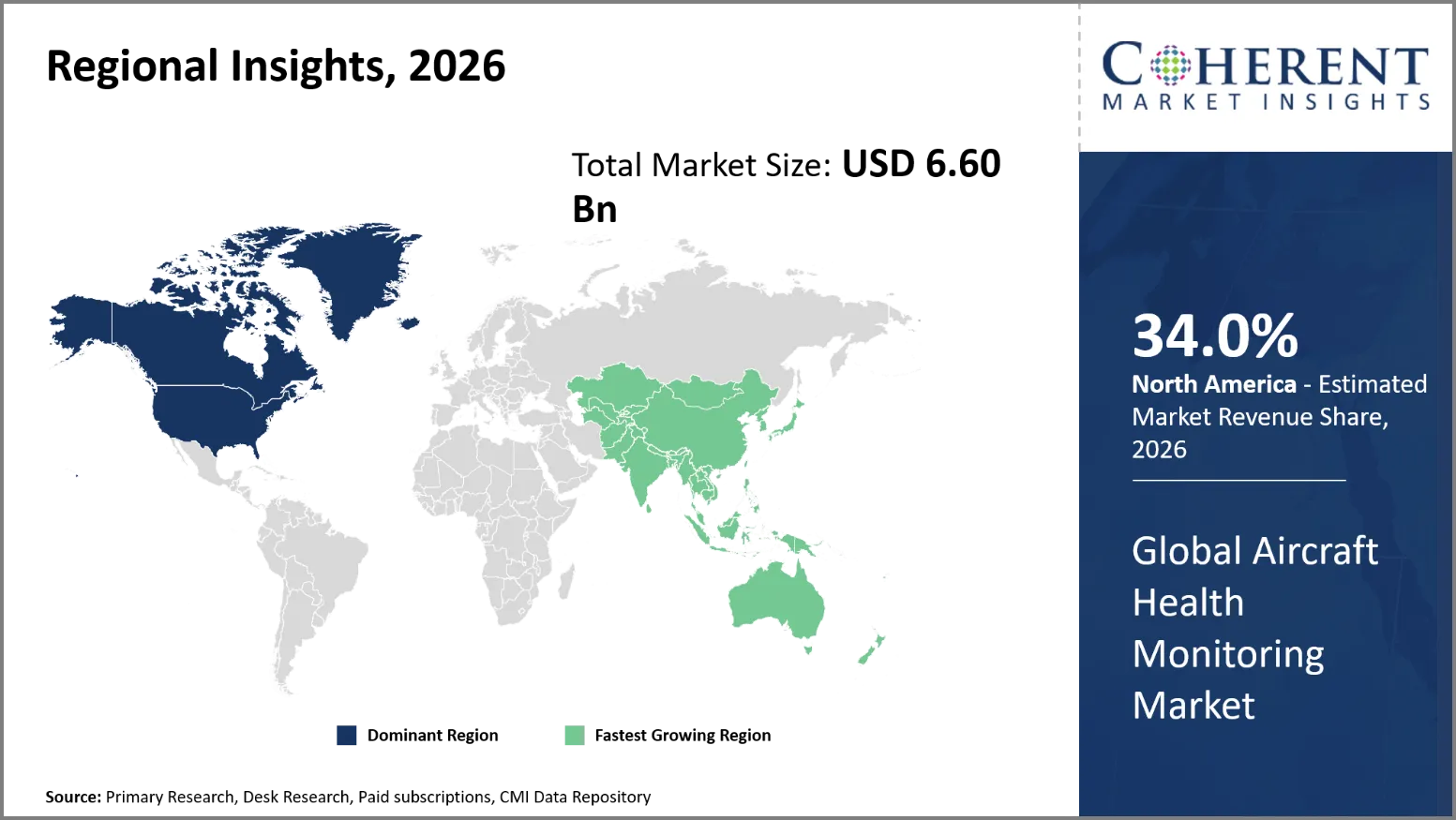
Why is North America a Strong Market for Aircraft Health Monitoring?
North America is expected to account for a market share of 34.0% in 2026. North America benefits from extensive connected-fleet deployment and mature digital aviation infrastructure. Airbus reports that the region holds 25% of the global in-service aircraft fleet. Airbus also expects 7,100 new aircraft deliveries across North America over two decades. Digital and connectivity services are identified as the region's fastest-growing aviation-services segment. Boeing's Airplane Health Management supports more than 120 airlines and 4,800 aircraft globally. Its system evaluates 4.2 million aircraft conditions daily. Boeing also processes 43 billion maintenance records through the platform. These capabilities support expanding demand for real-time diagnostics and predictive maintenance. The region's large installed aircraft base also supports extensive health-monitoring retrofits.
Why Does Asia Pacific Aircraft Health Monitoring Market Exhibit High Growth?
Asia Pacific is expected to register the fastest growth with a CAGR of 6.5% over the forecast period. The region is projected to account for 29.0% of the global aircraft health monitoring market in 2026. Asia Pacific benefits from rapid fleet expansion and accelerating digital maintenance adoption. Airbus expects the region to require 19,560 new passenger aircraft over the next two decades. This represents 46% of projected global passenger aircraft demand. Airbus also reports that airlines and maintenance providers increasingly use artificial intelligence and data analytics. These technologies address predictive maintenance requirements and regional technician shortages. India, Indonesia, Malaysia, and the Philippines are developing additional maintenance infrastructure. China is strengthening aircraft health management through domestic manufacturer support systems. Commercial Aircraft Corporation of China provides health monitoring using real-time Aircraft Communications Addressing and Reporting System data. Its platform combines Aircraft Communications Addressing and Reporting System information with post-flight Quick Access Recorder data.
Global Aircraft Health Monitoring Market Outlook for Key Countries
Why is U.S. Emerging as a Major Hub in the Aircraft Health Monitoring Market?
The U.S. benefits from Federal Aviation Administration recognition of Integrated Aircraft Health Management programs. Advisory Circular 43-218 provides guidance for using onboard sensors, data transmission, and analysis. The guidance supports airworthiness determinations using aircraft health information. Boeing has developed more than two decades of predictive health-management capabilities. Its platform has been validated across more than 44 million airline flights. Boeing also signed a 2026 agreement with Shift5 for near-real-time C-17 monitoring. The concept combines onboard data collection with predictive maintenance and cybersecurity detection. These improvements broaden need for integrated monitoring hardware, analytics and secure aircraft data systems.
Is China the Next Growth Engine for the Aircraft Health Monitoring Market?
China has the opportunity to increase domestic aircraft operations and improve health management capabilities driven by manufacturers. Commercial Aircraft Corporation of China provides an Aircraft Health Monitoring System for delivered aircraft. The system uses real-time Aircraft Communications Addressing and Reporting System data and post-flight Quick Access Recorder information. Customers can monitor aircraft operational status and track detected faults. Commercial Aircraft Corporation of China requires authorized data-link providers to transmit relevant flight messages. This architecture allows for direct integration of aircraft operations with manufacturer support. The growing commercial aviation ecosystem in China is creating new prospects for linked maintenance solutions. Domestic aircraft production also supports greater deployment of locally integrated monitoring solutions.
Germany Aircraft Health Monitoring Market Analysis and Trends
Germany benefits from advanced airline maintenance capabilities and manufacturer-independent aviation analytics. In February 2025, Lufthansa Technik added Technical Repetitive Examination to AVIATAR Reliability Suite. The solution combines artificial intelligence with engineering expertise to analyze recurring technical logbook defects. Lufthansa Technik had deployed the solution across more than 20 airlines. The participating airlines operate Airbus and Boeing aircraft types. This deployment demonstrates increasing use of artificial intelligence for airline reliability management. Germany’s robust MRO ecosystem also aids in the integration of health monitoring and engineering operations. AVIATAR’s manufacturer-independent architecture allows for cross-fleet and cross-technical data analysis.
France Aircraft Health Monitoring Market Analysis and Trends
France benefits from strong aircraft manufacturing and component expertise supporting advanced health monitoring deployment. Safran Landing Systems operates predictive maintenance services for Airbus A350 landing systems. Its system monitors ATA Chapter 32 equipment continuously and identifies imminent failures. Safran reports more than 120 contracted A350 aircraft for this service. The company monitors the complete ATA Chapter 32 scope in real time. Safran also reports that 90% of confirmed faults reach its maintenance shops. These capabilities demonstrate increasing integration between aircraft data recording and predictive maintenance. France's aerospace ecosystem therefore supports specialized monitoring for engines, landing systems, avionics, and other critical components.
U.K. Aircraft Health Monitoring Market Analysis and Trends
U.K. utilizes the broad engine health monitoring capabilities of Rolls-Royce across worldwide civil aviation fleets. Rolls-Royce’s Engine Health Monitoring program reviews data from every engine and flight under surveillance. The system detects anomalies and makes maintenance suggestions. Rolls-Royce currently monitors more than 8,000 aircraft across civil and business aviation. Its system supports RB211 and Trent engine families. Artificial intelligence is incorporated into its data analysis capabilities. The service provides specific troubleshooting recommendations using Fault Isolation Manual or Maintenance Manual tasks. This engine-focused expertise creates strong demand for continuous propulsion-system monitoring. The U.K.'s aerospace engineering base also promotes the development of advanced engine analytics.
Global Aircraft Health Monitoring Market – Growth in Average Daily Aircraft Utilization in Block Hours
Country | 2024 | 2025 | 2026 |
U.S. | 5.4 hours | 5.6 hours | 5.6 hours |
China | 8.9 hours | 8.9 hours | 9.0 hours |
India | 7.3 hours | 7.7 hours | 7.8 hours |
Japan | 6.8 hours | 7.0 hours | 7.1 hours |
South Korea | 9.4 hours | 9.7 hours | 9.8 hours |
United Kingdom | 6.5 hours | 6.7 hours | 6.8 hours |
Germany | 6.4 hours | 6.6 hours | 6.7 hours |
France | 6.3 hours | 6.5 hours | 6.6 hours |
How is Integration with Maintenance Repair and Overhaul Platforms Creating New Growth Opportunities in the Aircraft Health Monitoring Market?
The integration with maintenance, repair and overhaul platforms is creating opportunities by translating aircraft health signals directly into maintenance operations. Boeing’s Airplane Health Management connects directly with Maintenance Performance Toolbox and leading maintenance systems, including AMOS. Its software alerts in-flight while planes are still in the air, letting maintenance personnel begin diagnosing and arranging repairs before arrival. Lufthansa Technik uses AVIATAR and AMOS for predictive health analytics and maintenance and engineering workflows. In 2025, Air Transat rolled out the entire Digital Tech Ops Ecosystem on 43 Airbus A321 and A330 planes. The real-time integration of technical information with maintenance planning enables speedier turnaround decisions. Airbus also offers Skywise-connected operations and maintenance services to more than 11,900 commercial aircraft. These interfaces open the door for supplier monitoring to move to predictive maintenance, engineering analytics, automated work planning, and digital MRO services.
Market Players, Key Development, and Competitive Intelligence
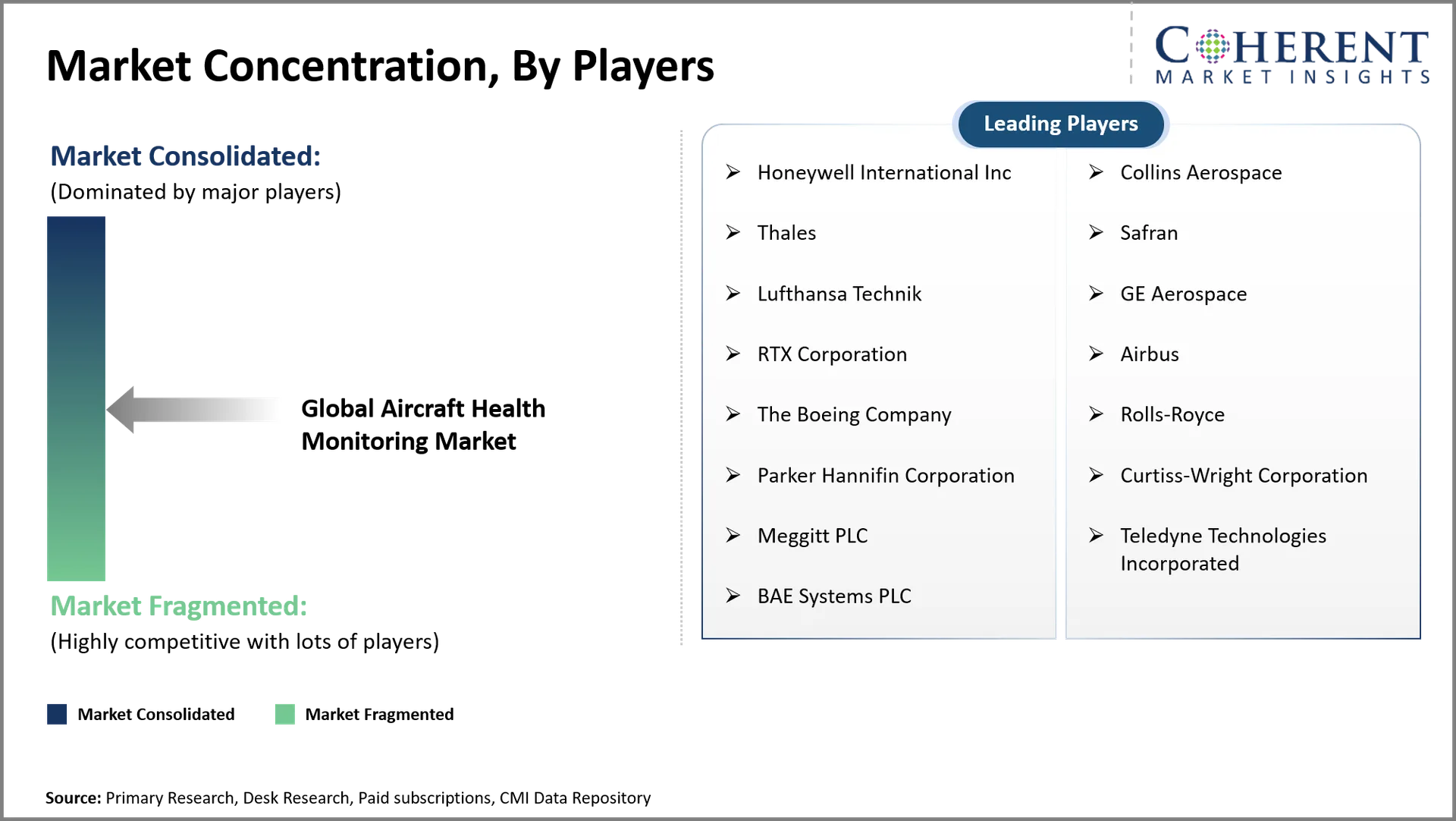
Key Developments
- On June 25, 2026, Rolls-Royce announced the launch of an advanced aircraft and engine health monitoring program for Bombardier Global 5500 and Global 6500 business jets, featuring the Pearl family’s state-of-the-art Engine Vibration & Health Monitoring Unit.
- On June 10, 2026, Platinum Eagle Aerospace announced the commercial launch of FLEX AI, an AI-powered structural health trending and monitoring platform that continuously measures the loads, stress, strain, and fatigue accumulation acting on an aircraft’s structure.
- On March 6, 2026, Odysight.ai Inc. announced a partnership with XP Services that is expected to result in the first U.S.-based installation of its system on an aircraft. The milestone marks a substantial step in the Company’s U.S. growth strategy and formally initiates the flight testing of Odysight.ai’s solution.
Competitive Landscape
Leading players are combining aircraft data, predictive analytics, engineering expertise, and maintenance execution capabilities. Boeing focuses on Airplane Health Management, condition-based maintenance, artificial intelligence recommendations, and direct Maintenance Execution System integration. More than 44 million flights have been authenticated on its platform. Airbus launches Skywise Fleet Performance+ for fleets including JetBlue’s A320 and A220 aircraft. Lufthansa Technik reinforces AVIATAR with predictive health analytics, technical logbooks and reliability tools. Its platform powers approximately 5,000 airplanes for more than 40 customers. Rolls-Royce is working on engine health monitoring and deeper analysis of engine parameters. Its systems monitor thousands of aircraft across civil and business aviation. Boeing is also combining predictive maintenance with cybersecurity through its Shift5 collaboration for military aircraft.
Market Report Scope
Global Aircraft Health Monitoring Market Report Coverage | |||
Report Coverage | Details | ||
Base Year | 2025 | Market Size in 2026: | USD 6.60 Bn |
Historical Data For: | 2020 To 2024 | Forecast Period: | 2026 To 2033 |
Forecast Period 2026 To 2033 CAGR: | 6.20% | 2033 Value Projection: | USD 10.00 Bn |
Geographies covered: |
| ||
Segments covered: |
| ||
Companies covered: | Honeywell International Inc, Collins Aerospace, Thales, Safran, Lufthansa Technik, GE Aerospace, RTX Corporation, Airbus, The Boeing Company, Rolls-Royce, Parker Hannifin Corporation, Curtiss-Wright Corporation, Meggitt PLC, Teledyne Technologies Incorporated, BAE Systems PLC | ||
Growth Drivers: |
| ||
Restraints & Challenges: |
| ||
Analyst Opinion (Expert Opinion)
- The future of aircraft health monitoring will center on continuous, aircraft-specific intelligence connected directly with maintenance execution. Real-time sensor streams will increasingly feed automated diagnostics, predictive models, and maintenance workflows. Boeing already integrates health alerts with Maintenance Performance Toolbox and leading maintenance systems. Airbus is extending real-time monitoring through Skywise Fleet Performance+ across multiple aircraft families. This direction should shift competition toward actionable health intelligence rather than standalone monitoring hardware.
- The strongest opportunities should emerge in software, integrated analytics, and propulsion monitoring applications. Engine health monitoring can generate substantial data because modern engines contain thousands of sensors. Rolls-Royce notes that an Airbus A350 can generate 2.5 terabytes daily from approximately 6,000 sensors. Airlines operating large Airbus and Boeing fleets should provide strong opportunities for predictive analytics providers. North America and Asia Pacific should receive particular attention because fleet expansion creates additional connected-aircraft deployments.
- Players seeking an edge should build aircraft-specific models and connect monitoring outputs directly with maintenance execution. Lufthansa Technik showcases this method with AVIATAR apps for condition monitoring, predictive health analytics and technical logbooks. Vendors should also integrate cybersecurity with health monitoring as aircraft connection grows. Boeing and Shift5 are already integrating predictive maintenance with onboard cyber security detection. Companies should focus on interoperability, validated alarms, explainable advice and fast integration with existing airline maintenance systems.
Speak to the analyst
Want personalized insights?
Take the findings above to one of our principal consultants, or have the report rebuilt around the segments, geographies and competitors you actually track.
Market Segmentation
- Component Insights (Revenue, USD Billion, 2021 - 2033)
- Hardware
- Software
- Services
- Platform Insights (Revenue, USD Billion, 2021 - 2033)
- Civil Aviation
- Military Aviation
- Advanced Air Mobility
- Technology Type Insights (Revenue, USD Billion, 2021 - 2033)
- Diagnostic Systems
- Prognostic Systems
- Detection Systems
- Others
- Fit Insights (Revenue, USD Billion, 2021 - 2033)
- Line Fit
- Retrofit
- Regional Insights (Revenue, USD Billion, 2021 - 2033)
- North America
- U.S.
- Canada
- Latin America
- Brazil
- Argentina
- Mexico
- Rest of Latin America
- Europe
- Germany
- U.K.
- Spain
- France
- Italy
- Russia
- Rest of Europe
- Asia Pacific
- China
- India
- Japan
- Australia
- South Korea
- ASEAN
- Rest of Asia Pacific
- Middle East
- GCC Countries
- Israel
- Rest of Middle East
- Africa
- South Africa
- North Africa
- Central Africa
- North America
Sources
Primary Research Interviews
- Aircraft Maintenance, Repair & Overhaul (MRO) Specialists
- Avionics Systems Engineers & OEM Representatives
- Airline Fleet Management Executives
- Defense Aviation & Military Aircraft Program Officers
Magazines
- Aviation Week & Space Technology
- Aerospace America
- Aircraft Technology Engineering & Maintenance (ATEM) Magazine
- AviationPros Magazine
Journals
- Journal of Aircraft (AIAA)
- Aerospace Science and Technology Journal (Elsevier)
Associations
- Aerospace Industries Association (AIA)
- International Air Transport Association (IATA)
- Aircraft Electronics Association (AEA)
- Society of Automotive Engineers (SAE) International – Aerospace Division
Public Domain Sources
- U.S. Federal Aviation Administration (FAA) – Official Reports & Publications
- European Union Aviation Safety Agency (EASA) – Safety Data & Regulatory Documents
- NASA Technical Reports Server (NTRS) – Aerospace Research Publications
- International Civil Aviation Organization (ICAO) – Global Aviation Statistics
Proprietary Elements
- CMI Data Analytics Tool
- Proprietary CMI Existing Repository of Information for the Last 10 Years
Get access to 250+ pages report
Every segment, forecast, competitor profile and data table behind the analysis above — available for instant download.
- ESOMAR Member
- ISO 9001:2015 Certified
- D-U-N-S Registered
- GDPR & CCPA Compliant
Frequently Asked Questions
The global aircraft health monitoring market is expected to stand at USD 6.60 Bn in 2026 and is expected to reach USD 10.00 Bn by 2033.
The CAGR of the global aircraft health monitoring market is projected to be 6.2% from 2026 to 2033.
Growing adoption of predictive aircraft maintenance and Increasing demand for real-time aircraft condition monitoring are the major factors driving the growth of the global aircraft health monitoring market.
High installation and retrofit costs and Complex integration with existing avionics are the major factors hampering the growth of the global aircraft health monitoring market.
In terms of component, hardware segment is estimated to dominate the market revenue share in 2026.
Aircraft health monitoring uses aircraft data to detect, diagnose, and predict component conditions.
Predictive maintenance helps airlines identify developing faults before they create unexpected maintenance events.