

Global Aluminum Fishing Boat Market Size and Forecast – 2026 To 2033
The global aluminum fishing boat market is expected to grow from USD 2.50 Bn in 2026 to USD 4.15 Bn by 2033, registering a compound annual growth rate (CAGR) of 5.2% from 2026 to 2033. The global aluminum fishing boat market is driven by superior durability in shallow and rocky fishing environments. In September 2025, G3 Boats introduced the 1860 WOF as part of its Gator Tough package. Built for rough situations, such as shallow rivers and rough backwaters, the model is made for rigorous outdoor use with an emphasis on durability.
Key Takeaways of the Global Aluminum Fishing Boat Market
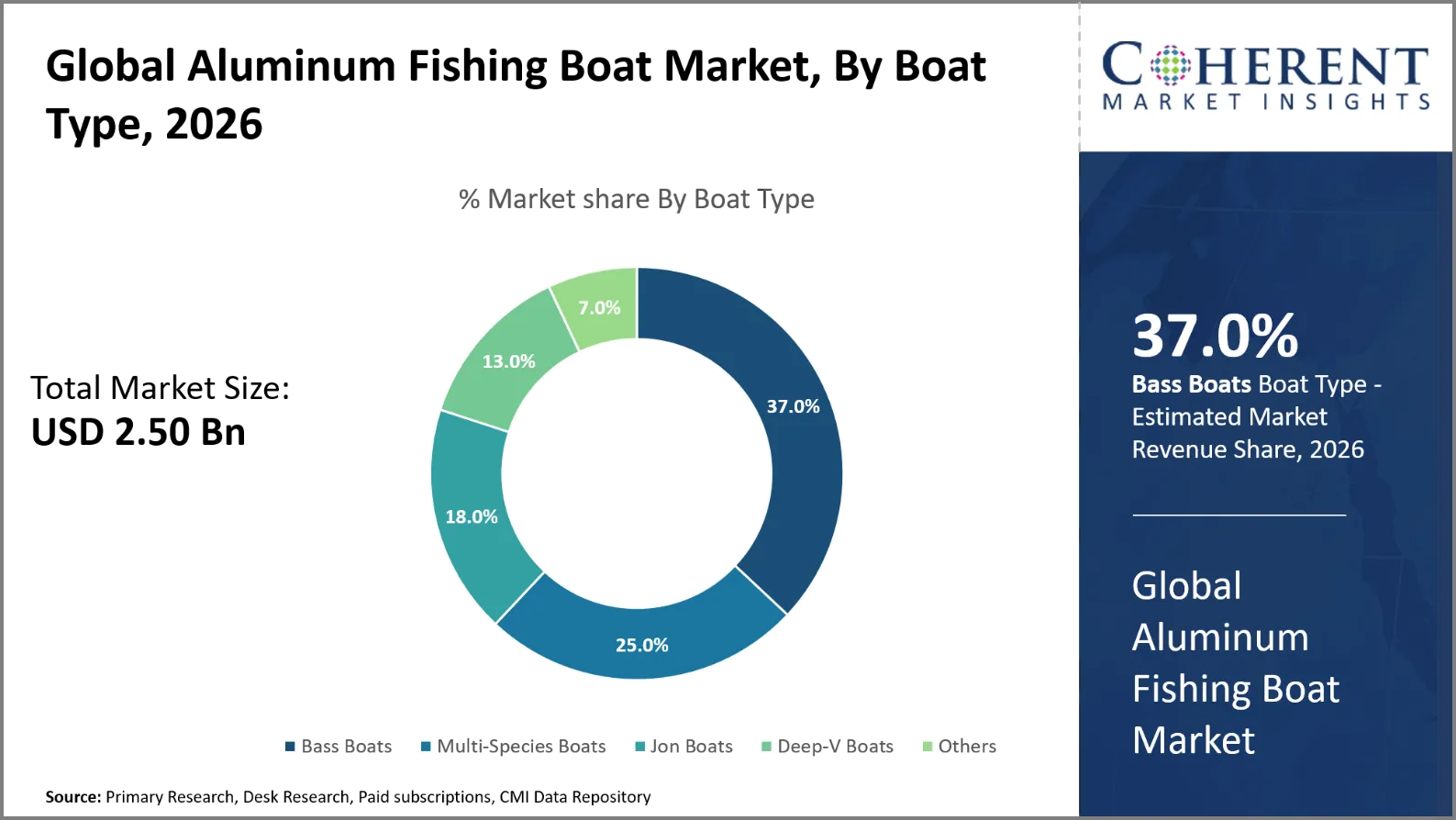
- The Bass Boats segment is expected to account for 37.0% of the global aluminum fishing boat market share in 2026. Growing adoption of advanced fish finders and navigation systems is driving the growth of the segment. In January 2025, Humminbird launched MEGA Live 2 forward-facing sonar and XPLORE fish finders. XPLORE incorporates high-definition mapping, SmartStrike, touchscreen controls, and compatibility with multiple imaging systems.
- The Outboard segment is estimated to capture 52.0% of the market share in 2026. Expansion of fishing tourism and outdoor recreation is majorly driving the growth of the segment. For instance, Nootka Marine Adventures reported 12 Seakeeper-equipped boats operating in 2025. It planned eight additional boats during 2025, targeting a fleet of 27 by the end of the 2026 season.
- The Less Than 14 Feet segment is estimated to capture 36.0% of the market share in 2026. Strong demand for compact boats among first-time buyers is driving the growth of the segment. G3 provides the 15 FL, a tiny aluminum Jon boat that is 14 feet 10 inches. Lightweight, uncomplicated design for fishermen who want effortless launch, functional fishing space and simple ownership.
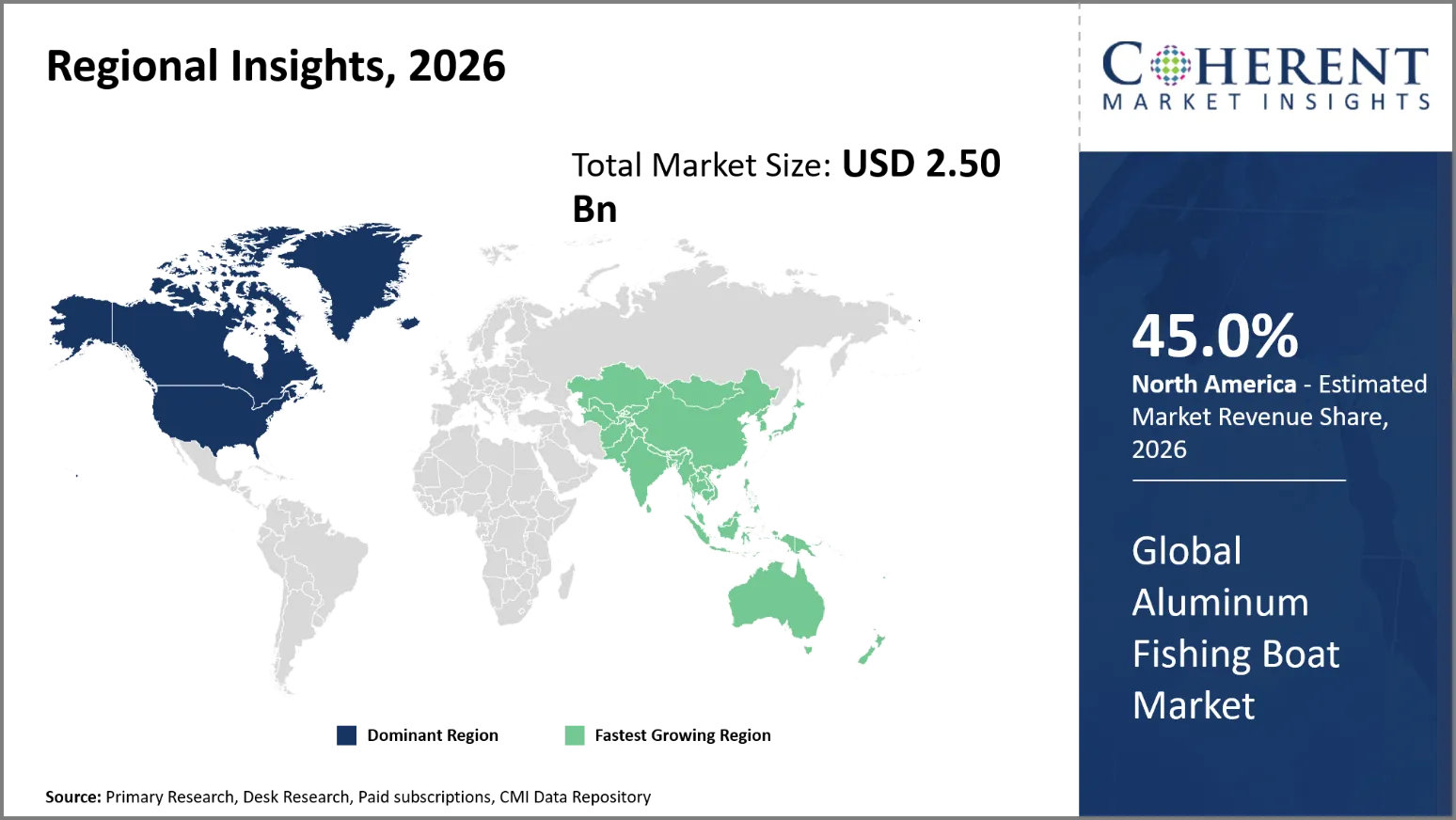
- North America is expected to dominate the aluminum fishing boat market in 2026 with a market share of 45.0%. Growing recreational fishing participation in North America is driving the growth of the regional market. In April 2026, Major League Fishing partnered with Wildlife Forever to expand the Getting Families Fishing and Boating Initiative.
- Asia Pacific is expected to account for 22.0% share in 2026. Expansion of aluminum boats for fishing tourism in Asia Pacific is driving the growth of the regional market. In May 2025, Whittley Boats introduced its new AL aluminum series across five factory-owned boating centers. The six-model range includes fishing-focused tiller, side-console, and center-console configurations.
Segmental Insights
Why Does Bass Boats Dominate the Global Aluminum Fishing Boat Market?
The bass boats segment is expected to account for 37.0% of the global aluminum fishing boat market share in 2026. The aluminum build is a big plus for bass boats, making them light to handle and able to stand up to freshwater fishing conditions. Their modest draft allows access to lakes, rivers and narrow fishing locations that larger boats are restricted from. Aluminum hulls also take the impact of submerged rocks and other underwater impediments on frequent fishing expeditions. Integrated casting decks, storage compartments and living wells accommodate unique angling requirements and increase onboard functionality. Therefore, the increased participation in recreational bass fishing maintains demand for purpose-built aluminum boats from freshwater anglers. On July 14, 2026, Tracker introduced the Bass Tracker Classic. The 16-foot-8-inch aluminum bass boat has an all-welded .100-inch 5052 marine alloy hull, and updated fishing equipment. A Lowrance Hook5 Reveal GPS fish finder, casting decks, rod storage and live well facilitate bass-focused angling.
- Current Industry Events of 2026
- Market Size Estimation
- Regional Breakdown
- Competitive Landscape
- Customer Intelligence
- Segmental Analysis
- Pricing Analysis
- Key Market Drivers, Challenges & Future Trends
- Customized Insights Section
Why is Outboard the Most Preferred Engine Type?
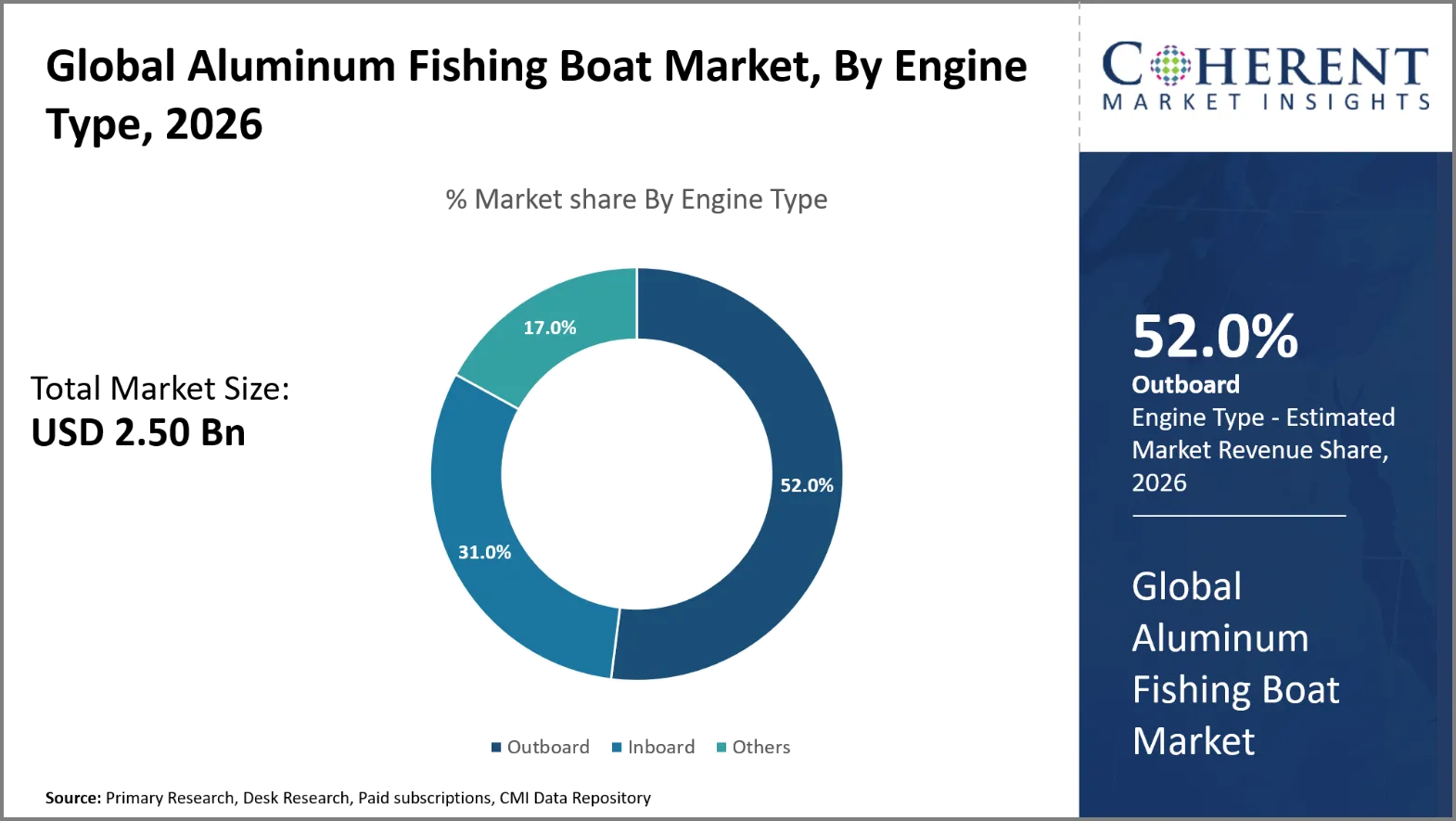
The outboard segment is expected to account for 52.0% of the global aluminum fishing boat market share in 2026. Outboard engines have offered a versatile means of propulsion to aluminum fishing boats for use on lakes, rivers and coastal waters. Easy exterior mounting for easy access to the engine for normal maintenance and servicing. And the outboard engine layout is great for maximizing internal space, since the propulsion parts are mounted outside the hull. Today’s outboards are fuel-efficient, easy to manage and powerful on a variety of boat sizes. These characteristics make outboard propulsion suitable for recreational anglers seeking practical and versatile fishing boats. On January 29, 2026, Suzuki Marine USA opened the Minneapolis Boat Show by unveiling two important new additions to its growing STEALTH LINE family of outboard motors. These two new models, the STEALTH LINE 9.9HP and 25HP, bring this popular look to an especially high-volume segment of the overall boating market. They also bring Suzuki’s STEALTH LINE family to 10 total models ranging from 9.9 to 350HP.
Less Than 14 Feet Dominates the Global Aluminum Fishing Boat Market
The less than 14 feet segment is expected to account for 36.0% of the global aluminum fishing boat market share in 2026. Boats below 14 feet offer easier transportation, storage, and launching for individual anglers. They are compact enough to enter smaller lakes, narrow rivers and shallows to fish. The lower purchase and operation costs of these boats also make them appealing to recreational fishing participants. Smaller hulls need fewer powerful engines; thus, they use less fuel and cost less to maintain. These practical benefits have created a great demand among anglers who need economical and simply controllable fishing platforms. For instance, Princecraft offered the Ungava 12 as a compact 12-foot aluminum fishing boat for the 2025 model year. The boat weighs 78 kg and has a maximum of 15 horsepower. Its 4-inch draft and 5052-H36 aluminum construction suit shallow lakes and narrow waterways. The compact dimensions also simplify transportation and launching for individual anglers.
Current Events and their Impact
Current Events | Description and its Impact |
U.S. - 33 CFR Part 183, Boats and Associated Equipment |
|
European Union - Recreational Craft Directive 2013/53/EU |
|
Aluminum Fishing Boat Market Dynamics
Market Drivers
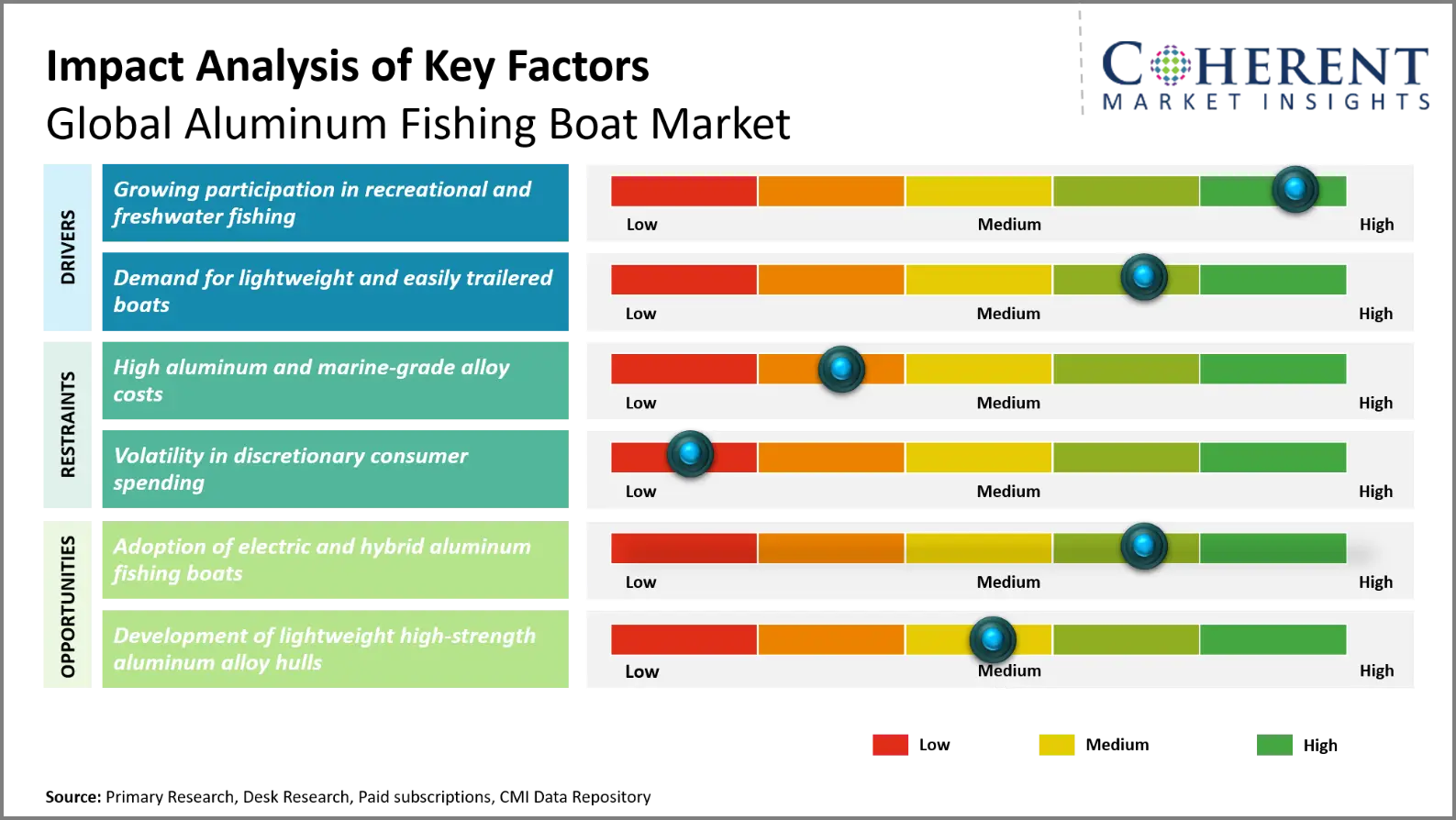
- Growing participation in recreational and freshwater fishing: Increasing participation in recreational and freshwater fishing promotes demand for accessible fishing boats across the world. Increasingly, anglers want boats that can be used on lakes, rivers, reservoirs and other inland waterways. They provide convenient platforms for frequent recreational fishing activity. As they are hardy and can live in shallow water, they can be used in many kinds of fresh water surroundings. Demand for tiny, purpose-built fishing boats also is bolstered by the rise in outdoor leisure engagement. On January 13, 2026, Major League Fishing, the world’s largest tournament-fishing organization, announced that Columbia PFG renewed and expanded its partnership with the organization, becoming the title sponsor of the MLF College Fishing circuit starting in 2026 and increasing its investment in the development of young anglers nationwide.
- Demand for lightweight and easily trailered boats: Demand for lightweight and easily trailered boats is growing among recreational anglers seeking more transportation options. Aluminum construction means that the boat is lighter overall than several heavier recreational boat layouts. Smaller boats need less hauling ability and are easier to deploy in various fishing spots. Their compact proportions also facilitate convenient storage for residences, marinas, and recreational facilities. These properties make lightweight aluminum boats excellent for fisherman regularly changing fishing spots. For example, Princecraft's 2026 Seasprite 12 weighs only 59 kg and measures 12 feet 4 inches. The boat carries a 10-horsepower outboard and incorporates stern grips for easy handling. Princecraft also lists an optional single-axle galvanized trailer for the model. These parameters facilitate transportation and launching for anglers with smaller tow vehicles.
Emerging Trends
- Electric and Hybrid Propulsion: Manufacturers are creating aluminum fishing boats compatible with electric and hybrid marine propulsion systems. These setups address demand for quieter operation, lower emissions, and decreased maintenance. Improved battery technologies are gradually expanding practical uses across freshwater recreational fishing situations.
- Advanced Fishing Electronics: Aluminum fishing boats increasingly integrate high-resolution sonar, satellite navigation, wireless trolling motors, and digital displays. These technologies improve fish location, route planning, and onboard monitoring. Connected electronics are becoming major differentiators across premium recreational fishing boat setups.
- Lightweight High-Strength Construction: Boat makers are employing new aluminum alloys and improved structural designs to minimize weight while preserving hull durability. Lightweight structure enhances towing efficiency, launching convenience, acceleration, and fuel economy. These advantages notably favor compact fishing boats.
- Modular Fishing Layouts: Modular seats, adjustable casting decks, removable storage systems, and customized accessories are increasing prominence among fishing boat customers. Flexible layouts let owners customize boats for various fishing styles and passenger needs. This trend allows for more personalized experiences inside recreational apps.
Regional Insights
Why is North America a Strong Market for Aluminum Fishing Boat?
North America is expected to account for a market share of 45.0% in 2026. North America advantages from existing freshwater fishing infrastructure and high levels of participation in the U.S. and Canada. U.S. had 57.9 million fishing participants in 2024. Freshwater fishing boats recorded approximately 53,000 U.S. unit sales in 2025. Canada’s British Columbia freshwater survey recorded 261,000 active fishers in 2024. Aluminum boats particularly suit Great Lakes, Canadian Shield lakes, and shallow inland waterways. Extensive trailerable fishing access also supports compact aluminum hull adoption.
Why Does Asia Pacific Aluminum Fishing Boat Market Exhibit High Growth?
Asia Pacific is expected to register the fastest growth with a CAGR of 6.3% and is projected to account for 22.0% of the global aluminum fishing boat market in 2026. The region benefits from expanding recreational fishing across diverse coastal and inland environments. Australia reports that one in five adults participates in recreational fishing annually. Australian Government says recreational fishing supports 100,000 jobs countrywide. Japan has a strong marine and inland fishing industry, and the government monitors recreational harvest separately. China is enhancing fisheries resources management and recreational fishing regulation. These conditions support demand for durable aluminum fishing platforms suited to varied waterways.
Global Aluminum Fishing Boat Market Outlook for Key Countries
Why is U.S. Emerging as a Major Hub in the Aluminum Fishing Boat Market?
The U.S. has exceptionally strong participation and established fishing-boat distribution networks. The Recreational Boating and Fishing Foundation recorded 57.9 million fishing participants during 2024. The National Marine Manufacturers Association reported 77,434 fishing boats sold during 2025. In 2025, the market for freshwater fishing boats was around 53,000 units. Aluminum fishing boats also continued to be among the top recreational entry-level categories. In instance, Florida, Texas, Michigan, North Carolina and New York were among the states with substantial recreational marine spending.
Is Australia the Next Growth Engine for the Aluminum Fishing Boat Market?
Australia benefits from exceptionally broad recreational fishing participation across coastal and inland waters. Government research found that one in five Australian adults fishes recreationally each year. Recreational fishing contributes approximately 100,000 jobs nationally. Coastal fishing represents the majority of recreational activity across Australian states and territories. Aluminum boats are well matched to Australia’s many estuaries, rivers, reservoirs and coastal fishing holes. Development of different fishing applications has resulted from state-specific management in Queensland, New South Wales, Victoria, Western Australia and Tasmania.
Canada Aluminum Fishing Boat Market Analysis and Trends
Canada benefits from extensive freshwater resources and strong fishing activity across western and central provinces. British Columbia recorded 261,000 active freshwater fishers during 2024. Those anglers generated approximately 3.4 million fishing days during the same year. British Columbia's freshwater fishing activity includes salmon, trout, kokanee, bass, and other species. Pacific tidal waters also recorded 333,478 resident sport-fishing licenses during 2023-2024. These activities support aluminum boats designed for lakes, rivers, and rugged fishing environments.
Japan Aluminum Fishing Boat Market Analysis and Trends
Japan offers a distinctive combination of marine and inland recreational fishing applications. Japanese research estimated 4.875 million sea anglers and 3.36 million inland-water anglers during 2015. Inland fishing targets included salmon, rainbow trout, ayu, crucian carp, largemouth bass, and carp. Japan's Fisheries Agency maintains dedicated recreational fishing catch statistics. Compact aluminum boats can address fishing applications across lakes, reservoirs, rivers, and sheltered coastal waters.
China Aluminum Fishing Boat Market Analysis and Trends
China's opportunity is closely connected with expanding recreational fishing and stronger fisheries-resource management. The revised Fisheries Law strengthens protection and sustainable utilization of aquatic resources. The law creates a new category of recreational fishing, distinct from commercial fishing operations, under municipal control and regulation. Recreational fishing vessels in Qingdao have regulations that recognize aluminum-alloy fishing vessels and have vessel inspection requirements. These measures give more certainty to recreational fishing vessels on how they will operate. Coastal cities such as Qingdao provide important examples of organized recreational fishing activity.
Global Aluminum Fishing Boat Market - Aluminum Boat Production Capacity by Country (2025)
Country | Estimated Production Capacity (Units) | Share of Listed Capacity |
U.S. | 70,000 | 50.5% |
Australia | 12,000 | 8.7% |
China | 25,000 | 18.0% |
Canada | 10,000 | 7.2% |
Finland | 6,000 | 4.3% |
Japan | 5,000 | 3.6% |
New Zealand | 3,000 | 2.2% |
India | 2,500 | 1.8% |
Other Countries | 2,500 | 1.8% |
How is Adoption of Electric and Hybrid Aluminum Fishing Boats Creating New Growth Opportunities in the Aluminum Fishing Boat Market?
Aluminum fishing boats with electric and hybrid power are finding prospects with quiet operation and specific shallow-water applications. Swedish business Candela has been developing electric boats based on hydrofoil technology, and is making significant strides in battery-powered marine propulsion. Vision Marine Technologies also produced high-performance electric outboard systems for smaller leisure boats. Electric propulsion can particularly benefit aluminum fishing boats used on lakes and reservoirs where noise reduction supports angling conditions. Hybrid systems can additionally provide longer operating flexibility for fishing trips requiring extended cruising and onboard electrical loads. On February 28, 2025, Buster announced it is partnering with Torqeedo, the world’s leading manufacturer of electric boat motors, to electrify selected models. The very first factory-produced electric Buster is the 4.18-meter-long Buster XSr, one of the most popular small recreational aluminum boats made by Buster.
Market Players, Key Development, and Competitive Landscape
Key Developments
- On April 1, 2025, BRP Inc. and Bryton Marine Group announced that they have entered into a definitive agreement whereby Bryton Marine Group will be acquiring Alumacraft assets in St. Peter, Minnesota, U.S. This transaction comes on the heels of BRP's decision to sell its Marine businesses to double down on its core Powersports activities, enhancing its position for long-term success.
- On September 26, 2024, Princecraft announced the launch of the all-new Sport 188 model. Building on the success of the Sport 175 debut in 2023, the all-new Sport 188 represents the next generation within the Crossover segment. Aligned with Sport Series, the aluminum hull on the Sport 188 offers a new design with a 12-inch longer running surface and is the only hull on the aluminum market with a cut nose providing more stability and fuel efficiency.
Competitive Landscape
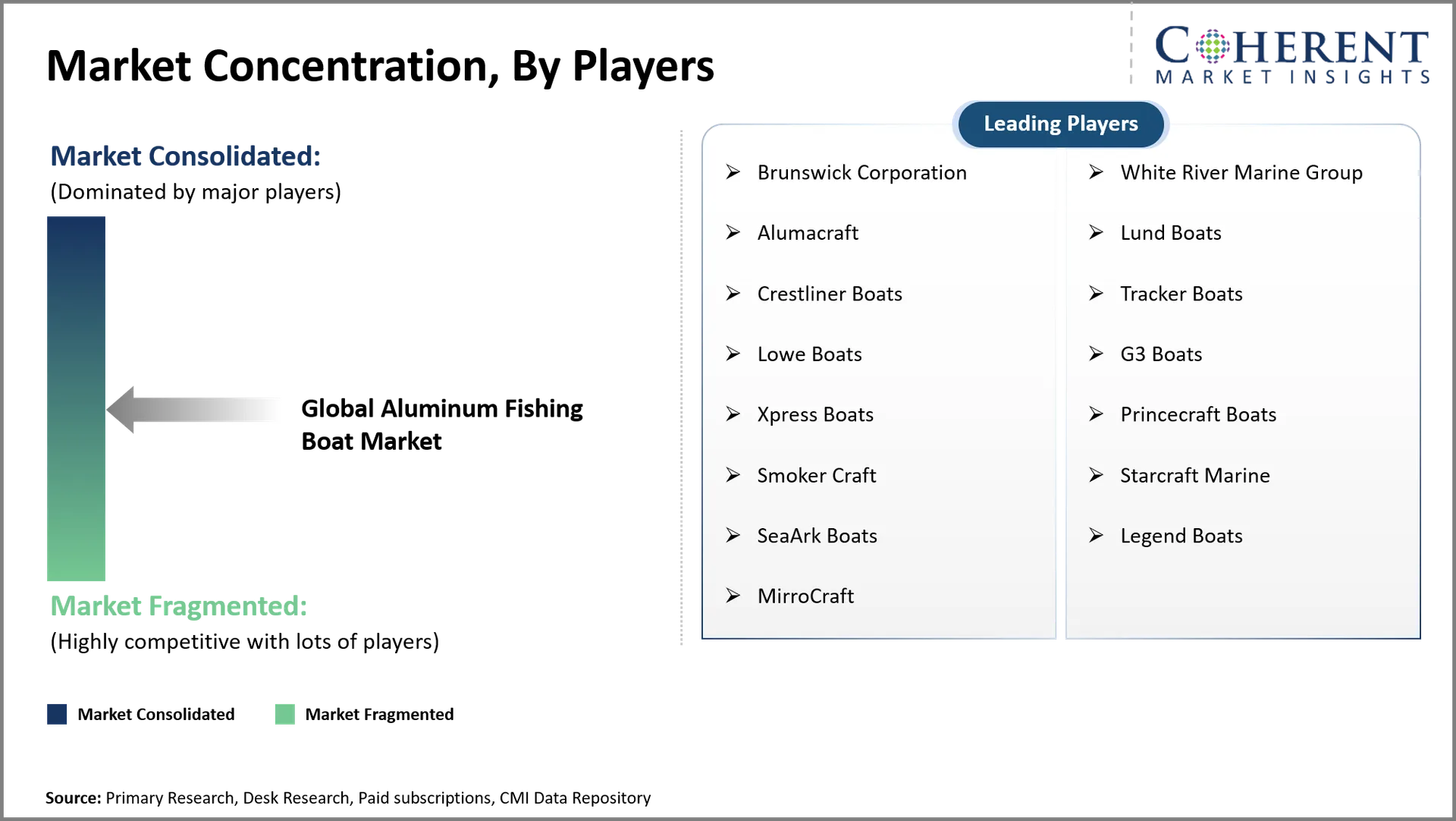
The competitive landscape includes Brunswick Corporation, Alumacraft, and Xpress Boats, with strong emphasis on specialized aluminum fishing platforms. Brunswick’s Aluminum Boat Group consolidates seven aluminum brands including Lund, Lowe, Crestliner and Princecraft. Its strategy includes extensive brand coverage with integrated propulsion, electronics, manufacturing and dealer capabilities. Alumacraft is a fishing boat specialist that has models such as Trophy, Competitor, Voyageur, Classic, Escape and V-Series. There’s a 2026 Competitor series in sport, side-console and tiller configurations with a variety of hull sizes. Xpress Boats emphasizes all-welded construction, high-performance hull engineering, and dedicated bass, bay, skiff, crappie, and catfish models.
Market Report Scope
Aluminum Fishing Boat Market Report Coverage | |||
Report Coverage | Details | ||
Base Year | 2025 | Market Size in 2026: | USD 2.50 Bn |
Historical Data For: | 2020 To 2024 | Forecast Period: | 2026 To 2033 |
Forecast Period 2026 To 2033 CAGR: | 5.2% | 2033 Value Projection: | USD 4.15 Bn |
Geographies covered: |
| ||
Segments covered: |
| ||
Companies covered: | Brunswick Corporation, White River Marine Group, Alumacraft, Lund Boats, Crestliner Boats, Tracker Boats, Lowe Boats, G3 Boats, Xpress Boats, Princecraft Boats, Smoker Craft, Starcraft Marine, SeaArk Boats, Legend Boats, MirroCraft | ||
Growth Drivers: |
| ||
Restraints & Challenges: |
| ||
Analyst Opinion (Expert Opinion)
- The industry is likely to move toward lighter, more technology-integrated fishing boats with increasingly specialized layouts. Electric propulsion will create additional design opportunities where quiet operation and low-speed maneuverability are important. Manufacturers will increasingly differentiate models through hull engineering, fishing electronics, storage systems, and propulsion integration.
- The strongest opportunities should center on bass boats, multispecies boats, and compact models below 20 feet. Freshwater recreational fishing should remain important because these boats can serve lakes, rivers, and reservoirs. There is plenty of room for specialized fishing models in the U.S., while Australia, Canada and Japan provide unique uses in both coastal and interior waterways.
- Players looking for an edge should build modular platforms with varied fishing combinations and propulsion options. They’ll have rugged welded structure, onboard sonar, navigation, trolling motors, and digital controls. Dealer service expansion, customization options and aftermarket accessories can help increase customer retention and the ownership experience.
Speak to the analyst
Want personalized insights?
Take the findings above to one of our principal consultants, or have the report rebuilt around the segments, geographies and competitors you actually track.
Market Segmentation
- Boat Type Insights (Revenue, USD Billion, 2021 - 2033)
- Bass Boats
- Multi-Species Boats
- Jon Boats
- Deep-V Boats
- Others
- Engine Type Insights (Revenue, USD Billion, 2021 - 2033)
- Outboard
- Inboard
- Others
- Boat Size Insights (Revenue, USD Billion, 2021 - 2033)
- Less Than 14 Feet
- 14-16 Feet
- 17-20 Feet
- More Than 20 Feet
- Engine Capacity Insights (Revenue, USD Billion, 2021 - 2033)
- Less Than 200 HP
- 200-300 HP
- More Than 300 HP
- Application Insights (Revenue, USD Billion, 2021 - 2033)
- Recreational Fishing
- Commercial Fishing
- Personal Use
- Others
- Regional Insights (Revenue, USD Billion, 2021 - 2033)
- North America
- U.S.
- Canada
- Latin America
- Brazil
- Argentina
- Mexico
- Rest of Latin America
- Europe
- Germany
- U.K.
- Spain
- France
- Italy
- Russia
- Rest of Europe
- Asia Pacific
- China
- India
- Japan
- Australia
- South Korea
- ASEAN
- Rest of Asia Pacific
- Middle East
- GCC Countries
- Israel
- Rest of Middle East
- Africa
- South Africa
- North Africa
- Central Africa
- North America
- Key Players Insights
- Brunswick Corporation
- White River Marine Group
- Alumacraft
- Lund Boats
- Crestliner Boats
- Tracker Boats
- Lowe Boats
- G3 Boats
- Xpress Boats
- Princecraft Boats
- Smoker Craft
- Starcraft Marine
- SeaArk Boats
- Legend Boats
- MirroCraft
Sources
Primary Research Interviews
- Aluminum Fishing Boat Manufacturers
- Marine Equipment Distributors & Dealers
- Commercial and Recreational Fishing Operators
- Boat Building Material Suppliers
Magazines
- Boating Industry Magazine
- Professional Boatbuilder Magazine
- Marine Business Journal
- Soundings Trade Only Magazine
Journals
- Journal of Ship Production and Design
- International Journal of Maritime Engineering
- Journal of Marine Science and Technology
- National Marine Manufacturers Association (NMMA)
- Recreational Boating & Fishing Foundation (RBFF)
Public Domain Sources
- U.S. Fish & Wildlife Service – National Fishing License Data
- U.S. Coast Guard – Recreational Boating Statistics
- Food and Agriculture Organization (FAO) – Fisheries & Aquaculture Reports
- World Trade Organization (WTO) – Marine Trade Data
Proprietary Elements
- CMI Data Analytics Tool
- Proprietary CMI Existing Repository of information for last 10 years
Get access to 250+ pages report
Every segment, forecast, competitor profile and data table behind the analysis above — available for instant download.
- ESOMAR Member
- ISO 9001:2015 Certified
- D-U-N-S Registered
- GDPR & CCPA Compliant
Missing comfort of reading report in your local language? Find your preferred language:
Frequently Asked Questions
The global aluminum fishing boat market is expected to stand at USD 2.50 Bn in 2026 and is expected to reach USD 4.15 Bn by 2033.
The CAGR of the global aluminum fishing boat market is projected to be 5.2% from 2026 to 2033.
Growing participation in recreational and freshwater fishing and Demand for lightweight and easily trailered boats are the major factors driving the growth of the global aluminum fishing boat market.
High aluminum and marine-grade alloy costs and volatility in discretionary consumer spending are the major factors hampering the growth of the global aluminum fishing boat market.
In terms of boat type, bass boats segment is estimated to dominate the market revenue share in 2026.
Yes, aluminum fishing boats can use electric propulsion when hull design, battery capacity, and motor requirements are appropriately matched.
Yes, aluminum fishing boats are widely suited to lakes, rivers, reservoirs, and other freshwater fishing environments.