

Global Apron Bus Market Size and Forecast – 2026 To 2033
The global apron bus market is expected to grow from USD 630 Mn in 2026 to USD 1,100 Mn by 2033, registering a compound annual growth rate (CAGR) of 7.5% from 2026 to 2033. The global apron bus market is driven by increasing remote aircraft stand operations. On July 10, 2026, Changi Airport Group completed construction of its first satellite gate, a standalone remote boarding and disembarkation facility designed to enhance the passenger experience for flights assigned to remote aircraft parking stands.
Key Takeaways of the Global Apron Bus Market
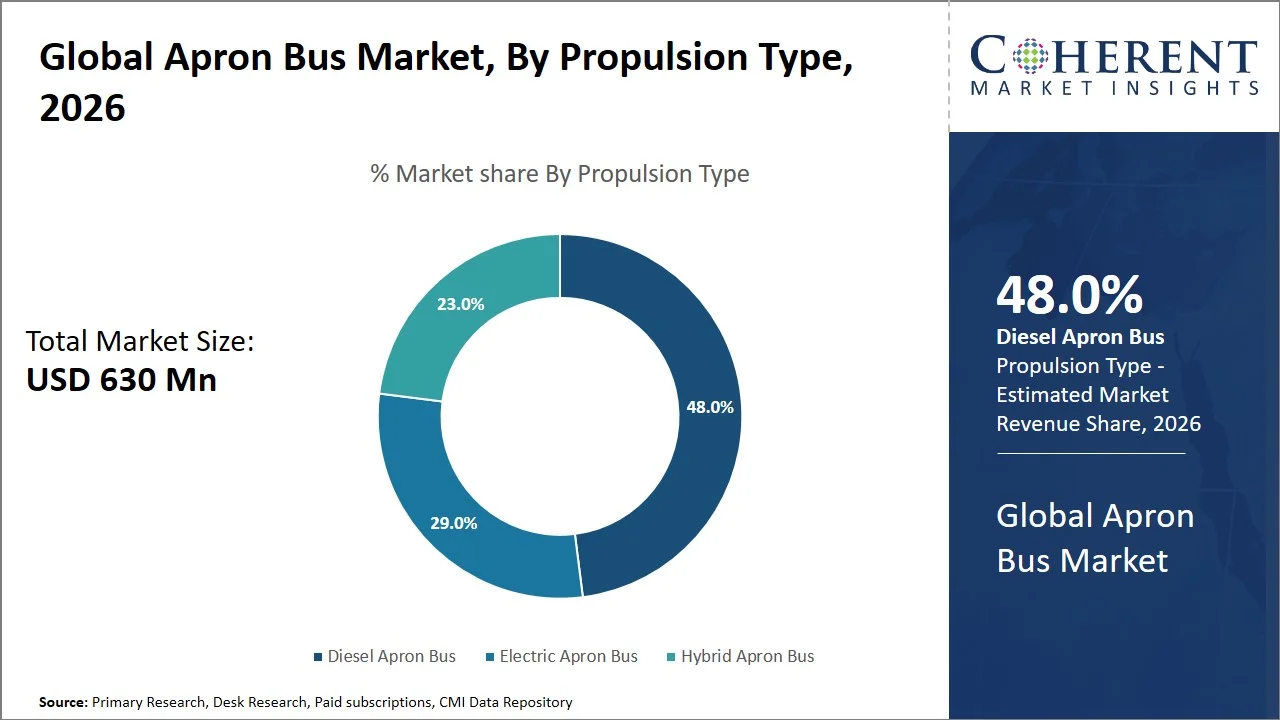
- The Diesel Apron Bus segment is expected to account for 48.0% of the global apron bus market share in 2026. Growing airport infrastructure investments is driving the growth of the segment. On December 18, 2025, Adani Airports announced plans to bid for 11 government-owned airports as part of an USD 11 billion expansion strategy.
- The Standard Apron Bus segment is estimated to capture 38.0% of the market share in 2026. Increasing focus on airside operational efficiency is majorly driving the growth of the segment. On April 8, 2025, Copenhagen Airports partnered with Assaia and Smarter Airports to develop Total Airport Management capabilities.
- The Passenger Transfer segment is estimated to capture 45.0% of the market share in 2026. Increasing airport fleet modernization programs is driving the growth of the segment. AeroGround operated 37 zero-emission apron passenger vehicles by May 2025. The fleet included 20 standard buses and 17 articulated buses.
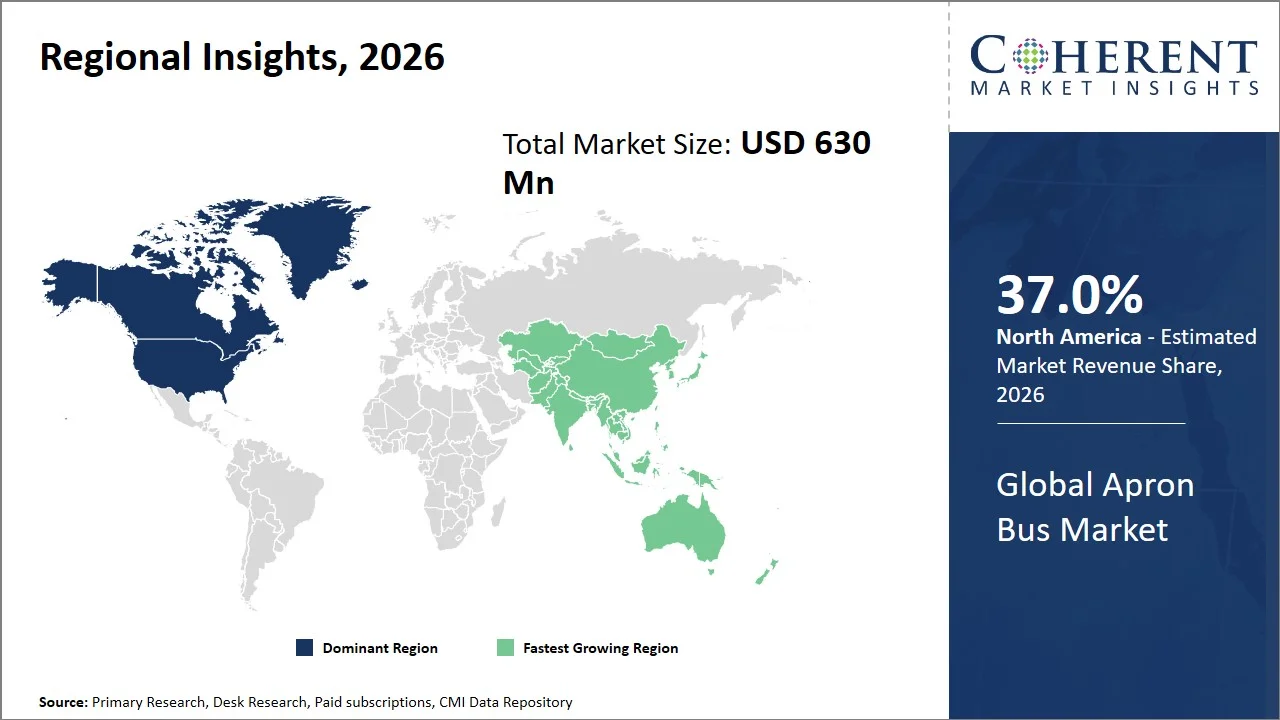
- North America is expected to dominate the apron bus market in 2026 with a market share of 37.0%. Integration of intelligent fleet management systems in North America is driving the growth of the regional market. On December 10, 2025, Swissport North America deployed Samsara Vehicle Gateways and AI Dash Cameras across its ground operations.
- Asia Pacific is expected to account for 33.0% share in 2026. Increasing demand of apron buses from emerging airports in Asia Pacific is driving the growth of the regional market. On October 8, 2025, Adani Airports inaugurated Navi Mumbai International Airport, creating Mumbai's second international airport.
Segmental Insights
Why Does Diesel Apron Bus Dominate the Global Apron Bus Market?
The diesel apron bus segment is expected to account for 48.0% of the global apron bus market share in 2026. Diesel apron buses are still commonly used because of their reliable operation under hectic airport operating schedules. Their existing refueling infrastructure allows for continuous operation without long charging breaks. Diesel engines are good for constant loading and unloading of passengers and moving small distances. Many airports still rely on existing diesel fleets due to the significant capital investment and infrastructural changes needed for replacement. These operational and economic advantages continue to drive the global deployment of diesel buses at airports. In September 2025, COBUS delivered its 5,000th apron bus to British Airways. This milestone reflects the ongoing demand for the proven COBUS platforms in major airline operations.
- Current Industry Events of 2026
- Market Size Estimation
- Regional Breakdown
- Competitive Landscape
- Customer Intelligence
- Segmental Analysis
- Pricing Analysis
- Key Market Drivers, Challenges & Future Trends
- Customized Insights Section
Why is Standard Apron Bus the Most Crucial Bus Type?
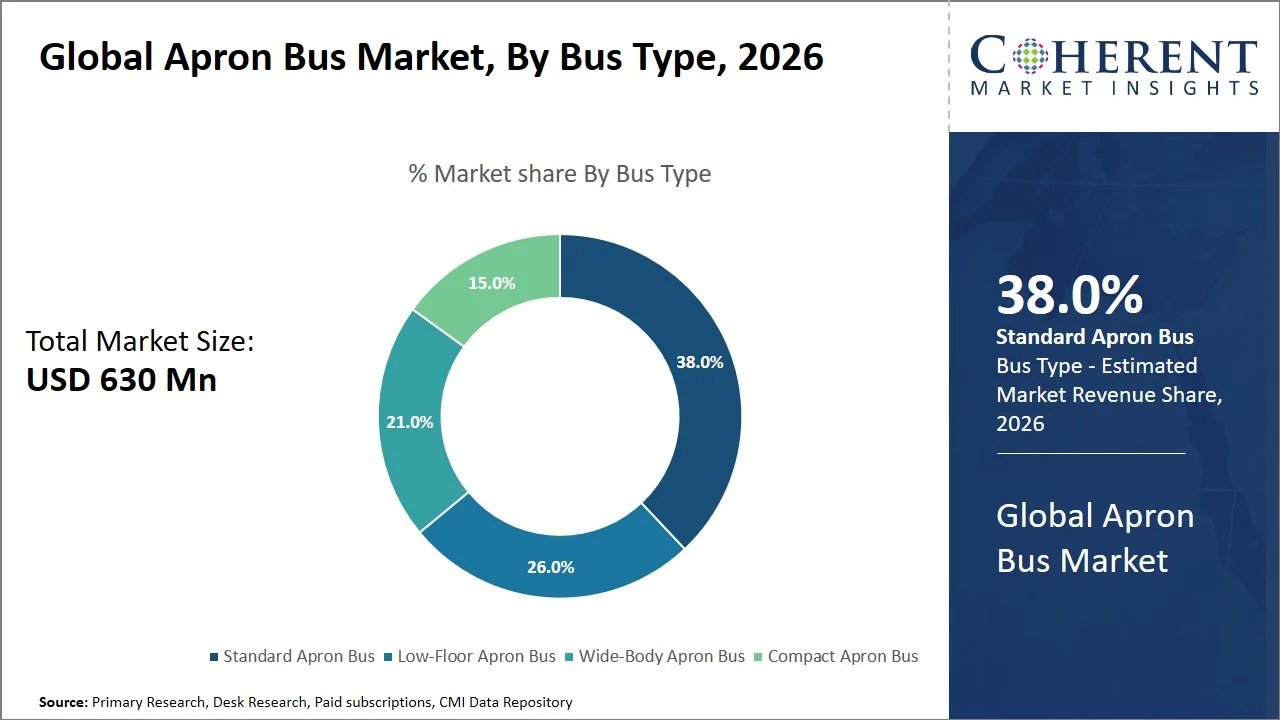
The standard apron bus segment is expected to account for 38.0% of the global apron bus market share in 2026. Standard apron buses enable flexible passenger transit between terminals and airplanes parked at outlying stands. Their higher passenger capacity means they can move quickly at busy boarding times. These buses can operate to the airport often without the need for specific infrastructure. Their traditional architecture also makes maintenance, driver training and fleet integration easier. The practical characteristics of ordinary apron buses make them quite useful for everyday transportation of airport passengers. For instance, on 26 November 2025, Vilnius Airport placed an order for 12 e.COBUS 2700 buses to transfer passengers between terminals and aircrafts. The vehicles are expected during the second half of 2026 and will replace the airport's diesel buses.
Passenger Transfer Dominates the Global Apron Bus Market
The passenger transfer segment is expected to account for 45.0% of the global apron bus market share in 2026. Passenger transfer requires frequent transportation between terminals and aircraft parked at remote stands. These buses are most appropriate for large groups of passengers during embarkation and disembarkation activities. They cut down on walking lengths across big airport aprons. In addition, they contribute to calm passenger flows at peak flight schedules. These operational conditions are favorable to broad acceptance for normal airport passenger transport. On 18 September 2025, Eicher handed out 6 Skyline Pro-E electric tarmac buses to IndiGo at Bengaluru Airport. The buses specifically transport passengers between the terminal and aircraft stands.
Current Events and their Impact
Current Events | Description and its Impact |
California Zero - Emission Airport Ground Support Equipment Program |
|
European Union Fit For 55 Aviation Decarbonization Measures |
|
Apron Bus Market Dynamics
Market Drivers
Rising global air passenger traffic
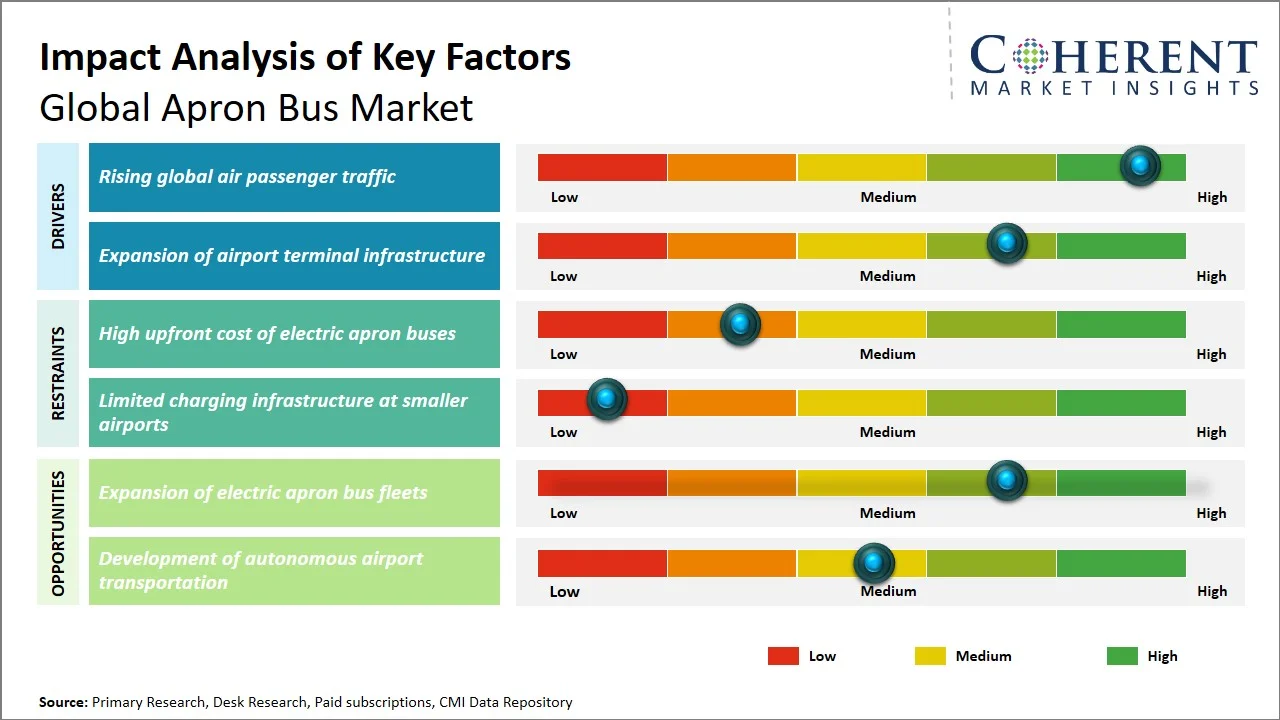
The increasing worldwide air passenger traffic is fueling the demand for effective passenger transit across busy airport aprons. Higher flight frequencies mean more frequent transfers between terminals and remotely parked planes. Dependable apron buses are crucial for airports to be able to transport passengers during peak periods of operation. Airports with continuous traffic growth also see that growing passenger loads lead to fleet expansion. This tendency encourages the continuous purchase of bigger capacity and efficient apron buses. On January 29, 2026, International Air Transport Association reported that global passenger demand rose 5.3% in 2025. International demand climbed 7.1% with an all-time high passenger load factor of 83.6%.
Expansion of airport terminal infrastructure
Expansion of airport terminal infrastructure is increasing the distance between passenger facilities and aircraft parking positions. New terminals sometimes require extra remote stands, increasing the demand for apron transfer services. Airport expansions also incentivize operators to upgrade their existing fleets of passenger transfer vehicles. Hence, larger infrastructure developments can create procurement possibilities for new apron buses. This development will increase demand at both established airports and fast-growing aviation hubs. On March 26, 2026, Tata Projects completed Phase 1 of Noida International Airport on March 26, 2026 ahead of commercial debut. Terminal 1 has an area of approximately 138,000 square meters and serves over 12 million passengers each year.
Emerging Trends
Rapid Electrification of Airport Fleets
Airports are progressively replacing traditional diesel apron buses with battery-electric types. The change is being driven by the push for lower emissions, reduced operational costs and the expansion of charging infrastructure. Electric fleets also help to meet airport sustainability obligations and tighter environmental restrictions.
Integration of Advanced Fleet Management Systems
Apron bus operators are increasingly using linked fleet management systems. Real-time location tracking, predictive maintenance, energy monitoring and route optimization boost vehicle use. These devices also assist airport operators to cut down on downtime and better manage the transfer of passengers.
Development of Autonomous Apron Transportation
Technologies for autonomous vehicles are gradually approaching the controlled environment of airports. Automated apron buses might drive down driver needs and increase operational consistency. Airports are exploring self-driving transport for recurring routes where controlled traffic conditions permit safer and more predictable transit of passengers.
Growing Adoption of High-Capacity Electric Buses
Airports are increasingly considering high-capacity electric buses for busy passenger transfer operations. Big battery systems and better charging technology provide longer working cycles. This step helps to clean transportation and maintain an effective passenger flow amid hectic airport schedules.
Regional Insights
Why is North America a Strong Market for Apron Bus?
North America is expected to account for a market share of 37.0% in 2026. North America benefits from significant hub airport modernization and the replacement of aged airside fleets. More passenger transfers are needed at major airports when remote stands and gate capacity are added. The U.S. Federal Aviation Administration Airport Improvement Program helps eligible airports improve their infrastructure. Electrification is another factor, with studies looking at charging needs at more than 300 US airports. Large airports may require substantial electrical capacity for electrified ground support equipment.
Why Does Asia Pacific Apron Bus Market Exhibit High Growth?
Asia Pacific is expected to register the fastest growth with a CAGR of 7.9% over the forecast period. The region is projected to account for 33.0% of the global apron bus market in 2026. Asia Pacific is benefiting from rapid construction of new airports and terminal expansions across China, India, Southeast Asia, and Australia. China expects big airport expansion and domestic manufacturing from Yutong, Xiamen King Long and Xinfa Airport Equipment The government’s focus on the Dual Carbon plan is driving the deployment of electric ground equipment. India is improving regional connection through developing airports and the regional connection scheme. Japan contributes demand through advanced airport operations and continued transport infrastructure investment.
Global Apron Bus Market Outlook for Key Countries
Why is U.S. Emerging as a Major Hub in the Apron Bus Market?
The U.S. apron bus market is being shaped strongly by airport electrification and electrical infrastructure planning. Research shows that vehicle deployment and charger needs are among the key planning issues for more than 300 U.S. airports. Electrified ground support equipment might add as much as 20 MW of peak electrical demand for the larger airports. Battery storage and solar photovoltaics could help to reduce peak loads and infrastructure expenses. These requirements are prompting airports to consider their apron bus purchase within the framework of wider energy planning.
Is China the Next Growth Engine for the Apron Bus Market?
China benefits from a robust domestic industrial base and fast-track construction of airport facilities. Locally manufactured apron bus options are provided by Zhengzhou Yutong, Xiamen King Long and Xinfa Airport Equipment. China’s Civil Aviation Administration is supporting upgrading with national Dual Carbon goals. Airports looking to reduce emissions for ground operations are increasingly opting for apron bus electrification. Expansion of regional aviation connectivity is also creating additional requirements for high-capacity airside transportation equipment.
Germany Apron Bus Market Analysis and Trends
Germany benefits from a mature airport ecosystem combining advanced vehicle engineering and established ground support equipment manufacturing. COBUS Industries and other German suppliers serve large international airport operations requiring high-capacity passenger transportation. Munich Airport has ordered 49 MAN electric buses with an option for 25 further vehicles. This acquisition shows progress toward large-scale electric fleet adoption instead of confined pilot operations. Sustainability standards and airport decarbonization programs further boost demand for low-emission apron buses.
Japan Apron Bus Market Analysis and Trends
Japan has a technology-based apron bus environment that emphasizes operational accuracy and passenger convenience. Airports are putting more emphasis on automated access systems, digital passenger processing and sophisticated terminal operations. These standards enable apron bus interoperability with integrated airport transportation systems. The desire for reliable low floor and passenger friendly vehicles is further supported by Japan’s well developed airport infrastructure. More investment in airport transport infrastructure creates further prospects for electric and technologically advanced apron buses.
India Apron Bus Market Analysis and Trends
Apron bus demand in India is driven by rapid terminal building and regional airport connectivity expansion. Major centers like Delhi, Mumbai and Bengaluru are undergoing capacity development and upgrading. The Regional Connectivity Scheme is helping to connect secondary cities and regional airports more widely. Air-conditioned apron buses are also being progressively adopted in Indian airports for passenger convenience when transferring to aircraft. Another area for growth is the conversion of fleets to electric and hybrid models as a means for airports to reduce operating emissions.
Global Apron Bus Market - Electric Apron Bus Deployment by Airport and Country (2025)
Country | Airport | Company / Operator | Electric Apron Bus Deployment |
Germany | Munich Airport | AeroGround / MAN Truck & Bus | 37 |
India | Kempegowda International Airport | IndiGo / Eicher Trucks & Buses | 6 |
Japan | Kansai International Airport | Kansai Airports / Nankai Bus | 4 |
United Kingdom | Heathrow Airport | British Airways / COBUS Industries | 23 |
China | Multiple Chinese Airports | Yutong Bus | 100+ |
How is Expansion of Electric Apron Bus Fleets Creating New Growth Opportunities in the Apron Bus Market?
Increasing fleets of electric apron buses are opening doors for integrated vehicle and charging infrastructure contracts. By May 2025 Munich Airport is operating 37 zero-emission apron buses, planning to deploy a maximum of 72 vehicles. The airport also installed 37 charging outlets with more charging capacity planned. Electric drive lines are particularly well suited for apron activities with short distances and low speeds. This presents chances for manufacturers to provide articulated buses, charging systems, energy management and fleet software as integrated solutions. On April 16, 2026, Tata Motors received an order from Air India SATS on April 16, 2026 for 21 electric airport passenger coaches. The trucks are being deployed at airports in Delhi, Bengaluru, Hyderabad and Thiruvananthapuram. The order expands an existing electric coach fleet of 37 vehicles.
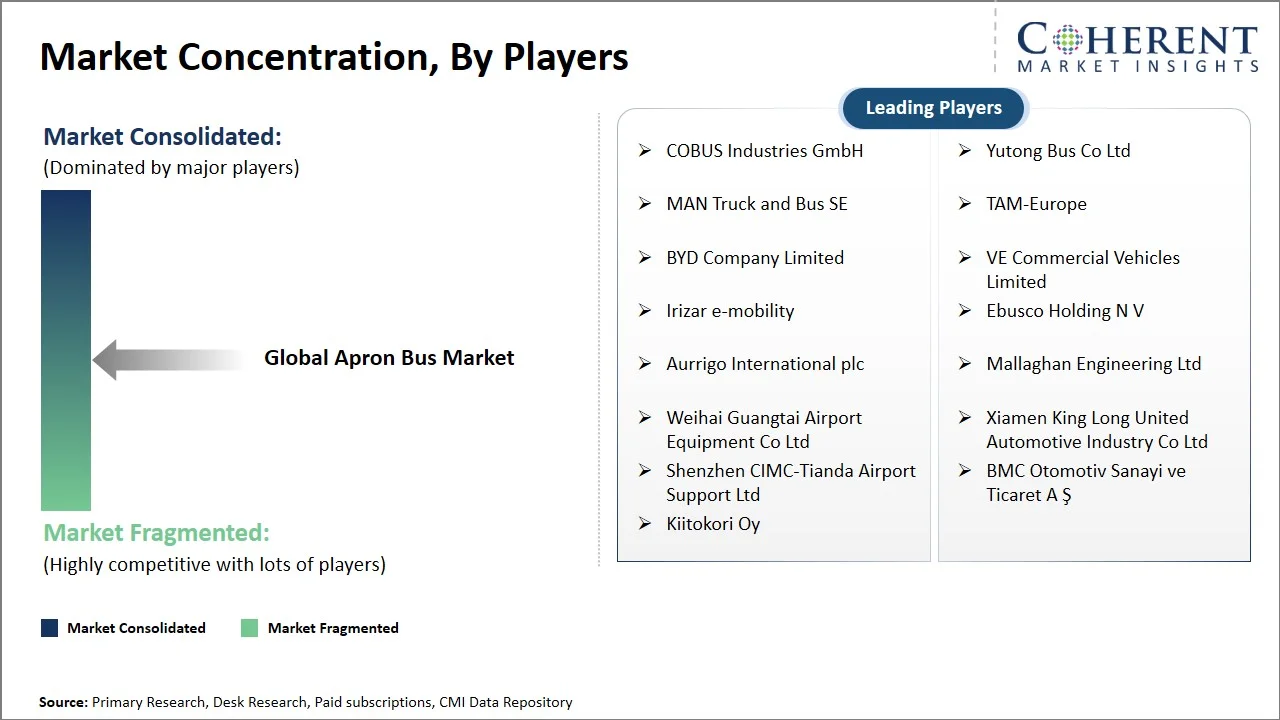
Market Players, Key Development, and Competitive Intelligence
Key Developments
- On February 13, 2026, Yutong delivered 16 apron buses to Jazeera Airways, Kuwait’s first private airline, during a handover ceremony at its Marketing Center. This delivery marks Yutong’s first entry into Kuwait’s apron bus market and a key milestone in its expansion across Middle East aviation hubs.
- On December 18, 2024, Hitachi ZeroCarbon announced a strategic partnership with COBUS Industries, a global leader in airport mobility solutions. The collaboration will see Hitachi equip 100 e.COBUS Extended Range (ER) buses worldwide, with its ZeroCarbon BatteryManager solution by 2025.
Competitive Landscape
COBUS Industries remains a leading specialist, combining long-standing apron bus expertise with electric fleet development. In September 2025, it delivered its 5,000th COBUS to British Airways, further strengthening its worldwide airline links. Zhengzhou Yutong Bus takes a different tack, focusing on large-scale electric platforms and international expansion. The company’s AB14E can carry 114 passengers and has battery capacity of up to 352 kilowatt-hours. Yutong also emphasizes battery safety, electric drivetrain technology, and airport-specific vehicle engineering. Competition is therefore increasingly focused on electric range, passenger capacity, charging compatibility, and airport-specific customization.
Market Report Scope
Apron Bus Market Report Coverage
| Report Coverage | Details | ||
|---|---|---|---|
| Base Year: | 2025 | Market Size in 2026: | USD 630 Mn |
| Historical Data for: | 2020 To 2024 | Forecast Period: | 2026 To 2033 |
| Forecast Period 2026 to 2033 CAGR: | 7.50% | 2033 Value Projection: | USD 1,100 Mn |
| Geographies covered: |
| ||
| Segments covered: |
| ||
| Companies covered: | COBUS Industries GmbH, Yutong Bus Co Ltd, MAN Truck and Bus SE, TAM-Europe, BYD Company Limited, VE Commercial Vehicles Limited, Irizar e-mobility, Ebusco Holding N V, Aurrigo International plc, Mallaghan Engineering Ltd, Weihai Guangtai Airport Equipment Co Ltd, Xiamen King Long United Automotive Industry Co Ltd, Shenzhen CIMC-Tianda Airport Support Ltd, BMC Otomotiv Sanayi ve Ticaret A Ş, Kiitokori Oy | ||
| Growth Drivers: |
| ||
| Restraints & Challenges: |
| ||
Analyst Opinion (Expert Opinion)
- Electric apron buses will become the industry's strongest growth opportunity as airports replace diesel fleets. Munich Airport already operates 37 zero-emission apron passenger vehicles, including 17 articulated buses. The airport plans to add 18 vehicles and eventually operate up to 72 units. This creates particularly strong opportunities for articulated electric buses at large international airports with intensive remote-stand operations.
- China and Germany should receive particular attention because both combine airport modernization with established electric bus manufacturing capabilities. How manufacturers might respond to increased passenger volumes with 114-person capacity and large battery storage is shown by Yutong’s AB14E. Munich Airport is already developing electric apron mobility beyond experimental projects, making Germany an important reference market.
- Players need to differentiate themselves by providing comprehensive airport mobility solutions, rather than selling stand-alone vehicles. Procurement proposals should cover charging infrastructure, battery management, predictive maintenance, fleet monitoring and passenger capacity. Connected electric buses offer operational and data-security considerations too, therefore manufacturers should contribute to cybersecurity measures as well. Long-term contracts combining vehicles, charging systems, software, and maintenance could provide stronger competitive positioning.
Speak to the analyst
Want personalized insights?
Take the findings above to one of our principal consultants, or have the report rebuilt around the segments, geographies and competitors you actually track.
Market Segmentation
- Propulsion Type Insights (Revenue, USD Million, 2021 - 2033)
- Diesel Apron Bus
- Electric Apron Bus
- Hybrid Apron Bus
- Bus Type Insights (Revenue, USD Million, 2021 - 2033)
- Standard Apron Bus
- Low-Floor Apron Bus
- Wide-Body Apron Bus
- Compact Apron Bus
- Application Insights (Revenue, USD Million, 2021 - 2033)
- Passenger Transfer
- Crew Transfer
- Airport Staff Movement
- Remote Stand Operations
- End User Insights (Revenue, USD Million, 2021 - 2033)
- Commercial Airports
- Airlines
- Ground Handling Companies
- Military Airbases
- Regional Insights (Revenue, USD Million, 2021 - 2033)
- North America
- U.S.
- Canada
- Latin America
- Brazil
- Argentina
- Mexico
- Rest of Latin America
- Europe
- Germany
- U.K.
- Spain
- France
- Italy
- Russia
- Rest of Europe
- Asia Pacific
- China
- India
- Japan
- Australia
- South Korea
- ASEAN
- Rest of Asia Pacific
- Middle East
- GCC Countries
- Israel
- Rest of Middle East
- Africa
- South Africa
- North Africa
- Central Africa
- North America
Sources
Primary Research Interviews
- Airport Ground Handling Service Providers
- Apron Bus Manufacturers & OEMs
- Airport Authorities & Terminal Operators
- Airline Fleet & Operations Managers
Magazines
- Airport World Magazine
- Ground Handling International Magazine
- Aviation Week & Space Technology
- Passenger Terminal World Magazine
Journals
- Journal of Air Transport Management
- International Journal of Aviation Technology, Engineering and Management
- Journal of Transportation Research
Associations
- International Air Transport Association (IATA)
- Airports Council International (ACI)
- International Association of Airport & Seaport Police (IAASP)
- Ground Support Worldwide Association
Public Domain Sources
- U.S. Federal Aviation Administration (FAA) Official Reports
- European Union Aviation Safety Agency (EASA) Publications
- ICAO Annual Reports & Statistics
- World Bank Transport & Infrastructure Data
Proprietary Elements
- CMI Data Analytics Tool
- Proprietary CMI Existing Repository of Information for Last 10 Years
Get access to 250+ pages report
Every segment, forecast, competitor profile and data table behind the analysis above — available for instant download.
- ESOMAR Member
- ISO 9001:2015 Certified
- D-U-N-S Registered
- GDPR & CCPA Compliant
Missing comfort of reading report in your local language? Find your preferred language:
Frequently Asked Questions
The global apron bus market is expected to stand at USD 630 Mn in 2026 and is expected to reach USD 1,100 Mn by 2033.
The CAGR of the global apron bus market is projected to be 7.5% from 2026 to 2033.
Rising global air passenger traffic and expansion of airport terminal infrastructure are the major factors driving the growth of the global apron bus market.
High upfront cost of electric apron buses and Limited charging infrastructure at smaller airports are the major factors hampering the growth of the global apron bus market.
In terms of propulsion type, diesel apron bus segment is estimated to dominate the market revenue share in 2026.
An apron bus transports passengers between airport terminals and aircraft parked away from terminal gates.
Electric models reduce local emissions and support airport decarbonization programs.