

Global Assistive Robotics Market Size and Forecast – 2026 To 2033
The global assistive robotics market is expected to grow from USD 11.20 Bn in 2026 to USD 33.21 Bn by 2033, registering a compound annual growth rate (CAGR) of 16.8% from 2026 to 2033. The market for global assistive robotics is poised for significant expansion, fueled by the increasing government support for AI-enabled assistive and rehabilitation technologies.
In February 2026, the U.S. Administration for Community Living (ACL) launched its Caregiver AI Prize Competition, allocating up to USD 2.5 million to develop AI solutions that support caregiving, home-based care, and people with disabilities. This highlight growing public-sector support for AI-enabled caregiving and home-based assistive solutions, creating a favorable environment for innovation and adoption of assistive robotics. (Source: U.S. Department of Health and Human Services)
Key Takeaways of the Global Assistive Robotics Market
- Wearable assistive robots are projected to hold 30.6% of the global assistive robotics market share in 2026, making it dominant robot type segment across North America due to the region’s established regulatory pathway for powered exoskeletons used for mobility and rehabilitation. For instance, the U.S. Food and Drug Administration (FDA) classifies powered lower-extremity exoskeletons as Class II medical devices under regulation 890.3480 and permits their review through the 510(k) pathway. This regulatory classification supports the development and commercialization of wearable robotic systems for individuals with weakened or paralyzed lower limbs.
- Semi-autonomous robots are projected to hold 46.7% of the global assistive robotics market share in 2026, making it dominant level of autonomy segment across North America supported by established safety and performance requirements for rehabilitation robotics. For instance, the U.S. FDA recognizes IEC 80601-2-78, which specifies basic safety and essential-performance requirements for medical robots used for rehabilitation, assessment, compensation, or alleviation of movement impairments. Such regulatory recognition supports the deployment of increasingly adaptive robotic systems in rehabilitation settings.
- Mobile robots are projected to hold 54.6% of the global assistive robotics market share in 2026, making it dominant mobility segment across Asia Pacific supported by Japan’s government-led focus on robotic technologies for elderly care and independent mobility. For instance, in June 2024, Japan’s Ministry of Health, Labour and Welfare (MHLW) and Ministry of Economy, Trade and Industry (METI) expanded their Priority Fields for Nursing Care Technology to include mobility assistance, transfer assistance, functional training, and independent-living support, directly supporting the development and adoption of mobile assistive robots in elderly care.
- North America market maintains dominance with an expected share of 40.1% in 2026, bolstered by its well-established medical-device regulation and increasing integration of robotics into rehabilitation and mobility care. For instance, in May 2026, the Government of Canada announced a USD 2.14 million (C$3 million) investment through Pacific Economic Development Canada to support the commercialization of an AI-integrated personal mobility exoskeleton and its expansion from clinical to home and community settings.
- Asia Pacific is expected to exhibit the fastest growth in the global assistive robotics market, registering an estimated CAGR of 21.8% during 2026–2033, driven by expanding government-backed funding and access mechanisms for assistive technologies. For instance, in September 2026, the Australian Government’s Assistive Technology and Home Modifications (AT-HM) scheme provided dedicated funding of up to USD 10,691 (A$15,000) or more for eligible high-tier assistive technology, supporting mobility and independent living among older people.
Segmental Insights
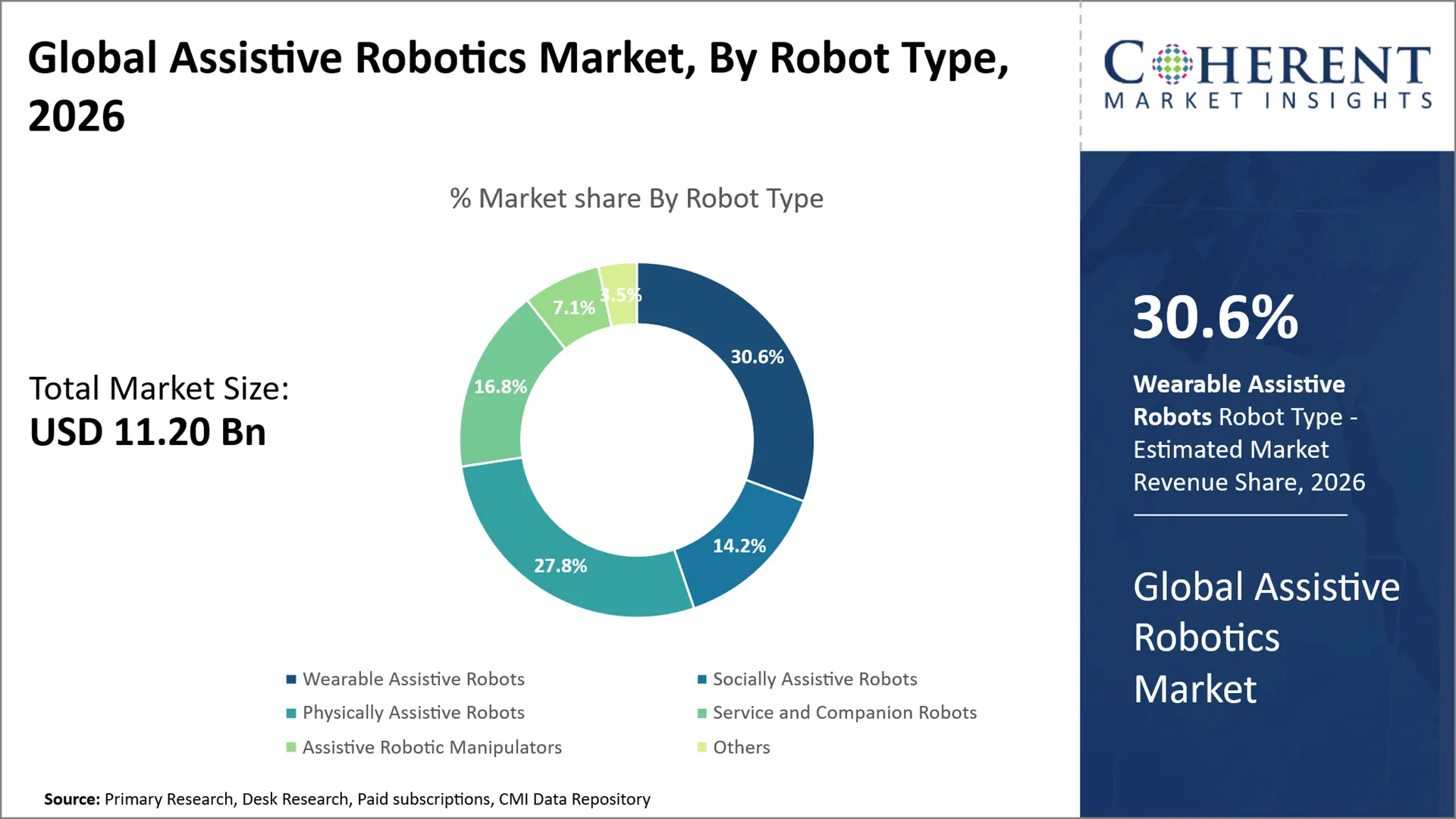
Why Do Wearable Assistive Robots Dominate the Global Assistive Robotics Market?
Wearable assistive robots are projected to hold the market share of 30.6% in 2026, as exoskeleton and wearable robotic system provide real-time assistance in mobility and rehabilitation in a collaborative manner with the user. Continual developments in sensors, the weight of the equipment and intuitive control mechanisms will probably improve performance and increase the applications for home-based mobility and rehabilitation. For instance, on September 2, 2026, the U.S. Food and Drug Administration (FDA) approved
Trexo Robotics, Inc.’s Trexo Theo powered exoskeleton as a 510(k) under the category of Class II powered exoskeleton for physical medicine. This regulatory clearance further reinforces the growing clinical adoption of wearable robotic systems for mobility and rehabilitation.
- Current Industry Events of 2026
- Market Size Estimation
- Regional Breakdown
- Competitive Landscape
- Customer Intelligence
- Segmental Analysis
- Pricing Analysis
- Key Market Drivers, Challenges & Future Trends
- Customized Insights Section
Why Does Semi-Autonomous Robots Represent the Largest Level of Autonomy Segment in the Assistive Robotics Market?
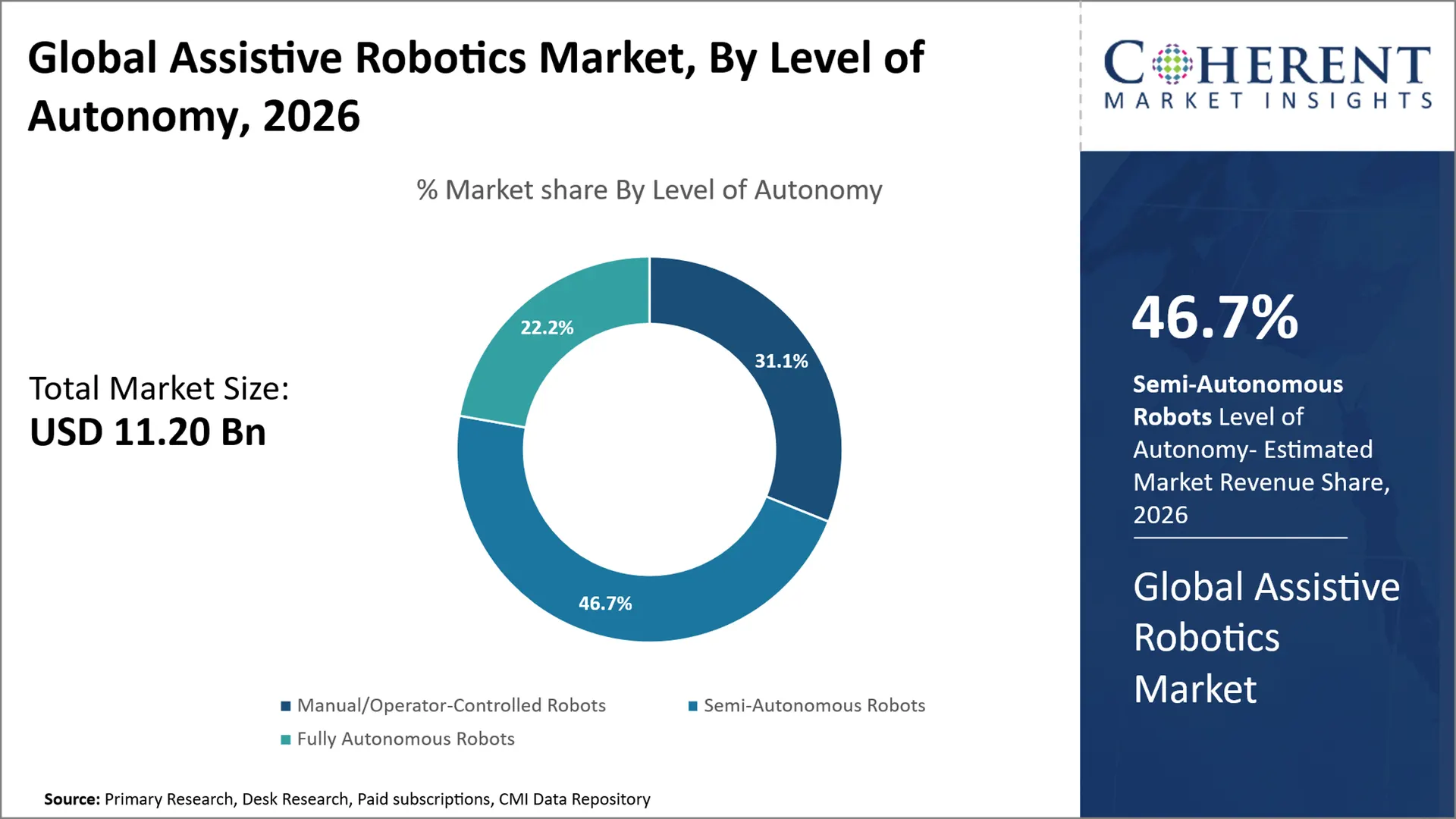
Semi-autonomous robots are projected to hold a market share of 46.7% in 2026, because of their ability to combine the use of automated navigation and assistance to users under human supervision. This gives a manageable compromise of independence and safety. Additionally, upgrades in sensors, shared-control systems and human-robot interfaces have improved their ability to detect user intent with the flexibility to allow user intervention. For instance, in January 2026, a peer-reviewed study published by the National Library of Medicine, demonstrated how a voice-controlled smart wheelchair can combine deep-learning speech recognition, LiDAR-based SLAM, and adaptive safety controls, embellishing the increasing use of shared intelligent control in assistive mobility.
Mobile Robots Segment Dominates the Global Assistive Robotics Market
The mobile robots segment is projected to hold a market share of 54.6% in 2026, due to their ability to provide mobility and act in various environments, such as at home or in rehabilitation centers, hence allowing the user to assist and accompany them. Improvements in navigation, sensor fusion and shared-control algorithms may improve their ability to assist users safely in real-life environments. For instance, on September 4, 2026, Tuya Inc. launched Doova, an AI home companion robot targeted at seniors living alone. The robot uses Lidar, AI vision and sound localization to find people in an emergency, identify falls and provide immediate help, illustrating the expansion of mobile assistive robots into home-based elderly care.
Current Events and their Impact
Current Events | Description and its Impact |
WHO South-East Asia Adopts Resolution on Assistive Technologies (September 2026) |
|
U.S. Launches Funding Opportunity for AI-Driven Assistive & Rehabilitation Technologies (June 2026) |
|
International Standard for Medical Rehabilitation Robots Enters Development (June 2026) |
|
Assistive Robotics Market Dynamics
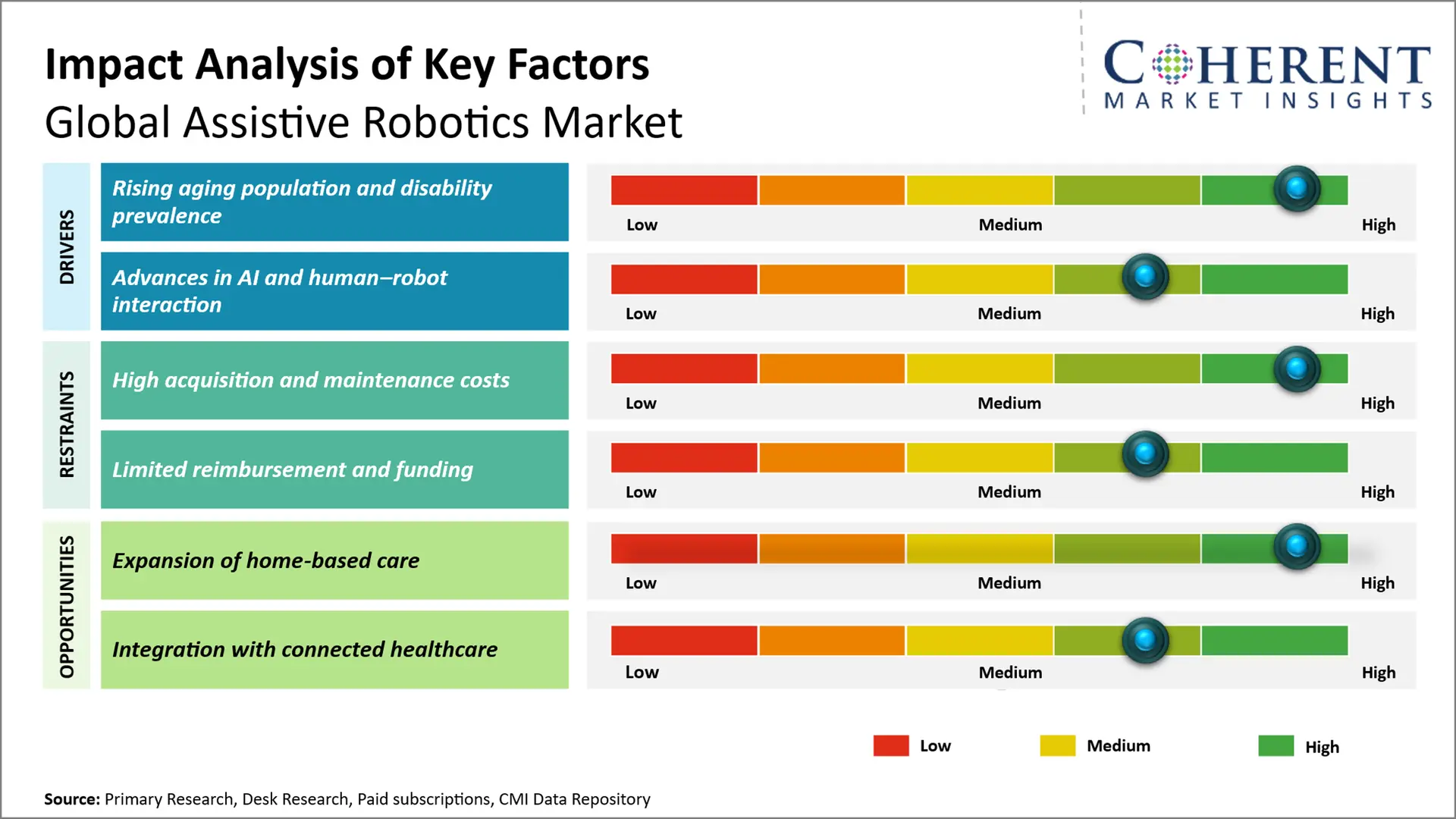
Market Drivers
- Rising aging population and disability prevalence: The rapid growth of the elderly population and increasing prevalence of disability are expanding the need for technologies that support mobility, independence, rehabilitation, and daily-living activities. As age-related functional limitations and chronic conditions become more prevalent, assistive robots are gaining relevance across healthcare, elderly-care, and home settings. This expanding unmet need is expected to support demand for robotic solutions that reduce dependence on caregivers and improve functional independence. For instance, according to WHO, the global population aged 60 years and older is projected to reach 2.1 billion by 2050, while more than 1.3 billion people currently live with a disability.
- Advances in AI and human–robot interaction: Advances in AI-driven motion control and sensor technologies are enabling assistive robots to interpret users’ movements and provide more responsive, personalized physical support. These developments are improving the naturalness of human–robot interaction while expanding the capabilities of wearable robotic systems for mobility and physical assistance. For instance, in May 2026, Hypershell launched its X Series of AI-powered exoskeletons, featuring the company’s HyperIntuition AI-driven motion-control algorithm. The system is designed to adapt assistance to the wearer’s movements, demonstrating the growing integration of AI with real-time human–robot interaction.
- Increasing adoption of robotic rehabilitation in clinical settings: The growing use of robotic systems in rehabilitation centers is supporting market expansion by enabling repetitive, intensive, and personalized therapy for patients with neurological and mobility impairments. Robotic assistance can also reduce therapist workload while improving the consistency and scalability of rehabilitation programs. For instance, in March 2026, Fortis Hospital Mohali introduced AI-powered robot-aided exoskeletal technology for patients with neurological and musculoskeletal impairments. The wearable lower-limb system supports gait improvement and assisted mobility training, reflecting the increasing integration of robotics into mainstream rehabilitation care.
Emerging Trends
- AI-driven personalized assistance: AI and machine learning are increasingly being integrated into assistive robots to recognize user intent, adapt assistance levels, and personalize rehabilitation in real time. This is supporting a shift from fixed robotic assistance toward more responsive, patient-specific systems.
- Growth of home-based robotic rehabilitation: Assistive robotics is moving beyond hospitals and rehabilitation centers into home environments, supported by compact robots, remote monitoring, and connected technologies. These systems can provide continuous exercise support, track progress, and deliver personalized assistance during daily activities.
- Sensor fusion and human-intent recognition: Advanced sensors such as EMG, IMUs, force/torque sensors, and motion sensors are being combined to detect user movement and intent more accurately. Sensor-driven control is enabling smoother, adaptive assistance in exoskeletons and other wearable robotic systems.
Regional Insights
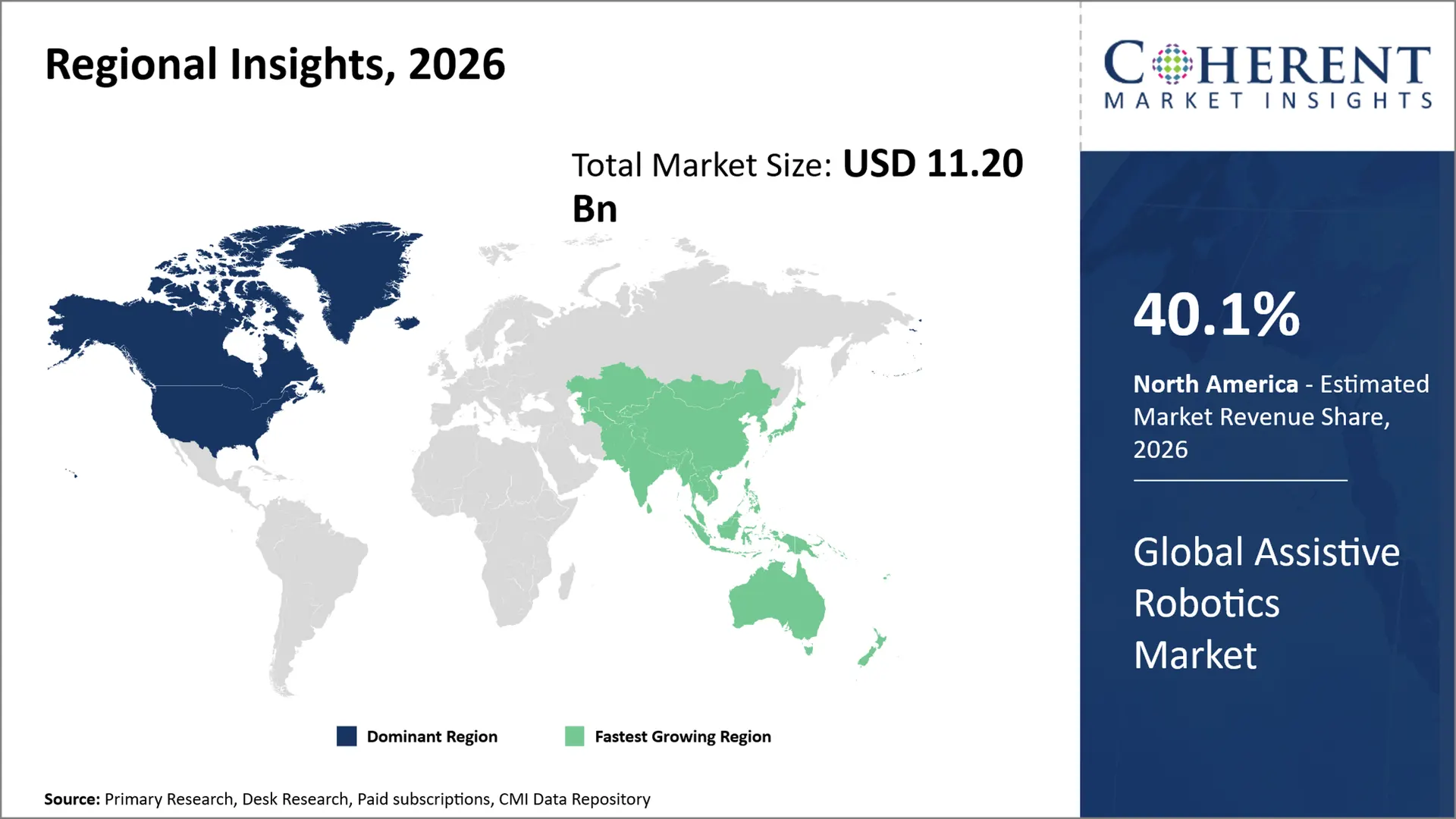
Why is North America a Strong Market for Assistive Robotics?
North America leads the global assistive robotics market, accounting for an estimated 40.1% share in 2026, owing to the presence of advanced healthcare infrastructure, high technological proficiency and high healthcare expenditure. Furthermore, supportive regulatory environment and government policies, such as government funding for healthcare robotics and aids, as well as streamlined regulations are expected to drive the technological innovation in assistive and rehabilitation robotics, thus promoting the product development & commercialization.
For instance, in March 2026, the U.S. National Institute of Health (NIH) awarded USD 212,931 to develop an artificial intelligence-enabled hip-exoskeleton control framework. The goal of this framework is to customize robotic assistance for each individual in a wide range of real-world mobility challenges. Additionally, growing collaboration among healthcare institutions, research organizations, and technology providers as well as high awareness and demand for mobility, rehabilitation and independent-living assistance drive the market growth in region.
Why Does Asia Pacific Assistive Robotics Market Exhibit High Growth?
Asia Pacific is expected to exhibit the fastest growth in the global assistive robotics market, registering an estimated CAGR of 21.8% during 2026–2033. The region is projected to account for 26.1% of the global market in 2026, attributed to the expansion of healthcare infrastructure, rising adoption of advanced rehabilitation robots, and the increasing government focus on aging and disability services. For instance, the National Rehabilitation Center for Persons with Disabilities, under the Ministry of Trade, Industry and Energy (Motie), is conducting a Translational Research Program (Care Robot) under a comprehensive service base including technology development, field demonstration and institutional innovation. This project offers assistance for the disabled and elderly including mobility, transfer, feeding, exercise, and activities of daily living.
In addition, rising healthcare expenditure, growing accessibility to rehabilitation, and improving awareness regarding the use of assistive robotics can be attributed to the fast-paced adoption of assistive robots across the region. Moreover, the growth of indigenous manufacturing, growing investments in technologies, and supportive government initiatives can be attributed to the commercialization and manufacture of affordable robotic devices.
Global Assistive Robotics Market Outlook for Key Countries
Why is the U.S. Leading Innovation and Adoption in the Assistive Robotics Market?
The U.S. is at the forefront of the assistive robotics market innovation and adoption, due to the growing integration of robotics research with clinical rehabilitation. Devices such as the exoskeletons and other NIH-supported projects may incorporate EEG, EMG, motion capture, and human-machine interfaces to help create customized rehabilitation. The country has well-developed safety regulations for medical robots used for rehabilitation and movement restoration, recognized by the Food and Drug Administration (FDA).
Is Japan a Favorable Market for Assistive Robotics Market?
Japan could be deemed as an attractive market for assistive robotics, owing to the government-supported push to encourage aging and disability care robotics adoption. The national priority framework increased the scope of 9 regions and 16 applications, which consist of transfer assistance, functional training, dementia care, monitoring, communication, among others. Furthermore, government subsidy for implementation and deployment of care robots and ICT technologies should be a reliable driving force for the market adoption of the care robots.
Is China Emerging as a Key Growth Hub for the Assistive Robotics Market?
China represents a significant new growth opportunity for the assistive robotics market, driven by government-led initiatives to increase the use of robotics in elderly care, rehabilitation and daily-living support. In 2025, the country launched a pilot program (2025-2027) for intelligent elderly-care service robots for home, community and institutional use. China’s 2026 disability-services plan also specifically encourages the use of artificial intelligence, brain-computer interfaces and robotics for rehabilitation and disability services.
Why Does Germany Top the European Assistive Robotics Market?
Germany is a leader in the European assistive robotics market, presumably because of high public support for innovations in health care and rehabilitation solutions. The German Innovation Fund supported pilot implementations for new patient-centered models of healthcare. In addition, future reforms are deepening the digitalization of the technology-enabled healthcare infrastructure and, thus, making German health care modernization programs seem conducive for assistive robotics in rehabilitation and care.
Is Assistive Robotics Market Developing in the UK?
The UK assistive robotics industry is growing as a result of various programs encouraging robotics adoption and innovation, funded by the UK government. In 2026, UK formed the Robotics Adoption Central Convening Body for accelerating the adoption of robotics for the service industry as part of the Smart Machines 2035.
Global Assistive Robotics Market — Adoption Potential By Application, 2026
Application | Key Use Cases | Adoption Potential |
Elderly Assistance | Mobility support, fall prevention, daily-living assistance | High |
Rehabilitation Assistance | Gait training, upper-limb rehabilitation, post-stroke therapy | High |
Mobility Assistance | Walking support, exoskeletons, transfer assistance | High |
Disability Assistance | Functional support, independent movement, ADL assistance | High |
Cognitive & Social Assistance | Reminders, communication, companionship, cognitive support | Moderate |
Caregiver Assistance | Patient handling, monitoring, routine-care support | Moderate |
Activities of Daily Living Assistance | Dressing, eating, reaching, household tasks | Moderate-High |
How is the expansion of home-based care creating new growth opportunities in the assistive robotics market?
The evolving shift to home care and rehabilitation opens up considerable opportunities for assistive robots in enabling patients to access care and support for activities of daily living outside traditional care settings. There is increasing evidence that portable, remotely monitored robots will be of considerable benefit in making therapy and help more accessible, encouraging therapy compliance, and are expected to likely reduce the need for repeat hospital visits. Additionally, progress in miniaturized robotics, connectivity and adaptable support is underpinning the transition to more tailored home-based rehabilitation.
For instance, in January 2025, a pilot study published by National Library of Medicine, evaluated a robotic rehabilitation device, Rebless in 26 adults with physical or neurological disabilities in community home settings in South Korea. During an 8-week period, Rebless showed increased upper-limb function and decreased caregiver burden indicating the potential applicability of robotic rehabilitation settings beyond clinical facilities.
Market Players, Key Development, and Competitive Landscape
Key Developments
- On September 17, 2026, Wandercraft launched Eve, a self-balancing personal exoskeleton designed to provide hands-free upright mobility in the home. The system is intended to support people with spinal cord injuries and other mobility impairments in performing everyday activities while standing and walking. The launch highlights the expansion of wearable assistive robotics from clinical rehabilitation toward personal, home-based mobility assistance.
- On September 15, 2026, Lifeward Ltd. announced the publication of an independent, peer-reviewed study evaluating its ReWalk personal exoskeleton for home-based activities of daily living. The study found significant improvements in perceived task performance and satisfaction, while participants reported lower pain during exoskeleton use compared with wheelchair use. The findings highlight the expanding role of wearable assistive robotics in supporting daily activities and independent living.
- On September 15, 2026, CYBERDYNE Inc. reported that Japan’s Minister of Health, Labour and Welfare visited Malaysia’s PERKESO Sultan Nazrin Shah Rehabilitation Centre and observed the use of its wearable cyborg HAL technology for rehabilitation. The center has more than 60 HAL units in operation, supporting functional improvement and return-to-work programs. The development highlights the expanding deployment of wearable neuro-robotics in rehabilitation and assistive care.
Competitive Landscape
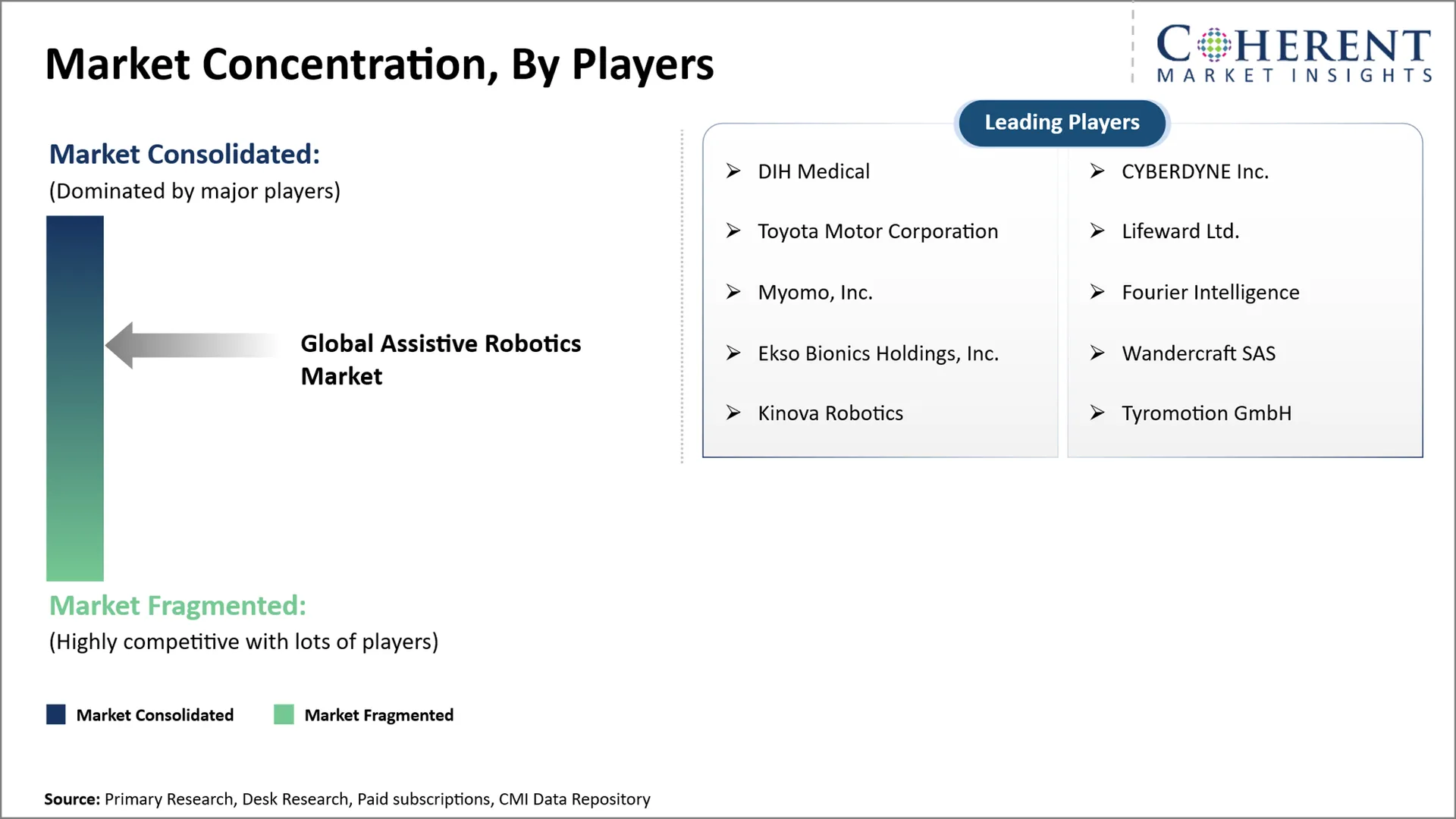
The global assistive robotics market is moderately competitive, with competition centered on technological innovation, product performance, safety, personalization, clinical validation, and expansion across rehabilitation and homecare settings. Market participants are increasingly focusing on developing advanced wearable and mobile robotic systems, improving human–robot interaction, and expanding applications across mobility assistance, rehabilitation, elderly care, and activities of daily living. Key focus areas include:
- Development of advanced wearable exoskeletons and robotic systems for mobility and rehabilitation assistance
- Integration of AI, machine learning, sensors, and computer vision for adaptive and personalized assistance
- Expansion of assistive robotics into homecare, elderly care, and activities of daily living
- Enhancement of human–robot interaction, safety, usability, and autonomous capabilities
- Strengthening of clinical validation, regulatory compliance, and partnerships with healthcare and rehabilitation providers
Market Report Scope
Assistive Robotics Market Report Coverage | |||
Report Coverage | Details | ||
Base Year | 2025 | Market Size in 2026: | USD 11.20 Bn |
Historical Data For: | 2020 To 2024 | Forecast Period: | 2026 To 2033 |
Forecast Period 2026 To 2033 CAGR: | 16.8% | 2033 Value Projection: | USD 33.21 Bn |
Geographies covered: |
| ||
Segments covered: |
| ||
Companies covered: | DIH Medical, CYBERDYNE Inc., Toyota Motor Corporation, Lifeward Ltd., Myomo, Inc., Fourier Intelligence, Ekso Bionics Holdings, Inc., Wandercraft SAS, Kinova Robotics, Tyromotion GmbH | ||
Growth Drivers: |
| ||
Restraints & Challenges: |
| ||
Analyst Opinion (Expert Opinion)
- In the coming years, global assistive robotics market will shift from clinic-centered rehabilitation toward personalized, connected, and home-based assistance. Advances in AI, lightweight robotics, sensor fusion, and adaptive control will enable robots to provide more intuitive support across mobility, rehabilitation, and daily-living activities. The industry is also expected to move toward multifunctional platforms that can continuously adapt to individual users rather than performing a single predefined task.
- The maximum opportunities are foreseen within wearable assistive robots for mobility & rehabilitation assistance in Japan. The country combines a rapidly aging population, established robotics capabilities, sophisticated rehabilitation infrastructure, and strong acceptance of technology-enabled elderly care. Players that develop lightweight, easy-to-use exoskeletons capable of supporting both rehabilitation and everyday mobility could address a broader user base and create opportunities beyond institutional healthcare settings.
- In order to gain a competitive advantage market players should prioritize product usability, personalization, and affordability alongside technological sophistication. Developing modular platforms that can be adapted to different mobility limitations, integrating AI-driven assistance and real-time user feedback, and simplifying operation for caregivers and home users can create stronger differentiation.
Speak to the analyst
Want personalized insights?
Take the findings above to one of our principal consultants, or have the report rebuilt around the segments, geographies and competitors you actually track.
Market Segmentation
- Robot Type Insights (Revenue, USD Bn, 2021 - 2033)
- Wearable Assistive Robots
- Socially Assistive Robots
- Physically Assistive Robots
- Service and Companion Robots
- Assistive Robotic Manipulators
- Others
- Level of Autonomy Insights (Revenue, USD Bn, 2021 - 2033)
- Manual/Operator-Controlled Robots
- Semi-Autonomous Robots
- Fully Autonomous Robots
- Mobility Insights (Revenue, USD Bn, 2021 - 2033)
- Stationary Robots
- Mobile Robots
- Application Insights (Revenue, USD Bn, 2021 - 2033)
- Mobility Assistance
- Rehabilitation Assistance
- Elderly Assistance
- Disability Assistance
- Activities of Daily Living Assistance
- Cognitive and Social Assistance
- Caregiver Assistance
- Others
- End User Insights (Revenue, USD Bn, 2021 - 2033)
- Hospitals and Rehabilitation Centers
- Specialty Clinics and Therapy Centers
- Homecare Settings
- Assisted Living and Elderly Care Facilities
- Research and Academic Institutions
- Others
- Regional Insights (Revenue, USD Bn, 2021 - 2033)
- North America
- U.S.
- Canada
- Latin America
- Brazil
- Argentina
- Mexico
- Rest of Latin America
- Europe
- Germany
- U.K.
- Spain
- France
- Italy
- Russia
- Rest of Europe
- Asia Pacific
- China
- India
- Japan
- Australia
- South Korea
- ASEAN
- Rest of Asia Pacific
- Middle East
- GCC Countries
- Israel
- Rest of Middle East
- Africa
- South Africa
- North Africa
- Central Africa
- North America
- Key Players Insights
- DIH Medical
- CYBERDYNE Inc.
- Toyota Motor Corporation
- Lifeward Ltd.
- Myomo, Inc.
- Fourier Intelligence
- Ekso Bionics Holdings, Inc.
- Wandercraft SAS
- Kinova Robotics
- Tyromotion GmbH
Sources
Primary Research Interviews
- Rehabilitation physicians and physical therapists involved in robotic rehabilitation, gait training, and mobility-assistance programs
- Robotics engineers and human–robot interaction specialists developing assistive robots, exoskeletons, and adaptive control systems
- Occupational therapists and rehabilitation specialists evaluating assistive robots for activities of daily living and independent living
- Healthcare providers and rehabilitation-center administrators involved in procurement, deployment, and evaluation of assistive robotic systems
- Researchers and academics specializing in assistive robotics, wearable robotics, neurorehabilitation, and robotic exoskeletons
Stakeholders
- Assistive robotics and medical robotics companies
- Hospitals, rehabilitation centers, and healthcare providers
- Elderly-care and assisted-living facilities
- Research universities and rehabilitation engineering institutes
- Medical device distributors and technology integrators
- Payers and health insurance providers
- Regulatory authorities and healthcare technology assessment organizations
- Patients, caregivers, and disability-support organizations
- Digital health and remote rehabilitation technology companies
- End-use Sectors
- Hospitals & Rehabilitation Centers
- Specialty Clinics & Therapy Centers
- Homecare Settings
- Assisted Living & Elderly Care Facilities
- Research & Academic Institutions
- Others
- Regulatory & Health Bodies
- U.S. Food and Drug Administration (FDA) – Medical-device classification, regulatory pathways, and safety requirements for powered exoskeletons and medical robots. FDA – Powered Exoskeleton Product Classification
- European Commission / European Medicines Agency (EMA) – Medical-device regulatory framework and health technology considerations relevant to assistive and rehabilitation technologies.
- International Organization for Standardization (ISO) – Standards covering personal-care robots, robotics safety, and related assistive technologies.
- International Electrotechnical Commission (IEC) – Safety and essential-performance standards for medical robots used in rehabilitation and movement assistance. FDA recognizes IEC 80601-2-78 for medical robots supporting rehabilitation, assessment, compensation, or alleviation of movement impairments.
- World Health Organization (WHO) – Global assistive-technology access, disability, aging, and healthcare policy information. WHO – Assistive Technology
- National Institutes of Health (NIH) – Research and development information on rehabilitation robotics, exoskeletons, mobility assistance, and neural interfacing.
Databases
- ClinicalTrials.gov – Clinical studies evaluating rehabilitation robots, exoskeletons, mobility assistance, and other assistive technologies.
- WHO International Clinical Trials Registry Platform (ICTRP) – Global clinical-trial information relevant to rehabilitation and assistive technologies.
- FDA Total Product Life Cycle (TPLC) Database – Regulatory and product information for medical-device categories, including powered exoskeletons.
- NIH RePORTER – Federally funded research projects involving assistive robotics, rehabilitation engineering, exoskeletons, and related technologies.
Associations
- IEEE Robotics and Automation Society (IEEE RAS) – Robotics research, standards, conferences, and developments in human-centered and assistive robotics.
- International Federation of Robotics (IFR) – Robotics industry data, technology developments, and global robotics trends.
- American Congress of Rehabilitation Medicine (ACRM) – Rehabilitation research and clinical knowledge relevant to robotic rehabilitation and assistive technologies.
- American Physical Therapy Association (APTA) – Clinical rehabilitation practices and technology applications relevant to mobility and physical therapy.
- RESNA (Rehabilitation Engineering and Assistive Technology Society of North America) – Rehabilitation engineering, assistive technology, accessibility, and professional resources.
- International Society for Prosthetics and Orthotics (ISPO) – Prosthetic, orthotic, mobility, and rehabilitation technology research and professional resources.
Public Domain Sources
- World Health Organization (WHO) – Global data on aging, disability, assistive-technology needs, and healthcare access.
- National Institutes of Health (NIH) – Biomedical and rehabilitation research, including robotics, exoskeletons, and neural-interface technologies.
- U.S. Food and Drug Administration (FDA) – Medical-device classifications, regulatory information, and safety requirements for powered exoskeletons and rehabilitation robots.
- National Institute of Child Health and Human Development (NICHD) – Research and information on rehabilitative and assistive technologies supporting people with disabilities.
- Centers for Disease Control and Prevention (CDC) – Disability, aging, injury, and population-health data relevant to assistive-technology demand.
- U.S. Census Bureau – Population, demographic, aging, and socioeconomic statistics supporting regional and end-user analysis.
Proprietary Elements
- CMI Data Analytics Tool, Proprietary CMI Existing Repository of information for last 10 years.
Get access to 250+ pages report
Every segment, forecast, competitor profile and data table behind the analysis above — available for instant download.
- ESOMAR Member
- ISO 9001:2015 Certified
- D-U-N-S Registered
- GDPR & CCPA Compliant
Missing comfort of reading report in your local language? Find your preferred language:
Frequently Asked Questions
The global assistive robotics market is estimated to be valued at USD 11.20 Bn in 2026 and is expected to reach USD 33.21 Bn by 2033.
Wearable assistive robots dominate due to rising demand for mobility support, rehabilitation, and independent living among people with physical impairments and aging populations.
Assistive robotics refers to robotic systems designed to support or enhance the mobility, rehabilitation, and daily-living capabilities of people with physical or age-related limitations.
The CAGR of global assistive robotics market is projected to be 16.8% from 2026 to 2033.
Rising aging population and disability prevalence, and advances in AI and human–robot interaction are the major factors driving the growth of the global assistive robotics market.
High acquisition and maintenance costs, and limited reimbursement and funding are the major factors hampering the growth of the global assistive robotics market.