

Global Automobile Antenna Market Size and Forecast – 2026 To 2033
The global automobile antenna market is expected to grow from USD 3.50 Bn in 2026 to USD 7.25 Bn by 2033, registering a compound annual growth rate (CAGR) of 13% from 2026 to 2033. The global automobile antenna market growth is primarily driven by the growing integration of AI-enabled communication systems in vehicles. For instance, the new BMW iX3, on show at CES 2026 in Las Vegas, U.S., is the first model to feature a BMW Intelligent Personal Assistant. (Source: BMW)
Key Takeaways of the Global Automobile Antenna Market
- The passenger vehicles segment is expected to account for 67.0 % of the global automobile antenna market share in 2026. Increasing consumer preference for in-car entertainment is a major factor driving the growth of the segment. On December 15, 2025, General Motors announced that Apple Music is now available natively across 2025 and newer Cadillac, Chevrolet, Buick, and GMC vehicles. (Source: General Motors)
- The ultra high segment is estimated to capture 53.0 % of the market share in 2026. The increasing requirement of utra high frequency antennas with increasing integration of smart antenna systems for tracking & monitoring is driving the growth of the segment. On January 13, 2026, HARMAN announced new safety capabilities for the latest generation of its Ready Care and Ready Aware products, delivering integrated in-cabin monitoring paired with sight beyond sight awareness to help improve safety performance and support NCAP requirements. (Source: Harman)
- North America is expected to dominate the automobile antenna market in 2026 with a market share of 34.0 %. Growing use of antennas to improve vehicle safety is a major factor driving the growth of the regional market. On August 1, 2025, Airgain announced the launch of its new patent-pending VHF/UHF whip base adapter, an add-on for its most popular antennas used widely in fleet and public safety vehicles. (Source: Airgain)
- Asia Pacific is expected to account for 26.0 % share in 2026 and is projected to record the fastest growth over the forecast period. Ongoing investments and facility expansions in the region are expected to boost the growth of the regional market. On September 9, 2024, DENSO CORPORATION announced that it will build a new plant by expanding the site of the Zenmyo Plant in Nishio City, Japan. (Source: DENSO)
- Shift Toward Connected & Smart Vehicle Antennas: Modern cars are loaded with linked technologies like 5G, Wi-Fi, V2X (Vehicle-to-Everything), GPS, satellite radio and automotive telematics This is fueling the demand for multipurpose smart antennas that can perform numerous communication functions in a compact package.
- Increasing Adoption of 5G and Advanced Telematics: The global rollout of 5G infrastructure is changing automotive communication features. Automobile antennas are improving to allow quicker data transfer, ultra-low latency, and improved infotainment experiences.
Segmental Insights
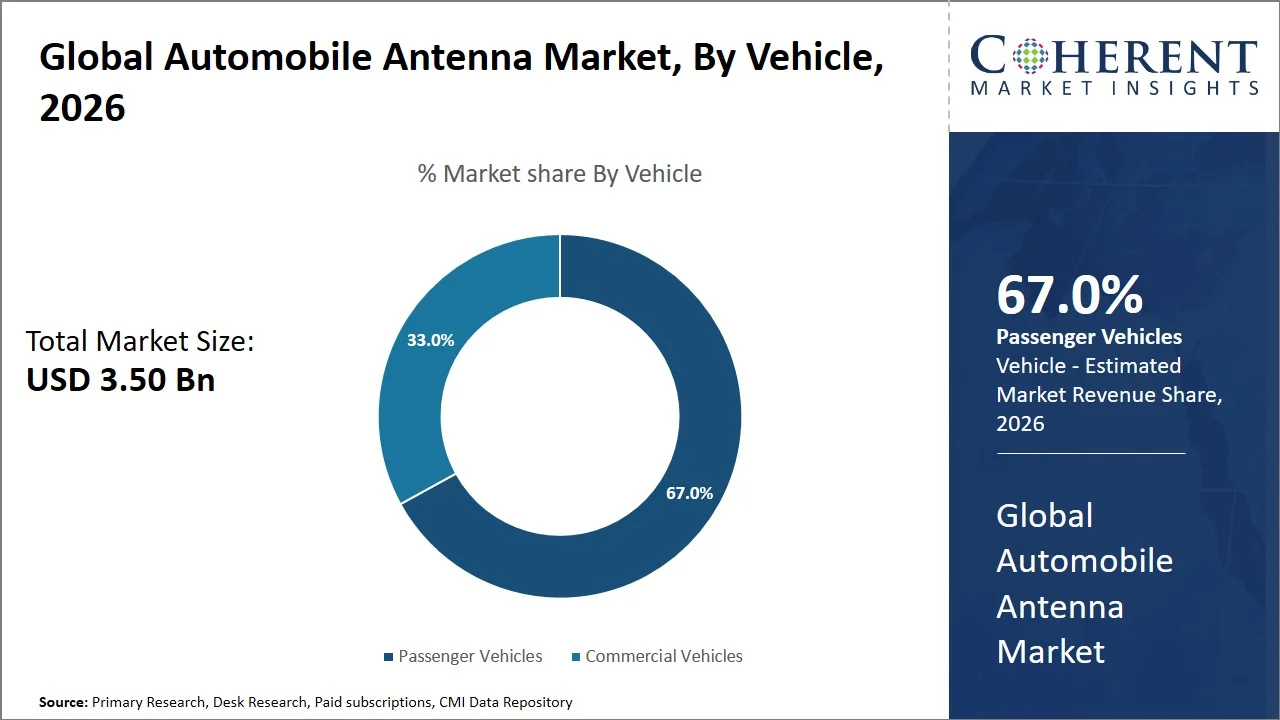
Why Do Passenger Vehicles Dominate the Global Automobile Antenna Market?
The passenger vehicles segment is expected to account for 67.0% of the global automobile antenna market share in 2026. Passenger vehicles dominate the automotive antenna market, due to the high level of integration of connection and infotainment technology in modern vehicles. GPS navigation, Bluetooth, Wi-Fi, satellite radio, enhanced telematics and smartphone connectivity are all increasingly in demand by consumers and they all need car antenna systems that work well. Passenger cars account for the highest percentage of vehicle production and sales worldwide, and the need for improved antennas in this category is substantially higher than in commercial vehicles. On July 21, 2025, TE Connectivity introduced its FP40 multi-port automotive antenna platform, designed for connected passenger vehicles and vehicular gateways. (Source: TE Connectivity)
- Current Industry Events of 2026
- Market Size Estimation
- Regional Breakdown
- Competitive Landscape
- Customer Intelligence
- Segmental Analysis
- Pricing Analysis
- Key Market Drivers, Challenges & Future Trends
- Customized Insights Section
Why is Ultra High the Most Preferred Frequency?
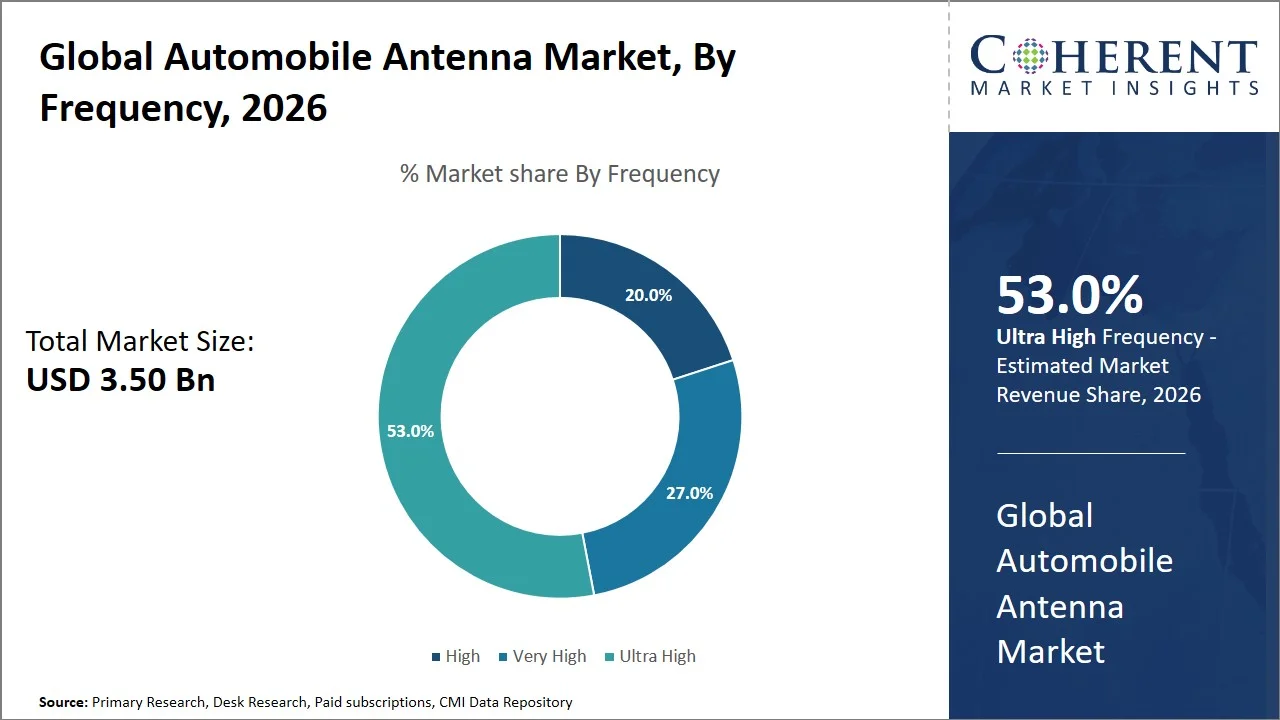
The ultra high segment is expected to account for 53.0% of the global automobile antenna market share in 2026. The UHF band is the most popular frequency in the car antenna industry, because it gives the best balance between signal range, bandwidth capacity, and dependability of connection. UHF signals may deliver a high rate of data to enable applications such as GPS navigation, mobile connectivity, satellite radio, and vehicle-to-everything (V2X) communication, as well as provide reliable performance in urban and high-mobility scenarios.
On March 16, 2026, TE Connectivity, a world leader in connectivity and sensors, launched its 56G MezzaWave connectors and cable assemblies, which help power demanding applications including edge AI, data centers, industrial automation and automotives. (Source: TE Connectivity)
Currents Events and their Impact
Current Events | Description and its Impact |
UNECE UN R155 & R156 Cybersecurity Regulations |
|
European Union Radio Equipment Directive (RED) Cybersecurity Requirements |
|
(Source: Bosch, European Commission)
Automobile Antenna Market Dynamics
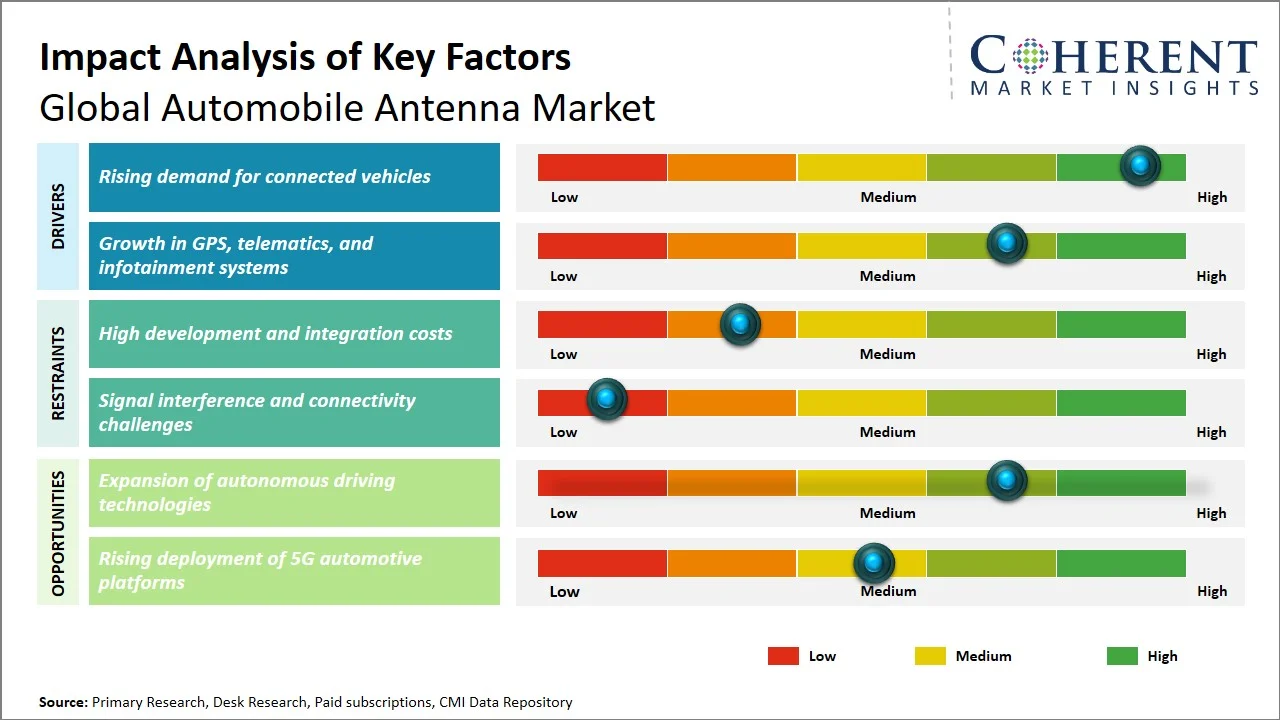
Market Drivers
Rising demand for connected vehicles
The growing demand for connected vehicles is a key factor driving the growth of the automobile antenna market as consumers are more inclined towards vehicles with advanced connectivity features such as real-time navigation, infotainment systems, telematics, Wi-Fi, and vehicle-to-everything (V2X) communication. Antenna innovation and adoption globally is being driven by connected car technology, with several high-performance antennas being embedded inside vehicles by automakers to provide seamless data transmission, over-the-air (OTA) upgrades and increased driving safety.
On January 6, 2026, AT&T and iM Media Labs announced a collaboration aimed at transforming the in-vehicle entertainment experience. Unveiled at CES 2026, this new offering from AT&T Connected Car will integrate iM Media Labs' innovative media platform with AT&T's 5G connectivity, creating a refined approach to connected car technology. (Source: AT&T)
Growth in GPS, telematics, and infotainment systems
The rapid growth of GPS, telematics and infotainment systems is driving the demand for advanced automobile antennas as modern vehicles are increasingly depending on real-time navigation, remote diagnostics, emergency communication and enhanced in-car entertainment features. With the introduction of advanced antenna systems, automakers are enabling robust connectivity, faster data transfer and smoother communication to drive the proliferation of smart and connected car technologies throughout automotive markets globally.
On January 16, 2025, u-blox launched its first automotive-grade Wi-Fi 7 module, enabling OEMs to enhance the user experience of in-vehicle infotainment and telematics. (Source: u-blox)
Emerging Trends
- Rapid Growth of Electric and Autonomous Vehicles: The advent of electric vehicles (EVs) and autonomous vehicles is creating a profound impact on antenna innovation. EVs need enhanced communications for battery management, charging connectivity and cloud-based software updates. Autonomous vehicles will require high-frequency antennas for radar, lidar, navigation and vehicle communications.
- Expansion in Industrial & Infrastructure Applications: Automobile antennas are increasingly expanding beyond traditional vehicle communication into broader industrial and infrastructure applications. Modern antenna systems are now used in connected transportation networks, smart highways, fleet management, construction machinery, and industrial automation, enabling reliable wireless communication through technologies such as GPS, 5G, V2X (Vehicle-to-Everything), and IoT connectivity.
Regional Insights
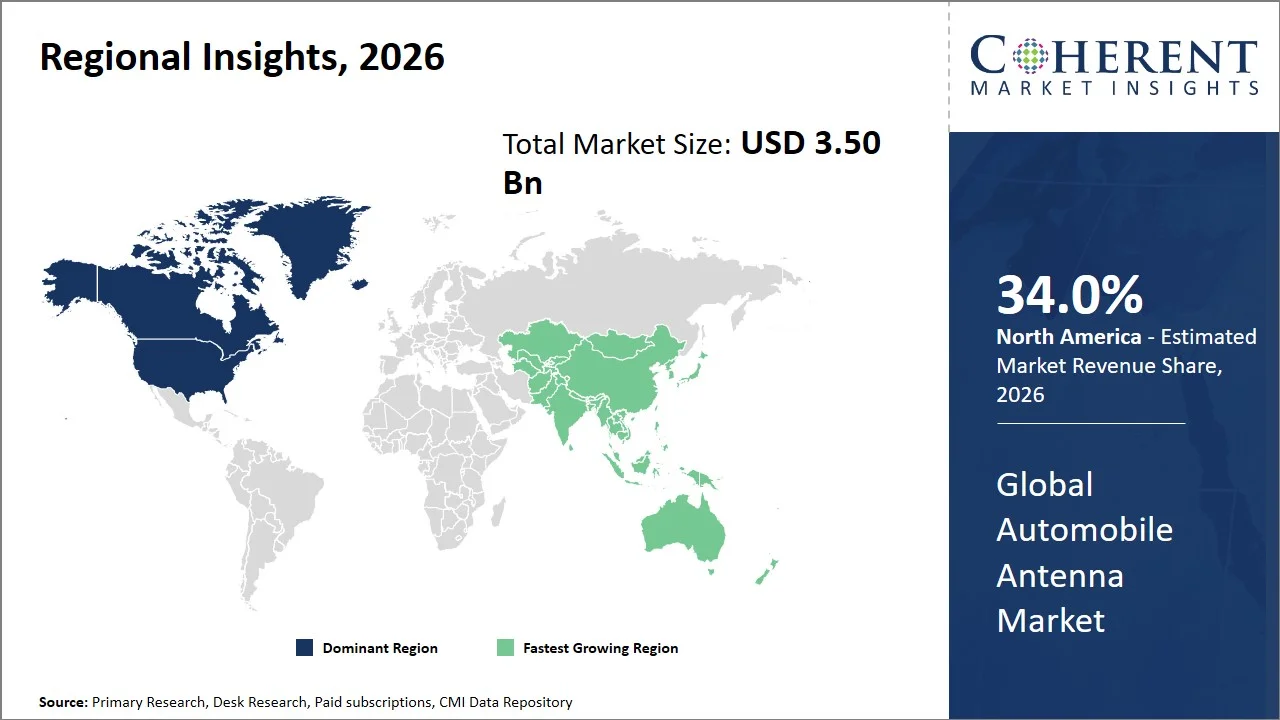
Why is North America a Strong Market for Automobile Antennas?
North America is expected to account for a market share of 34.0% in 2026. North America is a technologically advanced automobile antenna sector owing to the increased penetration of linked vehicles, research on autonomous driving and use of enhanced telematics. In the U.S. and Canada, automakers such as Tesla, Inc. and General Motors are using multi-band antennas that facilitate over-the-air updates, satellite connectivity, and V2X communication. The region also benefits from the robust rollout of 5G automotive communication networks and government-funded connected mobility programs.
On January 13, 2026, HARMAN announced portfolio enhancements across its award-winning Ready product lineup and car audio offerings. Available now for OEM integration, these solutions help automakers reduce integration complexity, accelerate hardware and software cycles, and deliver intelligent and meaningful in‑vehicle experiences that can be upgraded over the vehicle’s lifecycle. (Source: Harman)
Why Does the Asia Pacific Automobile Antenna Market Exhibit High Growth?
Asia Pacific is projected to account for 26.0% of the global automobile antenna market and is expected to register the fastest growth. The Asia Pacific automobile antenna market is growing at a fast rate due to large scale vehicle manufacturing and quick adoption of connected mobility technologies in countries like China, Japan, South Korea, and India. Some of the automakers incorporating 5G-enabled shark-fin antennas and telematics systems in electric and hybrid vehicles are Toyota Motor Corporation, Hyundai Motor Company and BYD Company. The region is also gaining from improving smart transportation infrastructure and increasing demand for in-car infotainment in metropolitan markets.
On October 16, 2025, DENSO CORPORATION announced that it will exhibit at the “Japan Mobility Show 2025” held at Tokyo, Japan. Under the theme “Changing the Shape of the Future with Technology: Community Meets Mobility,” DENSO will present technologies that create new value for society, starting with the evolution of the automobile and expanding connections with cities and people. (Source: DENSO CORPORATION)
Global Automobile Antenna Market Outlook for Key Countries
Why is the U.S. Emerging as a Major Hub in the Automobile Antenna Market?
Increased use of linked car technology, trials of autonomous cars and increased desire for premium entertainment features are driving growth in the U.S. automobile antenna market. Companies such as Ford Motor Company and Tesla, Inc. are incorporating high-frequency antennas for GPS, telematics, emergency communications, and assistance for autonomous driving. Growth is further driven by the growing deployment of software-defined vehicles which need constant wireless connectivity and OTA software upgrades.
Is China the Next Growth Engine for the Automobile Antenna Market?
China’s huge foothold in the global automobile antenna sector is due to its vast electric vehicle ecosystem and aggressive smart mobility expenditures. Domestic EV makers such BYD Company, NIO Inc. and XPeng Inc. are fitting vehicles with sophisticated roof-mounted smart antennas that facilitate autonomous navigation, AI-based cockpit systems and high-speed connectivity. China’s rapid development of 5G infrastructure and intelligent transportation projects is further boosting the need for integrated car antenna systems.
Germany Automobile Antenna Market Analysis and Trends
The Germany automobile antenna industry is driven by premium vehicle manufacturers and superior automotive engineering capabilities. Premium car manufactures such as BMW Group, Mercedes-Benz Group and Volkswagen AG are putting small multi-function antennas inside their cars for navigation, connected entertainment and driver-assistance systems. Innovation in embedded and aerodynamic antenna designs is also being spurred by Germany’s lead in R&D for autonomous driving and smart manufacturing.
The India automotive antenna market is fast expanding owing to the escalating demand for connected passenger vehicles and the increasing use of telematics in mid-range car models. Maruti Suzuki India Limited, Tata Motors, Mahindra & Mahindra, and other manufacturers are rolling out vehicles featuring shark fin antennae, GPS navigation, and integrated infotainment systems. The country’s market growth is further boosted by the roll-out of 4G/5G networks and government measures to encourage smart mobility and EV adoption.
How is the Expansion of Autonomous Driving Technologies Creating New Growth Opportunities in the Automobile Antenna Market?
The automobile antenna market is witnessing new growth prospects due to the rise of autonomous driving technologies, as the demand for continuous, high-speed and low-latency data transmission between automobiles, infrastructure and cloud systems is increasing. Autonomous vehicles leverage multi-antenna systems to provide LiDAR, Radar, GPS, V2X (vehicle-to-everything) connection, real-time mapping, and remote software processing. The demand for integrated smart antenna modules is rising as companies such as Tesla, Inc. and Waymo LLC advance self-driving platforms that rely on multi-band, high-frequency antennas to enable accurate positioning, safety, and seamless connectivity.
On May 21, 2026, Tesla announced that its Full Self-Driving capabilities are now available for its electric vehicles sold in China, as China’s domestic EV brands have long since rolled out proprietary self-driving technologies. (Source: CNBC)
Global Automobile Antenna Market - Government Mandates for Vehicle Connectivity and Emergency Systems
Country/Region | Government Mandate | Effective Timeline | Connectivity / Emergency Requirement |
European Union | EU eCall Regulation (EU) 2015/758 | Mandatory for all new M1 & N1 vehicles since April 2018 | Vehicles must include automatic emergency calling (112-based eCall) with GNSS and cellular connectivity |
4G/5G Packet-Switched eCall Upgrade Regulations (EU 2024/1180 & 2024/1084) | From January 2026 | New vehicle types must support eCall over 4G/5G networks | |
Russia / EAEU | ERA-GLONASS Emergency Response System | Mandatory since January 2015 for new vehicle approvals; broader implementation from 2017 | Vehicles require GLONASS/GPS-enabled emergency communication systems with automatic crash notification |
U.K. | Retention and modernization of eCall regulations | Ongoing transition toward 4G/5G-compatible eCall systems before 2033 | Vehicles need future-proof emergency communication capability as 2G/3G networks phase out |
Market Players, Key Development, and Competitive Intelligence
Key Developments
- On January 4, 2024, Ficosa International and indie Semiconductor announced a collaboration agreement to develop and commercialize automotive camera solutions deploying neural network-based (NN) artificial intelligence (AI) processing. The partnership will leverage Ficosa’s near decade-long expertise as a high-volume vision solution supplier, and indie’s field-proven, proprietary vision processing technology to deliver breakthrough imaging and in-camera object detection performance, particularly for challenging edge sensing applications.
Competitive Landscape
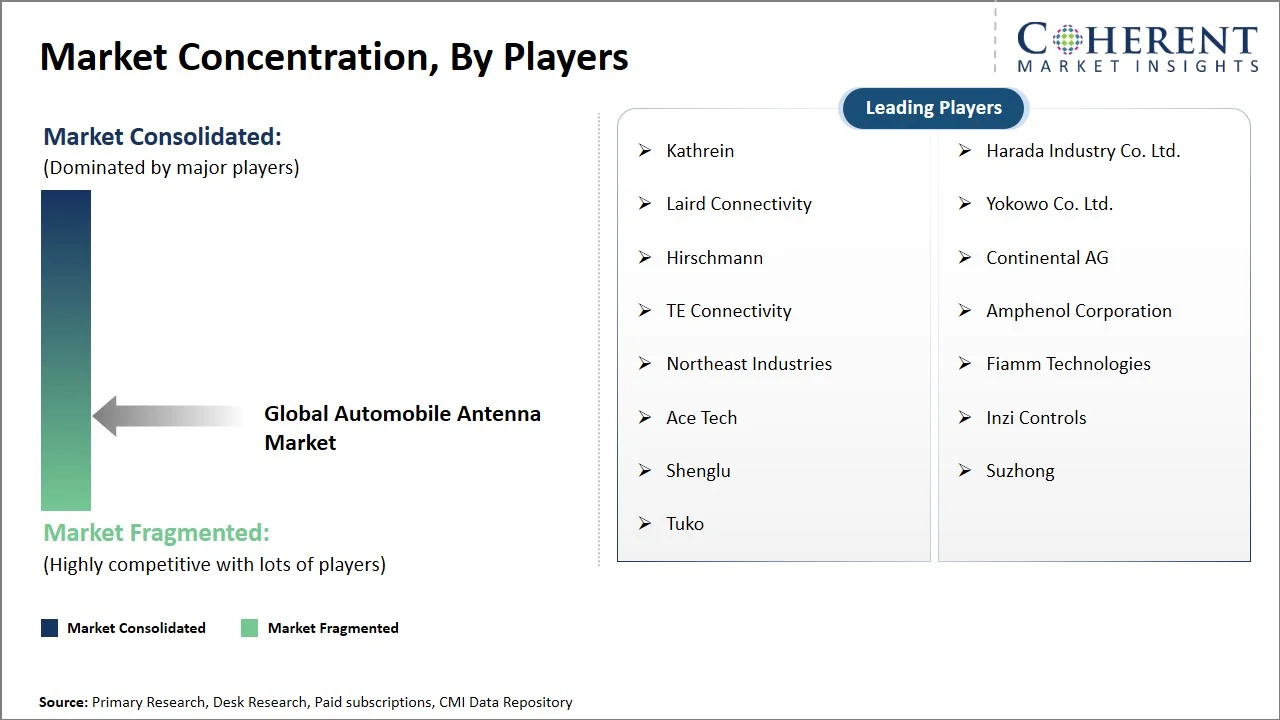
The worldwide automobile antenna industry is very competitive and the key success factors are innovation, integration capability, and relationships with OEMs. The market is characterized by the presence of established automotive providers such as Continental AG, DENSO Corporation, Harman International (a subsidiary of Samsung Electronics), and TE Connectivity focused on multi-band, compact and 5G enabled antenna systems. Companies are investing more and more, leading to intense competition, due to the increased adoption of smart antennas, V2X communication technologies, and strategic partnerships with electric and autonomous car makers.
Market Report Scope
Automobile Antenna Market Report Coverage
| Report Coverage | Details | ||
|---|---|---|---|
| Base Year: | 2025 | Market Size in 2026: | USD 3.50 Bn |
| Historical Data for: | 2020 To 2024 | Forecast Period: | 2026 To 2033 |
| Forecast Period 2026 to 2033 CAGR: | 13% | 2033 Value Projection: | USD 7.25 Bn |
| Geographies covered: |
| ||
| Segments covered: |
| ||
| Companies covered: | Kathrein, Harada Industry Co. Ltd., Laird Connectivity, Yokowo Co. Ltd., Hirschmann, Continental AG, TE Connectivity, Amphenol Corporation, Northeast Industries, Fiamm Technologies, Ace Tech, Inzi Controls, Shenglu, Suzhong, and Tuko | ||
| Growth Drivers: |
| ||
| Restraints & Challenges: |
| ||
Analyst Opinion (Expert Opinion)
- The automotive antenna market is being transformed by accelerated vehicle digitization and the move towards software-defined and autonomous vehicles. The market need for multi-functional, high-frequency antennas is strongly increasing, mainly in the electric and connected vehicles sector. Furthermore, automakers are focusing on localization of the supply chain and cybersecurity compliance needs. Also, emphasis is being laid on increasing R&D expenditure on integrated antenna modules to cater to next-generation mobility systems.
- The future of the automobile antenna market is predicted to be driven by the growing adoption of autonomous driving technologies, 5G/6G connectivity, and improved V2X communication systems. Antennas are expected to be progressively integrated into car body elements, allowing for concealed, aerodynamic and multi-functional designs. High performance communication systems will be critical to safety, navigation and real-time data exchange, where development of smart cities, expansion of linked infrastructure, and increasing penetration of electric vehicles are expected to generate strong growth prospects.
Speak to the analyst
Want personalized insights?
Take the findings above to one of our principal consultants, or have the report rebuilt around the segments, geographies and competitors you actually track.
Market Segmentation
- Vehicle Insights (Revenue, USD Billion, 2021 - 2033)
- Passenger Vehicles
- Commercial Vehicles
- Frequency Insights (Revenue, USD Billion, 2021 - 2033)
- High
- Very High
- Ultra High
- Regional Insights (Revenue, USD Billion, 2021 - 2033)
- North America
- U.S.
- Canada
- Latin America
- Brazil
- Argentina
- Mexico
- Rest of Latin America
- Europe
- Germany
- U.K.
- Spain
- France
- Italy
- Russia
- Rest of Europe
- Asia Pacific
- China
- India
- Japan
- Australia
- South Korea
- ASEAN
- Rest of Asia Pacific
- Middle East
- GCC Countries
- Israel
- Rest of Middle East
- Africa
- South Africa
- North Africa
- Central Africa
- North America
- Key Players Insights
- Kathrein
- Harada Industry Co. Ltd.
- Laird Connectivity
- Yokowo Co. Ltd.
- Hirschmann
- Continental AG
- TE Connectivity
- Amphenol Corporation
- Northeast Industries
- Fiamm Technologies
- Ace Tech
- Inzi Controls
- Shenglu
- Suzhong
- Tuko
Sources
Primary Research Interviews
- Automobile antenna manufacturers and suppliers
- Automotive OEMs and Tier-1 suppliers
- Antenna technology specialists and R&D professionals
- Automotive industry consultants and market experts
Magazines
- Automotive News
- Auto Components India Magazine
- Electronics For You Magazine
- Microwave Journal
Journals
- IEEE Transactions on Antennas and Propagation
- International Journal of Automotive Technology
- SAE International Journal of Passenger Cars
Associations
- Society of Automotive Engineers (SAE)
- Automotive Component Manufacturers Association (ACMA)
- International Association of Broadcasting Manufacturers (IABM)
- European Association of Automotive Suppliers (CLEPA)
Public Domain Sources
- Company annual reports and investor presentations
- Government statistical databases and trade publications
- Patent databases and technology publications
- Industry white papers and technical specifications
Proprietary Elements
- CMI Data Analytics Tool
- Proprietary CMI Existing Repository of information for last 10 years
Get access to 250+ pages report
Every segment, forecast, competitor profile and data table behind the analysis above — available for instant download.
- ESOMAR Member
- ISO 9001:2015 Certified
- D-U-N-S Registered
- GDPR & CCPA Compliant
Missing comfort of reading report in your local language? Find your preferred language:
Transform your Strategy with Exclusive Trending Reports
Frequently Asked Questions
The global automobile antenna market is expected to stand at USD 3.50 Bn in 2026 and is expected to reach USD 7.25 Bn by 2033.
The CAGR of the global automobile antenna market is projected to be 13% from 2026 to 2033.
Rising demand for connected vehicles and growth in GPS, telematics, and infotainment systems are the major factors driving the growth of the global automobile antenna market.
High development and integration costs and signal interference and connectivity challenges are the major factors hampering the growth of the global automobile antenna market.
In terms of vehicle, the passenger vehicles segment is estimated to dominate the market revenue share in 2026.
It improves GPS accuracy by receiving stronger and more stable satellite signals for real-time navigation.
V2X (Vehicle-to-Everything) allows cars to communicate with other vehicles, infrastructure, and networks for safer driving.