

Global Automotive Bearings Market Size and Forecast – 2026 To 2033
The global automotive bearings market is expected to grow from USD 28 Bn in 2026 to USD 37.50 Bn by 2033, registering a compound annual growth rate (CAGR) of 4.3% from 2026 to 2033. Growing demand for low-friction bearing technologies drives the market growth. On September 18, 2024, NSK Ltd. announced that it has developed a new low-friction hub unit bearing.
Key Takeaways of the Global Automotive Bearings Market
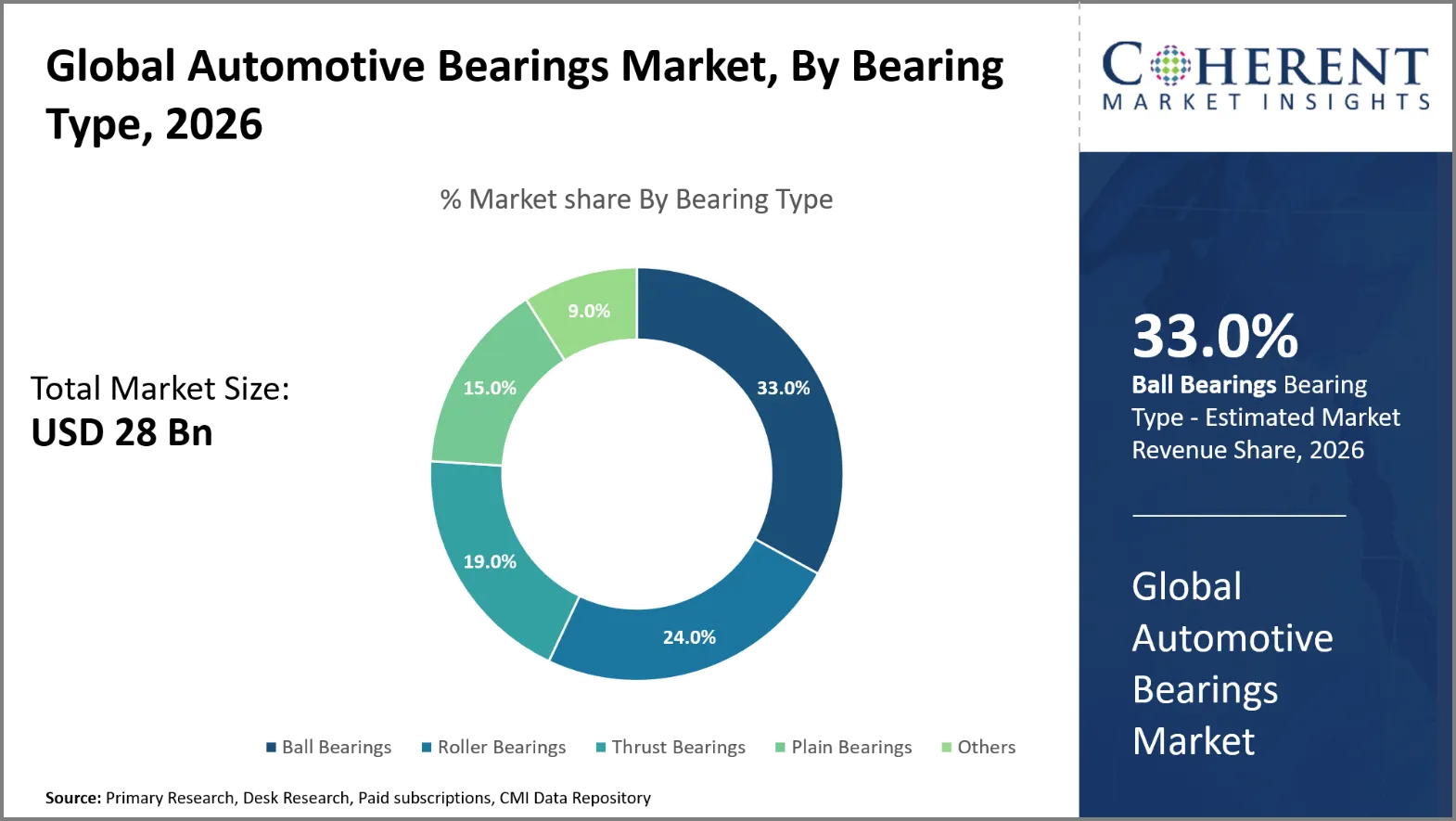
- The Ball Bearings segment is expected to account for 33.0% of the global automotive bearings market share in 2026. Expansion of automotive aftermarket services is driving the growth of the segment. On January 31, 2025, SKF India Limited launched a mobile van campaign across more than 100 cities in 19 states. The program targeted more than 8,000 two-wheeler mechanics.
- The Steel segment is estimated to capture 44.0% of the market share in 2026. Increasing adoption of sensor-integrated bearings is majorly driving the growth of the segment. In January 2026, NTN Corporation introduced machine learning into its automated third-generation hub bearing design system.
- The Passenger Vehicles segment is estimated to capture 56.0% of the market share in 2026. Growing demand for lightweight automotive components is majorly driving the growth of the segment. In March 2025, NSK announced a compact lightweight deep-groove ball bearing for electric vehicle drive units.
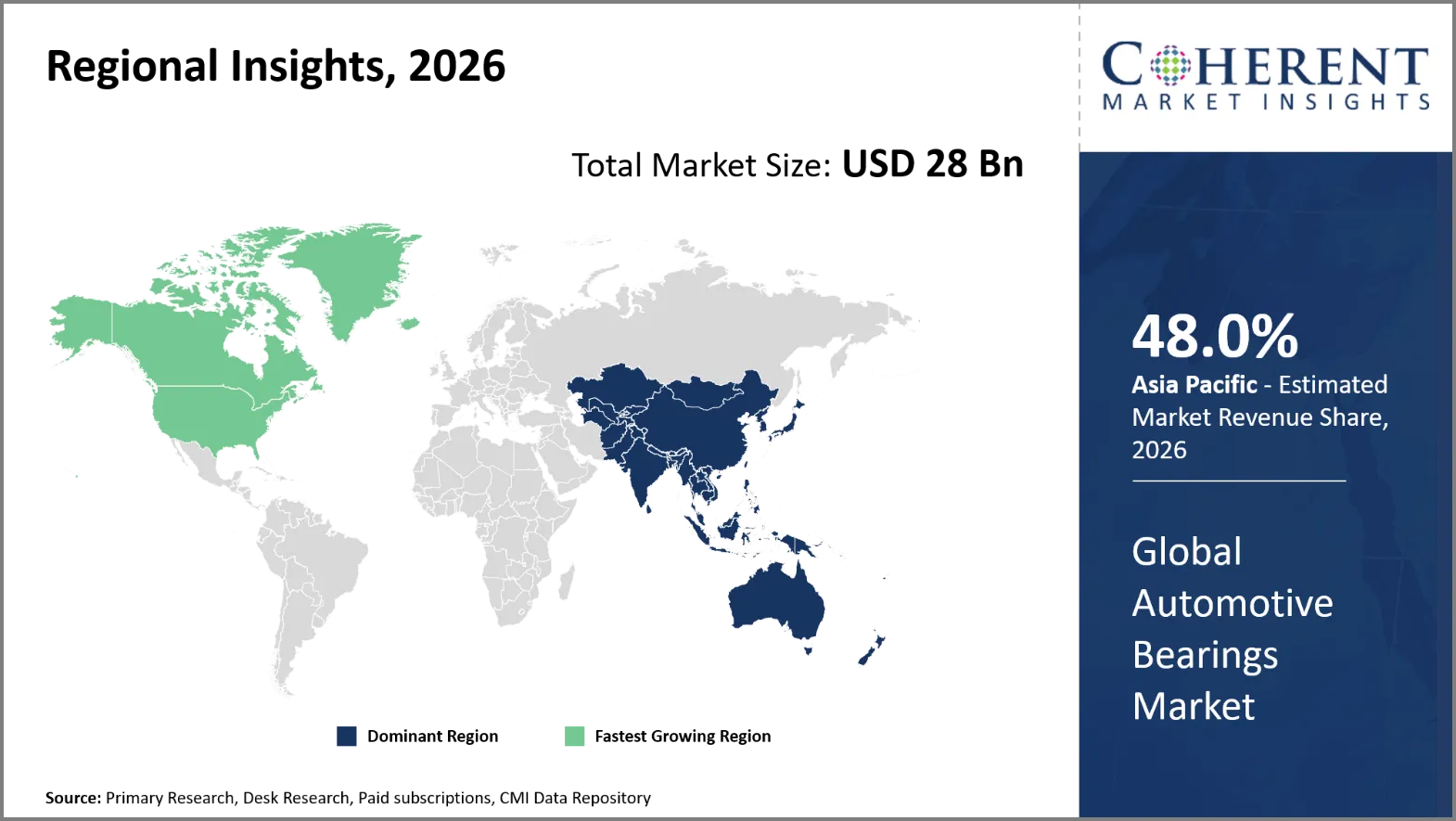
- Asia Pacific is expected to dominate the automotive bearings market in 2026 with a market share of 48.0%. Rising adoption of predictive maintenance technologies in Asia Pacific is driving the growth of the regional market. On April 22, 2026, Schaeffler partnered with Vietnamese humanoid robot manufacturer VinMotion. The partnership includes joint data collection for actuator optimization, condition monitoring, and predictive maintenance.
- North America is expected to account for 23.0% share in 2026 and is projected to record the fastest growth over the forecast period. Development of advanced bearing solutions for autonomous vehicles in North America is driving the growth of the regional market. On January 8, 2026, NTN Corporation introduced an artificial intelligence-assisted automated design system for third-generation hub bearings.
Segmental Insights
Why Does Ball Bearings Dominate the Global Automotive Bearings Market?
The ball bearings segment is expected to account for 33.0% of the global automotive bearings market share in 2026. Ball bearings are commonly utilized in high-speed automotive applications because they are efficient in reducing friction. They are compact in design which allows for smooth functioning in wheels, transmissions, electric motors and auxiliary systems. The uniform designs and wide availability on the vehicle platforms also assist manufacturers. The demand for bearings that can withstand high rotational speeds and lower energy losses is also increasing with the increasing electrification of vehicles. Those features make ball bearings a particularly good fit for modern vehicle engine and wheel end applications.
On March 26, 2025, NSK Ltd. announced the development of a compact, lightweight deep groove ball bearing for electric vehicle drive units. In an effort to further increase the driving range of the electric cars, the deep groove ball bearings used in the EV drive units should be further optimized in the aspects of compactness, lightweight, width reduction, friction reduction and high-speed performance.
- Current Industry Events of 2026
- Market Size Estimation
- Regional Breakdown
- Competitive Landscape
- Customer Intelligence
- Segmental Analysis
- Pricing Analysis
- Key Market Drivers, Challenges & Future Trends
- Customized Insights Section
Why is Steel the Most Preferred Material?
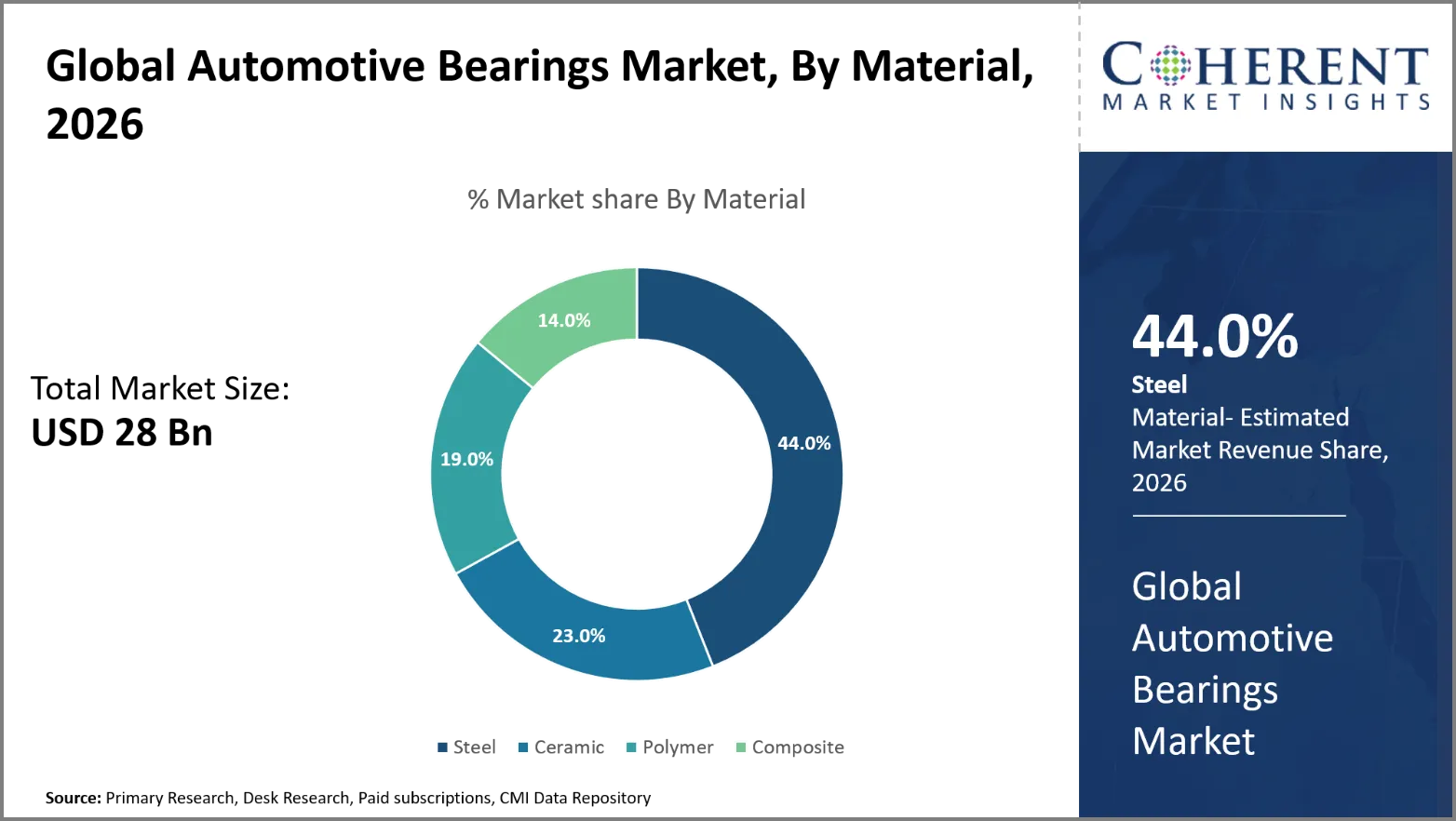
The steel segment is expected to account for 44.0% of the global automotive bearings market share in 2026. In automotive applications, steel delivers excellent strength, durability and resistance to repetitive mechanical loads. The capacity to tolerate high contact pressures contributes to reliable bearing performance under harsh operating circumstances. Automotive bearing components advanced heat treatment improves the hardness, fatigue resistance, and dimensional stability of the components. Steel also enables high production volume fabrication of rolling parts and bearing races. Such qualities make steel a good fit for wheel hubs, transaxles, engines and electric vehicle powertrains. For instance, in 2025, JTEKT Corporation developed its fifth-generation LFT-V tapered roller bearing for automotive applications. The company optimized the cage structure and internal bearing geometry to reduce friction torque. The bearing is designed for transmissions and differentials exposed to repeated mechanical loads.
Passenger Vehicles Dominates the Global Automotive Bearings Market
The passenger vehicles segment is expected to account for 56.0% of the global automotive bearings market share in 2026. Passenger vehicles require bearings across wheel hubs, transmissions, engines, steering systems, and electric drivetrains. Automotive bearing components continue to have original equipment requirements from global passenger vehicle production. The higher vehicle ownership increases the needs for replacement as the vehicles are in service for longer durations. The increasing use of electric passenger vehicles also escalates the need for specialist high-speed and low-friction bearings. These wide applications drive significant bearing consumption on passenger car platforms. For instance, The Timken Company continued to develop compact bearing assemblies for passenger and light-duty vehicle applications in 2025. Its automotive products are focused on load capacity, durability and decreased packing needs. The company also develops tapered roller bearing technology for drivetrain and wheel-end applications.
Current Events and their Impact
Current Events | Description and its Impact |
European Union - Euro 7 Regulation (EU) 2024/1257 |
|
U.S. - Phase 3 Greenhouse Gas Standards for Heavy-Duty Vehicles (40 Code of Federal Regulations Parts 1036 and 1037) |
|
Automotive Bearings Market Dynamics
Market Drivers
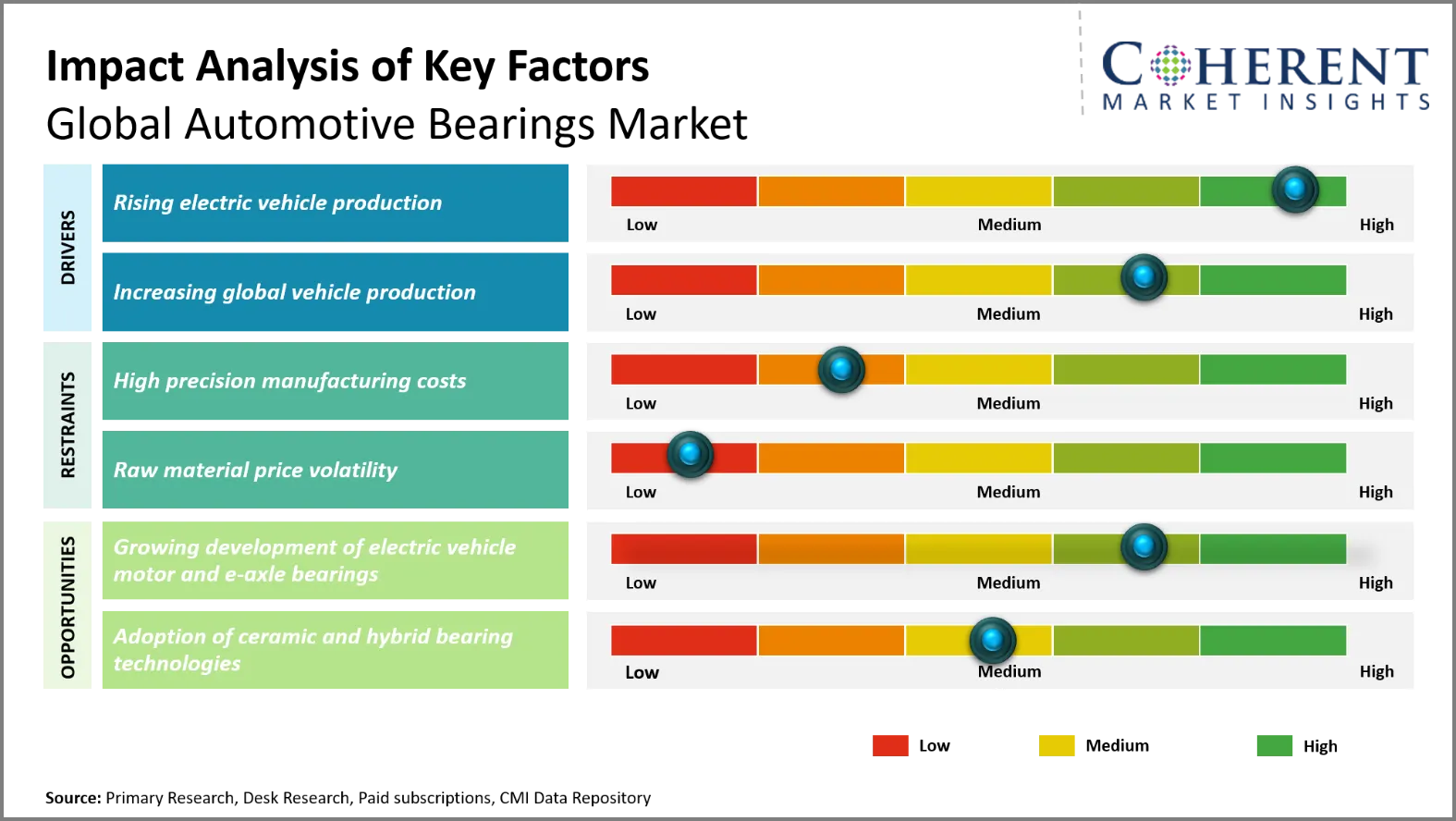
- Rising electric vehicle production: Increasing electric vehicle production drives demand for specialist bearings used in electric motors, e-axles, wheel hubs and transmissions. Electric drivetrains function at higher RPMs than many conventional ones. This raises the need for low friction bearings with high thermal and electrical performance. The growing production of electric vehicles also drives producers to design lighter bearings with better efficiency and durability. These technological criteria also generate additional prospects for advanced automobile bearing producers. On July 30, 2026, Mahindra & Mahindra announced plans to double its electric vehicle production capacity in the next five years. The expansion comes as demand for its electric sport utility vehicles continues to grow.
- Increasing global vehicle production: Increasing global vehicle production immediately leads to higher demand for bearings in engines, transmissions, wheels, steering systems and suspension assemblies. Higher vehicle production raises demand for original equipment from automotive manufacturers and component suppliers. Increased output in emerging nations further increases demand for localized bearing manufacturing and supply networks. Additional replacement demand across the automotive aftermarket channels is created by further growth in vehicle populations. This combination will support the ongoing demand of automotive bearings across a number of vehicle segments. On May 11, 2026, Toyota Motor Corporation announced plans to develop a new Toyota Kirloskar Motor plant in Bidkin industrial Area in Maharashtra, India. The new facility is expected to commence production in the first half of 2029 and is targeted at strengthening Toyota’s business base in the Indian market.
Emerging Trends
- Electric Vehicle Bearing Innovation: Manufacturers are developing bearings suited for high-speed electric motors, e-axles and transmissions. These items have more and more electrical insulation, better lubrication, improved sealing and less friction. The growing uptake of electric vehicles internationally drives these developments with unique operating conditions.
- Sensor Integrated Bearing Systems: Automotive vendors are embedding sensors in bearing assemblies to monitor speed, temperature, vibration and wheel conditions in real time. These smart technologies provide improved driver assistance, predictive maintenance and electronic stability features, all while lowering parts complexity and increasing vehicle durability.
- Lightweight Bearing Development: Bearing manufacturers are progressively investing in lightweight design, with optimized geometries, improved steels and alternative materials. Weight reduction boosts vehicle efficiency but doesn't need loss of capacity or durability. This trend is especially significant for electric vehicles, where lowering energy usage is still a top priority.
- Advanced Lubrication Technologies: As new bearing applications require ever more specialized lubricants capable of handling higher speeds, temperatures and electrical operating conditions. Manufacturers are producing low viscosity greases, longer life formulas and enhanced lubrication systems. These technologies lower friction, energy losses, wear and maintenance needs.
Regional Insights
Why is Asia Pacific a Strong Market for Automotive Bearings?
Asia Pacific is expected to account for a market share of 48.0% in 2026. Asia Pacific produced 59.2 million automobiles in 2025, accounting for almost 61% of the world’s total. China, Japan, India and South Korea led regional manufacturing activity. China manufactured 34.53 million vehicles, Japan 8.41 million. India produced 6.49 million automobiles with production of passenger and commercial vehicles increasing. South Korea produced 4.10 million vehicles during the same year. The region also recorded strong electric vehicle expansion, with China producing 16.63 million new-energy vehicles. This manufacturing concentration supports extensive demand for wheel bearings, transmission bearings, motor bearings, and electrically insulated bearings.
Why Does North America Automotive Bearings Market Exhibit High Growth?
North America is expected to register the fastest growth with a CAGR of 6.1% over the forecast period. It is projected to account for 23.0% of the global automotive bearings market in 2026. Strong pickup truck output along with North America’s robust light-vehicle manufacturing ecosystem support growth in demand for bearings. In 2025, the area built 15.57 million automobiles, with the U.S. accounting for 10.24 million of those. The U.S. continued to produce pickup trucks, sport utility vehicles, commercial vehicles and huge crossover platforms. Mexico's output also aids bearing suppliers to export-oriented assembly facilities. The production of electric vehicles in regional facilities is on the rise, and so is the demand for high-speed motor and e-axle bearings. These improvements in vehicle architecture further provide potential for specialized low friction and electrically insulated bearing systems.
Global Automotive Bearings Market Outlook for Key Countries
Why is China Emerging as a Major Hub in the Automotive Bearings Market?
China manufactured 34.53 million automobiles in 2025, remaining the world’s largest automotive manufacturing location. Production of new-energy vehicles rose 29% from a year ago to 16.63 million units. In 2025, new energy cars accounted for 47.9% of new vehicle sales in China. Passenger vehicles output was 30.27 million units while commercial vehicles production was 4.26 million units. The growth of electric powertrains is increasing the demands on high-speed motor bearings, e-axle bearings and electrically insulated designs. There was also increased demand for China’s automotive exports with 7.10 million vehicles exported, further supporting the domestic manufacturing and export-oriented component supply chains.
Is U.S. the Next Growth Engine for the Automotive Bearings Market?
The International Organization of Motor Vehicle Manufacturers reported that the U.S. manufacture 10.24 million vehicles in 2025. Light trucks, especially sport utility vehicles and pickups, were a key production base. The U.S. manufacturing scene also is seeing more electric vehicles being produced at big assembly plants. Battery-electric and hybrid platforms need unique bearings for traction motors, transmissions, wheel hubs and auxiliary systems. The country’s huge replacement vehicle population also supports the aftermarket bearing needs. Additional vehicles came from Mexico and Canada as part of integrated North American production networks. These cross-border supply chains result in re-occurring demands for standardized bearing components and tailored drivetrain products.
Germany Automotive Bearings Market Analysis and Trends
In 2025, Germany produced 4.15 million passenger cars, a rise of 2% over 2024. Electric passenger cars accounted for 40% of the manufacturing of domestic passenger automobiles. Passenger cars: Electric manufacturing came to 1.67 million units, of which 1.22 million were all-battery vehicles. Plug-in hybrid manufacturing jumped 54% to almost 450,000. In 2025, Germany also registered 545,100 new passenger cars with battery-electric power trains. The country’s strength in luxury vehicle manufacturing translates into demand for high-precision bearings for electric motor, transmission, wheel hub and innovative chassis systems. Also sent abroad by domestic companies were 3.17 million passenger automobiles from German automakers.
Japan Automotive Bearings Market Analysis and Trends
In 2025, Japan produced 8.41 million automobiles and maintained its status as a key manufacturing base for passenger and commercial vehicles. Japanese automakers have wide production opportunities in hybrid, battery-electric and conventional powertrains. Engineering for hybrid vehicles generates requirements for bearings that span engines, electric motors, transmissions and regenerative braking systems. Japanese auto suppliers also highlight compact components, durability, precision manufacture and low friction performance. These requirements enable enhanced bearing development for ever more complicated engine systems. Japan's existing export network increases component needs for vehicles built for global markets. This large-scale manufacture within the country so caters to both original equipment and replacement bearing uses.
South Korea Automotive Bearings Market Analysis and Trends
South Korea manufactured over 4.10 million automobiles in 2025, which will further boost the need for automotive bearing components. Its automotive sector has put more emphasis on battery-electric vehicles, innovative hybrids and vehicle platforms for export. Korean automakers have massive plants that make passenger cars, sport utility vehicles, commercial vehicles and electric platforms. The growing demand for electric drivetrains increases the requirements for high-speed motor bearings, e-axle bearings and electrically insulated bearing assemblies. South Korea’s battery and EV supply chains also lend themselves to deeper cooperation between car makers and component suppliers. The country’s strong export orientation further bolsters the need for bearings for domestic-made automobiles that are exported to international markets.
Global Automotive Bearings Market - Lightweight Bearing Adoption by Vehicle Category (2025)
Vehicle Category | Lightweight Bearing Adoption |
Passenger Vehicles | 58% |
Light Commercial Vehicles | 19% |
Heavy Commercial Vehicles | 13% |
Two-Wheelers | 10% |
How is Growing Development of Electric Vehicle Motor and E-Axle Bearings Creating New Growth Opportunities in the Automotive Bearings Market?
The growing electric vehicle manufacturing is creating a demand for bearings specifically developed for high-speed traction motors and e-axles. Electric motors can reach more than 20,000 revolutions per minute, making demands on low-friction and electrically insulated bearing designs. E-axle integration unites the motor, gearbox and differential thus small bearings that can take combined radial and axial loads are required. Therefore, manufacturers are working on ceramic rolling elements, insulated surfaces, customized cages and low viscosity lubrication systems. For example, NSK developed bearings for electric car motors that can overcome electric corrosion and high-speed operation. Schaeffler also offers customized bearing solutions for electric mobility applications such as electric axles and electric motors.
On June 14, 2026, JTEKT Corporation developed an ultra-high-speed rotating deep groove ball bearing for electric vehicle e-axles. This novel product enables the ultra-high-speed rotation of 40,000 r/min for deep groove ball bearings by optimizing the geometry and the substance of the resin cage. This contributes to the downsizing and weight reduction of e-Axles and adds value to electric vehicles, such as improving driving range and expanding in-vehicle space.
Market Players, Key Development, and Competitive Landscape
Key Developments
- On May 25, 2026, NTN Corporation developed hub bearings that further enhance its world-class low friction performance, reducing rotational friction by approximately 66% compared with the conventional product. This development contributes to improved energy efficiency of xEVs including battery electric vehicles, hybrid electric vehicles, and fuel cell vehicles.
- On October 1, 2025, SKF India Ltd. completed its demerger process with an ambition of strengthening its automotive and industrial businesses as two independent successful entities. The demerger marks a defining milestone in SKF India’s century-long journey of enabling reliability and performance across industries.
- On May 10, 2024, NSK Ltd. developed a practical magneto-strictive torque sensor for automobiles which enables failure prediction, a comfortable ride, extension of driving mileage and performance improvement owing to its weight-reducing and space-saving features, while also shortening the development period.
Competitive Landscape
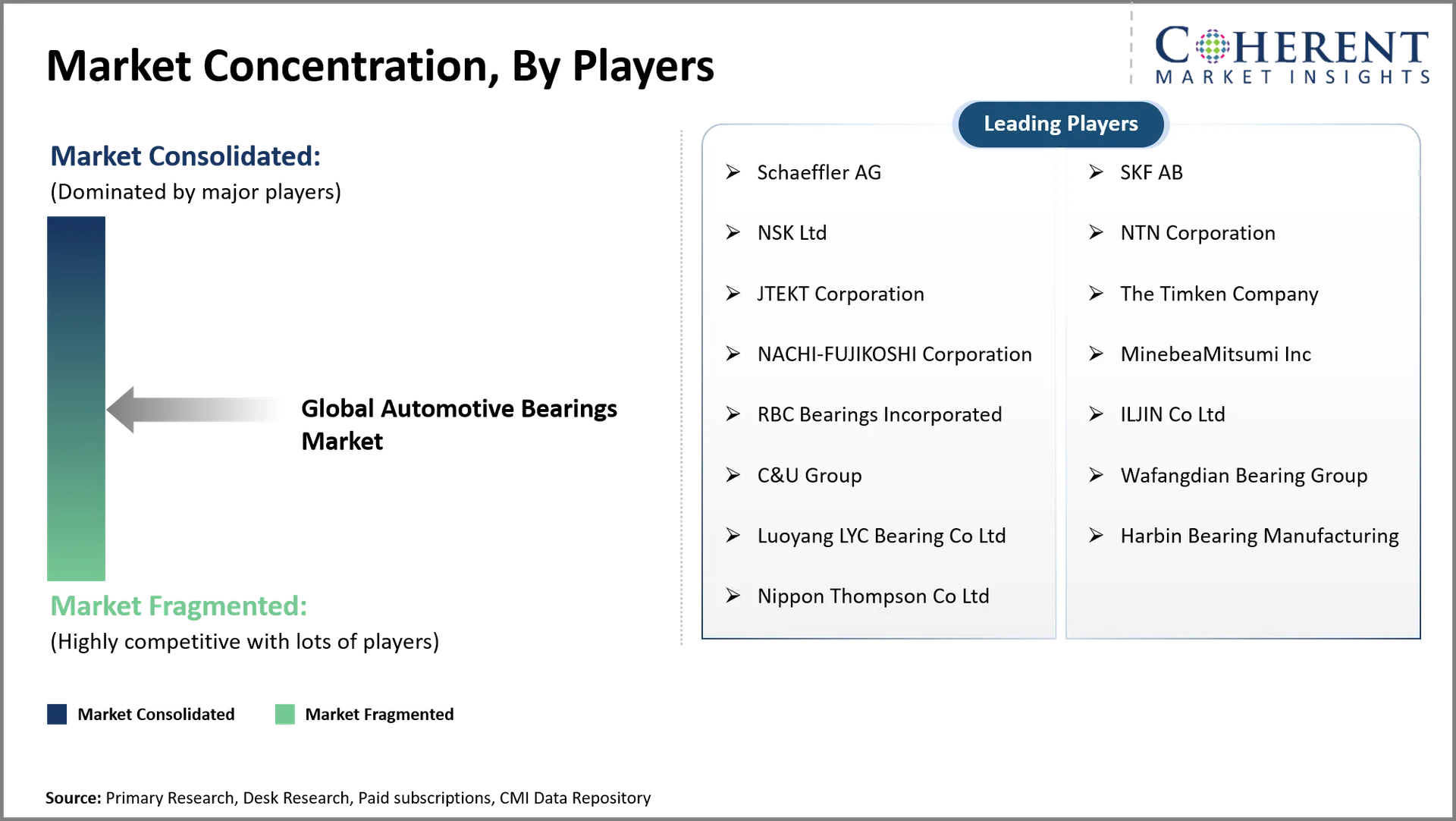
Leading players are shifting from conventional bearing supply toward specialized electric drivetrain solutions. SKF is focusing on electric vehicles, commercial vehicles, aftermarket expansion, and next-generation low-friction bearings. Schaeffler is combining bearings with electric motors, e-axles, electronics, and software through integrated drivetrain solutions. NSK aims to develop small e-axle bearings, with its 2025 design lowering the outer diameter by around 10% and weight by 51%. NSK is also working on bearings that can run at greater speeds, fit into thinner e-axle topologies and lower friction. Schaeffler is also working on electrically shielded bearing coatings that prevent current from passing through.
Market Report Scope
Automotive Bearings Market Report Coverage | |||
Report Coverage | Details | ||
Base Year | 2025 | Market Size in 2026: | USD 28 Bn |
Historical Data For: | 2020 To 2024 | Forecast Period: | 2026 To 2033 |
Forecast Period 2026 To 2033 CAGR: | 4.3% | 2033 Value Projection: | USD 37.50 Bn |
Geographies covered: |
| ||
Segments covered: |
| ||
Companies covered: | Schaeffler AG, SKF AB, NSK Ltd, NTN Corporation, JTEKT Corporation, The Timken Company, NACHI-FUJIKOSHI Corporation, MinebeaMitsumi Inc, RBC Bearings Incorporated, ILJIN Co Ltd, C&U Group, Wafangdian Bearing Group, Luoyang LYC Bearing Co Ltd, Harbin Bearing Manufacturing, Nippon Thompson Co Ltd | ||
Growth Drivers: |
| ||
Restraints & Challenges: |
| ||
Analyst Opinion (Expert Opinion)
- The industry is moving toward bearings engineered around electric drivetrain architectures rather than conventional replacement designs. Higher motor speeds, compact e-axles, and increasing electrical loads will raise technical requirements. Bearings combining low friction, electrical insulation, thermal resistance, and compact dimensions should receive greater engineering attention. NSK's latest e-axle bearing development demonstrates how small component changes can reduce drivetrain dimensions and energy consumption.
- The strongest opportunity should center on e-axle bearings, traction-motor bearings, and electrically insulated bearing systems. China offers a particularly important focus area because Schaeffler identifies new-energy vehicle penetration above 40% there. Japan also provides opportunities through advanced hybrid and electric drivetrain engineering. This is another interesting application created by commercial vehicle electrification and SKF particularly mentions electric vehicles and commercial vehicles as growth target areas.
- Market players looking to get ahead of the competition should primarily focus on application specific engineering. In product development, focus needs to be on higher rotational speeds, narrower bearing widths, electrical-current protection and lower friction. Collaborations with electric drivetrain manufacturers can help simplify qualification periods and increase integration into e-axle systems. Manufacturers should also strengthen aftermarket offerings because SKF identifies recurring aftermarket business as an important strategic area.
Speak to the analyst
Want personalized insights?
Take the findings above to one of our principal consultants, or have the report rebuilt around the segments, geographies and competitors you actually track.
Market Segmentation
- Bearing Type Insights (Revenue, USD Billion, 2021 - 2033)
- Ball Bearings
- Roller Bearings
- Thrust Bearings
- Plain Bearings
- Others
- Material Insights (Revenue, USD Billion, 2020 – 2033)
- Steel
- Ceramic
- Polymer
- Composite
- Vehicle Type Insights (Revenue, USD Billion, 2021 - 2033)
- Passenger Vehicles
- Commercial Vehicles
- Two-Wheelers
- Regional Insights (Revenue, USD Billion, 2021 - 2033)
- North America
- U.S.
- Canada
- Latin America
- Brazil
- Argentina
- Mexico
- Rest of Latin America
- Europe
- Germany
- U.K.
- Spain
- France
- Italy
- Russia
- Rest of Europe
- Asia Pacific
- China
- India
- Japan
- Australia
- South Korea
- ASEAN
- Rest of Asia Pacific
- Middle East
- GCC Countries
- Israel
- Rest of Middle East
- Africa
- South Africa
- North Africa
- Central Africa
- North America
- Key Players Insights
- Schaeffler AG
- SKF AB
- NSK Ltd
- NTN Corporation
- JTEKT Corporation
- The Timken Company
- NACHI-FUJIKOSHI Corporation
- MinebeaMitsumi Inc
- RBC Bearings Incorporated
- ILJIN Co Ltd
- C&U Group
- Wafangdian Bearing Group
- Luoyang LYC Bearing Co Ltd
- Harbin Bearing Manufacturing
- Nippon Thompson Co Ltd
Sources
Primary Research Interviews
- Automotive Bearing Manufacturers
- Original Equipment Manufacturers (OEMs)
- Automotive Component Distributors & Suppliers
- Automotive Aftermarket Service Providers
Magazines
- Automotive Engineering International
- Bearing & Power Transmission Magazine
- Motor Trend Industry Insights
- Automotive Industries Magazine
Journals
- Journal of Tribology (ASME)
- International Journal of Automotive Technology
- Journal of Mechanical Design
Associations
- Automotive Bearings Manufacturers Association (ABMA)
- International Federation of Automotive Engineering Societies (FISITA)
- Society of Automotive Engineers (SAE International)
- European Automobile Manufacturers' Association (ACEA)
Public Domain Sources
- U.S. Department of Energy – Office of Energy Efficiency & Renewable Energy
- European Commission – Automotive Industry Reports
- World Trade Organization (WTO) – Trade Data on Automotive Components
- International Trade Administration (ITA) – Automotive Industry Reports
Proprietary Elements
- CMI Data Analytics Tool
- Proprietary CMI Existing Repository of Information for Last 10 Years
Get access to 250+ pages report
Every segment, forecast, competitor profile and data table behind the analysis above — available for instant download.
- ESOMAR Member
- ISO 9001:2015 Certified
- D-U-N-S Registered
- GDPR & CCPA Compliant
Missing comfort of reading report in your local language? Find your preferred language:
Frequently Asked Questions
The global automotive bearings market is expected to stand at USD 28 Bn in 2026 and is expected to reach USD 37.50 Bn by 2033.
The CAGR of the global automotive bearings market is projected to be 4.3% from 2026 to 2033.
Rising electric vehicle production and increasing global vehicle production are the major factors driving the growth of the global automotive bearings market.
High precision manufacturing costs and raw material price volatility are the major factors hampering the growth of the global automotive bearings market.
In terms of bearing type, ball bearings segment is estimated to dominate the market revenue share in 2026.
Ball bearings support high-speed electric motors while helping reduce mechanical friction and energy losses.
Electric vehicles require bearings capable of handling higher speeds, electrical currents, temperature variations, and compact drivetrain designs.