

Global Automotive Operating System Market Size and Forecast – 2026 To 2033
The global automotive operating system market is expected to grow from USD 8.50 Bn in 2026 to USD 22.50 Bn by 2033, registering a compound annual growth rate (CAGR) of 14.9% from 2026 to 2033. The global automotive operating system market is driven by rising demand for connected vehicle platforms. On January 15, 2025, JLR announced it is partnering with Tata Communications to elevate the driving experience for clients to enable continuous connectivity and access to intelligent services across the remotest locations in 120 countries in JLR’s next generation software‑defined vehicles.
Key Takeaways of the Global Automotive Operating System Market
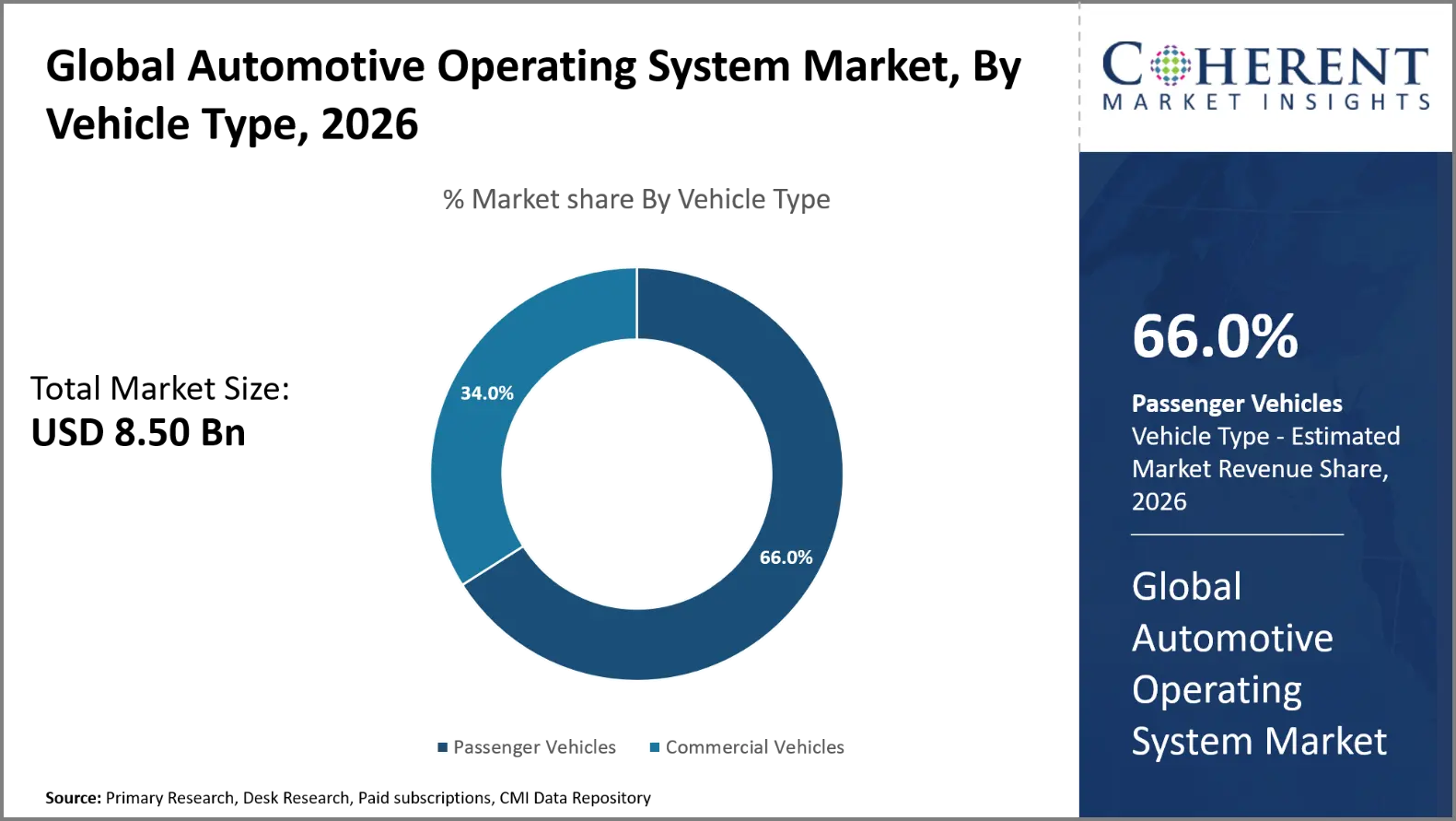
- The Passenger Vehicles segment is expected to account for 66.0% of the global automotive operating system market share in 2026. Increasing deployment of over-the-air software updates is driving the growth of the segment. On April 11, 2025, Mercedes-Benz announced its MBUX 2.6 software update. The update introduced Google Satellite View and Live Alternative Routes within supported navigation systems.
- The Monolithic Architecture segment is estimated to capture 41.0% of the market share in 2026. Growing complexity of automotive electronic architectures is majorly driving the growth of the segment. On January 6, 2025, Panasonic Automotive Systems and Qualcomm Technologies announced an expanded collaboration. The partnership incorporates Snapdragon Cockpit Elite processors into Panasonic's cockpit domain controllers and high-performance computing systems.
- The QNX segment is estimated to capture 33.0% of the market share in 2026. Rising investments in autonomous driving technologies is majorly driving the growth of the segment. On April 24, 2025, Volkswagen Group of America and Uber Technologies announced a strategic partnership. The collaboration targets deployment of thousands of autonomous electric ID. Buzz vehicles across multiple U.S. markets.
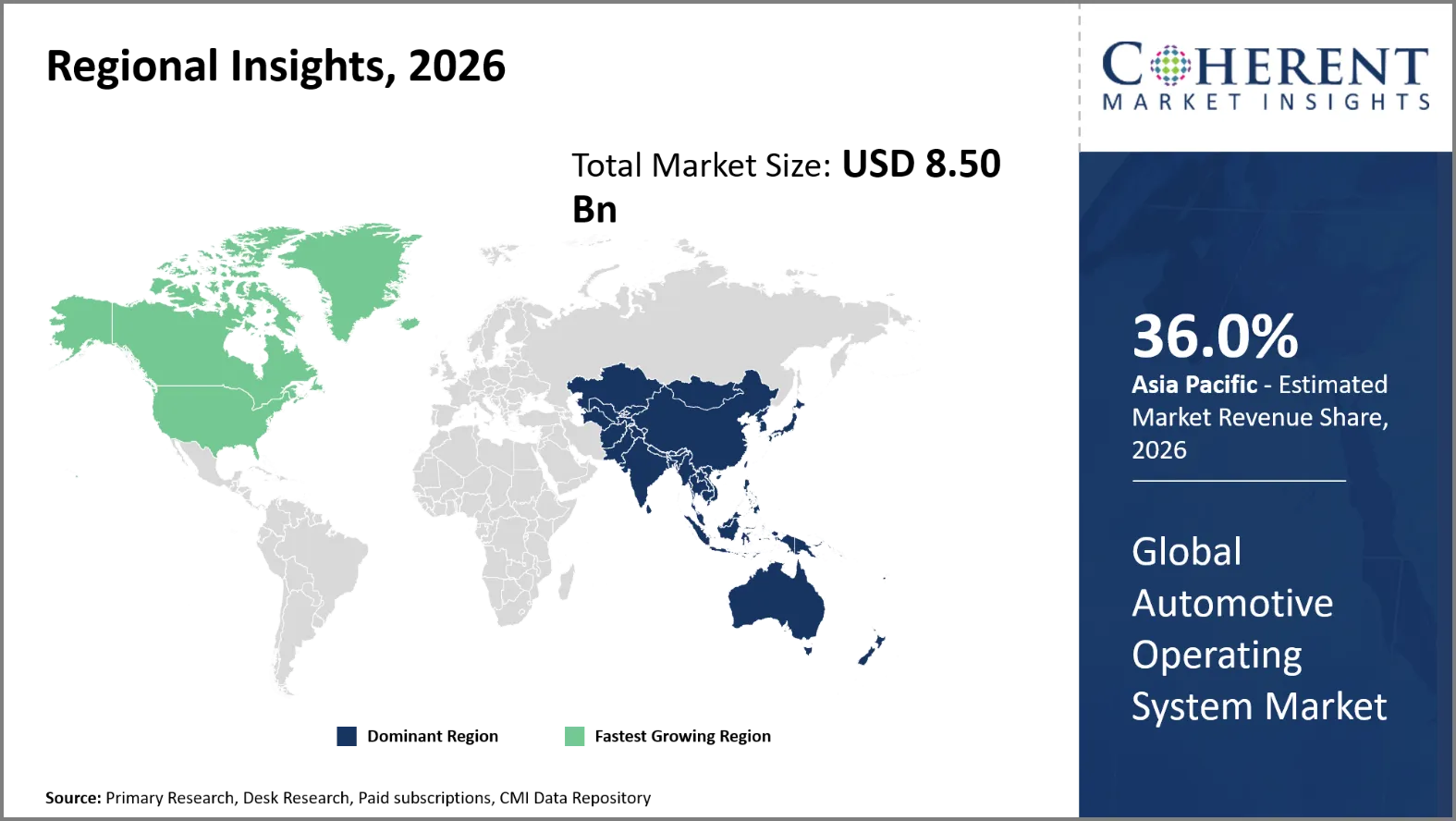
- Asia Pacific is expected to dominate the automotive operating system market in 2026 with a market share of 36.0%. Expansion of open-source automotive software ecosystems in Asia Pacific is driving the growth of the regional market. On April 23, 2025, Dongfeng Motor Corporation announced the release of its Tianyuan OS. The operating system targets passenger vehicles and commercial vehicles through an open-source development approach.
- North America is expected to account for 31.0% share in 2026 and is projected to record the fastest growth over the forecast period. Growing demand for real-time operating systems in North America is driving the growth of the regional market. On May 20, 2025, Red Hat announced that its In-Vehicle Operating System achieved functional safety certification. The platform received Safety Element out-of-Context certification against ISO 26262 ASIL-B requirements.
Segmental Insights
Why Does Passenger Vehicles Dominate the Global Automotive Operating System Market?
The passenger vehicles segment is expected to account for 66.0% of the global automotive operating system market share in 2026. Passenger vehicles dominate because automakers are embedding more and more sophisticated software into daily transportation. The demand for operating systems is growing with the increasing usage of infotainment, connected navigation, digital cockpits and enhanced driver assistance systems. Electric vehicles also need advanced software for battery management, energy optimization and vehicle diagnostics. It’s also being driven by increasing expectations of personal connectedness by consumers for car software integration. These advances raise OS requirements in entry-level, mid-range, and luxury passenger automobiles.
On March 10, 2025, BMW Group presented the new digital architecture for the passenger cars of the Neue Klasse series. The architecture pools computational power into four high-performance processors, termed Superbrains. The computers govern entertainment, automatic driving, driving dynamics, climate control and vehicle comfort.
- Current Industry Events of 2026
- Market Size Estimation
- Regional Breakdown
- Competitive Landscape
- Customer Intelligence
- Segmental Analysis
- Pricing Analysis
- Key Market Drivers, Challenges & Future Trends
- Customized Insights Section
Why is Monolithic Architecture the Most Crucial Software Architecture?
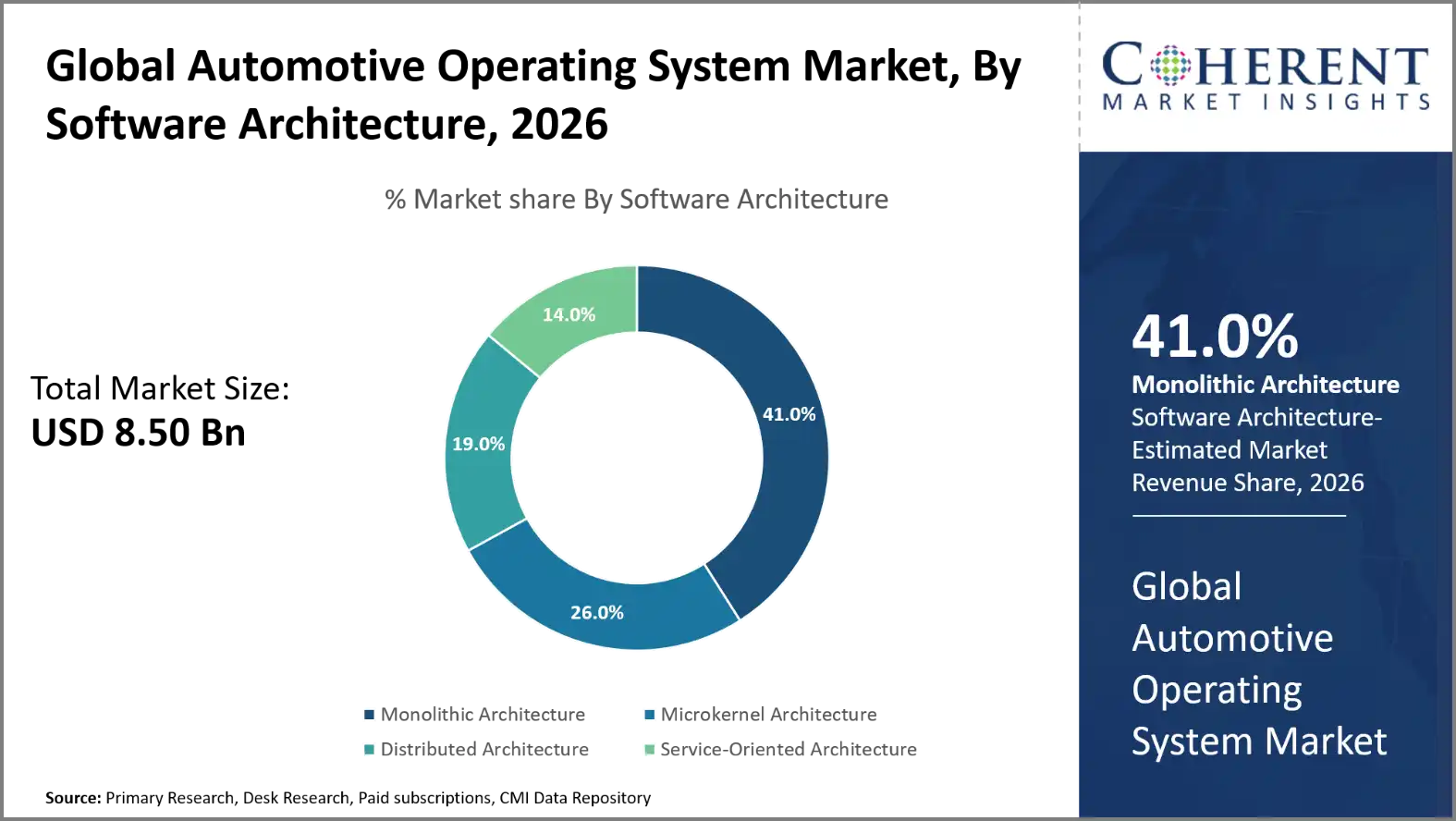
The monolithic architecture segment is expected to account for 41.0% of the global automotive operating system market share in 2026. Monolithic architecture is dominant as it bundles critical operating system functionalities into a single kernel. This structure allows the essential services to communicate directly, facilitating quick execution and minimum processing overhead. Predictable performance, resource management and compatibility with existing embedded software environments are beneficial for automotive applications. Automotive platforms based on Linux show its importance in infotainment and connected vehicle applications. However, safety-critical automotive systems increasingly prefer microkernel designs because of their greater isolation and fault containment.
On February 24, 2026, Elektrobit and Mobileye announced the integration of EB corbos Linux for Safety Applications into Mobileye Drive, a scalable end-to-end Level 4 self-driving system. As the foundation for global OEM offerings and robotaxi vendors, the Mobileye platform will utilize Elektrobit’s safety-compliant solution, delivering automotive grade features and field updates. This collaboration reflects Mobileye’s interest in EB corbos Linux for Safety Applications.
QNX Dominates the Global Automotive Operating System Market
The QNX segment is expected to account for 33.0% of the global automotive operating system market share in 2026. BlackBerry QNX is well positioned with safety-certified real-time operating systems and established partnerships in the automotive space. Its microkernel architecture delivers reliable performance, security and fault isolation for crucial vehicle applications. Automakers are using QNX technology in digital cockpits, advanced driver assistance systems, instrument clusters and domain controllers. BlackBerry expects more than 275 million vehicles to be running on its QNX technology by 2026. It is being adopted by prominent automakers and electric car manufacturers, which further strengthens its competitive position.
On January 7, 2025, BlackBerry Limited announced a multi-year collaboration with Vector Informatik GmbH and TTTech Auto. The companies planned to develop and commercialize a foundational vehicle software platform. The platform combines QNX safety-certified operating system technology with automotive middleware and integration capabilities.
Current Events and their Impact
Current Events | Description and its Impact |
United Nations Regulation No. 155 - Cybersecurity and Cyber Security Management Systems |
|
United Nations Regulation No. 156 - Software Updates and Software Update Management Systems. |
|
Automotive Operating System Market Dynamics
Market Drivers
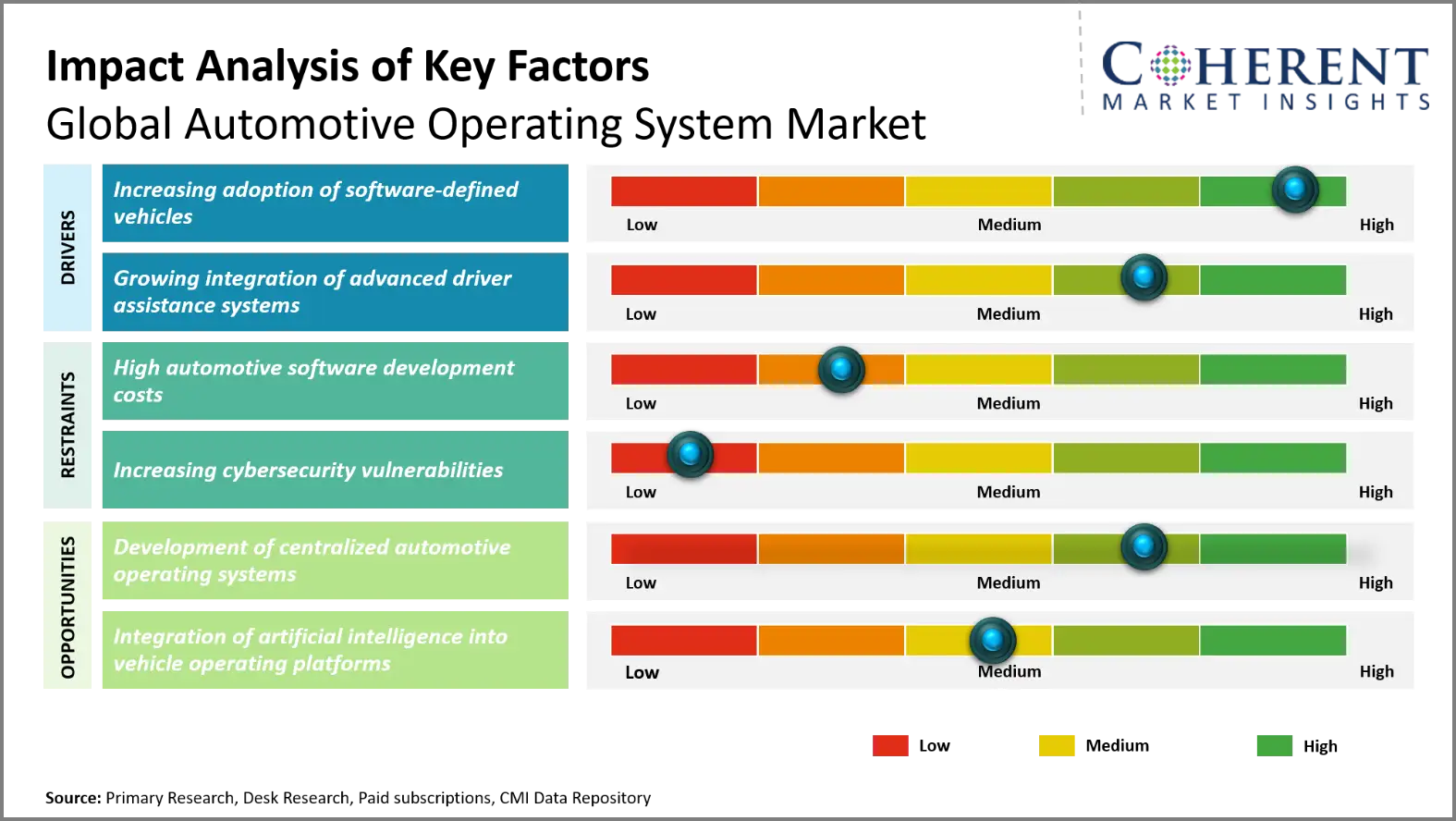
Increasing adoption of software-defined vehicles
Growing use of software-defined vehicles is changing automotive operating system requirements across global vehicle manufacturing. Car makers are moving toward centralized computing architectures, which allow vehicle operations to be managed by software. The architectures offer continual feature enhancement, remote diagnosis and over-the-air software updates. Automotive Operating Systems are the base on which electronic control units, vehicle applications and connected services are orchestrated. This is further accelerated by the growth in manufacturing of electric vehicles, where software controls the performance of the batteries, the consumption of energy and the operation of the engine. This trend raises the need for scalable operating systems with good cybersecurity and real-time processing capabilities.
On September 10, 2025, Valtech, the experience innovation company, announced the introduction of Nexus, a next-generation software-defined vehicle (SDV) platform developed in conjunction with Google Cloud. Nexus is open-source, AI-native, and cloud-powered, helping automakers create continuously developing, personalized and connected experiences across the entire car lifespan.
Growing integration of advanced driver assistance systems
Increasing integration of advanced driver assistance systems is driving demand for high-performance vehicle operating systems. Modern cars now commonly feature adaptive cruise control, automatic emergency braking, lane departure warnings and parking assistance. Such applications demand operating systems capable of interpreting sensor inputs and orchestrating electronic control units. With the wider deployment of cameras, radar and lidar comes a need for more computing power. Automotive operating systems must deliver predictable response times, functional safety and dependable communication amongst vehicle components. This development drives the need for real-time operating systems and safety approved software platforms supporting more and more automated driving functions.
On March 25, 2025, Volkswagen Group, Valeo and Mobileye announced a collaboration to improve the advanced driver assistance systems in future vehicles based on the MQB platform. The partnership is aimed at Level 2+ assisted driving capabilities across different Volkswagen Group models. The system consists of cameras, radar sensors, driver monitoring, parking assistance and emergency aid.
Emerging Trends
- Transition Toward Centralized Automotive Computing Architectures: Car manufacturers are replacing scattered electronic control units with centralized computing platforms. This move allows for integrated automotive software management, decreases hardware complexity, and allows further feature development.
- Impact: The centralized designs lead to the need for scalable automobile operating systems. They increase the synchronization of the processing, simplify software maintenance and allow over-the-air upgrades for many vehicle operations.
- Relevance to the market: Companies like Qualcomm Technologies, Inc. and NVIDIA Corporation build computing platforms that support central vehicle architectures and software-defined vehicle development.
- Increasing Adoption of Automotive Operating Systems Supporting Autonomous Driving: The increasing development of autonomous driving is increasing the demand for operating systems that support sensor processing, real-time communication, functional safety, and high-performance computing.
- Impact: This trend drives investment in deterministic processing, hardware separation, and dependable software integration. It is a driving force for complicated driver assistance apps on operating systems.
- Relevance to the market: BlackBerry QNX is providing safety-certified software platforms for advanced driver assistance systems and digital cockpits, indicating it is focusing more on automotive operating systems.
Regional Insights
Why is Asia Pacific a Strong Market for Automotive Operating System?
Asia Pacific is expected to account for a market share of 36.0% in 2026. Asia-Pacific benefits from growing electric vehicle production, indigenous software ecosystems and automotive electronics manufacturing. India’s Tata Motors is enhancing connected vehicle experiences with its acti.ev architecture and digital vehicle platforms. VinFast, the Vietnamese electric car manufacturer, has installed intelligent infotainment and connected services across its electric vehicle range. Mahindra of India is working on software-centric EV architectures under its INGLO platform. Regional semiconductor investments in India, Japan and South Korea also improve car computing supply chains. These developments create opportunities for operating systems supporting localized applications, multilingual interfaces, connected mobility, and electric vehicle energy management.
Why Does North America Automotive Operating System Market Exhibit High Growth?
North America is expected to register the fastest growth with a CAGR of 16.1% over the forecast period. North America is projected to account for 31.0% of the global automotive operating system market in 2026. North America is getting a boost from commercial vehicle software standardization, cross-brand technology collaborations, and rising investment in centralized computing. Stellantis extended their relationship with Qualcomm Technologies to incorporate Snapdragon Digital Chassis technologies by May 2026. The partnership enables cockpit computers, communication and sophisticated driving assistance across several car models. The region is also home to established automotive engineering activities and cloud-based software development infrastructure. These improvements have led operating system vendors to supply reusable software components, standardized interfaces and integrated computer platforms. More cooperation between car manufacturers and semiconductor businesses will increase regional demand for the integration of automotive software.
Global Automotive Operating System Market Outlook for Key Countries
Why is China Emerging as a Major Hub in the Automotive Operating System Market?
The rise of the domestic intelligent car and the competition among electric vehicle manufacturers are the driving forces of the automotive operating system market in China. This advancement is embodied in the flagship D19 of Leapmotor, which is powered by a centralized automotive computer created in collaboration with Qualcomm Technologies. The system merges cockpit functions, driver aid, body controls and vehicle connection. Chinese automakers are likewise establishing their own software ecosystems to differentiate digital driving experiences. The demand for localized speech recognition, sophisticated navigation and integrated cabin applications is pushing domestic operating system development. Government-backed intelligent connected car programs further bolster demand for locally created automotive software, semiconductor integration and vehicle computing technologies.
Is U.S. the Next Growth Engine for the Automotive Operating System Market?
The U.S. automobile operating system industry benefits from the increased investment in vehicle computing infrastructure and software update capabilities. General Motors announced a centralized computing platform for electric and gasoline-powered automobiles in October 2025. Cadillac Escalade IQ is set to bring this architecture to market in 2028. General Motors also stated that more than 4.5 million vehicles were enabled with over-the-air system updates. The central architecture is designed to decrease electronic modules and make it easier to operate the vehicle’s software. These innovations promote demand for operating systems that enable synchronized vehicle functions, scalable processing and continual software enhancements.
Germany Automotive Operating System Market Analysis and Trends
The German automotive operating system market benefits from established automotive engineering vendors who are building standardized software platforms. Robert Bosch GmbH is creating SDV.OS as a basis for reusable vehicle software and cross-domain computing. Its platform supports software portability and configurations targeting Automotive Safety Integrity Level D requirements. The TRATON Group introduced TRATON ONE OS for future commercial vehicles across Scania, MAN, International, and Volkswagen Truck & Bus. Its agreement with Red Hat in September 2026 enables an open Linux-based software ecosystem. These changes create the need for compatible operating systems across passenger and commercial vehicle designs.
Japan Automotive Operating System Market Analysis and Trends
Japan’s automobile operating system business is benefiting from next-generation cockpit electronics and hardware-independent software development. Mazda's all-new CX-5 adopts Mazda E/E Architecture+, supporting software-defined vehicle development and over-the-air updates. Panasonic Automotive Systems supplies its cockpit domain controller for this model. The controller integrates infotainment, instrument clusters, and head-up displays within an updatable architecture. Panasonic has also included VirtIO virtualization technology, which enhances software mobility across hardware settings. Such trends are fueling the demand for car operating systems that enable virtualized computing, synchronized displays, and continual cockpit improvements. More and more Japanese suppliers are turning to reusable software infrastructure as a competitive weapon.
South Korea Automotive Operating System Market Analysis and Trends
Automakers in South Korea are establishing their own software ecosystems and connected mobility services, supporting the automotive operating system industry. Hyundai Motor Group unveiled its Pleos software brand in March 2025. The platform incorporates vehicle operating systems, high-performance computing, infotainment and cloud infrastructure. Its Pleos Connect infotainment system is intended to be deployed more widely across the group's vehicle portfolio. The company is also building an application ecosystem for mobility services from third parties. These efforts are fueling demand for automotive operating systems that can handle application integration, vehicle data management and cloud-connected functionality. South Korea’s prowess in semiconductors also aids the development of modern automotive computing.
Global Automotive Operating System Market - Automotive AI Integration
Company | AI Platform / Technology | Operating System | AI Integration Metrics | Main Automotive Applications |
Bosch | AI Extension Platform | NVIDIA DRIVE AGX Orin and NVIDIA CUDA | 150-200 TOPS additional computing power | AI cockpit, voice assistants, vision-language models |
FPT and Telechips | Smart AI Cabin | Telechips Dolphin 5 SoC platform and modular AI software | 30+ AI agents, 30 milliseconds response time, 95% of requests processed on-device under 100 milliseconds | Driver personalization, navigation, energy optimization, voice and face recognition |
Garmin | Unified Cabin 2026 | Single SoC and one Android Automotive OS instance | 1 SoC, 1 operating system instance, 6-screen display environment | Conversational AI, multilingual assistance, cabin personalization |
Visteon and NVIDIA | AI-ADAS Compute Module | NVIDIA DRIVE AGX Orin and safety-certified NVIDIA DriveOS | Single scalable computing platform supporting cockpit and ADAS configurations | Intelligent cockpit, multimodal AI, driver assistance |
Qualcomm and Google | Agentic AI automotive platform | Snapdragon Digital Chassis and Android Automotive OS | 4 generations of Snapdragon Cockpit Platforms, 14+ SoCs, 10-year critical software update plan | Generative AI, conversational assistants, personalized infotainment |
How is Development of Centralized Automotive Operating Systems Creating New Growth Opportunities in the Automotive Operating System Market?
Growth prospects are being created by the development of centralized automobile operating systems that consolidate cockpit, communication, body control and driver assistance functions onto high performance computing platforms. This approach lowers the dependency on a plethora of vehicle-specific software environments and reduces the complexity of integration between electronic control systems. Volkswagen Group is working with Qualcomm Technologies to aid in the development of centralized computing for its future software-defined vehicles. Similarly, General Motors is creating centralized vehicle computing to simplify electronic modules. The increased use of these technologies drives the demand for operating systems that include virtualization, hardware abstraction, real-time computing, and cross-domain communication. Software vendors have the opportunity to seize more opportunities by delivering reusable platforms, middleware and integration frameworks for next-generation vehicle architectures.
On October 22, 2025, General Motors unveiled a centralized vehicle computer platform for electric and gasoline-powered vehicles. The architecture integrates many electronic control units in one computational core. It employs a central computing unit cooled by liquid and connected to three zone aggregators.
Market Players, Key Development, and Competitive Landscape
Key Developments
- On February 2, 2026, ECARX Holdings Inc., a global mobility tech provider, debuted a pre-production sample of its Zenith computing platform at CES 2026 in Las Vegas. This innovative and ground-breaking system offers a unified high-performance intelligent cockpit and ADAS architecture, powered by the Snapdragon Elite platform for automotive from Qualcomm Technologies, Inc.
- On January 9, 2026, ETAS announced that its RTA-CAR automotive runtime platform is now available for NXP Semiconductors’ new S32N7 super-integration processor series for the intelligent vehicle core, enabling OEMs and Tier 1 suppliers to deliver high-performance, safety-critical real-time software on one of the industry's most advanced vehicle computers.
- On January 7, 2026, DXC Technology introduced AMBER, a next generation automotive software platform designed to enhance in-vehicle infotainment systems developed by DXC Luxoft, DXC’s automotive software systems integrator. With embedded AI capabilities, AMBER enables auto manufacturers to navigate the increasing complexity of software-defined vehicles by streamlining in-car software engineering workflows.
Competitive Landscape
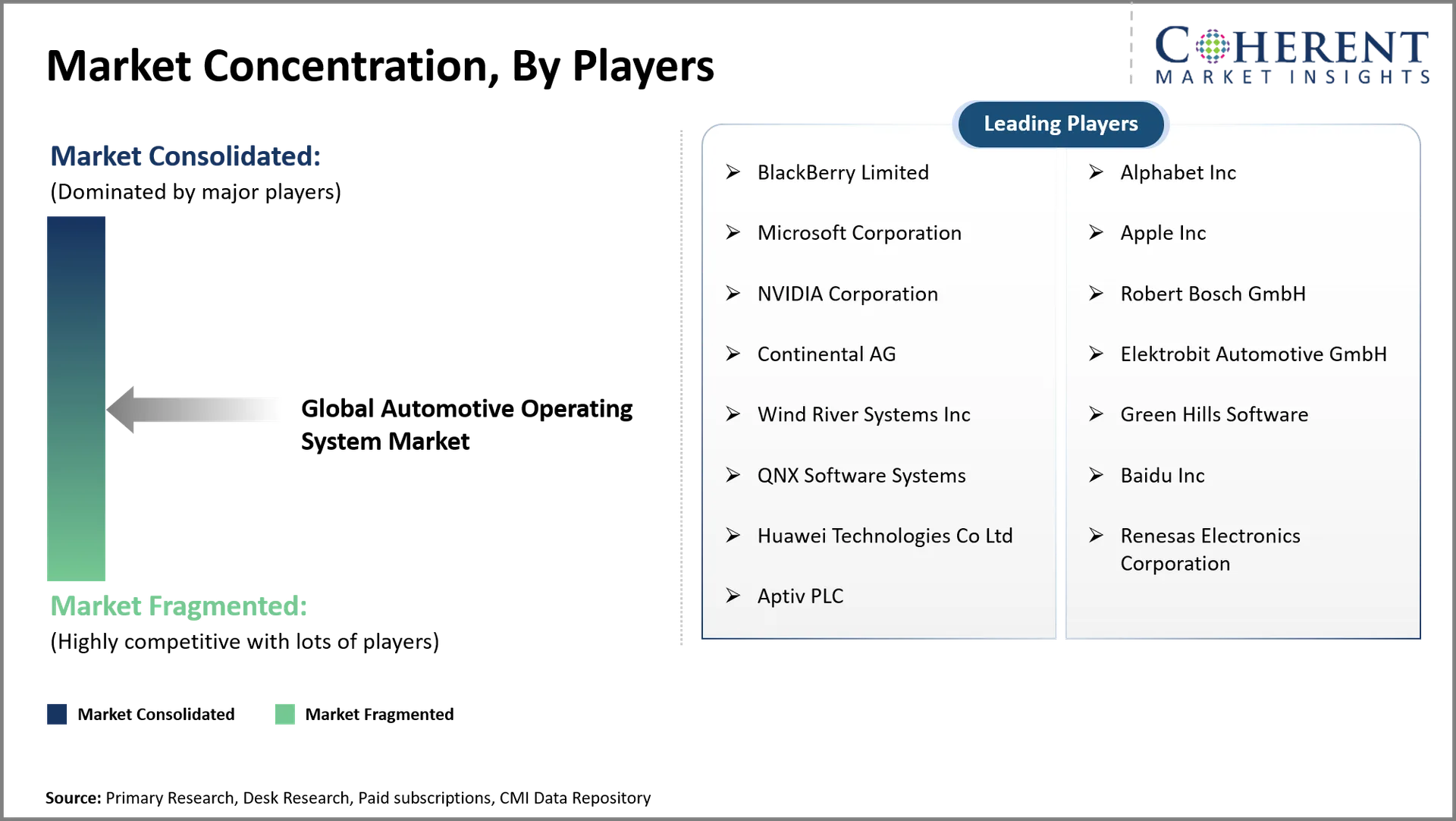
The global automotive operating system market is competitive, with specialized software vendors, semiconductor companies, and technology-driven automobile manufacturers vying for market share. BlackBerry Limited increases position with QNX Neutrino RTOS, QNX Hypervisor and safety-certified embedded software for digital cockpits and advanced driver assistance systems Alphabet Inc. adds Google built-in services, OEM collaborations to Android Automotive OS Elektrobit concentrates on AUTOSAR based platforms, software defined vehicles and integration services. NVIDIA Corporation produces software and processing solutions for autonomous driving: DRIVE. Wind River Systems focuses on real-time operating systems and cloud-to-edge automotive computing. Meanwhile, Huawei Technologies Co., Ltd. advances HarmonyOS-based intelligent cockpit ecosystems, particularly across Chinese automakers.
Top Manufacturers and Notable Products/Solutions in the Automotive Operating System Market
Manufacturer | Notable Product/Solution | Key features |
BlackBerry | QNX Software Development Platform 8.0 | Memory protection, fault isolation, deterministic performance, functional safety support, cybersecurity |
Android Automotive OS | Native vehicle integration, Google Maps, Google Play, voice assistance, application ecosystem | |
Wind River | VxWorks | Deterministic scheduling, multicore processing, memory protection, real-time execution |
Green Hills Software | INTEGRITY RTOS | Strong partitioning, memory protection, secure virtualization, functional safety certification |
Elektrobit | EB corbos Linux for Safety Applications | Open-source flexibility, automotive safety support, hardware abstraction, scalable software integration |
Automotive Operating System Market | |||
Report Coverage | Details | ||
Base Year | 2025 | Market Size in 2026: | USD 8.50 Bn |
Historical Data For: | 2020 To 2024 | Forecast Period: | 2026 To 2033 |
Forecast Period 2026 To 2033 CAGR: | 14.9% | 2033 Value Projection: | USD 22.50 Bn |
Geographies covered: |
| ||
Segments covered: |
| ||
Companies covered: | BlackBerry Limited, Alphabet Inc, Microsoft Corporation, Apple Inc, NVIDIA Corporation, Robert Bosch GmbH, Continental AG, Elektrobit Automotive GmbH, Wind River Systems Inc, Green Hills Software, QNX Software Systems, Baidu Inc, Huawei Technologies Co Ltd, Renesas Electronics Corporation, Aptiv PLC | ||
Growth Drivers: |
| ||
Restraints & Challenges: |
| ||
Analyst Opinion (Expert Opinion)
- The automotive operating system industry will increasingly move toward modular, centralized, and hardware-independent software architectures. Automakers will prioritize platforms capable of coordinating cockpit electronics, powertrain controls, connectivity, and driver assistance. Artificial intelligence integration will increase requirements for deterministic processing and hardware acceleration. Platforms combining real-time operating systems with hypervisors will become particularly important. Google's March 2026 expansion of Android Automotive OS toward software-defined vehicles demonstrates this architectural transition.
- The maximum opportunities will emerge in safety-certified real-time operating systems, automotive hypervisors, and centralized computing platforms. Advanced driver assistance systems, autonomous driving computers, and integrated digital cockpits will require increasingly sophisticated software foundations. China has considerable prospects through its local intelligent vehicle ecosystems and electric vehicle manufacturers. And the U.S. is creating opportunities through autonomous driving and semiconductor partnerships. Germany offers chances in commercial vehicle software and automotive engineering platforms. Qualcomm-powered Android Automotive and NVIDIA DriveOS are interesting technical directions.
- Market participants should focus on functional safety certification, cybersecurity integration, and the ability to work with different semiconductor designs. OS manufacturers should build virtualization features to segregate safety-critical apps from infotainment workloads. Working with carmakers and semiconductor producers can speed up the integration of manufacturing and certification of platforms. Companies should also enhance the tools they provide to developers, the environments in which they may simulate their programs, and the possibilities for updating the software. BlackBerry QNX, NVIDIA, and Google demonstrate different competitive approaches through safety software, accelerated computing, and expandable application ecosystems.
Speak to the analyst
Want personalized insights?
Take the findings above to one of our principal consultants, or have the report rebuilt around the segments, geographies and competitors you actually track.
Market Segmentation
- Vehicle Type Insights (Revenue, USD Billion, 2021 - 2033)
- Passenger Vehicles
- Commercial Vehicles
- Software Architecture Insights (Revenue, USD Billion, 2021 - 2033)
- Monolithic Architecture
- Microkernel Architecture
- Distributed Architecture
- Service-Oriented Architecture
- Operating System Type Insights (Revenue, USD Billion, 2021 - 2033)
- QNX
- Android Automotive OS
- Linux
- Windows
- Automotive Real-Time Operating Systems
- Proprietary Operating Systems
- Application Insights (Revenue, USD Billion, 2021 - 2033)
- Infotainment Systems
- Advanced Driver Assistance Systems
- Connected Vehicle Services
- Body Control and Comfort Systems
- Powertrain Control Systems
- Instrument Clusters
- Autonomous Driving Systems
- Regional Insights (Revenue, USD Billion, 2021 - 2033)
- North America
- U.S.
- Canada
- Latin America
- Brazil
- Argentina
- Mexico
- Rest of Latin America
- Europe
- Germany
- U.K.
- Spain
- France
- Italy
- Russia
- Rest of Europe
- Asia Pacific
- China
- India
- Japan
- Australia
- South Korea
- ASEAN
- Rest of Asia Pacific
- Middle East
- GCC Countries
- Israel
- Rest of Middle East
- Africa
- South Africa
- North Africa
- Central Africa
- North America
- Key Players Insights
- BlackBerry Limited
- Alphabet Inc
- Microsoft Corporation
- Apple Inc
- NVIDIA Corporation
- Robert Bosch GmbH
- Continental AG
- Elektrobit Automotive GmbH
- Wind River Systems Inc
- Green Hills Software
- QNX Software Systems
- Baidu Inc
- Huawei Technologies Co Ltd
- Renesas Electronics Corporation
- Aptiv PLC
Sources
Primary Research Interviews
- Automotive OEM Manufacturers
- Automotive Software Developers
- Tier-1 Automotive Suppliers
- Connected Vehicle Technology Providers
Magazines
- Automotive World Magazine
- Car and Driver (Technology Edition)
- Automotive News
- IEEE Spectrum (Automotive Technology)
Journals
- Journal of Automotive Engineering
- SAE International Journal of Connected and Automated Vehicles
- International Journal of Automotive Technology
Associations
- Society of Automotive Engineers (SAE International)
- European Automobile Manufacturers' Association (ACEA)
- Alliance for Automotive Innovation (AAI)
- International Organization of Motor Vehicle Manufacturers (OICA)
Public Domain Sources
- U.S. Department of Transportation (DOT)
- European Commission – Mobility and Transport
- National Highway Traffic Safety Administration (NHTSA)
- Ministry of Road Transport and Highways (MoRTH), India
Proprietary Elements
- CMI Data Analytics Tool
- Proprietary CMI Existing Repository of Information for the last 10 years
Get access to 250+ pages report
Every segment, forecast, competitor profile and data table behind the analysis above — available for instant download.
- ESOMAR Member
- ISO 9001:2015 Certified
- D-U-N-S Registered
- GDPR & CCPA Compliant
Frequently Asked Questions
The global automotive operating system market is expected to stand at USD 8.50 Bn in 2026 and is expected to reach USD 22.50 Bn by 2033.
The CAGR of the global automotive operating system market is projected to be 14.9% from 2026 to 2033.
Increasing adoption of software-defined vehicles and Growing integration of advanced driver assistance systems are the major factors driving the growth of the global automotive operating system market.
High automotive software development costs and Increasing cybersecurity vulnerabilities are the major factors hampering the growth of the global automotive operating system market.
In terms of vehicle type, passenger vehicles segment is estimated to dominate the market revenue share in 2026.
An automotive operating system manages vehicle software, electronic control units, computing resources, and connected applications.
Automotive operating systems support real-time processing, functional safety, vehicle communication, and specialized embedded computing requirements.