

Global Automotive Torque Converter Market Size and Forecast – 2026 To 2033
The global automotive torque converter market is expected to grow from USD 8 Bn in 2026 to USD 12 Bn by 2033, registering a compound annual growth rate (CAGR) of 5% from 2026 to 2033. The global automotive torque converter market is driven by growing hybrid vehicle production. On November 18, 2025, Toyota Motor North America, Inc., announced an investment of USD 912 million in five manufacturing plants in the U.S., involved in hybrid vehicle production to meet growing demand for the vehicles in the U.S.
Key Takeaways of the Global Automotive Torque Converter Market
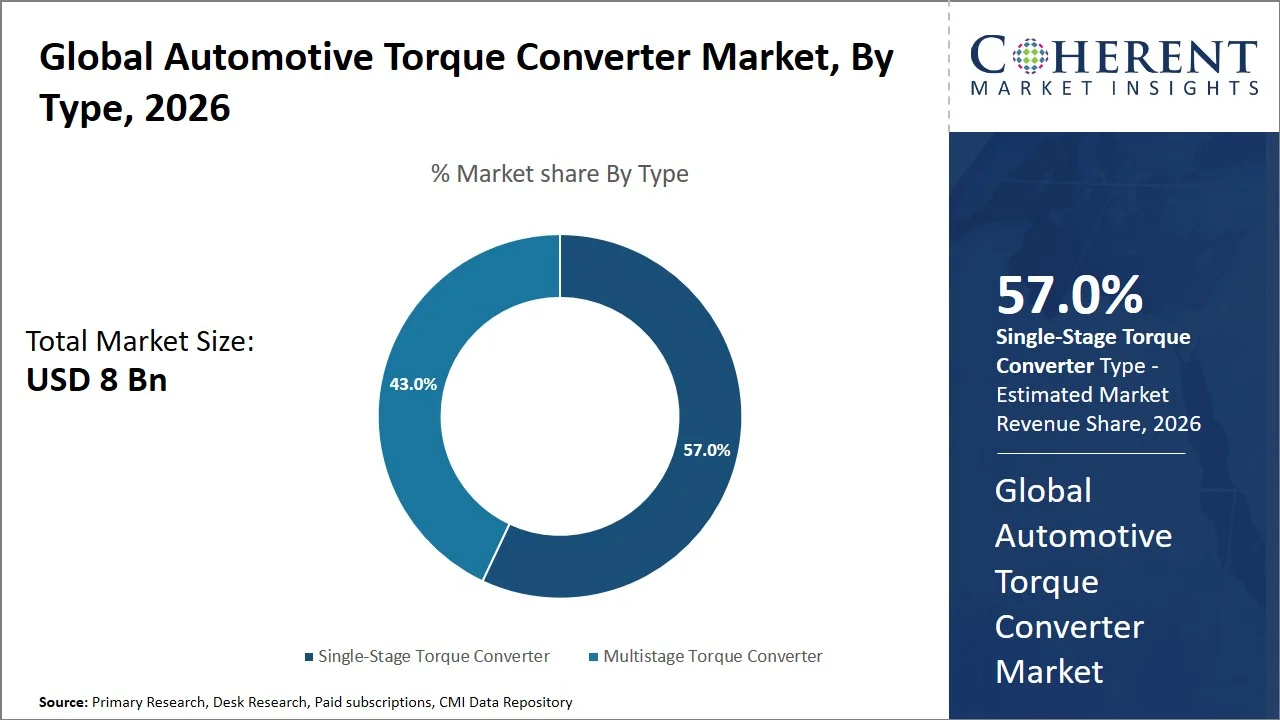
- The Single-Stage Torque Converter segment is expected to account for 57.0% of the global automotive torque converter market share in 2026. Expansion of passenger vehicle production is driving the growth of the segment. On October 14, 2025, Stellantis announced a USD 13 billion U.S. investment program through 2029. The plan includes reopening Belvidere for Jeep Cherokee and Jeep Compass production.
- The Automatic Transmission segment is estimated to capture 44.0% of the market share in 2026. Rising adoption of advanced lock-up clutch systems is majorly driving the growth of the segment. In June 2026, Aisin released details of its GR-DAT eight-speed automatic transmission. Its reinforced torque converter damper expands the lock-up range substantially.
- The Internal Combustion Engine Vehicles segment is estimated to capture 52.0% of the market share in 2026. Increasing demand for fuel-efficient drivetrains is majorly driving the growth of the segment. On April 21, 2025, Hyundai unveiled its next-generation hybrid powertrain with a 1.6-liter turbocharged engine.
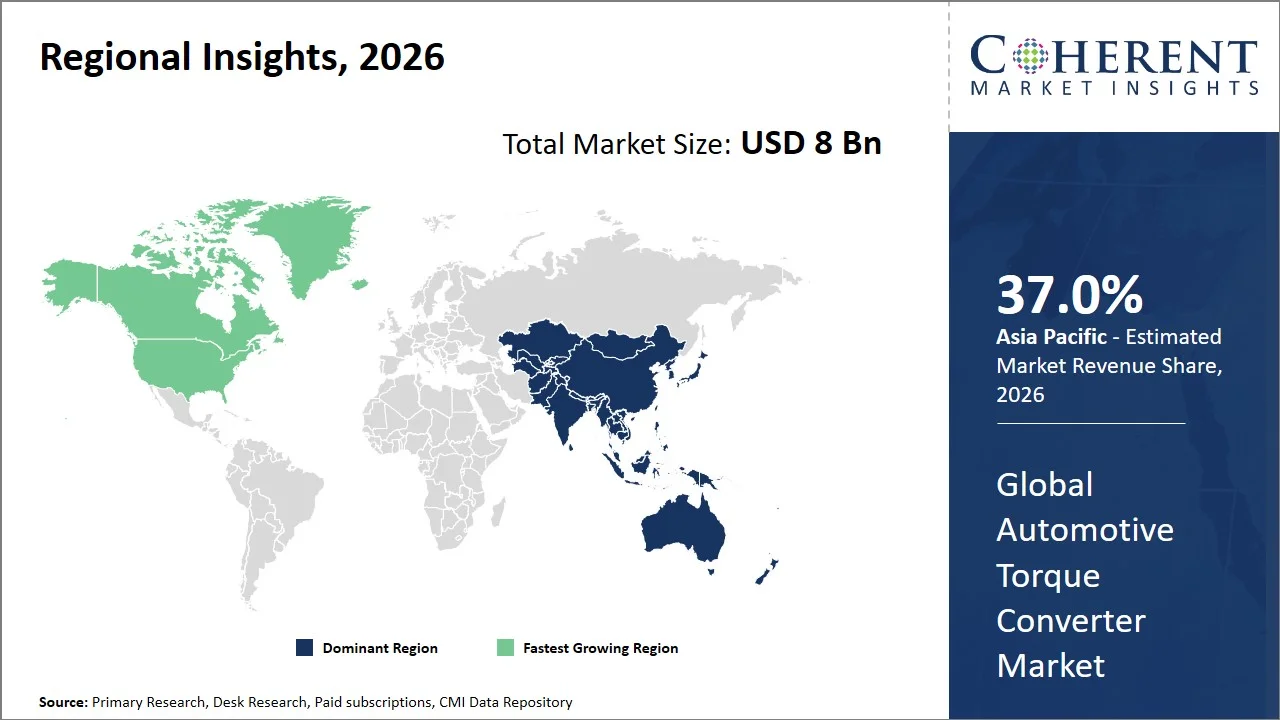
- Asia Pacific is expected to dominate the automotive torque converter market in 2026 with a market share of 37.0%. Expansion of aftermarket replacement demand in Asia Pacific is driving the growth of the regional market. In September 2025, Bosch strengthened its Japanese automotive activities through its new regional headquarters in Tokyo.
- North America is expected to account for 28.0% share in 2026 and is projected to record the fastest growth over the forecast period. Integration of advanced damping technologies in North America is driving the growth of the regional market. Schaeffler continued developing electrified drivetrain systems incorporating torque converter and damping technologies. Its North American operations include 19 plants and 9 research and development centers.
Segmental Insights
Why Does Single-Stage Torque Converter Dominate the Global Automotive Torque Converter Market?
The single-stage torque converter segment is expected to account for 57.0% of the global automotive torque converter market share in 2026. Automatic transmissions that use single-stage torque converters are easier to build and manufacture. The small design provides consistent torque multiplication for vehicle launch and low speed operation. Car manufactures gain from the easier integration across the widely adopted automatic transmission platforms. Its lower component complexity also means it will be cheaper to manufacture and maintain. Such benefits drive high-volume deployments in passenger and commercial vehicles around the world. For example, in 2025, Aisin secured financing from the Japanese government for their automatic gearbox production demonstration project. The effort is on the development of suppliers and local transmission production. This suggests further investment in simpler automatic gearbox technologies in regional vehicle production.
- Current Industry Events of 2026
- Market Size Estimation
- Regional Breakdown
- Competitive Landscape
- Customer Intelligence
- Segmental Analysis
- Pricing Analysis
- Key Market Drivers, Challenges & Future Trends
- Customized Insights Section
Why is Automatic Transmission the Most Crucial Transmission Type?
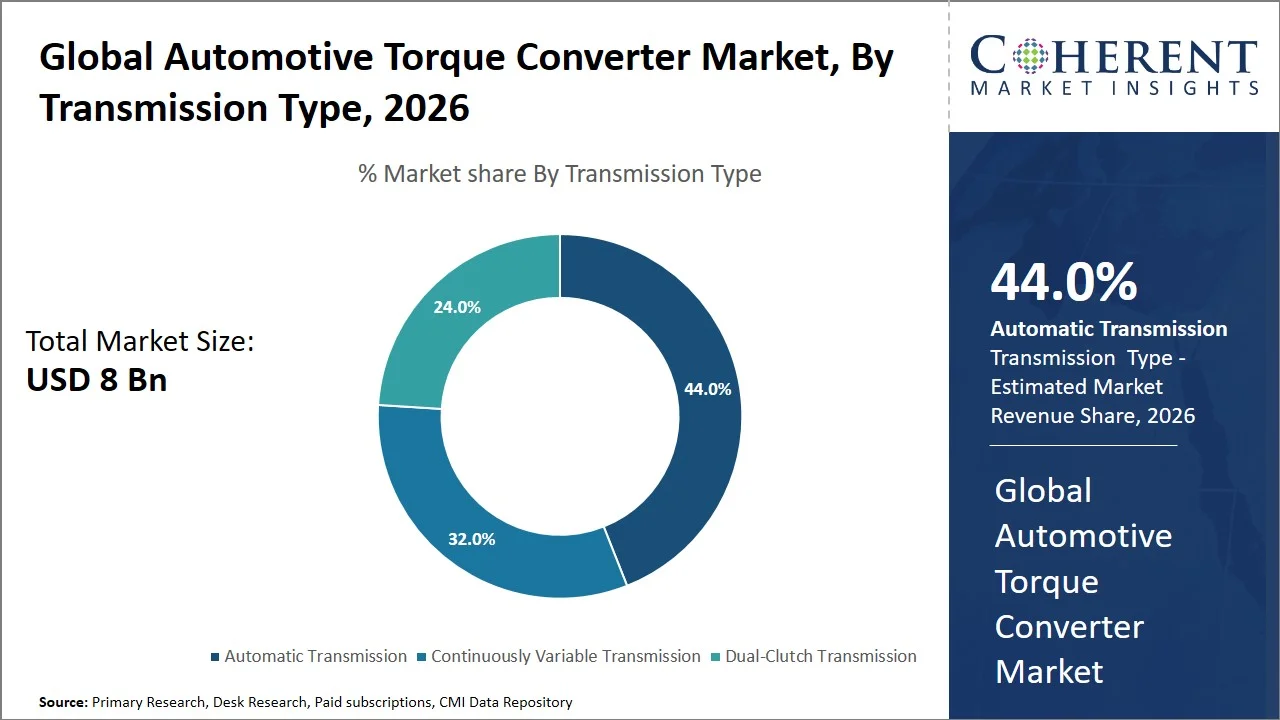
The automatic transmission segment is expected to account for 44.0% of the global automotive torque converter market share in 2026. Automatic transmissions smooth out gear changes and save driving strain during frequent accelerating and deceleration. Hydraulic and electronic control systems are optimized for different driving circumstances. This enhances driving comfort both in city traffic and on the highway. Wide interoperability with traditional powertrains and existing production capabilities already benefit manufacturers. These benefits enable further usage in both passenger car and commercial vehicle applications. On April 21, 2026, Aisin began contract manufacturing for Mazda’s six-speed automatic transmission in Indiana. The initiative strengthens localized automatic transmission production for North American vehicle manufacturers.
Internal Combustion Engine Vehicles Dominates the Global Automotive Torque Converter Market
The internal combustion engine vehicles segment is expected to account for 52.0% of the global automotive torque converter market share in 2026. Internal combustion engine cars have broad interoperability with traditional automatic gearbox systems and torque converters. Their tested drivetrain architecture allows for the use of common torque converter across different car segments. Large installed vehicle populations also support need for replacement and repair of transmission components. Internal combustion powertrains are continually being developed by manufacturers for better economy, emissions compliance, and drivability. This entrenched ecology enables the continuous use of torque converters in automobile manufacturing around the world. On May 27, 2025, General Motors announced plans to invest USD 888 million in its Tonawanda Propulsion plant to support the production of the sixth generation of GM’s V-8 engines, used in full-size trucks and SUVs. This new generation of engines is expected to deliver stronger performance existing engines while benefiting fuel economy and reducing emissions. New combustion and thermal management innovations are a key factor driving these improvements.
Current Events and their Impact
Current Events | Description and its Impact |
United States Environmental Protection Agency Multi-Pollutant Emissions Standards |
|
United States Environmental Protection Agency Heavy-Duty Vehicle Phase 3 Standards |
|
Automotive Torque Converter Market Dynamics
Market Drivers
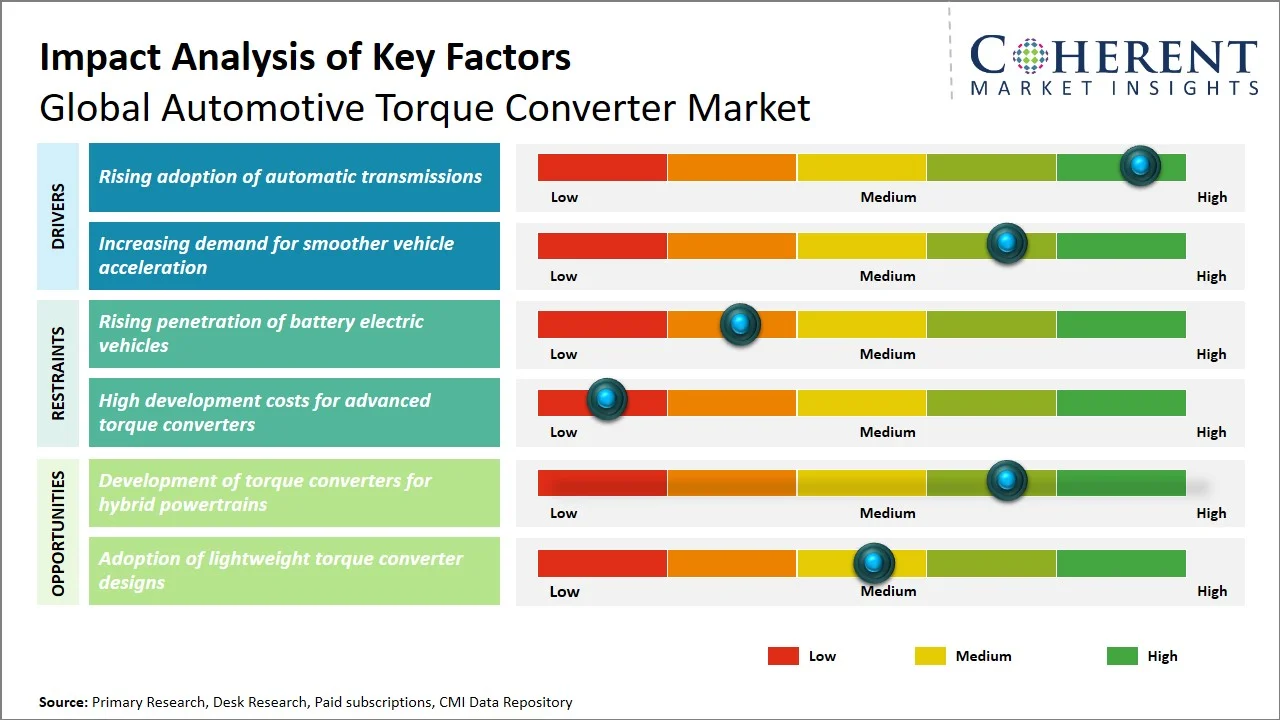
Rising adoption of automatic transmissions
Drivers like the convenience and ease of vehicle operation, thus the use of automatic transmissions is growing. Normal driving doesn't require frequent manual clutch engagement and gear selection with automatic systems. This feature is a real bonus in congested urban areas. The wider availability of automatic transmissions further widens the number of torque converter applications across passenger and commercial vehicle platforms. Higher automatic transmission penetration therefore strengthens demand for integrated torque converter systems. On March 10, 2026, ZF launched its eight-speed PowerLine automatic transmission on the Freightliner M2 106 Plus. The transmission pairs with Cummins’ B6.7 Octane engine for North American commercial applications.
Increasing demand for smoother vehicle acceleration
Consumers increasingly anticipate seamless acceleration with minimal drivetrain vibration and shifting disruptions. Torque converters allow controlled power transmission during vehicle launches and gear changes. Their hydraulic linkage helps decrease shock loads between the engine and transmission. This enhances low speed drivability, especially in stop-and-go traffic and hill starts. Therefore, increased expectations of a smooth driving experience are driving the adoption of torque converters in automatic automobiles. On June 18, 2025, ZF India Pvt Ltd. announced a strategic business collaboration with one of India’s largest commercial vehicle manufacturers to supply several thousand manual and AMT, 9-Speed gearboxes for the OEM’s trucks in the 1300Nm category. The partnership comprises the provision of ZF’s EcoMid and EcoTronic Mid transmissions specifically engineered for over 25t truck applications.
Emerging Trends
Advanced Lock-Up Clutch Integration
Torque converter manufacturers are developing advanced lock-up clutches that engage earlier, and over a wider range of operating conditions, reducing transmission slip and improving fuel efficiency.
Hybrid Powertrain Compatibility
Torque converters are being adapted by suppliers for hybrid and electric powertrains, where internal combustion engines, electric motors and automatic transmissions work in close interaction to provide smooth power delivery during engine starts, regenerative braking and mode transitions.
Lightweight Component Development
Manufacturers are increasingly using lightweight materials and optimized structural designs to reduce the rotating mass within torque converter assemblies. This improves transmission responsiveness, supports vehicle efficiency targets, and reduces mechanical losses across a range of driving conditions.
Advanced Damping Technologies
Torque converters are being developed with better damping systems to reduce the torsional vibrations generated by modern engines and transmissions. This improves cabin comfort, reduces stress on components, and enables more refined operation across a wider range of engine speeds.
Regional Insights
Why is Asia Pacific a Strong Market for Automotive Torque Converter?
Asia Pacific is expected to account for a market share of 37.0% in 2026. Widespread automobile manufacturing and fast adoption of automatic gearboxes in major economies are features of the Asia Pacific region. China is still a key production base. Japan provides advanced transmission engineering through Aisin and JATCO. India is launching automated solutions across small sport utility vehicles. Hyundai Motor India presently offers automatic, dual clutch and clever variable transmission options on cars including Venue and Creta. Hybrid powertrain development across Japan and China is creating additional requirements for integrated drivetrain control. Regional suppliers are consequently focusing on compact torque converters, improved damping, and efficient lock-up systems.
Why Does North America Automotive Torque Converter Market Exhibit High Growth?
North America is expected to register the fastest growth with a CAGR of 6.2% over the forecast period. North America is projected to account for 28.0% of the global automotive torque converter market in 2026. North America benefits from high automatic transmission penetration across pickup trucks, sport utility vehicles, and commercial vehicles. Pickup applications create particularly strong requirements for torque converters capable of managing high engine torque. Ford and General Motors use multi-speed automatic transmissions extensively across truck and sport utility vehicle platforms. Commercial vehicle applications provide another important demand source because automatic transmissions improve launch control under heavy loads. Allison Transmission is the partner of the regional ecosystem in providing commercial vehicle automatic transmission technologies. The hybridization is also pushing manufacturers to improve the working of torque converters with electric motor aid and regenerative braking systems.
Global Automotive Torque Converter Market Outlook for Key Countries
Why is China Emerging as a Major Hub in the Automotive Torque Converter Market?
China gains advantage from its large automobile production ecosystem and its quickly increasing local transmission capabilities. Chinese automakers are progressively equipping sedans, sport utility vehicles and premium passenger vehicles with automatic transmissions. Manufacturers also want more control of their own drivetrain technology and supply chains, which is driving a rise in local transmission production. Hybrid automatic gearbox systems may offer controlled power transfer through torque converters. Torque converters are a significant area of development for hybrid vehicles. Chinese automobile exporters also create additional demand for locally produced components for the drive train. The country’s expanding new energy vehicle industry is encouraging suppliers to develop specialized transmission technologies supporting hybrid applications alongside conventional internal combustion powertrains.
Is U.S. the Next Growth Engine for the Automotive Torque Converter Market?
The U.S. has long used automatic transmissions in pickup trucks, sport utility vehicles and commercial vehicles. Ford’s F-Series and General Motors’ full-size pickup chassis heavily use sophisticated automatic gearbox technologies. When a vehicle is required to pull a lot of weight, it needs a torque converter capable of handling a large amount of torque during acceleration and load changes. Allison Transmission provides automatic transmission systems for commercial and vocational applications. Fleet operators also want durability and reliable power supply under harsh operating conditions. These requirements encourage development of stronger lock-up clutches, improved damping systems, and transmission controls designed for high-load applications.
Germany Automotive Torque Converter Market Analysis and Trends
Germany benefits from sophisticated premium vehicle engineering and strong transmission manufacturing capabilities. ZF Friedrichshafen supplies eight-speed automatic transmission systems used across numerous premium vehicle applications. BMW has widely adopted eight-speed automatic transmission technology across rear-wheel-drive platforms. Mercedes-Benz also offers advanced automatic transmission systems throughout several passenger vehicle families. Germany’s emphasis on driving refinement encourages development of improved torque converter damping and lock-up performance. High-output engines create additional requirements for efficient torque transfer and vibration management. Hybrid vehicle development is also encouraging transmission engineers to coordinate combustion engines, electric motors, and automatic transmission systems more precisely.
Japan Automotive Torque Converter Market Analysis and Trends
Japan benefits from globally established transmission manufacturers and advanced hybrid powertrain development. Aisin supplies automatic transmission technologies for Toyota and other vehicle manufacturers. JATCO develops transmission systems for Nissan and other global automotive customers. Modern hybrid systems depend on the exact synchronization of the operation of the internal combustion engine and the electric motor. This promotes the development of compact gearbox topologies with regulated torque transfer and efficient power delivery. Japanese manufacturers also emphasize minimal vibration and good reliability in all passenger vehicle applications. Robust vehicle exports bolster domestic transmission production. Supplier expertise enables close integration between engines, transmissions, electronics, and vehicle control systems.
India Automotive Torque Converter Market Analysis and Trends
India benefits from expanding automatic transmission adoption across compact sport utility vehicles and urban passenger cars. Hyundai Motor India has the option of automatic gearbox across the likes of Venue, Creta and Alcazar. The Creta gets six-speed automatic, clever variable and seven-speed dual-clutch options on different powertrains. The Venue is also available in automatic and dual-clutch variants apart from manual. Wider availability of automatic is driven by growing consumer appetite for easier driving in cities. Local production of multiple automatic variants is also strengthening demand for transmission components and related supplier capabilities.
Global Automotive Torque Converter Market - Manufacturing Expansion by Major Transmission Suppliers (2025)
Major Transmission Supplier | Country | Manufacturing Expansion In 2025 | Investment Or Capacity Detail |
Allison Transmission | U.S. | Chennai facility expansion | More than USD 100 million investment |
Aisin Corporation | Japan | India automatic transmission production demonstration | Government supported demonstration project |
ZF Friedrichshafen | Germany | Saarbrücken fourth 8HP production line | Fourth production line |
Schaeffler | Germany | Shoolagiri manufacturing facility | 16,500 square metre Phase 1 facility |
JATCO | Japan | Fuji ePowertrain Plant | Dedicated production facility |
EXEDY Corporation | Japan | Global torque converter production optimization | Production transferred among three countries |
How is Development of Torque Converters for Hybrid Powertrains Creating New Growth Opportunities in the Automotive Torque Converter Market?
Hybrid powertrain development is creating new opportunities for specialized torque converter and transmission architectures. Aisin’s rear-wheel-drive hybrid transmission retains a torque converter while adding an HEV module, preserving towing and hill-climbing capability. The ZF 8HP design incorporates electric motors and power electronics inside the gearbox casing, which means it may be used in hybrid applications without increasing the overall external dimensions. These improvements give vendors the opportunity to design hybrid-specific dampers, clutches and torque management components. Aisin’s investment in Indian automatic transmission manufacture in 2026 also shows the growing regional manufacturing prospects for electric drivetrain systems. On May 20, 2025, Punch Powertrain announced its DHT120/150 dedicated hybrid transmission for compact A-segment and B-segment automobiles. The dual-motor architecture is suitable for hybrid and plug-in hybrid vehicles with sub-two-liter gasoline engines. Smooth power transitions and small packaging are noted.
Market Players, Key Development, and Competitive Intelligence
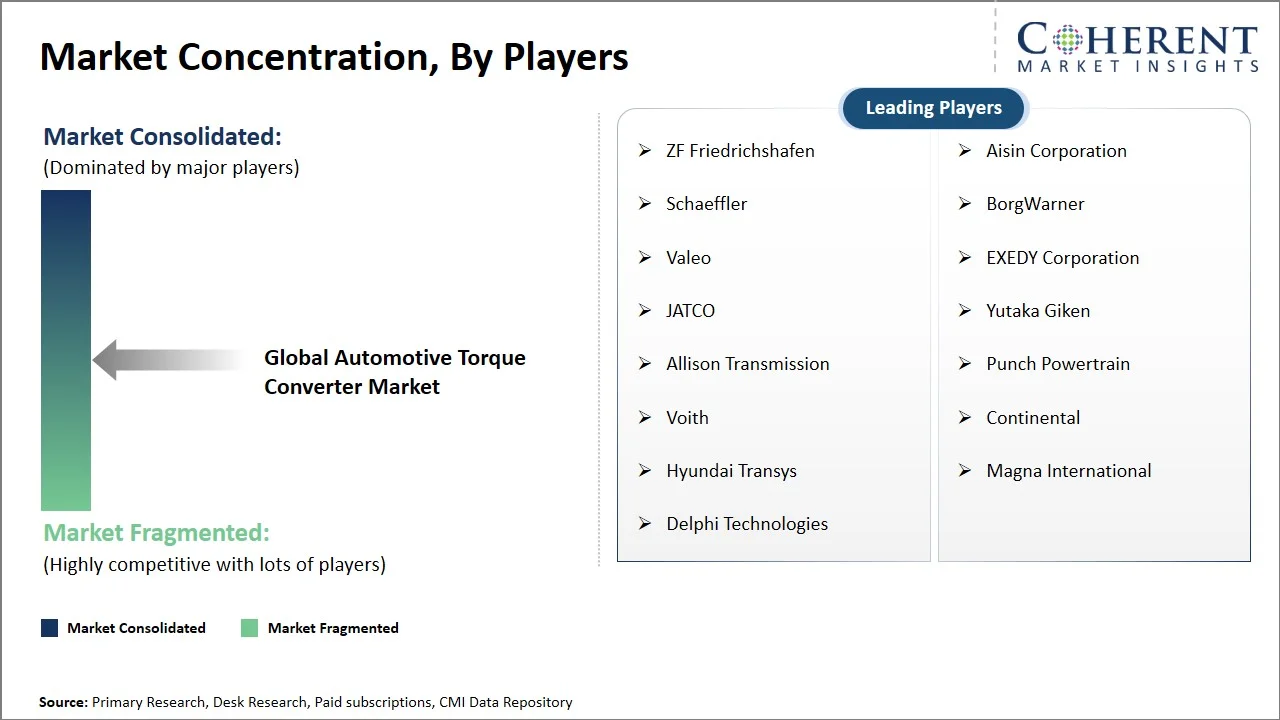
Key Developments
- On February 4, 2026, AISIN Corporation and AISIN AUTOMOTIVE HARYANA PRIVATE LIMITED (AHL), a consolidated subsidiary in India, decided to expand AHL’s existing plant and build a new plant in Maharashtra, India. The total investment amount will be approximately USD 200 million.
- On July 29, 2025, Allison Transmission announced that the Allison 4000 Series fully automatic transmission is now available with the new CARB low NOx compliant PACCAR MX-13 engine for Kenworth T880 and Peterbilt Model 567 truck models.
Competitive Landscape
Leading players are combining conventional torque converter expertise with hybrid and electronically controlled transmission technologies. Aisin is developing rear-wheel-drive hybrid transmissions that retain a torque converter while adding an HEV module. Its hybrid portfolio also includes dedicated dampers for controlling engine vibration. Allison Transmission is pursuing commercial vehicle applications through eGen Flex and integrated electric hybrid propulsion systems. Its eGen Flex can operate buses in engine-off mode for portions of their routes. ZF Friedrichshafen is focused on integrating electrification with established automatic transmission architectures. Competition is therefore shifting toward hybrid compatibility, improved damping, electronic controls, and application-specific torque management.
Market Report Scope
Automotive Torque Converter Market Report Coverage
| Report Coverage | Details | ||
|---|---|---|---|
| Base Year: | 2025 | Market Size in 2026: | USD 8 Bn |
| Historical Data for: | 2020 To 2024 | Forecast Period: | 2026 To 2033 |
| Forecast Period 2026 to 2033 CAGR: | 5 % | 2033 Value Projection: | USD 12 Bn |
| Geographies covered: |
| ||
| Segments covered: |
| ||
| Companies covered: | ZF Friedrichshafen, Aisin Corporation, Schaeffler, BorgWarner, Valeo, EXEDY Corporation, JATCO, Yutaka Giken, Allison Transmission, Punch Powertrain, Voith, Continental, Hyundai Transys, Magna International, Delphi Technologies | ||
| Growth Drivers: |
| ||
| Restraints & Challenges: |
| ||
Analyst Opinion (Expert Opinion)
- The industry is expected to move toward hybrid-compatible torque converters rather than relying exclusively on conventional applications. Aisin’s approach demonstrates how torque converter-equipped automatic transmissions can accommodate hybrid modules while preserving towing and hill-climbing capability. This creates a practical pathway for suppliers serving vehicles that retain combustion engines alongside electric propulsion. The strongest opportunity should emerge around hybrid automatic transmission applications requiring controlled engine-motor transitions. Suppliers should prioritize converter designs with efficient lock-up operation and stronger vibration damping.
- Commercial vehicles represent another attractive opportunity because torque converters remain valuable under frequent starts, heavy loads, and demanding duty cycles. Allison’s product portfolio demonstrates continued torque converter use across refuse, utility, construction, transit, and emergency applications. Hybrid propulsion can further expand these applications where engine-off operation is useful. Suppliers should therefore develop durable converter assemblies supporting high torque, repeated cycling, and hybrid control strategies. Asia Pacific should receive particular attention because Aisin and other suppliers are integrating hybrid transmission technologies into regional vehicle programs.
- To gain an edge, manufacturers should combine mechanical converter expertise with electronic control and hybrid system integration. Aisin already pairs hybrid transmissions with dedicated damping components and electric current sensing technologies. Allison similarly combines automatic transmission development with electrified propulsion systems and system-level integration. Suppliers should strengthen partnerships with automakers and transmission developers before vehicle platforms reach production. Modular designs can also reduce integration time across multiple hybrid transmission architectures.
Speak to the analyst
Want personalized insights?
Take the findings above to one of our principal consultants, or have the report rebuilt around the segments, geographies and competitors you actually track.
Market Segmentation
- Type Insights (Revenue, USD Billion, 2021 - 2033)
- Single-Stage Torque Converter
- Multistage Torque Converter
- Transmission Type Insights (Revenue, USD Billion, 2021 - 2033)
- Automatic Transmission
- Continuously Variable Transmission
- Dual-Clutch Transmission
- Powertrain Insights (Revenue, USD Billion, 2021 - 2033)
- Internal Combustion Engine Vehicles
- Hybrid Electric Vehicles
- Plug-in Hybrid Electric Vehicles
- Component Insights (Revenue, USD Billion, 2021 - 2033)
- Complete Torque Converter Assembly
- Lock-Up Clutch and Torque Converter Module Assembly
- Vehicle Type Insights (Revenue, USD Billion, 2021 - 2033)
- Passenger Vehicles
- Commercial Vehicles
- Sales Channel Insights (Revenue, USD Billion, 2021 - 2033)
- OEM
- Aftermarket
- Regional Insights (Revenue, USD Billion, 2021 - 2033)
- North America
- U.S.
- Canada
- Latin America
- Brazil
- Argentina
- Mexico
- Rest of Latin America
- Europe
- Germany
- U.K.
- Spain
- France
- Italy
- Russia
- Rest of Europe
- Asia Pacific
- China
- India
- Japan
- Australia
- South Korea
- ASEAN
- Rest of Asia Pacific
- Middle East
- GCC Countries
- Israel
- Rest of Middle East
- Africa
- South Africa
- North Africa
- Central Africa
- North America
Sources
Primary Research Interviews
- Automotive Torque Converter Manufacturers & OEM Representatives
- Transmission System Engineers & Technical Experts
- Automotive Component Distributors & Suppliers
- Automotive Industry Analysts & Consultants
Magazines
- Automotive Engineering International
- Motor Trend Magazine
- Automotive Industries Magazine
Journals
- International Journal of Automotive Technology
- Journal of Mechanical Design (ASME)
- SAE International Journal of Engines & Powertrains
Associations
- International Organization of Motor Vehicle Manufacturers (OICA)
- Society of Automotive Engineers (SAE International)
- Automotive Parts Manufacturers' Association (APMA)
- European Automobile Manufacturers' Association (ACEA)
Public Domain Sources
- U.S. Department of Energy – Alternative Fuels & Vehicle Technologies
- European Commission – Mobility & Transport Reports
- Japan Automobile Manufacturers Association (JAMA) – Public Reports
- World Bank – Global Automotive Industry Data
Proprietary Elements
- CMI Data Analytics Tool
- Proprietary CMI Existing Repository of Information for Last 10 Years
Get access to 250+ pages report
Every segment, forecast, competitor profile and data table behind the analysis above — available for instant download.
- ESOMAR Member
- ISO 9001:2015 Certified
- D-U-N-S Registered
- GDPR & CCPA Compliant
Missing comfort of reading report in your local language? Find your preferred language:
Frequently Asked Questions
The global automotive torque converter market is expected to stand at USD 8 Bn in 2026 and is expected to reach USD 12 Bn by 2033.
The CAGR of the global automotive torque converter market is projected to be 5% from 2026 to 2033.
Rising adoption of automatic transmissions and increasing demand for smoother vehicle acceleration are the major factors driving the growth of the global automotive torque converter market.
Rising penetration of battery electric vehicles and high development costs for advanced torque converters are the major factors hampering the growth of the global automotive torque converter market.
In terms of type, single-stage torque converter segment is estimated to dominate the market revenue share in 2026.
An automotive torque converter transfers engine power to an automatic transmission while providing torque multiplication during vehicle launch.
They enable smooth vehicle launches without requiring a manually operated clutch.