

Global Automotive Window Film Market Size and Forecast – 2026 To 2033
The global automotive window film market is expected to grow from USD 9.85 Bn in 2026 to USD 17.40 Bn by 2033, registering a compound annual growth rate (CAGR) of 7.3% from 2026 to 2033. The global automotive window film market is driven by increasing adoption of premium automotive accessories. On February 3, 2026, Cosmo Consumer, the consumer-facing vertical of Cosmo First, announced the launch of two new car protection solutions at Automechanika, while showcasing its complete range of automotive protection products at Yashobhoomi, Dwarka, India.
Key Takeaways of the Global Automotive Window Film Market
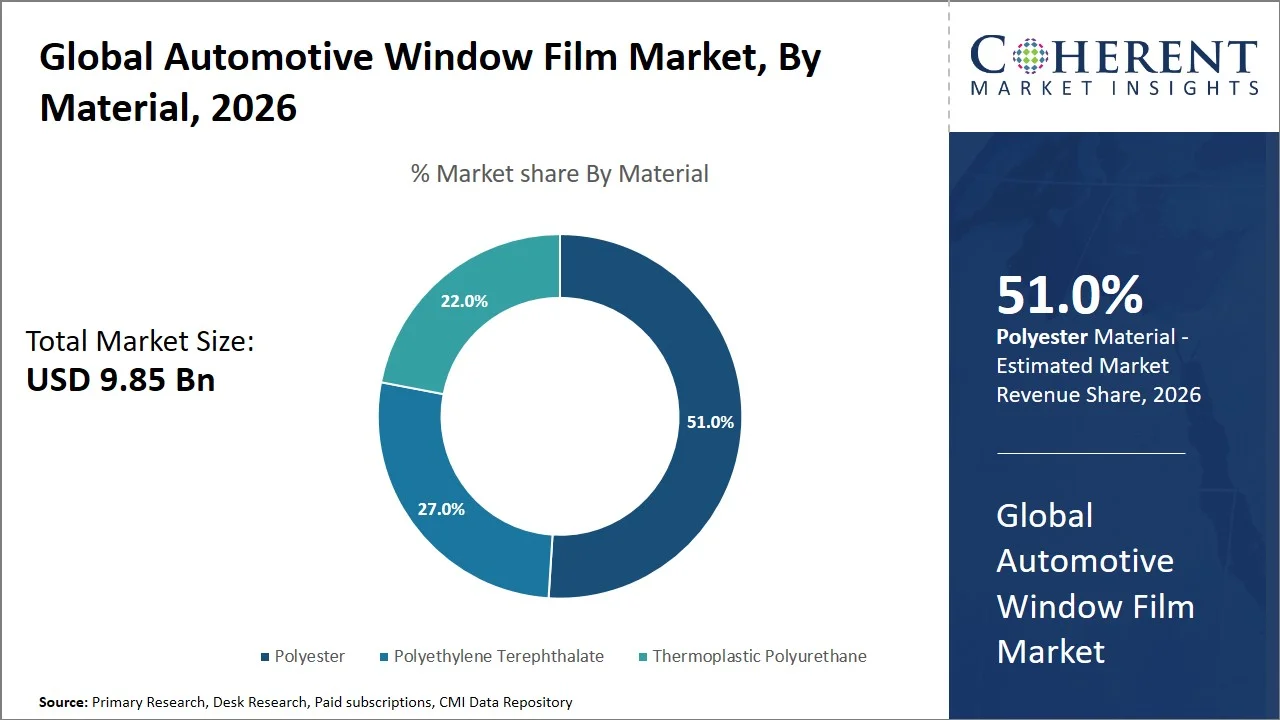
- The Polyester segment is expected to account for 51.0 % of the global automotive window film market share in 2026. Rising electric vehicle production and cabin thermal management needs is driving the growth of the segment. On June 2, 2025, ZF introduced its TherMaS thermal management system for battery-electric and plug-in hybrid vehicles.
- The Passenger Cars segment is estimated to capture 58.0 % of the market share in 2026. Growing demand for glare reduction and passenger comfort is majorly driving the growth of the segment. For instance, in 2025, BMW expanded comfort glazing, sun protection glazing, and Heat Comfort options across several models.
- The Dyed Window Films segment is estimated to capture 33.0 % of the market share in 2026. Increasing demand for automotive privacy and security solutions is driving the growth of the segment. China issued a national standard for intelligent automotive glass that changes color in February 2025.
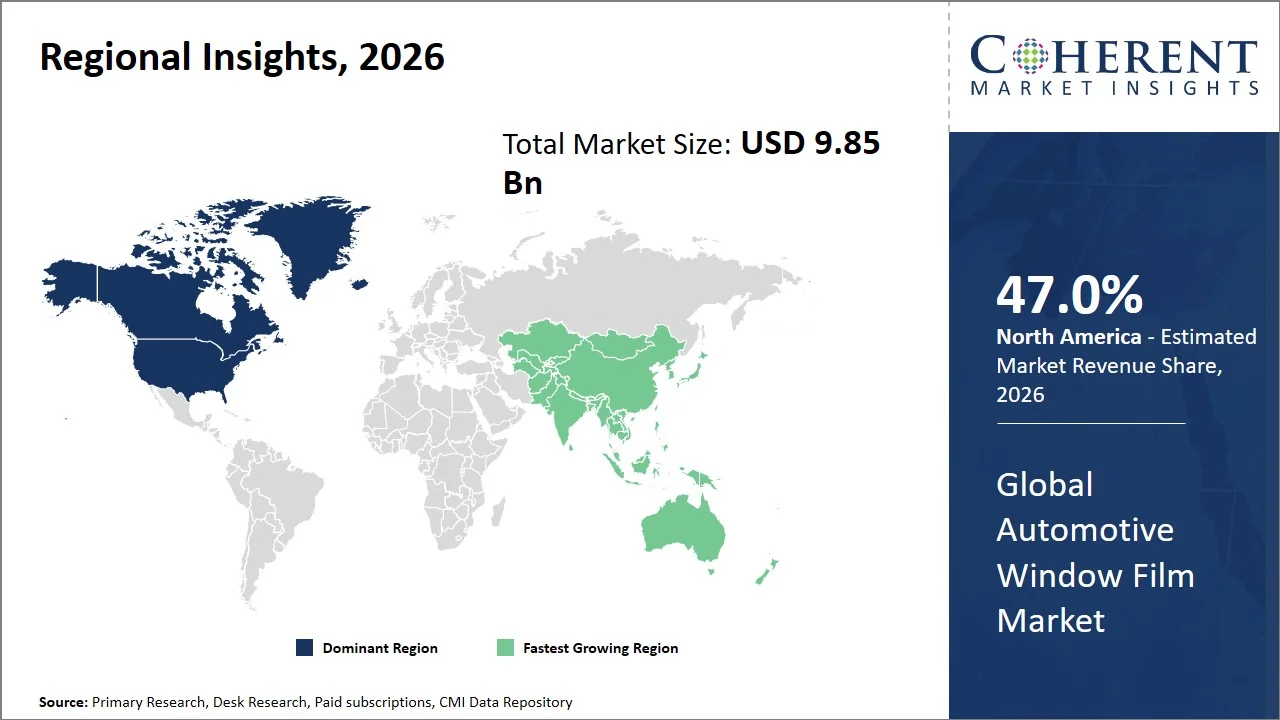
- North America is expected to dominate the automotive window film market in 2026 with a market share of 47.0 %. Rising demand for infrared heat rejection technologies in North America is driving the growth of the regional market. XPEL reported record second-quarter 2026 window-film sales of USD 32.5 million. Its U.S. revenue increased 11.7% during the quarter.
- Asia Pacific is expected to account for 26.0 % share in 2026. Increasing adoption of premium ultraviolet blocking films in Asia Pacific is driving the growth of the regional market. On June 24, 2025, Toyota introduced its Digital Curtain technology in the Century SUV. The laminated film blocks up to 99% of ultraviolet radiation while providing adjustable privacy.
Segmental Insights
Why Does Polyester Dominate the Global Automotive Window Film Market?
The polyester segment is expected to account for 51.0% of the global automotive window film market share in 2026. Polyester is preferred for its dimensional stability, durability and optical clarity for vehicle window film applications. Its resilience to stretching and ripping ensures steady performance when exposed to sunlight for extended periods. The use of polyester substrates also allows for effective integration of dyes, metallic layers and ceramic coatings. this allows manufacturers to produce films with higher heat rejection, UV protection and glare reduction qualities. These features provide consistent installation and long service life in a variety of vehicle settings. For example, Garware, in its 2025 automotive film roadmap, positioned itself as a polyester film and window-tinting maker. Its goods, made in India, are used in more than 80 countries, the company said. This is proof of the enduring role polyester holds in automobile film manufacture.
- Current Industry Events of 2026
- Market Size Estimation
- Regional Breakdown
- Competitive Landscape
- Customer Intelligence
- Segmental Analysis
- Pricing Analysis
- Key Market Drivers, Challenges & Future Trends
- Customized Insights Section
Why is Passenger Cars the Most Crucial Vehicle Type?
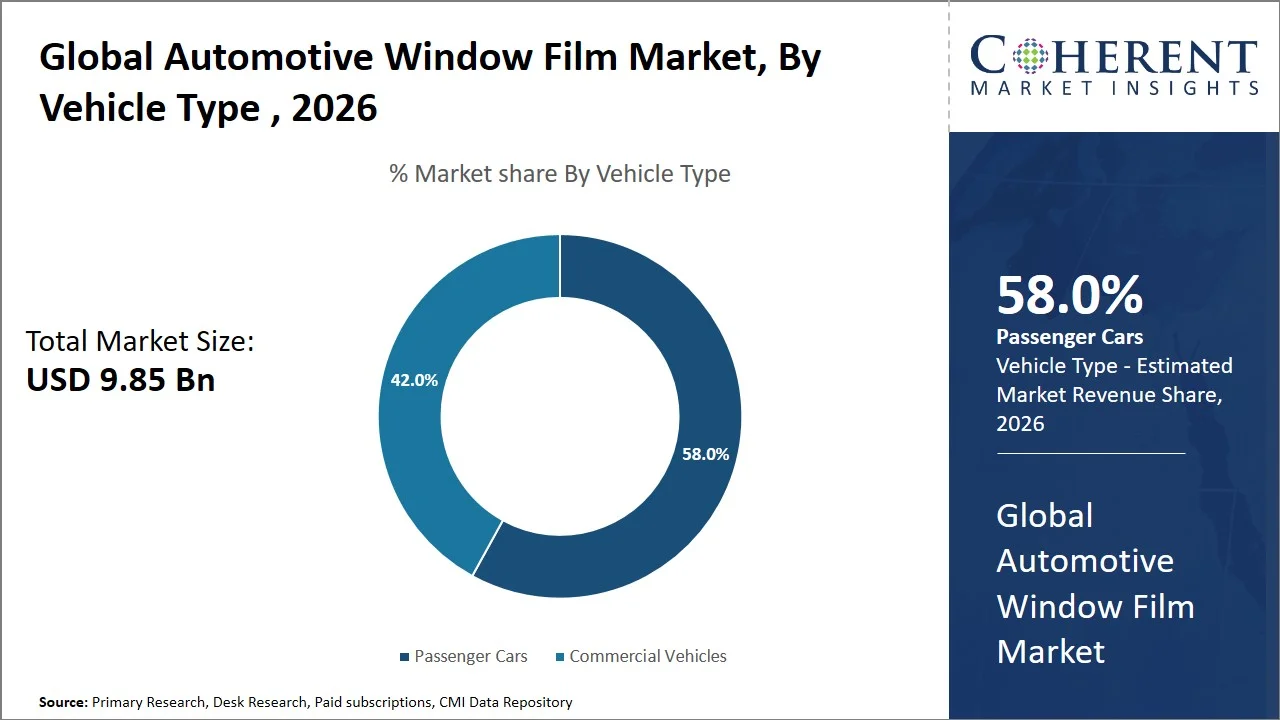
The passenger cars segment is expected to account for 58.0% of the global automotive window film market share in 2026. The automobile window film applications for passenger cars represent a wide addressable client market. As personal car ownership expands, so do the demands for interior comfort and ultraviolet protection. Car owners also are increasingly looking for seclusion, reduction of glare and improvements in exterior appearance. These criteria stimulate the use of window films in factory and after-market applications. The large population of passenger cars therefore leads to a stable demand in automotive markets in developed as well as developing regions. For instance, BMW Group India logged 18,001 car sales for 2025, up 14% year-on-year. Electric car sales were 3,753 units, up 200%. Demand for premium passenger car comfort amenities also saw a lift from long-wheelbase cars by 162%.
Dyed Window Films Dominates the Global Automotive Window Film Market
The dyed window films segment is expected to account for 33.0% of the global automotive window film market share in 2026. Dye films are a cost-effective alternative for the consumer who wants just a little privacy and glare reduction. Due to their simple design, they are inexpensive to manufacture and are readily available in the aftermarket. These films also give some ultraviolet protection and may improve the look of a car. Their cheaper price makes them attractive to passenger-vehicle buyers who are sensitive to price. The cost effectiveness allows for larger usage in mass market automobile applications. On May 5, 2025, Al-Rabiya added a new product to their premium Luminous window tinting line, the Luminous carbon vehicle window film. The product is a crucial addition to the company’s vehicle window film portfolio, offering customers a dependable, high-performance alternative to existing films.
Current Events and their Impact
Current Events | Description and its Impact |
India - Central Motor Vehicles Rules |
|
U.S. - Federal Motor Vehicle Safety Standard No. 205 |
|
Automotive Window Film Market Dynamics
Market Drivers
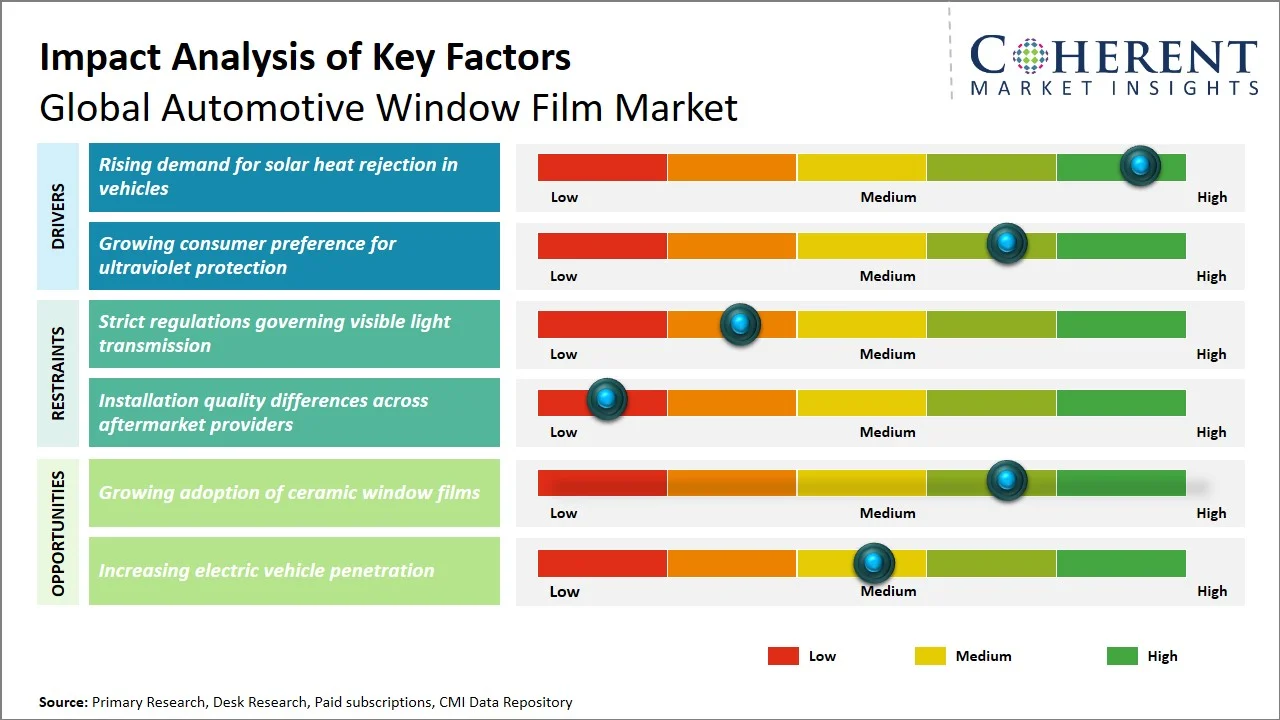
- Rising demand for solar heat rejection in vehicles: Higher cabin temperatures are driving up demand for automotive window films with enhanced solar heat rejection. This is a rising demand from vehicle owners who need to have lower interior temperatures under lengthy time exposure to sun light. Heat-reflecting coatings can minimize the amount of sun energy reaching the passenger compartment. This could improve occupant comfort and reduce reliance on the vehicle’s air conditioning. These films are especially desirable for owners of electric vehicles, as cooling loads can impact driving range. For example, BMW has put a high-end solar filter on the big panoramic roof of the new iX3. The glazing has full ultraviolet protection and solar-energy filtration. This is an example of how automobile manufacturers are incorporating solar-control technology into factory glazing.
- Growing consumer preference for ultraviolet protection: Consumers are increasingly looking for car window films that offer protection from ultraviolet light. Prolonged exposure to ultraviolet can cause fading of interior materials and exposure of passenger’s skin. Many types of advanced window films may filter a significant fraction of ultraviolet radiation, while allowing usable amounts of visible light to get through. That feature adds to its desirability for passenger car owners and premium car buyers. Manufacturers are consequently focusing on UV protection as well as heat rejection and glare reduction. Global Hi-Tech Films continues to offer car window films that filter UV radiation, while reducing heat and glare. 3M’s automobile window film portfolio focuses on UV protection, as well as heat and glare reduction. Its Crystalline Series offers high-performance solar control capabilities.
Emerging Trends
- Increasing adoption of ceramic window films: Ceramic formulations are garnering interest for infrared rejection, UV protection and glare reduction. The non-metallic structure of the bearings also supports connectivity-sensitive vehicles, making them appealing for connected vehicles and luxury passenger vehicle applications.
- Growing integration with electric vehicles: As electric vehicle manufacturers and owners increasingly seek improved window films for thermal management. Better solar heat rejection can lower cabin cooling requirements, assisting passenger comfort and potentially helping to preserve battery energy in hot weather.
- Rising demand for high-transmission films: Regulatory standards are pushing manufacturers to make films with high solar control but increased visible light transmission. These solutions can offer thermal benefits while complying with regulatory visibility requirements in different vehicle window placements and markets.
- Expansion of smart window film technologies: Electrically switchable and sophisticated optical films are gaining interest for premium vehicle applications. These technologies can deliver customizable transparency, better privacy and improved sun control to enable future vehicle interiors with more advanced comfort features.
Regional Insights
Why is North America a Strong Market for Automotive Window Film?
North America is expected to account for a market share of 47.0% in 2026. North America has a developed automotive aftermarket and a well-established infrastructure for professional tint installation. The area is also highly exposed to intense sun radiation. Hot weather in Arizona, Texas, Florida and Mexico driving demand for infrared-rejecting films. Premium ceramic films are becoming more attractive for luxury vehicles and electric vehicles. Additionally, the U.S. has a number of state tint standards that are quite complex, which result in high-transmission products that comply. Federal glazing rules usually mandate 70% light transmission for visibility-critical windows. This is why North American suppliers of automotive films stress optical clarity, heat rejection and signal compatibility. The existing detailing networks in the region only help to facilitate professional installation and premium film updates.
Why Does Asia Pacific Automotive Window Film Market Exhibit High Growth?
Asia Pacific is expected to register the fastest growth with a CAGR of 8.4% over the forecast period. The region is projected to account for 26.0% of the global automotive window film market in 2026. Asia Pacific benefits from concentrated vehicle manufacturing and expanding aftermarket customization across multiple climatic zones. China, Japan, India, and Southeast Asia together generate a broad demand for sun control films. China produced more than 31 million motor vehicles in 2024. The region has seen robust manufacturing and acceptance of electric vehicles, driving higher need for thermal management systems. In India and Southeast Asia, the strong sunshine and high temperatures further increase the interest in ultraviolet and infrared protection. Japan and South Korea choose premium film production through advanced coating and auto manufacturing skills. Expanding dealership networks are also improving access to professionally installed films.
Global Automotive Window Film Market Outlook for Key Countries
Why is U.S. Emerging as a Major Hub in the Automotive Window Film Market?
The rich aftermarket customizing culture and large professional installer networks support the U.S. market. Regional climate variables influence demand patterns throughout the country. Arizona, Nevada, Texas and Florida are areas with high solar exposure, thereby boosting the demand for heat rejecting films. California’s massive number of passenger vehicles raises further need for appropriate solar-control systems. Federal glazing rules drive producers to develop films that maintain the required level of visibility. Premium ceramic films are attracting attention as they reject infrared energy without using metallic layers. Another area of applicability are electric and hybrid automobiles because cabin cooling can impact energy usage.
Is China the Next Growth Engine for the Automotive Window Film Market?
China has a huge amount of car production, quick adoption of electric cars and growing personalization of cars. China made 27.48 million cars in 2024, according to the International Organization of Motor Vehicle Manufacturers. China's new energy vehicle sales amounted to 16.49 million units in 2025. Sales of new energy vehicles rose 28.2 percent year on year in the time. This growing electric car base is expected to increase demand for films that help to manage cabin temperature. Domestic producers are also boosting their ceramic film output to reduce dependence on imported luxury products. XPEL has been growing its income by 65.3% in China before it acquired a Chinese distributor in 2025.
Germany Automotive Window Film Market Analysis and Trends
Germany has high prospects as it has premium vehicle manufacturing and advanced automotive technology integration. The country produced some 4.1 million passenger cars in 2025. Electric vehicles represented 40.2% of German passenger car production during that year. This unusually high electrification level creates demand for films supporting thermal comfort within increasingly sophisticated vehicle cabins. German consumers also exhibit a considerable interest in high quality optical performance and premium car accessories. Luxury cars are offered in large ranges by major carmakers including BMW, Mercedes-Benz and Volkswagen. Large panoramic roofs and expansive glazing increase the relevance of solar-control technologies.
Japan Automotive Window Film Market Analysis and Trends
Japan combines substantial vehicle production with sophisticated automotive materials and coating technologies. The country manufactured more than 8.2 million motor cars in 2024. The Japanese providers are strong in precision coating, specialist polyester substrates and optical film technology. These characteristics provide for production of high clarity films with ultraviolet and infrared rejection. Japan also has tight criteria for visible light transmittance, which encourages compliance driven product development. Advanced glazing and huge glass panels are increasingly being used into premium household vehicles. Therefore, the automotive industry, from manufacturers to suppliers, has incentives to integrate solar-control technology without compromising visibility, esthetics or electrical connectivity.
India Automotive Window Film Market Analysis and Trends
India has high sun exposure, increasing passenger vehicle ownership and growing consumer spending on vehicle accessories. FY 2024-2025 passenger vehicle sales reached a record 4.3 million units. In that period utility vehicles made up 65% of all passenger car sales. These larger vehicles frequently have huge side glass and greater interior sections, needing more heat management. India has rules on dark aftermarket films, and is pushing for lighter films with heat and ultraviolet rejection. This has led consumers to select more for ceramic film, seeking better performance without too much darkness. Domestic manufacturers such as Garware Hi-Tech Films also support local availability and export-oriented suppl
Global Automotive Window Film Market - Ultraviolet Blocking Capacity by Leading Film Products
Company | Leading Film Product | Film Technology | Ultraviolet Blocking Capacity |
3M Company | Ceramic IR Series | Nano-ceramic | 99.9% |
Crystalline Series CR BLK | Multilayer ceramic | 99.9% | |
XPEL, Inc. | PRIME XR PLUS | Nano-ceramic | 99% |
PRIME XR | Ceramic | 99% | |
Eastman Chemical Company | LLumar IRX | Nano-ceramic | >99% |
FormulaOne Stratos | Nano-ceramic | 99% | |
FormulaOne Pinnacle | Nano-ceramic | 99% | |
FormulaOne CTX | Ceramic | 99% | |
Hüper Optik | Hüper Ceramics Series | Titanium Nitride ceramic | 99% |
Madico, Inc. | Black Pearl Nano-Ceramic | Nano-ceramic | 99% |
How is Growing Adoption of Ceramic Window Films Creating New Growth Opportunities in the Automotive Window Film Market?
Growing ceramic film adoption is creating premium opportunities through measurable infrared rejection and connectivity compatibility. 3M’s Ceramic IR Series rejects up to 95% infrared radiation and 66% total solar energy. Its metal-free structure also avoids interfering with GPS, cell networks, satellite radio and 5G connections. This opens up potential for electric vehicles and connected vehicles which require robust temperature control without signal disturbance. Ceramic films also offer up to 99.9% UV rejection making them more valuable for interior protection. These performance benefits enable installers to sell ceramic films as high end upgrades rather than commodity tinting goods. On November 5, 2025, Highly presented advanced thermal-management technologies at the Japan Mobility Show 2025. Its solutions target electric vehicles requiring efficient cabin and battery temperature management. Ceramic window films can complement these systems by reducing solar heat entering vehicle cabins.
Market Players, Key Development, and Competitive Landscape
Key Developments
- On September 3, 2025, Madico, Inc. announced the launch of SafetyShield G2, the most advanced safety and security film and attachment system ever developed. Building on more than 50 years of safety film innovation, Madico sets a new global standard in glass protection.
- On February 25, 2025, Avery Dennison debuted the new Encore automotive window films portfolio, an innovative range of products designed to set a new standard in performance and style for window film professionals and automotive enthusiasts.
Competitive Landscape
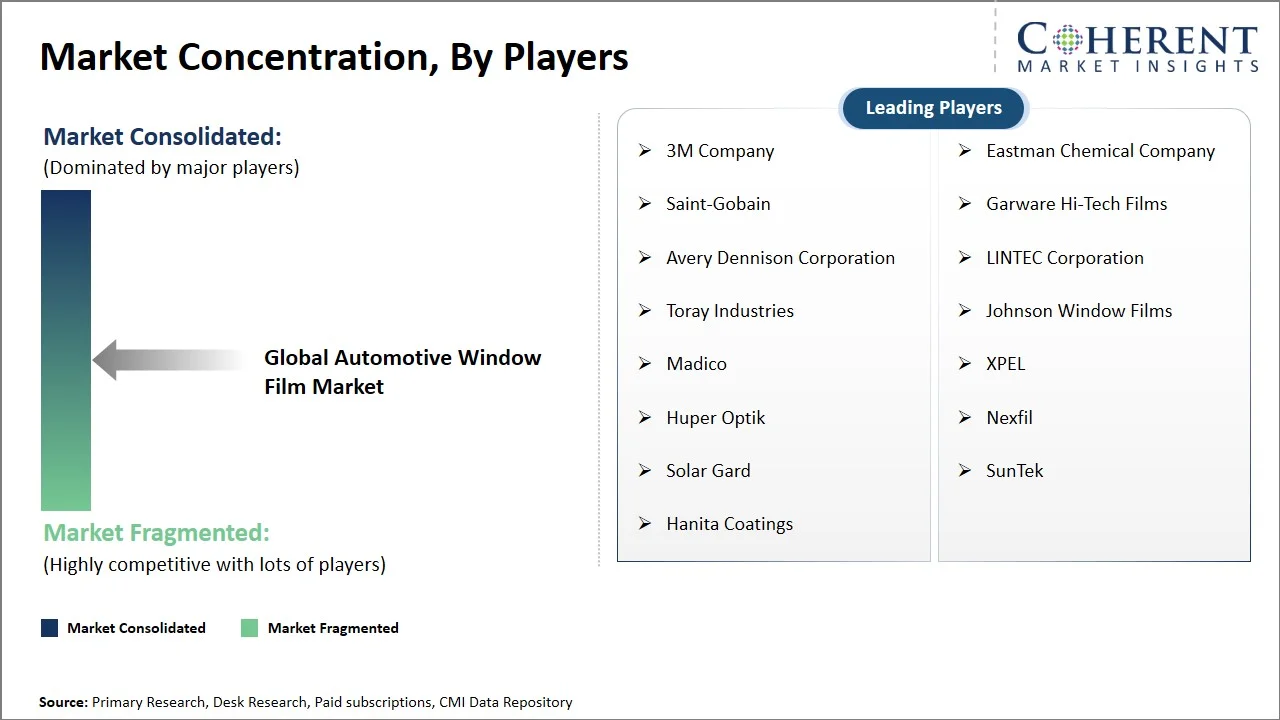
The competitive landscape is led by 3M Company, Eastman Chemical Company, and XPEL, Inc. 3M emphasizes ceramic technology, professional installation, and signal-compatible films. Its Ceramic IR Series offers up to 95% infrared rejection and 99.9% ultraviolet rejection. Eastman Chemical Company operates brands including LLumar, SunTek, Hüper Optik, Gila, and V-KOOL. Its line is aimed at diverse performance and pricing needs including ceramic and infrared rejecting goods. XPEL, Inc. is focused on installer connections, dealership penetration, worldwide distribution, and premium PRIME window films. It bought distributors in India, Thailand, Japan and China to boost direct access to the region. Avery Dennison Corporation, Garware Hi-Tech Films Limited, Madico, Inc., and LINTEC Corporation compete through specialized film constructions and established applicator networks.
Market Report Scope
Automotive Window Film Market Report Coverage
| Report Coverage | Details | ||
|---|---|---|---|
| Base Year: | 2025 | Market Size in 2026: | USD 9.85 Bn |
| Historical Data for: | 2020 To 2024 | Forecast Period: | 2026 To 2033 |
| Forecast Period 2026 to 2033 CAGR: | 7.3% | 2033 Value Projection: | USD 17.40 Bn |
| Geographies covered: |
| ||
| Segments covered: |
| ||
| Companies covered: | 3M Company, Eastman Chemical Company, Saint-Gobain, Garware Hi-Tech Films, Avery Dennison Corporation, LINTEC Corporation, Toray Industries, Johnson Window Films, Madico, XPEL, Huper Optik, Nexfil, Solar Gard, SunTek, Hanita Coatings | ||
| Growth Drivers: |
| ||
| Restraints & Challenges: |
| ||
Analyst Opinion (Expert Opinion)
- The industry's future will increasingly center on ceramic and nano-ceramic films rather than conventional dyed products. High infrared rejection without metallic construction will become particularly valuable in connected vehicles. 3M already demonstrates this direction through metal-free ceramic technology supporting 5G, GPS, and satellite connectivity. Premium films should therefore gain stronger positioning where thermal comfort and electronic compatibility matter simultaneously.
- The strongest opportunities should emerge around electric vehicles, large-glass vehicles, and hot-climate passenger cars. India, China, Southeast Asia, and southern U.S. states offer particularly attractive application conditions. India deserves specific attention because strong solar exposure combines with stringent tinting requirements. Therefore, focus should be placed on development of products with high visible light transmittance and infrared rejection.
- Leading firms should strengthen installation ecosystems, and improve film performance and regional product conformity. XPEL’s acquisitions in India, Japan, Thailand and China showcase the benefits of localized distribution management. Manufacturers should also develop products across several price tiers without compromising optical clarity. Strategic partnerships with vehicle dealerships could further increase factory-delivery and aftermarket conversion opportunities.
Speak to the analyst
Want personalized insights?
Take the findings above to one of our principal consultants, or have the report rebuilt around the segments, geographies and competitors you actually track.
Market Segmentation
- Material Insights (Revenue, USD Billion, 2021 - 2033)
- Polyester
- Polyethylene Terephthalate
- Thermoplastic Polyurethane
- Vehicle Type Insights (Revenue, USD Billion, 2021 - 2033)
- Passenger Cars
- Commercial Vehicles
- Film Type Insights (Revenue, USD Billion, 2021 - 2033)
- Dyed Window Films
- Metalized Window Films
- Ceramic Window Films
- Hybrid Window Films
- Carbon Window Films
- Function Type Insights (Revenue, USD Billion, 2021 - 2033)
- Heat Rejection Films
- Ultraviolet Protection Films
- Safety and Security Films
- Decorative Films
- Privacy Films
- Regional Insights (Revenue, USD Billion, 2021 - 2033)
- North America
- U.S.
- Canada
- Latin America
- Brazil
- Argentina
- Mexico
- Rest of Latin America
- Europe
- Germany
- U.K.
- Spain
- France
- Italy
- Russia
- Rest of Europe
- Asia Pacific
- China
- India
- Japan
- Australia
- South Korea
- ASEAN
- Rest of Asia Pacific
- Middle East
- GCC Countries
- Israel
- Rest of Middle East
- Africa
- South Africa
- North Africa
- Central Africa
- North America
- Key Players Insights
- 3M Company
- Eastman Chemical Company
- Saint-Gobain
- Garware Hi-Tech Films
- Avery Dennison Corporation
- LINTEC Corporation
- Toray Industries
- Johnson Window Films
- Madico
- XPEL
- Huper Optik
- Nexfil
- Solar Gard
- SunTek
- Hanita Coatings
Sources
Primary Research Interviews
- Automotive Window Film Manufacturers
- Automotive OEM Representatives
- Automotive Aftermarket Distributors & Installers
- Regulatory & Compliance Experts (Automotive Safety Standards)
Magazines
- Window Film Magazine
- Automotive Body Repair News (ABRN)
- Professional Carwashing & Detailing Magazine
Journals
- Journal of Applied Polymer Science
- Journal of Coatings Technology and Research
- International Journal of Automotive Technology
Associations
- International Window Film Association (IWFA)
- Specialty Equipment Market Association (SEMA)
- Alliance for Automotive Innovation
- European Automobile Manufacturers' Association (ACEA)
Public Domain Sources
- U.S. Environmental Protection Agency (EPA) – Vehicle Regulations & Standards
- National Highway Traffic Safety Administration (NHTSA)
- European Commission – Automotive Regulatory Framework
- U.S. Department of Energy – Vehicle Technologies Office
Proprietary Elements
- CMI Data Analytics Tool
- Proprietary CMI Existing Repository of Information for Last 10 Years
Get access to 250+ pages report
Every segment, forecast, competitor profile and data table behind the analysis above — available for instant download.
- ESOMAR Member
- ISO 9001:2015 Certified
- D-U-N-S Registered
- GDPR & CCPA Compliant
Missing comfort of reading report in your local language? Find your preferred language:
Transform your Strategy with Exclusive Trending Reports
Frequently Asked Questions
The global automotive window film market is expected to stand at USD 9.85 Bn in 2026 and is expected to reach USD 17.40 Bn by 2033.
The CAGR of the global automotive window film market is projected to be 7.3% from 2026 to 2033.
Automotive window film is a thin material applied to vehicle glass for solar control, privacy, and ultraviolet protection.
Window films reduce ultraviolet exposure that can accelerate fading and deterioration of interior materials.
Visible light transmission requirements encourage development of lighter films with strong thermal rejection.
Metal-free ceramic technology avoids the signal interference concerns associated with certain metallic films.
Ceramic films can reduce solar heat loads without requiring metallic layers that may affect connectivity.