

Global Autonomous Bus Market Size and Forecast – 2026 To 2033
The global autonomous bus market is expected to grow from USD 2.80 Bn in 2026 to USD 16.00 Bn by 2033, registering a compound annual growth rate (CAGR) of 11% from 2026 to 2033. The global autonomous bus market is driven by advancements in artificial intelligence and vehicle perception. On August 25, 2025, AEye, Inc. announced a strategic partnership with Blue-Band LLC. This collaboration integrates AEye’s cutting-edge Apollo lidar technology with Blue-Band’s advanced Integrator-AI platform as part of the recently unveiled OPTIS initiative.
Key Takeaways of the Global Autonomous Bus Market
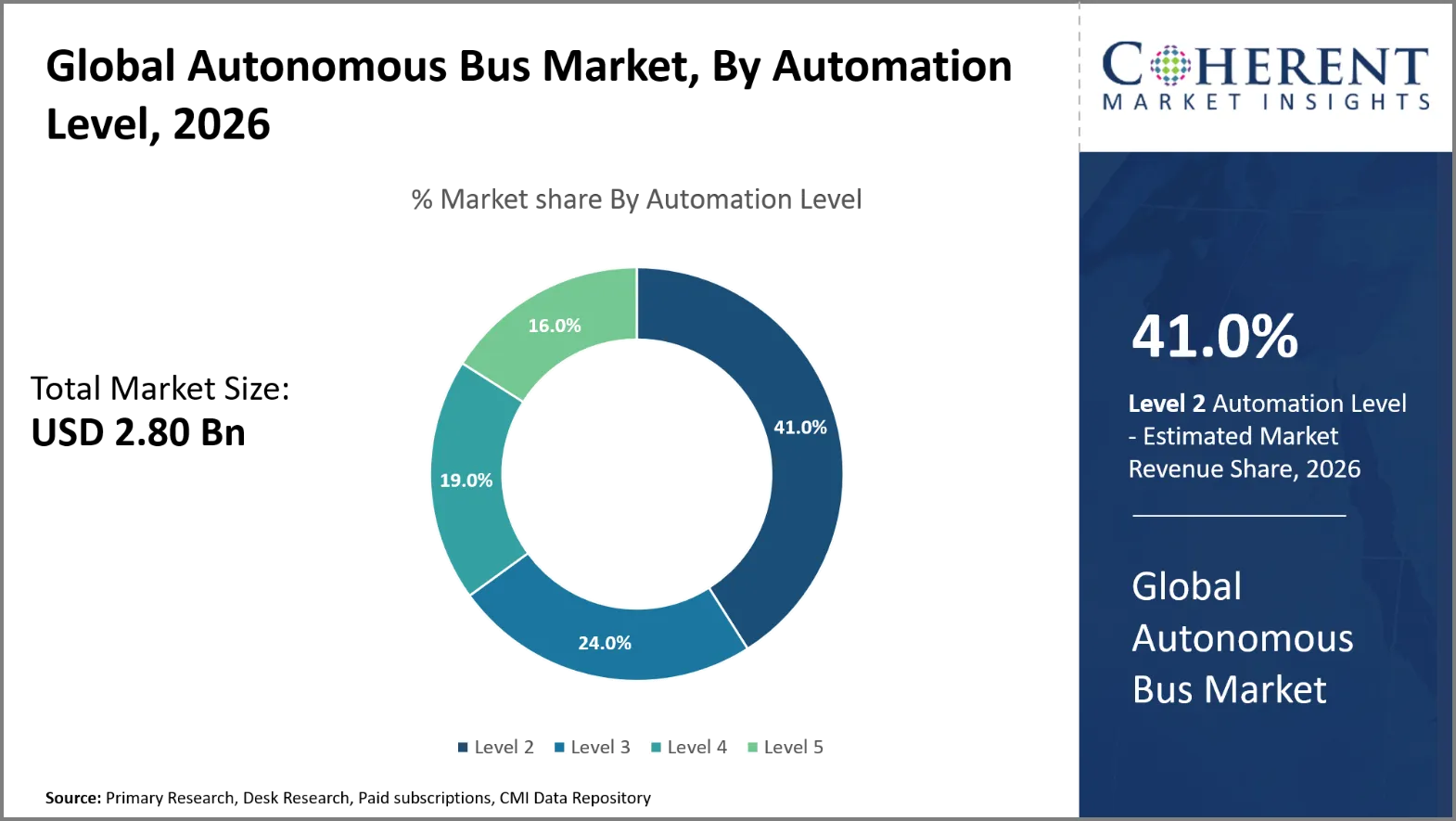
- The Level 2 segment is expected to account for 41.0% of the global autonomous bus market share in 2026. Expansion of electric public transportation fleets is driving the growth of the segment. On September 11, 2025, The International Finance Corporation announced USD 137 million in financing for JBM ECOLIFE and GreenCell Mobility. The projects aim to deploy 4,000 electric buses and associated charging stations across 39 municipalities in India.
- The Hardware segment is estimated to capture 53.0% of the market share in 2026. Growing integration of smart city transportation is majorly driving the growth of the segment. On July 8, 2025, Grab partnered with South Korean autonomous vehicle developer Autonomous A2Z to launch an electric shuttle pilot in Singapore.
- The Dedicated Routes segment is estimated to capture 48.0% of the market share in 2026. Driver shortages in public transportation is driving the growth of the segment. On December 23, 2025, Imagry announced a partnership with Toyota Tsusho Corporation to evaluate an autonomous public transportation platform in Japan. The planned pilot combines automated driving software, vehicle hardware, and operational support for a Level 4-ready bus.
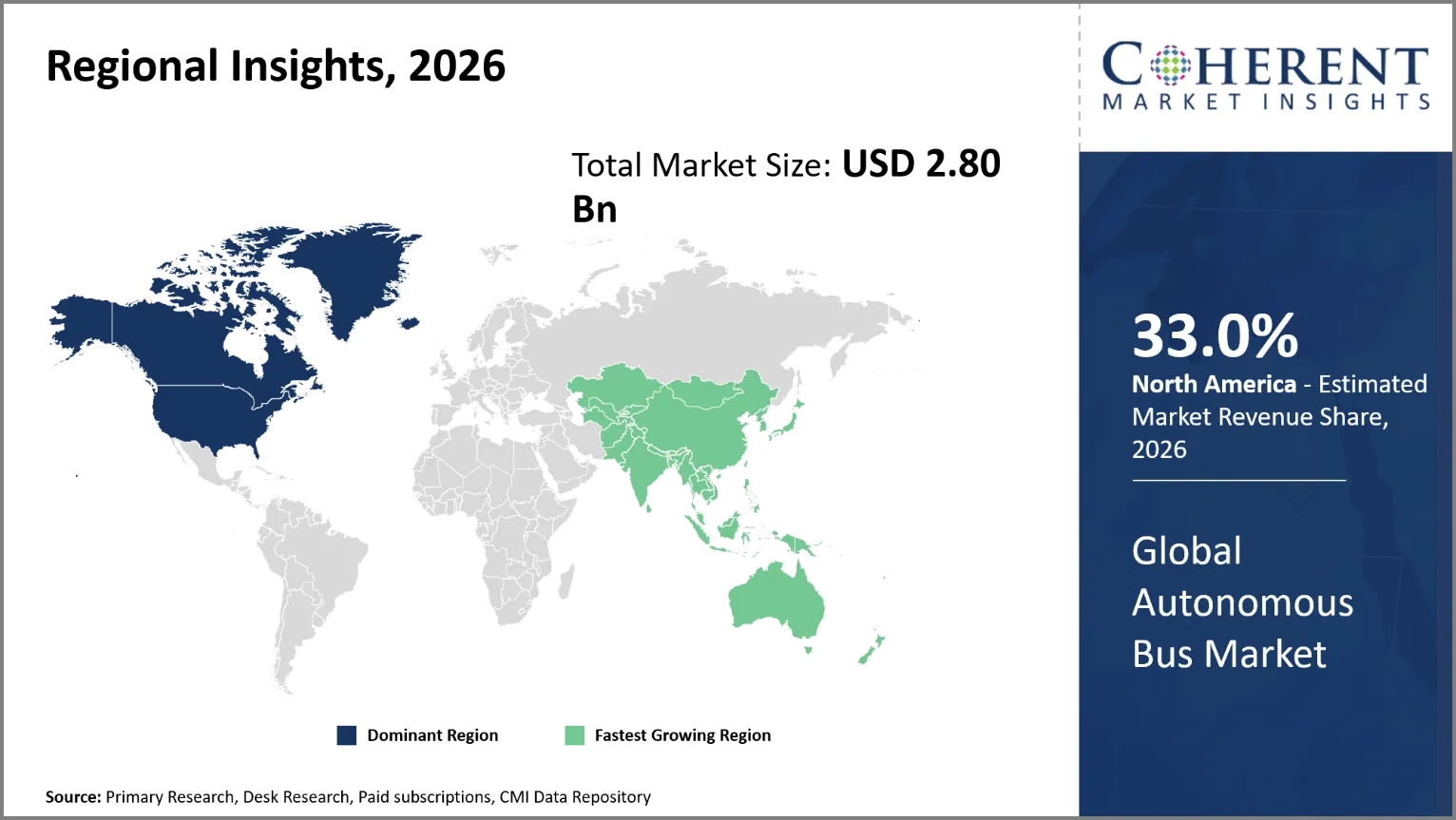
- North America is expected to dominate the autonomous bus market in 2026 with a market share of 33.0%. Expansion of electric autonomous bus fleets in North America is driving the growth of the regional market. On May 15, 2025, Capital Metropolitan Transportation Authority demonstrated a 40-foot automated battery-electric bus at its North Operations and Maintenance Facility in Austin, Texas, U.S.
- Asia Pacific is expected to account for 28.0% share in 2026. Growing emphasis on autonomous public transport in emerging economies in Asia Pacific is driving the growth of the regional market. On August 13, 2025, The Indian Institute of Technology, Hyderabad, introduced daily driverless electric bus services developed by its Technology Innovation Hub on Autonomous Navigation. The campus operated six-seat and fourteen-seat vehicles equipped with Autonomous Emergency Braking and Adaptive Cruise Control.
Segmental Insights
Why Does Level 2 Dominate the Global Autonomous Bus Market?
The level 2 segment is expected to account for 41.0% of the global autonomous bus market share in 2026. Level 2 automation remains attractive because it combines automated driving functions with human supervision. The system supports steering, acceleration, braking, and lane keeping under defined operating conditions. Human drivers remain responsible for monitoring traffic and intervening when necessary. This approach allows public transport operators to introduce automation without immediately adopting fully driverless operations. Existing vehicle platforms can also accommodate selected automation technologies, reducing implementation complexity. Demonstrations by manufacturers and transport authorities continue to evaluate these capabilities under real-world conditions.
On October 2, 2025, Daimler Buses announced enhanced safety systems for Mercedes-Benz and Setra buses, scheduled from the first quarter of 2026. The package includes Attention Assist 2, which uses a driver-facing camera to identify fatigue and distraction. The Active Brake Assist 6 Plus system can automatically apply emergency braking in specified situations.
- Current Industry Events of 2026
- Market Size Estimation
- Regional Breakdown
- Competitive Landscape
- Customer Intelligence
- Segmental Analysis
- Pricing Analysis
- Key Market Drivers, Challenges & Future Trends
- Customized Insights Section
Why is Hardware the Most Crucial Component?
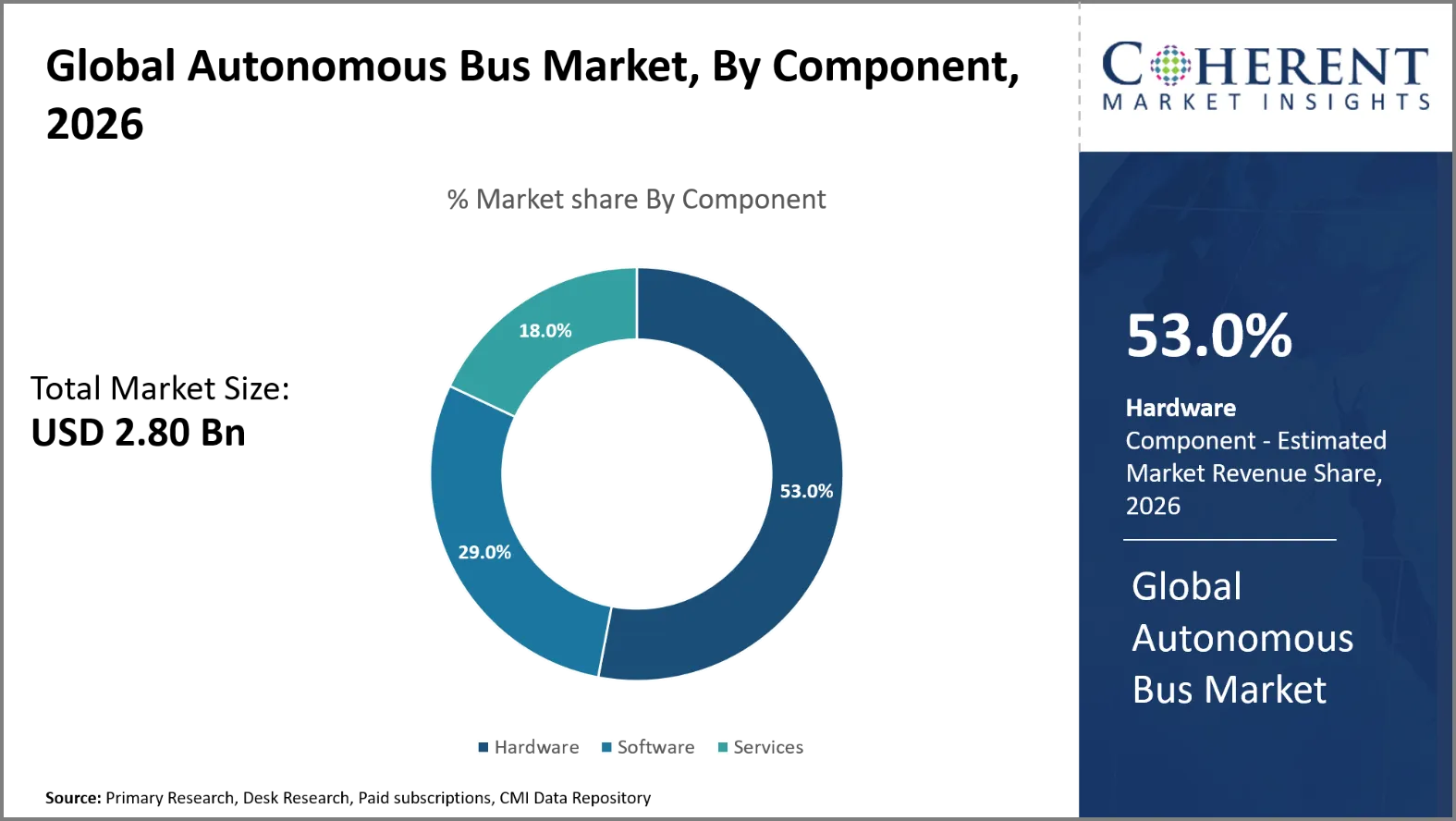
The hardware segment is expected to account for 53.0% of the global autonomous bus market share in 2026. Hardware is crucial because autonomous buses depend on physical sensing and vehicle-control systems to interpret surroundings and execute driving decisions. Light Detection and Ranging sensors, radar, cameras, and positioning systems help detect obstacles, identify road markings, and estimate vehicle location. Electronic control units process sensor inputs and coordinate steering, acceleration, and braking functions. Reliable hardware integration is essential for consistent performance in changing traffic and weather conditions. Maintenance, sensor calibration, and system redundancy also influence operational safety and fleet reliability.
On May 13, 2025, Innoviz Technologies announced accelerated delivery of its InnovizTwo LiDAR platform for Volkswagen Autonomous Mobility's ID: Buzz autonomous shuttles. Each vehicle was planned to integrate nine LiDAR units for comprehensive environmental sensing. The configuration supports object detection and navigation in complex urban environments.
Dedicated Routes Dominates the Global Autonomous Bus Market
The dedicated routes segment is expected to account for 48.0% of the global autonomous bus market share in 2026. Dedicated routes support autonomous bus deployment by providing predictable operating conditions and clearly defined travel paths. These routes simplify navigation, reduce exposure to unexpected traffic interactions, and facilitate repeated testing. Transport authorities can evaluate vehicle performance, passenger boarding, stopping accuracy, and remote supervision more systematically. Short, established routes also help operators identify technical limitations before expanding services. Singapore's Land Transport Authority selected relatively short routes for its autonomous bus pilot. This approach demonstrates how controlled route selection can support gradual deployment and operational validation.
On September 20, 2025, Singapore's Land Transport Authority announced three planned autonomous shuttle routes in Punggol. Grab and WeRide will operate two routes, while ComfortDelGro and Pony.ai will operate the third. The proposed routes span approximately 10 to 12 kilometers, connecting residential neighborhoods with clinics, markets, transport hubs, and community facilities.
Current Events and their Impact
Current Events | Description and its Impact |
United Nations Economic Commission for Europe. Global Automated Driving System Regulation, 2026 |
|
U.K. - Automated Vehicles Act 2024 |
|
Autonomous Bus Market Dynamics
Market Driver
Investment in autonomous public transportation
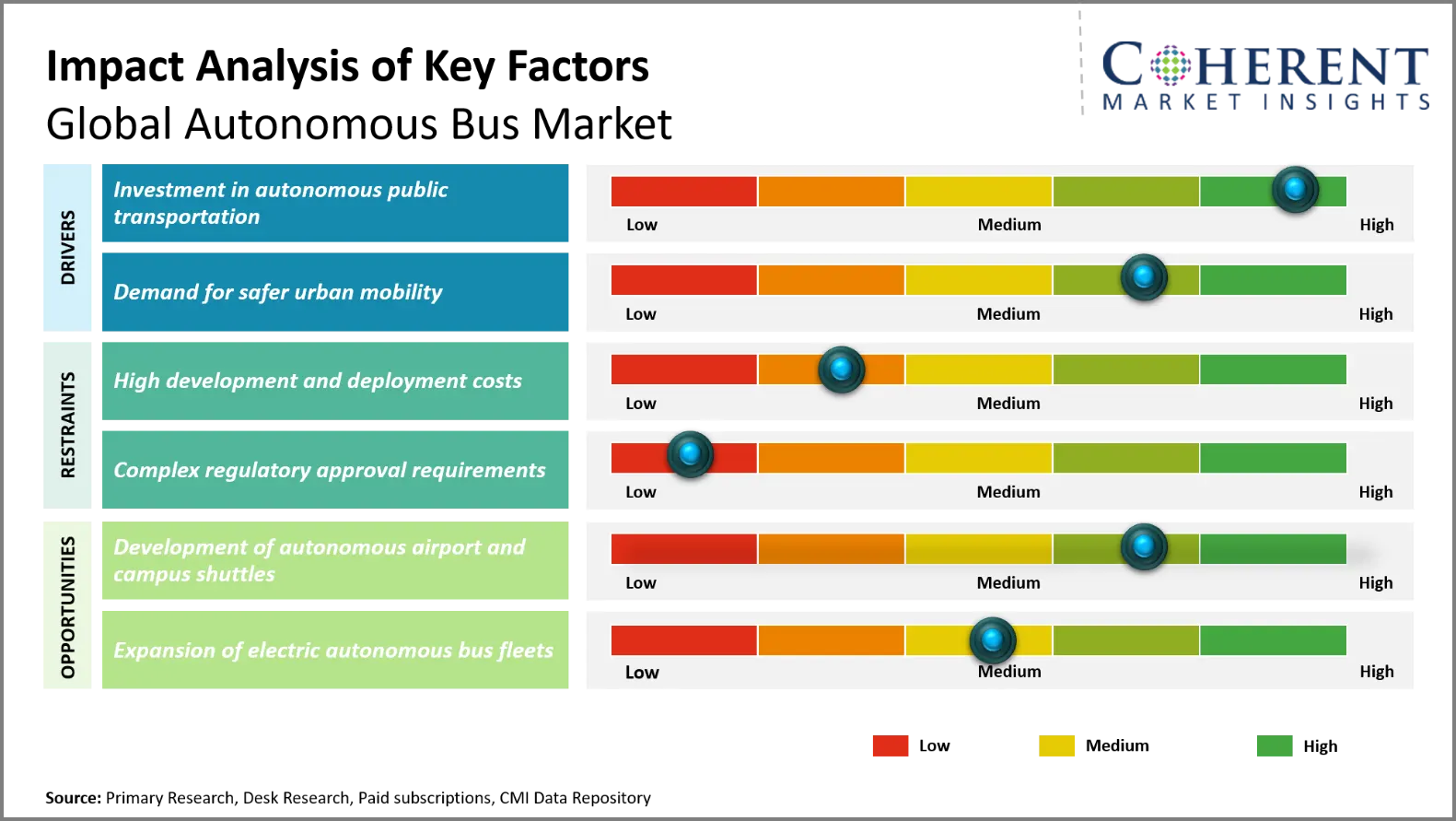
Investment in autonomous public transportation is supporting the development of driverless buses, intelligent transport infrastructure, and automated fleet management systems. Governments and transport operators are funding pilot programs to improve service efficiency and explore alternatives to conventional bus operations. Investments in sensors, onboard computing, vehicle connectivity, and charging infrastructure are also supporting autonomous electric bus deployments. Public-private partnerships enable technology developers and transit authorities to share development costs and operational responsibilities. These investments are creating opportunities for manufacturers offering autonomous driving systems, fleet monitoring platforms, and dedicated-route transportation solutions.
On July 1, 2025, Beep, Inc., a leading provider of autonomous shared mobility solutions, announced it has begun operating the Jacksonville Transportation Authority's autonomous vehicle service, NAVI. Backed by a five-year O&M contract, Beep will operate and maintain the NAVI service, which is part of the JTA's groundbreaking Ultimate Urban Circulator program.
Demand for safer urban mobility
Demand for safer urban mobility is encouraging cities to evaluate autonomous bus technologies that support consistent vehicle control and continuous environmental monitoring. Cameras, radar, and Light Detection and Ranging sensors help automated systems detect pedestrians, cyclists, vehicles, and roadside obstacles. Automated braking and collision-warning functions can support safer driving when implemented within validated operating conditions. Public transport authorities are assessing these technologies to address road safety concerns and improve service reliability. However, autonomous buses require rigorous testing, cybersecurity safeguards, and appropriate operational supervision before widespread deployment.
On October 6, 2025, Gauzy Ltd. unveiled its next-generation Smart-Vision Camera Monitor System (CMS) for the bus and coach market at Busworld 2025, the world’s premier bus and coach exhibition. Gauzy’s next-generation AI-powered Smart-Vision CMS delivers real-time object detection, adaptive overlays, and advanced driver assistance functions with industry-leading AI performance per watt, low latency, and superior image quality.
Emerging Trends
- Artificial Intelligence-Enabled Autonomous Driving: Manufacturers are integrating artificial intelligence, sensor fusion, and advanced perception software into autonomous buses. These technologies help vehicles interpret complex traffic environments, identify vulnerable road users, and improve navigation decisions. Continued development focuses on reliable performance across changing weather and road conditions.
- Expansion of Dedicated-Route Autonomous Services: Transport authorities are deploying autonomous buses on university campuses, airports, business parks, and designated urban corridors. Predictable routes simplify navigation, enable controlled testing, and support operational monitoring. Successful deployments can help operators gradually expand services into more complex public-road environments.
- Integration of Autonomous and Electric Bus Technologies: Manufacturers are combining autonomous driving systems with battery-electric bus platforms to support automated, low-emission public transportation. Integrated vehicle management systems can coordinate energy consumption, charging schedules, route planning, and fleet operations. This convergence encourages investment in smart charging infrastructure and digitally managed transit fleets.
- Remote Fleet Supervision and Vehicle Connectivity: Autonomous bus operators are adopting remote monitoring platforms to track vehicle health, route performance, passenger operations, and potential safety incidents. Vehicle-to-infrastructure communication can provide additional information about traffic signals and road conditions. These capabilities support fleet coordination, maintenance planning, and emergency response procedures.
Regional Insights
Why is North America a Strong Market for Autonomous Bus?
North America is expected to account for a market share of 33.0% in 2026. North America is advancing autonomous bus technology through transit-agency demonstrations, depot automation, and first-mile connectivity projects. In Austin, Texas, Capital Metropolitan Transportation Authority demonstrated a 40-foot automated battery-electric bus in May 2025. The vehicle navigated an active maintenance depot, avoided unexpected obstacles, and positioned itself beneath charging equipment. This application highlights an important regional growth factor: automating repetitive depot movements and charging operations before introducing driverless buses into complex traffic. In Jacksonville, Florida, the Jacksonville Transportation Authority launched its NAVI autonomous transportation service in June 2025. The region's development combines transit infrastructure modernization, electric fleet integration, and practical operational testing.
Why Does Asia Pacific Autonomous Bus Market Exhibit High Growth?
Asia Pacific is expected to register the fastest growth with a CAGR of 11.6% over the forecast period. Asia Pacific is projected to account for 28.0% of the global autonomous bus market in 2026. Asia Pacific is developing autonomous bus services through government-backed smart mobility programs, domestic vehicle manufacturing, and integrated transport infrastructure. China is advancing Level 4 bus trials, while Japan is introducing approved autonomous services to address public transport accessibility. Singapore is preparing autonomous buses for established public bus routes, with real-time monitoring and phased safety supervision. These developments reflect distinct deployment models across the region. China benefits from large-scale intelligent vehicle development, Japan emphasizes mobility access amid driver shortages, and Singapore prioritizes carefully supervised integration into existing transit networks. Government involvement in route approvals, testing facilities, and operating procedures continues to shape commercial adoption.
Global Autonomous Bus Market Outlook for Key Countries
Why is U.S. Emerging as a Major Hub in the Autonomous Bus Market?
The U.S. autonomous bus market is gaining practical experience through public transit research and permanent autonomous passenger services. In Jacksonville, Florida, the Jacksonville Transportation Authority launched NAVI on June 30, 2025, as a revenue-generating autonomous transportation service. By June 2026, NAVI had transported more than 15,200 passengers and travelled over 61,000 miles in autonomous mode without an incident caused by its autonomous driving system. In Austin, Texas, Capital Metropolitan Transportation Authority demonstrated automated operation of a 40-foot electric bus inside an active depot. These projects highlight two distinct opportunities: passenger transportation and automated maintenance operations.
Is China the Next Growth Engine for the Autonomous Bus Market?
China is expanding autonomous bus deployment through municipal testing programs, intelligent connected vehicle infrastructure, and domestic technology suppliers. In Nanjing, the municipal government reported Level 4 autonomous bus testing in May 2025 across two routes measuring approximately 11 kilometers and six kilometers. The buses used radar and cameras to detect road users and respond to obstacles. Testing requirements included at least 1,000 kilometers or 240 hours of road testing before subsequent demonstration stages. China also benefits from companies developing autonomous driving hardware, software, and fleet management systems. This combination of local government support and domestic manufacturing strengthens opportunities for scalable autonomous public transportation.
Germany Autonomous Bus Market Analysis and Trends
Germany's autonomous bus market benefits from established automotive engineering capabilities and regulatory frameworks supporting automated vehicle development. The country is particularly relevant for testing automated public transport within structured urban mobility systems. Germany's Federal Ministry for Digital and Transport introduced the Act on Autonomous Driving in 2021, creating a legal framework for Level 4 vehicles in defined operating areas. This legislation supports the development of automated shuttle and bus services under approved conditions. German manufacturers and technology suppliers can apply expertise in vehicle safety engineering, electronic control systems, and industrial automation. These capabilities create opportunities for autonomous buses designed for controlled urban routes and scheduled public transport services.
Japan Autonomous Bus Market Analysis and Trends
Japan is advancing autonomous buses to address persistent driver shortages, rural transport accessibility, and the ageing population. In January 2026, the Ministry of Economy, Trade and Industry announced the start of commercial Level 4 autonomous mid-sized bus operations in Kashiwa, Chiba Prefecture. The service supports students, university employees, and visitors travelling to the University of Tokyo. Operators obtained the necessary permissions under the Road Transportation Act before beginning commercial operations. Japan's approach focuses on introducing autonomous services where conventional transport staffing is difficult. Rural communities, university campuses, and regional transport connections provide important opportunities for deployment and operational validation
Singapore Autonomous Bus Market Analysis and Trends
Singapore is developing autonomous buses through carefully controlled integration with established public transport services. In October 2025, the Land Transport Authority awarded an autonomous bus pilot contract to a consortium comprising MKX Technologies, Zhidao Network Technology, and BYD Singapore. The initial program covers six electric buses with 16 passenger seats, serving public bus routes 400 and 191. The three-year pilot includes real-time monitoring, onboard safety operators during initial operations, and potential progression to remote supervision. The authority may procure 14 additional buses following performance assessments. This approach creates opportunities for autonomous vehicle suppliers, fleet management providers, charging infrastructure companies, and public transport operators.
Global Autonomous Bus Market - Automation Level Distribution by Region, 2025-2026
Region | Level 2 | Level 3 | Level 4 | Level 5 |
North America | 45% | 15% | 40% | 0% |
Europe | 40% | 15% | 45% | 0% |
Asia Pacific | 55% | 15% | 30% | 0% |
Latin America | 65% | 15% | 20% | 0% |
Middle East and Africa | 60% | 15% | 25% | 0% |
How is Development of Autonomous Airport and Campus Shuttles Creating New Growth Opportunities in the Autonomous Bus Market?
The development of autonomous airport and campus shuttles is creating new growth opportunities by enabling transport operators to automate short, repetitive journeys within controlled environments. Airports can deploy autonomous shuttles for terminal connections, employee transportation, and parking transfers, reducing dependence on fixed driver availability. University campuses and technology parks offer similarly predictable routes connecting academic buildings, accommodation, laboratories, and transit stations. For example, Jacksonville Transportation Authority's NAVI service demonstrates autonomous passenger transportation in a defined urban operating environment. Singapore's autonomous bus pilots also illustrate how supervised deployment can progress toward broader public transport integration. These applications create demand for compact electric buses, precision navigation systems, remote fleet supervision, and dedicated charging infrastructure.
On July 11, 2025, Karsan delivered two Autonomous e-ATAK buses to Dutch operator DAM Shuttles. The buses began carrying passengers between Rotterdam Hague Airport's terminal and Meijersplein metro station. The project involves Rotterdam Hague Airport, Rotterdamse Elektrische Tram, the City of Rotterdam, and technology partners ADASTEC and Applied Autonomy.
Market Players, Key Development, and Competitive Landscape
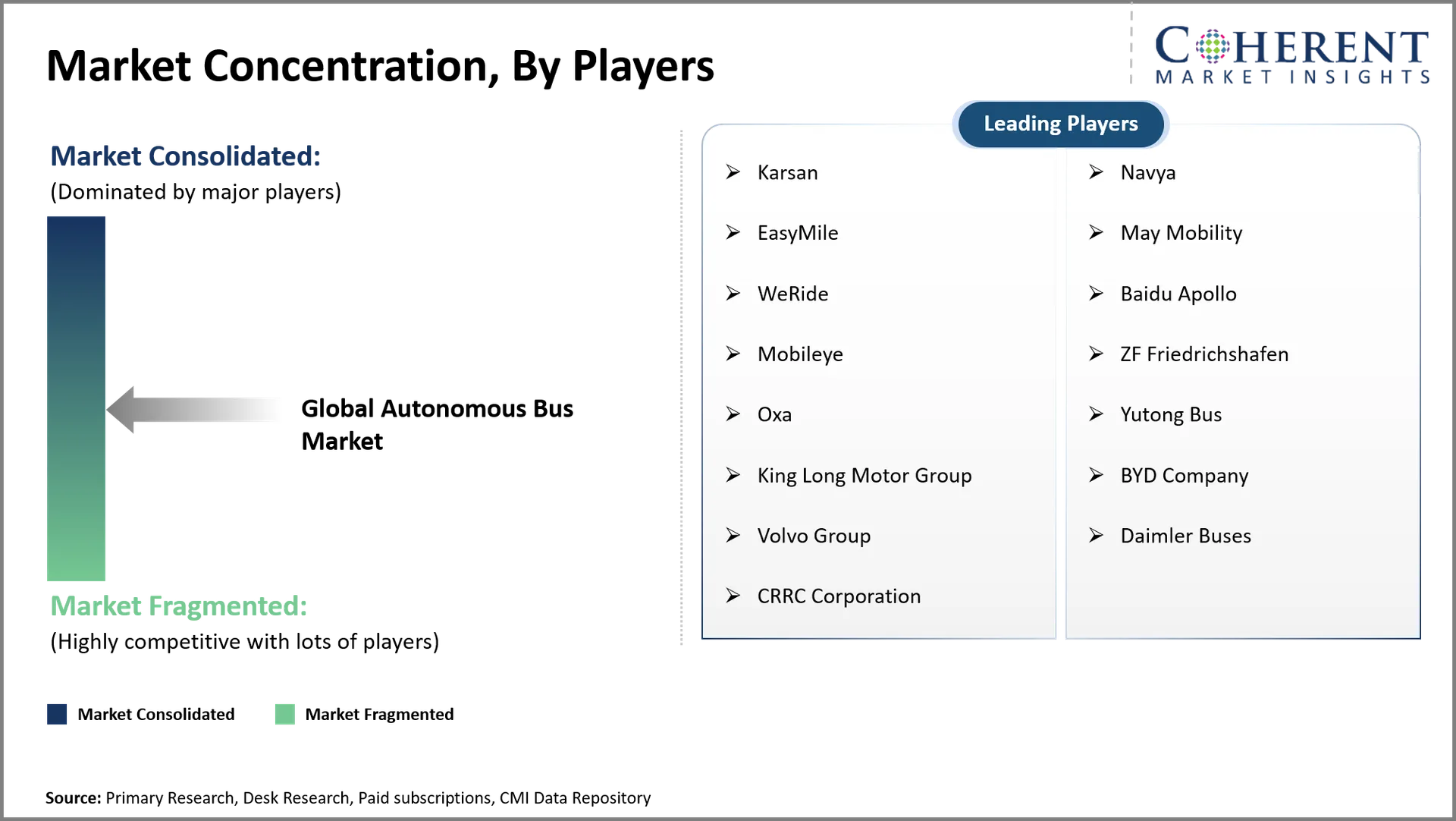
Key Developments
- On September 19, 2025, WeRide announced that its Robobus received Belgium's first federal test permit for a Level 4 autonomous shuttle. With this approval, WeRide becomes the only technology company in the world with products holding autonomous driving permits in seven countries: Belgium, China, France, the UAE, Saudi Arabia, Singapore, and the US.
- On November 28, 2024, Brussels Airport launched a pilot project to test the use of an electric, self-driving shuttle at the airport, a first for Belgium. The shuttle will operate entirely autonomously, transporting airport employees across the tarmac for a three-month trial period.
- On September 4, 2024, HOLON announced plans for an approximately 500,000-square-foot autonomous electric shuttle manufacturing facility in Jacksonville, Florida, U.S. The company expected construction completion in 2026, with initial production targeting that year.
Competitive Landscape
The global autonomous bus market features vehicle manufacturers, autonomous driving technology developers, and fleet integration specialists. Karsan is expanding its Level 4 portfolio through the Autonomous e-ATAK and Autonomous e-JEST, supported by technology partner ADASTEC. In June 2026, its Autonomous e-JEST began passenger operations on Atlanta's ATL Spoke route, connecting MARTA West End Station with the Atlanta Beltline Southwest Trail. WeRide is pursuing commercial deployments through its Robobus platform, including airport, resort, and urban shuttle applications. Singapore's autonomous bus program demonstrates the importance of partnerships. Zhidao Network Technology supplies autonomous driving hardware, software, and fleet management systems, while BYD Singapore supplies electric buses. These strategies highlight competition across vehicle design, automation software, operational integration, and deployment support.
Top Manufacturers and Notable Products in the Autonomous Bus Market
Manufacturer | Notable Product | Key features |
Karsan | Autonomous e-ATAK | Level 4 automation, LiDAR and radar sensing, RGB and thermal cameras, Global Navigation Satellite System positioning, 220 kWh battery, range up to 300 km |
WeRide | Robobus LCR 2.0 | Level 4 driverless technology, 360-degree perception, integrated hardware and software, high-performance computing platform, 10-seat capacity |
Yutong | Xiaoyu autonomous bus | Autonomous navigation, environmental sensing, electric powertrain, passenger shuttle applications, intelligent vehicle control |
Baidu | Apolong autonomous minibus | Driverless operation, artificial intelligence-based perception, integrated autonomous driving software, electric shuttle configuration |
HOLON | HOLON urban | Fully electric autonomous shuttle design, low-floor accessibility, modular interior, public transport and on-demand mobility applications |
Market Report Scope
Report Coverage | Details | ||
Base Year | 2025 | Market Size in 2026: | USD 2.80 Bn |
Historical Data For: | 2020 To 2024 | Forecast Period: | 2026 To 2033 |
Forecast Period 2026 To 2033 CAGR: | 11% | 2033 Value Projection: | USD 16.00 Bn |
Geographies covered: |
| ||
Segments covered: |
| ||
Companies covered: | Karsan, Navya, EasyMile, May Mobility, WeRide, Baidu Apollo, Mobileye, ZF Friedrichshafen, Oxa, Yutong Bus, King Long Motor Group, BYD Company, Volvo Group, Daimler Buses, CRRC Corporation | ||
Growth Drivers: |
| ||
Restraints & Challenges: |
| ||
Analyst Opinion (Expert Opinion)
- The future of the autonomous bus industry will depend on commercially reliable Level 4 systems operating within clearly defined service areas. Manufacturers should prioritize vehicles capable of navigating mixed traffic, stopping accurately, and handling passenger boarding safely. Karsan's Autonomous e-ATAK received German public-road testing approval in May 2025, illustrating the importance of regulatory validation. Electric minibuses and compact autonomous shuttles are well positioned for routes where conventional buses face staffing or scheduling constraints. Commercial success will increasingly depend on dependable operations, accessible vehicle designs, and manageable maintenance requirements.
- The strongest opportunities lie in airport transfers, university campuses, business parks, and selected urban bus routes. Airport operators can deploy autonomous shuttles between terminals, parking facilities, and nearby rail stations. Rotterdam The Hague Airport received two Autonomous e-ATAK buses for airport-to-metro connectivity in July 2025. Singapore offers another opportunity through established public bus services and structured regulatory supervision. China provides opportunities for suppliers combining domestic vehicle production with autonomous driving software. Compact vehicles should target short routes, while larger automated buses should address higher passenger demand on validated corridors.
- Market participants should differentiate themselves through operational reliability, local regulatory expertise, and integrated fleet support. Vehicle manufacturers should establish partnerships with transit operators, charging providers, and autonomous software specialists before pursuing large deployments. Technology suppliers should demonstrate safe obstacle handling, accurate docking, remote recovery, and reliable operation during communication interruptions. Companies entering Germany should prioritize approval requirements and documented safety validation. Suppliers targeting Singapore should support real-time monitoring, accessible boarding, and staged transitions from onboard supervision. Competitive advantage will increasingly come from proven service performance, transparent safety procedures, and lifecycle support rather than vehicle automation claims alone.
Speak to the analyst
Want personalized insights?
Take the findings above to one of our principal consultants, or have the report rebuilt around the segments, geographies and competitors you actually track.
Market Segmentation
- Automation Level Insights (Revenue, USD Billion, 2021 - 2033)
- Level 2
- Level 3
- Level 4
- Level 5
- Component Insights (Revenue, USD Billion, 2021 - 2033)
- Hardware
- Software
- Services
- Operating Environment Insights (Revenue, USD Billion, 2021 - 2033)
- Dedicated Routes
- Mixed Urban Traffic
- Controlled Environments
- Propulsion Type Insights (Revenue, USD Billion, 2021 - 2033)
- Battery Electric
- Hybrid Electric
- Internal Combustion Engine
- Application Insights (Revenue, USD Billion, 2021 - 2033)
- Public Transportation
- Airport Shuttles
- University and Corporate Campuses
- Tourist Transportation
- Industrial and Logistics Facilities
- Regional Insights (Revenue, USD Billion, 2021 - 2033)
- North America
- U.S.
- Canada
- Latin America
- Brazil
- Argentina
- Mexico
- Rest of Latin America
- Europe
- Germany
- U.K.
- Spain
- France
- Italy
- Russia
- Rest of Europe
- Asia Pacific
- China
- India
- Japan
- Australia
- South Korea
- ASEAN
- Rest of Asia Pacific
- Middle East
- GCC Countries
- Israel
- Rest of Middle East
- Africa
- South Africa
- North Africa
- Central Africa
- North America
- Key Players Insights
- Karsan
- Navya
- EasyMile
- May Mobility
- WeRide
- Baidu Apollo
- Mobileye
- ZF Friedrichshafen
- Oxa
- Yutong Bus
- King Long Motor Group
- BYD Company
- Volvo Group
- Daimler Buses
- CRRC Corporation
Sources
Primary Research Interviews
- Autonomous Bus Manufacturers & OEMs
- Public Transit Authorities & Fleet Operators
- Technology & Software Solution Providers (AI, Sensors, Connectivity)
- Government & Regulatory Bodies (Transportation Departments)
Magazines
- Automotive World Magazine
- Mass Transit Magazine
- Intelligent Transport Magazine
- Autonomous Vehicle International
Journals
- Journal of Intelligent Transportation Systems (Taylor & Francis)
- Transportation Research Part C: Emerging Technologies (Elsevier)
- IEEE Transactions on Intelligent Transportation Systems
Associations
- International Association of Public Transport (UITP)
- American Public Transportation Association (APTA)
- Society of Automotive Engineers (SAE International)
- European Automobile Manufacturers' Association (ACEA)
Public Domain Sources
- U.S. Department of Transportation (DOT) – Autonomous Vehicles Reports
- European Commission – Connected & Automated Mobility Publications
- International Energy Agency (IEA) – EV & Mobility Data
- World Economic Forum (WEF) – Future of Mobility Reports
Proprietary Elements
- CMI Data Analytics Tool
- Proprietary CMI Existing Repository of Information for Last 10 Years
Get access to 250+ pages report
Every segment, forecast, competitor profile and data table behind the analysis above — available for instant download.
- ESOMAR Member
- ISO 9001:2015 Certified
- D-U-N-S Registered
- GDPR & CCPA Compliant
Frequently Asked Questions
The global autonomous bus market is expected to stand at USD 2.80 Bn in 2026 and is expected to reach USD 16.00 Bn by 2033.
The CAGR of the global autonomous bus market is projected to be 11% from 2026 to 2033.
Investment in autonomous public transportation and Demand for safer urban mobility are the major factors driving the growth of the global autonomous bus market.
High development and deployment costs and Complex regulatory approval requirements are the major factors hampering the growth of the global autonomous bus market.
In terms of automation level, level 2 segment is estimated to dominate the market revenue share in 2026.
The global autonomous bus market comprises vehicles equipped with automated driving technologies for passenger transportation with varying levels of human supervision.
Light Detection and Ranging sensors generate three-dimensional environmental information that helps autonomous buses identify obstacles, estimate distances, and navigate surroundings.