

Global Autonomous Delivery Vehicles Market Size and Forecast – 2026 To 2033
The global autonomous delivery vehicles market is expected to grow from USD 3.80 Bn in 2026 to USD 18.00 Bn by 2033, registering a compound annual growth rate (CAGR) of 24.9% from 2026 to 2033. The global autonomous delivery vehicles market is driven by growing investments in autonomous last-mile logistics. On March 31, 2026, ALSO announced a partnership with DoorDash to accelerate autonomous delivery. Through a strategic investment and multi-year commercial collaboration, the companies will work together to deploy small, purpose-built EVs designed to optimize how goods move in dynamic, population-dense environments.
Key Takeaways of the Global Autonomous Delivery Vehicles Market
- The Short-Distance Delivery segment is expected to account for 47.0% of the global autonomous delivery vehicles market share in 2026. Increasing labor shortages in delivery operations is driving the growth of the segment. On January 30, 2025, Avride partnered with Grubhub to expand robotic food deliveries across American university campuses. Its initial deployment included 100 robots at The Ohio State University.
- The Sidewalks and Pedestrian Areas segment is estimated to capture 34.0% of the market share in 2026. Rising adoption of sidewalk delivery robots is majorly driving the growth of the segment. On May 19, 2025, LOMBY partnered with Seven-Eleven Japan and Suzuki Motor for outdoor autonomous deliveries. The trial began in the Minami-Osawa area of Hachioji, Tokyo, Japan.
- The Level 2 segment is estimated to capture 42.0% of the market share in 2026. Growing demand for cost-efficient urban logistics solutions is driving the growth of the segment. On March 30, 2026, Neolix announced plans to expand its RoboVan-as-a-Service operations across 50 Chinese cities. Its Qingdao operations had completed more than 1.5 million orders.
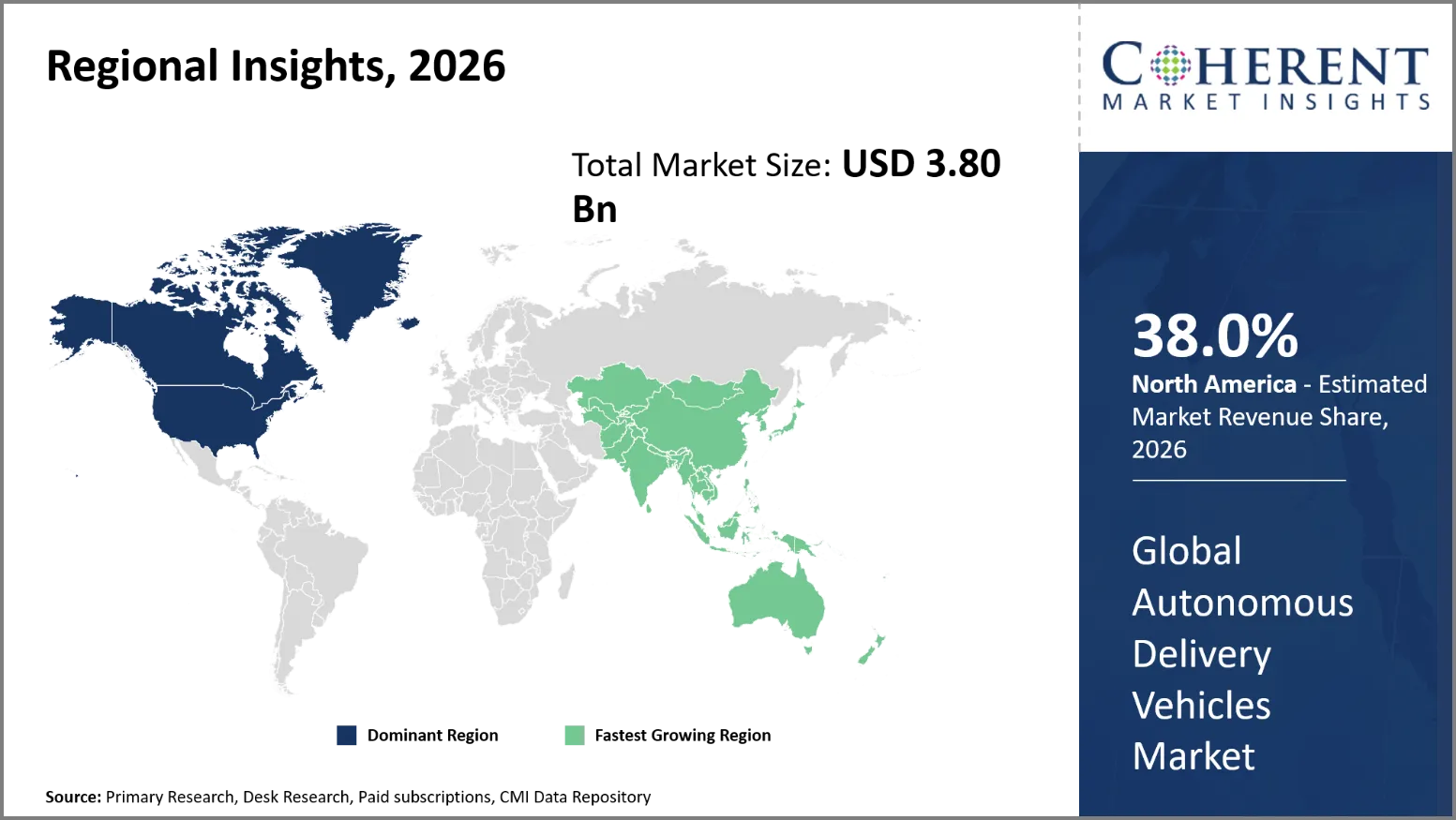
- North America is expected to dominate the autonomous delivery vehicles market in 2026 with a market share of 38.0%. Integration of AI-based navigation in North America is driving the growth of the regional market. On August 18, 2025, Serve Robotics acquired Vayu Robotics to accelerate end-to-end learned autonomy for last-mile delivery. The acquisition combines Serve's real-world sidewalk navigation datasets with Vayu's large-scale artificial intelligence models and simulation-powered data engine.
- Asia Pacific is expected to account for 33.0% share in 2026. Increasing deployment of autonomous delivery robots in Asia Pacific is driving the growth of the regional market. On August 24, 2026, Newbility began demonstrating its Neubi autonomous delivery robot in Tokyo's Sasazuka district through a partnership with Japanese delivery platform Demae-can.
Segmental Insights
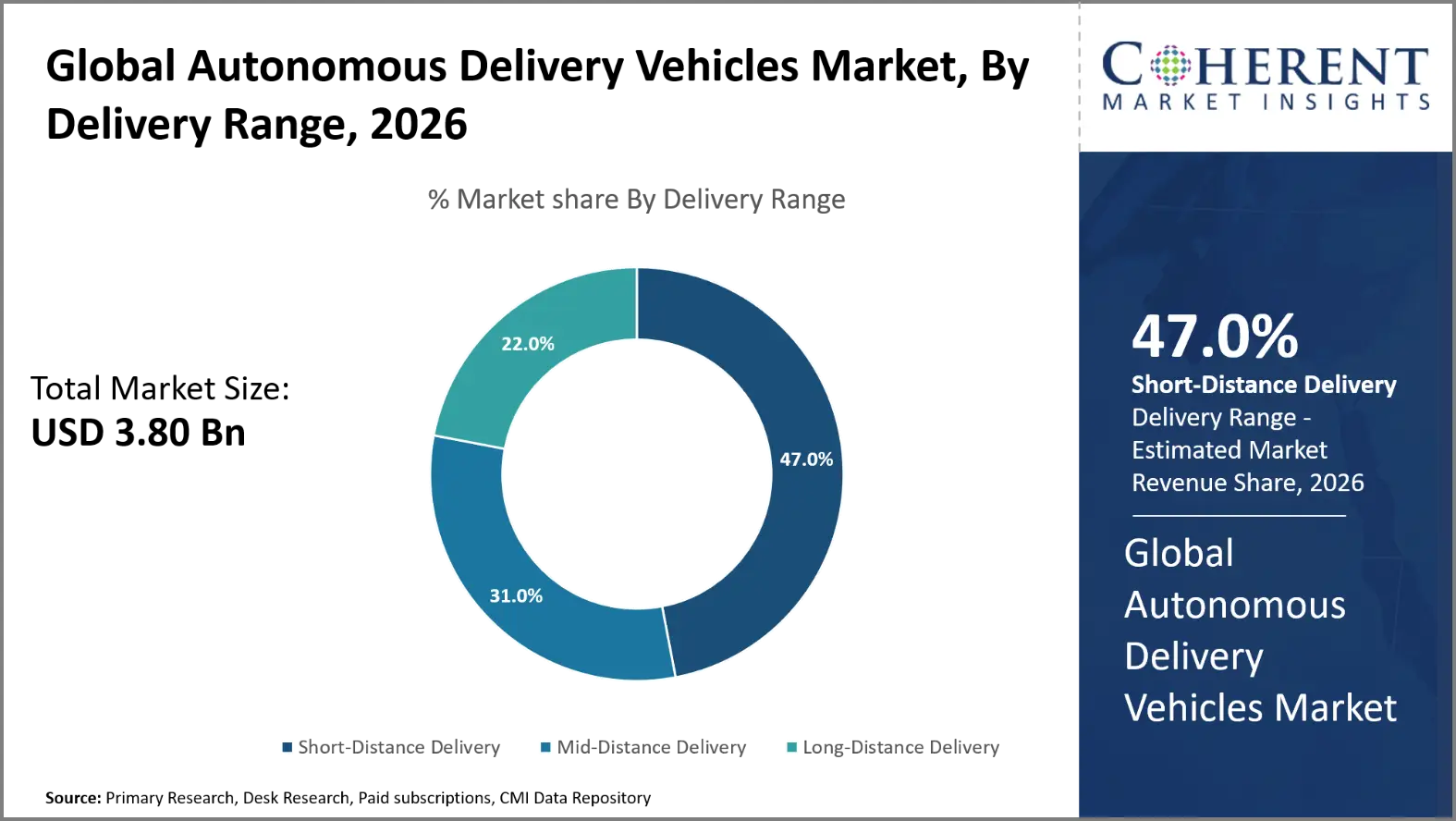
Why Does Short-Distance Delivery Dominate the Global Autonomous Delivery Vehicles Market?
The short-distance delivery segment is expected to account for 47.0% of the global autonomous delivery vehicles market share in 2026. Short-distance delivery prevails because autonomous vehicles are well suited to frequent, repeated last-mile transportation activities. Grocery orders, restaurant meals and retail items all demand fast delivery at the neighborhood level. Shorter routes make it easier to navigate, to manage the batteries, and to monitor operations. Businesses can deliver inside predictable delivery zones with tiny autonomous vehicles. These operations make distribution more consistent and lessen reliance on conventional delivery fleets. High frequency orders also result in more vehicle usage and route optimization. Consequently, short-distance logistics remains the primary commercial application for autonomous delivery vehicles.
On December 2, 2025, foodora announced it is launching a pilot project in Prague 8 to deliver hot food and grocery orders using robots. The project was developed in cooperation with Starship Technologies, the world’s leading provider of autonomous delivery services. Following a successful operational rollout in Sweden, foodora’s robotic delivery now makes its debut in Central Europe.
- Current Industry Events of 2026
- Market Size Estimation
- Regional Breakdown
- Competitive Landscape
- Customer Intelligence
- Segmental Analysis
- Pricing Analysis
- Key Market Drivers, Challenges & Future Trends
- Customized Insights Section
Why is Sidewalks and Pedestrian Areas the Most Crucial Operating Environment?
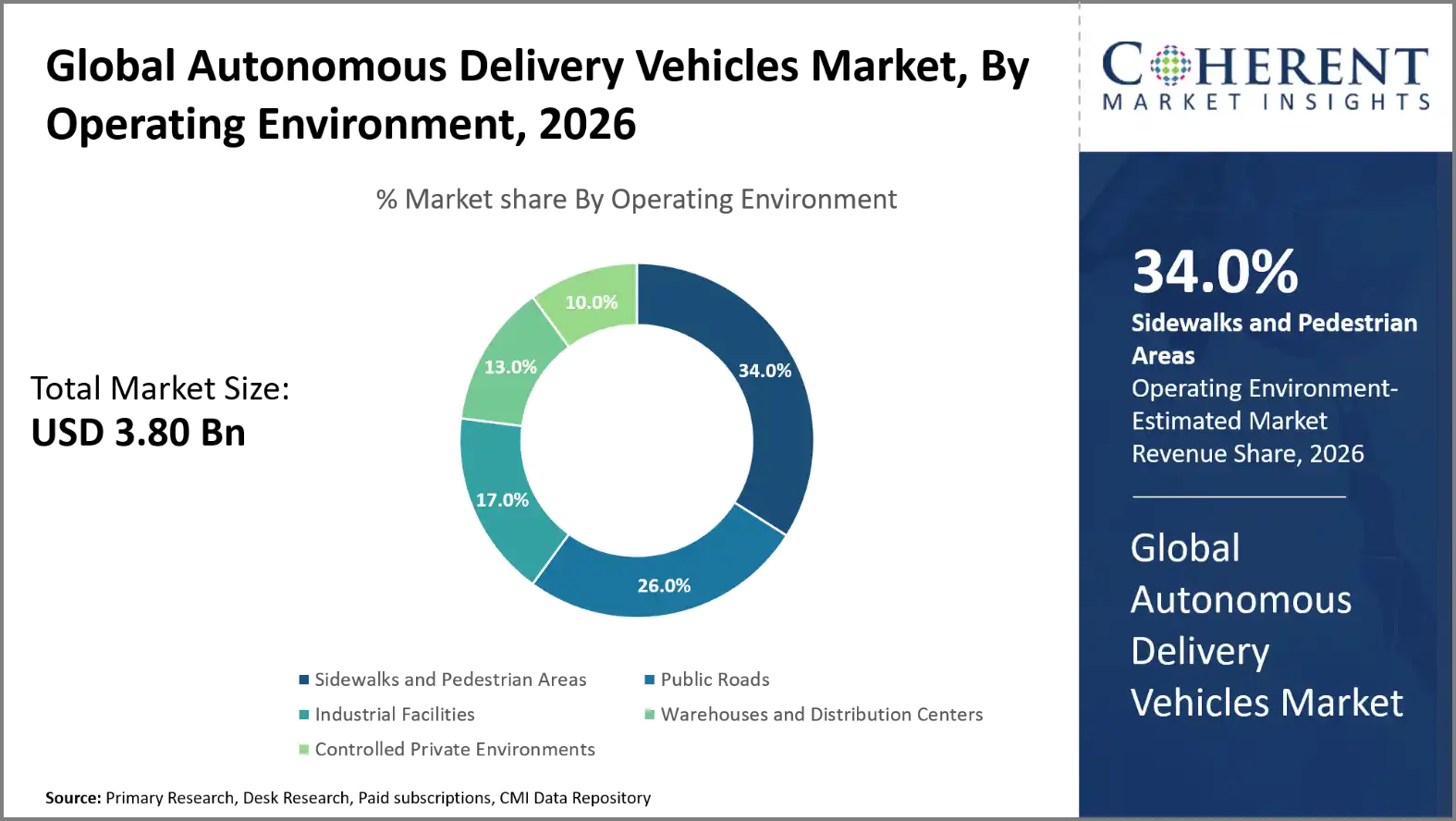
The sidewalks and pedestrian areas segment is expected to account for 34.0% of the global autonomous delivery vehicles market share in 2026. Sidewalks and pedestrian areas are crucial because they support direct access to residential buildings, campuses, and commercial establishments. Autonomous delivery robots can convey items while not using traditional road lanes. Their compact design makes it easy to travel on dedicated pedestrian paths. These environments also support localized delivery across university, office park, hospital and residential community settings. Operational safety is enhanced used geofencing, obstacle detection and pedestrian recognition. The growing number of deployments in regulated pedestrian areas increases the requirement for sidewalk-based autonomous delivery systems.
On May 29, 2025, Real Life Robotics and Skip combine to launch a three-month sidewalk delivery test in Markham, Ontario, Canada. Four supervised robots operated within a two-kilometer radius of participating restaurants. Customers could select robot delivery when ordering through Skip.
Level 2 Dominates the Global Autonomous Delivery Vehicles Market
The level 2 segment is expected to account for 42.0% of the global autonomous delivery vehicles market share in 2026. Level 2 autonomous delivery vehicles benefit from established automation technologies and comparatively manageable operational requirements. They incorporate automatic steering, acceleration and braking under predetermined operating circumstances. Human supervision is still required to monitor the vehicle’s performance and deal with tricky situations. This method allows logistics operators to implement automation more slowly. They can incorporate existing commercial sensors, cameras and advanced driver-assistance systems. Less technologically sophisticated, therefore more widely deployable across controlled delivery contexts. Therefore, Level 2 technologies provide a feasible stepping stone toward higher levels of vehicle autonomy.
On July 1, 2025, T2 Inc. commenced commercial operations using Level 2 autonomous trucks between Japan’s Kanto and Kansai regions. The trucks supported long-distance freight transportation along designated expressway sections.
Current Events and their Impact
Current Events | Description and its Impact |
France - Order of 28 July 2026 on autonomous delivery robot approval |
|
United Nations Economic Commission for Europe - Global Autonomous Driving Regulation, 2026 |
|
Autonomous Delivery Vehicles Market Dynamics
Market Drivers
Increasing demand for contactless delivery services
The deployment of autonomous delivery vehicles globally is fueled by the increasing demand for contactless delivery services. Consumers are now opting for convenient deliveries with less direct human contact. Customers can have their groceries, meals and retail items delivered by autonomous cars without the need for a traditional hand over. These trucks have secure compartments, computerized access codes and delivery notifications in real time. Healthcare facilities, residential communities and commercial campuses are all embracing contactless logistic solutions. Delivery companies are looking into autonomous fleets to improve the availability of service and operational effectiveness. Such progress is driving demand for autonomous last mile delivery options.
On June 26, 2025, DoorDash and Flytrex announced that they are launching their drone delivery service in the Dallas-Fort Worth metroplex after a successful pilot program. This is the first third-party app integration for Flytrex and will enable customers to order straight through the DoorDash app.
Rising e-commerce and online grocery delivery volumes
Increasing e-commerce and online grocery delivery volumes are driving demand for autonomous delivery vehicles. Effective last mile logistics are essential for online businesses to cope with numerous orders and tight delivery windows. Autonomous vehicles serving neighboring residential districts are very beneficial to grocery platforms. Compact delivery robots can deliver groceries, packaged food and critical household supplies in approved delivery zones. Higher order frequency also allows logistics companies to improve their fleet utilization. Companies are putting money on self-driving navigation, smart routing and automatic fleet management. The innovations are opening up business prospects for producers of autonomous delivery vehicles.
On November 4, 2025, The Kroger Co. and Instacart expanded their digital grocery delivery partnership. Instacart powered fulfillment for about 2,700 Kroger stores and over 20 retail banners. The companies have expanded their Express Delivery service to offer groceries in roughly 30 minutes.
Emerging Trends
- Integration of Artificial Intelligence and Advanced Autonomous Navigation: Artificial intelligence, computer vision, LiDAR and sensor fusion are increasingly being used in autonomous delivery vehicles to provide accurate navigation. These technologies improve obstacle identification, pedestrian recognition, route planning and autonomous decision making in complex urban delivery scenarios.
- Impact: Advanced navigation results in fewer delivery disruptions, higher pedestrian safety and improved operational reliability. Improved route optimization reduces energy consumption and boosts fleet productivity in high-delivery traffic zones.
- Relevance to the market: Companies such as Nuro and Serve Robotics are pushing the limits of autonomous navigation capabilities. Their solutions for smart delivery fleets operating in residential areas and pedestrian environments are proving to be of growing appeal to businesses.
- Expansion of Autonomous Delivery Robots Through Strategic Partnerships: Autonomous delivery companies are expanding their commercial deployment through partnerships with restaurants, grocery platforms, retailers, and logistics providers. These agreements expand client reach and build repeat delivery operations throughout metro markets.
- Impact: Strategic relationships boost growth in volumes delivered, enhance vehicle utilization and reduce client acquisition challenges. They also drive investment in fleet expansion, automated dispatch systems, and delivery infrastructure support.
- Relevance to the market: Starship Technologies is collaborating with academic campuses and food-service providers for robotic delivery. These implementations show the commercially viable operating settings that existing customer networks provide for autonomous delivery vehicles.
Regional Insights
Why is North America a Strong Market for Autonomous Delivery Vehicles?
North America is expected to account for a market share of 38.0% in 2026. Commercial alliances between autonomous robotics startups, food delivery platforms and established merchants are benefiting North America. In April 2025, DoorDash extended sidewalk robot deliveries with Coco Robotics in Los Angeles and Chicago. First, almost 600 merchants were involved in the integration. Serve Robotics also increased its distribution in major U.S. cities such as Miami, Atlanta and Dallas. Canada is also a great place for more prospects on academic campuses, controlled commercial districts and trials of automated logistics. Regional demand is fueled by restaurant delivery density, growing operating expenses for couriers and established digital ordering systems. Partnerships with existing delivery applications reduce customer acquisition barriers and accelerate commercial fleet utilization.
Why Does Asia Pacific Autonomous Delivery Vehicles Market Exhibit High Growth?
Asia Pacific is expected to register the fastest growth with a CAGR of 27.2% over the forecast period. The region is projected to account for 33.0% of the global autonomous delivery vehicles market in 2026 and has a strong smart-city infrastructure, a mature robotics manufacturing industry and huge urban logistics operations. China is showing that autonomous supermarket distribution and local delivery networks are commercially viable. Meituan stated it has made over five million autonomous vehicle deliveries by the end of 2024. Its vehicles covered a total of approximately 13 million kilometers over 340 testing and operating routes. As of September 2025, four businesses in Beijing operated 361 unmanned delivery vehicles. Japan is creating autonomous delivery options for communities that suffer from courier shortages. These developments support demand for compact delivery vehicles, automated dispatch platforms, and high-capacity unmanned logistics fleets.
Global Autonomous Delivery Vehicles Market Outlook for Key Countries
Why is U.S. Emerging as a Major Hub in the Autonomous Delivery Vehicles Market?
Existing food-delivery platforms, venture-backed robot startups and burgeoning commercial sidewalk operations exist in the U.S. market and are a great boost for autonomous delivery vehicles. In December 2025, Serve Robotics reported it has more than 2,000 deployed delivery robots. It launched in Los Angeles, Atlanta, Dallas-Fort Worth, Miami, Fort Lauderdale, Chicago and Alexandria. DoorDash launched its Dot automated delivery robot in September 2025. Dot can travel on roads, bike paths, sidewalks and driveways. Serve teamed up with DoorDash to provide robotic deliveries to restaurant ordering systems. These projects show the demand for delivery automation in a variety of metropolitan settings.
Is China the Next Growth Engine for the Autonomous Delivery Vehicles Market?
China has significant instant-commerce networks, builds its own AVs, and it has a large urban logistics infrastructure. As of December 2025, Meituan has executed over 5.5 million orders for outdoor full-scenario autonomous delivery. Its vehicles have logged over 19 million kilometers of autonomous driving. In September 2025, there were 361 unmanned delivery vehicles in Beijing, operated by Neolix, JD Logistics, Meituan and HoloMatic. Meituan also uses autonomous vehicles in its fast delivery dispatch system. This method helps coordinate human couriers with autonomous fleets in the periods of high demand. The vast retail distribution networks in China present new options for autonomous neighborhood replenishment.
Germany Autonomous Delivery Vehicles Market Analysis and Trends
Germany's strong automotive engineering base, supermarket logistics demands, and growing licenses for public-road deployment are fueling the country's autonomous delivery vehicle business. One major development took place in Regenstauf, Bavaria, in November 2026. Innok Robotics launched its autonomous INDUROS delivery robot on public roads between its headquarters and a local REWE supermarket. The deployment received approval involving Bavarian transport and economic authorities. This application showcases automated groceries replenishment between business facilities and retail shops. Germany’s existing retail networks present prospective operational settings for regular deliveries. Industrial automation experience also helps develop robust autonomous navigation and vehicle-control systems.
Japan Autonomous Delivery Vehicles Market Analysis and Trends
Japan’s autonomous delivery vehicle market benefits from an older population, difficulties accessing shopping in remote areas and continuous labor shortages in the logistics sector. In February 2025, the Ministry of Economy, Trade and Industry issued a dedicated roadmap for the introduction of autonomous delivery robots. The roadmap targets robots with better capacity for grocery, pharmacy, package and food-delivery applications. Japan has launched subsidy-backed demonstration projects for robots with enhanced delivery capabilities. Such efforts spur businesses to make vehicles beyond modest, low-speed sidewalk vehicles. Public implementation projects are focused on communities with limited retail access. Such applications give the opportunity for autonomous delivery systems to reach senior residents and underprivileged neighborhoods.
U.K. Autonomous Delivery Vehicles Market Analysis and Trends
The U.K. market benefits from established grocery relationships, concentrated residential delivery zones and increasing integration with internet food-ordering platforms. In 2018 Starship Technologies launched its first commercial grocery delivery service in Milton Keynes. It recorded about 9.6 million deliveries worldwide in 2025, based on its company-reported operational history. Starship Technologies and Uber Eats established a cooperation focused on the U.K. in November 2025. first deployment. Between them they envisage further European expansion in 2026. Milton Keynes also offers a proven operating environment for autonomous grocery delivery. These developments strengthen opportunities for automated residential deliveries and platform-integrated robotic logistics.
Global Autonomous Delivery Vehicles Market - Autonomous Delivery Vehicle Deployment by Application (2025-2026)
Application | Major Companies | Deployment Data and Operational Examples | Deployment Geography |
Restaurant and food delivery | Serve Robotics, Starship Technologies | 2,000+ sidewalk robots deployed and 4,500+ restaurant partners reported by Serve Robotics | U.S., including 20 cities and 110+ neighborhoods |
Grocery and retail delivery | Zipline, Starship Technologies | 2.5 million+ cumulative commercial deliveries reported by Zipline by July 2026 | U.S., Africa, and other international markets |
E-commerce and parcel delivery | Serve Robotics, Zipline | 2,000+ Serve Robotics sidewalk robots deployed, with small parcels and return logistics identified as expansion opportunities | 44 U.S. cities, 150+ neighbourhoods, and 14 states |
Healthcare and pharmaceutical delivery | Diligent Robotics, Zipline | 300,000+ Moxi pharmacy deliveries reported by Diligent Robotics in July 2025 and 5,000+ healthcare facilities served by Zipline in January 2026 | U.S. hospitals and healthcare facilities across four continents |
Industrial and commercial logistics | Aurora Innovation, McLane Company | 280,000+ autonomous miles and 1,400 loads completed during Aurora's supervised McLane pilot | Dallas–Houston corridor, Texas, U.S. |
How is Expansion of Autonomous Grocery Delivery Services Creating New Growth Opportunities in the Autonomous Delivery Vehicles Market?
Autonomous grocery delivery services are gaining traction, generating new growth prospects for merchants to automate order fulfillment at the neighborhood level and reach underserved residential regions. In October 2026, Just Eat also expanded its Starship Technologies relationship with Morrisons into Cambourne, delivering groceries autonomously to more than 12,000 homes. The rollout extended robot-based access to groceries to places where Just Eat did not yet deliver groceries. The same month, DoorDash and Coco Robotics launched DashMart deliveries to Los Angeles, Chicago and Miami. These improvements offer potential for manufacturers to introduce grocery-compatible robots, temperature-controlled compartments and retailer-integrated fleet management systems.
On June 17, 2025, H-E-B confirmed an autonomous grocery delivery pilot at its Mueller store in Austin, Texas. The program began in May 2025 through Favor, H-E-B's delivery application. Autonomous robots transported selected grocery orders to customers living approximately one mile away.
Market Players, Key Development, and Competitive Landscape
Key Developments
- On November 11, 2026, Arrive AI announced a strategic equity investment in Ottonomy, Inc. and a deployment agreement to extend autonomous ground robot delivery across Arrive AI partner sites. As part of the arrangement, up to 50 Ottonomy ground robots could be deployed, with potential for further deployments as the relationship continues to evolve.
- On April 23, 2026, Pudu Robotics, a world-leading provider of commercial service robotics, announced the completion of a new fundraising round of about USD 150 million. The funding has propelled the company’s valuation to above USD 1.5 billion, a strong vote of confidence from the capital market in Pudu’s technology limitations, commercial scalability, and worldwide leadership.
- On June 25, 2025, Cartken and Melco Mobility Solutions expand their strategic collaboration with an agreement for industrial logistics. As part of this collaboration, Melco Mobility Solutions has placed an order for approximately 100 AI-powered Cartken Hauler robots, which will be deployed throughout industrial locations in Japan.
Competitive Landscape
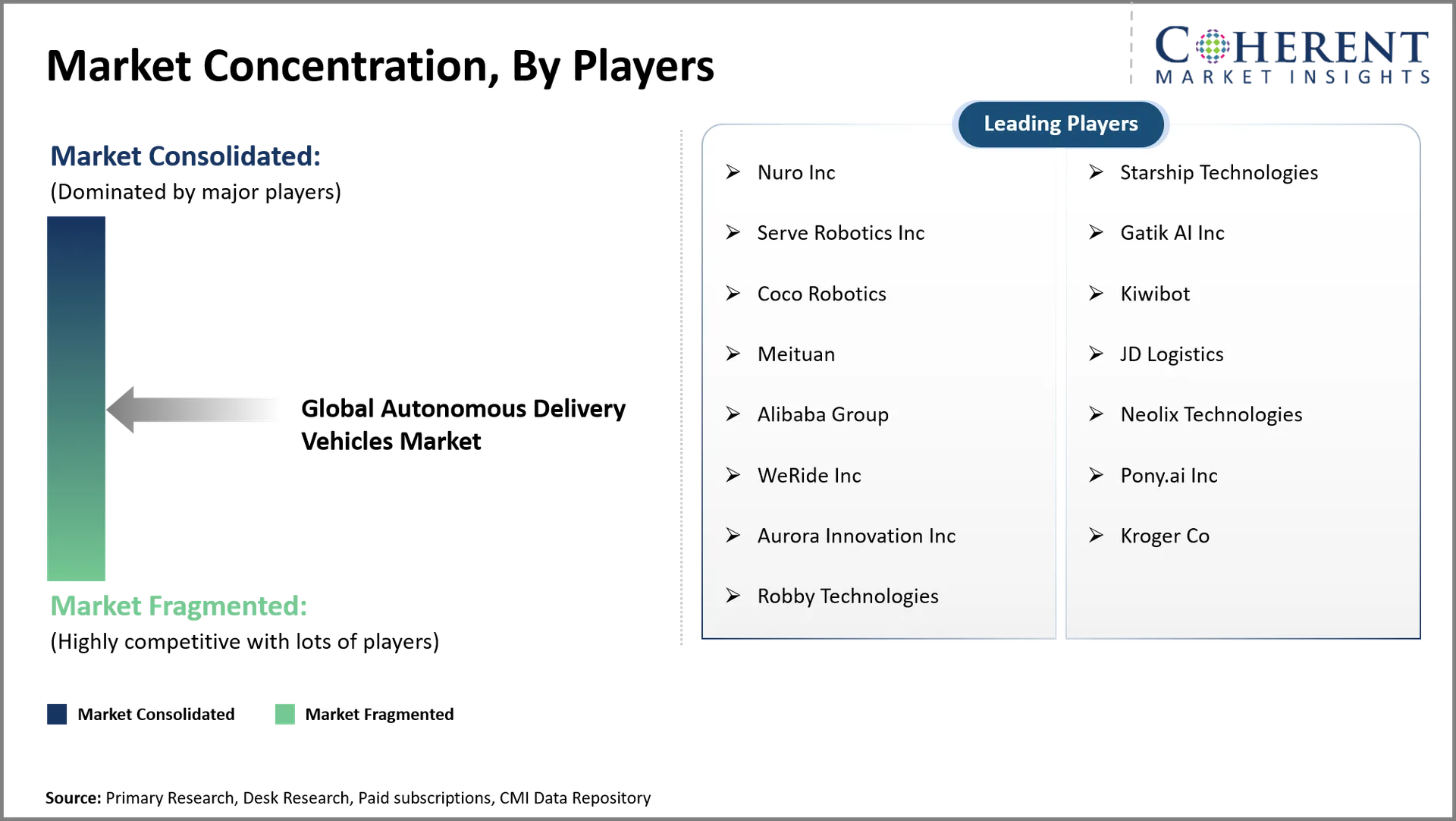
Globally, the autonomous delivery vehicles market competes in sidewalk robots, road-going delivery vehicles and autonomous logistics platforms. Serve Robotics is focused on commercial sidewalk fleets, artificial intelligence and multi-platform integration. By March 2026, it projected deploying 2,000 robots and partnering with Uber Eats and DoorDash. Starship Technologies is focused on supermarket delivery, campus logistics and worldwide expansion. Its agreement with Uber Eats in November 2025 was focused on installations across Europe and the U.S. Nuro concentrates on larger autonomous road vehicles and commercial logistical applications. Meituan is focusing on the integration of autonomous cars and its instant-commerce delivery network. Coco Robotics is focused on restaurant delivery and spatial artificial intelligence integration. These strategies demonstrate competition through fleet scalability, platform integration, proprietary navigation, and application diversification.
Top Manufacturers and Notable Products in the Autonomous Delivery Vehicles Market
Manufacturer | Notable Product | Key features |
Starship Technologies | Starship Delivery Robot | Level 4 autonomy, 10 kg payload, 12 cameras, ultrasonic sensors, radar, computer vision, GPS navigation, pedestrian detection, secure delivery compartments |
Serve Robotics | Serve Gen 3 | 23 kg payload, Ouster REV7 digital lidar, autonomous sidewalk navigation, obstacle detection, remote fleet supervision, electric operation |
Neolix Technologies | Xolra 3 | 520 kg payload, 3 m³ cargo volume, Level 4 autonomy, 12 HD cameras, lidar, 100–120 km range, swappable batteries, indoor and outdoor navigation |
Nuro, Inc. | Nuro R3 | 225 kg payload, 0.917 m³ cargo capacity, 360-degree sensor coverage, lidar, radar, cameras, thermal imaging, modular compartments, heating and cooling capabilities |
Coco Robotics | Coco 2 | 90-litre cargo volume, approximately 32 km range, 21 km/h maximum speed, NVIDIA Jetson Orin NX computing platform, autonomous navigation |
Autonomous Delivery Vehicles Market | |||
Report Coverage | Details | ||
Base Year | 2025 | Market Size in 2026: | USD 3.80 Bn |
Historical Data For: | 2020 To 2024 | Forecast Period: | 2026 To 2033 |
Forecast Period 2026 To 2033 CAGR: | 24.9% | 2033 Value Projection: | USD 18.00 Bn |
Geographies covered: |
| ||
Segments covered: |
| ||
Companies covered: | Nuro Inc, Starship Technologies, Serve Robotics Inc, Gatik AI Inc, Coco Robotics, Kiwibot, Meituan, JD Logistics, Alibaba Group, Neolix Technologies, WeRide Inc, Pony.ai Inc, Aurora Innovation Inc, Kroger Co, Robby Technologies | ||
Growth Drivers: |
| ||
Restraints & Challenges: |
| ||
Analyst Opinion (Expert Opinion)
- The future of the autonomous delivery vehicles industry will increasingly depend on commercially sustainable fleets rather than isolated technology demonstrations. Manufacturers will develop vehicles capable of operating across residential streets, shopping districts, and industrial premises. Multi-platform compatibility will become particularly important as retailers seek flexible delivery infrastructure. Companies combining autonomous navigation, remote supervision, and automated fleet maintenance will achieve stronger operational scalability. Indoor logistics and healthcare transportation will also create additional opportunities beyond conventional parcel delivery.
- The maximum opportunity will emerge in Level 4 sidewalk delivery robots and compact autonomous road vehicles. Grocery distribution, restaurant deliveries, pharmaceutical transportation, and industrial component movement offer attractive applications. In the U.S., opportunities exist in delivery platforms and commercial robot infrastructure. There is huge potential in China with instant-commerce ecosystems and indigenous manufacture of autonomous vehicles. Industrial logistics and labor-constrained delivery applications present promising opportunities in Germany and Japan. The manufacturer should be concentrating on producing cars for specific operational settings; not trying to produce all-purpose platforms.
- Players in the market should focus on unique navigation software, dependable obstacle detection and inexpensive maintenance. Partnerships with restaurant franchise, grocery chains and logistics firms can secure contracts for recurrent deliveries. Manufacturers should also design modular compartments for grocery, temperature-sensitive items and industrial components. Connecting fleet analytics with retailer ordering systems can increase vehicle use. Companies need to build local service networks and regulatory alliances before entering new cities. Delivery economics, vehicle durability and consistent performance in varying operational settings will become increasingly important for commercial success.
Speak to the analyst
Want personalized insights?
Take the findings above to one of our principal consultants, or have the report rebuilt around the segments, geographies and competitors you actually track.
Market Segmentation
- Delivery Range Insights (Revenue, USD Billion, 2021 - 2033)
- Short-Distance Delivery
- Mid-Distance Delivery
- Long-Distance Delivery
- Operating Environment Insights (Revenue, USD Billion, 2021 - 2033)
- Sidewalks and Pedestrian Areas
- Public Roads
- Industrial Facilities
- Warehouses and Distribution Centers
- Controlled Private Environments
- Autonomy Level Insights (Revenue, USD Billion, 2021 - 2033)
- Level 2
- Level 3
- Level 4
- Level 5
- Application Insights (Revenue, USD Billion, 2021 - 2033)
- Food and Beverage Delivery
- Grocery Delivery
- E-commerce Delivery
- Healthcare and Pharmaceutical Delivery
- Industrial Goods Delivery
- Parcel and Package Delivery
- Regional Insights (Revenue, USD Billion, 2021 - 2033)
- North America
- U.S.
- Canada
- Latin America
- Brazil
- Argentina
- Mexico
- Rest of Latin America
- Europe
- Germany
- U.K.
- Spain
- France
- Italy
- Russia
- Rest of Europe
- Asia Pacific
- China
- India
- Japan
- Australia
- South Korea
- ASEAN
- Rest of Asia Pacific
- Middle East
- GCC Countries
- Israel
- Rest of Middle East
- Africa
- South Africa
- North Africa
- Central Africa
- North America
- Key Players Insights
- Nuro Inc
- Starship Technologies
- Serve Robotics Inc
- Gatik AI Inc
- Coco Robotics
- Kiwibot
- Meituan
- JD Logistics
- Alibaba Group
- Neolix Technologies
- WeRide Inc
- Pony.ai Inc
- Aurora Innovation Inc
- Kroger Co
- Robby Technologies
Sources
Primary Research Interviews
- Autonomous Vehicle Manufacturers & OEMs
- Last-Mile Delivery & Logistics Service Providers
- Technology Solution Providers (AI, Sensors & Navigation Systems)
- Regulatory & Policy Authorities
Magazines
- Autonomous Vehicle Technology Magazine
- Logistics Management Magazine
- IEEE Spectrum
- Robotics Business Review
Journals
- Journal of Field Robotics
- IEEE Transactions on Intelligent Transportation Systems
- Transportation Research Part C: Emerging Technologies
Associations
- Autonomous Vehicle Industry Association (AVIA)
- International Federation of Robotics (IFR)
- Association for Unmanned Vehicle Systems International (AUVSI)
- European Automobile Manufacturers' Association (ACEA)
Public Domain Sources
- U.S. Department of Transportation (DOT)
- National Highway Traffic Safety Administration (NHTSA)
- European Commission – Transport & Mobility Reports
- World Economic Forum (WEF) – Future of Mobility Reports
Proprietary Elements
- CMI Data Analytics Tool
- Proprietary CMI Existing Repository of Information for the Last 10 Years
Get access to 250+ pages report
Every segment, forecast, competitor profile and data table behind the analysis above — available for instant download.
- ESOMAR Member
- ISO 9001:2015 Certified
- D-U-N-S Registered
- GDPR & CCPA Compliant
Frequently Asked Questions
The global autonomous delivery vehicles market is expected to stand at USD 3.80 Bn in 2026 and is expected to reach USD 18.00 Bn by 2033.
The CAGR of the global autonomous delivery vehicles market is projected to be 24.9% from 2026 to 2033.
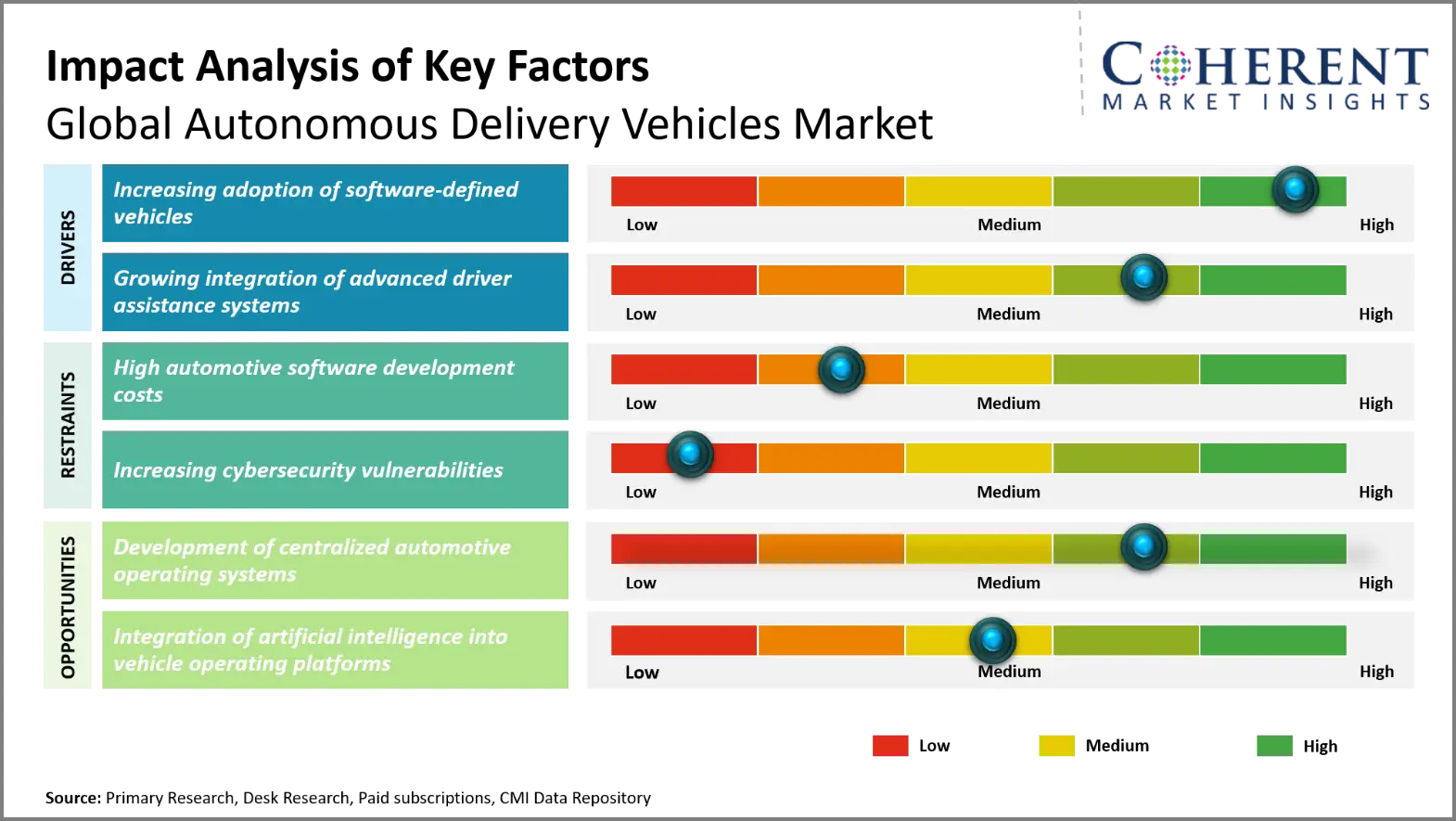
Increasing adoption of software-defined vehicles and Growing integration of advanced driver assistance systems are the major factors driving the growth of the global autonomous delivery vehicles market.
High automotive software development costs and Increasing cybersecurity vulnerabilities are the major factors hampering the growth of the global autonomous delivery vehicles market.
In terms of delivery range, short-distance delivery segment is estimated to dominate the market revenue share in 2026.
Autonomous delivery vehicles are self-operating robots or vehicles designed to transport goods without continuous human driving.
LiDAR generates three-dimensional environmental information that helps vehicles identify obstacles and navigate complex surroundings.