

Global Computer Vision Market Size and Forecast – 2026 To 2033
The global computer vision market is expected to grow from USD 28 Bn in 2026 to USD 101 Bn by 2033, registering a compound annual growth rate (CAGR) of 13.3% from 2026 to 2033. The global computer vision market is driven by rising demand for real time quality control and defect detection. On July 3, 2025, ZEISS announced it is launching a new 2D X-ray inspection system that has been specially developed to meet the requirements of modern high-volume production in the automotive industry.
Key Takeaways of the Global Computer Vision Market
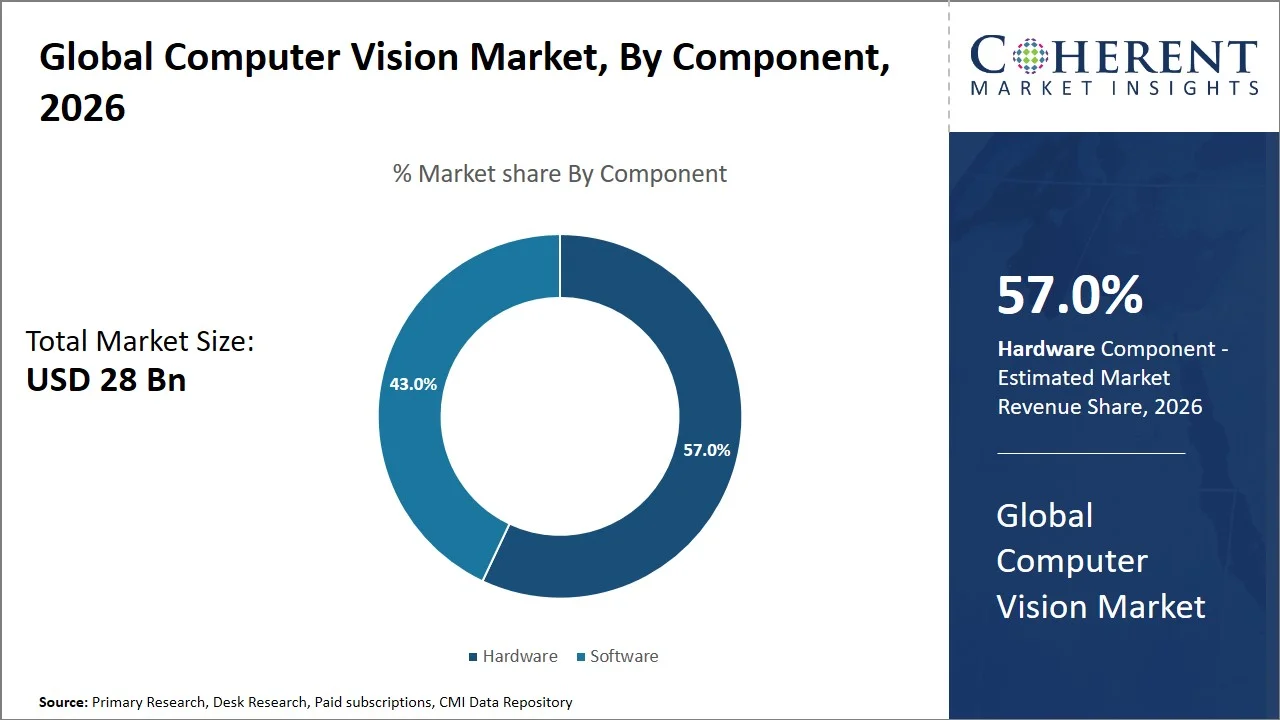
- The Hardware segment is expected to account for 57.0 % of the global computer vision market share in 2026. Expansion of smart cameras and edge AI devices is driving the growth of the segment. On May 15, 2025, EverFocus launched the PHX-N1000 series edge ai cameras, combining interchangeable lenses with NVIDIA Jetson Orin Nano and Orin NX computing platforms and extensive i/o connectivity.
- The PC Based segment is estimated to capture 51.0 % of the market share in 2026. Growing utilization of facial recognition and video analytics for security is majorly driving the growth of the segment. On August 12, 2026, The London metropolitan police announced plans to deploy live facial recognition cameras along London's oxford street by the end of 2026, with fixed cameras scanning passersby against police watchlists.
- The Quality Assurance and Inspection segment is estimated to capture 36.0 % of the market share in 2026. Increasing deployment of computer vision in healthcare diagnostics and medical imaging is majorly driving the growth of the segment. On April 29, 2026, Aidoc raised USD 150 million in series e funding to expand its clinical ai platform for medical imaging, which analyzes ct scans and x-rays for applications including emergency triage, liver and spleen injuries, and appendicitis.
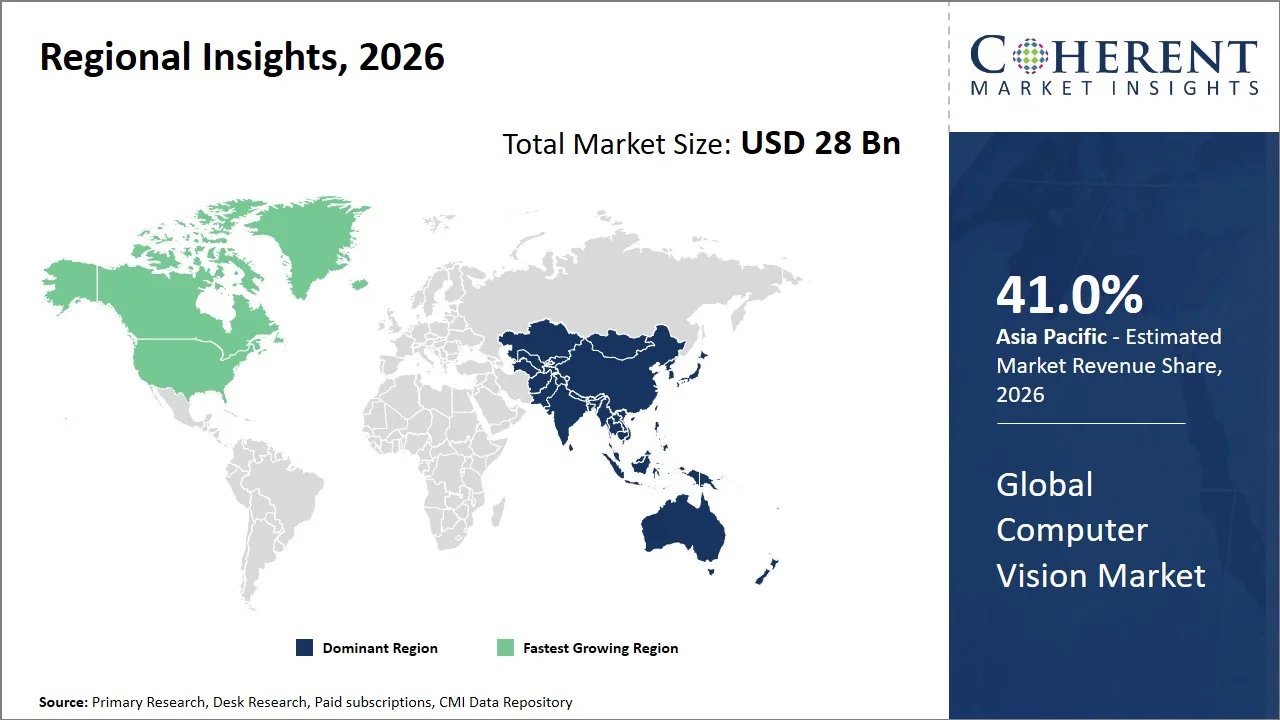
- Asia Pacific is expected to dominate the computer vision market in 2026 with a market share of 41.0 %. Growth of vision guided autonomous mobile robots in Asia Pacific is driving the growth of the regional market. On June 26, 2025, Hikrobot India showcased its latest machine vision and mobile robot portfolio at the India Warehousing Show, including the sc1000 smart camera alongside QF-series pallet-handling AMRS and tugger AMRS for internal logistics.
- North America is expected to account for 27.0% share in 2026 and is projected to record the fastest growth over the forecast period. Expansion of AI powered medical imaging in North America is driving the growth of the regional market. On May 15, 2025, GE Healthcare launched CleaRecon DL, using a deep-learning algorithm to improve cone-beam ct image quality by removing streak artifacts associated with blood flow and contrast distribution.
Segmental Insights
Why Does Hardware Dominate the Global Computer Vision Market?
The hardware segment is expected to account for 57.0% of the global computer vision market share in 2026. Hardware is the dominant player as computer vision systems need high-performance cameras, image sensors, CPUs, lighting equipment, and edge computing devices to reliably capture and interpret visual input with minimal latency. The growing use of smart cameras and vision-based inspection systems in manufacturing, automotive production, logistics and retail has fueled demand for dedicated vision hardware, as these applications demand constant real-time image acquisition and fast analysis at the point of operation. On March 11, 2025, Teledyne announced it will showcase latest imaging technologies at Vision China, at the Shanghai New International Expo Center (SNIEC). Teledyne will feature a range of innovative products, including the Linea HS2 16k BSI and Linea Lite 8k Super Resolution line scan cameras, AxCIS Contact Image Sensor, Z-Trak 3D laser profiler and BOA AI optical inspection camera.
- Current Industry Events of 2026
- Market Size Estimation
- Regional Breakdown
- Competitive Landscape
- Customer Intelligence
- Segmental Analysis
- Pricing Analysis
- Key Market Drivers, Challenges & Future Trends
- Customized Insights Section
Why is PC Based the Most Preferred Product?
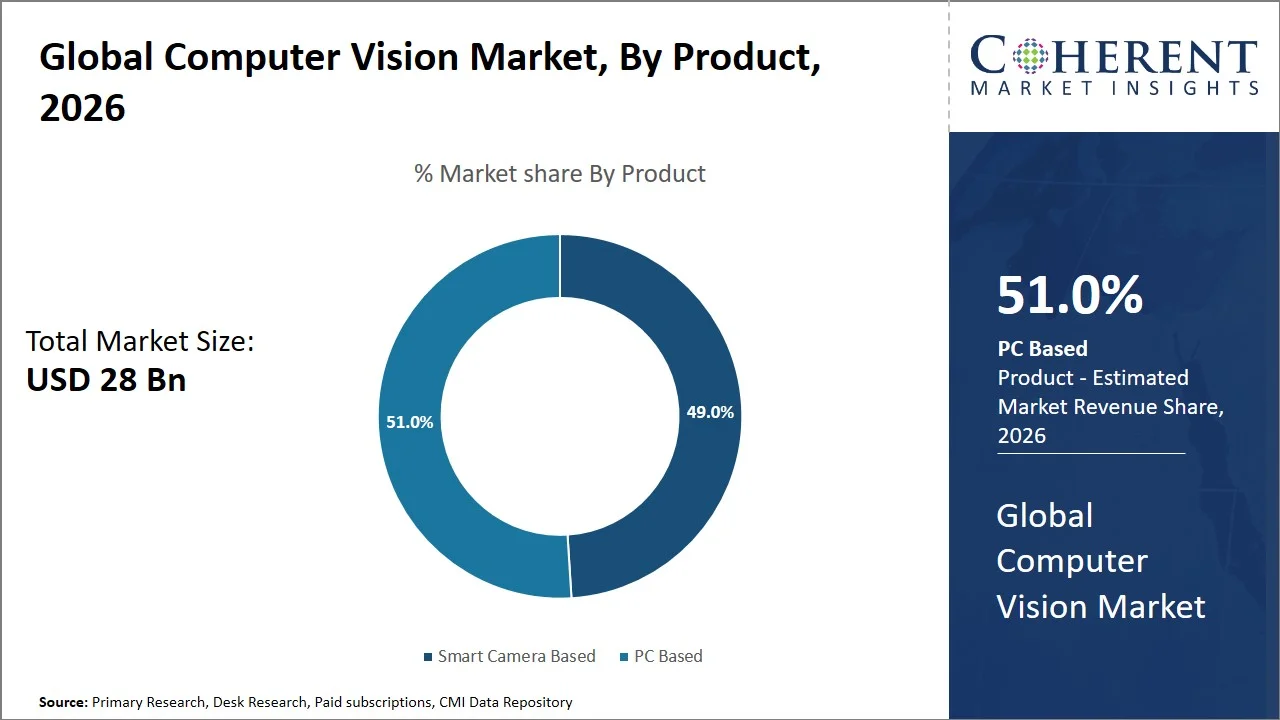
The PC based segment is expected to account for 51.0% of the global computer vision market share in 2026. PC based systems are favored as they have more processing power, flexibility and compatibility with modern vision software. This makes them suited for complicated inspection and analysis activities that demand high-resolution image processing and sophisticated AI methods. They can host several cameras, specialized image processing tools and integrate with current industrial automation systems, enabling businesses to change vision configurations for varied production requirements without replacing the entire system. In September 2025, Imago technologies introduced the vision box age-x6, a modular industrial pc built around 14th-generation intel core embedded processors and equipped with four usb4 interfaces supporting up to 40 gbit/s per channel.
Quality Assurance and Inspection Dominates the Global Computer Vision Market
The quality assurance and inspection segment is expected to account for 36.0% of the global computer vision market share in 2026. The significant uptake of computer vision for quality assurance and inspection is driven by the requirement to reliably detect flaws, dimensional variations, surface imperfections and assembly errors at high production rates. Automated vision systems can analyze large quantities of products in real time while maintaining uniform inspection standards, reducing dependence on manual checks and helping manufacturers minimize scrap, rework and product recalls in automotive, electronics, pharmaceuticals, food and beverage and other industries. In October 2025, Omron highlighted the increasing use of 3D CT X-Ray inspection for generative AI server boards, which feature high-density PCB assemblies with fine-pitch BGA packages, chiplets, press-fit connectors and parts that can be difficult to check with conventional 2D X-Ray.
Current Events and their Impact
Current Events | Description and its Impact |
European Union Artificial Intelligence Act |
|
India Digital Personal Data Protection Rules 2025 |
|
Computer Vision Market Dynamics
Market Drivers
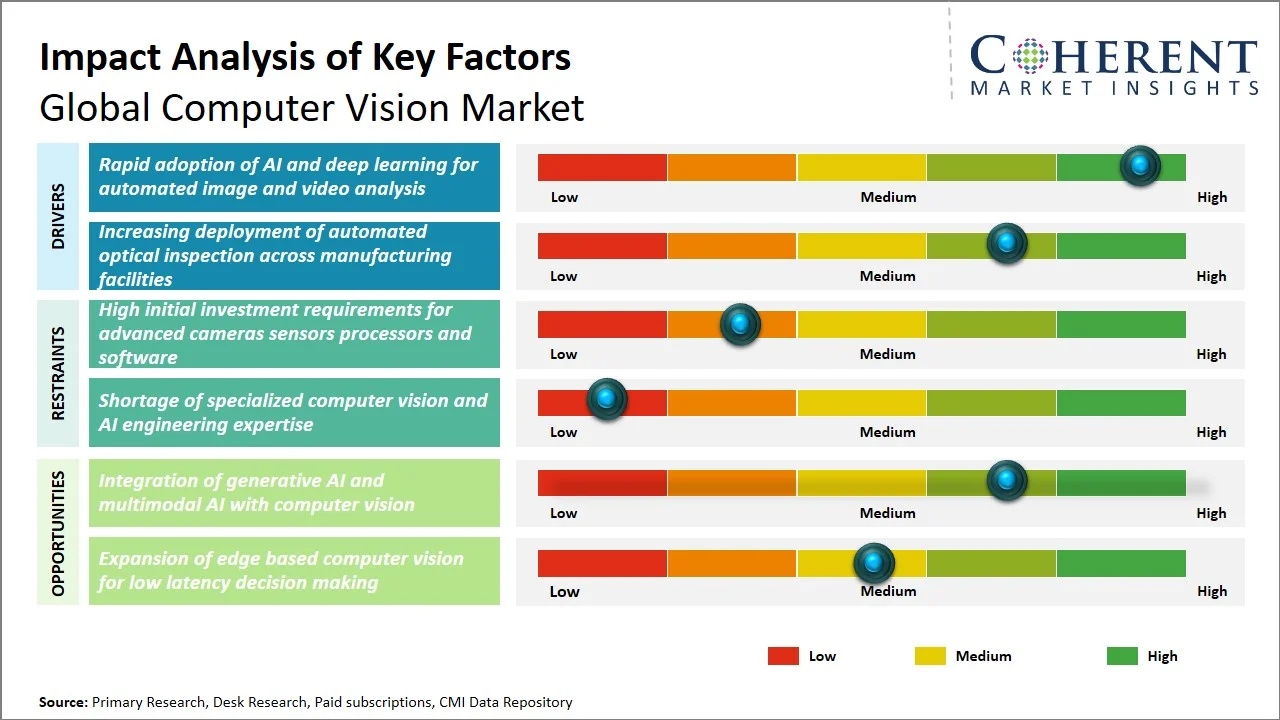
- Rapid adoption of AI and deep learning for automated image and video analysis: The rapid adoption of AI and deep learning is helping to increase the deployment of computer vision by enabling systems to identify objects, recognize patterns, find anomalies and interpret complex visual information with higher accuracy and speed. Deep learning models provide real-time analysis of enormous amounts of image and video data, empowering organizations to automate tasks such as defect detection, facial identification, traffic monitoring, medical image analysis, and security surveillance, reducing reliance on manual visual inspection. On February 20, 2026, HCLTech launched VisionX 2.0, the next-gen version of their multi-modal AI edge platform. This technology provides real-time intelligence, better safety and operational efficiency at scale for mission critical industrial situations.
- Increasing deployment of automated optical inspection across manufacturing facilities: Manufacturers are turning to automated optical inspection to provide faster and more consistent quality control on high-volume production lines. Computer vision systems with high-resolution cameras, image sensors and AI-based inspection software can detect surface flaws, component placement errors, dimensional deviations and assembly errors in real time, allowing manufacturers to reduce rework and production waste and to produce consistent product quality. On February 10, 2025, Saki Corporation announced the introduction of its latest 3Si/3Di-EX Series of 3D Solder Paste Inspection (SPI) and Automated Optical Inspection (AOI) systems, which will be available from April 2025. The 3Si/3Di-EX Series benefits from a modular hardware architecture, which allows the optical unit to be easily upgraded, providing long-term flexibility for evolving inspection needs, leveraging the proven high-rigidity gantry frame from the Saki 3Si/3Di Series.
Emerging Trends
- Integration of generative AI with computer vision: Generative AI is being increasingly integrated with computer vision to enhance image understanding, synthetic image generation, visual inspection, and multimodal analysis, providing systems with the ability to interpret complex visual information and generate contextual responses with reduced reliance on manually engineered rules.
- Shift toward edge-based computer vision: Computer vision processing is increasingly moving to edge devices such as smart cameras, industrial gateways, and embedded processors to reduce latency, minimize data transmission requirements, and enable real-time decision making in manufacturing, autonomous systems, retail, and security applications.
- Growing adoption of 3D computer vision and vision-guided robotics: 3D vision is gaining traction in robotics, enabling robots to perceive the location, orientation, shape and spatial relationship of objects for purposes such as automated picking, bin picking, assembly, welding and warehouse logistics with depth data.
- Expansion of privacy-preserving computer vision: Heightened regulatory scrutiny around facial recognition, biometric identification, and personal data is spurring the development of privacy-preserving vision technologies, including anonymization, on-device processing, selective data retention, and systems designed to extract operational insights without unnecessarily storing identifiable visual information.
Regional Insights
Why is Asia Pacific a Strong Market for Computer Vision?
Asia Pacific is expected to account for a market share of 41.0% in 2026. Asia pacific is benefiting from the concentration of electronics manufacturing, industrial robotics, automotive production, and smart-factory investment across China, Japan, South Korea, Singapore, and India. The region had a density of 182 manufacturing robots per 10,000 employes in 2023, with Korea, China and Japan among the world’s most automated economies, establishing a strong installed base for machine vision, robotic guiding, inspection and automated handling. Japan’s Society 5.0 and China’s intelligent manufacturing drive are also pushing cameras, sensors, edge computing and ai into production settings. Computer vision is also moving out of the factory into smart transportation, healthcare imaging, retail analytics and security applications.
Why Does North America Computer Vision Market Exhibit High Growth?
North America is expected to register the fastest growth with a CAGR of 14.6% over the forecast period. The region is projected to account for 27.0% of the global computer vision market in 2026. North America is being propelled by the integration of computer vision with AI-enabled manufacturing, autonomous systems, logistics, and advanced robotics, particularly in the United States. The national institute of standards and technology reports that 46% of manufacturers were already using AI tools and that more than 80% expected to increase AI use over the following two years, while AI-enabled cameras are being deployed for defect detection, inventory management, workplace safety, and production monitoring. The region also benefits from the presence of major technology and semiconductor companies developing processors, AI platforms, autonomous driving systems, and edge-computing infrastructure that enable increasingly sophisticated visual perception.
Global Computer Vision Market Outlook for Key Countries
Why is China Emerging as a Major Hub in the Computer Vision Market?
The main reason for China’s usage of computer vision has been the rapid transformation of traditional industries into highly automated production lines. In these facilities, computer vision is used to guide robots, inspect, identify components and monitor production. In 2024, the number of industrial robots in operation in China exceeded two million, and domestic robot makers accounted for 57% of the country’s robot market, forming a large ecosystem that allows vision systems to be directly embedded into locally produced automation equipment. Recent deployments such as Sany's no 18 smart factory in Changsha demonstrate how ai and visual perception are being combined with robotics to identify and manipulate complex components and extend automation into traditionally labor-intensive manufacturing sectors.
Is U.S. the Next Growth Engine for the Computer Vision Market?
Instead of depending on conventional machine vision, the U.S. industry is being bolstered by the convergence of computer vision with sophisticated AI, autonomous vehicles, robotics, healthcare imaging, and high-value manufacturing. The National Institute of Standards and Technology specifically lists AI-enabled cameras for inspection and defect detection, safety monitoring and automated inventory counting. AI-driven robots utilize computer vision for autonomous material handling and navigation around factory obstacles. This combination of large-scale AI development, sophisticated semiconductor infrastructure, autonomous mobility research, and increasing factory automation is expanding demand for vision systems capable of real-time perception and decision making.
Germany Computer Vision Market Analysis and Trends
Germany is being driven by the deep integration of machine vision with automotive manufacturing, industrial robotics, and precision production, where automated inspection is particularly valuable for detecting defects and verifying assembly quality. Among the most automated manufacturing economies in the world is Germany, with 449 industrial robots per 10,000 manufacturing employes in 2024. Producers of automotive and industrial equipment are increasingly combining robotic systems with cameras and AI-based inspection to support flexible production and nearshoring initiatives. The country’s established engineering ecosystem and automotive supplier concentration also provide fertile ground for vision-guided robotics, dimensional inspection and automated quality-control applications.
Japan Computer Vision Market Analysis and Trends
Japan’s growth relies on its established robotics ecosystem, its precision electronics manufacturing, and a desire to automate processes facing manpower shortages. Japan was estimated to have 450,500 industrial robots in use in 2024, and it was the world’s second largest market for installations of industrial robots, generating enormous prospects for vision systems in robotic picking, assembly, inspection and factory logistics. Japan is also a major producer of industrial robots, with Japanese manufacturers accounting for 38% of global robot production, while the country's electronics industry remains an important customer for robotic automation and associated visual inspection technologies.
South Korea Computer Vision Market Analysis and Trends
South Korea is being driven by the exceptionally high automation intensity of its semiconductor, electronics, and automotive industries, where computer vision is required for microscopic inspection, component positioning, wafer and display inspection, and robotic manufacturing processes. In 2024, the country had the largest density of industrial robots in the world, with 1,220 robots per 10,000 manufacturing employees, with electronics and automotive recognized as its two major industrial-robot customers, thus creating a particularly strong deployment environment for machine vision. Continued investment in semiconductor manufacturing is supporting this ecosystem. The government announced a 5 trillion won semiconductor fund in 2026, and large investments from Samsung Electronics, SK Hynix, suppliers and local governments for new semiconductor manufacturing projects.
Global Computer Vision Market - Industrial Camera Shipments By Region (2025)
Region | Estimated Industrial Camera Shipments | Share Of Global Shipments |
Asia Pacific | 1.64 million units | 41.0% |
North America | 1.08 million units | 27.0% |
Europe | 0.96 million units | 24.0% |
Rest of world | 0.32 million units | 8.0% |
Global | 4.00 million units | 100.0% |
How is Integration of Generative AI and Multimodal AI With Computer Vision Creating New Growth Opportunities in the Computer Vision Market?
The combination of Generative AI and multimodal AI is offering new potential as computer vision systems can now analyze images in conjunction with text, sensor readings, maintenance records and operating instructions rather than viewing visual data as a siloed input. A specific example is AWS’s 2025 implementation using amazon nova pro, a multimodal model, to identify manufacturing defects from product images without requiring the extensive training data traditionally needed for automated inspection, potentially opening computer vision adoption to smaller manufacturers with limited defect datasets.
In industrial asset inspection, Amazon has also demonstrated systems that convert large volumes of 2D and 3D imagery into automated inspection reports that can be explored through LLM prompts, while Levatas integrated NVIDIA metropolis vision language models and video search capabilities into its inspection solutions for utilities, oil and gas, rail, and logistics applications. These developments create a growth opportunity for computer vision providers to move beyond image classification and defect detection toward vision-language systems that can explain anomalies, generate inspection reports, respond to natural-language queries, and support autonomous operational decisions.
On May 18, 2025, NVIDIA introduced its AI Blueprint for video search and summarization, combining vision-language models, large language models, and Graph-RAG to allow AI agents to understand live and archived video through natural-language queries.
Market Players, Key Development, and Competitive Landscape
Key Developments
- On August 11, 2026, Sony Semiconductor Solutions Corporation and Taiwan Semiconductor Manufacturing Company Limited announced the execution of a legally binding definitive agreement for the establishment of Advanced Vision Semiconductor Manufacturing Corporation as a joint venture in Koshi City, Kumamoto Prefecture, Japan. The joint venture will serve as a core hub for the development and manufacturing activities required for the volume production of image sensors for smartphones utilizing advanced manufacturing process technology.
- On May 5, 2026, Cognex Corporation announced the launch of the In-Sight 3900 Vision System. Built on a new generation of Cognex embedded AI vision technology and powered by Qualcomm Dragonwing platforms, the In-Sight 3900 is a fully integrated vision system that delivers industry-leading speed, accuracy, and resolution at the edge, enabling manufacturers to run demanding inspections without sacrificing throughput or simplicity.
Competitive Landscape
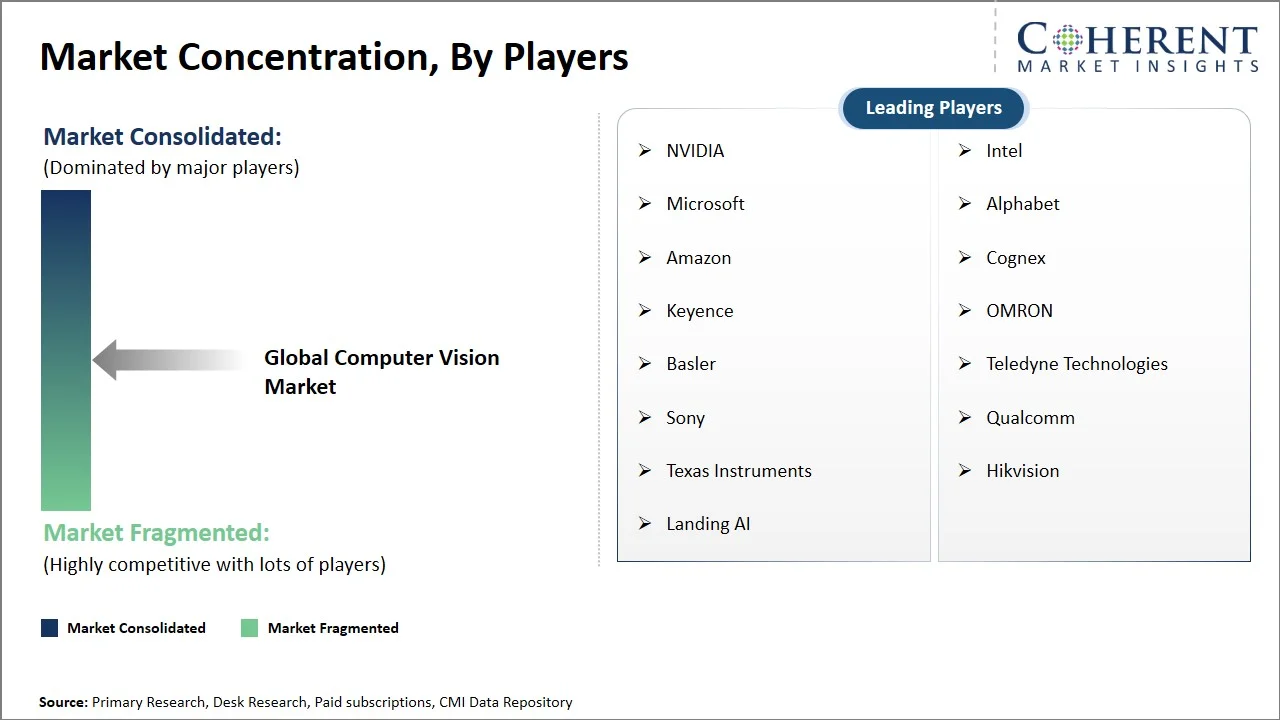
The competitive landscape is increasingly being shaped by the transition from conventional image-processing systems toward AI-enabled visual intelligence, with NVIDIA, Cognex, Keyence, Intel, and Sony maintaining strong positions through different technology strategies. NVIDIA is pushing beyond GPU hardware through its Metropolis platform, which combines visual AI models, video analytics, automated inspection, robotics, and intelligent transportation, while its 2025 Metropolis workflows incorporated synthetic data generation and digital twins through Omniverse for factory and warehouse applications.
Cognex is concentrating on industrial machine vision and has identified becoming a leading provider of AI technology for industrial vision as a core strategic objective, with applications spanning semiconductor manufacturing, logistics, 3D robotic guidance, aerospace, and regulated manufacturing. Keyence is differentiating through ai-enabled inspection that works alongside traditional rule-based vision, particularly for production environments where part appearance varies and frequent manual retuning would otherwise be required. This competitive shift is increasingly favoring companies capable of combining cameras, edge processors, ai models, industrial software, and application-specific workflows rather than competing solely on camera or sensor specifications.
Market Report Scope
Computer Vision Market Report Coverage
| Report Coverage | Details | ||
|---|---|---|---|
| Base Year: | 2025 | Market Size in 2026: | USD 28 Bn |
| Historical Data for: | 2020 To 2024 | Forecast Period: | 2026 To 2033 |
| Forecast Period 2026 to 2033 CAGR: | 13.3% | 2033 Value Projection: | USD 101 Bn |
| Geographies covered: |
| ||
| Segments covered: |
| ||
| Companies covered: | NVIDIA, Intel, Microsoft, Alphabet, Amazon, Cognex, Keyence, OMRON, Basler, Teledyne Technologies, Sony, Qualcomm, Texas Instruments, Hikvision, Landing AI | ||
| Growth Drivers: |
| ||
| Restraints & Challenges: |
| ||
Analyst Opinion (Expert Opinion)
- The future of the industry is expected to move toward vision AI agents and multimodal computer vision, particularly systems that can interpret continuous video, reason about events, and interact with operators through natural language. NVIDIA is already positioning Metropolis around visual ai agents that can search and understand live or archived video across factories, warehouses, retail locations, airports, and transportation environments, indicating a transition from simple object detection toward systems capable of operational reasoning.
- The strongest opportunity is expected to be concentrated in industrial automated inspection, robotics, and edge-based 3D vision, with Asia Pacific offering particularly attractive deployment opportunities because of its concentration of electronics, semiconductor, automotive, and robotics manufacturing. Within applications, semiconductor inspection, robotic picking, warehouse automation, and complex defect detection should receive greater attention because these environments generate large volumes of visual data and require rapid decisions directly at the production or operational edge.
- To gain an edge, players should focus on reducing deployment complexity rather than only improving model accuracy. Companies that provide pretrained models, synthetic-data generation, low-code model training, edge inference, and seamless integration with cameras, robots, plc systems, and existing manufacturing software can shorten deployment cycles substantially; NVIDIA's combination of Omniverse synthetic data, TAO model training, Metropolis inference, and factory workflows illustrates this integrated approach, while Keyence's emphasis on AI inspection with limited image requirements demonstrates the importance of making advanced vision accessible to factory engineers rather than only specialist AI teams.
Speak to the analyst
Want personalized insights?
Take the findings above to one of our principal consultants, or have the report rebuilt around the segments, geographies and competitors you actually track.
Market Segmentation
- Component Insights (Revenue, USD Billion, 2021 - 2033)
- Hardware
- Software
- Product Insights (Revenue, USD Billion, 2021 - 2033)
- Smart Camera Based
- PC Based
- Application Insights (Revenue, USD Billion, 2021 - 2033)
- Quality Assurance and Inspection
- Positioning and Guidance
- Identification
- Measurement
- Others
- Regional Insights (Revenue, USD Billion, 2021 - 2033)
- North America
- U.S.
- Canada
- Latin America
- Brazil
- Argentina
- Mexico
- Rest of Latin America
- Europe
- Germany
- U.K.
- Spain
- France
- Italy
- Russia
- Rest of Europe
- Asia Pacific
- China
- India
- Japan
- Australia
- South Korea
- ASEAN
- Rest of Asia Pacific
- Middle East
- GCC Countries
- Israel
- Rest of Middle East
- Africa
- South Africa
- North Africa
- Central Africa
- North America
- Key Players Insights
- NVIDIA
- Intel
- Microsoft
- Alphabet
- Amazon
- Cognex
- Keyence
- OMRON
- Basler
- Teledyne Technologies
- Sony
- Qualcomm
- Texas Instruments
- Hikvision
- Landing AI
Sources
Primary Research Interviews
- Computer vision system manufacturers
- Machine vision camera and sensor manufacturers
- Industrial automation equipment manufacturers
Journals
- IEEE Transactions on Pattern Analysis and Machine Intelligence
- Computer Vision and Image Understanding
Associations
- International Federation of Robotics
- International Society for Optics and Photonics
Public Domain Sources
- National Institute of Standards and Technology
- U.S. Department of Energy
Proprietary Elements
- CMI Data Analytics Tool
- Proprietary CMI Existing Repository of Information for the Last 10 Years
Get access to 250+ pages report
Every segment, forecast, competitor profile and data table behind the analysis above — available for instant download.
- ESOMAR Member
- ISO 9001:2015 Certified
- D-U-N-S Registered
- GDPR & CCPA Compliant
Missing comfort of reading report in your local language? Find your preferred language:
Transform your Strategy with Exclusive Trending Reports
Frequently Asked Questions
The global computer vision market is expected to stand at USD 28 Bn in 2026 and is expected to reach USD 101 Bn by 2033.
The CAGR of the global computer vision market is projected to be 13.3% from 2026 to 2033.
Logistics companies are using vision systems for parcel identification, barcode and label reading, package dimensioning, automated sorting, warehouse monitoring, and robotic handling.
Healthcare organizations are applying computer vision to medical image analysis, disease detection, surgical assistance, pathology, patient monitoring, and diagnostic workflows.
In terms of component, hardware segment is estimated to dominate the market revenue share in 2026.
High initial investment requirements for advanced cameras sensors processors and software and shortage of specialized computer vision and AI engineering expertise are the major factors hampering the growth of the global computer vision market.
Rapid adoption of AI and deep learning for automated image and video analysis and increasing deployment of automated optical inspection across manufacturing facilities are the major factors driving the growth of the global computer vision market.