

Global Autonomous Driving Software Market Size and Forecast – 2026 - 2033
The global autonomous driving software market is expected to grow from USD 2.66 Bn in 2026 to USD 6.78 Bn by 2033, at a compound annual growth rate (CAGR) of 14.30% over 2026–2033. Autonomous driving software is the code that lets a vehicle see, decide and act. It reads camera, radar and lidar signals, builds a model of the road, predicts how other road users will move, chooses a path and sends commands to steering, braking and propulsion. Until recently, most of this was written as hand-built rules for one function at a time, such as lane keeping or adaptive cruise. Automakers and fleet operators are now replacing those rules with trained neural networks that cover the whole driving task, and they license the software per vehicle, per subscription or per mile. Regulators are helping this shift by writing common safety requirements, among them NHTSA in the U.S., UNECE for global type approval and MIIT in China. For wider context, readers can review the advanced driver assistance system market and the autonomous vehicle market.
The gains are easy to measure. In February 2026, Waymo reported more than 400,000 rides every week across six major U.S. metropolitan areas, 127 million miles of fully autonomous operation and a 90% reduction in serious-injury crashes against human drivers over those miles. On the driver-assistance side, Mobileye reported on October 29, 2026 that its EyeQ shipments rose 11% in the first nine months of 2026, while global automotive production fell by about 1%.
Key Takeaways of the Global Autonomous Driving Software Market:
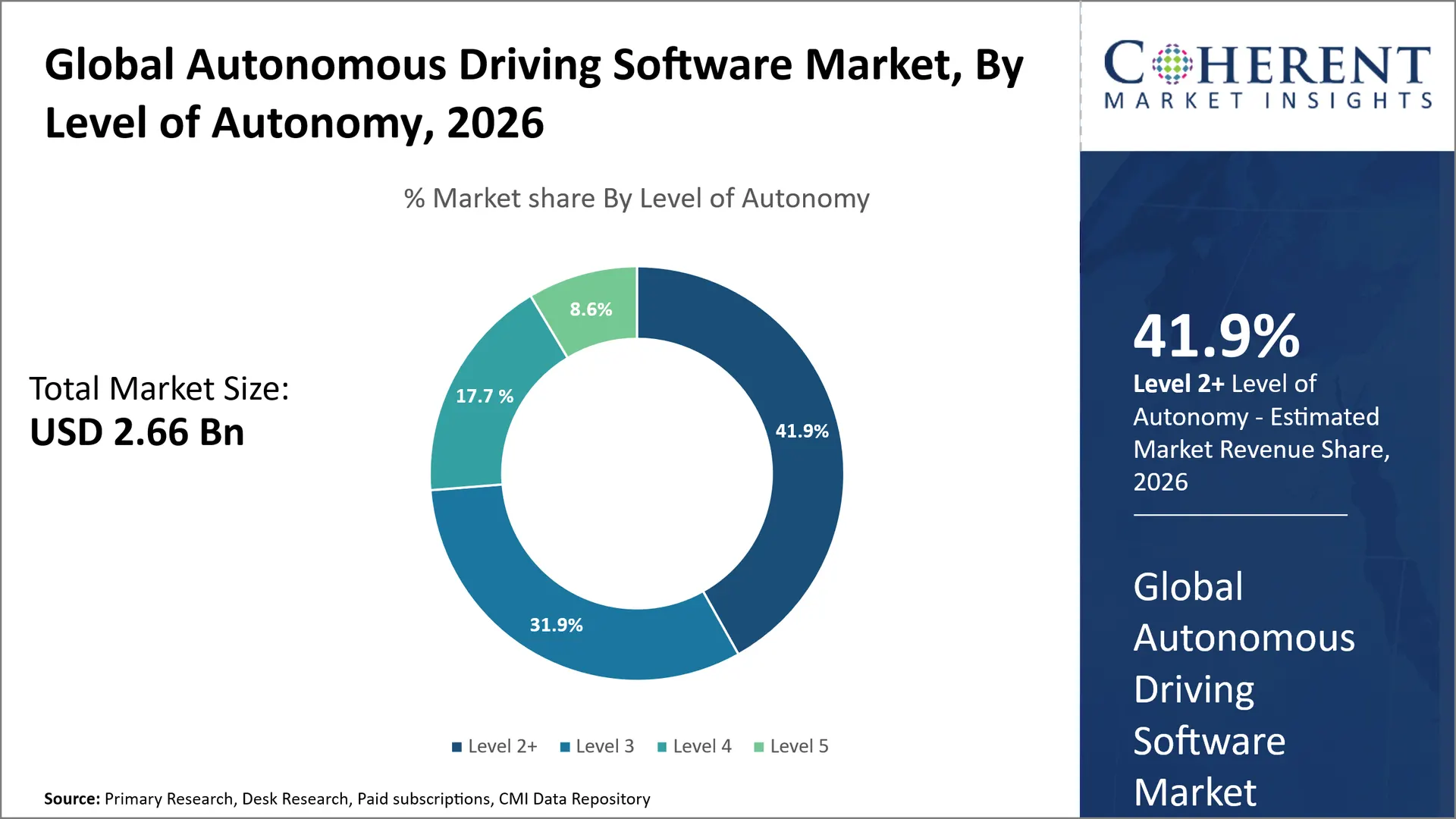
- The Level 2+ segment is expected to account for 41.9% of the global autonomous driving software market share in 2026. Automakers can sell hands-off driving as an option pack or subscription on production sensors and improve it through over-the-air updates. On January 5, 2026, Mobileye announced that Surround ADAS added its second top-10 automaker customer.
- The perception and planning software segment is expected to hold 47.4% of the software type segment in 2026. This layer needs the most data and gets retrained the most often, so it takes more of the software budget than any other. On April 24, 2026, Pony.ai presented an upgraded world model at Auto China 2026, aimed at making the training of its Virtual Driver more efficient.
- Passenger cars are expected to hold 75.6% of the vehicle type segment in 2026. Cars are built in far larger numbers than any other vehicle, and safety packages that regulators now push into new models give software suppliers their widest route to scale. On March 23, 2026, Mobileye won a major driver monitoring production program with a leading U.S. automaker.
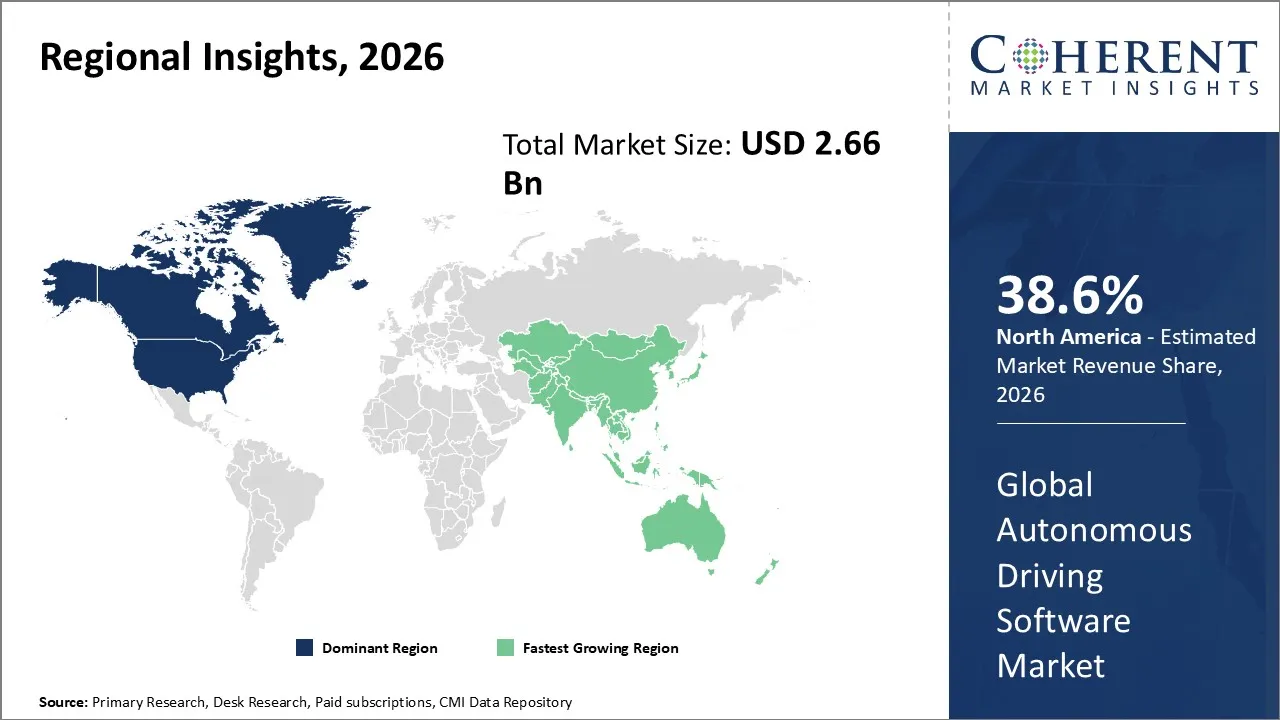
- North America is expected to lead the market in 2026 with a share of 38.6%. Most of the robotaxi operators, trucking developers and technology companies that build driving software are based in the region. On October 14, 2026, Waymo opened its service to anyone in San Antonio, San Diego and Tampa, including rides at San Antonio International Airport.
- Asia Pacific is expected to account for a 22.6% share in 2026 and to be the fastest-growing region. Large Level 2 volumes and national approval programs are widening the base. On November 16, 2026, Pony.ai and Toyota launched fully driverless commercial services with the Gen-7 bZ4X Robotaxi in Guangzhou.
Segmental Insights
Why Does Level 2+ Dominate the Global Autonomous Driving Software Market?
In terms of level of autonomy, Level 2+ is expected to account for 41.9% of the global market in 2026. The category covers systems that steer, brake and accelerate on well-marked roads without the driver's hands on the wheel, while camera-based monitoring checks that the driver is watching the road. Automakers favor it because it runs on sensors already in production vehicles, can be priced as an option pack or subscription and is improved through over-the-air updates. Each release adds road types and driving conditions without a hardware change, so software revenue per vehicle keeps growing after the sale.
On February 10, 2026, Mobileye announced that Mahindra & Mahindra selected its SuperVision and Surround ADAS for future models. SuperVision uses 11 cameras and two EyeQ6H chips for point-to-point navigate-on-pilot in designated areas, while Surround ADAS uses 5 cameras and one EyeQ6H chip for hands-off, eyes-on highway driving.
- Current Industry Events of 2026
- Market Size Estimation
- Regional Breakdown
- Competitive Landscape
- Customer Intelligence
- Segmental Analysis
- Pricing Analysis
- Key Market Drivers, Challenges & Future Trends
- Customized Insights Section
Why Does Perception and Planning Software Lead the Market?
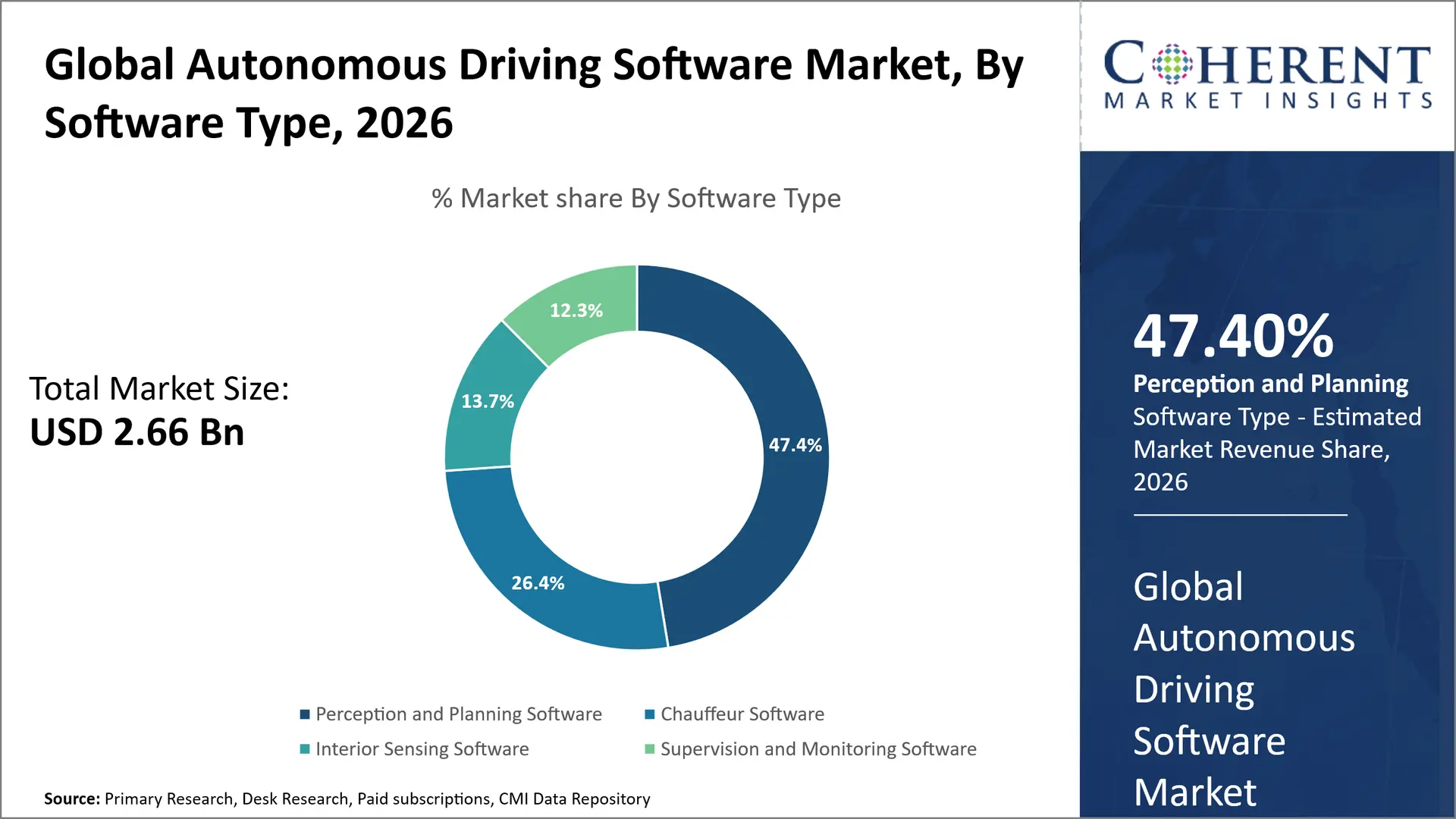
In terms of software type, perception and planning is expected to account for 47.4% of the global market in 2026. This layer reads camera, radar and lidar data, identifies lanes, vehicles, pedestrians and signs, predicts how they will move and selects a safe path. Its share is high because every driving function depends on it, and because it needs continuous retraining on new driving data. End-to-end neural networks are folding detection and trajectory planning into a single model, which raises the software value of this layer and makes it the main item in supplier licence agreements.
On March 5, 2026, PlusAI launched SuperDrive 6.0, built on more than 7 million miles of real-world driving across the U.S., Europe and Asia. The release added night driving and construction-zone handling and sped up AI model training by 10 times.
Why Do Passenger Cars Lead the Vehicle Type Segment?
In terms of vehicle type, passenger cars are expected to account for 75.6% of the global market in 2026. Tens of millions of cars are built each year, and software priced per vehicle across those volumes gives suppliers a much larger base. Consumers are also getting used to hands-off highway features, and safety rules are placing camera and radar stacks in more models, which creates the hardware base for later software upgrades.
In September 2025, Qualcomm and BMW introduced Snapdragon Ride Pilot on the BMW iX3, with a jointly developed software stack validated across 60 countries and expansion to more than 100 planned by 2026.
SAE Level Reference
Level | Who Drives | Typical Deployment |
Level 2+ | Driver supervises, hands may be off | Highway and urban assistance packs on production cars |
Level 3 | System drives in set conditions, driver takes over on request | Approved traffic-jam and highway pilots in Germany and China |
Level 4 | System drives within a defined area, no driver | Robotaxi and driverless trucking corridors |
Level 5 | System drives everywhere | Not yet commercially deployed |
Current Events and their Impact
Current Events | Description and its Impact |
UNECE Adopts Global Regulation on Automated Driving Systems (June 24, 2026) |
|
China Publishes GB 44721 for L3 and L4 Systems (August 4, 2026) |
|
U.S. Emergency Braking Standard FMVSS No. 127 (May 9, 2024; compliance by September 1, 2029) |
|
Autonomous Driving Software Market Dynamics
Market Drivers
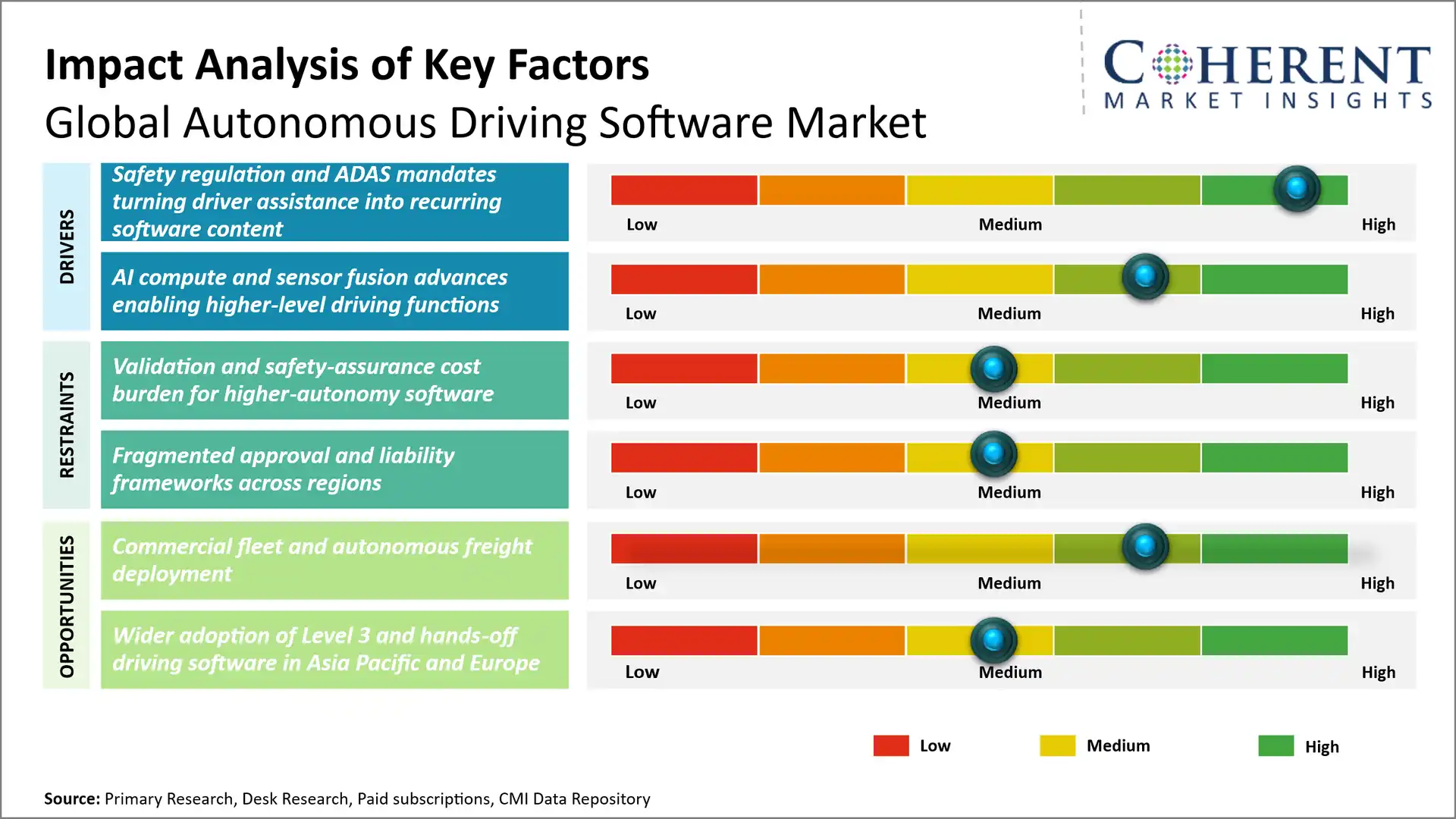
Safety regulation and ADAS mandates turning driver assistance into recurring software content
Rules that make braking, lane keeping and driver monitoring mandatory are turning optional features into standard software that must be maintained, updated and re-certified for the life of the vehicle. Once a car carries a camera-and-radar stack for compliance, the automaker can add hands-off driving on the same hardware through paid updates, so each regulatory step adds both volume and revenue per vehicle. Regulation also sets a common reference for what counts as safe, which lowers the risk for automakers that license software instead of writing it in-house.
China's industry ministry reported On September 11, 2026 that more than 70% of new passenger cars sold in the first half of 2026 carried Level 2 combined driver assistance. On January 6, 2026, Aptiv announced that a leading commercial vehicle maker selected its Gen 6 ADAS platform for future trucks and buses in India, combining Aptiv radar and smart cameras with its modular software for cost-effective regulatory compliance.
AI compute and sensor fusion advances enabling higher-level driving functions
Vehicle computers now run large neural networks on board, and sensor fusion merges camera, radar and lidar into one consistent view of the road. Higher compute lets one model handle detection, prediction and planning together, and better sensing cuts the number of edge cases that need human takeover. Both trends lower the cost of each driverless function and widen the set of roads where software can take over, which moves systems from Level 2+ toward Level 3 and Level 4.
On March 16, 2026, NVIDIA announced that BYD, Geely and Nissan are developing Level 4 programs on its Hyperion reference platform, and that its Alpamayo 1.5 reasoning model had been downloaded by more than 100,000 automotive developers. On February 12, 2026, Waymo reported that its 6th-generation Driver uses 17-megapixel imagers, needs fewer than half as many cameras as the previous generation and brings the camera to cost parity with standard automotive units.
Emerging Trends
- Reasoning AI models are reaching commercial trucks: Vendors are adding foundation models that explain and plan their driving decisions, and they are moving them from cars to freight vehicles. On March 16, 2026, PlusAI announced an expanded collaboration with NVIDIA to bring the Alpamayo foundation model to its SuperDrive virtual driver, with factory-built Level 4 trucks planned with International Motors from 2027.
- Impact: Trucks gain more human-like handling of complex roads, which brings forward the point where safety drivers can be removed.
- Relevance to the market: This expands spending on training data, simulation and onboard compute for commercial vehicles.
- Open, scalable compute stacks are replacing closed systems: Suppliers are packaging chips, middleware and driving software so automakers can mix their own code with a vendor stack. In January 2026, ZF and Qualcomm announced an open ADAS compute system that pairs the ZF ProAI supercomputer with the Snapdragon Ride Platform. On October 21, 2026, Aptiv announced an expanded collaboration with NVIDIA built on Hyperion and the Halos safety system, including NVIDIA Thor-based compute with air cooling to lower system cost.
- Impact: Automakers can scale the same stack from mass-market to premium vehicles and avoid single-supplier lock-in.
- Relevance to the market: This supports demand for middleware, integration and validation software that works across several chip families.
- Safety evidence is becoming a product feature: Suppliers now publish certifications, safety cases and readiness metrics next to their software, because regulators and automakers ask for them in approvals. On February 2, 2026, PlusAI announced that it had secured four ISO certifications, including ISO 26262 for functional safety, ahead of its commercial launch.
- Impact: Buyers can compare suppliers on audited evidence rather than demonstrations alone.
- Relevance to the market: This favors suppliers with established processes and raises the entry barrier for new players.
Regional Insights
Why Does North America Lead the Global Autonomous Driving Software Market?
North America is expected to account for a market share of 38.6% in 2026, or about USD 1.03 Bn. The region is home to the largest robotaxi operations, several autonomous trucking developers and many of the compute and software companies that supply the stack. Federal rules on emergency braking and a streamlined exemption path for purpose-built vehicles give suppliers a route from testing to revenue. Operators also find large and willing rider bases: in September 2026, Waymo reported that more than 100,000 people had registered interest before it began welcoming public riders in Las Vegas on fleets that are majority 6th-generation vehicles.
Why Is Asia Pacific the Fastest-Growing Region in the Autonomous Driving Software Market?
Asia Pacific is expected to account for 22.6% of the global market in 2026, or about USD 0.60 Bn, and to register the fastest growth over the forecast period. China combines the world's highest Level 2 adoption with a national Level 3 pathway and a new mandatory safety standard. Japan is preparing next-generation assistance systems from Japanese automakers, and India is moving advanced driver assistance into mainstream models. Local software specialists such as Momenta, Baidu, Pony.ai and WeRide sit alongside global chip and software suppliers building regional engineering teams.
Global Autonomous Driving Software Market Outlook for Key Countries
Is the U.S. the Largest Market for Autonomous Driving Software?
The U.S. autonomous driving software market is projected to reach USD 0.85 Bn in 2026, the largest of any country. The country has the broadest set of commercial driverless services and the deepest base of chip, AI and software suppliers. Autonomous trucking is also scaling: on April 30, 2026, Aurora reported that its driver had logged more than 800,000 miles and delivered over 2,000 loads for Hirschbach Motor Lines, which plans to own 500 Aurora Driver-powered trucks from 2027 under a non-binding memorandum.
Is China the Main Engine of Growth in Asia Pacific?
China’s autonomous driving software market is projected to reach USD 0.31 Bn in 2026, the largest in Asia Pacific. Demand rests on three things: a high share of new cars with Level 2 features, a base of local chip and software suppliers, and robotaxi permits issued city by city. On March 19, 2026, Pony.ai announced an upgraded partnership with OnTime Mobility, under which more than 100 Gen-7 Robotaxis, built on the GAC Aion V, will be delivered to OnTime’s ride-hailing platform.
Why Is Germany a Key Market for Autonomous Driving Software in Europe?
Germany's market is projected to reach USD 0.23 Bn in 2026, the largest in Europe. Germany was the first country to open its road traffic law to Level 3, and its premium automakers are the main European buyers of driving software. On December 17, 2024, Mercedes-Benz announced that the German Federal Motor Transport Authority had approved the 95 km/h version of DRIVE PILOT for Level 3 driving on German motorways, delivered as a free update to existing customers.
Japan Autonomous Driving Software Market Analysis and Trends
Japan's market is projected to reach USD 0.13 Bn in 2026. Automakers are moving from single-lane highway assistance to systems that handle city streets. On December 10, 2025, Nissan and Wayve signed definitive agreements to integrate next-generation ProPILOT with Wayve AI software, with the first Japanese model planned in fiscal year 2027.
U.K. Autonomous Driving Software Market Analysis and Trends
The U.K. market is projected to reach USD 0.12 Bn in 2026. Government has created a permit route for driverless passenger services, and London is the first major city to host them. On August 5, 2026, Wayve and Uber reported that Transport for London had granted private hire vehicle licences to Wayve's autonomous Ford Mustang Mach-E vehicles, with more than 100,000 Londoners signed up for early rides.
Global Autonomous Driving Software Market – Key Platforms and Technical Specifications
Platform | Producer | Main Features and Uses |
EyeQ6 High with SuperVision | Mobileye | Delivers 10 times the frames-per-second processing of EyeQ5 High with only double the headline compute and 25% higher power use; SuperVision pairs it with 11 cameras for point-to-point navigate-on-pilot |
Waymo Driver (6th generation) | Waymo | 17-megapixel cameras, imaging radar, lidar and external audio receivers; fewer than half the cameras of the prior generation; production ramping in Metro Phoenix |
NVIDIA Hyperion with Halos OS | NVIDIA | Reference architecture combining compute, sensors, networking and safety; Halos OS is built on ASIL D-certified DriveOS foundations |
Snapdragon Ride Pilot | Qualcomm | Scalable automated driving system with toolchains, data management and simulation; first deployed on the BMW iX3 |
Gen 6 ADAS Platform | Aptiv | Sensor-to-cloud stack of radar, smart cameras and modular software, adapted for passenger and commercial vehicles |
Wayve AI Driver | Wayve | Vehicle-agnostic embodied AI that runs on onboard compute and standard sensors without high-definition maps |
SuperDrive 6.0 | PlusAI | Level 4 virtual driver for factory-built trucks with night driving and construction-zone handling |
R6 Flywheel Big Model | Momenta | Reinforcement-learning end-to-end model used in mass-production vehicles in China |
How Is the Commercial Fleet and Autonomous Freight Opportunity Shaping the Market?
Robotaxi, middle-mile and long-haul fleets pay for driving software through per-mile or per-vehicle subscriptions, which creates recurring revenue for every vehicle added. Fleet customers also demand uptime, remote assistance and fast over-the-air updates, so operations experience becomes a competitive advantage for software vendors. On February 6, 2026, WeRide and Uber announced a plan to deploy at least 1,200 Robotaxis across Abu Dhabi, Dubai and Riyadh, which they described as the largest robotaxi commercial commitment in the MENA region. On March 11, 2026, Wayve, Uber and Nissan signed a memorandum of understanding to prepare a Tokyo robotaxi pilot by late 2026, as part of a planned rollout across more than 10 cities.
How Can Level 3 and Hands-Off Driving Software Expand in Asia Pacific and Europe?
Approved Level 3 pilots in Germany and China, together with international type-approval rules, give automakers a legal basis to sell eyes-off driving on highways. Premium and upper-mid segments are the first buyers, and software can be sold as a paid upgrade as speed limits and road coverage grow. Several large automaker programs are already in development: in its first-quarter 2026 results on April 23, 2026, Mobileye reported milestones on its EyeQ6H-based SuperVision L2++ and Chauffeur L3 programs with the Volkswagen Group, along with the first U.S. pre-production vehicles running EyeQ6 High-based SuperVision on a 2,000-kilometer unplanned drive
Market Players, Key Development, and Competitive Landscape
Key Developments
- On November 16, 2026, Baidu reported that Apollo Go reached 30 cities as of October 2026, accumulated about 34 million autonomous kilometers in the third quarter and passed 390 million cumulative autonomous kilometers by October 31, 2026.
- On October 26, 2026, Aurora announced a non-binding memorandum under which Charger Logistics intends to buy up to 500 Aurora Driver-powered trucks, delivered over 2027 and 2028 under a Driver as a Service model.
- On October 22, 2026, Mobileye announced its first TÜV SÜD inspection certificate for its automatic emergency braking development process, which conforms with ISO 21448 for safety of the intended functionality.
- On September 3, 2026, Wayve and Uber launched supervised autonomous rides in London, the first autonomous ride-hailing service in the U.K.
- On July 21, 2026, Mobileye announced it will supply Cloud-Enhanced ADAS for select future Stellantis vehicles, with first U.S. applications expected in 2027.
- On June 16, 2026, Mobileye announced plans to build its own robotaxi business, starting with about 100 vehicles in a major U.S. market from 2027 and a target of roughly 17,000 vehicles over the following five years.
- On February 25, 2026, Wayve announced a USD 1.2 Bn Series D round and USD 1.5 Bn of total capital to deploy its autonomy platform, with supervised software in consumer vehicles from 2027.
Competitive Landscape
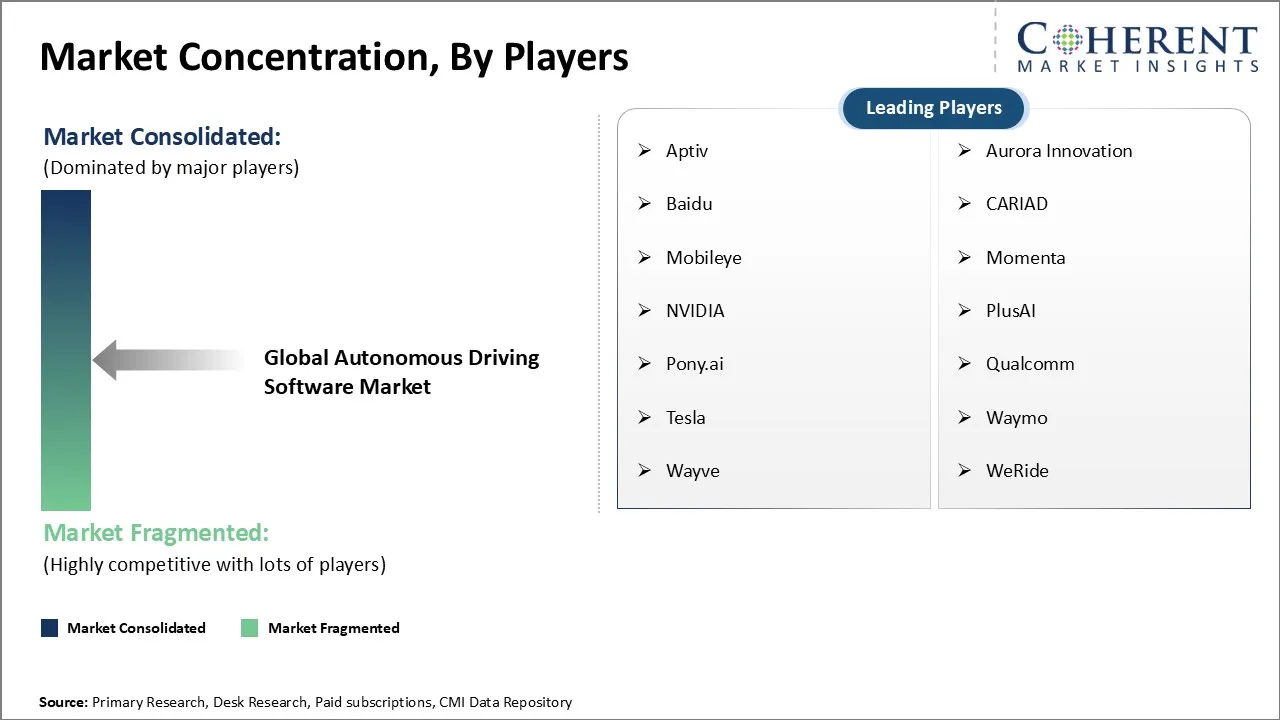
The market is shared between four groups that increasingly work together. Technology specialists such as Waymo, Wayve, Momenta and PlusAI build the driving models and sell them as licensed software or as a service. Chip and platform suppliers such as NVIDIA, Qualcomm and Mobileye provide the processors, reference architectures and driver-assistance products that the software runs on. Tier 1 suppliers and automaker software units, including Aptiv and CARIAD, integrate these stacks into production vehicles. Robotaxi and trucking operators such as Baidu Apollo Go, Pony.ai, WeRide and Aurora run fleets and also supply their own driving software. Competition centers on safety evidence, cost per vehicle and the speed at which a supplier can add road coverage through software updates. Long automaker qualification cycles and strict functional safety requirements make it hard for new entrants to win large programs.
Top Companies and Notable Products in the Autonomous Driving Software Market
Company | Notable Product | Key Features |
Waymo | Waymo Driver | Fully autonomous ride-hailing software and sensor suite, now in its 6th generation |
NVIDIA Corporation | DRIVE AV, Hyperion, Halos OS, Alpamayo | Full-stack autonomous driving software, reference platform, safety architecture and open reasoning models for developers |
Mobileye Global Inc. | SuperVision, Surround ADAS, Mobileye Drive | Camera-first driver assistance and driverless software built on EyeQ system-on-chips |
Qualcomm Technologies, Inc. | Snapdragon Ride Platform and Ride Pilot | Scalable ADAS and automated driving compute with jointly developed software stacks |
Wayve Technologies | Wayve AI Driver | Embodied AI driver that learns end to end and runs without high-definition maps |
Baidu, Inc. | Apollo Go | Robotaxi service and driving software operating in 30 cities as of October 2026 |
Aurora Innovation, Inc. | Aurora Driver | Self-driving software for long-haul trucks sold through a Driver as a Service model |
Tesla, Inc. | Full Self-Driving (Supervised) | Camera-based driver supervision system updated over the air |
Momenta | R6 Flywheel Big Model | Reinforcement-learning, end-to-end assisted driving model in mass-production vehicles |
Pony AI Inc. | Pony.ai Virtual Driver | Level 4 software for robotaxis and light trucks across Gen-7 vehicle platforms |
WeRide | WeRide One platform | Driverless software for robotaxi, robobus and robovan services |
Market Report Scope
Autonomous Driving Software Market | |||
Report Coverage | Details | ||
Base Year | 2025 | Market Size in 2026: | USD 2.66 Bn |
Historical Data For: | 2020 To 2024 | Forecast Period: | 2026 To 2033 |
Forecast Period 2026 To 2033 CAGR: | 14.30% | 2033 Value Projection: | USD 6.78 Bn |
Geographies covered: |
| ||
Segments covered: |
| ||
Companies covered: | Aptiv, Aurora Innovation, Baidu, CARIAD, Mobileye, Momenta, NVIDIA, PlusAI, Pony.ai, Qualcomm, Tesla, Waymo, Wayve, WeRide | ||
Growth Drivers: |
| ||
Restraints & Challenges: |
| ||
Analyst Opinion (Expert Opinion)
- Level 2+ takes the largest share, and the higher levels build on the same software. Level 2+ is expected to make up 41.86% of the market in 2026, against 31.86% for Level 3, 17.69% for Level 4 and 8.59% for Level 5. That split fits a market where most automakers are still selling hands-off driving on current production sensors. Level 3 and Level 4 programs are moving from approvals to named routes and fleets, and the same perception and planning models, safety processes and update systems carry across levels. Suppliers that offer one stack with a clear upgrade path from Level 2+ to higher levels tend to win the larger multi-year contracts.
- Growth is likely to be strongest in North America and Asia Pacific, with two main risks. North America holds 38.6% of the market in 2026 because robotaxi, trucking and technology companies scaled there first, while Asia Pacific, at 22.6%, is catching up fastest on the back of high Level 2 adoption and national approval programs. The first risk is cost: validating and certifying higher-autonomy software needs large amounts of simulation, road testing and independent audit, and these costs fall unevenly across suppliers. The second risk is fragmented approval and liability frameworks across regions, which slow how fast one software release can be sold in many markets. Suppliers that can reuse one safety case across UNECE, U.S. and Chinese requirements are the least exposed.
Speak to the analyst
Want personalized insights?
Take the findings above to one of our principal consultants, or have the report rebuilt around the segments, geographies and competitors you actually track.
Market Segmentation
- Level Of Autonomy Insights (Revenue, USD Billion, 2021 - 2033)
- Level 2+
- Level 3
- Level 4
- Level 5
- Software Type Insights (Revenue, USD Billion, 2021 - 2033)
- Perception and Planning Software
- Chauffeur Software
- Interior Sensing Software
- Supervision and Monitoring Software
- Vehicle Type Insights (Revenue, USD Billion, 2021 - 2033)
- Passenger Cars
- Light Commercial Vehicles
- Heavy Commercial Vehicles
- Propulsion Insights (Revenue, USD Billion, 2021 - 2033)
- Internal Combustion Engine
- Plug-in Electric (BEV, PHEV)
- Regional Insights (Revenue, USD Billion, 2021 - 2033)
- North America
- U.S.
- Canada
- Latin America
- Brazil
- Argentina
- Mexico
- Rest of Latin America
- Europe
- Germany
- U.K.
- Spain
- France
- Italy
- Russia
- Rest of Europe
- Asia Pacific
- China
- India
- Japan
- Australia
- South Korea
- ASEAN
- Rest of Asia Pacific
- Middle East
- GCC Countries
- Israel
- Rest of Middle East
- Africa
- South Africa
- North Africa
- Central Africa
- North America
- Key Players Insights
- Aptiv
- Aurora Innovation
- Baidu
- CARIAD
- Mobileye
- Momenta
- NVIDIA
- PlusAI
- Pony.ai
- Qualcomm
- Tesla
- Waymo
- Wayve
- WeRide
Sources
Primary Research Interviews
- Automakers (ADAS and Automated Driving Program Teams)
- Tier 1 Suppliers and Software Integrators
- Autonomous Driving Software Developers
- Semiconductor and Compute Platform Suppliers
- Robotaxi and Autonomous Trucking Operators
- Safety Validation and Testing Laboratories
Magazines
- Automotive News
- Automotive World
- Automotive Engineering (SAE International)
- Just Auto
- EE Times
- The Robot Report
Journals
- IEEE Transactions on Intelligent Transportation Systems
- IEEE Transactions on Intelligent Vehicles
- IEEE Access
- SAE International Journal of Connected and Automated Vehicles
- Transportation Research Part C: Emerging Technologies
Associations
- SAE International
- International Organization for Standardization (ISO)
- UNECE World Forum for Harmonization of Vehicle Regulations (WP.29)
- Autonomous Vehicle Industry Association (AVIA)
- European Automobile Manufacturers' Association (ACEA)
- Euro NCAP
Public Domain Sources
- U.S. National Highway Traffic Safety Administration (NHTSA): FMVSS No. 127 final rule and AV Framework announcements, 2024-2026
- UNECE: global regulation on automated driving systems, June 2026
- China Ministry of Industry and Information Technology (MIIT): GB 44721—2026 and Level 3 product access announcements, 2025-2026
- U.K. Department for Transport: automated passenger services permitting scheme, April 2026
- U.S. Securities and Exchange Commission (SEC): company annual filings
- Company press releases
Proprietary Elements
- CMI Data Analytics Tool
- Proprietary CMI Existing Repository of information for last 10 years
Get access to 250+ pages report
Every segment, forecast, competitor profile and data table behind the analysis above — available for instant download.
- ESOMAR Member
- ISO 9001:2015 Certified
- D-U-N-S Registered
- GDPR & CCPA Compliant
Frequently Asked Questions
The global autonomous driving software market is valued at USD 2.66 Bn in 2026 and is expected to reach USD 6.78 Bn by 2033.
The CAGR of the global autonomous driving software market is projected to be 14.30% from 2026 to 2033.
Safety regulation and ADAS mandates turning driver assistance into recurring software content, and AI compute and sensor fusion advances enabling higher-level driving functions, are the major factors driving market growth.
The validation and safety-assurance cost burden for higher-autonomy software, and fragmented approval and liability frameworks across regions, are the major factors hampering market growth.
In terms of level of autonomy, Level 2+ is expected to dominate the market, with a revenue share of 41.9% in 2026.
Autonomous driving software is the code that lets a vehicle sense its surroundings, decide how to move and control steering, braking and acceleration. Its core layers are perception, sensor fusion, mapping and localization, planning, vehicle control, driver monitoring and simulation. Some functions run in the vehicle, and others, such as training and simulation, run in the cloud.
In Level 2+ the system steers, brakes and accelerates but the driver keeps watching the road, even with hands off the wheel. In Level 3 the system drives in set conditions and asks the driver to take over only when requested. In Level 4 the system drives within a defined area or route with no driver needed, as in robotaxi and driverless trucking services.