

Global Barrier Films Market Size and Forecast – 2026 To 2033
The Global Barrier Films Market is estimated to be valued at USD 33.64 Bn in 2026 and is expected to reach USD 55.81 Bn by 2033, growing at a compound annual growth rate (CAGR) of 7.50% from 2026 to 2033. Growth is supported by greater use of high-barrier flexible packaging for foods, pharmaceuticals, healthcare products, and other moisture- or oxygen-sensitive applications, alongside packaging redesign toward lighter and more recyclable structures.
Film producers are consequently investing in mono-material-compatible solutions that retain protection and processing performance. In January 2025, Berry Global successfully trialed its Entour MDO-PE lamination films on B&B Verpackungstechnik equipment, demonstrating recyclable PE/PE alternatives to conventional mixed-material laminates for pouches, flow wraps, food, and pet-food packaging.
Key Takeaways of the Global Barrier Films Market
- Ethylene Vinyl Alcohol (EVOH) is projected to expand at an estimated CAGR of 8.1% during 2026–2033 and account for 28.6% of the global barrier films market in 2026. Its value lies in achieving strong oxygen protection with a relatively thin functional layer, helping converters control resin use while preserving packaged-product quality. In July 2025, Kuraray highlighted biocircular EVAL EVOH grades for recyclable mono-material barrier packaging.
- Multilayer Barrier Films are forecast to register an estimated CAGR of 7.9% during 2026–2033 while representing 68.6% of the global barrier films market in 2026. Their leadership reflects the ability to assign different functions to individual layers, allowing converters to optimize sealing, toughness, printability, and barrier performance without relying on one material. In March 2026, Amcor expanded Italian production of high-barrier recycle-ready films for lidding and pouches.
- Oxygen Barrier Films are expected to record an estimated CAGR of 8.0% during 2026–2033 and capture 38.7% of the global barrier films market in 2026. Their commercial importance is strongest where oxidation can shorten saleable life, alter taste, or affect product appearance, making controlled oxygen transmission a procurement priority. In November 2025, UFlex introduced a metallized BOPP film engineered for very low oxygen and moisture transmission.
- Asia Pacific is anticipated to grow at an estimated CAGR of 7.8% during 2026–2033 and retain 35.8% of the global barrier films market in 2026. Its leadership is supported by dense packaging-conversion networks serving processed foods, pharmaceuticals, consumer goods, and export manufacturing, which create sustained demand for locally produced specialty films. In March 2024, TOPPAN announced production of GL-SP OPP-based barrier film in India for domestic and export markets.
- Europe is positioned to achieve an estimated CAGR of 8.3% during 2026–2033 and hold 27.6% of the global barrier films market in 2026. Its faster trajectory reflects a shift in packaging specifications toward structures that must satisfy barrier performance and recyclability requirements simultaneously, encouraging material redesign rather than simple capacity growth. In May 2026, Jindal Films expanded its European portfolio with barrier and sealing technologies aimed at PPWR-compatible mono-PP packaging.
Segmental Insights
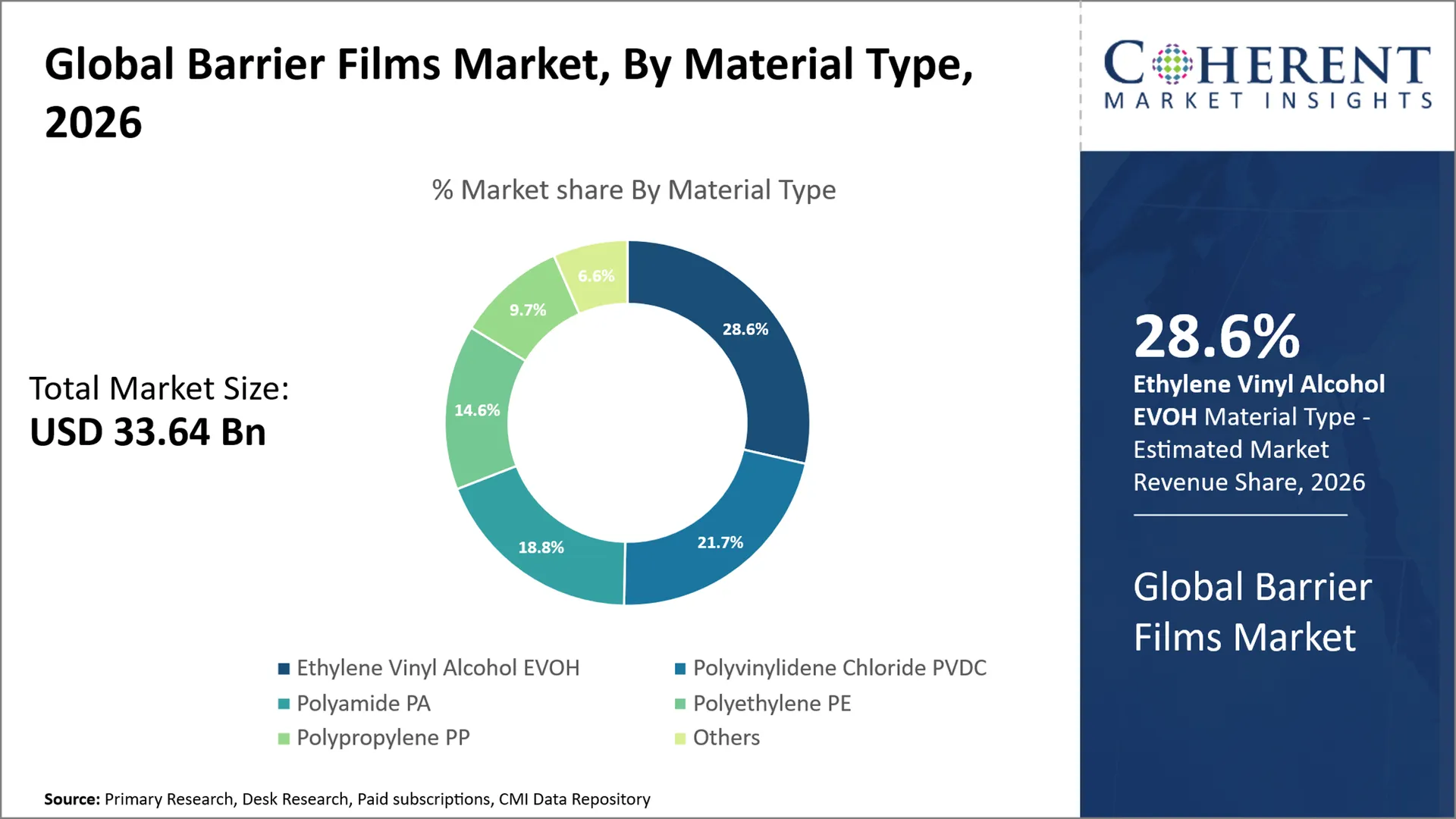
Why Does Ethylene Vinyl Alcohol (EVOH) Dominate the Material Type Segment of the Global Barrier Films Market?
EVOH leads the material category with 28.6% share in the global barrier films market because a thin resin layer can deliver strong gas-barrier performance without adding substantial package weight. Demand is particularly relevant for meat, dairy, ready-to-eat foods, and other oxygen-sensitive products where shelf-life protection must coexist with lightweight structures. Its compatibility with PE and PP also gives converters flexibility in multilayer construction. For manufacturers, the material’s high barrier efficiency supports downgauging and differentiated film formulations, while specialized processing capabilities reinforce supply consistency. In December 2025, Mitsubishi Chemical Corporation developed a paper-coating technology using SoarnoL EVOH resin, adding gas-barrier and oil-resistance functionality to paper packaging and broadening EVOH’s addressable packaging formats.
- Current Industry Events of 2026
- Market Size Estimation
- Regional Breakdown
- Competitive Landscape
- Customer Intelligence
- Segmental Analysis
- Pricing Analysis
- Key Market Drivers, Challenges & Future Trends
- Customized Insights Section
Why Does Multilayer Barrier Films Represent the Largest Film Structure Segment in the Global Barrier Films Market?
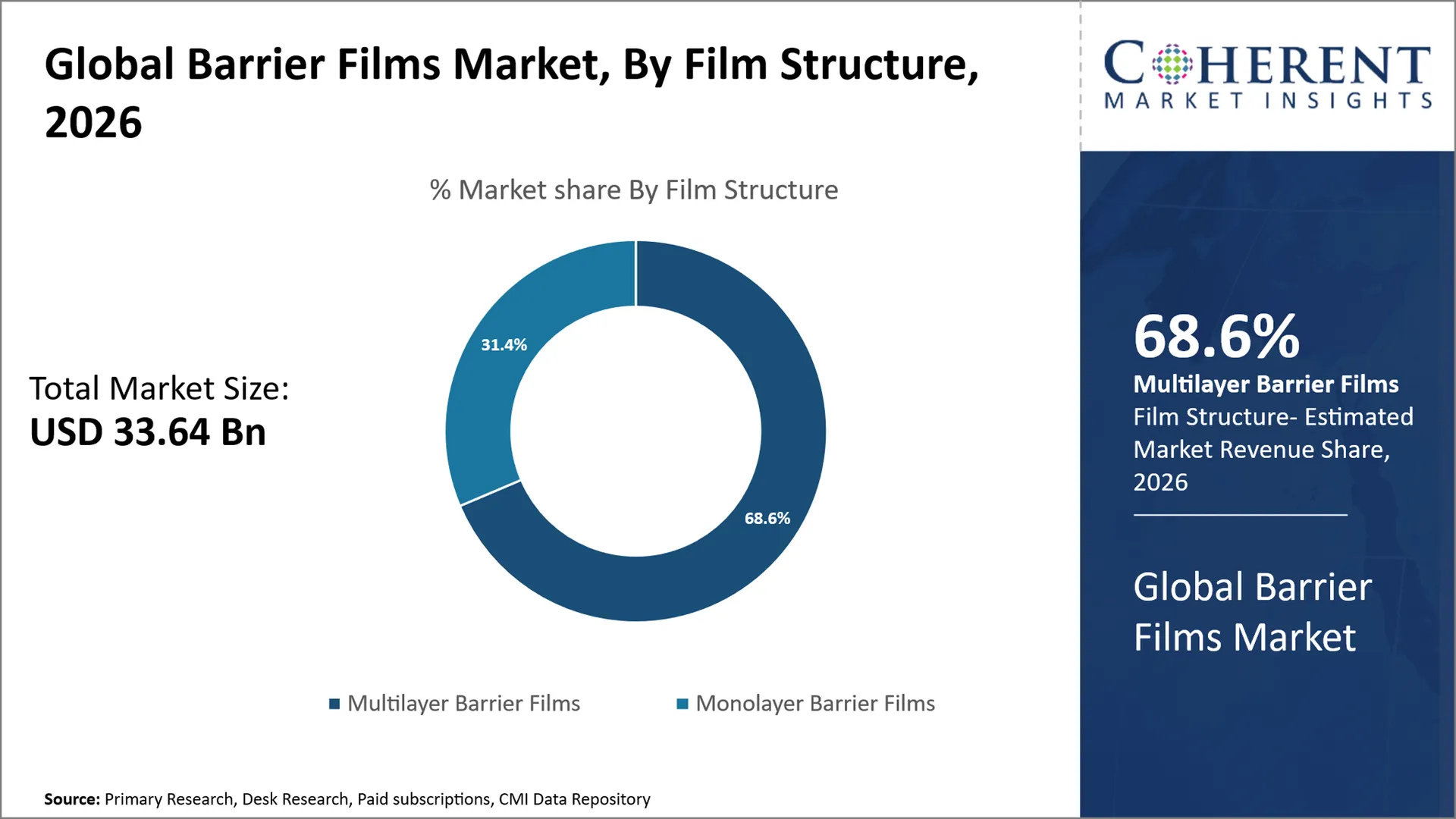
Multilayer Barrier Films command the film-structure category with 68.6% share in the global barrier films market because converters can engineer individual layers for sealing, strength, printability, moisture control, and gas protection rather than relying on one material to satisfy every requirement. This design flexibility is particularly valuable for powdered foods, dairy products, meat, and pharmaceutical formats with demanding protection specifications. Production economics also benefit from selective use of costly barrier components within a broader structural film. In September 2025, Camvac launched Camfoil, a multilayer metallized barrier-film laminate engineered to combine light, moisture, and gas protection with heat-sealing performance for products including milk, infant formula, and protein powders
Why Does Oxygen Barrier Films Dominate the Barrier Property Segment of the Global Barrier Films Market?
Oxygen Barrier Films hold the largest barrier-property with 38.7% share in global barrier films market because oxidation directly affects freshness, flavor, color, nutrient stability, and usable shelf life, making oxygen transmission a core specification for packaged foods and sensitive products. Buyers therefore prioritize predictable oxygen-control performance when selecting films for dry foods, snacks, confectionery, and other oxidation-prone applications. For suppliers, coatings and film treatments that deliver barrier performance with lower material complexity create opportunities to serve sustainability-conscious converters. In September 2024, Henkel and Panverta developed oxygen-barrier film solutions for dry-food packaging, achieving oxygen transmission performance that enabled movement toward mono-material polypropylene structures.
Current Events and their Impact
Current Event | Description and Its Impact |
European Commission PPWR Implementation Guidance – June 2026 |
|
India Plastic Waste Management Amendment Rules – March 2024 |
|
UK PackUK Flexible-Plastic Classification under Packaging EPR – October 2025 |
|
Global Barrier Films Market Dynamics
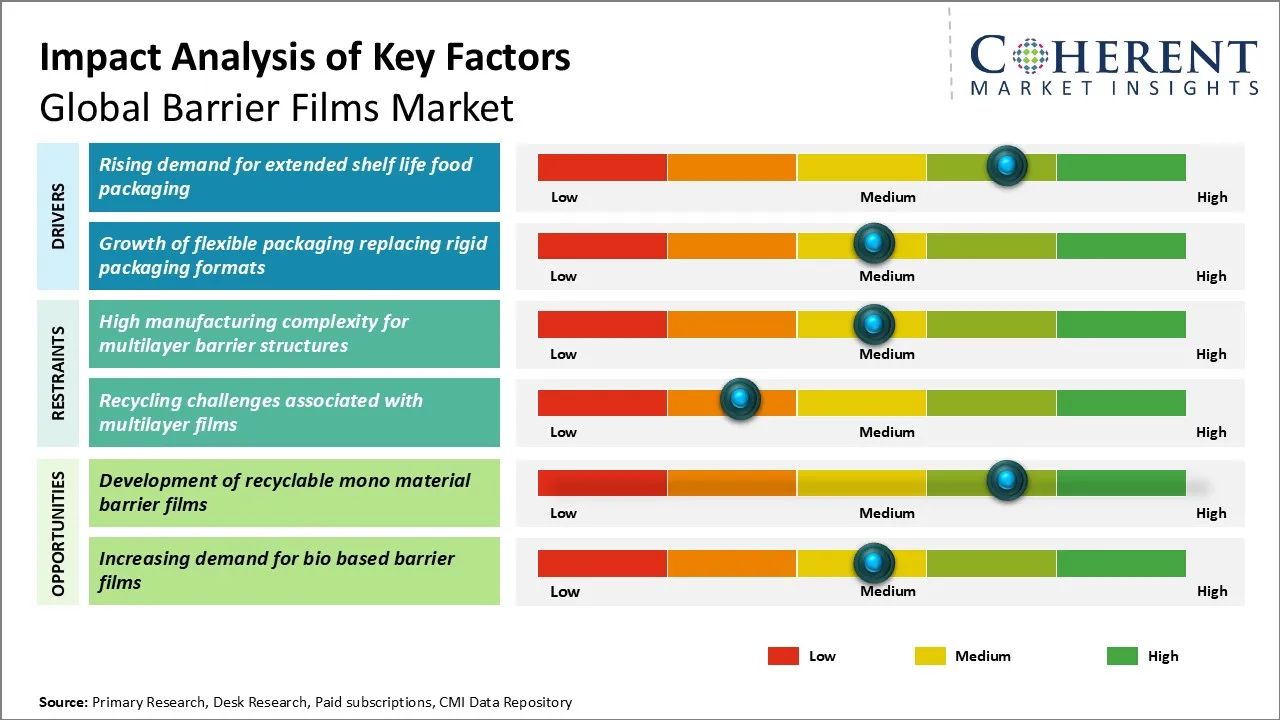
Key Market Drivers
- Rising demand for extended shelf life food packaging: Extended shelf life is becoming a direct procurement requirement as food brands widen distribution, increase chilled and convenience ranges, and seek to reduce spoilage without adding preservatives. Barrier films protect products against oxygen and moisture ingress, helping meat, poultry, seafood, dairy, and prepared-food processors maintain sensory quality through longer logistics cycles. This benefits film producers, converters, tray-lidding suppliers, and food manufacturers by improving product protection and reducing write-offs. In June 2025, Coveris launched BarrierFresh MAP trays using an EVOH barrier film to support 21-day shelf life for chilled meat, fish, and poultry applications.
- Growth of flexible packaging replacing rigid packaging formats: Flexible barrier packaging is gaining share where brands can replace bottles, tubs, and other rigid formats without sacrificing product protection, dispensing performance, or transport durability. Pouches use less material, occupy less warehouse and freight space, and allow converters to combine sealing, printing, and barrier functions within one structure. This shift benefits film extruders, laminators, pouch makers, and refill-format suppliers. In June 2025, ProAmpac and ScottsMiracle-Gro introduced a spouted pouch that replaced a rigid container format while using substantially less plastic and retaining chemical and UV resistance.
Emerging Market Trends
- Right-Sized Barrier Performance Replacing Overengineered Film Structures: Barrier-film development is moving away from maximizing protection at any cost toward right-sized performance matched to the product’s actual exposure profile. Converters are increasingly balancing oxygen transmission, moisture resistance, seal integrity, stiffness, optics, and gauge rather than specifying the heaviest laminate available. This changes formulation and equipment priorities because excessive barrier can add cost, complexity, and recycling penalties without creating proportional value. Resin suppliers, coating specialists, and converters with strong application-testing capability should benefit as buyers demand structures engineered around product life, filling conditions, distribution route, and end-of-life requirements.
- Pack-Level Qualification Becoming More Important Than Film-Level Specifications: Buyer qualification is shifting from film-level properties toward whole-pack performance, making machinability and recyclability evidence as important as laboratory barrier values. Brand owners and co-packers increasingly need materials that seal consistently at commercial line speeds, tolerate contamination, preserve print quality, and remain compatible with established collection or recycling streams. Suppliers that can validate performance across forming, filling, sealing, sterilization, storage, and recovery will gain stronger specification positions. This trend may pressure commodity film producers because technical service, converter collaboration, testing data, and pack-level design expertise become more decisive in procurement.
Regional Insights
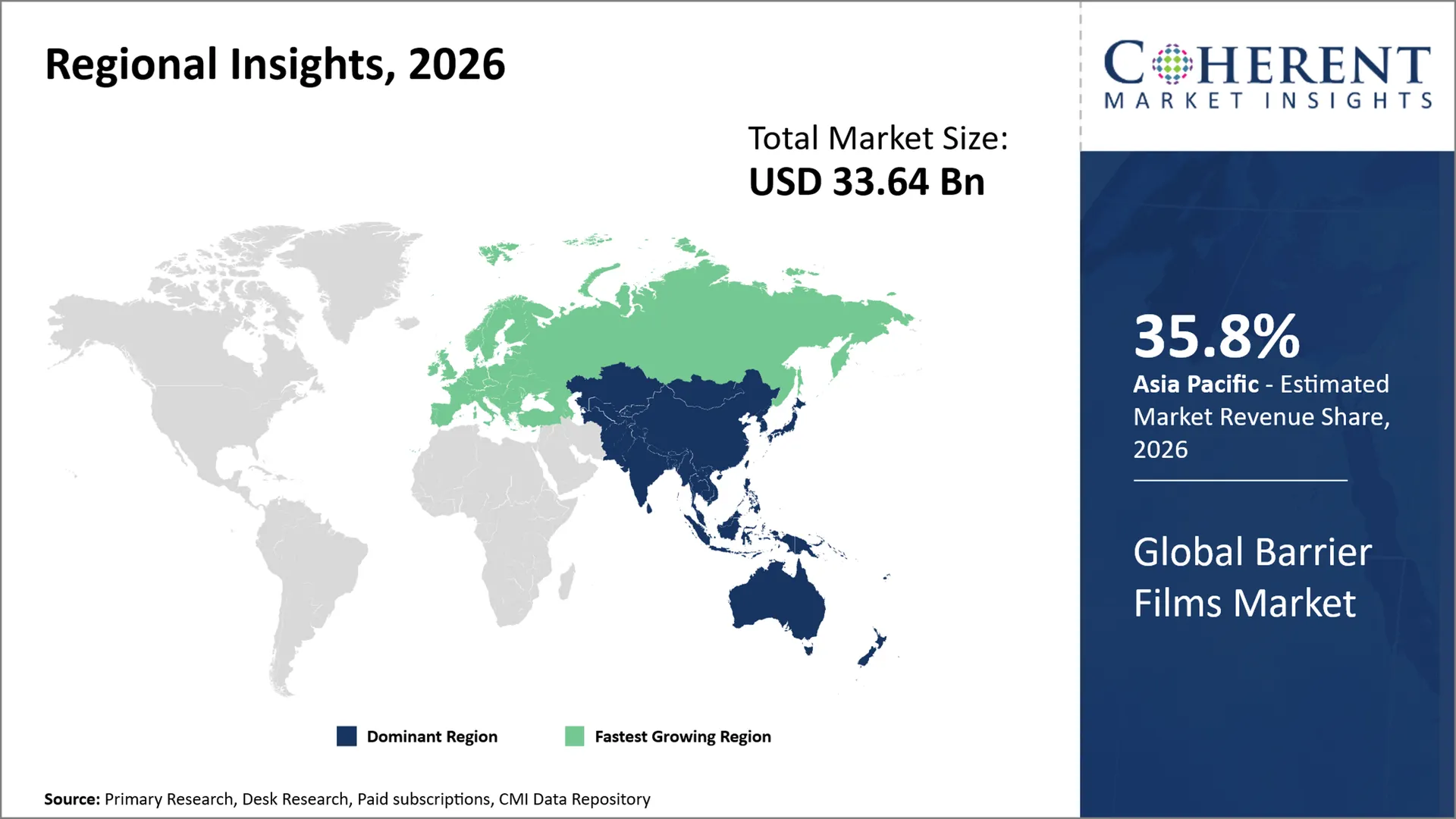
Why Does Asia Pacific Dominate the Global Barrier Films Market?
Asia Pacific is expected to account for 35.8% of the global barrier films market in 2026, supported by dense food-processing, flexible-packaging, pharmaceutical, and consumer-goods manufacturing networks across China, Japan, Southeast Asia, and other production hubs. Barrier films are commercially important because packaged foods increasingly move through long distribution chains requiring oxygen, moisture, aroma, and heat resistance without excessive package weight. Local availability of multilayer extrusion, thermoforming, lamination, and converting capacity also shortens qualification cycles for food and healthcare customers. In June 2025, SCGP showcased high-barrier thermoform packaging from Vexcel Pack at THAIFEX–ANUGA ASIA, using advanced multilayer material to extend shelf life for food and fruit under sterilized conditions. The development illustrates how regional suppliers are connecting barrier performance with convenience-food preservation and processing requirements.
Why Is Europe Emerging as the Fastest-Growing Region in the Global Barrier Films Market?
Europe is expected to hold 27.6% of the global barrier films market in 2026 and emerge as the fastest-growing region as packaging specifications shift toward recyclability, material efficiency, and verifiable end-of-life performance. This is creating replacement opportunities for mono-material-compatible barrier films, coated polyolefins, and redesigned multilayer structures rather than simply increasing conventional laminate volumes. Europe also has a strong food, pharmaceutical, medical, and specialty-packaging customer base requiring documented barrier and processing performance. In February 2025, the European Commission confirmed the entry into force of the Packaging and Packaging Waste Regulation, introducing requirements aimed at making packaging recyclable and expanding circular material use. For film suppliers, structures capable of maintaining oxygen and moisture protection while simplifying recycling pathways should become increasingly important during customer qualification and packaging redesign
Global Barrier Films Market Outlook for Key Countries
Why Is the U.S. a Key Market for the Global Barrier Films Market?
The U.S. is a key market for barrier films because large protein, dairy, snack, pet-food, healthcare, and specialty-consumer sectors rely on flexible packaging that combines shelf-life protection with high-speed converting performance. Domestic buyers increasingly assess films on barrier efficiency, seal integrity, downgauging potential, and compatibility with emerging recycling and producer-responsibility requirements. This supports investment in MDO-PE, multilayer extrusion, and recycle-ready barrier structures rather than conventional mixed-material laminates alone. Reflecting this manufacturing transition, in December 2025, Charter Next Generation announced new nine-layer and five-layer extrusion lines equipped with machine-direction orientation technology to expand high-barrier, recycle-ready film capacity. The company also operates multiple MDO-PE lines across its U.S. manufacturing network. Such investments strengthen local supply for food, confectionery, pet-food, and specialty packaging applications requiring performance alongside material simplification.
Why Does China Support Growth in the Global Barrier Films Market?
China supports barrier films market growth through its large converting base, extensive food and beverage manufacturing, packaged convenience-food consumption, and domestic capabilities in multilayer film, coating, and lamination. Scale is commercially important because Chinese converters supply both domestic brands and export-oriented packaged goods, creating requirements for consistent oxygen and moisture protection across high-volume production. Technical standardization is also becoming more specific for advanced film structures, improving qualification discipline. In August 2026, China published GB/T 28117-2026, General Quality Rules of Multi-layer Co-extrusion Films and Pouches for Food Packaging, scheduled for implementation in March 2027. The standard replaces an earlier specification for multilayer co-extruded food-packaging films. This favors suppliers capable of controlling layer construction, sealing, mechanical performance, and product consistency at industrial scale while supporting more sophisticated packaged-food applications.
Why Is Japan Important in the Global Barrier Films Market?
Japan is important in the global barrier films market because packaging buyers emphasize product preservation, precise material performance, compact pack formats, and dependable quality across food, pharmaceutical, cosmetics, and healthcare applications. Convenience foods and sensitive packaged products create a strong requirement for films combining oxygen, moisture, and light protection without compromising appearance or recyclability. Japan also contributes advanced coating and metallization expertise that supports higher-value film development. This innovation capability is visible in domestic material design. In July 2025, Dai Nippon Printing developed a PP-based high-barrier metallized IB-FILM for mono-material packaging, improving protection against oxygen and water vapor while supporting easier recycling. DNP positioned the structure for pharmaceuticals, cosmetics, and foods, illustrating how Japanese suppliers are addressing applications where preservation performance and material simplification must be achieved within the same package architecture.
Why Is Germany a Strategic Country in the Global Barrier Films Market?
Germany is a strategic barrier films market because its packaging ecosystem combines advanced converting equipment, demanding food and pharmaceutical customers, export-oriented manufacturing, and increasingly rigorous recyclability assessment. Buyers therefore require more than oxygen or moisture protection alone; film structures must also demonstrate process compatibility and credible end-of-life performance. This makes layer design, material selection, testing, and technical documentation important competitive factors for suppliers serving German converters. Regulatory methodology is reinforcing this procurement shift. In August 2025, Germany’s Central Agency Packaging Register, in agreement with the German Environment Agency, published the 2025 minimum standard for assessing packaging recyclability. The framework gives packaging producers a structured basis for evaluating recyclability and preparing for broader European requirements. Barrier-film suppliers that can document workable recycling routes for high-performance structures should therefore hold an advantage over difficult-to-validate laminate combinations.
Why Is Brazil an Important Growth Market for the Global Barrier Films Market?
Brazil is an important growth market for barrier films because its food economy combines large meat, poultry, dairy, coffee, pet-food, and processed-food industries with long domestic transport distances and substantial export activity. These conditions increase the commercial value of films that manage oxygen, moisture, aroma, puncture, and seal performance throughout extended distribution cycles. Flexible barrier packaging can also help processors protect products while reducing package weight relative to many rigid formats. Packaging policy is adding a second consideration alongside preservation performance. In October 2025, Brazil issued Decree No. 12,688 establishing a national reverse-logistics system for plastic packaging and requiring manufacturers, importers, distributors, and retailers to participate across the packaging life cycle. The decree also requires recyclability and durability to be considered during packaging design, strengthening the case for simplified or recyclable barrier-film structures within future packaging specifications.
Innovation, Production & Manufacturing Landscape in the Global Barrier Films Market
Manufacturing Approach | Commercial Role | Adoption Position | Strategic Implication |
Multilayer Co-extrusion | Combines EVOH, PA, PE, PP, tie layers, and sealants to achieve tailored oxygen, moisture, mechanical, and sealing performance. | Established and broadly commercial | Producers with precise layer control can reduce expensive barrier-material usage while maintaining performance and enabling downgauging. |
AlOx and SiOx Transparent Barrier Coating | Deposits transparent inorganic layers that provide strong gas-barrier performance while retaining product visibility. | Scaling in premium applications | Creates foil-replacement potential in transparent food, pharmaceutical, medical, and sensitive-product packaging where visibility has commercial value. |
Vacuum Metallization | Applies thin metallic layers to BOPP, BOPET, CPP, or other substrates to enhance oxygen, moisture, aroma, and light protection. | Highly commercialized | Process consistency, pinhole reduction, adhesion, and lower metal usage increasingly determine cost and barrier reliability. |
MDO-PE and Oriented Polyolefin Structures | Improves stiffness, dimensional stability, printability, and heat resistance in PE-rich structures designed for simplified recycling streams. | Rapidly scaling | Enables converters to replace selected PET/PE or mixed-polymer laminates while retaining processing performance. |
Functional Water-Based Barrier Coatings | Adds oxygen, grease, moisture, or aroma resistance without depending entirely on thick multilayer structures. | Emerging to scaling | Coating expertise can reduce material complexity and allow differentiated performance using thinner functional layers. |
Active Oxygen-Management Films | Incorporates oxygen-scavenging or reactive functionality into packaging to manage residual or ingress oxygen after sealing. | Selective specialist adoption | Particularly valuable for highly oxidation-sensitive foods, pharmaceuticals, and specialty products where passive barrier alone may not provide sufficient protection. |
How Are Transparent Recyclable High-Barrier Films Creating New Growth Opportunities in the Global Barrier Films Market?
Transparent recyclable high-barrier structures represent an underdeveloped opportunity in pharmaceutical, medical, diagnostics, and electronics packaging, where buyers often need product visibility together with strict protection against oxygen and moisture. The commercial gap exists because conventional high-barrier laminates can be difficult to recycle, while simpler mono-material films may not yet satisfy demanding shelf-life, sterilization, or sensitive-component requirements. Suppliers can capture this opportunity by combining transparent coatings, optimized polyolefin substrates, controlled sealing layers, and application-specific validation. Success will require investment in coating uniformity, migration testing, clean manufacturing, line-trial support, and documentation suitable for regulated customers. Specialist converters and vertically integrated film producers are likely to hold an advantage because they can coordinate substrate design, coating, lamination, testing, and qualification. The strongest route to market will be co-development with pharmaceutical packers, medical-device firms, diagnostic suppliers, and electronics manufacturers seeking recyclable protection without sacrificing visibility, traceability, processing reliability, and evolving cross-border compliance requirements.
Market Players, Key Development, and Competitive Intelligence
Key Developments
- In November 2025, BOBST introduced the next-generation EXPERT K5 vacuum metallizer with automated process control for advanced metallized and transparent barrier films. This matters for the global barrier films market because more consistent coating and metallization can improve barrier quality, production yield, and converter economics across high-performance flexible packaging.
- In June 2025, Cosmo First commissioned a new BOPP film line at its Aurangabad site, expanding its production platform for specialty and packaging films. This matters for the global barrier films market because added BOPP capacity supports larger-scale supply of engineered substrates used in barrier, metallized, and laminated packaging structures.
- In October 2024, Klöckner Pentaplast launched two recyclable barrier flow-wrap films based on PE and PP structures for food packaging. This matters for the global barrier films market because the launch shows how high-barrier formats are being redesigned around mono-material content while retaining product protection and commercial pack-line compatibility.
Competitive Landscape
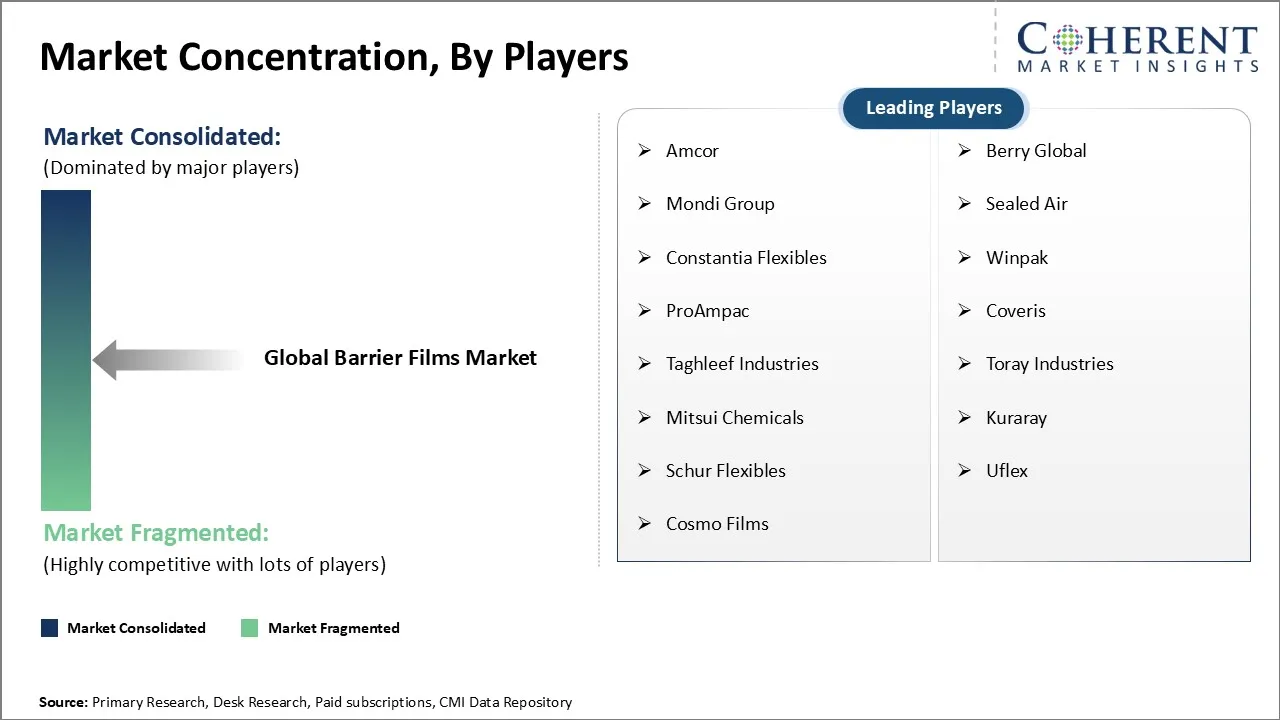
The global barrier films market is moderately fragmented, combining large integrated polymer and film producers with multinational converters, packaging specialists, coating-technology suppliers, and regional manufacturers. Competition centers on barrier consistency, downgauging, recyclability, seal performance, regulatory compliance, and dependable supply. Regional specialists remain relevant where short lead times and customized structures matter, while scale players benefit from broader R&D, qualification support, and multi-country manufacturing networks.
Key focus areas include
- Barrier-to-gauge efficiency: Delivering required protection with less material supports both margin control and packaging reduction targets.
- Conversion performance: Seal-window stability, machinability, print quality, anti-fog properties, and puncture resistance influence converter qualification.
- Recyclability engineering: Mono-material compatibility and simplified layer structures are becoming stronger differentiators in customer specifications.
- Manufacturing reliability: Consistent coating thickness, film flatness, optical quality, and uninterrupted supply remain essential for high-speed packaging operations.
- Application customization: Food, pharmaceutical, medical, electronics, and industrial buyers require different barrier and processing combinations.
- Technical service capability: Line trials, failure analysis, shelf-life validation, and material-selection support strengthen long-term customer relationships.
- Regional supply flexibility: Local manufacturing and multiple sourcing routes help reduce freight exposure, qualification risk, and customer lead times.
Market Report Scope
Global Barrier Films Market Report Coverage | |||
Report Coverage | Details | ||
Base Year | 2025 | Market Size in 2026: | USD 33.64 Bn |
Historical Data For: | 2020 To 2024 | Forecast Period: | 2026 To 2033 |
Forecast Period 2026 To 2033 CAGR: | 7.50% | 2033 Value Projection: | USD 55.81 Bn |
Geographies covered: |
| ||
Segments covered: |
| ||
Companies covered: | Amcor, Berry Global, Mondi Group, Sealed Air, Constantia Flexibles, Winpak, ProAmpac, Coveris, Taghleef Industries, Toray Industries, Mitsui Chemicals, Kuraray, Schur Flexibles, Uflex, Cosmo Films | ||
Growth Drivers: |
| ||
Restraints & Challenges: |
| ||
Analyst Opinion (Expert Opinion)
- Barrier-film leadership is likely to shift from selling film as a specification product toward solving complete packaging-performance problems. Suppliers able to integrate substrate design, coating, sealing behavior, line trials, compliance documentation, and end-of-life design should gain deeper customer relationships and stronger pricing resilience than producers competing mainly on gauge and resin cost.
- A major disruption could come from pack designs that deliver required barrier performance with fewer functional layers and less dependence on difficult-to-separate laminates. This would pressure legacy structures built around complexity as a performance proxy. Participants with coating science, orientation technology, surface treatment, and precise process control should benefit as buyers demand simpler structures with equivalent protection.
- Market participants should prioritize application laboratories, converter partnerships, regulatory testing, and manufacturing flexibility rather than overinvesting only in nameplate film capacity. Pharmaceutical, medical, retort, and sensitive-food applications deserve focused development, but qualification cycles and raw-material volatility can compress returns. Local technical support and multi-source resin strategies can reduce risk while protecting service levels and customer retention.
Speak to the analyst
Want personalized insights?
Take the findings above to one of our principal consultants, or have the report rebuilt around the segments, geographies and competitors you actually track.
Market Segmentation
- Material Type Insights (Revenue, USD Bn, 2021 - 2033)
- Ethylene Vinyl Alcohol EVOH
- Polyvinylidene Chloride PVDC
- Polyamide PA
- Polyethylene PE
- Polypropylene PP
- Others
- Film Structure Insights (Revenue, USD Bn, 2021 - 2033)
- Multilayer Barrier Films
- Monolayer Barrier Films
- Barrier Property Insights (Revenue, USD Bn, 2021 - 2033)
- Oxygen Barrier Films
- Moisture Barrier Films
- Aroma Barrier Films
- Light Barrier Films
- Other Functional Barriers
- Application Insights (Revenue, USD Bn, 2021 - 2033)
- Food Packaging
- Pharmaceutical Packaging
- Medical Packaging
- Electronics Packaging
- Industrial Packaging
- Others
- Food Packaging Application Insights (Revenue, USD Bn, 2021 - 2033)
- Meat Poultry and Seafood Packaging
- Dairy Packaging
- Bakery and Confectionery Packaging
- Ready to Eat Food Packaging
- Beverage and Liquid Packaging
- Others
- Distribution Channel Insights (Revenue, USD Bn, 2021 - 2033)
- Direct Sales
- Indirect Sales
- Regional Insights (Revenue, USD Bn, 2021 - 2033)
- North America
- U.S.
- Canada
- Latin America
- Brazil
- Argentina
- Mexico
- Rest of Latin America
- Europe
- Germany
- U.K.
- Spain
- France
- Italy
- Russia
- Rest of Europe
- Asia Pacific
- China
- India
- Japan
- Australia
- South Korea
- ASEAN
- Rest of Asia Pacific
- Middle East
- GCC Countries
- Israel
- Rest of Middle East
- Africa
- South Africa
- North Africa
- Central Africa
- North America
Sources
Primary Research Interviews
- Barrier film manufacturers multilayer film producers coating and metallization specialists
- Flexible packaging converters food pharmaceutical and medical packaging companies
- Polymer resin suppliers extrusion equipment manufacturers brand owners and procurement professionals
Stakeholders
- Barrier film manufacturers and converters
- EVOH PVDC PA PE PP resin and coating-material suppliers
- Food pharmaceutical medical electronics and industrial packaging companies
- Distributors importers exporters machinery suppliers and contract converters
End-use Sectors
- Food and beverage packaging
- Pharmaceutical and medical packaging
- Electronics packaging
- Industrial and specialty packaging
Regulatory and Industry Bodies
- U.S. Food and Drug Administration FDA
- European Commission
- European Chemicals Agency ECHA
- U.S. Environmental Protection Agency EPA
- International Organization for Standardization ISO
- ASTM International
- National food-contact packaging and environmental authorities
Databases
- Company annual reports and investor presentations
- UN Comtrade packaging film and polymer trade datasets
- Eurostat and national manufacturing databases
- Polymer resin and specialty film pricing databases
- Barrier film production capacity and converting databases
- Patents product specifications and packaging technology databases
Magazines and Journals
- Packaging Technology and Science
- Food Packaging and Shelf Life
- Journal of Plastic Film & Sheeting
- Polymer Testing
- Journal of Applied Polymer Science
- Packaging Europe
Associations
- Flexible Packaging Association FPA
- CEFLEX
- Association of Plastic Recyclers APR
- PlasticsEurope
- Flexible Packaging Europe FPE
- Regional packaging and plastics industry associations
Public Domain Sources
- Flexible packaging production and consumption data
- Food pharmaceutical and medical packaging statistics
- Polymer resin production and trade flows
- Barrier coating and multilayer film technology developments
- Recycling infrastructure and packaging waste data
- Food-contact and packaging regulatory updates
- Sustainability and circular packaging initiatives
Key Standards and Regulations
- EU Packaging and Packaging Waste Regulation PPWR
- EU Regulation No. 10/2011 on plastic food-contact materials
- U.S. FDA food-contact packaging requirements
- ASTM D3985 oxygen transmission rate testing
- ASTM F1249 water vapor transmission rate testing
- ISO packaging and environmental standards
- Extended Producer Responsibility EPR and recyclability requirements
Proprietary Elements
- CMI Data Analytics Tool
- Proprietary CMI repository containing 10+ years of flexible packaging barrier films polymer resins food and pharmaceutical packaging production capacity trade flows pricing technology developments regulatory changes and competitive intelligence.
Get access to 250+ pages report
Every segment, forecast, competitor profile and data table behind the analysis above — available for instant download.
- ESOMAR Member
- ISO 9001:2015 Certified
- D-U-N-S Registered
- GDPR & CCPA Compliant
Frequently Asked Questions
The CAGR of global barrier films market is projected to be 7.50% from 2026 to 2033.
The global barrier films market is estimated to be valued at USD 33.64 Bn in 2026 and is expected to reach USD 55.81 Bn by 2033.
Rising demand for packaging that extends food shelf life, together with the shift from rigid packaging to flexible formats, are the key factors supporting growth of the global barrier films market.
High manufacturing complexity for multilayer barrier structures and Recycling challenges associated with multilayer films are the major factor hampering the growth of global barrier films market.
In terms of material type, ethylene vinyl alcohol EVOH are estimated to dominate the market revenue share in 2026.
Amcor, Berry Global, Mondi Group, Sealed Air, Constantia Flexibles, Winpak, ProAmpac, Coveris, Taghleef Industries, Toray Industries, Mitsui Chemicals, Kuraray, Schur Flexibles, Uflex, Cosmo Films are the major players.
Asia Pacific is expected to lead the global barrier films market in 2026.