

Global Brake Lathe Machine Market Size and Forecast – 2026 To 2033
The global brake lathe machine market is expected to grow from USD 4.30 Bn in 2026 to USD 6.30 Bn by 2033, registering a compound annual growth rate (CAGR) of 5.6% from 2026 to 2033. The global brake lathe machine market is driven by the rising emphasis on extending brake component life to reduce maintenance costs. On June 10, 2025, Brembo unveiled its new GT Braking System during the 2025 24 Hours of Le Mans, with competition debut scheduled for the 2026 FIA World Endurance Championship.
Key Takeaways of the Global Brake Lathe Machine Market
- The on-car brake lathe machines segment is expected to account for 39.0 % of the global brake lathe machine market share in 2026. Increasing adoption of precision CNC and automatic brake lathes by workshops is driving the growth of the segment. On February 28, 2025, COMEC launched the FSV SMART digital control system, which provides the workshop operator with an easier way to regulate machining parameters on brake disc and drum machining equipment.
- The manual segment is estimated to capture 42.0 % of the market share in 2026. Rising investments in dealership workshop modernization is majorly driving the growth of the segment. On January 14, 2026, Mercedes-Benz announced that it has increased investment in its global retail network, upgrading dealership service facilities with advanced digital workshop technologies, connected diagnostics, and technician support systems as part of its customer experience strategy.
- The passenger vehicles segment is estimated to capture 49.0 % of the market share in 2026. The growing expansion of aftermarket service centers is driving the growth of the segment. On April 3, 2026, Maruti Suzuki India Limited announced addition of a record 502 new service touchpoints in FY 2025-26. With this, Maruti Suzuki’s total after-sales service network has reached to 5,926 touchpoints, covering 3,000 cities and towns in India.
- North America is expected to dominate the brake lathe machine market in 2026 with a market share of 38.0 %. Expansion of automotive service chains in North America is driving the growth of the regional market. On February 20, 2025, Valvoline Inc. announced that it has signed a definitive agreement to acquire Breeze Autocare from Greenbriar Equity Group. Breeze Autocare is a strong operator of nearly 200 stores across 17 states in the U.S.
- Asia Pacific is expected to account for 30.0 % of the market share in 2026 and is projected to record the fastest growth over the forecast period. Integration of digital measurement systems and automated diagnostics with brake lathes in Asia Pacific is driving the growth of the regional market. On February 7, 2026, ZF Aftermarket showcased its ZF MultiScan diagnostics platform and connected workshop solutions at ACMA Automechanika New Delhi 2026.
- Adoption of CNC and Fully Automated Brake Lathe Systems: Automotive service centers are increasingly adopting CNC and fully automated brake lathes over traditional manual brake lathes as CNC and automated systems provide better machining accuracy, reduced setup times, automatic feed control and reduced dependence on operators, which, in turn, helps to improve workshop productivity and consistency in automotive brake systems.
- Growth of On-Car Brake Lathe Technology for Precision Servicing: On-car brake lathes are gaining wider adoption because they resurface brake rotors directly on the vehicle hub, ensuring precise hub-to-rotor alignment while minimizing lateral runout and brake vibration. Their ability to improve machining accuracy, reduce service time, and consistently meet OEM brake performance standards is driving increased adoption across automotive dealerships and professional repair workshops.
Segmental Insights
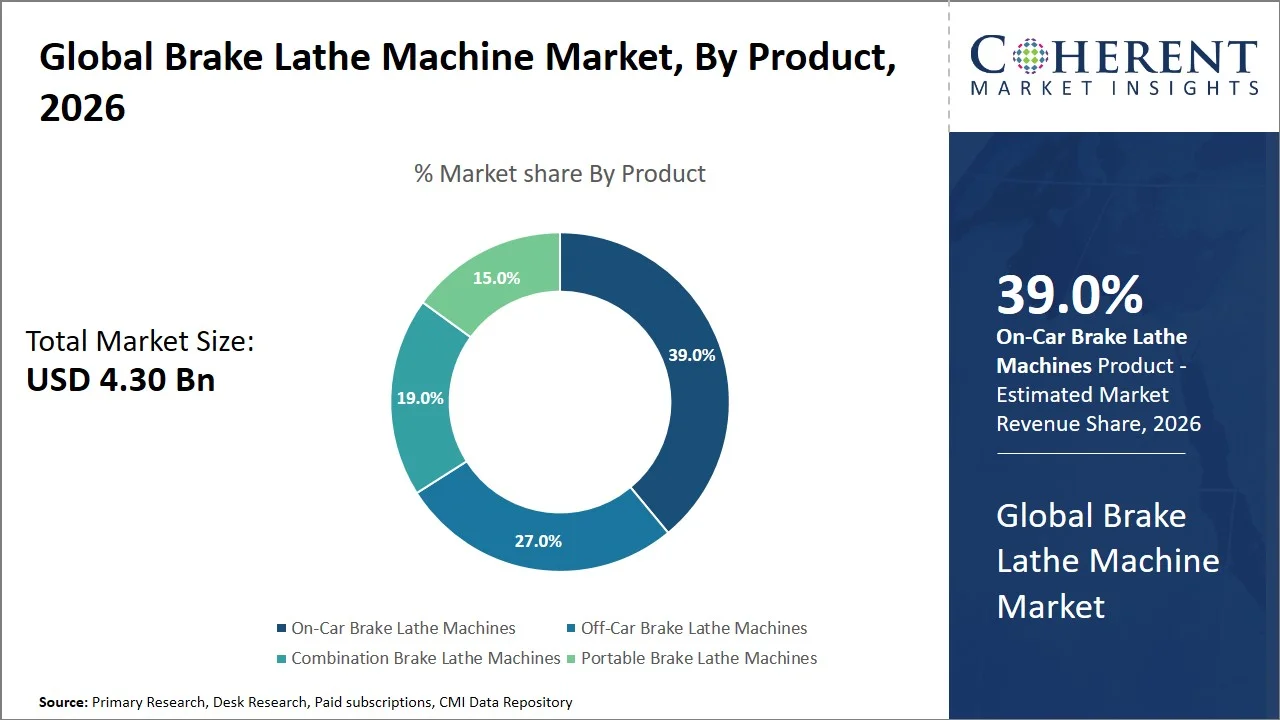
Why Do On-Car Brake Lathe Machines Dominate the Global Brake Lathe Machine Market?
The on-car brake lathe machines segment is expected to account for 39.0% of the global brake lathe machine market share in 2026. For brake lathe machines, the best method is on-car brake lathe machines since they mill the brake rotor while attached to the vehicle hub and do not create errors due to removal and reinstallation of the rotor. This method greatly increases machining accuracy by aligning the rotor to the real hub alignment, minimizing brake vibration, lateral runout and noise after service. As a result, professional repair shops and automotive dealerships are utilizing on-car systems to deliver OEM-level braking performance and to cut down on repeat repair and maintenance visits. On November 8, 2024, Pro-Cut International introduced the X1 HD On-Truck Brake Lathe at SEMA 2024 and expanded demonstrations and training for fleets and shops servicing heavy-duty vehicles, encouraging on-vehicle brake machining to decrease rotor replacement and enhance hub-aligned machining accuracy.
- Current Industry Events of 2026
- Market Size Estimation
- Regional Breakdown
- Competitive Landscape
- Customer Intelligence
- Segmental Analysis
- Pricing Analysis
- Key Market Drivers, Challenges & Future Trends
- Customized Insights Section
Why is Manual the Most Preferred Functionality?
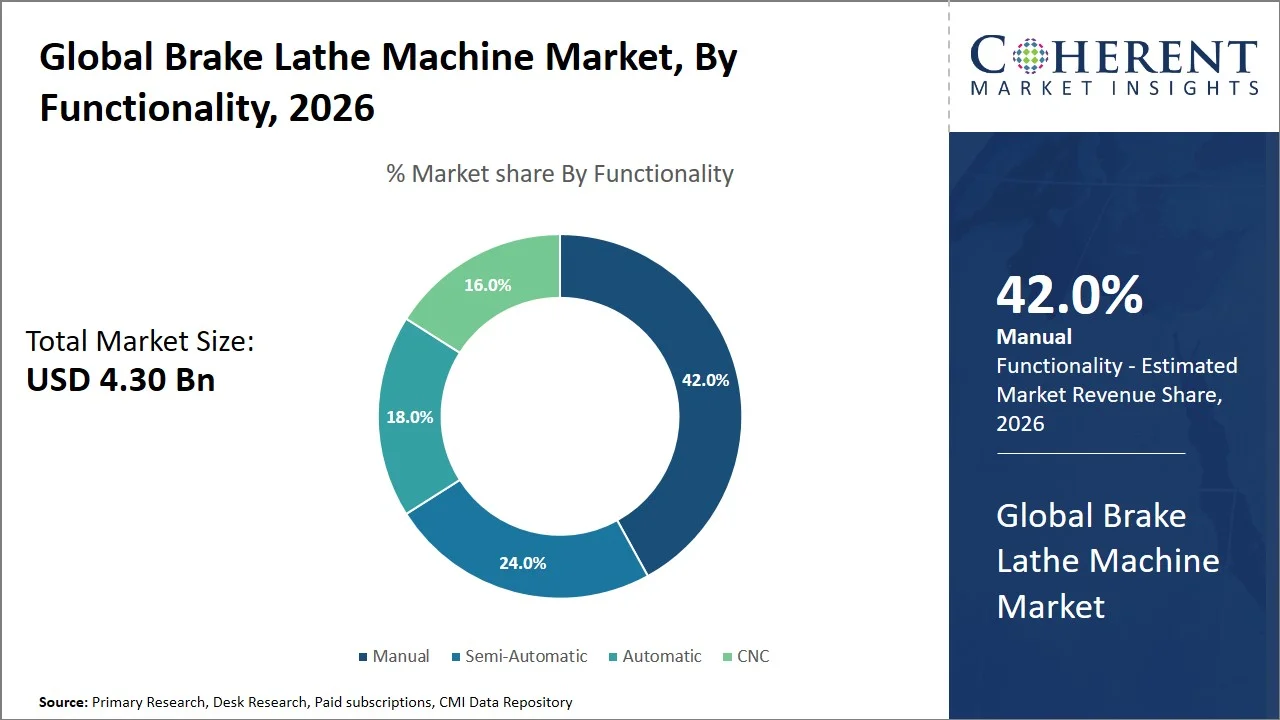
The manual segment is expected to account for 42.0% of the global brake lathe machine market share in 2026. Manual functionality remains the most preferred because it offers a cost-effective solution that meets the operational needs of the large number of independent automotive repair shops and small service garages worldwide. These machines require lower initial investment, are easier to maintain, and allow experienced technicians to perform precise brake rotor resurfacing without the complexity of automated systems, making them a practical choice for workshops with moderate service volumes. For instance, Pro-Cut International continues the expansion of its virtual training and live product demonstration programs, helping independent workshops improve technician proficiency and brake machining quality while supporting both existing equipment users and new customers.
Passenger Vehicles Dominate the Global Brake Lathe Machine Market
The passenger vehicles segment is expected to account for 49.0% of the global brake lathe machine market share in 2026. Passenger vehicles have the highest demand because they make up the most common category of cars needing routine brake maintenance over their lifetime. Daily commuting, city driving and scheduled maintenance create a constant demand for brake lathe machines in dealerships, independent repair shops and other automotive service centers. On June 30, 2025, VinFast Auto announced a strategic service collaboration with myTVS, a leading automotive service provider in the country. As part of its commitment to enhancing customer experience, VinFast aims to establish 120 Extended Service Workshops by partnering with potential service providers to boost its aftersales operations across India.
Current Events and their Impact
Current Events | Description and its Impact |
U.S. - National Highway Traffic Safety Administration Final Rule on Automatic Emergency Braking |
|
European Union – Euro 7 Regulation (Regulation (EU) 2024/1257) |
|
Global Brake Lathe Machine Market Dynamics
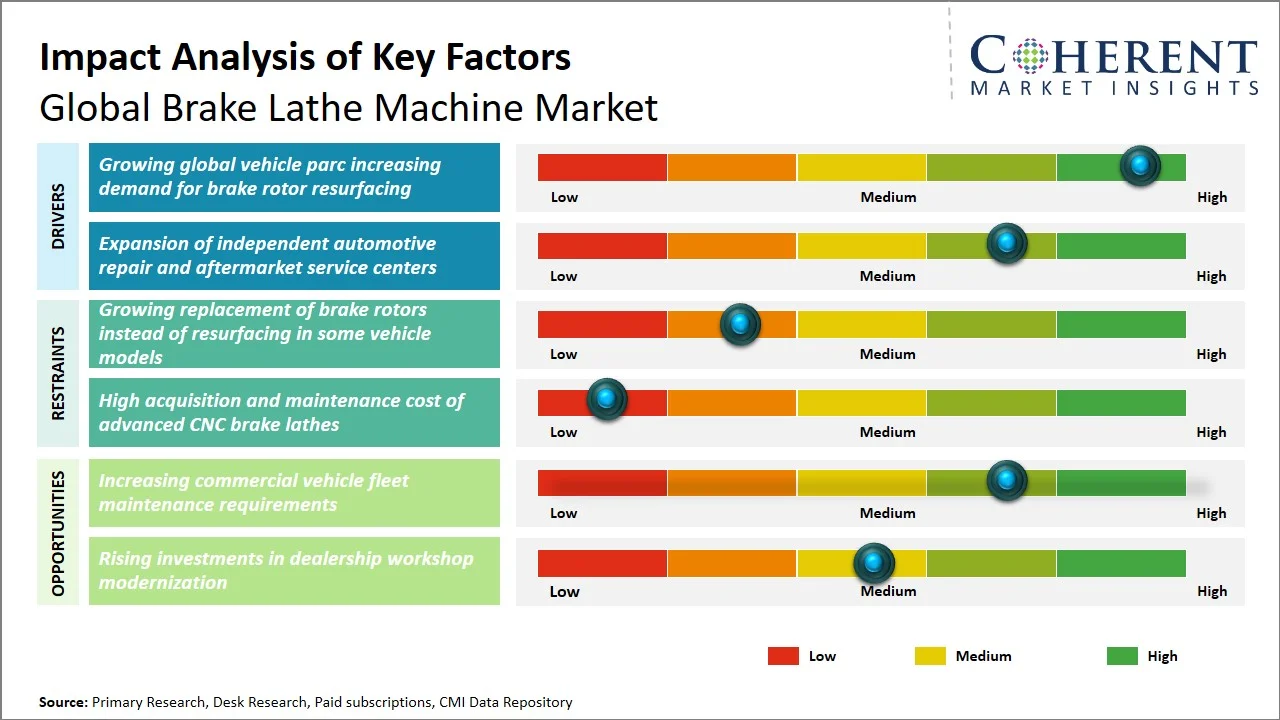
Market Drivers
- Growing global vehicle parc increasing demand for brake rotor resurfacing: The ever-growing global vehicle parc is increasing the frequency of the routine brake maintenance and producing a sustained need for brake rotor resurfacing equipment. Brake rotors on passenger cars, light commercial vehicles and heavy-duty fleets experience repetitive wear from daily operation since these vehicles remain in service longer, and need to be resurfaced at intervals to restore braking performance and extend component life. This trend is prompting repair shops and dealerships to invest in brake lathe equipment with improved machining accuracy and reduced replacement prices. On January 20, 2025, Brakes India announced that the company will invest a minimum of USD 10 billion by 2030 to ramp up its braking component manufacturing capacity to meet the growing demand from passenger and commercial vehicle markets. The investment will boost production capacity for brake discs and related parts that facilitate aftermarket brake servicing.
- Expansion of independent automotive repair and aftermarket service centers: The exponential growth of independent automotive repair shops and organized aftermarket service networks is accelerating the adoption of brake lathe machines globally. These facilities are expanding their maintenance capabilities to offer cost-effective brake servicing which allows clients to resurface brake rotors instead of replacing them when allowed by OEM specifications. The increasing requirement for full in-house repair facilities is forcing workshops to adopt advanced brake lathe equipment that enhances turnaround time, service quality and operational efficiency. On June 16, 2025, Mavis Tire Express Services Corp., a leading provider of automotive repair and maintenance services and one of the largest independent tire and service providers in North America, announced that it has completed the purchase of Midas from TBC Corporation.
Emerging Trends
- Integration of Digital Measurement and Smart Diagnostics: Modern brake lathe machines are integrating digital thickness gauges, laser alignment systems, touch-screen interfaces and electronic diagnostic capabilities that allow technicians to verify rotor dimensions, optimize machining settings and meet OEM service requirements.
- Expansion of Heavy-Duty and Commercial Vehicle Brake Maintenance Solutions: The growth in commercial vehicle fleets, transit buses, logistics trucks and construction equipment has increased the need for heavy-duty brake lathe machines that can resurface larger brake discs and drums, leading manufacturers to develop higher-capacity machines with improved durability and faster machining cycles.
Regional Insights
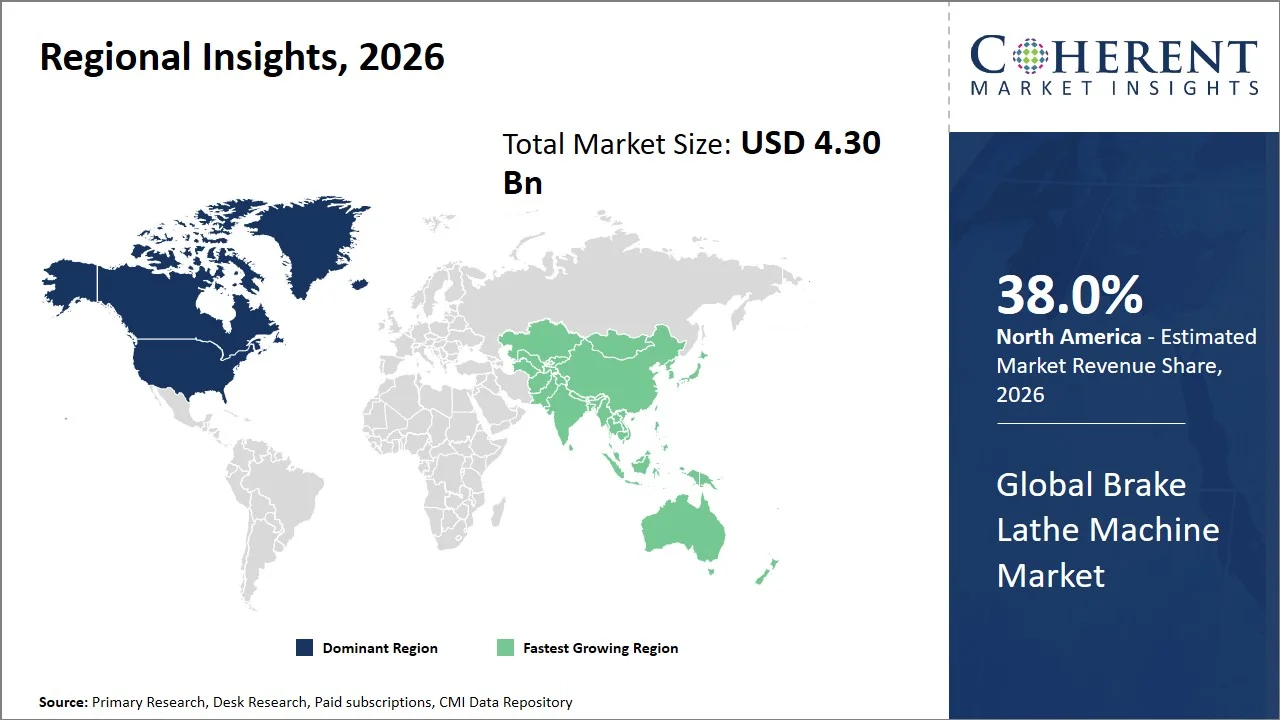
Why is North America a Strong Market for Brake Lathe Machines?
North America is expected to account for a market share of 38.0% in 2026. North America is still the most mature market for brake lathe machines, due to the large size of the automobile aftermarket and the resurfacing of brake rotors instead of outright replacement. The U.S. and Canada have a combined over 170,000 vehicle repair and maintenance businesses that create a continuing demand for brake servicing equipment. Major workshop equipment producers including Hunter Engineering, Pro-Cut International, BendPak and AMMCO supply and manufacture on-car and off-car brake lathes through dealership and independent repair networks. Dealer groups handling brands including Ford, General Motors, Stellantis, Toyota, Honda, BMW, Mercedes-Benz, and Hyundai commonly use precision brake lathes to conform to OEM rotor runout specs. The increasing penetration of ADAS-equipped vehicles has further raised the demand for highly accurate rotor machining, as braking performance directly affects automatic emergency braking system calibration and reliability.
Why Does the Asia Pacific Brake Lathe Machine Market Exhibit High Growth?
Asia Pacific is projected to account for 30.0% of the global brake lathe machine market and is expected to register the fastest growth. Asia Pacific is witnessing the fastest expansion in brake lathe machine adoption, supported by rapid vehicle ownership growth and the modernization of automotive service infrastructure across China, Japan, India, South Korea, Thailand, and Australia. In China alone, there are tens of thousands of authorized 4S dealerships, and Japan has one of the largest densities of licensed automobile service workshops in the world. Regional builders are now bringing small CNC and digital brake lathes to high-volume businesses and multi-brand service centers. The growth of commercial vehicle fleets supporting e-commerce logistics in China and India is also helping to spur investment in heavy-duty brake resurfacing equipment for trucks and buses. The region’s advantages are further amplified by government programs that promote professional vehicle repair standards and technician certification, pushing shops to acquire OEM-approved brake machining equipment.
Global Brake Lathe Machine Market Outlook for Key Countries
Why is the U.S. Emerging as a Major Hub in the Brake Lathe Machine Market?
The U.S. represents the largest single-country market, supported by one of the world's largest vehicle populations and a highly developed independent repair industry. Large aftermarket chains including Firestone Complete Auto Care, Midas, Meineke, Christian Brothers Automotive, Monro Auto Service and Tire Centers, Pep Boys, and Les Schwab Tire Centers perform high volumes of brake servicing and utilize advanced brake lathe equipment to reduce rotor replacement costs. Hunter Engineering in Missouri and Pro-Cut International in Massachusetts continue to develop on-car brake lathes with digital compensation systems for modern vehicles. Fleet operators, such as Penske Truck Leasing, Ryder System and municipal transit agencies, also employ heavy-duty brake lathes to service buses and commercial vehicles. Demand for precision brake repair is increasing as the adoption of electric vehicles from Tesla, Ford, General Motors, Rivian, Hyundai and Lucid boosts the demand for rotor resurfacing as regenerative braking increases rotor life but requires accurate resurfacing when conventional braking components are serviced.
Is China the Next Growth Engine for the Brake Lathe Machine Market?
China has become one of the fastest growing markets with the country’s fleet growing with the rapidly modernizing automotive service industry. Domestic leading manufacturers including BYD, SAIC Motor, Geely, Chery, Great Wall Motor and FAW Group have built national dealership service networks with advanced workshop machinery. Thousands of authorized 4S dealers do OEM level brake work using advanced resurfacing equipment, while independent repair shops move from manual to semi-auto and CNC brake lathes. Demand for high-duty brake lathes capable of cutting larger brake discs and drums is also rising among the country’s growing heavy truck manufacturers including FAW Jiefang, Sinotruk, Dongfeng Commercial Vehicle and Shacman. Chinese workshop equipment makers are also seeing export growth, which should help local manufacturing capacity.
Germany Brake Lathe Machine Market Analysis and Trends
Germany has a very matured brake lathe machine market with world-class automobile engineering and rigorous OEM service protocols. Brake servicing must meet stringent rotor thickness and runout specs required by manufacturers such as Mercedes-Benz, BMW, Volkswagen Group, Audi, Porsche and Bosch Car Service. Precision brake servicing solutions for dealer workshops and professional service centers are offered by large workshop equipment providers like Hofmann Megaplan and CEMB. The extensive vehicle inspection system (TÜV) in Germany encourages preventive brake maintenance and the huge premium car population in Germany maintains the demand for high-precision brake resurfacing technology. The introduction of digitally controlled brake lathes capable of cutting to nano levels has also been driven by the increasing use of high-performance braking systems in luxury and electric vehicles.
Japan Brake Lathe Machine Market Analysis and Trends
The market in Japan is bolstered by one of the world's most sophisticated automotive repair ecosystems and stringent inspection regulations under the Shaken vehicle inspection program. Toyota, Honda, Nissan, Mazda, Subaru, Suzuki and Mitsubishi Motors all have extensive authorized dealership networks with precision workshop equipment for OEM-compliant brake servicing. Automotive service companies and certified maintenance facilities are using compact on-car brake lathes to help them reduce brake vibration and improve rotor accuracy. High average reliability of vehicles in Japan encourages preventive maintenance rather than reactive repairs, keeping the demand for brake resurfacing equipment during the life of a vehicle. The country’s sound manufacturing capabilities in precision machine tools also promote continued innovation in small, high-accuracy brake lathe technology.
India Brake Lathe Machine Market Analysis and Trends
India is emerging as a high growth market with rapid rise of passenger car fleet and organized automotive aftermarket. Vehicle makers such as Maruti Suzuki, Tata Motors, Mahindra, Hyundai Motor India, Kia India, Toyota Kirloskar Motor, Honda Cars India and Ashok Leyland are expanding dealership workshops with state-of-the-art brake servicing equipment. Organized service chains such as Bosch Car Service, Mahindra First Choice Services, GoMechanic and TVS Mobility are investing in brake lathe machines to minimize rotor replacement costs and boost workshop productivity. The commercial vehicle segment is experiencing an increase in demand for heavy-duty brake lathes that can accommodate larger braking systems, driven by growing freight transportation and state transport bus fleets. The enhanced vehicle fitness checks for commercial vehicles and increasing trend of preventive maintenance by fleet operators are driving up the adoption of professional brake resurfacing equipment.
Global Brake Lathe Machine Market - Automotive Aftermarket Workshop Expansion
Country | Estimated Automotive Aftermarket Workshop Growth (2025 vs 2024) | Major Example |
India | 11.8% | Maruti Suzuki expanded its service network to 5,926 touchpoints, while VinFast partnered with myTVS for 120 service workshops |
China | 9.6% | Bosch Car Service and regional EV service providers expanded certified workshop coverage in major cities |
U.S. | 8.2% | Mavis completed the acquisition of Midas, significantly expanding its North American service footprint |
Germany | 6.9% | Bosch Car Service continued expanding digitally connected workshops across Germany |
Japan | 5.8% | Toyota dealers expanded advanced service bays for hybrid and battery electric vehicles |
Canada | 5.4% | Midas and Fountain Tire continued adding and modernizing service facilities |
Australia | 5.2% | mycar Tyre & Auto expanded metropolitan service capacity |
South Korea | 4.9% | Hyundai Motor Service centers upgraded digital diagnostic capabilities |
U.K. | 4.6% | Bosch Car Service and Halfords Autocentres expanded workshop capabilities |
Brazil | 4.3% | Bosch Car Service expanded certified aftermarket partner workshops |
How are Increasing Commercial Vehicle Fleet Maintenance Requirements Creating New Growth Opportunities in the Global Brake Lathe Machine Market?
Commercial vehicle fleets are growing rapidly in the long-haul logistics, public transit, mining and construction sectors, and this is driving steady demand for high-capacity brake lathe machines that can resurface huge brake discs and drums with minimum vehicle downtime. Fleet operators are implementing preventive maintenance programs based on mileage and operating hours to reduce unexpected brake failures and extend the life of components. Rotor resurfacing is a cost-effective alternative to premature replacement where OEM specifications allow.
Heavy-duty brake lathes that service multiple platforms (Class 8 trucks, buses, trailers and vocational vehicles) are being purchased by large fleet maintenance organizations and transit depots, and integrated digital measurement systems allow technicians to maintain precise rotor tolerances in high-volume maintenance operations. This move to centralized fleet servicing is prompting manufacturers to develop faster, more durable workshop-linked brake lathe machines for ongoing commercial vehicle servicing.
On March 11, 2025, Volvo Trucks announced enhancements to Volvo Connect, its digital fleet management platform, and the remote programming offering for both the all-new Volvo VNL and the all-new Volvo VNR as well as legacy product offerings. Volvo Trucks will now streamline over-the-air updates for customers by proactively sending software updates to opted-in fleets, ensuring seamless deployment across the rolling population of trucks.
Market Players, Key Development, and Competitive Landscape
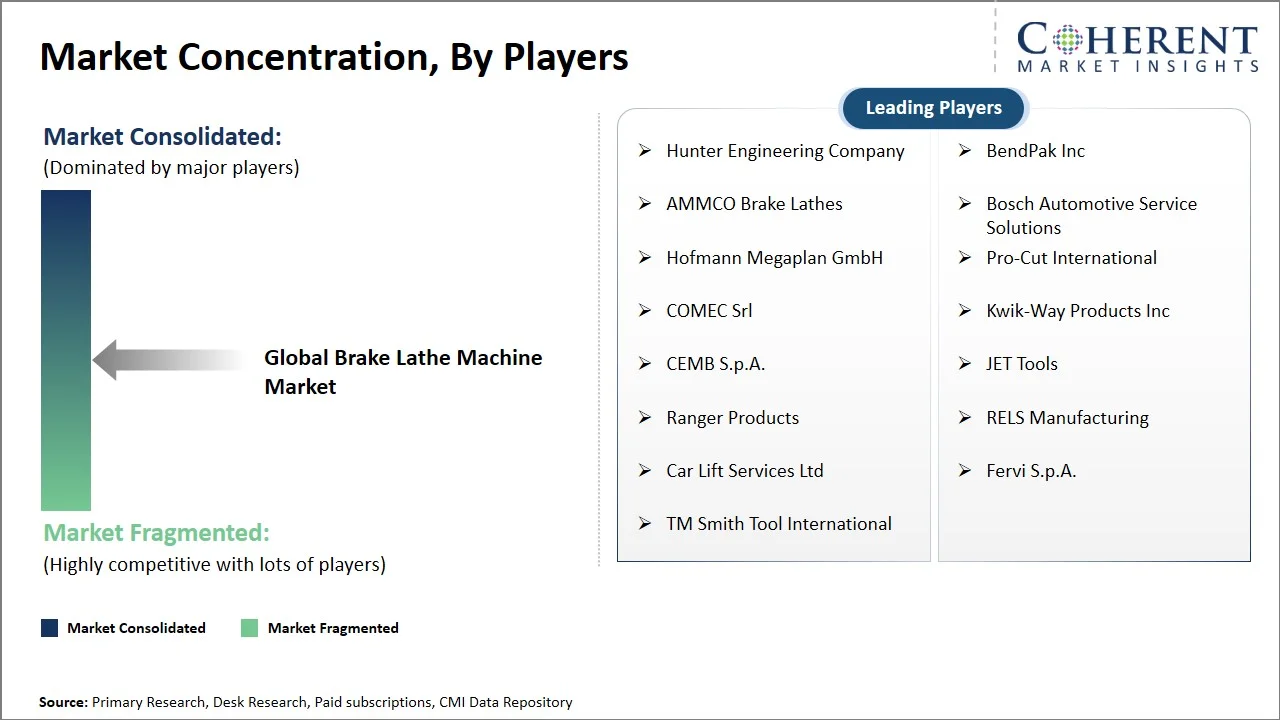
Key Developments
- On April 3, 2025, Ranger Division of BendPak launched the Ranger Select service program to provide professional installation, setup and on-site training for new Ranger wheel balancers, tire changers, and brake lathes across the United States.
- On August 19, 2024, Hunter Engineering announced that it will be taking part in the 2024 Automechanika trade fair in Frankfurt, Germany, where it will showcase its latest workshop equipment portfolio, including AutoComp Elite on-car brake lathes, BL Series bench brake lathes, and connected service technologies for dealership and independent repair workshops.
Competitive Landscape
Hunter Engineering Company, Pro-Cut International, AMMCO, BendPak, COMEC Srl, Hofmann Megaplan and CEMBA are the leading companies in the global brake lathe machine market. The competition in this market is based on the precision of machining, OEM approvals and workshop productivity, not on the volume of equipment. Hunter Engineering has made its name with its BenchBrake and AutoComp Elite platforms, which offer automatic compensation and touchscreen controls for dealership service departments. Pro-Cut International specializes in OEM-approved on-car brake lathes and has established relationships with dealership networks for General Motors, Ford, Stellantis, Toyota, Honda, Nissan, Hyundai and Subaru where rotor machining accuracy is required to meet manufacturer service procedures.
COMEC Srl provides European workshops with heavy duty disc and drum systems for machining, for commercial vehicles, whereas AMMCO is well represented among independent repair shops with long-lasting manual and semi-automatic machinery. Manufacturers are increasingly differentiating their products by integrating laser alignment, digital rotor measurement, automatic feed systems, and cloud-enabled service diagnostics rather than competing solely on machine capacity.
Market Report Scope
Brake Lathe Machine Market Report Coverage
| Report Coverage | Details | ||
|---|---|---|---|
| Base Year: | 2025 | Market Size in 2026: | USD 4.30 Bn |
| Historical Data for: | 2020 To 2024 | Forecast Period: | 2026 To 2033 |
| Forecast Period 2026 to 2033 CAGR: | 5.6% | 2033 Value Projection: | USD 6.30 Bn |
| Geographies covered: |
| ||
| Segments covered: |
| ||
| Companies covered: | Hunter Engineering Company, BendPak Inc, AMMCO Brake Lathes, Bosch Automotive Service Solutions, Hofmann Megaplan GmbH, Pro-Cut International, COMEC Srl, Kwik-Way Products Inc, CEMB S.p.A., JET Tools, Ranger Products, RELS Manufacturing, Car Lift Services Ltd, Fervi S.p.A., and TM Smith Tool International | ||
| Growth Drivers: |
| ||
| Restraints & Challenges: |
| ||
Analyst Opinion (Expert Opinion)
- The brake lathe machine market is being increasingly influenced by the bridging gap between brake resurfacing accuracy and electronically controlled braking systems rather than vehicle production alone. The capacity to mill brake rotors within increasingly restrictive OEM tolerance limitations, mandated for vehicles equipped with automatic emergency braking, electronic stability control and regenerative braking systems, is anticipated to be a competitive advantage.
- Brake lathes are changing from standalone workshop machines to connected diagnostic service equipment with a greater emphasis on software-assisted calibration, digital inspection records and technician-guided machining workflows. Changing demand is also coming from fleet operators who desire consistent maintenance at many service locations, and ask for equipment that can conduct repetitive machining with little variance from the operator.
- Brake lathe systems that combine rotor measurement, machinery, inspection and digital service documentation in one workflow are predicted to be a driver of future market development. It is expected that manufacturers will develop machines that can automatically identify vehicle-specific machining parameters using VIN-based service databases and wireless communication with workshop management software.
- Investment in heavy-duty brake lathe platforms for electric buses, battery electric trucks and high-performance commercial fleets is likely to increase as these vehicles require accurate rotor maintenance despite reduced friction brake consumption due to regenerative braking. Fully automated brake resurfacing systems that can reduce technician involvement while maintaining OEM-certified machining accuracy are also expected to see commercialization accelerate with increased collaboration between brake lathe manufacturers, automotive OEMs and dealership equipment suppliers.
Speak to the analyst
Want personalized insights?
Take the findings above to one of our principal consultants, or have the report rebuilt around the segments, geographies and competitors you actually track.
Market Segmentation
- Product Insights (Revenue, USD Billion, 2020 - 2033)
- On-Car Brake Lathe Machines
- Off-Car Brake Lathe Machines
- Combination Brake Lathe Machines
- Portable Brake Lathe Machines
- Functionality Insights (Revenue, USD Billion, 2020 - 2033)
- Manual
- Semi-Automatic
- Automatic
- CNC
- Application Insights (Revenue, USD Billion, 2020 - 2033)
- Passenger Vehicles
- Commercial Vehicles
- Heavy Equipment
- Railway Maintenance
- Regional Insights (Revenue, USD Billion, 2020 - 2033)
- North America
- U.S.
- Canada
- Latin America
- Brazil
- Argentina
- Mexico
- Rest of Latin America
- Europe
- Germany
- U.K.
- Spain
- France
- Italy
- Russia
- Rest of Europe
- Asia Pacific
- China
- India
- Japan
- Australia
- South Korea
- ASEAN
- Rest of Asia Pacific
- Middle East
- GCC Countries
- Israel
- Rest of Middle East
- Africa
- South Africa
- North Africa
- Central Africa
- North America
- Key Players Insights
- Hunter Engineering Company
- BendPak Inc
- AMMCO Brake Lathes
- Bosch Automotive Service Solutions
- Hofmann Megaplan GmbH
- Pro-Cut International
- COMEC Srl
- Kwik-Way Products Inc
- CEMB S.p.A.
- JET Tools
- Ranger Products
- RELS Manufacturing
- Car Lift Services Ltd
- Fervi S.p.A.
- TM Smith Tool International
Sources
Primary Research Interviews
- Brake Lathe Machine Manufacturers
- Automotive Service Equipment Distributors
- Vehicle Maintenance & Repair Workshop Owners
- Automotive OEM Procurement Specialists
Magazines
- Motor Age Magazine
- Automotive Body Repair News (ABRN)
- Professional Tool & Equipment News (PTEN)
- Vehicle Service Pros Magazine
Journals
- Journal of Manufacturing Processes
- International Journal of Automotive Technology
- Journal of Mechanical Engineering Research
Associations
- Automotive Service Association (ASA)
- Motor & Equipment Manufacturers Association (MEMA)
- Specialty Equipment Market Association (SEMA)
- Association of Equipment Manufacturers (AEM)
Public Domain Sources
- U.S. Bureau of Labor Statistics (BLS) – Automotive Repair Industry Data
- U.S. International Trade Commission (USITC) – Trade Data on Machine Tools
- European Automobile Manufacturers' Association (ACEA) – Industry Statistics
- World Trade Organization (WTO) – Global Trade Data on Industrial Equipment
Proprietary Elements
- CMI Data Analytics Tool
- Proprietary CMI Existing Repository of Information for the Last 10 Years
Get access to 250+ pages report
Every segment, forecast, competitor profile and data table behind the analysis above — available for instant download.
- ESOMAR Member
- ISO 9001:2015 Certified
- D-U-N-S Registered
- GDPR & CCPA Compliant
Missing comfort of reading report in your local language? Find your preferred language:
Transform your Strategy with Exclusive Trending Reports
Frequently Asked Questions
The global brake lathe machine market is expected to stand at USD 4.30 Bn in 2026 and is expected to reach USD 6.30 Bn by 2033.
The CAGR of the global brake lathe machine market is projected to be 5.6% from 2026 to 2033.
CNC technology provides greater machining precision, automation, and repeatable results.
Preventive maintenance reduces unexpected brake failures and extends component service life.
Growing global vehicle parc increasing demand for brake rotor resurfacing and expansion of independent automotive repair and aftermarket service centers are the major factors driving the growth of the global brake lathe machine market.
Growing replacement of brake rotors instead of resurfacing in some vehicle models and high acquisition and maintenance cost of advanced CNC brake lathes are the major factors hampering the growth of the global brake lathe machine market.
In terms of product, the on-car brake lathe machines segment is estimated to dominate the market revenue share in 2026.