

Automotive Brake System Market Size and Share Analysis: (2026 – 2033)
The global automotive brake system market is expected to experience a CAGR of 4.2% in 2026 and have a share of USD 36.67 Mn with further estimation for USD 48.91 Mn in 2033. The increasing production of vehicles, the rising need for safety systems, the growing use of electric vehicles, and the regulatory policies related to safety measures in vehicles are the major factors fueling the growth of the market.
Key Takeaways from the Global Automotive Brake System Market Report
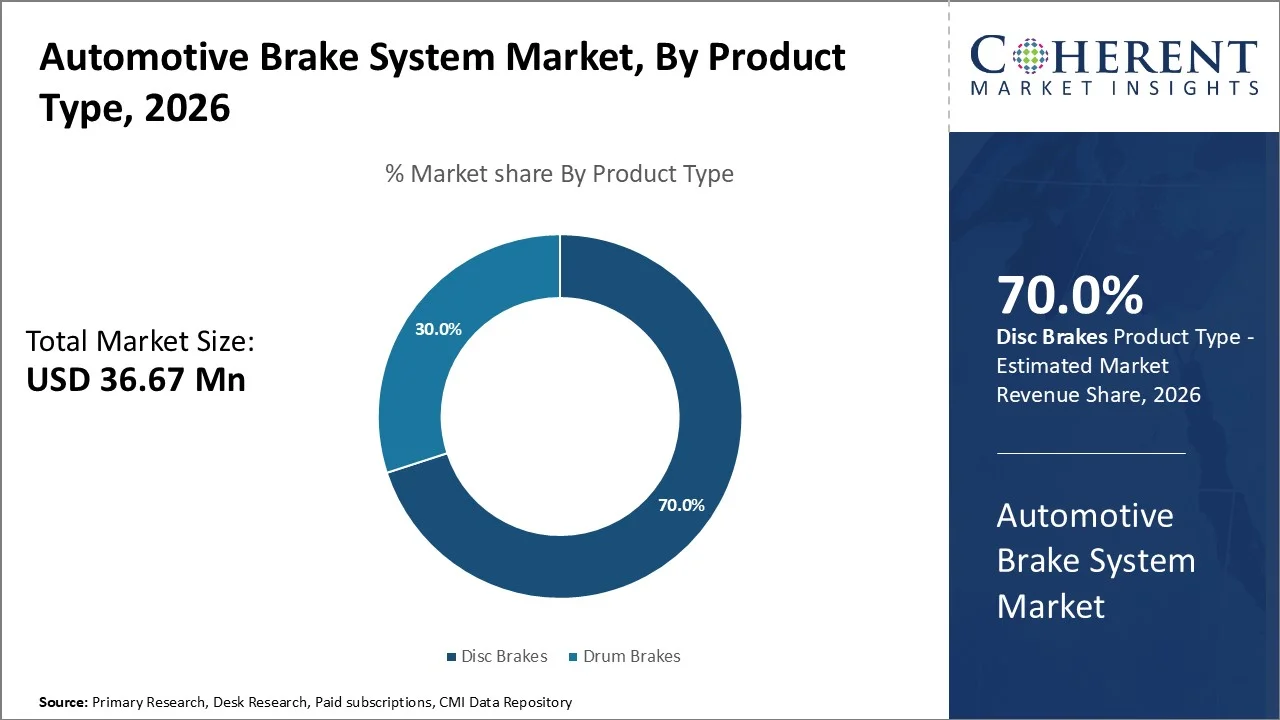
- The disc brakes segment is anticipated to hold a market share around 70% by 2026, due to their effectiveness in braking, heat dissipation, and higher prevalence among passengers and luxury cars. The National Highway Traffic Safety Administration reports that defects related to the brakes result in several recalls every year.
- The metallic brake pads market is anticipated to capture about 48% market share by 2026 owing to their durability, thermal stability, and extensive application across commercial and sports cars. As per the European Automobile Manufacturers' Association, the number of commercial vehicle production and registrations has been continuously growing.
- The OEMs are predicted to lead with a market share of nearly 73% in 2026, driven by growing production of vehicles as well as the adoption of ABS, ESC, and regenerative braking systems by manufacturers. Based on data from the International Organization of Motor Vehicle Manufacturers, the worldwide production of motor vehicles went past 93 million recently.
- The passenger cars segment is estimated to account for the leading market share of about 75%, as of 2026, owing to higher adoption rates of passenger vehicles, urbanization, and increasing inclination towards safety-oriented cars. The International Energy Agency has revealed that more than 14 million units of electric cars have been sold globally.
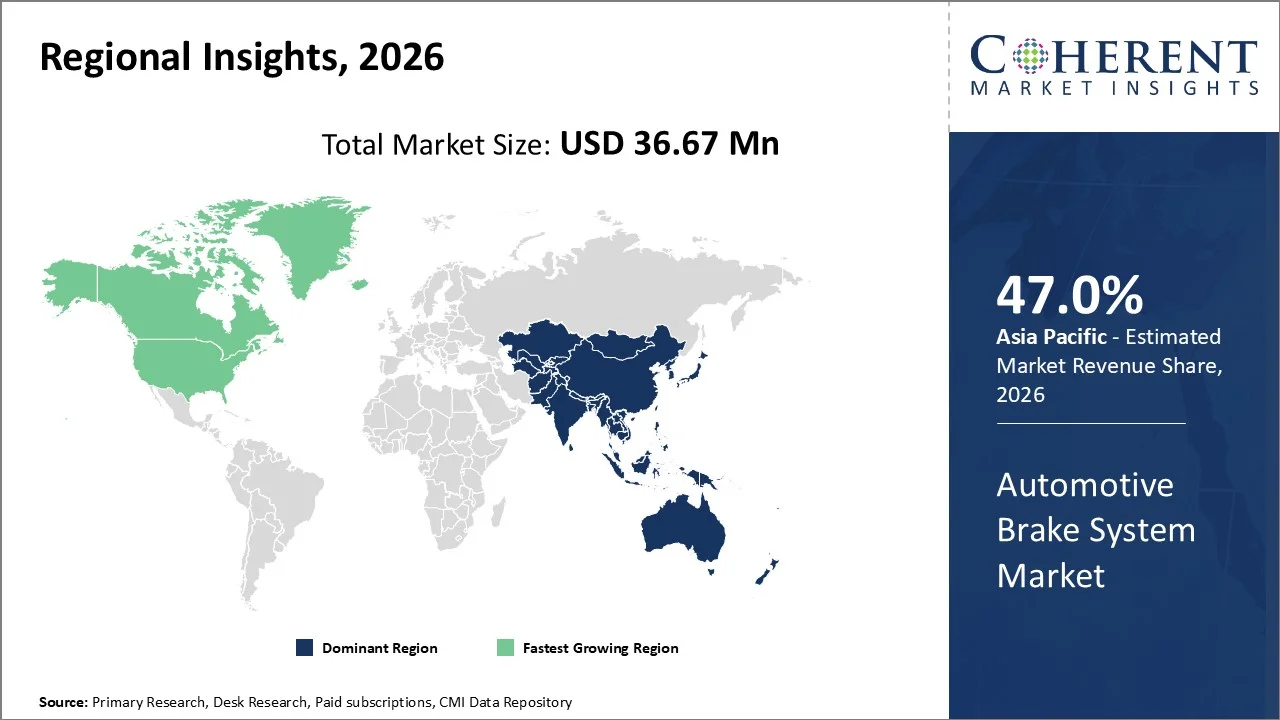
- Asia Pacific is forecasted to lead the global automotive brake system market with a share of about 47% in 2026 owing to excellent automobile manufacturing expertise, high vehicle production, growing use of electric vehicles, and increased application of advanced technologies like ABS and ESC. As per data published by OICA, Asia Pacific has the largest share in terms of global vehicle production with China, India, Japan, and South Korea leading the pack.
Segmental Insights
Why Is Demand for Disc Brakes Rising Rapidly in the Automotive Brake System Market?
In automotive brake system market analysis, the disc brakes market is expected to lead the overall market with almost 70% market share in 2026. The growth in the market will be mainly attributed to higher efficiency, better heat dissipation, lesser brake fade, and growing usage in passenger vehicles.
According to the World Health Organization, nearly 1.19 million people die annually in road traffic accidents globally, increasing the focus on advanced braking and vehicle safety technologies.
- Current Industry Events of 2026
- Market Size Estimation
- Regional Breakdown
- Competitive Landscape
- Customer Intelligence
- Segmental Analysis
- Pricing Analysis
- Key Market Drivers, Challenges & Future Trends
- Customized Insights Section
Which Brake Pad Material Segment Leads the Automotive Brake System Market?
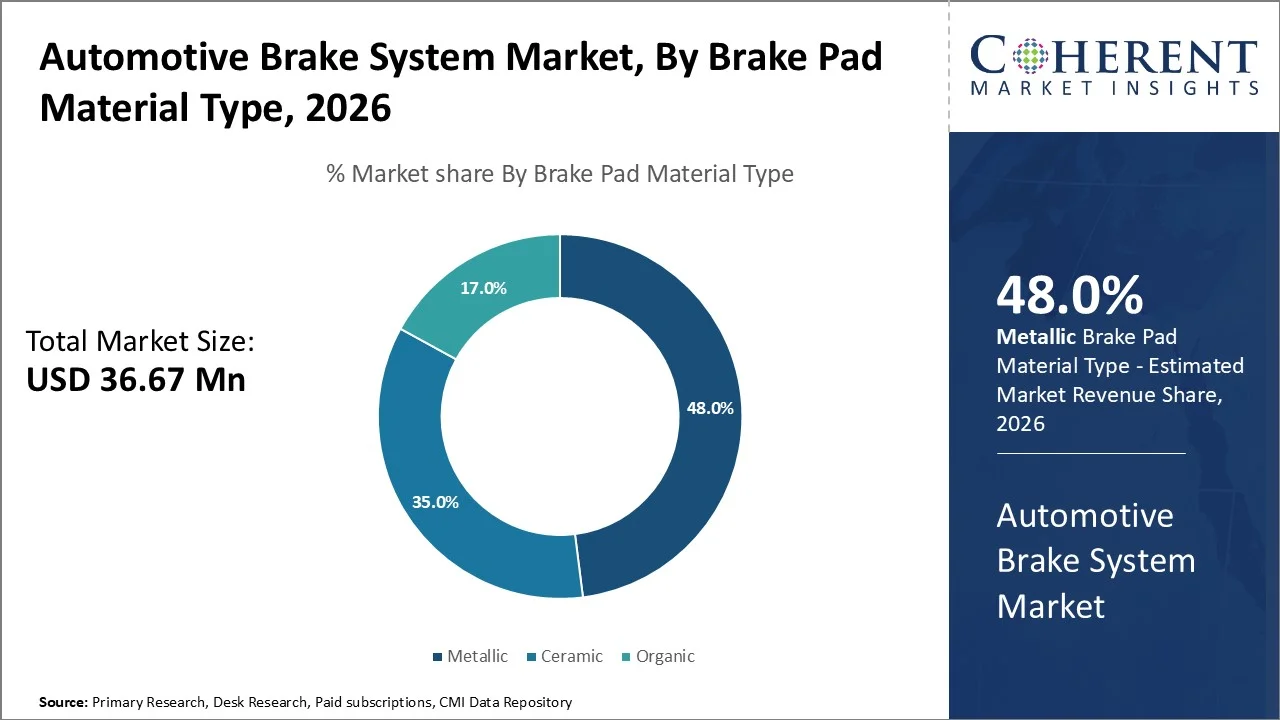
Based on brake pad material type, the metallic brake pads segment is estimated to dominate the market, accounting for a significant market share of about 48% in 2026, owing to their long life, excellent thermal conductivity, and good braking performance at high temperatures.
Metallic brake pads have gained immense popularity in both commercial and sport cars owing to their capability of functioning well under tough conditions. The rise in the use of commercial and heavy-duty vehicles will drive the demand for durable material-based brake pads.
According to the World Health Organization, vulnerable road users account for more than 50% of global road fatalities, increasing demand for reliable and high-performance braking systems across vehicle categories.
Why Are OEMs Dominating the Automotive Brake System Market?
By sales channel, the Original Equipment Manufacturers (OEMs) sector is expected to dominate the market and hold a market share of around 73% in 2026. The reasons behind such growth are the increasing vehicle population across the globe and the inclusion of high-end braking systems in automobiles.
Brakes that are advanced, such as ABS, ESC, autonomous emergency brakes, and regenerative brakes, are being adopted by the OEMs due to the stringent safety norms associated with vehicles, as well as their enhanced efficiency. The production of electric vehicles and consumers' desire for safety in cars are also boosting OEM demands for brakes.
As per statistics provided by OICA (International Organization of Motor Vehicle Manufacturers), the number of automobiles produced worldwide was approximately 93.5 million in 2023, which underscores the magnitude of automotive components required for OEM installation purposes, such as brakes.
Why Do Passenger Cars Hold the Largest Share in the Automotive Brake System Market?
The passenger car segment is anticipated to lead the market and occupy the dominant share of about 75% in the forecast period due to the rising count of passenger cars, urbanization, and the safety-oriented preference of consumers.
Passenger vehicle safety brakes are needed for safe driving, comfort, and compliance with safety regulations. Passenger vehicles are increasingly preferred due to rising disposable income, larger middle classes, and urban mobility.
In January 2026, ZF Friedrichshafen AG inaugurated a new Electric Park Brake (EPB) production line in India, expanding OEM supply for passenger EV platforms.
Market Drivers
Rising Vehicle Production and Safety Regulations are Accelerating Growth in the Global Automotive Brake System Market
Rising automobile production globally and strict auto-safety standards have created substantial growth opportunities for advanced brake systems in the automotive industry. Governments and transport regulatory agencies in many developed countries have been compelling automobile manufacturers to adopt anti-lock braking systems (ABS), electronic stability control (ESC), and autonomous emergency braking (AEB) systems.
According to the International Organization of Motor Vehicle Manufacturers (OICA), global motor vehicle production reached around 92.5 million units in 2024, reflecting continued strong but slightly moderated automotive manufacturing activity worldwide.
Growing Electric Vehicle Adoption is Transforming the Automotive Brake System Industry
The rapid growth of the electric vehicles (EVs) market is transforming the industry for brakes due to increasing demand for regenerative braking and electronic braking systems. The employment of modern braking technologies by producers of electric vehicles makes their product more efficient and effective. The role of the regenerative brake system is crucial for converting kinetic energy into electrical energy while braking.
As per the statistics, the International Energy Agency, more than 17 million vehicles were sold globally, and this accounted for a growth of over 20% from last year. Some of the major regions for such vehicles include China, Europe, and the United States.
Current Events and Their Impact on the Automotive Brake System Market
Current Event | Description and its Impact |
Expansion of Mandatory Vehicle Safety Regulations Globally |
|
Rapid Growth in Electric Vehicle Production and Investments |
|
Automotive Brake System Market Trends
- Increasing use of brake-by-wire and electric braking technologies due to safety requirements; ESC could lower deaths by as much as 50%.
- Increased number of electric vehicle owners demanding regenerative braking systems; sales of electric cars would reach more than 17 million in 2024, which is 20% of all cars sold globally.
- Higher vehicle production volumes in line with OEM brake needs, which is estimated to reach 93.5 million units in 2023 globally.
- Growing number of ADAS-compatible braking systems (AEB), which improve safety and encourage OEMs to install them in their vehicles.
Regional Insights
Asia Pacific dominates owing to strong automotive manufacturing and rising vehicle production
The Asia Pacific region is expected to dominate the market share with about 47 percent by 2026. This can be attributed to the presence of manufacturing hubs of automobiles in nations such as China, India, Japan, and South Korea. The Asia-Pacific area is responsible for the manufacture of more than half of the vehicles manufactured globally (above 53 million units annually).
In November 2025, Honda Motor Co., Ltd. showcased its next-generation electrified vehicle technologies at the Honda Automotive Technology Workshop.
North America is the fastest-growing region owing to strong adoption of advanced safety technologies
North America is expected to remain one of the fastest growing regions till 2026-2033 owing to the fast adoption of sophisticated automotive technology solutions, robust regulatory safety regulations, and the proliferation of electric vehicles. North America is one of the highly integrated regions with ABS, ESC, and AEB systems that are commonly found in modern-day passenger cars.
In September 2024, Robert and Bosch LLC (North America) announced the development and real-world deployment of an advanced electronic braking control system using Bosch Motorsport technology for the IMSA racing program in the United States.
United States Automotive Brake System Market Trends
The U.S. brake system market for automobiles is showing a rapid expansion due to rising applications of sophisticated vehicle safety systems, growing presence of electric vehicles, and stringent federal safety norms. Original equipment manufacturers (OEMs) have been adopting anti-lock braking system (ABS), electronic stability control (ESC), automatic emergency braking system (AEB), and brake-by-wire technology extensively.
The U.S. government is actively pushing for wider deployment of Advanced Emergency Braking (AEB), which will lead to stringent regulations that will make the AEB mandatory in passenger cars, making it necessary for new light vehicles to have the AEB system by 2029.
Japan Automotive Brake System Market Trends
The Japan automotive brake system market is projected to experience growth, driven by a number of factors, including automotive innovation, high standards of safety for vehicles, and the fast electrification of passenger cars in Japan. The country’s automotive sector has been increasingly integrating advanced brake systems into new generation cars.
Technological innovation is also strong in Japan with leading automobile manufacturers like Toyota, Honda, and Nissan constantly working on advancing their car models through installation of brake systems linked to advanced driving assistance system technology and also electronic stability technology.
Who are the Major Companies in Automotive Brake System Industry
Some of the major key players in Automotive Brake System are ZF TRW Co., Akebono Brake Industry Co., TVS Brake Linings Co., Brembo SpA, Performance Friction Corporation (PFC) Brakes, Robert Bosch GmbH, Hella Pagid GmbH, Continental AG, Federal-Mogul Holding Co., Disc Brakes Australia (DBA), and Aptiv PLC (Delphi).
Key News
- In July 2025, ZF announced the market introduction of its Brake-by-Wire (BbW) portfolio, enabling fully electric and hybrid braking architectures for next-generation vehicles, including EV and autonomous platforms.
- In November 2024, Akebono Brake Corporation launched new EURO and Severe Duty ultra-premium disc brake pad kits, expanding coverage across multiple vehicle models and improving OEM and aftermarket braking performance
Market Report Scope
Automotive Brake System Market Report Coverage
| Report Coverage | Details | ||
|---|---|---|---|
| Base Year: | 2025 | Market Size in 2026: | USD 36.67 Mn |
| Historical Data for: | 2020 To 2024 | Forecast Period: | 2026 To 2033 |
| Forecast Period 2026 to 2033 CAGR: | 4.2% | 2033 Value Projection: | USD 48.91 Mn |
| Geographies covered: |
| ||
| Segments covered: |
| ||
| Companies covered: | ZF TRW Co., Akebono Brake Industry Co., TVS Brake Linings Co., Brembo SpA, Performance Friction Corporation (PFC) Brakes, Robert Bosch GmbH, Hella Pagid GmbH, Continental AG, Federal-Mogul Holding Co., Disc Brakes Australia (DBA), and Aptiv PLC (Delphi) | ||
| Growth Drivers: |
| ||
| Restraints & Challenges: |
| ||
Analyst Opinion
- The automobile brake system industry is based on safety need rather than discretionary purchase as there is an absolute need for braking systems in all types of cars and trucks around the world.
- The increasing global manufacturing of vehicles totaling 93 million each year directly correlates with the equivalent requirement of OEM installed braking systems.
- Regulatory push is a key structural factor, where ABS, ESC, and AEB are mandated in the leading automotive nations. This implies that advanced braking systems have become essential for all cars rather than being optional.
- Electric vehicles will change the industry landscape, as more than 17 million EVs were sold worldwide in 2024, increasing the demand for regenerative braking systems and brake-by-wire systems in new vehicles.
- The industry is witnessing a shift from traditional mechanical braking systems to software-defined braking systems, where compatibility with ADAS and autonomous driving systems is crucial for manufacturers.
Speak to the analyst
Want personalized insights?
Take the findings above to one of our principal consultants, or have the report rebuilt around the segments, geographies and competitors you actually track.
Market Segmentation
- By Product Type (Revenue, USD Mn, 2021-2033)
- Disc Brakes
- Drum Brakes
- By Brake Pad Material Type (Revenue, USD Mn, 2021-2033)
- Organic
- Metallic
- Ceramic
- By Sales Channel (Revenue, USD Mn, 2021-2033)
- OEMs
- Aftermarket
- By Vehicle Type (Revenue, USD Mn, 2021-2033)
- Passenger Cars
- Commercial Vehicles
- By Region (Revenue, USD Mn, 2021-2033)
- North America
- U.S.
- Canada
- Latin America
- Brazil
- Mexico
- Argentina
- Rest of Latin America
- Europe
- Germany
- U.K.
- France
- Italy
- Spain
- Russia
- Rest of Europe
- Asia Pacific
- China
- India
- Japan
- Australia
- South Korea
- ASEAN
- Rest of Asia Pacific
- Middle East
- GCC
- Israel
- Rest of Middle East
- Africa
- South Africa
- Central Africa
- North Africa
- North America
- Key Players
- ZF TRW Co.
- Akebono Brake Industry Co.
- TVS Brake Linings Co.
- Brembo S.p.A.
- Performance Friction Corporation (PFC) Brakes
- Robert Bosch GmbH
- Hella Pagid GmbH
- Continental AG
- Federal-Mogul Holding Co.
- Disc Brakes Australia (DBA)
- Aptiv PLC (Delphi)
Sources
Primary Research Interviews
- Automotive OEM engineers (passenger cars and commercial vehicles)
- Brake system manufacturers and suppliers
- Tier-1 automotive component suppliers
- R&D heads of braking technology companies
- Automotive industry consultants and Key Opinion Leaders (KOLs)
- Fleet operators and commercial vehicle maintenance managers
Databases
- International Organization of Motor Vehicle Manufacturers (OICA)
- International Energy Agency (IEA)
- National Highway Traffic Safety Administration (NHTSA)
- European Automobile Manufacturers’ Association (ACEA)
- United Nations Economic Commission for Europe (UNECE)
- World Bank (transport and mobility datasets)
Magazines
- Automotive News
- SAE International Mobility Magazine
- Automotive Engineering Magazine
- Motor Trend Business Section
Journals
- SAE International Journal of Vehicle Dynamics, Stability, and NVH
- IEEE Transactions on Intelligent Transportation Systems
- Journal of Automotive Engineering
- International Journal of Automotive Technology
Newspapers
- The Wall Street Journal
- Financial Times
- The New York Times (Automotive & Mobility coverage)
- Reuters Business News
Associations
- Society of Automotive Engineers (SAE International)
- European Automobile Manufacturers’ Association (ACEA)
- International Organization of Motor Vehicle Manufacturers (OICA)
- National Highway Traffic Safety Administration (NHTSA – U.S.)
- European New Car Assessment Programme (Euro NCAP)
Public Domain Sources
- Company Annual Reports and Investor Presentations (Bosch, ZF, Continental, Brembo, etc.)
- Government transportation and safety regulatory publications
- EV and mobility reports from IEA and World Bank
- Automotive safety compliance filings and regulatory announcements
Proprietary Elements
- CMI Data Analytics Tool
- Internal automotive components market repository (historical + 10 forecast datasets)
Get access to 250+ pages report
Every segment, forecast, competitor profile and data table behind the analysis above — available for instant download.
- ESOMAR Member
- ISO 9001:2015 Certified
- D-U-N-S Registered
- GDPR & CCPA Compliant
Missing comfort of reading report in your local language? Find your preferred language:
Transform your Strategy with Exclusive Trending Reports
Frequently Asked Questions
The Automotive Brake System Market is projected to reach USD 48.91 Mn in 2033, increasing from USD 36.67 Mn in 2026.
The market is expected to grow at a CAGR of 4.2% during the forecast period 2026–2033.
The disc brakes segment is expected to lead the market with nearly 70% share in 2026 due to superior braking efficiency, better heat dissipation, and wide adoption in passenger and premium vehicles.
Market growth is driven by rising vehicle production, increasing adoption of electric vehicles, stringent government safety regulations, and growing integration of ADAS technologies.
Key challenges include high cost of advanced braking systems, complex integration with electronic and EV platforms, raw material price fluctuations, and cybersecurity concerns in software-based braking systems
Key players include ZF TRW Co., Akebono Brake Industry Co., TVS Brake Linings Co., Brembo SpA, Performance Friction Corporation (PFC) Brakes, Robert Bosch GmbH, Hella Pagid GmbH, Continental AG, Federal-Mogul Holding Co., Disc Brakes Australia (DBA), and Aptiv PLC (Delphi).
North America is one of the fastest-growing regions due to strong adoption of advanced safety systems such as ABS, ESC, AEB, and increasing EV penetration.