

Global Automotive Cabin Ac Filter Market Size and Share Analysis – Growth Trends and Forecasts (2026-2033)
Automotive Cabin Ac Filter Market is estimated to be valued at USD 6,084.4 Mn in 2026 and is expected to reach USD 9,643.1 Mn in 2033, exhibiting a compound annual growth rate (CAGR) of 6.8% from 2026 to 2033.
Key Takeaways
- Based on Filter Type, Particulate Filter Segment dominates the global automotive cabin AC filter market with 34.4% shares is 2026. This is due to its cost-effectiveness, widespread usage, and ability to effectively block dust, pollen, and airborne particles.
- Asia Pacific is the market leader with 32.2% share of global revenue in 2026. This is due to the high automotive production in that region.
Market Overview
Automotive cabin AC filter market is driven by increased in-car air quality consciousness among consumers, increased urban air pollution levels, and increasing health issues triggered by allergens, fine particulate matter (PM2.5), and volatile organic compounds (VOCs). As OEMs target passenger comfort and well-being of the environment, the need for advanced cabin filtration systems such as HEPA and activated carbon filters is increasingly growing. Additionally, tighter cabin air and emissions regulations in nations like Europe, the U.S., and Asia-Pacific are pressuring original equipment manufacturers (OEMs) to install more-performing filters in electric vehicles (EVs) as well as internal combustion engine (ICE) vehicles.
In 2026, EcoDrive Components, a German automaker parts company, debuted its AI-powered Smart Air Sense Filter System. It monitors air quality inside the vehicle in real-time and adjusts filtration capability depending on pollution levels using AI algorithms and sensors. Not only does it increase air purification efficiency but also reduces filter replacement demands, which aligns with sustainability goals.
Current Events and Its Impact on Automotive Cabin AC Filter Market
Current Events | Description and its impact |
Bosch Introduces Sophisticated FILTER+Pro Cabin AC Filter with Antiviral & Allergen Shield |
|
Uno Minda Launches Environment-Friendly, Long-Life Reusable Cabin Air Filters in Indian Market |
|
Pricing Analysis of Automotive Cabin AC Filter Market
Filter Technology Type
- Standard Particulate Filters: $8-25
- Activated Carbon Filters: $15-35
- HEPA Filters: $25-55
- Multi-layer Premium Filters: $35-85
Vehicle Category
- Economy/Compact Cars: $8-30
- Mid-size Sedans/SUVs: $15-45
- Luxury Vehicles: $25-85
- Commercial Vehicles: $20-65
- Current Industry Events of 2026
- Market Size Estimation
- Regional Breakdown
- Competitive Landscape
- Customer Intelligence
- Segmental Analysis
- Pricing Analysis
- Key Market Drivers, Challenges & Future Trends
- Customized Insights Section
Global Automotive Cabin AC Filter Market Drivers
- Market players and government of different countries are focusing on reducing greenhouse gas emission
Governments around the world are concentrating on reducing greenhouse gas emissions, supporting lower car emissions, and putting air quality improvement plans into action as a result of rising pollution on a worldwide scale. Additionally, market players are working to lessen the effects of pollution by releasing improved cabin air filters.
- Increasing demand and production of passenger cars across the globe
There is a growing trend toward car ownership resulting in the increasing demand for passenger vehicles. The growing demand coupled with efficient production of passenger cars will result in the growth of the automotive cabin AC Filter market as well. According to World Motor Vehicle Production, 85.4 million cars were produced in 2022. This number is expected to increase exponentially in the coming years.
Global Automotive Cabin AC Filter Market Opportunities
- The refurbishment of older vehicles with cabin AC filters is anticipated to present a lucrative growth potential
Older automobiles still have a conventional HVAC system even if newer vehicles are fitted with cabin air filters. But customers are becoming more and more conscious of the harmful impact that air pollution has on the human body. As a result, these vehicles are being updated with cabin AC system, and their individual HVAC systems are in need of customized cabin AC filters. For market participants, this will present lucrative growth prospects over the course of the forecast period.
- Advanced technology and deployment of sensors that facilitate better air quality and protection against allergens and other harmful material
The recent development in the cabin air quality technology has made way for introduction of smart solutions that deploy advanced sensors to detect VOCs and other poisonous gases. These monitoring solutions work as a built-in HVAC air control module and can be developed as per the specifications of OEMs. Air purification solutions work in tandem with the air quality monitoring modules to keep the pollutants under optimum levels.
Global Automotive Cabin AC Filter Market Trends
- The breakthrough technology of Particle Charging is changing the way filtration works
Before entering through the HVAC air intake vent, outside air has typically been cleaned using a cabin air filter. These filters can stop particles larger than 10 microns in size, such as dust, pollen, pet fur, etc. These mechanical filters have some restrictions on the pollutants they can effectively filter out, and they are typically poor at filtering out CO2, CO2, and VOCs.
At this point, technology replaces the mechanical filters. Particle charging is one of the ground-breaking technologies that has proven to be quite successful. The basic idea behind this technology is to electrostatically charge the airborne particles, typically with a negative charge. Particle charging is one of the ground-breaking technologies that has proven to be quite successful.
The basic idea behind this technology is to electrostatically charge the airborne particles, typically with a negative charge. This is accomplished using a variety of techniques, one of which involves exposing the airborne particles to a corona discharge (caused by fluid ionization). When the particles become negatively charged, the positively charged filters begin to draw them in.
- A significant trend in the market is the merger and acquisition of significant market participants.
In order to strengthen their market presence and acquire a competitive edge in the global industry, the major players in the automobile cabin AC filter market are concentrating on strategic actions like mergers and acquisitions.
Segmental Insights

The Global Automotive Cabin AC Filter Market Insights, By Filter Type
Based on Filter type, during the projection period, the market for particulate segment is anticipated to dominate. The particulate filter segment dominates the global automotive cabin AC filter market due to its cost-effectiveness, widespread usage, and ability to effectively block dust, pollen, and airborne particles. These filters are commonly used in both economy and mid-range vehicles, making them the standard choice for mass production.
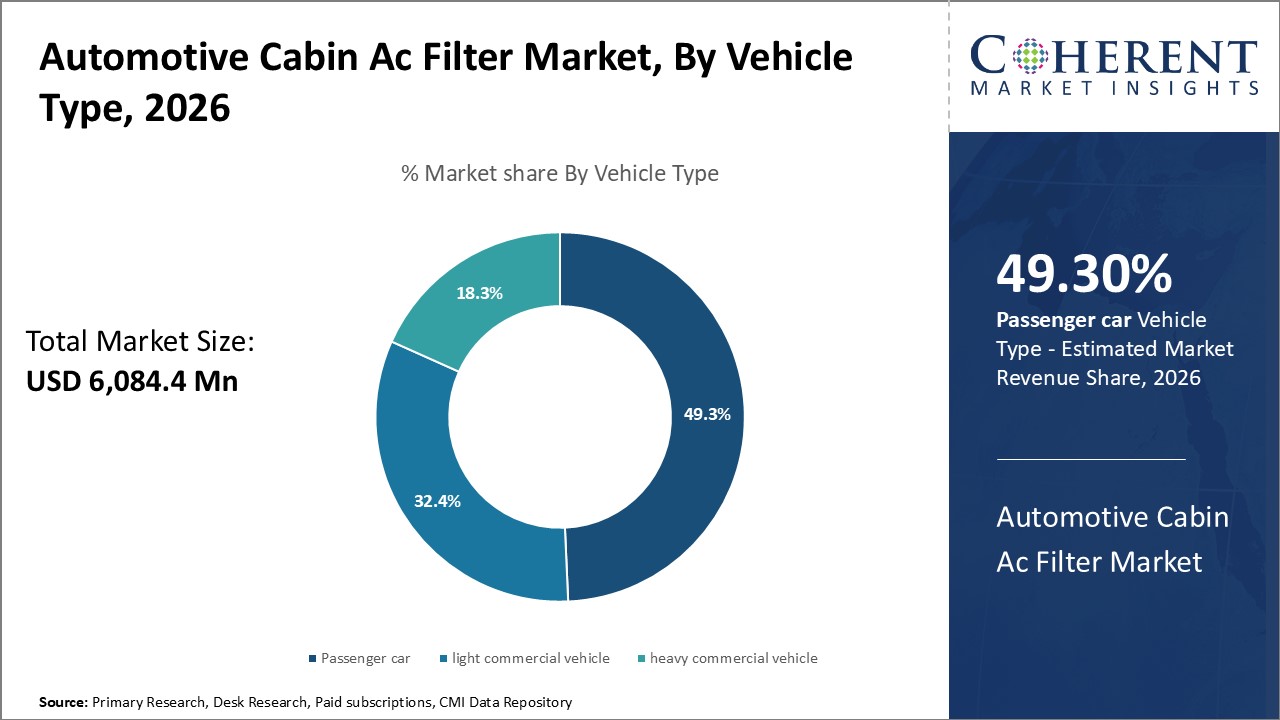
The Global Automotive Cabin AC Filter Market Insights, By Vehicle Type
By Vehicle type, the market is expected to be dominated by the passenger vehicle segment. Due to increased disposable income and consumer awareness of health issues, the category for passenger vehicles is predicted to grow at the highest CAGR over the course of the estimated period. Due to the market-dominating air filter components, sales of this type of vehicle are anticipated to rise.
The Global Automotive Cabin AC Filter Market Insights, By End User Type
By End user type, The OEMs are predicted to dominate the automotive air filters market in terms of end users over the forecast period. The global production of passenger automobiles, light commercial vehicles, and heavy commercial vehicles is directly associated with the sales of automotive air filters by original equipment manufacturers (OEMs).
The rise in global demand for automobiles is the main driver of the OEM end-use category's growth over the projection period. To improve fuel efficiency and promote passenger comfort, major international players are participating in the procurement of premium air filters. Due to the rising demand for high-end products for vehicles, OEMs often use a different distribution channel. The aforementioned factors suggest that the end-use segment will expand.
Regional Insights
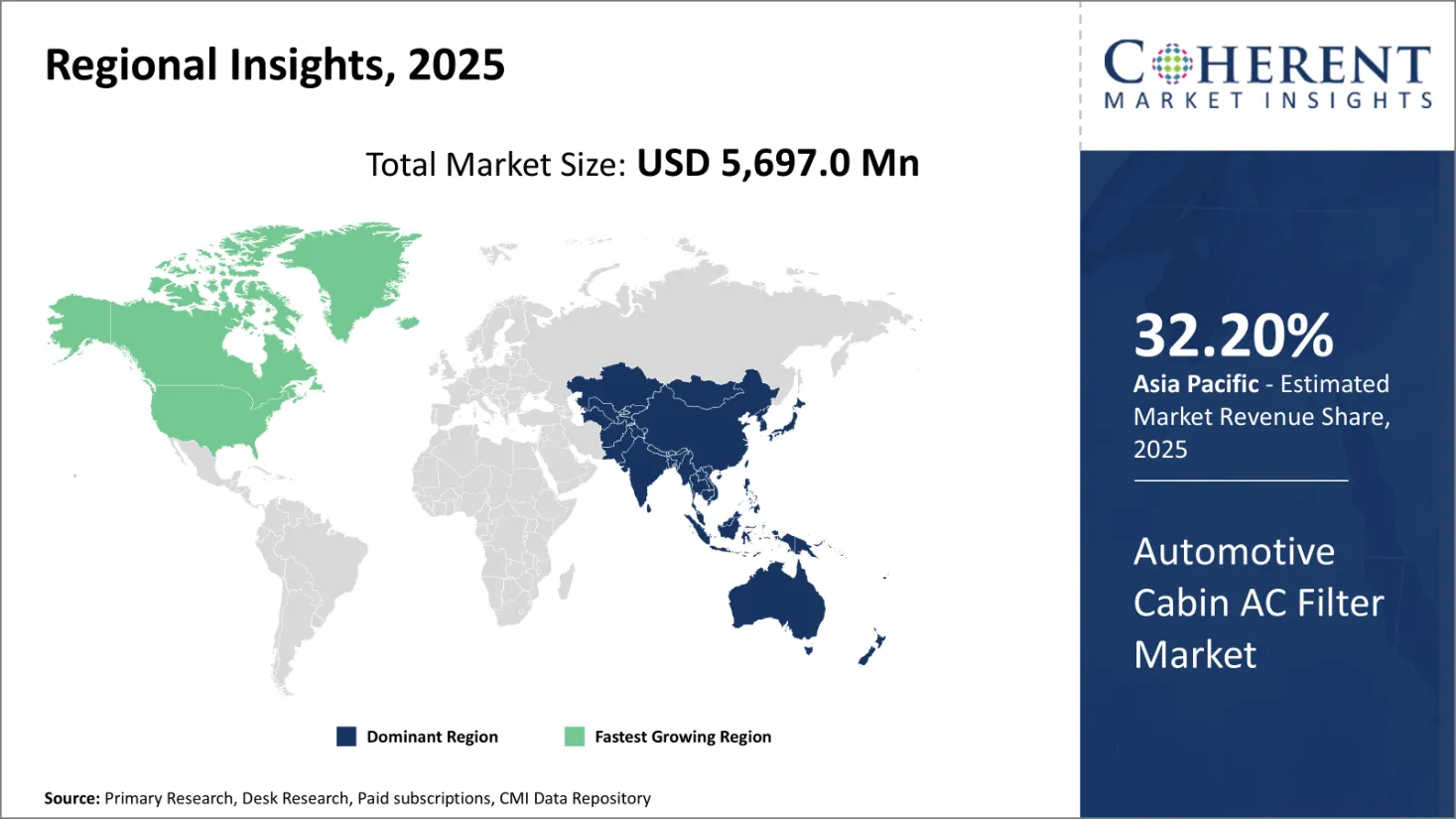
Global Automotive Cabin AC Filter Market: Regional Insights
Asia Pacific is the market leader with 32.2% share of global revenue in 2026 due to the high automotive production in that region. This added to the favorable government policies in the countries of India and China to ramp up production is expected to accelerate the growth of this market in this particular sector.
The increasing number of companies in the region of North America will turn out to be fruitful for sector. The automotive industry in North America is regarded as being mature and producing a sizable number of passenger cars, big commercial vehicles, and passenger cars. Along with producing passenger vehicles, it is anticipated that light commercial vehicles will also continue to be produced for the length of the forecast period.
European countries such as Germany, France and UK are expected to drive the Automotive AC filter market in that region owing to their extensive R&D and the presence of automobile manufacturing giants like Audi, Mercedes, etc. These luxury cars have high end HVAC filters and also exhibit high frequency for filter replacement while carrying out maintenance services.
In emerging economies like Africa and Egypt, growth is slow due to the economic conditions of certain countries like Nigeria. Moreover, the growth is also expected to be hampered due to stringent government regulations in some countries. Although the growth is slow, demand for automotive air filters will be increasing in the forecast period.
Automotive Cabin AC Filter Market Dominating Countries
United States Automotive Cabin AC Filter Market Analysis and Trend
The U.S. is one of the leading markets for car cabin AC filters, driven by a high vehicle population, stringent EPA air quality regulations, and increased consumer awareness of in-cabin air contamination. Growing use of HEPA and carbon filters in new vehicles and replacement items remains to provide consistent demand, especially in urban regions where there are elevated levels of pollution.
Germany Automotive Cabin AC Filter Market Analysis and Trend
Germany dominates the European market with its strong automobile manufacturing base, with premium OEMs like BMW, Audi, and Mercedes-Benz making advanced cabin air filter systems the norm. EU legislation regarding particulate emissions and greater public health consciousness about air quality have accelerated the deployment of high-efficiency filters across all vehicle segments.
China Automotive Cabin AC Filter Market Analysis and Trend
China is one of the fastest-growing marketplaces, fueled by worsening urban air quality and growing car ownership. Government initiatives on in-cabin air quality and adoption towards electric vehicles (EVs) have driven demand for high-performance and intelligent cabin filters, particularly in major metropolitan cities like Beijing and Shanghai.
India Automotive Cabin AC Filter Market Analysis and Trend
India's market is expanding rapidly with urban air pollution levels driving consumer demand for cleaner in-cabin air. Price remains a primary concern, but increased awareness and pressures from governments to raise automobile standards have led to rising applications of activated carbon and particulate filters on mid-range vehicles, with OEMs gradually building up offerings.
Market Report Scope
Automotive Cabin AC Filter Market Report Coverage
| Report Coverage | Details | ||
|---|---|---|---|
| Base Year: | 2025 | Market Size in 2026: | USD 6,084.4 Mn |
| Historical Data for: | 2020 To 2024 | Forecast Period: | 2026 To 2033 |
| Forecast Period 2026 to 2033 CAGR: | 6.8% | 2033 Value Projection: | USD 9,643.1 Mn |
| Geographies covered: |
| ||
| Segments covered: |
| ||
| Companies covered: | Cummins Filtration Inc., Denso Corporation, Donaldson Company Inc., Freudenberg Filtration Technologies SE & Co. KG, K&N Engineering Inc., Lydall Inc., Mahle GmbH, Mann+Hummel, PARKER HANNIFIN CORP, Robert Bosch GmbH, Roki Co. Ltd, SogefiS.p.A., Toyota Boshoku Corporation Valeo S.A., and others | ||
| Growth Drivers: |
| ||
| Restraints & Challenges: |
| ||
Global Automotive Cabin AC Filter Market: Key Developments
- In June 2024, MANN+HUMMEL launched the FreciousPlus nanofiber cabin air filter that can trap as much as 90% of PM1 and 80% of ultrafine PM0.1 particulates. It is a new benchmark for in-cabin air quality, with the focus on premium cars and in line with more stringent health and emissions regulations.
- In February 2024, SKF, together with CabinAir Sweden AB, introduced the SKF Smart Air Purification System with active particle charging and mechanical filtration and real-time air monitoring through the Nordzone app. This solution allows for improved cabin safety through significantly minimizing contaminants and offering digital intelligence on air quality for pre-emptive maintenance.
Analyst View
- The automotive cabin air AC filter market reflects strong momentum fueled by growing consumer concern over air quality and health issues in car cabins. Strict government regulations for better vehicle air filtration systems, especially in developed economies, are major growth drivers. Rising urban air pollution levels have led to greater demand for sophisticated filtration technologies such as HEPA and activated carbon filters that are highly effective in catching particulate matter and toxic gases.
- Nonetheless, the market is subject to significant restraints such as price sensitivity among budget-conscious consumers and a lack of awareness in developing markets regarding the need for routine filter changes. Further, there are both opportunities and challenges with the move toward electric vehicles since producers need to modify filtration systems to fit new vehicle architectures and possibly varied air circulation patterns.
- Strong opportunities arise through technological innovation in smart filtration systems that can track air quality in real-time and automatically send filter-replacement alerts. Merging IoT capabilities and creation of antimicrobial and anti-allergen filter material offer attractive growth opportunities.
- The market is led by the Asia-Pacific region, fueled by enormous volumes of automotive production in China and India, with declining air quality conditions in urban centers. The North American and European markets also retain large market shares thanks to strict environmental policies and high levels of consumer awareness. The aftermarket business continues to grow with rising vehicle ownership across the globe, translating into continuous demand for replacement filters in all regional markets.
Market Segmentation
- Global Automotive Cabin AC Filter Market, By Filter Type (Revenue, USD Mn, 2021 - 2033)
- Particulate
- Electrostatic
- Charcoal
- Global Automotive Cabin AC Filter Market, By Vehicle (Revenue, USD Mn, 2021 - 2033)
- Passenger Car
- LCV
- HCV
- Global Automotive Cabin AC Filter Market, By Sales Channel (Revenue, USD Mn, 2021 - 2033)
- OEM
- After Market
- Global Automotive Cabin AC Filter Market, By Geography (Revenue, USD Mn, 2021 - 2033)
- North America
- U.S.
- Canada
- Latin America
- Brazil
- Argentina
- Mexico
- Rest of Latin America
- Europe
- Germany
- U.K.
- Spain
- France
- Italy
- Russia
- Rest of Europe
- Asia Pacific
- China
- India
- Japan
- Australia
- South Korea
- ASEAN
- Rest of Asia Pacific
- Middle East
- GCC Countries
- Israel
- Rest of Middle East
- Africa
- South Africa
- North Africa
- Central Africa
- North America
- Company Profiles
- Cummins Filtration Inc.
- Denso Corporation
- Donaldson Company Inc.
- Freudenberg Filtration Technologies SE & Co. KG
- K&N Engineering Inc.
- Lydall Inc.
- Mahle GmbH
- Mann+Hummel
- PARKER HANNIFIN CORP
- Robert Bosch GmbH
- Roki Co. Ltd
- SogefiS.p.A.
- Toyota Boshoku Corporation Valeo S.A.
Sources
Primary Research Interviews
- Automotive OEMs and Tier1 Suppliers
- Cabin Air Filter Manufacturers and Distributors
- Automotive Aftermarket Retailers and Service Centers
- Fleet Management Companies
- Others
Databases
- Global Trade Atlas (GTA)
- Automotive Industry Database (AID)
- Others
Magazines
- Automotive News
- Ward's Auto World
- Automotive Engineering International
- Auto Service Professional
- Others
Journals
- Journal of Automotive Engineering
- International Journal of Automotive Technology
- SAE International Journal of Passenger Cars
- Others
Newspapers
- The Wall Street Journal
- Financial Times
- Automotive News Europe
- Detroit Free Press
- Others
Associations
- Society of Automotive Engineers (SAE)
- Automotive Aftermarket Industry Association (AAIA)
- Motor & Equipment Manufacturers Association (MEMA)
- International Organization of Motor Vehicle Manufacturers (OICA)
- Others
Public Domain Sources
- U.S. Environmental Protection Agency (EPA)
- European Automobile Manufacturers Association (ACEA)
- National Highway Traffic Safety Administration (NHTSA)
- International Trade Administration (ITA)
- Others
Proprietary Elements
- CMI Data Analytics Tool
- Proprietary CMI Existing Repository of information for last 8 years
*Definition: Automotive Cabin AC Filter is a tiny pleated filtration unit that is usually made of engineered material or multifiber cotton paper. Before air enters the car's interior, it passes through this filter, which traps any impurities in the air to keep them out of the air you breathe.
Get access to 250+ pages report
Every segment, forecast, competitor profile and data table behind the analysis above — available for instant download.
- ESOMAR Member
- ISO 9001:2015 Certified
- D-U-N-S Registered
- GDPR & CCPA Compliant
Missing comfort of reading report in your local language? Find your preferred language:
Transform your Strategy with Exclusive Trending Reports
Frequently Asked Questions
The Automotive Cabin Ac Filter Market size is estimated to be valued at USD 6,084.4 Mn in 2026, and is expected to reach USD 9,643.1 Mn by 2033.
The CAGR of the global Market is projected to be 6.8% from 2026 to 2033.
Filter segment is the leading end user segment in the Market
Lack of awareness and inadequate supply-demand ratios associated with Automotive Cabin AC Filter are the major factors restraining growth of the global Market.
Cummins Filtration Inc., Denso Corporation, Donaldson Company Inc., Freudenberg Filtration Technologies SE & Co. KG, K&N Engineering Inc., Lydall Inc., Mahle GmbH, Mann+Hummel, PARKER HANNIFIN CORP, Robert Bosch GmbH, Roki Co. Ltd, SogefiS.p.A., Toyota Boshoku Corporation Valeo S.A., and others.
Yes, the rising adoption of electric vehicles is shifting the cabin air filter market toward high-efficiency, multi-stage solutions like HEPA and activated carbon filters to enhance in cabin air quality in sealed EV cabin.