

Automotive Flywheel Market Size and Forecast — 2026-2033
Overview
A flywheel is a mechanical device designed to store the rotational energy. Increasing demand for fuel efficient vehicles is a major driver for growth of the global automotive flywheel market. Adoption of duel mass flywheels by various Original Equipment Manufacturer (OEM) to reduce the weight of the engine by developing lightweight components to enhance fuel efficiency is expected to boost growth of global automotive flywheel market over the forecast period.
Advances in kinetic energy recovery system also provides growth opportunity to automotive flywheel market. Flywheel-based kinetic energy recovery system continuously transfers the energy form the wheels to the flywheels by variable transmission.
Flywheel-based kinetic energy recovery system aims to mechanically store kinetic energy to other source from rear driveshaft. GKN plc and Volvo are some of the major companies that use the flywheel equipment in their automotive products.
Automotive Flywheel Market Size and Forecast – 2026 – 2033
The Automotive Flywheel Market size is estimated to be valued at USD 3.44 billion in 2026 and is expected to reach USD 5.66 billion by 2033, exhibiting a compound annual growth rate (CAGR) of 7.4% from 2026 to 2033.
Key Takeaways
In By Flywheel Type segment, Mechanical Flywheels dominate with a 46% industry share driven by widespread applicability, while Composite Flywheels exhibit the fastest growth due to lightweight and durable characteristics.
Passenger Vehicles hold the largest revenue share within the Vehicle Type segment, but Electric & Hybrid Vehicles are the fastest growing category empowered by stringent emission norms and rising green vehicle adoption.
Asia Pacific leads the automotive flywheel market with over 33% market share fueled by robust automotive manufacturing hubs in China and India. Europe follows with significant technology advancements, whereas North America displays steady growth influenced by government incentives for hybrid vehicle production.
Automotive Flywheel Market – Segmentation Analysis
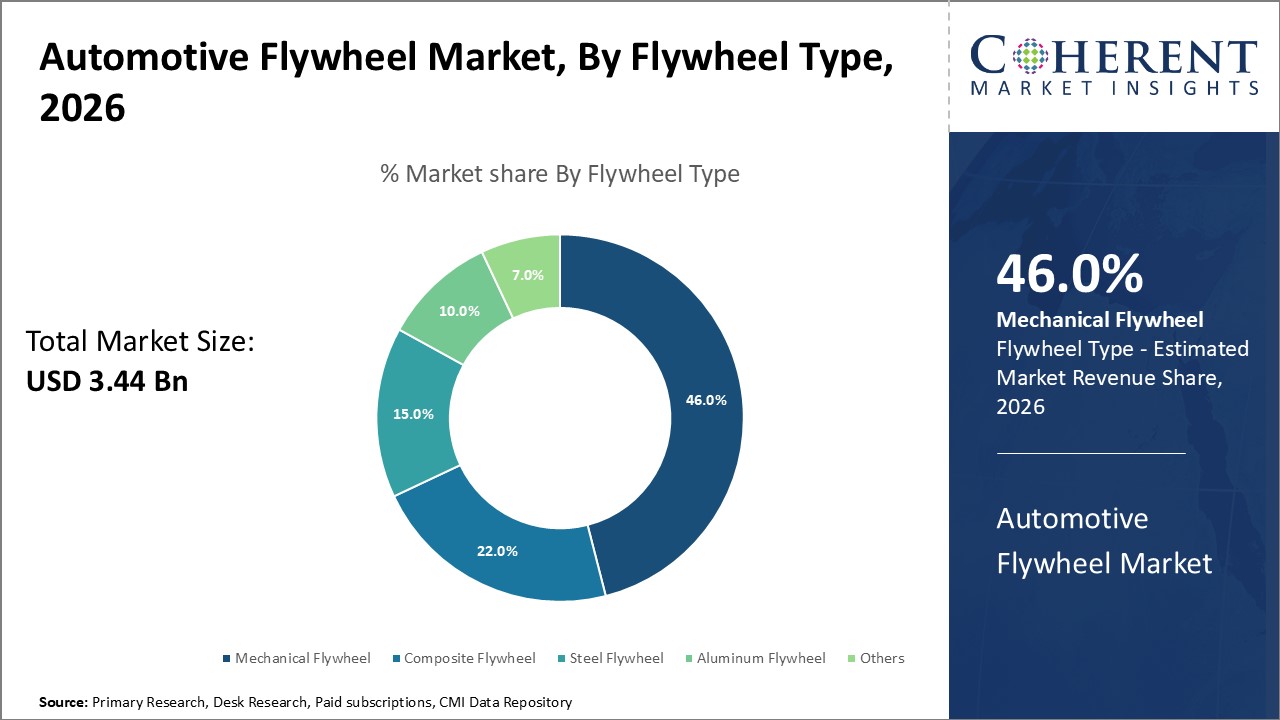
Automotive Flywheel Market Insights, By Flywheel Type
The market is segmented into Mechanical Flywheel, Composite Flywheel, Steel Flywheel, Aluminum Flywheel, and Others. Among these, Mechanical Flywheels dominate the market share at 45%. They remain the preferred choice due to their robust construction, cost-effectiveness, and proven reliability in traditional combustion engine applications.
Automotive Flywheel Market Insights, By Vehicle Type
The market segmentation here includes Passenger Vehicles, Commercial Vehicles, Electric & Hybrid Vehicles, and Others. Passenger Vehicles hold the largest share due to the vast market size and steady demand for enhanced powertrain efficiency.
Automotive Flywheel Market Insights, By Application
This segment is divided into Engine Balancing, Energy Storage & Recovery, Transmission Systems, and Others. Engine Balancing leads in market share by maintaining engine smoothness and improving overall vehicle performance across all vehicle types. Energy Storage & Recovery represents the most significant growth driver as flywheels play an integral role in regenerative braking systems and hybrid energy recuperation, especially in electric and hybrid vehicle applications.
Automotive Flywheel Market Insights, By Geography

Asia Pacific Automotive Flywheel Market Analysis and Trends
In Asia Pacific, the dominance in the Automotive Flywheel market is driven by rapid industrialization, expansive automotive manufacturing bases in China, India, and Japan, and proactive government policies enabling innovation in energy-efficient powertrain components. Asia Pacific commands a 33% market share, supported by abundant OEM presence and evolving consumer demand for hybrid and electric vehicles. Regions like India are witnessing accelerated flywheel demand due to growing urban mobility needs and stricter emission standards.
Europe Automotive Flywheel Market Analysis and Trends
Europe, on the other hand, is growing at the quickest rate, with a CAGR of about 8.1%, driven by strict EU emission standards, a developed automotive ecosystem, and significant R&D investment. Leading automakers are increasingly using composite flywheel technology in Germany and France, two crucial markets, to achieve sustainability objectives and lessen their environmental effect.
Automotive Flywheel Market Outlook for Key Countries
United States Automotive Flywheel Market Analysis and Trends
Strong expenditures in the development of hybrid and electric vehicles, along with government incentives that hasten the adoption of flywheel-based energy recovery systems, are driving the automotive flywheel industry in the United States. U.S. OEMs incorporated flywheel components into more than 45% of hybrid cars in 2025 alone, which significantly increased market revenue. Taking advantage of the region's sophisticated manufacturing infrastructure and robust aftermarket demand, major manufacturers like BorgWarner and Aisin Seiki keep production operations there. This environment fosters favorable conditions for long-term market expansion and increased technological innovation.
China Automotive Flywheel Market Analysis and Trends
Since China leads the globe in both sales and production quantities of electric vehicles, the market is expanding quickly. Due to increased production of hybrid vehicles and OEM use of flywheel-based energy recovery technologies, flywheel demand increased by 18% in 2025. Dynamic company growth in this industry is fueled by government programs that encourage clean mobility and significant infrastructural development. Businesses such as Schaeffler AG and LuK GmbH use local alliances to expand their product offerings and bolster their market dominance in the area.
Analyst Opinion
Rapid Scaling of Production Capacity is a key indicator of market growth; automotive manufacturers escalated flywheel production by 15% in 2025 to meet rising demand for hybrid vehicle components such as the automotive engine cover. For example, the surge in production capacity across Asia Pacific in 2025 contributed to a 10% uplift in market revenue in the region.
Pricing dynamics reveal a steady optimization with flywheel unit costs reducing by 5% between 2023 and 2026 due to raw material cost efficiencies and advanced manufacturing techniques. This improved cost structure enabled increased adoption in mid-segment passenger vehicles in North America, which grew flywheel market share by 12%.
Demand-side factors highlight diversified use cases beyond traditional combustion engines, most notably in start-stop systems and regenerative braking technologies where the flywheel acts as an energy buffer. North America's automotive sector recorded a 20% increase in flywheel-based regenerative braking systems penetration in 2025.
Micro-indicators such as supply chain resilience post-2023 disruptions demonstrate enhanced logistics frameworks, cutting component delivery times by 18%, directly influencing faster OEM assembly lines and improving market growth momentum in Europe. This efficiency raised market revenue from the European region by 8% in 2025.
- Current Industry Events of 2026
- Market Size Estimation
- Regional Breakdown
- Competitive Landscape
- Customer Intelligence
- Segmental Analysis
- Pricing Analysis
- Key Market Drivers, Challenges & Future Trends
- Customized Insights Section
Market Scope
| Report Coverage | Details | ||
|---|---|---|---|
| Base Year: | 2025 | Market Size in 2026: | USD 3.44 billion |
| Historical Data for: | 2020 To 2024 | Forecast Period: | 2026 To 2033 |
| Forecast Period 2026 to 2033 CAGR: | 7.4% | 2033 Value Projection: | USD 5.66 billion |
| Geographies covered: |
| ||
| Segments covered: |
| ||
| Companies covered: | BorgWarner Inc., Schaeffler AG, Valeo SA, Aisin Seiki Co., Ltd., LuK GmbH & Co. KG, NTN Corporation, Exedy Corporation, Schaeffler Technologies AG & Co. KG, ZF Friedrichshafen AG, Emerson Electric Co. | ||
| Growth Drivers: |
| ||
Growth factors
The increasing penetration of hybrid and electric vehicles necessitates high-performance flywheels, driving substantial market growth. The transition towards lightweight materials like carbon fiber composites is enhancing flywheel efficiency and reducing overall vehicle weight, supporting business growth across OEMs focusing on sustainable mobility. Furthermore, stringent vehicle emission norms globally are intensifying demand for energy recovery applications of flywheels, which optimize fuel consumption and reduce CO2 emissions. Additionally, advancements in manufacturing technologies have lowered production costs and improved product gaps, facilitating expanded market penetration. These factors collectively fuel market growth strategies and reinforce the positive market dynamics observed through 2025.
Automotive Flywheel Market Development
- In August 2026, Faraday Future Intelligent Electric Inc, a California-based global shared intelligent electric mobility ecosystem company, has officially launched its “EAI + Crypto” Dual-Flywheel & Dual-Bridge Ecosystem Strategy marking the beginning of a new chapter in AI mobility and Web3 integration. FF is positioned at the forefront of the next age in global industrial and financial evolution thanks to this program, which combines Embodied AI (EAI) with the rapidly expanding crypto asset economy to establish a two-way, autonomously running circular growth engine between Web2 and Web3.
Market Trends
The evolving automotive flywheel market is marked by increased adoption of composite and carbon fiber technologies which enhance energy storage efficiency and durability. Start-stop systems and kinetic energy recovery applications are expanding rapidly, reflecting a market shift towards multifunctional flywheel integration in electric and hybrid powertrains. The rise of connected and autonomous vehicles necessitates precise energy management, opening new avenues for smart flywheel systems embedded with IoT-enabled diagnostics, a trend increasingly demonstrated in the latest vehicle models launched in 2025.
Tire Pressure Monitoring System technologies are also complementing this evolution by providing critical real-time data that supports overall vehicle safety and efficiency, integrating seamlessly into the advanced vehicle management systems of modern automobiles. Moreover, regional shifts towards government incentives for green vehicles are accelerating growth in Asia Pacific and Europe, with manufacturers increasingly investing in flywheel innovation to capitalize on these policy changes.
Key Players
BorgWarner Inc.
Schaeffler AG
Aisin Seiki Co., Ltd.
LuK GmbH & Co. KG
NTN Corporation
Exedy Corporation
Schaeffler Technologies AG & Co. KG
ZF Friedrichshafen AG
Emerson Electric Co.
Several market companies have adopted strategic joint ventures and technology licensing agreements to bolster innovation in composite flywheel technologies. For example, BorgWarner’s 2025 partnering with an advanced materials firm increased their composite flywheel production capacity by 21%, creating a competitive edge via lighter, more durable solutions catering to electric vehicle manufacturers. Similarly, Valeo’s push for modular flywheel designs for hybrid vehicles has enhanced their product adaptability, contributing to a 15% revenue increase in their automotive components segment in 2025.
Automotive Flywheel Market Future Outlook
The automotive flywheel market has a bright future ahead of it, with consistent growth anticipated through 2030 due to rising vehicle production and developments in car transmission technology. In order to improve energy storage and transmission efficiency, manufacturers are developing new flywheel designs, especially for hybrid and electric vehicles, as consumer demand for high-performance, fuel-efficient automobiles rises. Advances in lightweight and durable materials, such composites and high-strength metals, are helping the market by improving performance and lowering vehicle weight. Government policies encouraging fuel efficiency and environmentally friendly transportation are helping the industry grow in emerging nations with growing automotive industries.
Additionally, flywheels are increasingly utilized in regenerative braking systems and dual-mass configurations to reduce vibrations and improve gear shifts. While challenges such as high manufacturing costs and competition from alternative energy storage technologies exist, ongoing innovation and rising automotive production globally position the flywheel market for sustainable and dynamic growth.
Historical Analysis
For instance, in 2015, GKN plc, an England-based automotive and aerospace company, announced the development of an electric flywheel hybrid system for buses. Moreover, increasing sales of passenger cars also provided a growth opportunity to the global automotive flywheel market. According to ‘Organisation Internationale des Constructeurs d’Automobiles,’ a France-based organization, it sold 69.5 million units of passenger cars in 2016, up from 66.3 million units in 2015.
According to ‘Organisation Internationale des Constructeurs d’Automobiles,’ a France-based organization, an estimated 24.4 million units of personal cars were sold in 2016 in China, up from 21.2 million in 2015. Similarly, in India, 3 million units of personal cars were sold in 2016, up from 2.8 million in 2015.
Sources
Primary Research interviews:
Automotive Component Manufacturers
R&D Heads of Electric Vehicle Companies
Aftermarket Distributors & Dealers
Databases:
World Bank Data
OECD Data
UN Comtrade Database
Magazines:
Autocar Professional
Motor Trend
Car and Driver
Journals:
Journal of Materials Processing Technology
International Journal of Automotive Technology
Journal of Manufacturing Processes
Newspapers:
The Hindu Business Line
Financial Express (Auto Section)
The Guardian (Automotive)
Associations:
Society of Indian Automobile Manufacturers (SIAM)
European Automobile Manufacturers Association (ACEA)
Japan Automobile Manufacturers Association (JAMA)
Get access to 250+ pages report
Every segment, forecast, competitor profile and data table behind the analysis above — available for instant download.
- ESOMAR Member
- ISO 9001:2015 Certified
- D-U-N-S Registered
- GDPR & CCPA Compliant
Missing comfort of reading report in your local language? Find your preferred language:
Transform your Strategy with Exclusive Trending Reports
Frequently Asked Questions
The dominant market players include BorgWarner Inc., Schaeffler AG, Valeo SA, and Aisin Seiki Co., Ltd., who actively invest in composite technologies and strategic partnerships to maintain market leadership.
The industry size is projected to grow from USD 3.44 billion in 2026 to USD 5.66 billion by 2033, with a CAGR of 7.4%, driven by electrification and energy recovery system adoption.
Passenger vehicles currently present the largest market share; however, the electric and hybrid vehicle segment offers the fastest expansion opportunity.
Increased integration of carbon fiber composite flywheels, smart energy management solutions, and government incentives supporting green automotive technologies will reshape market growth strategies and trends.
The competitive landscape is marked by innovation-driven strategies focusing on reducing flywheel weight and improving energy efficiency, with challenges around raw material cost volatility and supply chain complexities.
Key strategies include technology partnerships, modular product development, and geographic expansion to penetrate emerging markets for electric and hybrid vehicles.