

Global Tire Pressure Monitoring System Market Size and Forecast: 2026-2033
The global tire pressure monitoring system market is estimated to be valued at USD 9.95 Bn in 2026 and is expected to reach USD 21.31 Bn by 2033, exhibiting a compound annual growth rate (CAGR) of 11.5% from 2026 to 2033.
Key Takeaways of the Global Tire Pressure Monitoring System Market
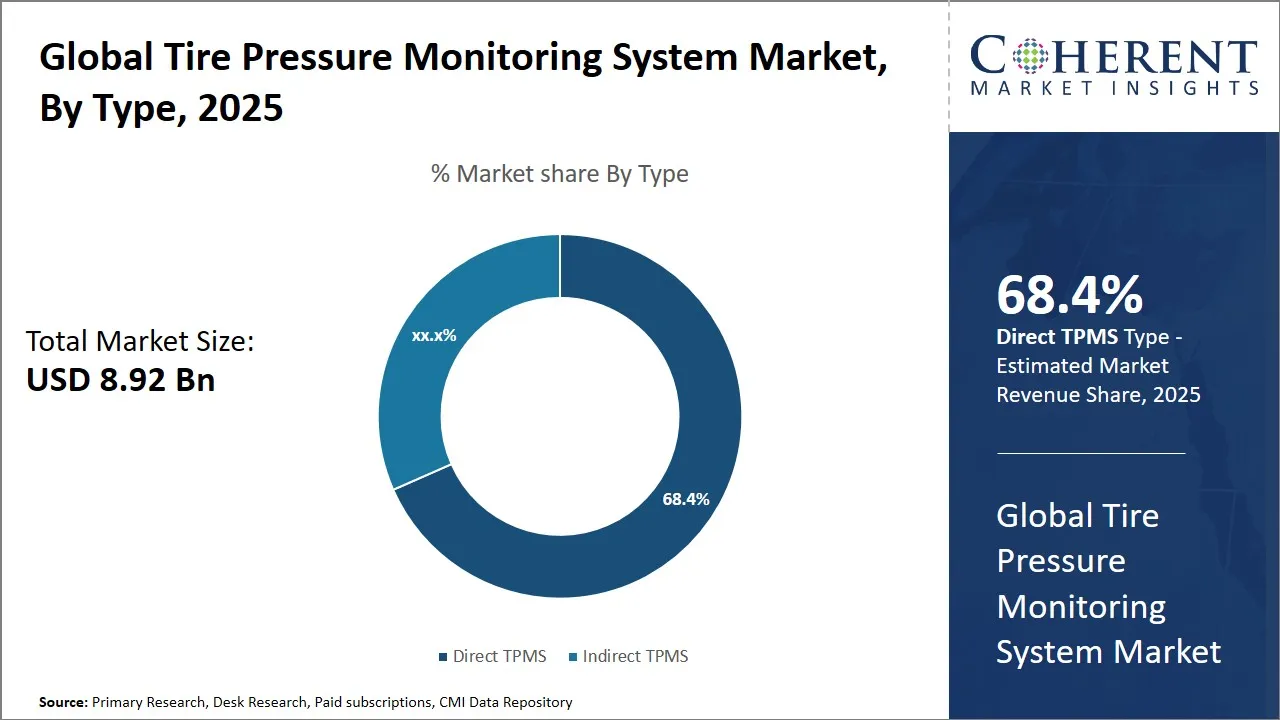
- The direct TPMS segment leads the market holding an estimated share of 69.4% in 2026.
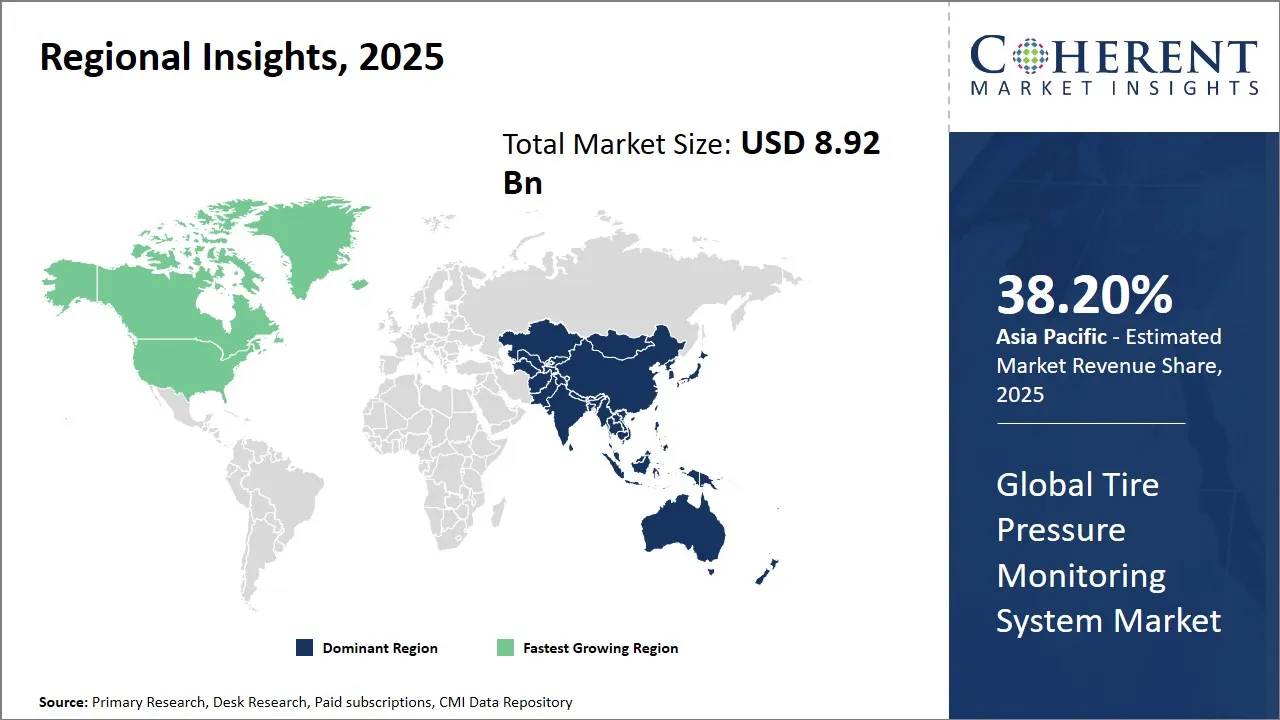
- Asia Pacific is estimated to lead the market with a share of 38.2% in 2026.
- North America, holding an estimated share of 23.8% in 2026, is projected to be the fastest growing region.
Market Overview
The market is witnessing a fast shift towards integrating smart and connected tire pressure monitoring systems that use IoT and AI for real-time data analytics and predictive maintenance. Additionally, the rising demand for electric and autonomous vehicles is fueling innovation in Tire Pressure Monitoring System (TPMS), with manufacturers focusing on improving sensor accuracy, battery life, and system integration to enhance overall vehicular safety and performance standards.
Current Events and their Impact
Current Events | Description and its Impact |
Geopolitical and Trade Developments |
|
Economic and Infrastructure Trends |
|
Segmental Insights
- Current Industry Events of 2026
- Market Size Estimation
- Regional Breakdown
- Competitive Landscape
- Customer Intelligence
- Segmental Analysis
- Pricing Analysis
- Key Market Drivers, Challenges & Future Trends
- Customized Insights Section
Global Tire Pressure Monitoring System Market Insights, By Type – Superior Accuracy and Real-Time Monitoring Fuel Direct TPMS Segment Growth
The direct TPMS segment is projected to account for 69.4% share in 2026. Unlike indirect systems that estimate tire pressure through wheel speed sensors, direct TPMS uses dedicated pressure sensors installed within each tire, offering precise and immediate readings. Direct TPMS systems are better equipped to meet these stringent standards as they directly measure pressure levels and alert drivers to any deviations, thus reducing the risk of accidents caused by underinflated tires. Automotive OEMs actively integrate direct TPMS in new vehicles to comply with such regulations and enhance overall vehicle performance. For instance, in 2023, Continental AG introduced its Next-Generation Direct TPMS Sensors (GDX series), designed with extended battery life and integrated wireless communication features.
Furthermore, the advancement in sensor technology, including improved battery life and miniaturization of sensors, has enhanced the reliability and durability of direct TPMS. These technological improvements allow for seamless integration with vehicles’ onboard diagnostics and telematics systems, enabling advanced functions such as remote tire monitoring and predictive maintenance alerts. Consumer awareness and demand for advanced safety features also drive the prominence of direct TPMS. With increasing knowledge of the dangers associated with tire underinflation, drivers are more inclined to invest in vehicles equipped with accurate real-time monitoring systems.
Impact of Artificial Intelligence (AI) on the Tire Pressure Monitoring System Market
Artificial Intelligence (AI) is reshaping the tire pressure monitoring system market by enabling predictive analytics, adaptive calibration, and integration with connected vehicle ecosystems. Traditional TPMS solutions primarily alert drivers to under-inflated or over-inflated tires, but AI enhances this capability by analyzing sensor data in real time to predict potential failures, optimize tire life, and improve overall vehicle efficiency. For fleet operators, AI-enabled platforms can aggregate sensor data across vehicles, detecting usage patterns and forecasting maintenance schedules, which lowers downtime and operating costs.
A real instance of AI integration is Continental’s ContiConnect 2.0 platform, incorporates data analytics and machine learning to provide fleet managers with predictive insights on tire health. By combining TPMS data with AI algorithms, the system not only flags pressure issues but also identifies anomalies such as slow leaks or irregular wear before they lead to failures.
Regional Insights
Asia Pacific Tire Pressure Monitoring System Market Analysis and Trends
The Asia Pacific region, holding a share of 38.20% in 2026, is expected to dominate the tire pressure monitoring system market because of fast vehicle production expansion, rising safety awareness among consumers, and increasingly strict government policies aimed at improving road safety. Countries such as China, India, and Japan are adopting TPMS technologies because of increasing disposable incomes and urbanization that add to vehicle sales.
Moreover, government initiatives promoting safer automotive standards and growing aftermarket opportunities are crucial growth factors. The regional market ecosystem is also supported by big players like Denso, Hyundai Mobis, and ZF Friedrichshafen investing in local R&D centers and production facilities. Also, rising exports and cross-border trade in Asia Pacific improve supply networks, adding to adoption.
North America Tire Pressure Monitoring System Market Analysis and Trends
North America, holding a share of 23.8% in 2026, is expected to exhibit the fastest growth in the global tire pressure monitoring system market, largely driven by a mature automotive industry, stringent government regulations on vehicle safety, and high consumer awareness regarding vehicle maintenance. Federal agencies like the National Highway Traffic Safety Administration (NHTSA) have mandated TPMS in all new passenger vehicles since the early 2010s, adding greatly to market penetration.
The region sees a well-established supply chain and the presence of leading OEMs and Tier-1 suppliers such as Continental AG (with a strong U.S. presence), Schrader Electronics, and VDO Automotive. The advanced ecosystem includes widespread partnerships between automotive manufacturers and TPMS technology providers, ensuring rapid adoption and innovation focused on safety and connectivity features.
Global Tire Pressure Monitoring System Market Outlook for Key Countries
U.S. Tire Pressure Monitoring System Market Analysis and Trends
The U.S. remains pivotal due to mandatory TPMS regulations implemented federally, which have resulted in consistently high demand from automakers and aftermarket channels. Major companies such as Schrader Electronics (a subsidiary of Sensata Technologies) and VDO Automotive provide comprehensive solutions, fostering innovation in sensor accuracy and wireless communication. The aftermarket segment is also mature, supported by widespread repair shops and tire service centers endorsing TPMS replacement and upgrades. Strong safety culture and consumer preference for advanced vehicle diagnostics further keep the market robust.
China Tire Pressure Monitoring System Market Analysis and Trends
China is rapidly evolving, driven by government policies focused on automotive safety standards and the shift from basic vehicles to smart, connected cars. Leading local electronics firms along with multinational corporations like Denso and Continental have invested heavily in expanding production capabilities here. The expanding domestic automotive manufacturing base, which is the largest globally, creates a vast in-country demand for TPMS technologies both on original vehicles and in the aftermarket. Increasing export manufacturing activities further amplify supply chain optimization, making China a crucial hub in the Asia Pacific tire pressure monitoring system market.
Germany Tire Pressure Monitoring System Market Analysis and Trends
Germany continues to lead the Europe tire pressure monitoring system market with its strong automotive manufacturing sector, home to premium automakers such as Volkswagen, BMW, and Mercedes-Benz, companies that often incorporate TPMS as standard features in vehicle safety packages. German-based component suppliers like Continental have pioneered advanced TPMS sensor technologies and integrated solutions supporting both Original Equipment Manufacturers (OEMs) and the aftermarket. Additionally, Europe’s stringent vehicle safety regulations and consumer demand for fuel efficiency bolster ongoing adoption, encouraging continuous technological advancements in the German market ecosystem.
India Tire Pressure Monitoring System Market Analysis and Trends
India is witnessing noteworthy expansion fueled by government initiatives aimed at enhancing automotive safety through regulatory frameworks similar to global standards. Rising vehicle ownership, increasing awareness of vehicle safety, and a growing middle class contribute to demand growth. Domestic and international players such as ZF Friedrichshafen and Hyundai Mobis are actively developing cost-effective TPMS technologies tailored for India’s diverse vehicle fleet, including two-wheelers and commercial vehicles. The emerging aftermarket segment benefits from expanding tire service infrastructure and increased consumer focus on preventive maintenance.
Japan Tire Pressure Monitoring System Market Analysis and Trends
Japan benefits from its advanced automotive industry known for incorporating innovative technologies early in the vehicle lifecycle. Companies like Denso and Aisin Seiki have been instrumental in developing sophisticated TPMS components that align with strict national safety guidelines. The country’s focus on vehicle automation and connected car technologies integrates with TPMS functionalities, enhancing predictive maintenance and safety features. Japanese consumers’ preference for quality and reliability sustains adoption in both the original equipment and aftermarket channels, while government policies emphasize safety and environmental efficiency.
Market Players, Key Development, and Competitive Intelligence
Key Developments
- In July 2025, STMicroelectronics, a global semiconductor leader serving customers across the spectrum of electronics applications, announced the acquisition of NXP Semiconductors’ MEMS sensors business, focused on automotive safety products as well as sensors for industrial applications. The transaction will complement and expand ST’s leading MEMS sensors technology and product portfolio.
- In February 2025, BARTEC commissioned its new BARTEC production plant in Pinghu, China. The commissioning of the new factory marked a key step in the company's strategic layout in APAC and laid a solid foundation for further expansion in China.
- In September 2024, Continental, one of the largest tire and automotive technology suppliers in the world, announced the market launch of its two new ContiConnect Lite and Pro versions for customized fleet management at the IAA Transportation 2024
- In February 2024, Dutch logistics company, the Vredeveld Group, adopted Continental’s ContiConnect digital tire monitoring technology, which enables 24/7 monitoring of vehicles, particularly those on extended trips. With a fleet consisting of 125 trucks and 200 semitrailers, Vredeveld transports various bulk goods nationally and internationally. By using Continental’s technology to digitalize processes, the company aims to optimize supply chains and minimize costs.
Top Strategies Followed the Tire Pressure Monitoring System Market Players
- Established industry giants typically lead the market by investing heavily in research and development (R&D).
- Continental AG launched its upgraded ContiConnect Lite and Pro (2024), a result of extensive R&D in fleet telematics and AI-driven predictive tire monitoring.
- Mid-level TPMS manufacturers, on the other hand, concentrate efforts on offering cost-effective solutions that strike a balance between quality and affordability.
- Hamaton Automotive Technology (China) provides competitively priced aftermarket TPMS sensors compatible with multiple vehicle brands. This cost-efficiency allows them to scale in developing regions where OEM fitment is not yet mandatory.
- Smaller-scale players often differentiate themselves by developing specialized features or unique product offerings that cater to particular customer needs, such as aftermarket replacements, integration with smartphone applications, or enhanced sensor accuracy for specific vehicle types.
- NIRA Dynamics (Sweden, but active in APAC and beyond) offers software-based indirect TPMS that integrates with vehicle dynamics systems, appealing to niche OEMs seeking lightweight, non-sensor hardware solutions for compact and performance vehicles.
Market Report Scope
Tire Pressure Monitoring System Market Report Coverage
| Report Coverage | Details | ||
|---|---|---|---|
| Base Year: | 2025 | Market Size in 2026: | USD 9.95 Bn |
| Historical Data for: | 2020 To 2024 | Forecast Period: | 2026 To 2033 |
| Forecast Period 2026 to 2033 CAGR: | 11.5% | 2033 Value Projection: | USD 21.31 Bn |
| Geographies covered: |
| ||
| Segments covered: |
| ||
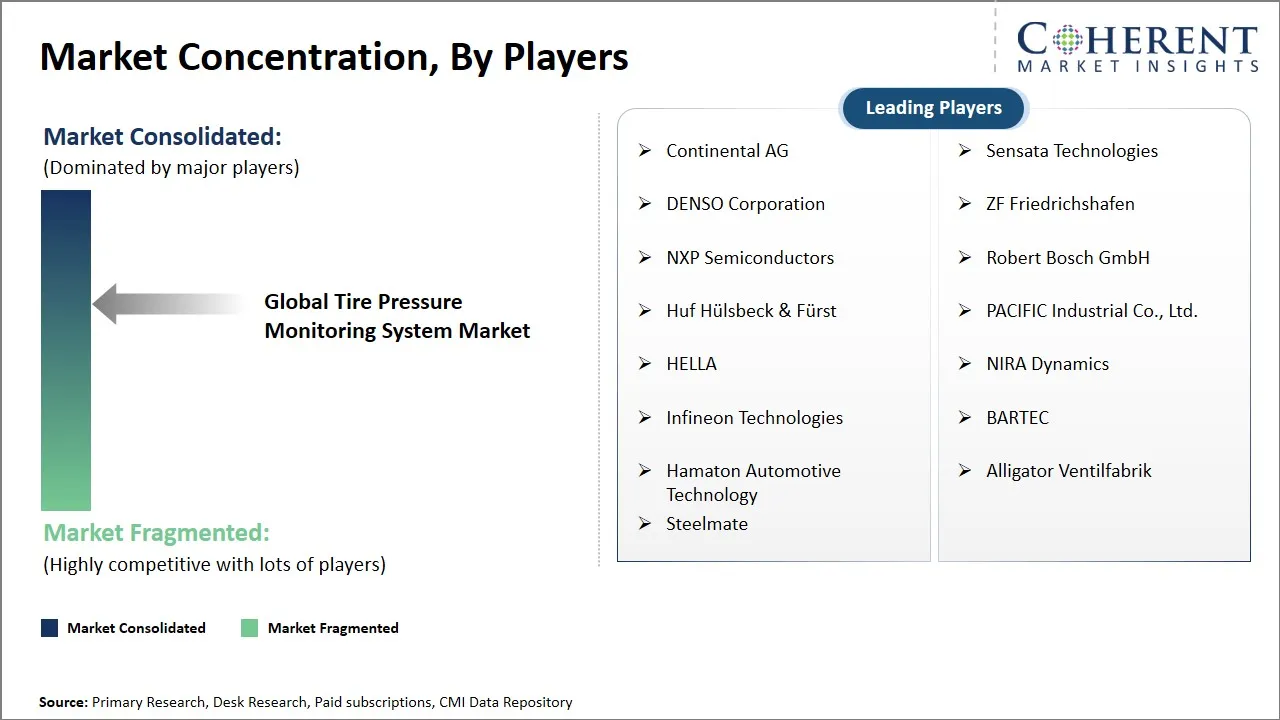
| Companies covered: | Continental AG, Sensata Technologies, DENSO Corporation, ZF Friedrichshafen, NXP Semiconductors, Robert Bosch GmbH, Huf Hülsbeck & Fürst, PACIFIC Industrial Co., Ltd., HELLA, NIRA Dynamics, Infineon Technologies, BARTEC, Hamaton Automotive Technology, Alligator Ventilfabrik, and Steelmate | ||
| Growth Drivers: |
| ||
| Restraints & Challenges: |
| ||
Market Dynamics
Global Tire Pressure Monitoring System Market Driver – Regulatory Mandates & Vehicle Safety Standards
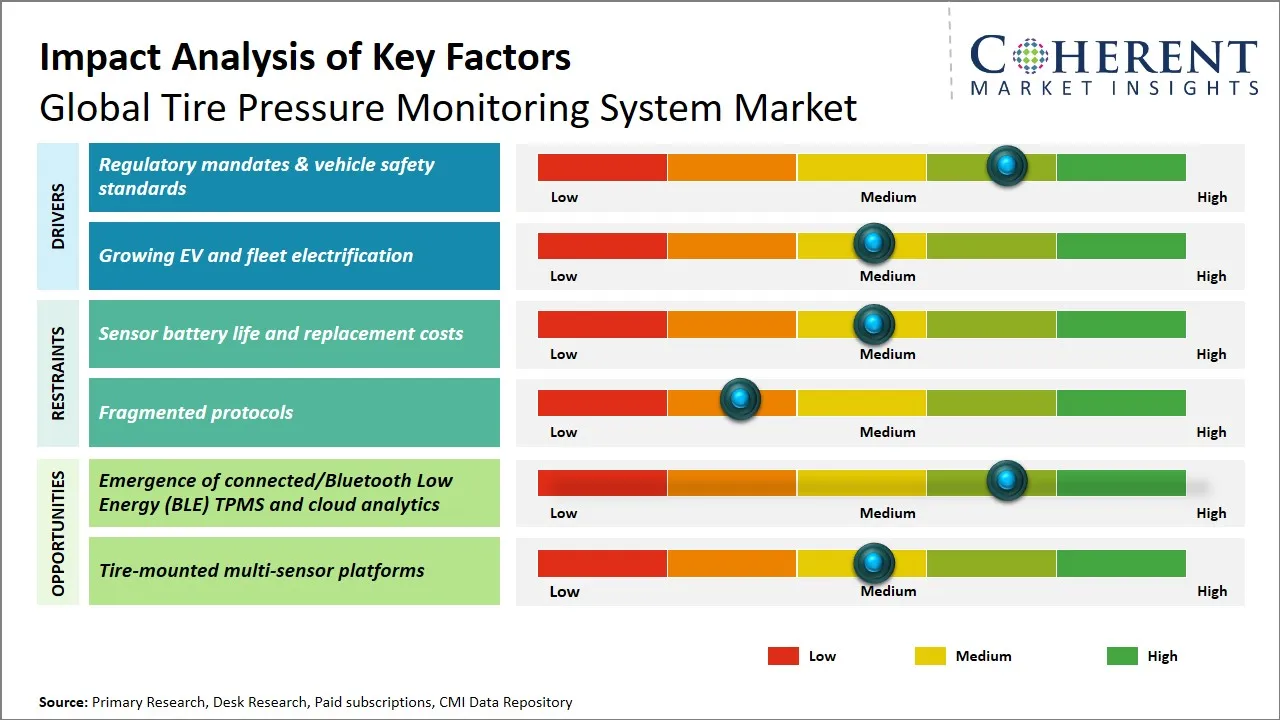
The growing emphasis on improving vehicle safety through stringent regulatory mandates and updated vehicle safety standards has become a significant driver for the global tire pressure monitoring system market. Governments and transport authorities across various regions are increasingly enforcing regulations that require new vehicles to be equipped with TPMS as a critical safety feature aimed at reducing accidents caused by under-inflated tires. These regulatory frameworks not only enhance real-time monitoring of tire pressure but also contribute to lowering the risk of tire blowouts and improving fuel efficiency.
The mandatory integration of TPMS in passenger vehicles and commercial fleets is further reinforced by safety protocols established by agencies such as the National Highway Traffic Safety Administration (NHTSA) in the United States and the European Union’s type approval requirements. For instance, In India, the government introduced Bharat NCAP (2023) and new safety mandates requiring advanced safety features, including TPMS, in passenger cars. As a result, automotive manufacturers are compelled to adopt advanced TPMS technologies to comply with these standards, thus accelerating innovation and widespread adoption, which ultimately drives the market forward.
Global Tire Pressure Monitoring System Market Opportunity – Emergence of Connected/Bluetooth Low Energy (BLE) TPMS and Cloud Analytics
The global tire pressure monitoring system market is witnessing a significant growth opportunity driven by the emergence of connected TPMS technologies, particularly those utilizing Bluetooth Low Energy (BLE) and cloud analytics. BLE-enabled TPMS devices enhance real-time vehicle monitoring capabilities by providing seamless, low-power wireless communication between tires and user interfaces such as smartphones or onboard vehicle systems. This connectivity enables drivers and fleet managers to receive instant alerts on tire conditions, improving safety and reducing maintenance costs.
Furthermore, integrating TPMS data with cloud-based analytics platforms allows for sophisticated data processing, enabling predictive maintenance, trend analysis, and enhanced fleet management strategies. The cloud infrastructure facilitates centralized data storage and access, offering stakeholders actionable insights into tire performance, wear patterns, and environmental effects, thereby optimizing operational efficiency. For instance, Sensata Technologies (U.S.) has developed Bluetooth Low Energy (BLE) TPMS solutions, which have been adopted by multiple OEMs for new EV platforms. The rising adoption of connected vehicles and the increasing emphasis on Internet of Things (IoT) integration within the automotive industry further bolster the demand for BLE TPMS.
Analyst Opinion (Expert Opinion)
- Asia Pacific will continue to dominate demand due to rising vehicle production, rapid urbanization, and increasingly stringent safety mandates in markets like China and India. OEM-driven installations are the primary growth engine, with aftermarket adoption also gaining traction in developing economies.
- North America is projected to be the fastest-growing demand center, supported by strong aftermarket activity, high replacement cycles, and rapid EV adoption. The region’s regulatory environment (NHTSA mandates) ensures baseline adoption, while connected and BLE-based TPMS solutions are expanding demand further.
- Europe maintains steady demand growth, largely driven by regulatory compliance (EU General Safety Regulation and Euro 7 standards). While the market is mature, the integration of TPMS with connected fleet management systems and predictive maintenance platforms is fueling incremental demand across commercial fleets.
Speak to the analyst
Want personalized insights?
Take the findings above to one of our principal consultants, or have the report rebuilt around the segments, geographies and competitors you actually track.
Market Segmentation
- Type Insights (Revenue, USD Bn, 2021 - 2033)
- Direct TPMS
- Indirect TPMS
- Regional Insights (Revenue, USD Bn, 2021 - 2033)
- North America
- U.S.
- Canada
- Latin America
- Brazil
- Argentina
- Mexico
- Rest of Latin America
- Europe
- Germany
- U.K.
- Spain
- France
- Italy
- Russia
- Rest of Europe
- Asia Pacific
- China
- India
- Japan
- Australia
- South Korea
- ASEAN
- Rest of Asia Pacific
- Middle East
- GCC Countries
- Israel
- Rest of Middle East
- Africa
- South Africa
- North Africa
- Central Africa
- North America
- Key Players Insights
- Continental AG
- Sensata Technologies
- DENSO Corporation
- ZF Friedrichshafen
- NXP Semiconductors
- Robert Bosch GmbH
- Huf Hülsbeck & Fürst
- PACIFIC Industrial Co., Ltd.
- HELLA
- NIRA Dynamics
- Infineon Technologies
- BARTEC
- Hamaton Automotive Technology
- Alligator Ventilfabrik
- Steelmate
Sources
Primary Research Interviews
Stakeholders
- Automotive OEMs
- TPMS Sensor Manufacturers
- Tier-1 Automotive Suppliers
- Semiconductor Providers
- Fleet Operators & Logistics Companies
- Aftermarket Distributors & Retailers
- Automotive Safety Regulators & Policy Advisors (APAC, EU, U.S.)
Databases
- Eurostat
- U.S. Department of Transportation (DOT) Vehicle Safety Database
- OECD Mobility Outlook
- Automotive World Database
- Japan Automobile Manufacturers Association (JAMA)
Magazines
- Automotive News
- Tire Technology International
- Fleet Maintenance Magazine
- Connected Car Magazine
Journals
- IEEE Transactions on Intelligent Transportation Systems
- SAE International Journal of Passenger Cars – Electronic and Electrical Systems
- Journal of Automotive Safety and Energy
- Sensors and Actuators Journal
Newspapers
- The Detroit News (U.S.)
- Nikkei Asia (Japan)
- The Economic Times (India)
- Automotive Business Review (Global)
Associations
- Society of Automotive Engineers (SAE)
- European Automobile Manufacturers’ Association (ACEA)
- National Highway Traffic Safety Administration (NHTSA)
- Automotive Component Manufacturers Association of India (ACMA)
- Tire Industry Association (TIA)
Public Domain Sources
- U.S. National Highway Traffic Safety Administration (NHTSA) Reports
- EUROSTAT
- United Nations Economic Commission for Europe (UNECE) – Vehicle Regulations
- World Bank Mobility Reports
- ResearchGate
Proprietary Elements
- CMI Data Analytics Tool
- Proprietary CMI Existing Repository of Information for last 8 years
Get access to 250+ pages report
Every segment, forecast, competitor profile and data table behind the analysis above — available for instant download.
- ESOMAR Member
- ISO 9001:2015 Certified
- D-U-N-S Registered
- GDPR & CCPA Compliant
Missing comfort of reading report in your local language? Find your preferred language:
Transform your Strategy with Exclusive Trending Reports
Frequently Asked Questions
The global tire pressure monitoring system market is estimated to be valued at USD 9.95 Bn in 2026 and is expected to reach USD 21.31 Bn by 2033.
The CAGR of the global tire pressure monitoring system market is projected to be 11.5% from 2026 to 2033.
Regulatory mandates & vehicle safety standards and growing EV and fleet electrification are the major factors driving the growth of the global tire pressure monitoring system market.
Sensor battery life and replacement costs and fragmented protocols are the major factors hampering the growth of the global tire pressure monitoring system market.
In terms of type, the direct TPMS segment is estimated to dominate the market revenue share in 2026.
Continental AG, Sensata Technologies, DENSO Corporation, ZF Friedrichshafen, NXP Semiconductors, Robert Bosch GmbH, Huf Hülsbeck & Fürst, PACIFIC Industrial Co., Ltd., HELLA, NIRA Dynamics, Infineon Technologies, BARTEC, Hamaton Automotive Technology, Alligator Ventilfabrik, and Steelmate are the major players.
Asia Pacific is expected to lead the global tire pressure monitoring system market in 2026.