

Automotive Internet of Things Market Size and Share Analysis: (2026-2033)
The Automotive Internet of Things Market size is anticipated to grow at a CAGR of 19.9% with USD 225.32 Bn in 2026 and is expected to reach USD 802.88 Bn in 2033. The primary drivers are defined by rising connected vehicle adoption, increasing integration of telematics, ADAS, infotainment, and vehicle diagnostics, and growing demand for real-time fleet monitoring, predictive maintenance, and safer mobility systems. Some of the other factors include faster 5G and V2X deployment, rising electric vehicle penetration, over-the-air software updates, data-driven insurance models, smart city infrastructure, and growing OEM focus on software-defined vehicles. According to the IEA, electric car sales topped 20 million globally in 2025, reinforcing demand for Automotive Internet of Things solutions.
Key Takeaways:
- The hardware segment is likely to dominate the market with 52.5% in 2026. The segment’s growth is owing to its extensive use in telematics control units, sensors, embedded connectivity modules, infotainment systems, ECUs, and vehicle gateways that enable real-time diagnostics, navigation, safety alerts, and connected vehicle operations. According to the U.S. Bureau of Transportation Statistics, 92% of U.S. households had access to at least one vehicle in 2023, thereby reinforcing the large installed base for the adoption of automotive IoT hardware.
- The embedded segment is set to lead with 48.5% in 2026. The segment’s growth is owing to the rising factory-fit integration of eSIMs, inbuilt telematics units, emergency calling systems, connected infotainment, and OEM-managed vehicle data platforms, which reduce dependency on external smartphones or tethered devices. According to the European Commission, 112 eCall can speed up emergency response times by 40% in urban areas and 50% in rural areas.
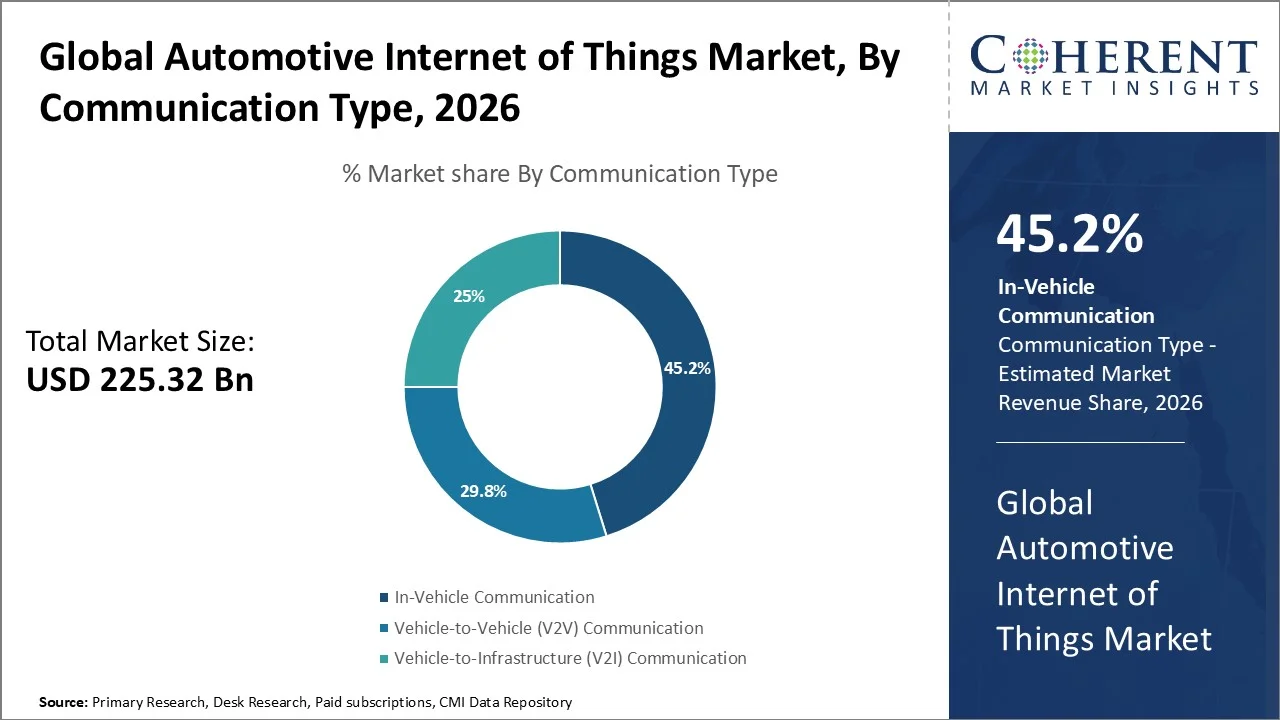
- The in-vehicle communication segment is set to lead with 45.2% in 2026. The segment’s growth is owing to the need for high-speed data exchange between vehicle sensors, ECUs, ADAS systems, powertrain components, infotainment units, and diagnostic platforms to support safer and smarter vehicle operations. According to the U.S. Department of Transportation,
- The telematics segment is set to lead with 43.5% in 2026. The segment’s growth is owing to the increasing use of fleet tracking, remote diagnostics, predictive maintenance, driver behavior monitoring, usage-based insurance, vehicle recovery, and real-time route optimization across passenger and commercial vehicles. According to the Federal Motor Carrier Safety Administration, the ELD Final Rule was expected to impact approximately three million commercial drivers and save 26 lives annually.
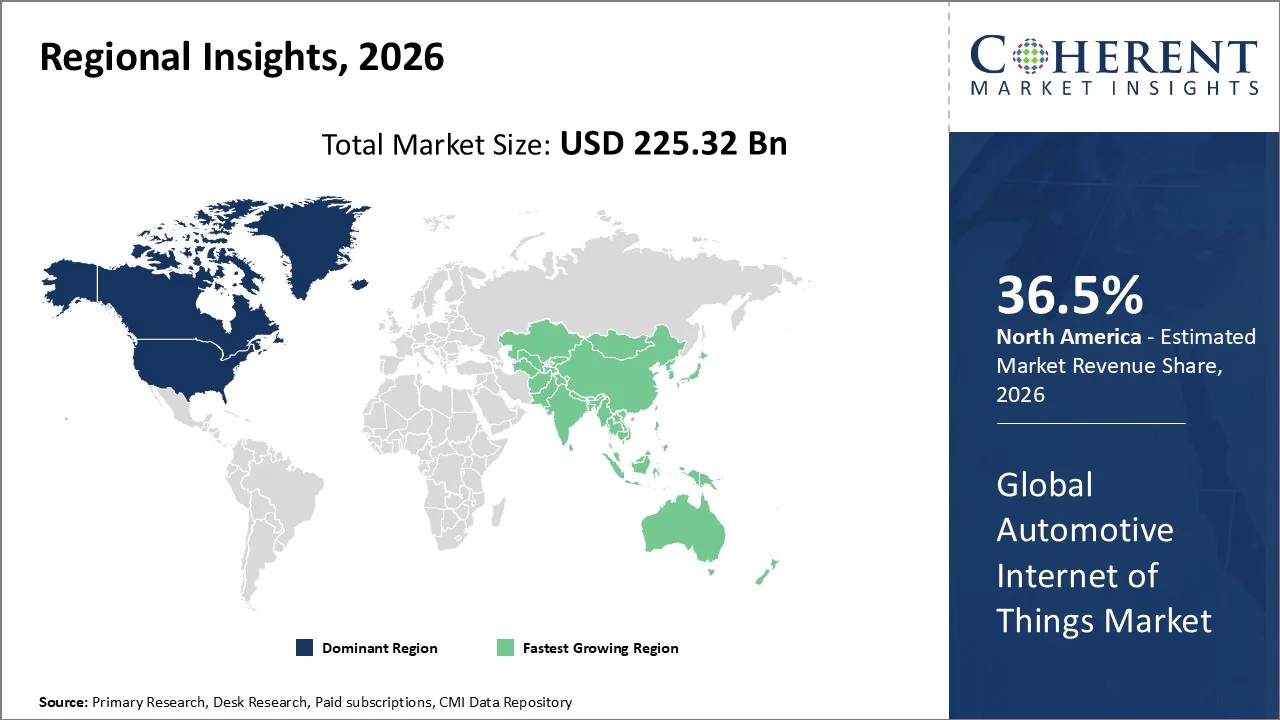
- North America is expected to acquire the prominent share of 36.5% in 2026. The region’s growth is owing to the strong connected vehicle adoption, advanced automotive electronics penetration, large fleet telematics usage, OEM investments in connected platforms, and regulatory momentum around V2X and C-V2X deployment for safer and more efficient mobility. In August 2024, the U.S. Department of Transportation released a national V2X deployment plan and announced nearly USD 60 million in grants to promote V2X technology deployment.
Segmental Insights
Why is In-Vehicle Communication Acquiring the Largest Share?
On the basis of communication type, the in-vehicle communication segment is projected to account for the largest Automotive Internet of Things Market share of 45.2% in 2026. The segment’s growth is owing to its critical role in linking sensors, ECUs, ADAS, infotainment, telematics, powertrain, battery systems, and safety controllers inside connected vehicles.
NHTSA reported that distracted-driving crashes killed 3,208 people and injured over 315,000 in 2024, strengthening demand for in-cabin alerts and safety monitoring. In April 2024, NHTSA finalized FMVSS No. 127 for automatic emergency braking, projected to save at least 360 lives and prevent 24,000 injuries annually, supporting sensor-to-brake communication.
In April 2026, Hyundai Motor Group unveiled Pleos Connect, a next-generation in-vehicle infotainment system for software-defined vehicles. The system will debut on the GRANDEUR in Korea and the IONIQ 3 in Europe. It offers AI-powered navigation, Split Screen display, App Market access, and over-the-air software updates.
- Current Industry Events of 2026
- Market Size Estimation
- Regional Breakdown
- Competitive Landscape
- Customer Intelligence
- Segmental Analysis
- Pricing Analysis
- Key Market Drivers, Challenges & Future Trends
- Customized Insights Section
Telematics hold the Largest Market Share
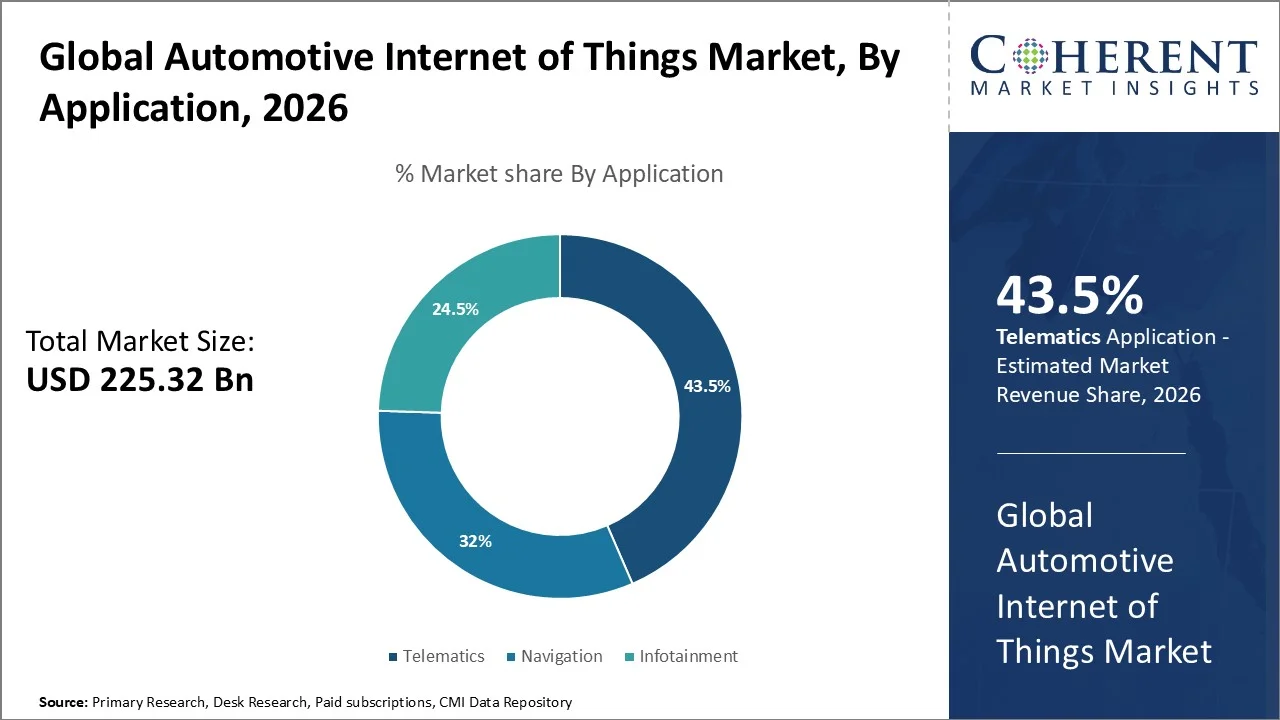
On the basis of application, the telematics segment lead with a major 43.5% share in 2026. The growth is owing to the rising integration of embedded connectivity, vehicle diagnostics, remote monitoring, usage-based insurance, GPS fleet tracking, and safety alert systems across passenger and commercial vehicles.
Telematics is becoming mission-critical as the U.S. recorded 36,640 traffic fatalities in 2025, while the fatality rate stood at 1.10 deaths per 100 million vehicle miles traveled, thereby increasing the need for connected safety intelligence. The fleet adoption is supported by the FMCSA electronic logging device rule, which was expected to impact around 3 million commercial truck and bus drivers by requiring engine-synchronized driving-time records.
In September 2025, Lytx Inc. launched Lytx+ with Geotab, a unified fleet safety and management solution. It combines video safety technology with Geotab telematics and also offers the GO Anywhere device to track powered as well as non-powered assets seamlessly.
Market Drivers
EV Expansion and Connected Charging Ecosystem is Transforming the Automotive Internet of Things Market in the US
The EV expansion is strengthening the U.S. Automotive Internet of Things Market. This is because vehicles, chargers, utilities, and fleet platforms are become more and more data-connected.
According to Argonne National Laboratory, more than 1.5 million EVs were sold in the U.S. in 2024, representing 9.9% of light-duty vehicle sales, while more than 5.7 million EVs were already on the U.S. roads. This enlarges the installed base for telematics, battery monitoring, connected navigation, charging optimization, as well as over-the-air software services.
The U.S. Department of Energy’s EVGrid Assist also estimates that the country will need 28 million EV charging ports by 2030 to support 33 million EVs. This creates the demand for IoT-enabled charging, grid communication, payment systems, and uptime monitoring.
AI-Enabled Connected Cockpit and Predictive Vehicle Intelligence: A Major Breakthrough in the Automotive Internet of Things Market
AI-enabled connected cockpits and predictive vehicle intelligence are gaining importance. This is owing to the automakers integrating driver-monitoring cameras, voice interfaces, sensor fusion, navigation data, ADAS alerts, and cloud diagnostics in one vehicle intelligence layer. These systems support distraction detection, fatigue alerts, predictive maintenance, automated emergency response, route optimization, and safer human-machine interaction.
The need is strong. The NHTSA reported that nearly 3,208 people were killed in the U.S. crashes involving distracted drivers in 2024. According to the NHTSA’s Fatality Analysis Reporting System and Crash Reporting Sampling System, in 2023, an estimated 324,819 people were injured and 3,275 were killed in distracted-driving-related crashes, thus accounting for 13% of all crashes.
In April 2025, the U.S. DOT launched the Rural Autonomous Vehicle Research Program, backed by a USD 25 million funding opportunity to advance automated vehicle technology in rural and Tribal communities. These supports connected, AI-enabled mobility systems which improve safety, accessibility, and vehicle intelligence.
Current Events and Their Impact on the Automotive Internet of Things Market
Current Event | Description and its Impact |
U.S. C-V2X Deployment Push and 5.9 GHz Spectrum Rules
|
|
EU Data Act Rollout for Connected Vehicle Data Access |
|
Automotive Internet of Things Market Trends
- Rising adoption of connected car platforms enables real-time vehicle diagnostics, predictive maintenance, usage-based insurance, and remote monitoring across passenger and commercial fleets.
- Expansion of 5G, embedded connectivity, and cloud-based vehicle data platforms improves low-latency communication, supporting infotainment, OTA updates, ADAS, and software-defined vehicle functions.
- Government-led V2X programs are speeding up the connected mobility adoption. The U.S. Department of Transportation’s 2024 national V2X plan supports the wider deployment of interoperable communication between vehicles, road infrastructure, mobile devices, and traffic systems, with federal grant funding helping cities and transport agencies scale real-world V2X use cases.
- Rising road safety and cybersecurity requirements are shaping the automotive IoT adoption. The NHTSA estimated 39,345 U.S. traffic fatalities in 2024, thereby reinforcing the demand for connected safety systems, while its vehicle cybersecurity research covers intrusion detection, firmware updates, OTA mechanisms, and V2V communication interfaces. In Europe, the intelligent speed assistance became mandatory for all new cars sold from July 2024, thereby supporting the wider adoption of sensor- and connectivity-enabled vehicle systems.
Regional Insights
North America Dominates Owing to the Connected Vehicle Infrastructure and 5G-Enabled V2X Deployment
The North America region accounts for 36.5% of the market share in 2026. The region’s growth is owing to strong connected vehicle infrastructure, federal V2X support, and rapid commercialization of 5G-enabled mobility platforms.
The U.S. Department of Transportation’s Intelligent Transportation Systems Joint Program Office notes that USDOT has sponsored over 30 V2X applications through prototyping, field demonstrations, and deployment, strengthening the ecosystem for vehicle-to-vehicle, vehicle-to-infrastructure, and vehicle-to-pedestrian communication.
In June 2025, Verizon Business launched the Edge Transportation Exchange, a 5G and LTE-based vehicle-to-everything platform. It enables near real-time communication between vehicles, pedestrians, and infrastructure, supporting safety alerts, traffic management, and smart city applications with multiple commercial partners.
Asia Pacific Automotive Internet of Things Market Trends
Asia Pacific is expected to witness strong growth in Automotive Internet of Things Market over the forecast period. The region’s growth is owing to the rapid electrification, connected-vehicle rollouts, and government-backed digital mobility programs.
China provides the largest demand base, as its official auto output reached 31.282 million units and sales reached 31.436 million units in 2024, creating a large installed base for embedded telematics, vehicle diagnostics, infotainment, and V2X-enabled services.
In India, the PM E-DRIVE allocated ₹2,000 crore for EV public charging stations like 22,100 fast chargers for electric four-wheelers. This investment will support the connected charging infrastructure, real-time charger discovery, payment integration, fleet telematics, and smart energy management in high-adoption cities as well as highways.
In April 2025, Volkswagen Group China showcased five intelligent, fully connected vehicles and a new AI-based ADAS system at Auto Shanghai. The locally developed system, debuting in the compact class in 2026, provides Level 2++ automated driving functions.
Federal Safety Policy, Connected Infrastructure, and Fleet Digitization are Accelerating the Automotive Internet of Things Market in United States
The U.S. Automotive Internet of Things Market is growing as federal safety policy, connected infrastructure rollout, and fleet digitization increase demand for real-time vehicle data, telematics, and V2X-enabled mobility systems.
U.S. government data show that Vehicle‑to‑Everything (V2X) communications technologies can cut traffic fatalities and severe crashes significantly, with DOT plans targeting 20
In February 2026, Geotab launched its next-generation GO and GO Plus telematics devices at Geotab Connect in Las Vegas. These devices provide high-fidelity data processing and actionable insights, enabling global fleets to operate more safely, efficiently, and effectively.
China Automotive Internet of Things Market Trends
China’s Automotive Internet of Things Market is strengthening as intelligent connected vehicles, smart cockpits, autonomous driving, and cloud-based vehicle control move into mainstream vehicle platforms. Government-backed deployment is accelerating real-time vehicle data exchange, ADAS, C-V2X communication, and connected mobility services.
From January to July 2025, China sold 7.76 million new passenger cars equipped with Level-2 driving-assistance functions, reaching 62.58% penetration, showing strong adoption of IoT-enabled vehicle intelligence.
In September 2025, China also advanced its “vehicle-road-cloud” integration program across 20 pilot cities, supporting connected infrastructure, demonstration roads, and cloud-linked vehicle operations for safer and smarter mobility.
Who are the Major Companies in Automotive Internet of Things Industry
Some of the major key players in Automotive Internet of Things Market are Apple, Inc., AT&T Inc., Audi AG, Cisco Systems, Inc., Ford Motor Company, General Motors, Google Inc., Intel Corporation., International Business Machines Corporation, Microsoft Corporation, NXP Semiconductors N.V., Robert Bosch GmbH, Texas Instruments Inc., Thales Sa, and Tomtom N.V.
Key News
- In February 2026, Mercedes-Benz Egypt received IoT service licenses from the National Telecommunication Agency to launch connected car services under the Digital Egypt strategy. The initiative enables navigation, real-time tracking, and emergency assistance while ensuring data protection and road safety.
- In January 2026, Valeo and Kapsch TrafficCom announced a partnership to develop a real-time V2X tolling solution. The system enables autonomous vehicles to communicate securely with toll infrastructure, providing seamless, SAE J3217-compliant transactions and enhanced driver experience.
- In September 2025, Telenor IoT launched IoT Drive, an automotive connectivity service for software-defined vehicles. The solution provides compliant global connectivity, supports in-car Wi-Fi and digital services, and enables automakers to deliver seamless connected experiences through API-based integration.
Market Report Scope
Automotive Internet of Things Market Report Coverage
| Report Coverage | Details | ||
|---|---|---|---|
| Base Year: | 2025 | Market Size in 2026: | USD 225.32 Bn |
| Historical Data for: | 2020 To 2024 | Forecast Period: | 2026 To 2033 |
| Forecast Period 2026 to 2033 CAGR: | 19.9% | 2033 Value Projection: | USD 802.88 Bn |
| Geographies covered: |
| ||
| Segments covered: |
| ||
| Companies covered: | Apple, Inc., AT&T Inc., Audi AG, Cisco Systems, Inc., Ford Motor Company, General Motors, Google Inc., Intel Corporation., International Business Machines Corporation, Microsoft Corporation, NXP Semiconductors N.V., Robert Bosch GmbH, Texas Instruments Inc., Thales Sa, and Tomtom N.V. | ||
| Growth Drivers: |
| ||
| Restraints & Challenges: |
| ||
Analyst Opinion
- The Automotive Internet of Things Market is driven by real safety, efficiency, and connectivity needs, not only by digital trends. Globally, there were over 400 million connected cars in operation by 2025, up sharply from roughly 237 million in 2021, reflecting the rapid adoption of IoT‑enabled connectivity and data systems in vehicles.
- Embedded connectivity is already standard in most new vehicles. In 2024, about 79 % of all new cars sold worldwide came with OEM‑embedded telematics systems that support safety alerts, navigation, diagnostics, and remote services, with this proportion continuing to rise year‑on‑
- Further growth is expected as the vehicle fleet electrifies and smart features proliferate. Analysts project that by 2029, there will be well over 500 million connected cars with embedded telematics globally, reinforcing Automotive IoT’s role in predictive maintenance, fleet analytics, safety systems, and the broader future mobility ecosystem.
Speak to the analyst
Want personalized insights?
Take the findings above to one of our principal consultants, or have the report rebuilt around the segments, geographies and competitors you actually track.
Market Segmentation
- By Offering (Revenue, USD Bn, 2021-2033)
- Hardware
- Software
- Services
- By Connectivity Form Factor (Revenue, USD Bn, 2021-2033)
- Embedded
- Tethered
- Integrated
- By Communication Type (Revenue, USD Bn, 2021-2033)
- In-Vehicle Communication
- Vehicle-To-Vehicle Communication
- Vehicle-To-Infrastructure Communication
- By Application (Revenue, USD Bn, 2021-2033)
- Navigation
- Telematics
- Infotainment
- By Region (Revenue, USD Bn, 2021-2033)
- North America
- U.S.
- Canada
- Latin America
- Brazil
- Mexico
- Argentina
- Rest of Latin America
- Europe
- Germany
- U.K.
- France
- Italy
- Spain
- Russia
- Rest of Europe
- Asia Pacific
- China
- India
- Japan
- Australia
- South Korea
- ASEAN
- Rest of Asia Pacific
- Middle East
- GCC
- Israel
- Rest of Middle East
- Africa
- South Africa
- Central Africa
- North Africa
- North America
- Key Players
- Apple, Inc.
- AT&T Inc.
- Audi AG
- Cisco Systems, Inc.
- Ford Motor Company
- General Motors
- Google Inc.
- Intel Corporation.
- International Business Machines Corporation
- Microsoft Corporation
- NXP Semiconductors N.V.
- Robert Bosch GmbH
- Texas Instruments Inc.
- Thales Sa
- Tomtom N.V.
Sources
Primary Research Interviews
- Connected Vehicle OEMs
- Automotive IoT Solution Providers
- Telematics Platform Providers
- Tier-1 Automotive Electronics Suppliers
- V2X Technology Providers
- Fleet Management Solution Providers
- Automotive Cybersecurity Experts
- Smart Mobility & ITS Consultants
- Others
Databases
- Bloomberg Terminal
- Thomson Reuters Eikon
- S&P Global Mobility
- IHS Markit
- Wards Intelligence
- AutoForecast Solutions
- Omdia
- Statista
- Others
Magazines
- Automotive News
- Connected World Magazine
- IoT World Today
- SAE Automotive Engineering Magazine
- Telematics Wire
- Automotive World
- Others
Journals
- IEEE Internet of Things Journal
- IEEE Transactions on Intelligent Transportation Systems
- SAE International Journal of Connected and Automated Vehicles
- Vehicular Communications Journal
- Sensors Journal
- Journal of Intelligent Transportation Systems
- Others
Newspapers
- Financial Times
- The Wall Street Journal
- Reuters
- Bloomberg News
- The Economic Times
- Business Standard
- Others
Associations
- SAE International
- 5G Automotive Association (5GAA)
- Automotive Information Sharing and Analysis Center (Auto-ISAC)
- International Organization of Motor Vehicle Manufacturers (OICA)
- Intelligent Transportation Society of America (ITS America)
- GSM Association (GSMA)
- Others
Public Domain Sources
- U.S. Department of Transportation (USDOT)
- National Highway Traffic Safety Administration (NHTSA)
- Federal Highway Administration (FHWA)
- European Commission – Mobility and Transport
- UNECE – World Forum for Harmonization of Vehicle Regulations
- National Institute of Standards and Technology (NIST)
- World Bank Open Data
- Others
Proprietary Elements
- CMI Data Analytics Tool
- Proprietary CMI Existing Repository of Information for the Last 10 Years
Get access to 250+ pages report
Every segment, forecast, competitor profile and data table behind the analysis above — available for instant download.
- ESOMAR Member
- ISO 9001:2015 Certified
- D-U-N-S Registered
- GDPR & CCPA Compliant
Missing comfort of reading report in your local language? Find your preferred language:
Transform your Strategy with Exclusive Trending Reports
Frequently Asked Questions
The Automotive Internet of Things Market is expected to reach USD 802.88 Bn in 2033.
Major players operating in the global Automotive Internet of Things Market include Apple, Inc., AT&T Inc., Audi AG, Cisco Systems, Inc., Ford Motor Company, General Motors, Google Inc., Intel Corporation., International Business Machines Corporation, Microsoft Corporation, NXP Semiconductors N.V., Robert Bosch GmbH, Texas Instruments Inc., Thales Sa, and Tomtom N.V.
The high integration costs, cybersecurity vulnerabilities, a lack of standardized operating systems, and inadequate telecom infrastructure in emerging regions are the key factors hampering growth of the market.
The rising demand for connected vehicles, the rollout of 5G networks, stringent government regulations regarding road safety, and the shift toward autonomous and electric mobility is boosting the demand for Automotive Internet of Things.
The Automotive Internet of Things Market is anticipated to grow at a CAGR of 19.9% between 2026 and 2033.
Among regions, North America is expected to account for a largest market share in the global Automotive Internet of Things Market over the forecast period.